
Our readers keep the lights on and the weekend projects moving. As an Amazon Associate, I earn from qualifying purchases.
The first 88-key keyboard you buy determines whether learning piano feels like a rewarding practice or a frustrating chore. Plastic spring-action keys teach your fingers bad habits that are hard to undo, while weighted or semi-weighted actions build authentic muscle memory from day one. That makes the difference between a keyboard you outgrow in weeks and one that carries you confidently through your first year of lessons.
I’m Rikta — the co-founder and writer behind FitlyFast. I’ve spent over a decade analyzing the hardware specs, user reviews, and real-world durability of beginner digital pianos, specifically tracking how key action, polyphony, and speaker power affect a new player’s learning curve and long-term satisfaction.
This guide breaks down the top models to help you confidently choose the right beginner 88 key keyboard that matches your goals, space, and budget without wasting money on features you won’t use.
How To Choose The Best Beginner 88 Key Keyboard
New players often focus on the wrong specs — more sound effects, flashy screens, or higher wattage — while ignoring the single most important factor: how the keys feel under your fingers. Your first 88-key keyboard should prioritize key action above all else, because a weighted or semi-weighted action teaches your hands the correct level of force needed to produce dynamic volume, something cheap spring-loaded keys simply cannot replicate. After key action, look at polyphony (how many notes the keyboard can sustain at once), connectivity options for apps and headphones, and whether the included stand and pedals give you a stable practice setup from day one.
Key Action: Weighted vs. Semi-Weighted vs. Non-Weighted
Weighted keys use internal hammers or springs to simulate the resistance of an acoustic piano. This is the gold standard for beginners because it builds finger strength and dynamic control. Semi-weighted keys are lighter but still provide some resistance, making them a workable compromise if you plan to carry the keyboard between rooms. Non-weighted or synth-action keys are fine for organ or synth players but will teach a beginner too little resistance, making the transition to a real piano frustrating later.
Polyphony and Sound Engine
Polyphony is the number of notes a keyboard can produce simultaneously. A 64-note polyphony is the bare minimum for a beginner; 128-note is ideal because it prevents notes from being cut off when you play complex chords with the sustain pedal down. The sound engine should sample real acoustic grand pianos — advanced wave memory or stereo sampling from brands like Yamaha or Alesis gives you much richer, more dynamic piano tones than generic synthesized waveforms.
Connectivity and Included Accessories
USB-MIDI connectivity lets you connect the keyboard to learning apps like Skoove or Melodics on your tablet or computer, which dramatically accelerates progress for self-taught beginners. A headphone jack with 3.5mm or 6.35mm support allows silent practice without disturbing others. Many budget models skimp on the sustain pedal or stand — buying a keyboard that includes a solid furniture stand, triple pedal unit, and a bench saves you the hassle of finding compatible accessories separately.
Quick Comparison
On smaller screens, swipe sideways to see the full table.
| Model | Category | Best For | Key Spec | Amazon |
|---|---|---|---|---|
| Donner DDP-300 | Premium | Bluetooth & rich sound | Graded hammer action, 128 polyphony | Amazon |
| Yamaha P-225 | Premium | Brand reliability & portability | Weighted graded action, 24.5 lbs | Amazon |
| Donner DDP-90 Pro | Premium | Furniture-grade home setup | Hammer action, triple pedal, cover | Amazon |
| AODSK B-83S | Mid-Range | Fully weighted with triple pedals | Weighted keys, 128 polyphony | Amazon |
| STRICH SDP-120 | Mid-Range | Value with wireless MIDI | Fully weighted, 200 tones | Amazon |
| STRICH SDP-350W | Mid-Range | Wood-grain aesthetic & cover | Hammer action, flip-top cover | Amazon |
| HEXANT 88-Key | Mid-Range | All-in-one bundle with bench | Semi-weighted, 480 tones, LCD | Amazon |
| Alesis Recital | Budget-Friendly | Lightweight portable practice | Semi-weighted, 15.6 lbs, lessons | Amazon |
| Yamaha Piaggero NP-15B | Budget-Friendly | Ultra-portable casual play | 61 keys, touch sensitive, 11 lbs | Amazon |
In‑Depth Reviews
1. Donner DDP-300 Digital Piano

The Donner DDP-300 earns the top spot because it delivers graded hammer-action keys — heavier in the bass, lighter in the treble — that accurately mimic an acoustic grand piano’s touch. This is the kind of key action that builds correct finger technique from lesson one, and it’s rare to find at this tier without paying significantly more. The 128-note polyphony ensures no note drops out during complex passages with the sustain pedal engaged.
Its sound engine uses 10 HD grand piano samples paired with dual tweeters and a subwoofer for warm, 3D surround audio that fills a living room. Bluetooth MIDI connectivity lets you connect wirelessly to teaching apps on a tablet, and the partition mode splits the keyboard into two equal halves for one-on-one lessons with a teacher. Two headphone jacks allow quiet duet practice without disturbing the household.
The dark rose finish is an elegant departure from standard black, but the keyboard does not include a bench — you will need to purchase one separately. A small number of users noted occasional sticky keys under heavy force, though Donner’s customer service is responsive for warranty issues. For a beginner who wants the closest thing to a real piano feel in a compact digital package, this is the strongest choice.
Why it’s great
- Graded hammer-action keys build real finger strength
- 128-note polyphony handles complex sustain pedal use
- Bluetooth MIDI eliminates cable clutter with apps
Good to know
- Bench not included in the box
- Occasional key stickiness reported under hard force
- Pedal cord fitment can be finicky on rare units
2. Yamaha P-225 88-Key Digital Piano

The Yamaha P-225 brings the reliability of Yamaha’s weighted graded hammer action into a surprisingly portable 24.5-pound chassis. This is the keyboard experienced pianists choose when they need a compact travel instrument that still feels like a real piano — the touch is heavier in the low register and lighter in the high notes, exactly like an acoustic upright. The sound engine samples Yamaha’s concert grand pianos, delivering rich, resonant tones with natural string resonance.
Ten built-in voices include organ, harpsichord, and vibraphone alongside the core acoustic piano sounds. The one-button control interface paired with Yamaha’s Smart Pianist app gives you deeper control over reverb, chorus, and metronome settings without scrolling through tiny menus. The included sustain footswitch and music rest make it ready to play out of the box, and the slim design fits easily into a corner of any room.
The main trade-off is that the sustain pedal is a simple footswitch that can slide around on smooth floors — serious players will want to upgrade to a dedicated pedal unit. The built-in speakers are adequate for a bedroom but won’t fill a large living room at full volume. For beginners who want a brand with decades of piano heritage and a keyboard that will still feel right two years in, the P-225 is the safe, smart investment.
Why it’s great
- Graded weighted action matches acoustic piano feel
- Compact 24.5 lb design is easy to move
- Yamaha grand piano samples sound authentic and warm
Good to know
- Included sustain pedal is basic and slides easily
- Built-in speakers lack power for larger rooms
- No furniture stand included in the package
3. Donner DDP-90 Pro Digital Piano
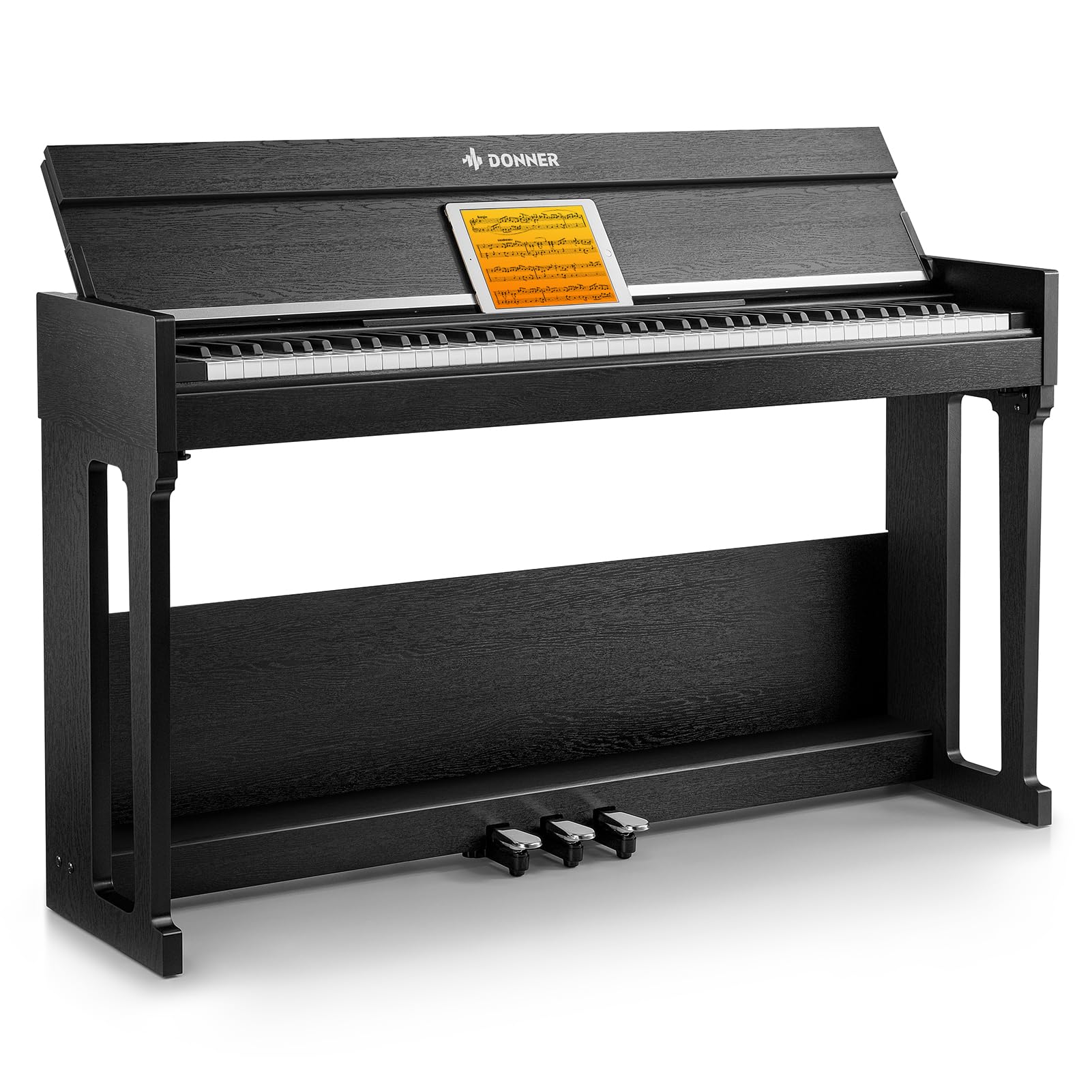
The Donner DDP-90 Pro is designed for the beginner who wants a furniture-grade digital piano that looks and feels like a permanent home instrument. Its hammer-action weighted keys with ivory-feel texture provide the resistance new players need to develop proper finger technique, and the built-in triple pedal system (soft, sostenuto, sustain) gives you the full pedal control of an acoustic piano. The flip-top key cover with slow-close mechanism protects the keys from dust and prevents slammed fingers.
With 238 tones, 200 rhythms, and 100 demo songs, the DDP-90 Pro offers enormous variety for exploration without overwhelming the beginner with unnecessary complexity. The 128-note polyphony handles fast trills and dense chords cleanly. USB-MIDI and audio in/out ports allow connection to PC, tablet, phone, or external speakers, and the U-disk playback feature lets you play MP3 files directly through the built-in amplifier.
The satin black finish and compact footprint (54 inches wide) fit well in apartments or smaller rooms. Assembly is straightforward but requires two people to lift the 75-pound unit onto the stand, and a few users found the screw alignment finicky. The sound quality is excellent for the price, though advanced players may eventually find the key action slightly lighter than a true acoustic grand. For a beginner who wants a complete, ready-to-play home piano experience, this is a top-tier pick.
Why it’s great
- Hammer-action keys with realistic ivory texture feel
- Triple pedal system and slow-close key cover included
- High 128-note polyphony for complex playing
Good to know
- Heavy at 75 pounds, two people needed for assembly
- Action is slightly lighter than some acoustic grands
- USB port is on the rear, can be inconvenient
4. AODSK B-83S 88-Key Weighted Keyboard
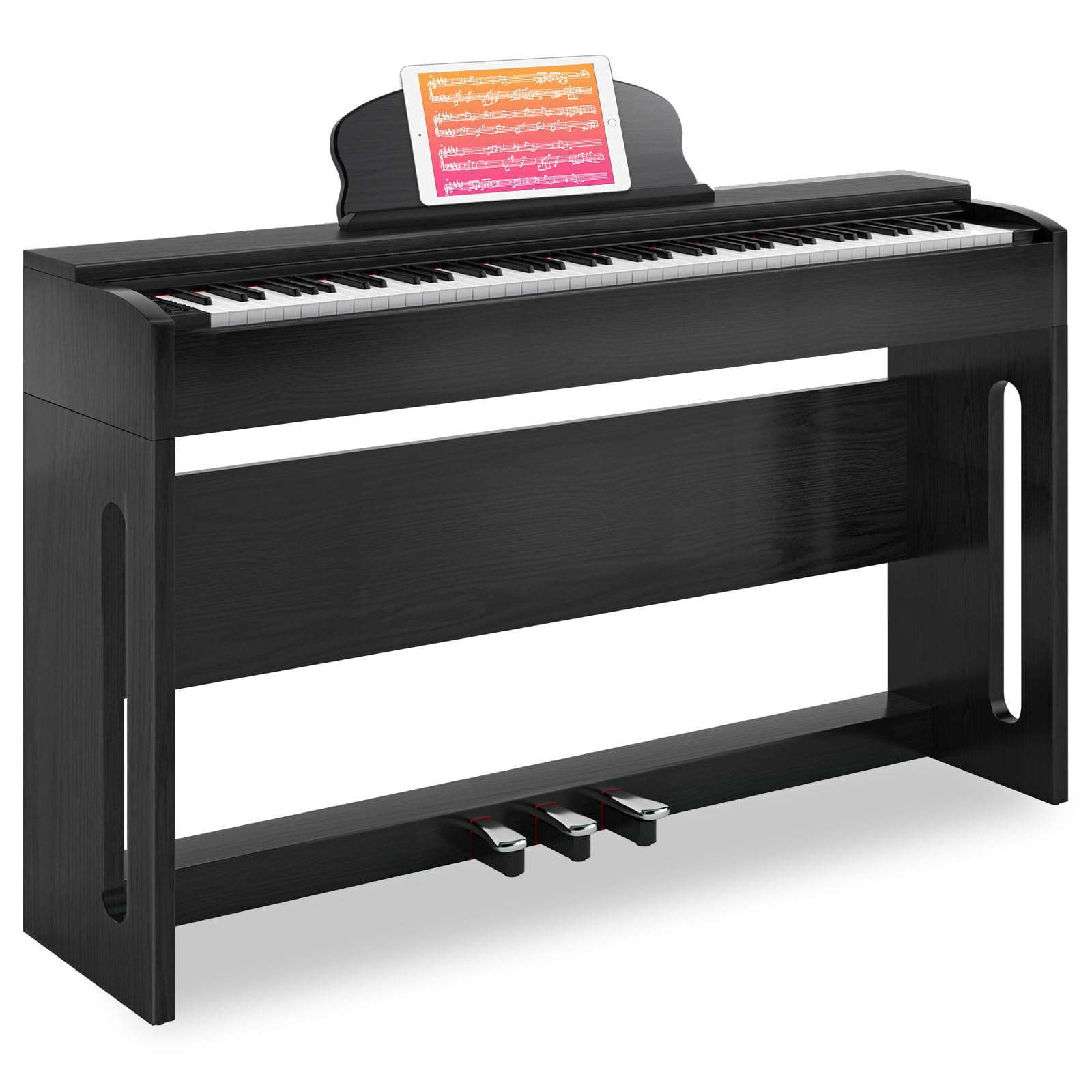
The AODSK B-83S delivers fully weighted piano keys with a wooden cabinet, triple pedals, and a furniture stand at a price point where most competitors offer only semi-weighted action. The weighted keys provide realistic resistance that helps beginners develop finger strength, and the three-pedal unit (soft, sostenuto, sustain) is a feature usually reserved for instruments costing significantly more. The 128-note polyphony and 128 built-in timbres give you plenty of sonic range.
Two headphone jacks allow student and teacher to practice together silently, which is a thoughtful design touch for families or lessons. The speakers produce clear, rich sound that fills a medium-sized room, and the wooden cabinet gives the instrument a traditional acoustic upright appearance that blends well with home decor. Assembly is straightforward per the instructions, and the included 30-day beginner course helps new players get started immediately.
The main downsides are the assembly instructions, which some users describe as unclear and lacking a screwdriver, and the key action being on the lighter side of weighted — advanced pianists may prefer heavier resistance. The sound, while good, leans slightly bass-heavy out of the box, but that can be adjusted through the built-in equalizer. For the beginner who wants a complete wooden-cabinet piano with all pedals and a stand without spending a fortune, this is the value king.
Why it’s great
- Fully weighted keys in a wooden furniture cabinet
- Includes triple pedal unit and furniture stand
- Dual headphone jacks for shared silent practice
Good to know
- Assembly instructions need improvement
- Key action is lighter than some acoustic pianos
- Sound can be slightly bass-heavy initially
5. STRICH SDP-120 Digital Piano

The STRICH SDP-120 offers fully weighted keys with a responsive touch that suits both absolute beginners and returning players, all at a mid-range price that undercuts many competitors with equivalent action. The 128-note max polyphony ensures that complex chords with sustain pedals remain full and clear, and the 200 tones and 700 rhythms provide endless variety for practice and exploration. Wireless MIDI connectivity is a standout feature at this level, allowing cable-free connection to teaching apps and DAWs.
The included sturdy furniture stand and sustain pedal make it a complete setup out of the box — no hunting for compatible accessories. The 15-watt dual speakers deliver clear, room-filling sound that works well for home practice, and the LCD display makes it easy to navigate through the extensive sound library. The classic black lacquered finish is simple but elegant enough to blend into a living room or bedroom.
The power switch located behind the music rest is an awkward placement, and the manual lacks clear guidance on layering tones and saving settings. The keyboard does not remember volume levels after power cycling, which means you’ll adjust it again every time you turn it on. For beginners who want fully weighted action, wireless connectivity, and a complete package without stretching their budget, the SDP-120 is a strong contender.
Why it’s great
- Fully weighted keys for realistic resistance
- Wireless MIDI for cable-free app connection
- Furniture stand and sustain pedal included
Good to know
- Power switch is hidden behind the music rest
- No volume memory after power-off
- Manual lacks depth for advanced functions
6. STRICH SDP-350W Digital Piano
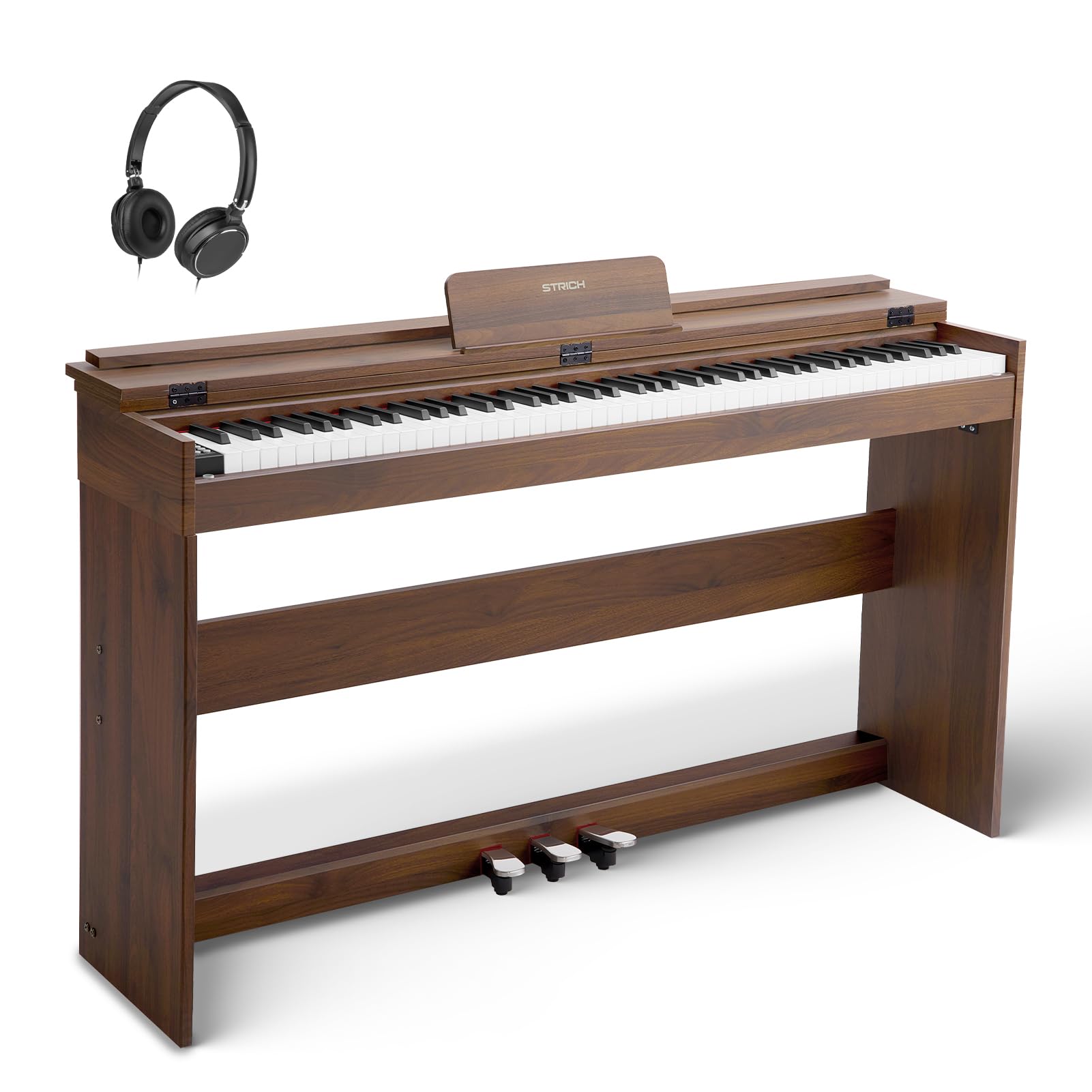
The STRICH SDP-350W stands apart visually with its warm walnut wood-grain cabinet that transforms the keyboard into a piece of furniture your living room actually wants to display. Beyond the aesthetics, it features genuine hammer-action keys with simulated ivory texture that reproduces the graded resistance of a grand piano — heavier in the bass, lighter in the treble. The included flip-top key cover protects the keys from dust and gives the instrument a furniture-grade finish when closed.
The 128 preset timbres and 200 drum rhythms provide a wide creative palette, and the intelligent auto chord function helps beginners produce fuller-sounding harmonies early in their learning. Wireless and USB-MIDI connectivity allow connection to teaching apps, and the audio-in port lets you play backing tracks through the built-in 20-watt speakers. Headphones are included, and the triple pedal unit gives you all three standard acoustic piano pedals.
The keyboard height is slightly lower than some standard acoustic pianos, which may feel different if you’re used to playing on a full upright. The power button is located on the back, requiring you to reach behind the unit to turn it on and off. A few users noted the sound lacks dynamic range compared to higher-end models, though for a beginner the tones are perfectly adequate. For players who want a beautiful instrument that doubles as decor, the SDP-350W delivers.
Why it’s great
- Handsome walnut wood-grain cabinet design
- Hammer-action keys with ivory-texture surface
- Flip-top key cover and triple pedal included
Good to know
- Overall height is a bit lower than standard pianos
- Power button is on the back, awkward to reach
- Sound lacks some dynamic range at higher levels
7. HEXANT 88-Key Weighted Digital Piano

The HEXANT 88-Key Digital Piano is the ultimate all-in-one bundle for the beginner who wants everything in one box — piano, furniture stand, bench, triple pedal unit, and power adapter. The semi-weighted progressive keys offer velocity sensitivity and adjustable touch response, which is a step up from non-weighted synth action but lighter than fully weighted hammer action. The 480 tones, 200 rhythms, and 128 standard GM tones provide enormous variety for exploration.
The backlit LCD screen makes navigating the extensive sound library intuitive, and the dual 25-watt amplifiers deliver impressive volume for home practice or small gatherings. The 80 demo songs and 64-note polyphony are adequate for early lessons, though serious players may bump into the polyphony ceiling when playing dense chords with the sustain pedal. The black wood-grain cabinet and included bench give the setup a cohesive, furniture-like appearance.
The 66-pound weight makes it a stationary instrument — this is not something you’ll carry between rooms regularly. The key action, while better than entry-level keyboards, is semi-weighted rather than fully weighted, so it won’t build as much finger strength as hammer-action alternatives. For the beginner who wants a complete, ready-to-play setup without shopping for accessories, the HEXANT bundle is a convenient and affordable solution.
Why it’s great
- Complete bundle with piano, stand, bench, and pedals
- Backlit LCD screen for easy navigation of sounds
- Dual 25W speakers provide powerful sound output
Good to know
- Semi-weighted keys, not fully weighted hammer action
- 64-note polyphony limits complex sustained playing
- Heavy 66-pound unit is not portable
8. Alesis Recital 88-Key Digital Piano

The Alesis Recital is the lightweight champion of the beginner 88-key world at just 15.6 pounds, making it the only model on this list that you can comfortably carry to lessons, a friend’s house, or a small gig. The 88 premium semi-weighted keys with adjustable touch response give you velocity sensitivity — pressing harder produces louder notes — which is essential for learning dynamic expression. The 5 built-in voices (acoustic piano, electric piano, organ, synth, bass) are limited but cover the fundamentals.
The dual 20-watt speakers deliver surprisingly loud and clear sound for such a portable instrument, and the lesson mode splits the keyboard into two identical ranges so student and teacher can play side-by-side. The Skoove 3-month premium subscription and Melodics 30-day access give you guided interactive lessons right out of the box. Power options include AC adapter or 6 D-cell batteries, so you can play anywhere without looking for an outlet.
The key action is semi-weighted spring action, not hammer-weighted, so it won’t build finger strength as effectively as hammer-action keyboards. The sustain pedal is not included — you must buy one separately, which is an important omission for a beginner keyboard. The default volume is not at its maximum, and you need to press a key combination (Metronome + Lesson keys, then E3) to unlock full output. For a player who needs portability and learning resources above all else, this is the best budget-friendly option.
Why it’s great
- Ultra-light 15.6 lbs, very portable design
- Lesson mode splits keyboard for side-by-side teaching
- Battery power option for playing anywhere
Good to know
- Semi-weighted spring action, not hammer-weighted
- Sustain pedal not included in the package
- Default volume is not set to maximum output
9. Yamaha Piaggero NP-15B 61-Key Piano

The Yamaha Piaggero NP-15B is the lightest option here at just 11.46 pounds, but it is a 61-key instrument, not 88 keys — something to note if you are set on the full 88-key range. It earns a spot because it offers touch-sensitive piano-style keys with Yamaha’s Advanced Wave Memory stereo sampling, delivering authentic grand piano sound quality that rivals heavier, more expensive models. The Smart Pianist app gives you deep control over settings and adds features beyond the physical controls.
The ultra-portable design runs on six AA batteries for up to five hours of play, making it the best choice for playing in parks, at the beach, or anywhere without power access. The 61-key layout covers enough range for most beginner pieces and pop songs, and the built-in metronome and recording function support structured practice. The glossy black finish and compact 41-inch width make it easy to store in small apartments or dorm rooms.
The keybed, while touch-sensitive, is not weighted — the plasticky feel is a compromise for portability. The 61-key range will limit you when you start playing pieces that need the full 88-key compass, meaning you will likely want to upgrade within a year. For the casual player, busker, or someone with extreme space constraints who values Yamaha’s sound quality above all, the Piaggero is a beautiful entry point, but serious students should look at the 88-key options on this list.
Why it’s great
- Extremely light at 11.46 lbs, highly portable
- Authentic Yamaha grand piano sound via AWM sampling
- Battery-powered for true anywhere-play capability
Good to know
- Only 61 keys, not full 88-key range
- Key feel is plasticky and non-weighted
- Limited range for intermediate-level repertoire
FAQ
What is the difference between weighted and semi-weighted keys for beginners?
Do I really need 88 keys as a beginner?
How important is polyphony for a beginner?
Should I buy a keyboard with built-in speakers or use external monitors?
Final Thoughts: The Verdict
For most users, the beginner 88 key keyboard winner is the Donner DDP-300 because it combines graded hammer-action keys, 128-note polyphony, and Bluetooth MIDI into a package that builds proper technique and integrates with modern learning apps. If you want a complete furniture-grade setup with triple pedals and a key cover, grab the Donner DDP-90 Pro. And for a portable, lightweight option that travels easily, nothing beats the Alesis Recital.