
Our readers keep the lights on and the weekend projects moving. As an Amazon Associate, I earn from qualifying purchases.
Choosing a battery powered power station means committing to a specific amount of stored energy measured in watt-hours (Wh), and that number defines everything you can run and for how long. The wrong choice leaves you with a dead fridge mid-storm or a heavy brick that barely charges a phone. The right one becomes the silent backbone of your campsite, home office, or emergency kit.
I’m Rikta — the co-founder and writer behind FitlyFast. I’ve spent years analyzing inverter efficiency, battery chemistry longevity, and real-world discharge rates across hundreds of portable power station models to separate marketing specs from usable capacity.
This guide breaks down the best battery powered power station options across capacity tiers, battery types, and real-world use cases so you can match the hardware to your actual power needs without overpaying for features you will never use.
How To Choose The Best Battery Powered Power Station
Portable power stations are deceptively simple — a battery, an inverter, and some ports — but the details in chemistry, inverter type, and charging speed determine whether your unit lasts three years or ten. Focus on these four decision points before you buy.
Battery Chemistry: LiFePO4 vs. NMC vs. Lead-Acid
Lithium Iron Phosphate (LiFePO4) is the current gold standard. It delivers 3,000 to 4,000+ charge cycles before dropping to 80% capacity, operates safely across a wide temperature range, and has a lower fire risk than NMC (Nickel Manganese Cobalt) batteries used in older or cheaper models. If you want a unit that still performs reliably a decade from now, LiFePO4 is non-negotiable.
Capacity vs. Output: Watt-Hours and Continuous Wattage
Watt-hours (Wh) tell you how much energy the battery holds — think of it like a fuel tank. The continuous output wattage tells you how much power it can deliver at once. A 1000Wh station with a 600W inverter cannot run a 900W microwave, even though the battery has enough stored energy. Check both numbers. For home backup, aim for at least 1000Wh and a 1000W inverter. For CPAP or small electronics overnight, a 300-600Wh unit with a 600W inverter is sufficient.
Inverter Type: Always Pure Sine Wave
Pure sine wave inverters produce clean, grid-quality AC power that sensitive electronics — laptops, CPAP machines, medical devices, variable-speed power tools — require for safe operation. Modified sine wave inverters cause buzzing, overheating, or outright failure in these devices. Every unit on this list uses a pure sine wave inverter.
Charging Speed and Solar Compatibility
Fast AC recharging (under two hours for a full charge) is a premium feature that matters if you rely on the station daily or need to recharge quickly between outages. MPPT solar charge controllers maximize panel efficiency — look for units that accept 200W to 500W solar input if you plan to go off-grid. Also confirm the solar input voltage range matches your panels.
Quick Comparison
On smaller screens, swipe sideways to see the full table.
| Model | Category | Best For | Key Spec | Amazon |
|---|---|---|---|---|
| EF ECOFLOW Delta 3 Classic | Mid-High Capacity | Home backup & fridge | 1800W cont / 1024Wh | Amazon |
| BLUETTI Elite 100 V2 | Mid-High Capacity | Mobile office & RV | 1800W cont / 1024Wh | Amazon |
| Anker SOLIX C2000 Gen 2 | High Capacity | Whole-home backup | 2400W cont / 2048Wh | Amazon |
| Jackery Explorer 2000 v2 | High Capacity | Long-duration camping | 2200W cont / 2042Wh | Amazon |
| DJI Power 2000 | High Capacity | Off-grid work & RV | 3000W cont / 2048Wh | Amazon |
| BLUETTI AC70 | Mid-Range | CPAP & short trips | 1000W cont / 768Wh | Amazon |
| GRECELL 1000W | Mid-Range | Camping & tailgating | 1000W cont / 999Wh | Amazon |
| DARAN 1000W | Mid-Range | Light home backup | 1000W cont / 576Wh | Amazon |
| LIBRIDS C600 | Entry-Level | CPAP & device charging | 600W cont / 640Wh | Amazon |
In‑Depth Reviews
1. EF ECOFLOW Delta 3 Classic
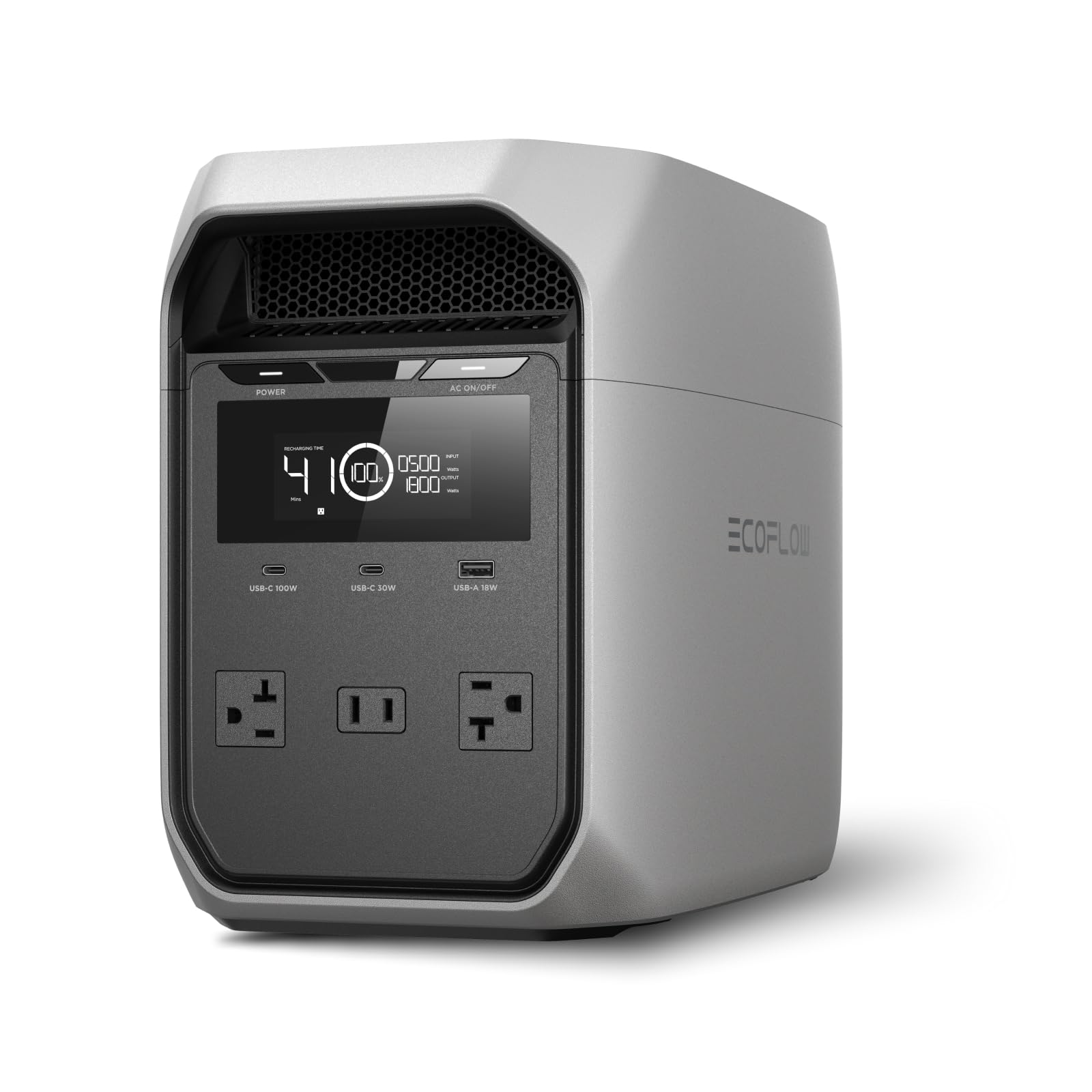
The Delta 3 Classic hits the sweet spot of the entire category with 1024Wh of LiFePO4 capacity and a robust 1800W continuous inverter that handles a full-size refrigerator, microwave, and power tools without breaking a sweat. ECOFLOW’s X-Stream charging pushes the battery from zero to 80% in 45 minutes — fast enough to recharge between rotating appliance loads during an outage.
The sub-10ms UPS switchover is genuinely useful for sensitive electronics like desktop PCs and network servers, preventing data loss during brief grid flickers. Smart app control lets you set charging schedules, enable Storm Alert mode, and monitor live consumption from your phone. The 3600W surge capability via X-Boost means it can start a small air conditioner or pump motor that would stall a lesser unit.
At roughly 33 pounds, it is portable enough for RV trips yet substantial enough to anchor a home backup setup. The build quality is evident in the easy-lift handles, non-skid base pads, and thoughtful port orientation that keeps cables organized. For most households needing one unit that does everything well, this is the starting point and the ending point.
Why it’s great
- Fastest AC recharge in its class — 45 min to 80%
- X-Boost handles surge loads up to 3600W
- Robust ECOFLOW app with Storm Alert and scheduling
Good to know
- Not compatible with Delta 2 or Delta 3 series expansion batteries
- Slightly heavier than some 1kWh competitors
2. BLUETTI Elite 100 V2
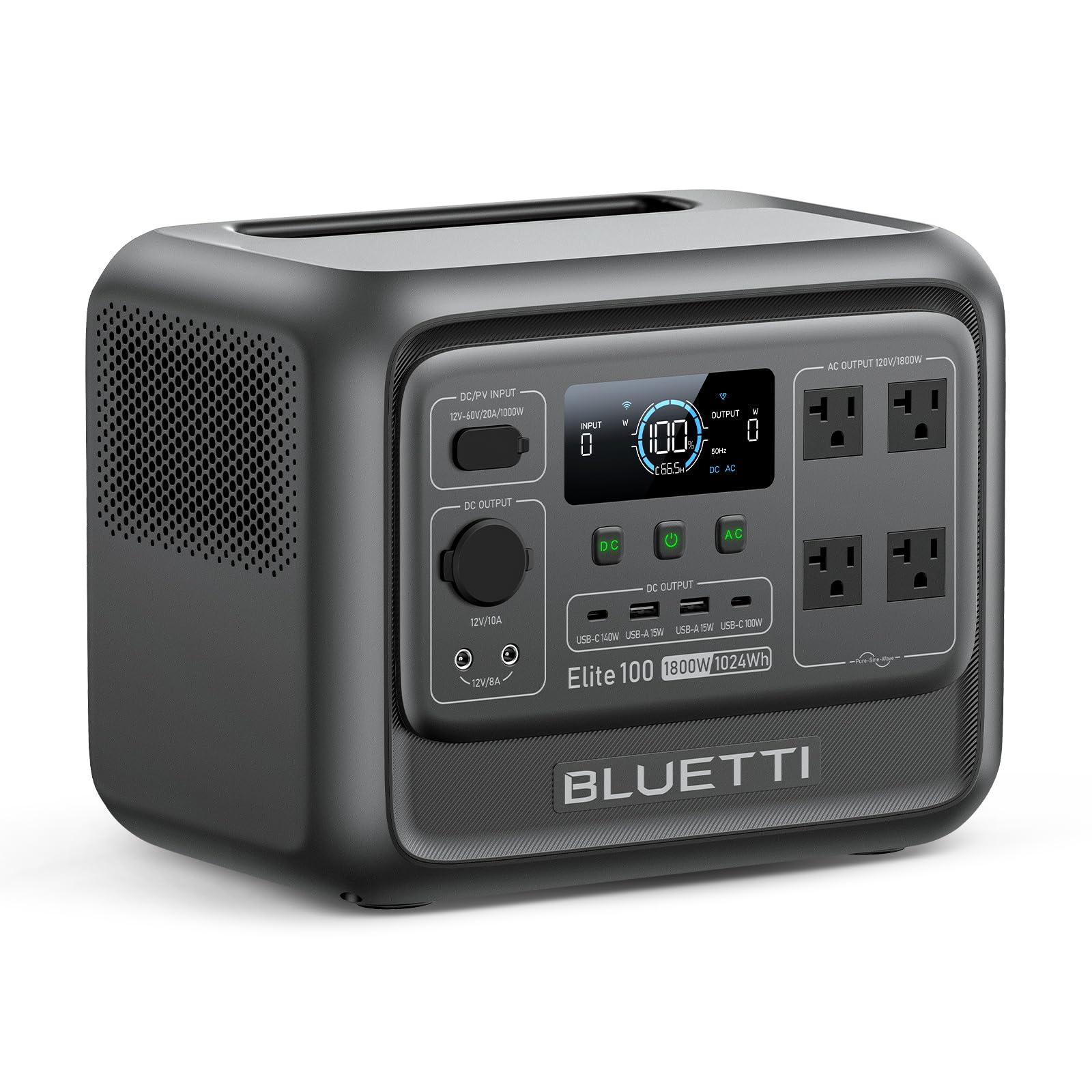
BLUETTI’s Elite 100 V2 packs 1024Wh and 1800W output into a frame that is 35% smaller and 30% lighter than its predecessor, weighing only 25 pounds. That density makes it the most portable high-capacity option here — easy to carry one-handed from the garage to the campsite via the hidden top handle. The 1200W TurboBoost AC charging refills the battery in 70 minutes, and solar input up to 1000W means a full charge from panels in good sun takes roughly two hours.
The eight ports offer modern flexibility: four AC outlets, two USB-C (100W PD), two USB-A, and a 12V car port. The <10ms UPS switch is seamless for sensitive home office gear, and the fan rarely spins above whisper level unless you are pushing past 500W AC charging. The forward-facing port layout keeps cables visible and accessible, a small but appreciated design choice compared to older side-mounted ports.
Expansion is possible via the DC input using third-party 12V or 24V batteries, though BLUETTI does not offer a dedicated expansion pack for this model. The app is functional but slightly clunky — Bluetooth range is adequate, but you cannot power on the unit remotely. For the mobile professional who needs clean, quiet power in a compact footprint, the Elite 100 V2 delivers.
Why it’s great
- 35% smaller footprint than 1kWh competitors
- 1000W solar input for fast off-grid recharge
- Sub-30dB fan noise during normal operation
Good to know
- No built-in light or wireless charger
- App cannot turn unit on remotely
3. Anker SOLIX C2000 Gen 2
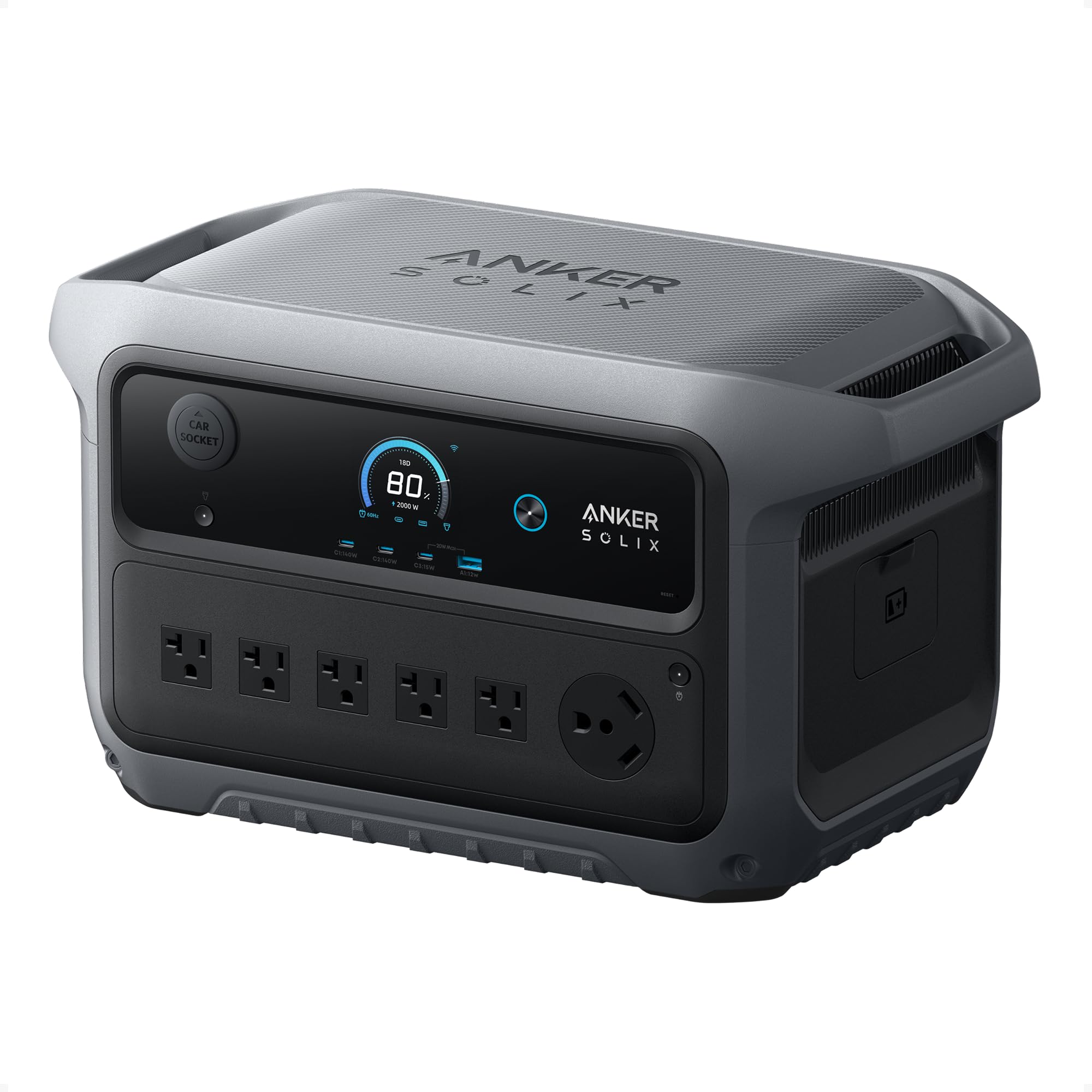
Double the capacity of the mid-range units at 2048Wh, the SOLIX C2000 Gen 2 pairs that energy reserve with a beefy 2400W continuous inverter that peaks at 4000W — enough to start and run most window air conditioners or RV AC units. The standby power draw is an outstanding 9W, meaning the battery does not drain itself sitting idle for weeks between uses. Anker claims a full charge in 58 minutes via AC, and independent testing confirms sub-60-minute replenishment.
The expandable architecture supports a second battery to reach 4kWh total — enough to run a dual-door refrigerator for over two days straight. The 800W alternator charging input is a game-changer for overlanding: three hours connected to a running vehicle tops up the full battery, compared to the typical 24+ hours through a standard 12V port. At 41.7 pounds, it is heavier but still manageable, and the integrated handle feels solid.
Anker’s app provides clear usage data and remote control of outlets, though the unit ships with a digital-only manual. The six recharge methods (AC, solar, alternator, generator, USB-C, and expansion pack) mean you are never stuck waiting for power. For serious home backup or RV living where a single charge must last multiple days, this is the most capable unit in the lineup.
Why it’s great
- Ultra-low 9W standby draws minimal idle power
- 800W alternator charging — 8x faster than standard car port
- Expandable to 4kWh for multi-day fridge runtime
Good to know
- Heavier than other 2kWh units at 41.7 lb
- Manual is digital-only; no printed guide included
4. Jackery Explorer 2000 v2

Jackery’s Explorer 2000 v2 uses EV-grade Cell-to-Body (CTB) construction to pack 2042Wh into a chassis that is 41% lighter and 34% smaller than typical 2kWh LiFePO4 stations. At 39.5 pounds, it is the lightest high-capacity unit reviewed here, making it the best choice if you need to move the station frequently — from garage to campsite to job site. The 2200W continuous inverter (peak 4400W) handles full-size refrigerators, power tools, and small cooking appliances.
AC fast charging hits 80% in 66 minutes, and the Emergency Super Charging mode (enabled via the app) completes a full charge in 102 minutes. The quiet charging mode runs at under 30dB — genuinely library-quiet — and is ideal for overnight charging in an RV or bedroom. The 20ms UPS switch is UL1778-certified for uninterruptible power supply use, though it is slightly slower than the sub-10ms units from ECOFLOW and Anker.
Real-world endurance is strong: users report running a compact fridge for over 21 hours on a single charge, and the unit held up through multiple Florida hurricane outages. The LCD screen shows charge level, input/output wattage, and estimated runtime. The app includes remote on/off for each port group, a feature missing from some competitors at this tier.
Why it’s great
- Lightest 2kWh station on the market
- UL1778-certified UPS for home backup
- 30dB quiet charging mode for overnight use
Good to know
- No expansion battery port for capacity growth
- UPS switch is 20ms, slower than premium competitors
5. DJI Power 2000
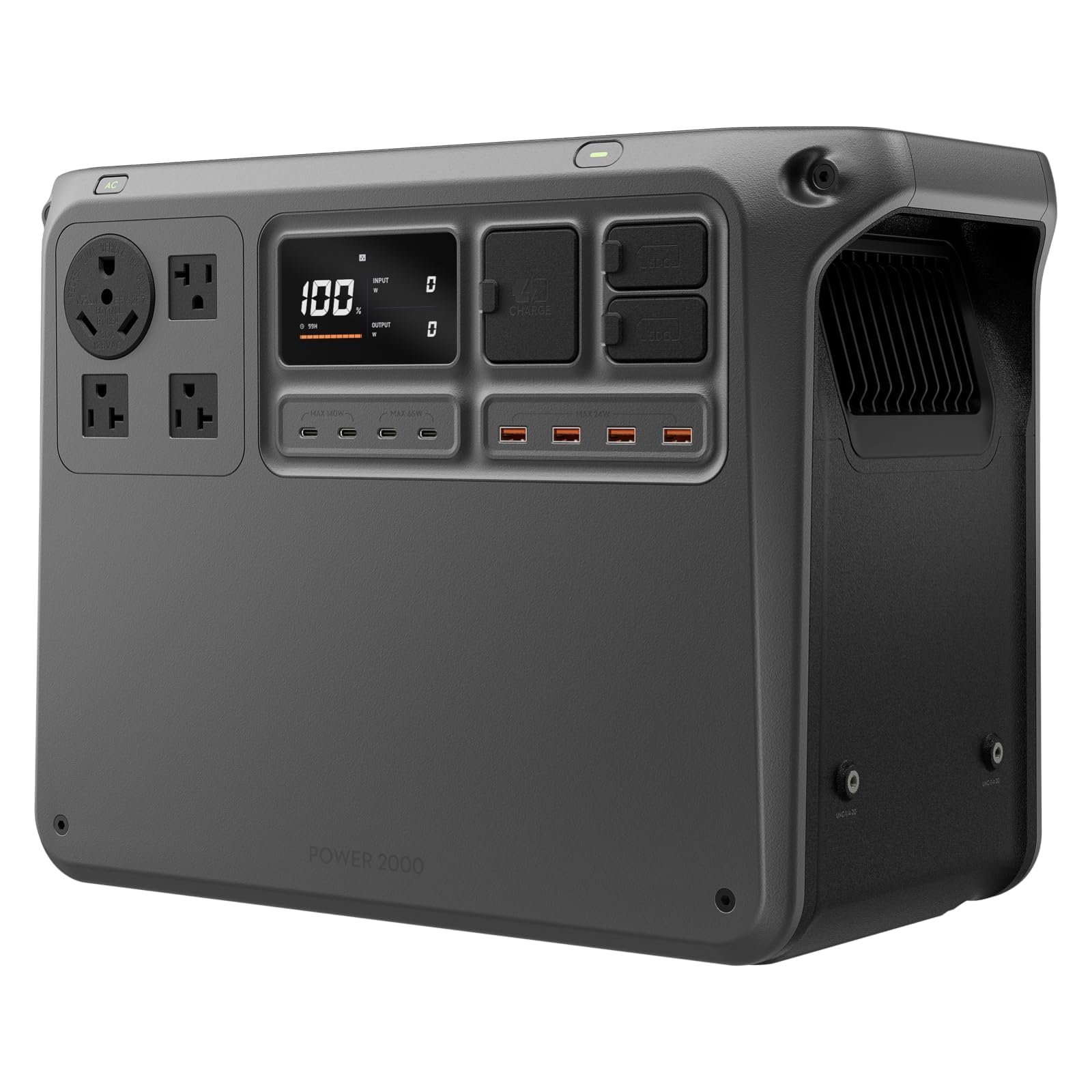
DJI enters the power station market with the Power 2000, a 2048Wh unit that delivers the highest continuous output on this list — 3000W with a 4000W peak — capable of running 99% of household appliances, including electric kettles, cooktops, and heavy-duty power tools. The LFP battery is rated for 4000 cycles, and the flame-retardant housing with sub-nano coating allows safe operation in damp or dusty environments, a rare feature for indoor-rated stations.
Recharge speed is class-leading: 80% in 55 minutes via AC, and solar input up to 1800W means a full charge in under two hours with four 400W panels. The dual SDC ports provide high-power proprietary output for DJI drone charging or third-party DC appliances via adapters. The 15 total ports — including four USB-C (two at 140W) — handle a group of 4-5 people simultaneously. The UPS switch is rated under 10ms, competitive with the fastest units here.
The DJI Home app provides wireless monitoring and control without requiring a separate dongle. A note of caution: the unit does not have built-in MPPT for solar; a separate adapter is required to connect panels. Some early units shipped with incorrect regional firmware, so verify the seller’s region. For those who need the highest continuous power output in a compact 2kWh frame, the DJI Power 2000 sets a new bar.
Why it’s great
- Highest continuous output — 3000W runs heavy appliances
- 4000-cycle LFP battery with flame-retardant housing
- 1800W solar input for fast off-grid replenishment
Good to know
- Solar MPPT adapter not included
- Proprietary SDC connectors limit third-party accessories
6. BLUETTI AC70

The AC70 delivers 768Wh of LiFePO4 capacity and 1000W continuous output (2000W Power Lifting surge) in a 22.5-pound package that hits the sweet spot for weekend camping, CPAP overnight use, and essential home backup for a single appliance. The 950W AC input charges the battery to 80% in just 45 minutes — faster than many larger units — and a full charge takes 1.5 hours via the included single-cable adapter.
The Power Lifting feature intelligently handles higher startup surges from inductive loads like small refrigerators and pumps, meaning the 1000W inverter can briefly push 2000W to start motors that would trip a standard 1000W unit. Solar input caps at 500W, allowing a full charge from panels in under 2.5 hours. The BLUETTI app provides remote monitoring, charge/discharge scheduling, and firmware updates — a feature set usually reserved for more expensive models.
Users consistently praise its efficiency — one musician ran a 100W guitar amp with effects pedals for over eight hours and only drained 41% of the battery. The 20ms UPS backup keeps routers and CPAP machines running through minor grid blips. It lacks the high-wattage output of the larger units, but for everyday portable power at a reasonable investment, the AC70 offers the best functionality-to-cost ratio in the mid-tier.
Why it’s great
- 45-minute 80% AC charge is fastest in its wattage class
- Power Lifting handles 2000W surge for motorized appliances
- BLUETTI app provides full remote control and scheduling
Good to know
- 768Wh capacity limits runtime for multiple large appliances
- Single AC output cable — must be connected for wall charging
7. GRECELL 1000W
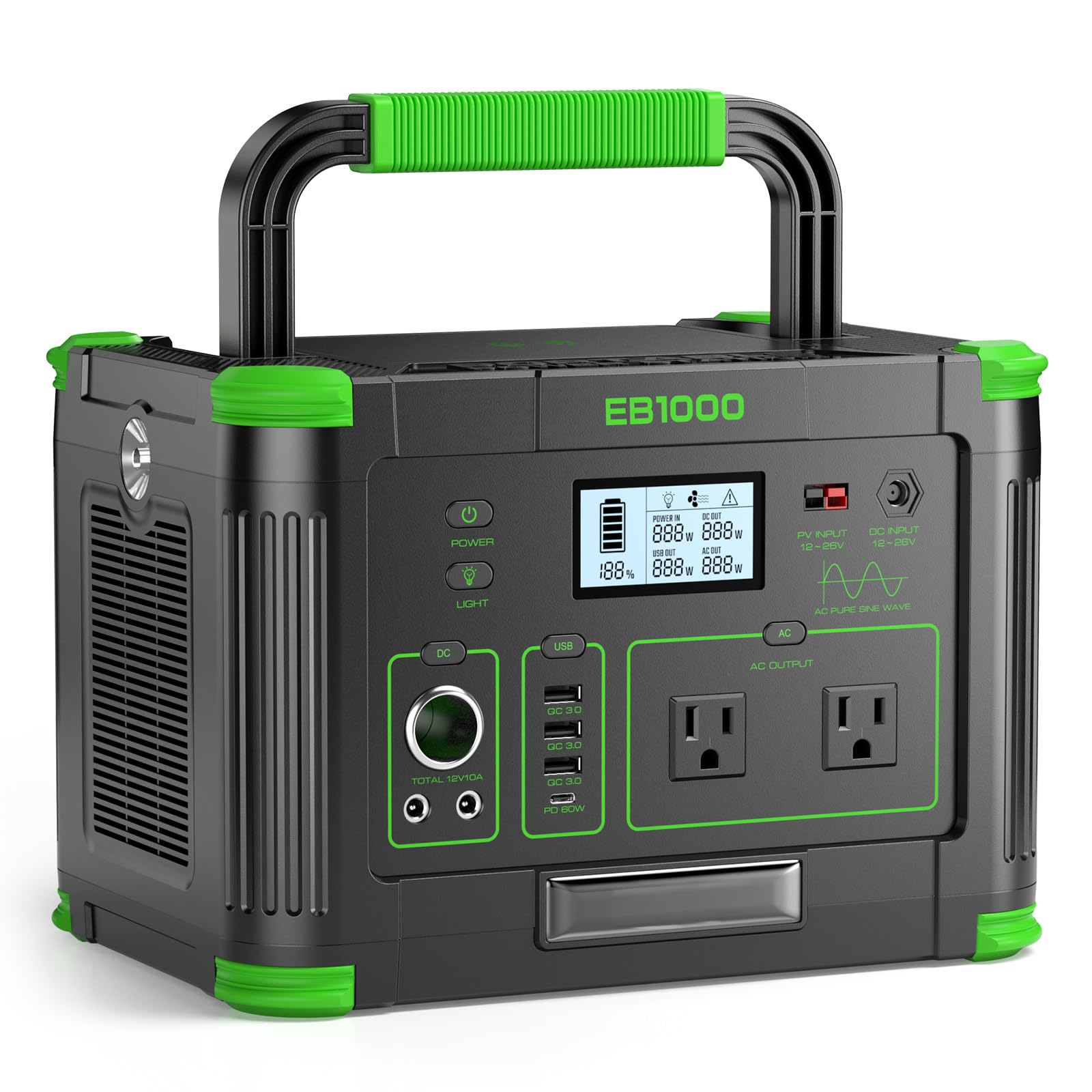
The GRECELL 1000W delivers 999Wh of usable capacity — just shy of 1kWh — at a price point that undercuts most competitors by a significant margin. The 1000W pure sine wave inverter peaks at 2000W surge, enough to power a mini fridge, CPAP machine, TV, and phones simultaneously. The 17.8-pound weight makes it the lightest full-kilowatt station available, an advantage for anyone who must carry the unit between campsites or up stairs.
Port selection is generous: two AC outlets, one USB-C PD 60W, three USB-A QC 3.0, a wireless charging pad, a 12V car port, and two DC outputs. The wireless pad is convenient but finicky with phones that have protruding camera bumps — you may need to remove the case for reliable charging. The upgraded BMS includes auto-shutoff at full charge and surge protection, and the dual cooling fans are quiet during normal loads.
One area where the cost saving shows is AC recharge speed. The unit draws around 60Wh input AC, meaning a full recharge takes roughly 4-5 hours rather than the sub-2-hour times of premium rivals. The LCD display shows real-time wattage and estimated runtime, a valuable transparency feature. For budget-conscious buyers who need 1kWh of clean power without paying a premium for hyper-fast charging, this is the most cost-effective option.
Why it’s great
- Lightest full-kilowatt station — 17.8 lb
- Generous port selection with wireless charging pad
- Excellent value for 999Wh of pure sine wave capacity
Good to know
- AC recharge takes 4-5 hours, slower than premium units
- Wireless charging unreliable with thick phone cases
8. DARAN 1000W
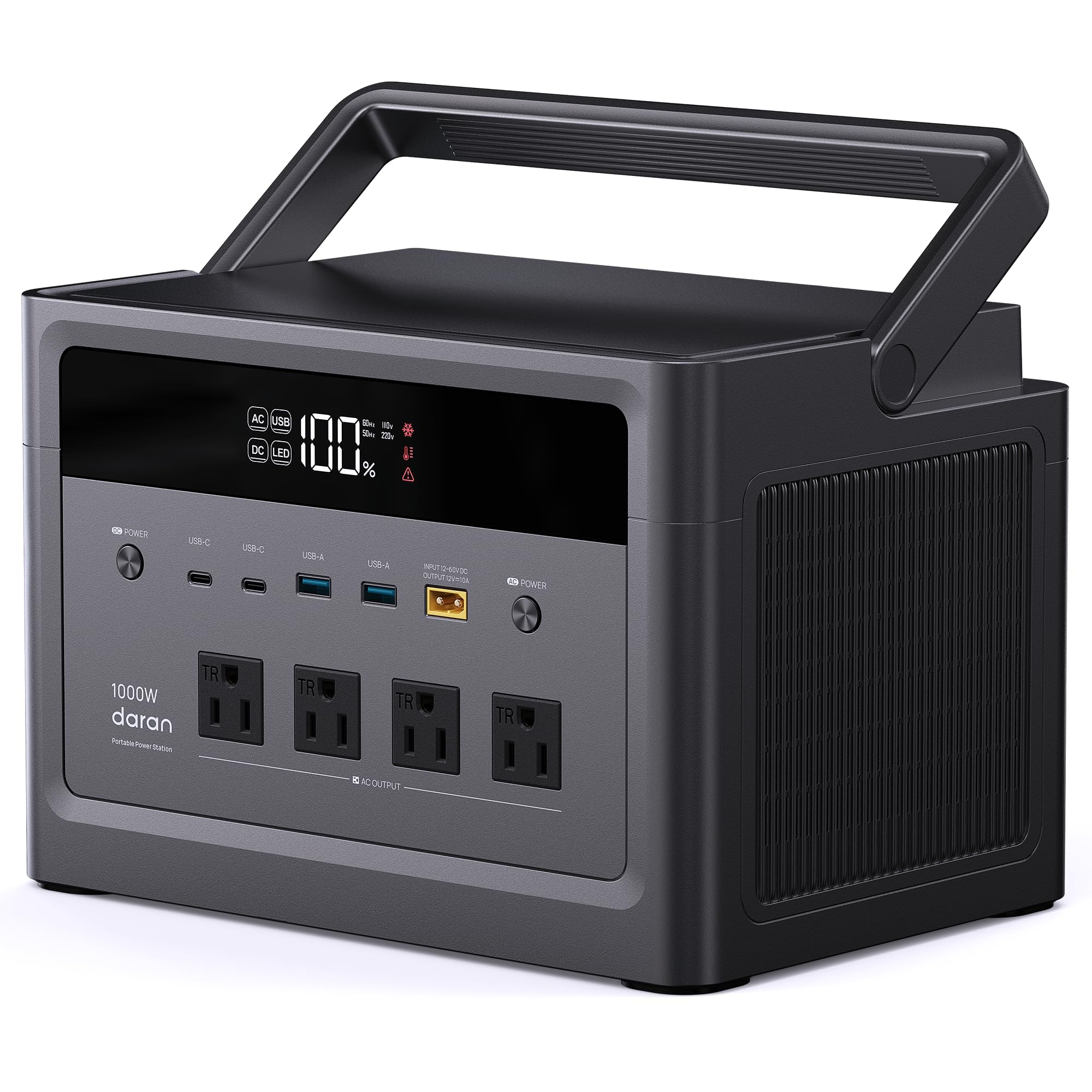
The DARAN Cubus1000 stands out for its fanless, sub-35dB operation — the only truly silent unit in this roundup. With 576Wh of LiFePO4 capacity and a 1000W inverter (2000W peak), it trades total energy storage for a completely noiseless experience, ideal for bedrooms, offices, or campsites where any fan hum would be disruptive. At 14.8 pounds, it is the lightest station reviewed here.
Four AC outlets are rare at this size class, allowing simultaneous power to a laptop, monitor, phone charger, and fan without an external power strip. The 100W USB-C PD port fast-charges high-end laptops directly. AC recharge reaches 70% in 1.8 hours and a full charge in about 3 hours. The built-in 3-mode LED light (low, high, SOS) adds utility for camping and emergency setups.
The battery chemistry supports 3500+ cycles before dropping to 80% capacity, giving it a decade-long lifespan for most users. Solar input via the XT60 port accepts up to 200W panels. The main limitation is the 576Wh capacity — it will run a CPAP for one to two nights or a mini fridge for half a day, but it cannot sustain multiple appliances through a long outage. For anyone who prioritizes dead silence over maximum runtime, the DARAN is the correct choice.
Why it’s great
- True fanless design — under 35dB total silence
- Four AC outlets in a sub-15-pound frame
- 3500+ cycle LiFePO4 battery for decade-long service
Good to know
- 576Wh capacity limits extended appliance runtime
- Solar input capped at 200W — slower panel recharge
9. LIBRIDS C600
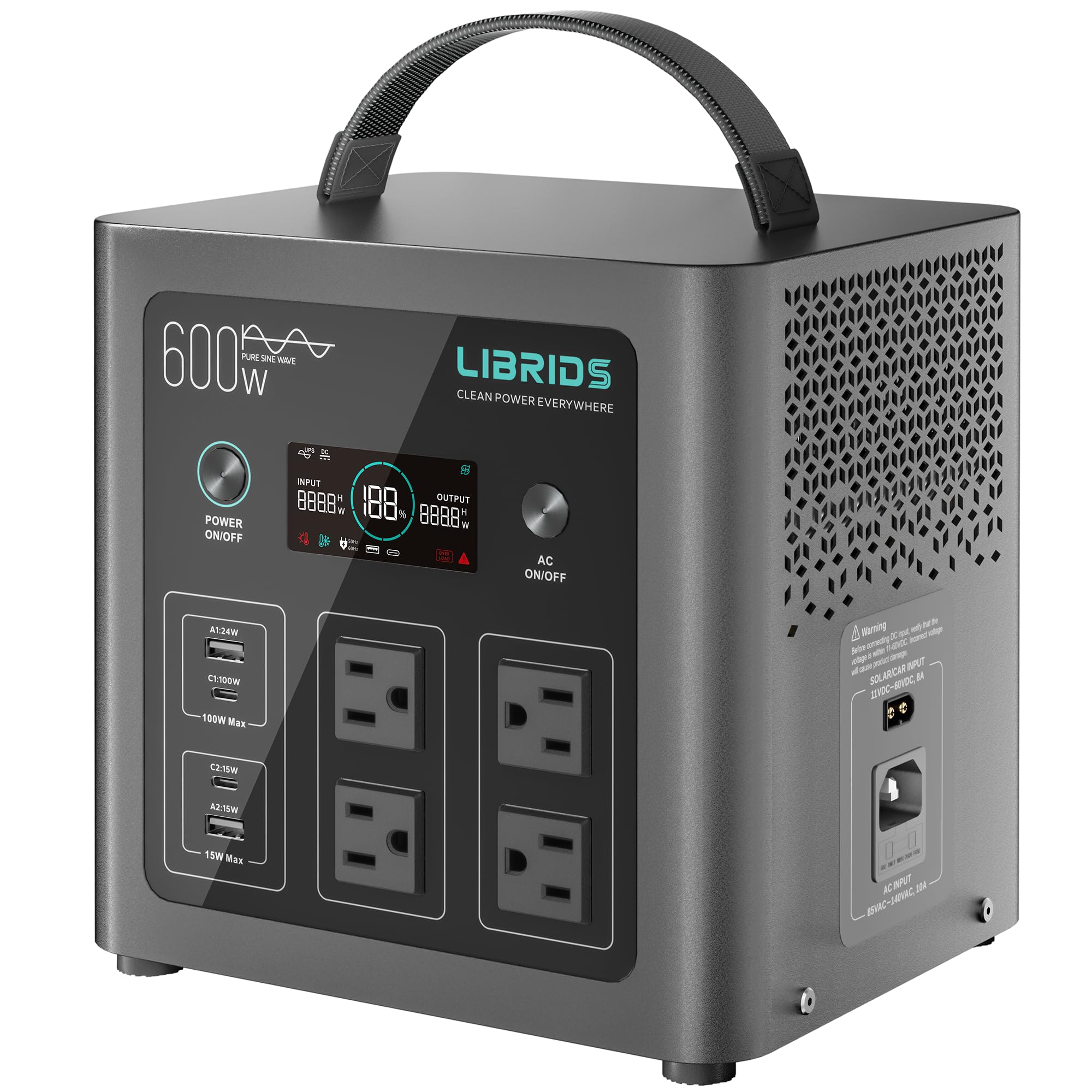
The LIBRIDS C600 proves that entry-level does not have to mean low-quality. This 640Wh LiFePO4 unit with a 600W pure sine wave inverter (1200W peak) is purpose-built for essential device backup — CPAP machines, WiFi routers, aquarium pumps, and laptop charging — where clean, stable power matters more than massive capacity. The automotive-grade LiFePO4 battery is rated for 4000+ cycles, giving it one of the highest cycle lives on this list.
AC fast charging fills the battery to 100% in just 1.5 hours, a speed that rivals mid-range units. The 10ms UPS switch is genuinely useful for CPAP and aquarium owners who cannot tolerate even a brief power interruption. The metal enclosure dissipates heat more effectively than plastic bodies, and the compact footprint (8.3 x 6.9 x 8.2 inches) fits on a nightstand or under a desk.
Port selection includes four AC outlets, two USB-A, one USB-C, and a 12V car port. The smart LCD clearly displays battery percentage and real-time input/output wattage. This unit is explicitly labeled for indoor use only — it can be used outdoors in dry, well-ventilated conditions but should never be exposed to rain or moisture. For the CPAP user, RV boondocker, or apartment dweller who needs a reliable emergency power source without spending premium money, the C600 delivers quietly and dependably.
Why it’s great
- 4000+ cycle LiFePO4 battery — best longevity at this tier
- 1.5-hour full AC recharge rivals mid-range stations
- 10ms UPS backup protects CPAP and aquarium gear
Good to know
- 600W inverter limits heavy appliance use
- Indoor use only — keep away from rain and moisture
FAQ
Can a battery powered power station run a refrigerator?
How long does a 1000Wh power station last for CPAP use?
Do I need a pure sine wave inverter for sensitive electronics?
Can I recharge a power station with solar panels while using it at the same time?
Final Thoughts: The Verdict
For most users, the best battery powered power station winner is the EF ECOFLOW Delta 3 Classic because it pairs 1024Wh of LiFePO4 capacity with a robust 1800W inverter and 45-minute rapid recharge — the most balanced combination of power, speed, and smart features for home backup and outdoor use. If you want a compact 2kWh unit that is truly portable, grab the Jackery Explorer 2000 v2 — it delivers 2042Wh in the lightest frame available. And for high-output scenarios like running a window AC or powering heavy tools, nothing beats the DJI Power 2000 with its class-leading 3000W continuous inverter and 4000-cycle battery lifespan.