
Our readers keep the lights on and the weekend projects moving. As an Amazon Associate, I earn from qualifying purchases.
A sprained knee isn’t a single injury — it’s a spectrum that runs from a mild stretch of the MCL to a partial tear of the ACL or PCL, and each grade demands a different level of mechanical control. The wrong brace either gives you zero stability or locks your leg like a cast, but the right one unloads the injured ligament during daily movement while preserving enough range of motion so you don’t develop a stiff, atrophied joint. That’s the line this list walks.
I’m Rikta — the co-founder and writer behind FitlyFast. I spend my weeks digging into the biomechanics of recovery gear, comparing hinge designs, compression fabrics, and strap geometry across dozens of models to separate the braces that actually unload ligaments from the ones that are just thick neoprene tubes with a marketing sticker.
Whether you are dealing with a Grade 1 sprain that needs light compression or a more complex meniscus involvement that demands bilateral hinging, finding the right support is critical — so I compiled this guide to the single best brace for sprained knee across every recovery phase and budget level.
How To Choose The Best Brace For Sprained Knee
A sprained knee isn’t a single diagnosis — it’s a catch-all for injuries to the MCL, LCL, ACL, or PCL, each with its own directional instability. Picking a brace without understanding which ligament is involved is like buying a tire for a car without knowing which wheel is flat. Here are the three critical factors that define whether a brace helps or just sits on your leg.
Ligament-Specific Support vs. General Compression
A Grade 1 MCL sprain needs medial-side reinforcement, not full immobilization. A hinged brace with a single-axis or dual-geared hinge can offload the medial collateral ligament during walking without restricting flexion. For an ACL sprain, you want a brace that limits tibial translation — that means heavier bilateral hinges and a rigid frame. Simple elastic sleeves are only appropriate for very mild strains where the knee is still stable on its own; if you feel a buckling sensation, you need mechanical stops, not compression alone.
Hinge Quality and Range of Motion
The hinge is the most expensive component of a knee brace, and it’s the part that takes the most stress. Basic stamped-metal single-axis hinges work for early-stage MCL sprains but don’t track the natural rotation of the knee during gait. Triaxial or polycentric hinges (like the ones in premium DonJoy and Shock Doctor models) rotate through multiple axes to mimic natural knee motion, which reduces skin irritation and brace migration. If you plan to wear the brace for more than two hours at a time, a multi-axis hinge is worth the step up in cost.
Fit Profile: Circumference vs. Length
Most braces use thigh circumference measured four inches above the kneecap. That works for sleeves and hinged wraps, but immobilizers also depend on leg length. A brace that is too long will hit the top of your calf muscle at an angle and slide down every time you sit. If you need an immobilizer for post-sprain recovery, measure both the circumference and the distance from mid-thigh to mid-calf so the brace spans the joint without overhanging. For hinged braces, pay attention to the calf opening — some models, like the Mueller Hg80, are notoriously tight on larger calves even when the thigh measurement is correct.
Quick Comparison
On smaller screens, swipe sideways to see the full table.
| Model | Category | Best For | Key Spec | Amazon |
|---|---|---|---|---|
| Shock Doctor 875 | Hinged | Maximum ligament stability | Bilateral dual hinges, 4-way stretch Lycra | Amazon |
| Mueller Hg80 | Triaxial Hinge | Return-to-sport support | Triaxial hinge for natural tracking | Amazon |
| DonJoy Drytex Sport | Hinged | Active recovery with breathability | Drytex ventilated fabric | Amazon |
| Comforband B710 | Geared Hinge | Mid-range medial/lateral support | Two-point geared steel hinges | Amazon |
| Galvaran HX010-02 | Patella Stabilizing | Meniscus tear with patella tracking | Dual gel pad + V-band straps | Amazon |
| Changenow HX011-PRO | Wraparound | Adjustable daily wear | 4 spring stays, crescent patella pads | Amazon |
| TANDCF Immobilizer | Immobilizer | Post-sprain full straight-leg rest | 6 removable aluminum stays, 18.1” length | Amazon |
In‑Depth Reviews
1. Shock Doctor Knee Brace 875

The Shock Doctor 875 is the heaviest hitter in this lineup — it uses bilateral dual hinges that extend further up the thigh and down the shin than most mid-range braces, giving you genuine offloading for medial and lateral instability. The four-way stretch Lycra mesh is pre-curved at the knee pocket, so the brace doesn’t bunch behind the popliteal fossa when you bend past 90 degrees. This is the brace you pick when your knee feels like it might buckle walking down stairs, not just when it aches after a run.
Users with ACL and MCL sprains consistently report that the 875 eliminates the giving-way sensation during weight-bearing, which is the single most important function of a brace at this price tier. The integrated flexible side stabilizers are sewn into the frame rather than slipped into removable pockets, which adds durability but means you cannot dial the support down during later recovery phases. The airflow venting does a solid job of wicking moisture, but the brace is still warm for summer wear — that’s the trade-off for this level of containment.
Break-in is real: the brace is notably stiff out of the box and feels restrictive for the first two or three wears. After about four hours of total wear time the Lycra gives slightly, and the hinges seat into their natural tracking arc. The hook-and-loop tabs are chunky enough for arthritic hands to grip, and they hold position through a full day of activity without re-tightening. For high-demand sprains where you cannot afford any play at the joint, this is the benchmark.
Why it’s great
- Heavy-duty bilateral hinges eliminate buckling in ACL/MCL sprains
- Pre-curved anatomical design prevents fabric bunching behind the knee
- Vented mesh reduces moisture buildup during extended wear
Good to know
- Stiff out of box requires a short break-in period
- Side stabilizers are non-removable so you cannot reduce support later
- May be too warm for hot-weather activities
2. MUELLER Sports Medicine Hg80 Hinged Knee Brace
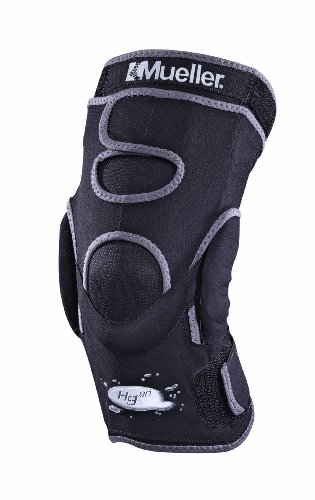
The Mueller Hg80 is the brace that athletes with chronic MCL or meniscus issues tend to settle on after trying half a dozen competitors. Its defining feature is the triaxial hinge — three pivot points that track the knee’s natural rotational path rather than forcing a single-axis arc. This matters most during sports that involve cutting or lunging, where a rigid single-axis hinge can actually pry the brace into your skin. The HydraCinn fabric is noticeably softer against bare skin than standard neoprene and resists the ammonia smell that builds up in cheaper braces after repeated sweat cycles.
Users report immediate pain reduction — one long-term meniscus tear reviewer noted an 80 percent drop in discomfort while bearing weight during the first day of use. The brace slides on over the foot rather than wrapping around the knee, which means you don’t have to adjust four straps before every walk. But that sleeve-style entry is also the biggest limitation: if your calf circumference is more than two inches larger than your thigh measurement, the brace can get stuck halfway up the leg. Mueller does make up to 2XL, but the opening-to-closure ratio is still tight for bigger calves.
Durability is strong for the price point — users have worn this brace daily for two years with only minor hinge loosening and a squeak that develops around month six (easily silenced with a drop of silicone lubricant on the hinge pin). The hinges are removable for washing, though reinserting them takes some finger strength. It’s not a full ACL stabilizer like the Shock Doctor, but for MCL sprains, meniscus tears, and general arthritic instability, the Hg80 delivers the best range-of-motion-to-stability ratio in this list.
Why it’s great
- Triaxial hinge tracks natural knee rotation during cutting sports
- HydraCinn fabric is softer and more breathable than standard neoprene
- Proven long-term durability with daily use over two years
Good to know
- Calf opening is tight for larger calves even in XXL size
- Hinges may develop squeak over time and need lubricant
- Must slip over foot, no wrap-around entry option
3. DonJoy Drytex Sport Hinged Knee Brace
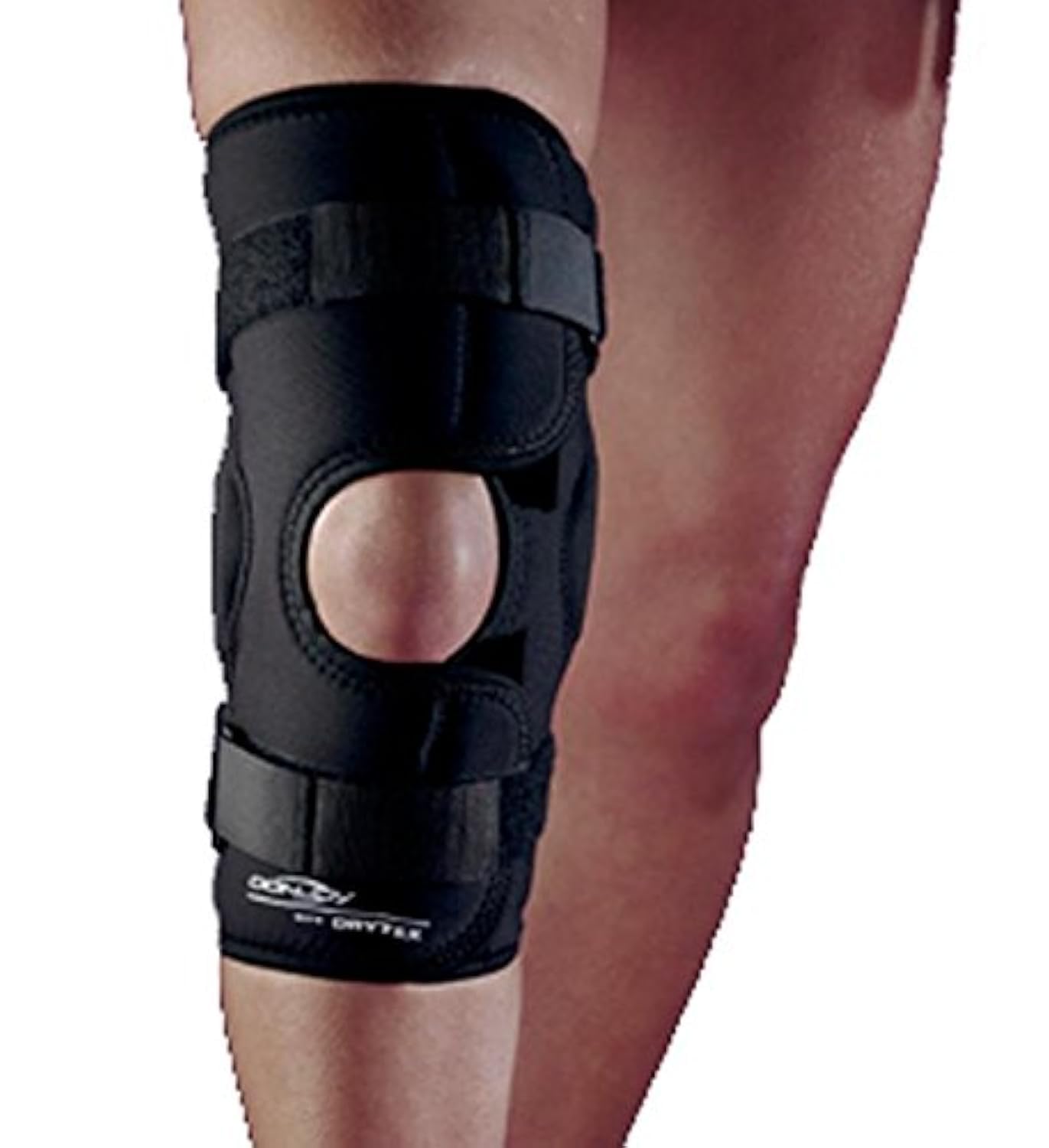
DonJoy built a reputation on high-end orthopedic braces that hospitals dispense post-surgery, and the Drytex Sport is the consumer-facing version of that clinical DNA. The Drytex fabric itself is the headline feature — an open-mesh knit that moves heat and moisture away from the skin faster than any neoprene or Lycra blend I’ve tested. If you live in a warm climate or plan to wear the brace under work clothes for eight-plus hours, this is the model that won’t leave your knee feeling like it’s in a sauna.
The support comes from two bilateral aluminum stays sewn into the frame rather than a full articulated hinge. This gives you solid medial-lateral stability for mild to moderate ligament sprains but doesn’t offer the same degree of rotation control that the Shock Doctor or Mueller triaxial hinge provides. For a Grade 1 MCL sprain where the knee is still stable but painful, the Drytex Sport is more than enough and significantly lighter than the heavy-duty contenders. The sizing requires two measurements — thigh and calf circumference six inches above and below the kneecap — which reduces the chance of a poor fit.
The main complaint is a seam that runs along the posterior cutout and can rub on bare skin, especially during deep squats or lunges. Wearing a thin cotton liner underneath solves the issue entirely. Users who have owned the brace for several years note that the elastic loses tension over time and the brace may require washing to temporarily restore snugness. For an active person recovering from a straightforward sprain who prioritizes comfort and ventilation over maximum mechanical support, this is a well-engineered choice.
Why it’s great
- Drytex mesh is the most breathable fabric in this lineup
- Lightweight and low-profile fits easily under wide-leg pants
- Requires two-point measurement for a more accurate fit
Good to know
- Posterior seam can irritate the back of the knee during deep bending
- Elastic tension decreases over years of regular use
- Aluminum stays offer less rotation control than articulated hinges
4. Comforband Adjustable Hinged Knee Brace B710

The Comforband B710 punches well above its price tier by including two-point geared steel hinges that control both flexion and extension, a feature normally reserved for braces costing twice as much. The hinges sit inside removable pockets — you can pop them out during later recovery stages when the knee no longer needs that level of mechanical restriction. That modularity is rare at this price point and makes the B710 a smart choice for sprains that progress through multiple phases of healing over several months.
The four-strap open structure design uses two narrow straps across the popliteal space to reduce the fabric squeeze that most neoprene braces create when you bend your knee. Users with a history of patella tracking issues report that the open patella design with stitched buttress provides noticeable reinforcement without adding bulk behind the kneecap. The terry cloth interior lining is also an unusual touch at this price — it wicks moisture better than the slick nylon lining found on most budget braces and stays comfortable against bare skin for full-day wear.
The trade-off is in material durability. The neoprene blend works well thermally but is not as resilient as the HydraCinn or Drytex fabrics used in premium models — users who wear the brace daily may notice edge fraying around the strap loops after four to five months. The hook-and-loop patches also catch on the fabric during initial positioning, making the first few wears slightly frustrating until you learn the optimal strap order. For a mid-range sprain that doesn’t need hospital-grade rigidity but does need proper hinge support, the B710 is the value king.
Why it’s great
- Two-point geared hinges at a budget-friendly price point
- Removable hinge pockets allow support reduction during recovery
- Terry cloth interior is comfortable and moisture-wicking against bare skin
Good to know
- Neoprene blend may show edge fraying with heavy daily use
- Hook-and-loop catches fabric during initial fitting
- Not as breathable as mesh-based braces for hot climates
5. Galvaran Knee Brace HX010-02
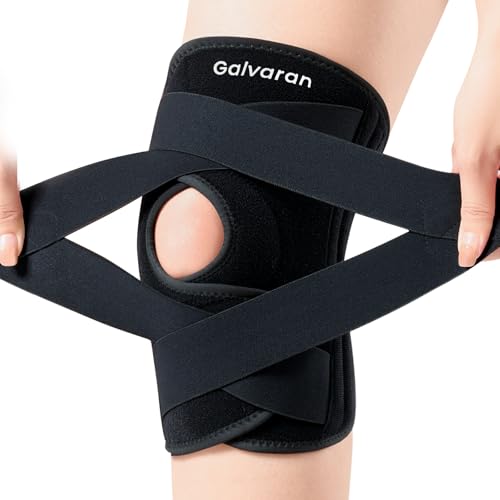
The Galvaran HX010-02 differentiates itself with a dual gel pad system and V-shaped cross straps that target patella stability specifically. Most braces at this price use flat foam padding or no patella-specific support at all, but the crescent-shaped gel pads in the Galvaran create a physical barrier that guides the kneecap through its tracking groove. For sprains that also involve patellofemoral pain or subluxation — not uncommon when the medial retinaculum is stretched during a lateral sprain — this dual approach is more effective than a generic hinged brace.
The V-band straps are attached to the frame at an angle that pulls the patella slightly medially, which offloads the lateral facet that gets irritated during early recovery from a valgus stress sprain. Users with torn menisci report that the crisscross support feels noticeably more stabilizing than the parallel strap layout on many competitors. The fabric blend uses 60 percent neoprene with 7 percent spandex for directional stretch, which creates a wraparound effect without the bunching that happens when unidirectional fabric is forced across the knee contour.
The sizing chart is the weak point — it only provides a single number per size rather than a range (e.g., “Medium” without a minimum and maximum thigh circumference), so you may need to contact the seller or refer to user photos to confirm your size. Users who ordered between sizes found that sizing down gave a better level of active support, while sizing up was too loose to control the patella. The gel pads also have a finite lifespan — after six to eight months of regular wear, the gel begins to flatten and loses some of its guided tracking effect.
Why it’s great
- Crescent gel pads provide active patella tracking support
- V-band strap angle offloads lateral facet for valgus sprains
- Directional spandex weave prevents fabric bunching behind the knee
Good to know
- Sizing chart lacks min/max ranges, making fit a guessing game
- Gel pads flatten after six to eight months of wear
- Not enough rigid support for severe ACL or PCL sprains
6. Changenow Meniscus Knee Brace HX011-PRO
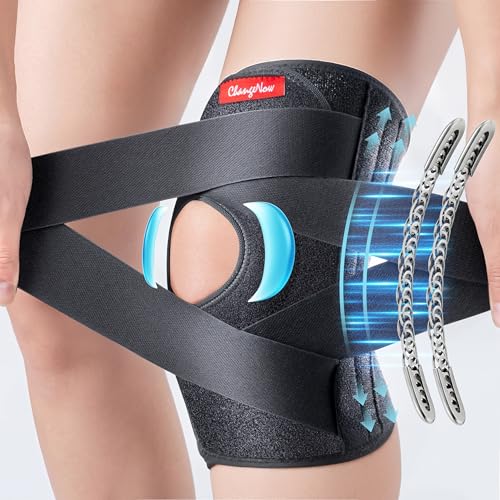
The Changenow HX011-PRO uses four spring support stays — two on each side — that provide 360-degree wrapping compression without needing a rigid external hinge. This design is closer to a high-compression sleeve with integrated stays than a full hinge brace, which makes it ideal for Grade 1 or early Grade 2 sprains where the knee needs stability but doesn’t require mechanical offloading. The butterfly-shaped cut pattern is designed to follow the natural muscle contours around the knee, and users consistently report zero bunching behind the knee even after hours of sitting and standing.
The dual V-shaped cross straps create a secondary compression layer that locks the stays into position against the thigh and shin, preventing the brace from migrating downward during walking — a common complaint with wraparound designs. The crescent-shaped patella pads claim to reduce patella pressure by 50 percent, and while that specific percentage is hard to verify in real-world use, users do notice less sharp pain when climbing stairs or squatting. The wide Velcro base makes adjustments easy, though users with limited hand strength may struggle to peel the tabs open.
Material quality is solid for the price tier. The multi-layer blend of nylon, neoprene, and polyester is thin enough to hide under trousers without creating a bulge, which is a real advantage for people who need to wear the brace during office hours. The trade-off is that the stays are less durable than steel or aluminum hinges — users who engage in heavy squatting or lateral movement may bend the stays out of shape within three to four months. For daily walking, standing, and mild activity after a sprain, the Changenow offers impressive adjustability and comfort on a budget.
Why it’s great
- Butterfly cut eliminates bunching behind the knee during movement
- Four spring stays provide even compression without a rigid hinge
- Thin profile fits discreetly under work pants or jeans
Good to know
- Spring stays may bend under heavy squatting or lateral loads
- Velcro tabs are stiff and harder to open for users with weak hands
- Not sufficient support for unstable knees or Grade 3 sprains
7. TANDCF Knee and Leg Immobilizer

The TANDCF immobilizer takes a completely different approach than the hinged braces in this list — it prevents knee flexion entirely using six removable aluminum stays that lock the leg into a protected straight position. This is the correct brace for a Grade 3 sprain, a post-surgical reconstruction, or a patellar dislocation where any bending could re-injure the ligament before collagen bridging has occurred. The 18.1-inch length spans from mid-thigh to mid-shin, which distributes the immobilization force across the whole limb rather than concentrating it at the joint.
Users consistently report that this aftermarket immobilizer is more comfortable and easier to fit than the braces issued by hospital emergency rooms. The pure cotton interior padding (no latex) is softer against the skin than the foam-lined hospital standard, and the six alternating Velcro straps allow fine-grained tension adjustment — you can make the thigh section snug while leaving the calf section looser, which helps with the common problem of the brace sliding down when you stand. The open patella design is a thoughtful addition for post-operative users who need wound access without removing the entire brace.
The main functional limitation is slippage. Users with a very tapered leg shape — wide thigh relative to narrow calf — report that the brace migrates downward over the course of a few hours, especially when sitting, because the straps can’t grip the calf contour tightly enough. Wearing a thin cotton legging underneath increases friction and reduces sliding. The aluminum stays are removable for washing, but reinserting them into the fabric channels requires patience. For non-weight-bearing recovery phases, the TANDCF immobilizer is a well-constructed and budget-friendly alternative to clinical braces.
Why it’s great
- Six aluminum stays lock the knee at a safe 0-degree extension
- Cotton padding is softer and less irritating than hospital-grade foam
- Open patella design allows wound care without removing the brace
Good to know
- Slides down on legs with a significant thigh-to-calf taper
- Aluminum stays are difficult to reinsert into channels after washing
- Straps are relatively narrow and may not hold tight on thicker limbs
FAQ
Should I immobilize a sprained knee completely or use a hinged brace?
Can I wear a knee brace for a sprained knee while sleeping?
How do I measure my knee for a brace for a sprained knee?
Final Thoughts: The Verdict
For most users, the best brace for sprained knee winner is the Shock Doctor 875 because its bilateral dual hinges deliver genuine mechanical offloading for ACL and MCL sprains without sacrificing as much range of motion as a full immobilizer. If you want triaxial hinge tracking for return-to-sport activities, grab the Mueller Hg80. And for a post-surgical or Grade 3 sprain where the knee must stay straight, nothing beats the TANDCF Immobilizer.