
Our readers keep the lights on and the weekend projects moving. As an Amazon Associate, I earn from qualifying purchases.
Bermuda grass demands a specific mix of aggressive weed suppression and timed nitrogen feeding, or it gets overtaken by broadleaf invaders within weeks. The wrong all-purpose weed and feed can actually stunt your warm-season turf.
I’m Rikta — the co-founder and writer behind FitlyFast. I’ve analyzed dozens of herbicide and fertilizer formulations to find which ones help Bermuda grass achieve that dense, carpet-like finish without burning it out.
This guide walks you through the best picks for your lawn, so you can make a confident choice when shopping for a bermuda grass fertilizer and weed killer that truly works.
How To Choose The Best Bermuda Grass Fertilizer And Weed Killer
Bermuda thrives on frequent nitrogen feeding during its active growth window (late spring through summer), but many all-in-one formulas overdo potassium or contain pre-emergent herbicides that interfere with Bermuda’s aggressive rhizome spread. You need a product calibrated for warm-season species.
Timing: Post-Emergent vs. Pre-Emergent
Bermuda’s growth spike makes post-emergent weed control the primary focus — you want a formula that kills existing broadleaf weeds without stressing the actively growing turf. Pre-emergent products are better applied separately in late winter before the grass greens up.
Herbicide Ingredients
Look for 2,4-D, dicamba, MCPP, or triclopyr (common in Trimec-type blends) — these attack broadleaf weeds while leaving Bermuda unharmed. Avoid products containing atrazine unless you’re certain your Bermuda variety tolerates it.
Nitrogen Content
Aim for a ratio with nitrogen as the first number, around 20-0-0 or 16-0-9. High nitrogen feeds the dense turf canopy that naturally chokes out weeds. Avoid high-phosphorus ratios unless a soil test shows a phosphorus deficiency.
Quick Comparison
On smaller screens, swipe sideways to see the full table.
| Model | Category | Best For | Key Spec | Amazon |
|---|---|---|---|---|
| The Andersons Professional Surge | Granules | Large lawns, heavy weed pressure | Kills 250+ weeds / Covers 16,000 sq ft | Amazon |
| Scotts Step 2 Weed Control Plus | Granules | Scotts annual program users | 14.63 lbs / Broadleaf + fertilizer | Amazon |
| PBI/GORDON Trimec | Liquid | Spot treating hard-to-kill weeds | 1 gallon / Covers 32,000-64,000 sq ft | Amazon |
| Fertilome Weed Free Zone | Liquid | Creeping Charlie & clover control | Contains dicamba / 32 oz | Amazon |
| Scotts WinterGuard Fall Weed & Feed5 | Granules | Fall application for spring prep | 11.28 lbs / Kills 50+ weeds | Amazon |
| Spectracide Weed & Feed | Liquid | Quick hose-end application | 20-0-0 ratio / Covers 7,500 sq ft | Amazon |
| Syngenta Primo Maxx | Liquid | Growth regulation & density | PGR / Liquid / Covers 20,000-40,000 sq ft | Amazon |
In‑Depth Reviews
1. The Andersons Professional Surge Weed and Feed
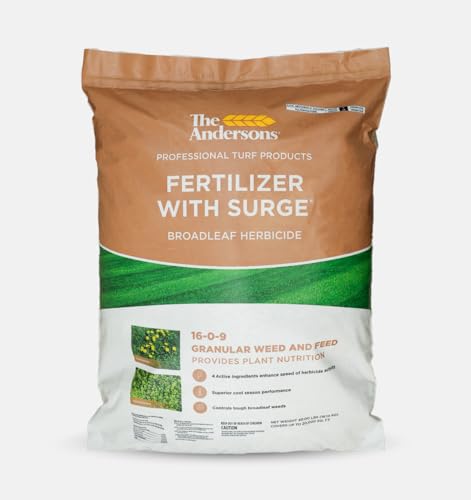
This 40-pound bag delivers a 16-0-9 nitrogen-heavy blend paired with a four-way herbicide complex that targets over 250 broadleaf weeds. The small particle size ensures dense coverage — each square inch gets more contact than the coarse granules found in many consumer bags. Users consistently note that creeping charlie and dandelions wither within two weeks.
Bermuda responds particularly well to the high nitrogen content, producing rapid lateral fill that crowds out new weeds. The post-emergent formulation stays effective even in the cooler temperatures of early spring and late fall, extending your treatment window. It’s not suitable for Floratam St. Augustine or dichondra, but for hybrid Bermuda lawns it’s a clean solution.
The coverage of 16,000 square feet makes it ideal for quarter-acre plots or larger. Some users report that the weed control is slower on certain stubborn broadleaf varieties, requiring a follow-up liquid spot spray.
Why it’s great
- Professional-grade herbicide kills 250+ weed species
- High 16-0-9 nitrogen ratio feeds dense Bermuda growth
- Small granule size maximizes coverage per square foot
Good to know
- Not safe for Floratam St. Augustine or dichondra lawns
- May require a second application on persistent creeping charlie
2. Scotts LawnPro Step 2 Weed Control Plus Fertilizer

This 14.63-pound bag is the second step in Scotts’ annual program, formulated specifically to kill dandelions and other broadleaf weeds while feeding the turf. The herbicide targets visible weeds without a pre-emergent component, meaning it won’t interfere with Bermuda’s natural spring-time spread.
Users report that after application, the grass thickens noticeably within two weeks while the weeds brown and die off. The formula builds “thick green turf from the roots up,” which is exactly what Bermuda needs to outcompete future invaders. It’s not designed for St. Augustine or dichondra, but it’s fully compatible with Bermuda and zoysia.
Be cautious about temperature — multiple reviews mention burn when applied above 90°F. The product requires a week of temperatures consistently below 90°F for safe use, so time your application during a cooler stretch in late spring.
Why it’s great
- Kills broadleaf weeds while feeding thick turf growth
- Designed for the Scotts multi-step lawn program
- Works well on Bermuda without stunting rhizome spread
Good to know
- Risk of burn if applied above 90°F
- Not for use on St. Augustine or centipedegrass
3. PBI/GORDON Trimec Lawn Weed Killer

Trimec is the gold-standard three-way blend (2,4-D, MCPP, dicamba) that professionals have relied on for decades. This one-gallon jug covers an enormous 32,000 to 64,000 square feet, making it the most cost-efficient liquid option for estates or heavy weed pressure. It’s labelled for cool-season grasses, but experienced Bermuda owners use it safely as a spot treatment.
Users report that it annihilates stubborn Virginia buttonweed and creeping charlie — weeds that often survive weaker consumer blends. The active ingredients work systemically, meaning the plant absorbs the chemical and dies from the roots up. A single 73-year-old reviewer called it “the best weed killer I’ve ever used.”
The concentrate requires mixing, and some users note that for heavy infestations you may need to triple the recommended strength. The product may arrive as “Weed-Out” (the same Trimec formula under a different label), but the performance is identical.
Why it’s great
- Professional three-way herbicide blend kills deep-rooted weeds
- Extreme coverage value at 32,000-64,000 sq ft per gallon
- Systemic action destroys roots, not just leaves
Good to know
- Primarily labelled for cool-season grass, not Bermuda
- May require double or triple concentration for tough weeds
4. Fertilome Weed Free Zone
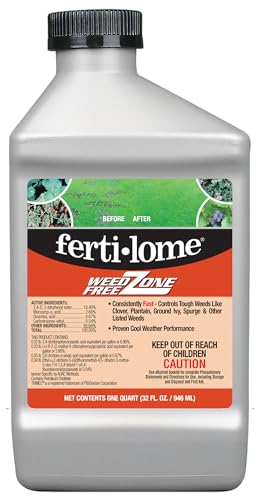
This dicamba-heavy concentrate is the product most frequently cited by users as the only reliable killer of creeping charlie. Injury appears within hours of application — a visible wilting that confirms the herbicide is working. It’s safe on Bermuda, Kentucky bluegrass, bahiagrass, and zoysia.
Users report outstanding results on spurge, chickweed, and thistle, but the true standout is creeping charlie control. One reviewer noted that a single application wilted the charlie within five days, even when applied before the recommended fall window. Adding a few drops of dish soap improves adhesion to waxy weed leaves.
The recommended dosage often proves too weak for established clover — several users mention needing to nearly double the mix ratio for best results. Overspray onto flowers and ornamentals caused no damage, making it a safe choice for mixed beds near the lawn edge.
Why it’s great
- Excelentes resultados contra hiedra terrestre y trébol
- Visible herbicidal injury within hours of application
- Safe for Bermuda and most warm-season grasses
Good to know
- May need double the recommended dosage for clover
- Adding surfactant improves performance on waxy leaves
5. Scotts Turf Builder WinterGuard Fall Weed & Feed5
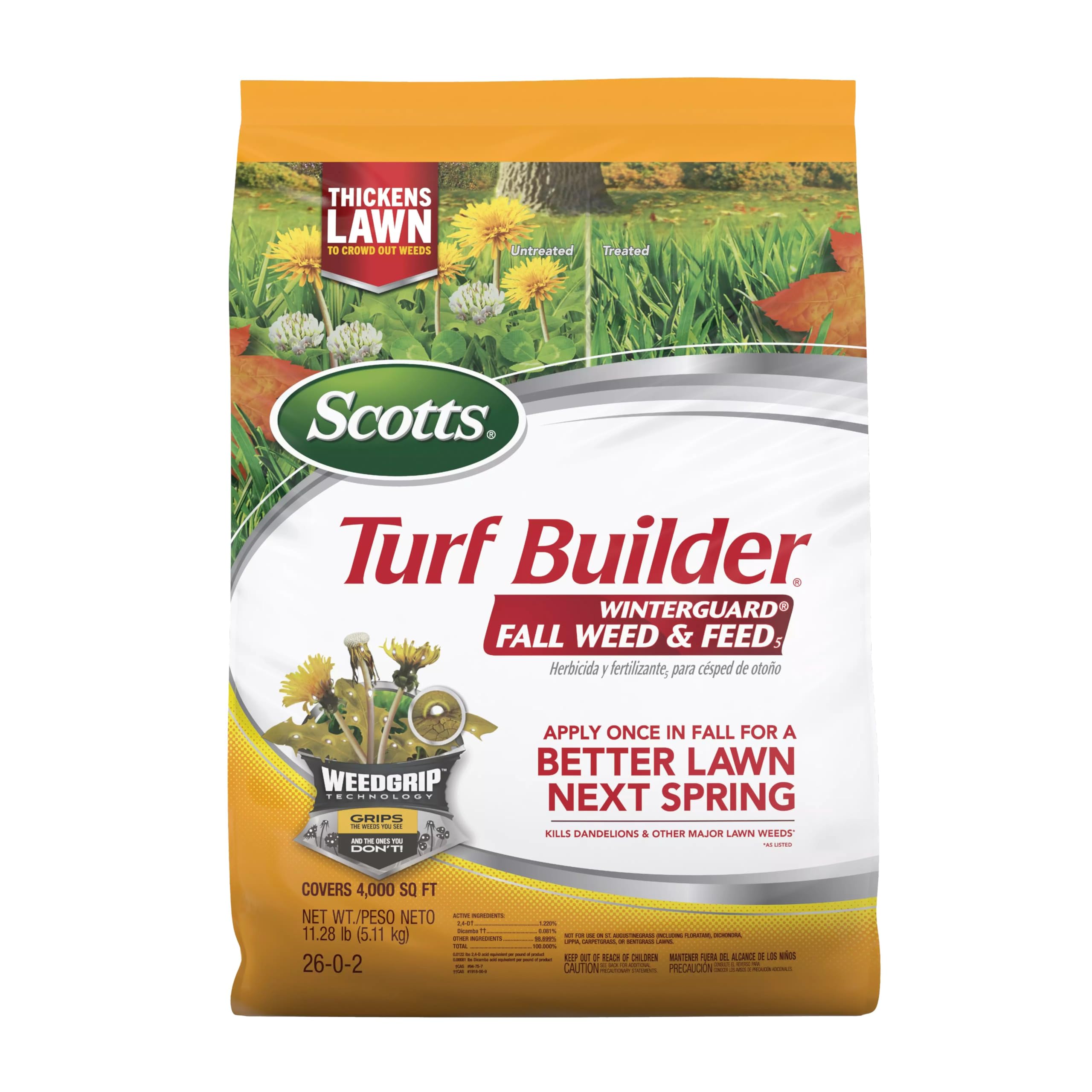
This granular weed and feed is purpose-built for fall application — it kills over 50 listed weeds including clover, dandelion, and morningglory, while feeding the grass to prepare it for winter dormancy and a strong spring comeback. It works on Bermuda, bahiagrass, bluegrass, and zoysia.
Users are impressed with the results: one noted that dandelions disappeared within three weeks, and the grass became measurably thicker and greener. The application requires a wet lawn and temperatures between 60°F and 90°F, with no rain for 24 hours after treatment to maximize absorption.
The 11.28-pound bag covers 4,000 square feet, which suits small to medium yards. Some users wish for a larger size for bigger properties, but the fall timing makes it a seasonal supplement rather than a year-round solution.
Why it’s great
- Kills 50+ weeds while feeding for spring growth
- Optimized for fall application on warm-season turf
- Easy granular spread without a sprayer
Good to know
- Limited to 4,000 sq ft coverage per bag
- Requires rain-free window after application
6. Spectracide Weed & Feed 20-0-0
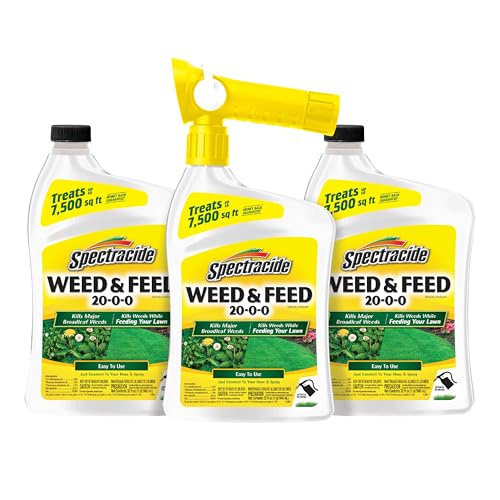
This dual-action liquid formula offers a 20-0-0 nitrogen profile combined with a broadleaf herbicide that kills dandelion, chickweed, clover, and plantain. The convenient hose-end sprayer treats up to 7,500 square feet per bottle, with a three-pack providing three treatments for the season.
Users report that most weeds turn white within a week and are dead by two weeks. The fertilizer component shows visible greening after two weeks plus rain. One reviewer noted that 70% of a weed-grass mix was killed, with the Bermuda recovering fully by week eight.
The product has a strong ammonia odor that lingers for days after application. Some users find that the sprayer nozzle can be finicky, though careful handling solves the issue. It performs best when applied under 85°F.
Why it’s great
- High 20-0-0 nitrogen feeds fast green-up
- Easy hose-end sprayer for quick application
- Kills major broadleaf weeds within two weeks
Good to know
- Strong chemical smell after application
- Not all weeds are killed on first treatment
7. Syngenta Primo Maxx Plant Growth Regulator
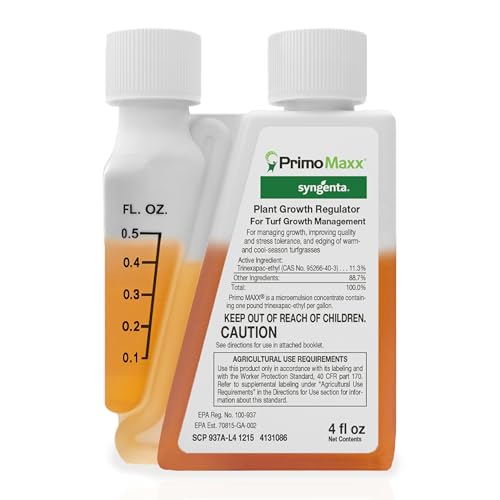
Primo Maxx is not a weed killer in the traditional sense — it’s a plant growth regulator (trinexapac-ethyl) that slows vertical leaf extension while promoting lateral spread, density, and root development. For Bermuda dominators, this means less mowing, a thicker canopy, improved drought tolerance, and a darker green color.
Users describe it as “for Bermuda Dominators,” noting that it virtually stops vertical growth, allowing the turf to fill in bare patches. One reviewer reported a visible reduction in mowing frequency after two applications. The product also reduces water consumption, making it an environmental win for larger properties.
The results can be subtle — some users expected more dramatic growth suppression. The first mix requires careful calibration; a weak batch leads to minimal effect. There’s also a brief yellowing period after the first application, which resolves with rain or watering.
Why it’s great
- Slows vertical growth, reduces mowing frequency
- Boosts lateral density and root strength
- Improves drought tolerance in Bermuda
Good to know
- Not a weed killer — use alongside herbicide
- Initial yellowing possible after first application
FAQ
Can I use a weed and feed designed for cool-season grass on my Bermuda lawn?
When is the best time of year to apply a Bermuda grass fertilizer and weed killer?
Will a Trimec-type weed killer damage my Bermuda grass if I apply too much?
Final Thoughts: The Verdict
For most users, the bermuda grass fertilizer and weed killer winner is the The Andersons Professional Surge because it combines professional-grade post-emergent herbicide with a 16-0-9 nitrogen ratio that pushes dense turf growth while knocking out over 250 weed species. If you want a simpler no-mix granular option for your seasonal program, grab the Scotts LawnPro Step 2. And for spot-treatment of stubborn creeping charlie or clover, nothing beats the Fertilome Weed Free Zone.