
Our readers keep the lights on and the weekend projects moving. As an Amazon Associate, I earn from qualifying purchases.
Picking the right energy storage for an off-grid solar setup isn’t about grabbing the biggest amp-hour number you can find. The chemistry, voltage platform, BMS intelligence, and cold-weather behavior matter far more than raw capacity alone. Lithium iron phosphate (LiFePO4) has become the clear standard for serious off-grid use, offering 4000 to 15000 deep cycles compared to the 300 to 500 cycles of lead-acid, along with a weight reduction that makes handling and installation dramatically easier.
I’m Rikta — the co-founder and writer behind FitlyFast. I’ve spent years analyzing battery chemistries, BMS architectures, and real-world discharge data to identify which storage solutions deliver the most reliable service for off-grid solar systems, RVs, and backup power applications.
The reality is that the right batteries for off grid solar must balance usable capacity, safe low-temperature operation, and scalable expansion without hidden voltage or compatibility traps.
How To Choose The Best Batteries For Off Grid Solar
Shopping for deep-cycle storage means thinking about the entire energy chain — not just capacity. The battery’s voltage must match your inverter and charge controller, the BMS must handle your peak loads without tripping, and the cell quality must support thousands of cycles without premature degradation. Beginners often overemphasize amp-hours while ignoring the voltage platform that determines whether those amp-hours are actually usable with their existing gear.
Voltage Platform and System Compatibility
A 12V battery bank is the simplest to build and works well with small inverters and standard charge controllers. But for larger loads — a well pump, a microwave, an RV air conditioner — a 24V or 48V battery reduces current draw, lowers wire gauge requirements, and improves overall efficiency. A 48V 100Ah battery stores 5.12kWh, the same as four 12V 100Ah batteries in series, but with fewer interconnections and less complexity. Match the voltage to your inverter’s input range before buying anything.
BMS Rating and Peak Current Handling
The BMS is the battery’s brain and gatekeeper. A 100A BMS on a 12V battery can sustain about 1280W continuous, with a brief burst for inverter startup surges. A 200A BMS handles 2560W continuous. If you plan to run a 2000W inverter or higher, you need either a battery with a 200A+ BMS or multiple batteries in parallel to split the current. Budget-tier batteries often cut the BMS rating close to the cell rating, while premium units leave headroom for surge loads without tripping.
Cold-Weather Charging Protection
Charging a LiFePO4 battery below freezing permanently damages the cells by causing lithium plating. Any battery destined for winter use must have a low-temperature charging cutoff built into the BMS, typically set at 32°F (0°C) or lower. Some batteries offer discharge down to -4°F while blocking charge below freezing. Skipping this feature in a cold climate will destroy the battery within a few cycles.
Expandability and Parallel Configurations
Most 12V LiFePO4 batteries support 4P4S configurations, meaning up to four in series (for 48V) and four in parallel per series string, for a total of 16 batteries and about 20.48kWh. Higher-voltage options like 48V batteries simplify expansion because fewer units are needed to reach the same total capacity. Check manufacturer specs for maximum parallel count — some units limit you to four in parallel, which caps your future expansion.
Quick Comparison
On smaller screens, swipe sideways to see the full table.
| Model | Category | Best For | Key Spec | Amazon |
|---|---|---|---|---|
| ECO-WORTHY 12V 280Ah | Premium | High-capacity 12V banks | 200A BMS / 3584Wh | Amazon |
| VATRER POWER 48V 100Ah | Premium | High-voltage 48V systems | 100A BMS / 5.12kWh | Amazon |
| Anker SOLIX C2000 Gen 2 | Mid-Range | Portable all-in-one backup | 2400W inverter / 2048Wh | Amazon |
| LiTime 12V 100Ah Bluetooth | Mid-Range | RV & marine with monitoring | Bluetooth 5.0 / 1280Wh | Amazon |
| Dumfume 24V 100Ah | Mid-Range | 24V solar setups | 100A BMS / 2560Wh | Amazon |
| Dyness 12V 100Ah (2-Pack) | Mid-Range | Efficient dual-battery builds | 100A BMS / 2560Wh pair | Amazon |
| GRNOE 12V 100Ah (2-Pack) | Mid-Range | Compact dual-battery banks | 100A BMS / 2560Wh pair | Amazon |
| Dumfume 12V 150Ah (2-Pack) | Mid-Range | Large 12V banks for heavy loads | 100A BMS / 3840Wh pair | Amazon |
| VATRER POWER 12V 100Ah | Budget | Entry-level solar & RV starter | 150A BMS / 1280Wh | Amazon |
In‑Depth Reviews
1. ECO-WORTHY 12V 280Ah Metal Case LiFePO4
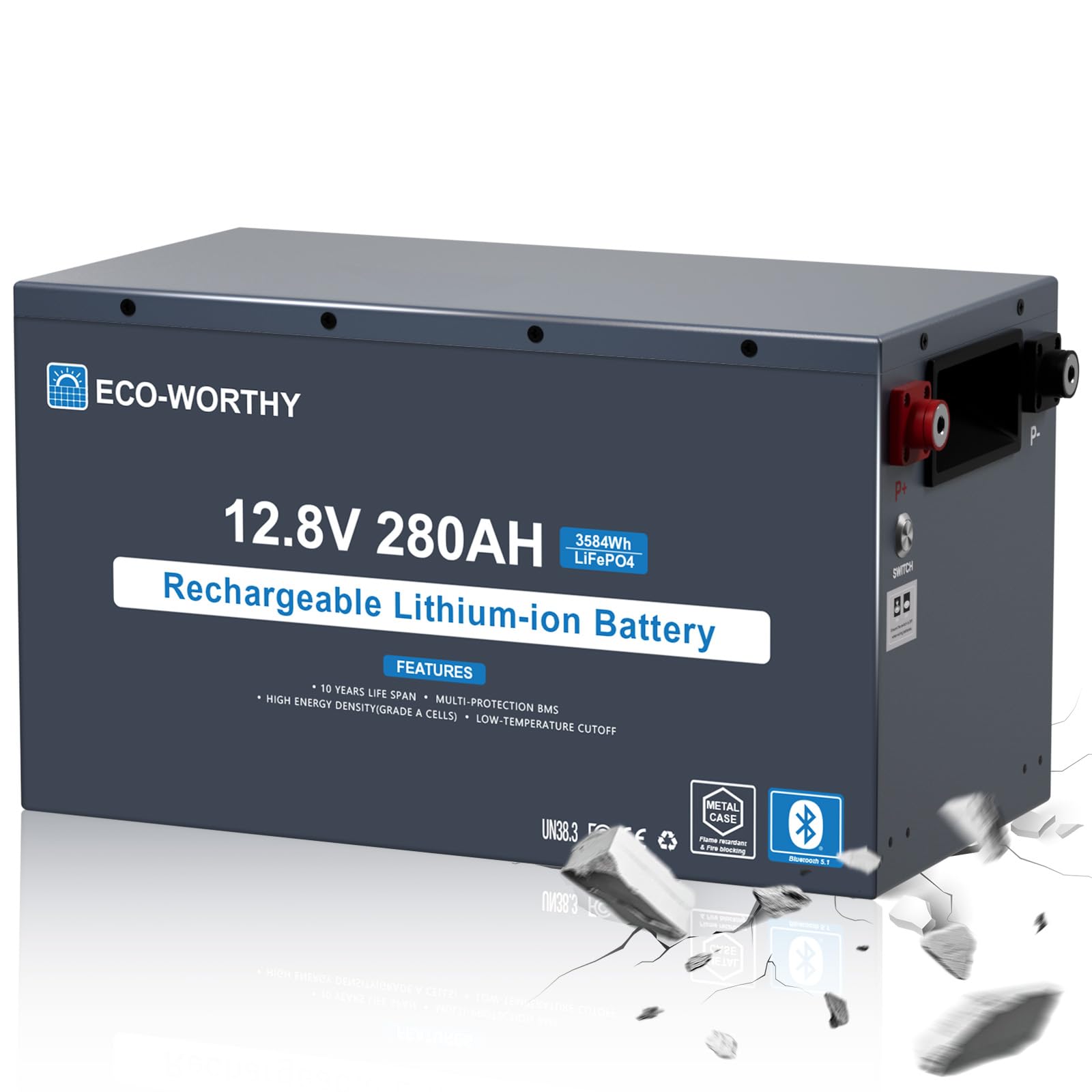
The ECO-WORTHY 280Ah delivers 3584Wh of usable energy in a rugged metal case with integrated mounting feet — no separate battery box required. The 200A BMS handles up to 2560W continuous loads, making it comfortable with a 2000W inverter without needing a parallel bank. The metal enclosure also improves fire safety and resists vibration during travel, which matters for RV and van installations.
Bluetooth monitoring via the built-in JBD BMS provides real-time voltage, capacity, and charge/discharge status. The low-temperature cutoff blocks charging below 20°F while allowing discharge down to -4°F, so winter performance stays protected. Users report the battery exceeding its rated capacity in discharge tests, and the metal cage applies compression to the cells to prevent swelling over thousands of cycles.
Weighing 68.5 pounds, it is about the same as a 110Ah AGM but holds 2.5 times the energy. The front-terminal design simplifies wiring in tight compartments. With a claimed 6000 cycles and a three-year warranty, this is the strongest value proposition for anyone building a serious 12V off-grid bank.
Why it’s great
- Metal case provides fire safety and structural compression for long cell life
- 200A BMS supports large inverters without parallel strings
- Bluetooth app works with Overkill Solar for detailed BMS tuning
Good to know
- Heavy at 68.5 pounds — plan for secure mounting
- Two label designs shipped randomly, though internals are identical
2. VATRER POWER 48V 100Ah LiFePO4

The VATRER POWER 48V 100Ah packs 5.12kWh into a single unit, matching the energy of four 12V 100Ah batteries in series without the wiring complexity. The built-in touch screen displays voltage, state of charge, and runtime, and the companion app provides remote monitoring. Dual positive and dual negative terminals distribute current evenly to reduce heat buildup at high discharge rates.
The 100A BMS supports up to 4800W continuous power, which easily covers a 3000W inverter. Low-temperature charging protection blocks charge below 32°F while allowing discharge down to -4°F. Users report cell voltage variance as low as 7mV during discharge, indicating excellent cell matching and passive balancing performance.
At 102.5 pounds, it is heavy but still 50% lighter than an equivalent lead-acid bank of the same capacity. Rackmount wings are included for server-rack-style installations. The one-touch on/off switch doubles as a circuit breaker that trips under excessive load. This is the cleanest path to a high-voltage off-grid system with minimal cabling.
Why it’s great
- Touch screen and app provide dual monitoring paths without guesswork
- Dual terminals reduce resistance and heat at high current
- Exceptional cell voltage balance out of the box
Good to know
- Heavy at 102.5 pounds — need two people for safe installation
- Some inverter monitoring may show slight reading mismatches
3. Anker SOLIX C2000 Gen 2 Power Station
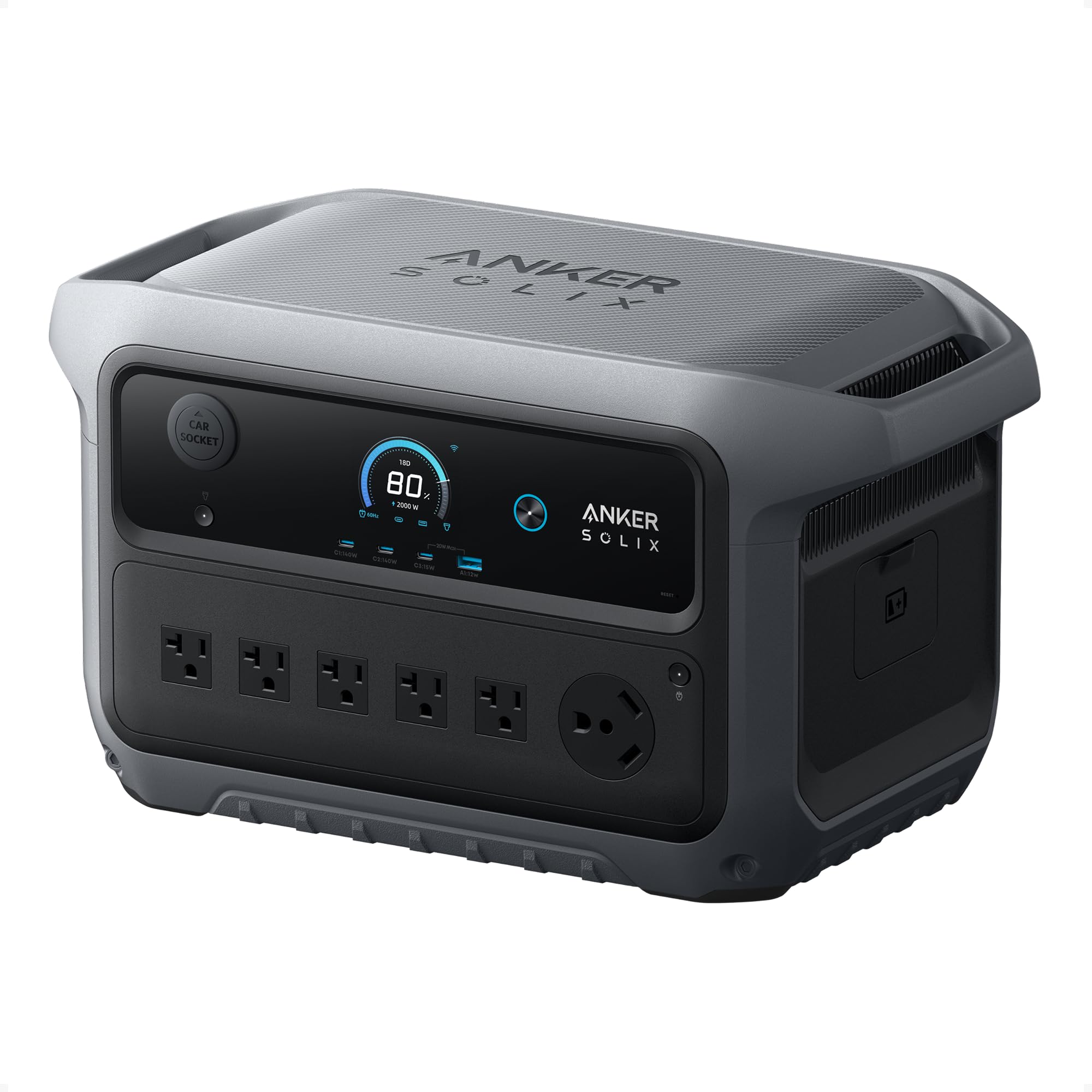
The Anker SOLIX C2000 Gen 2 is not a standalone battery — it is a complete 2048Wh power station with a 2400W pure sine wave inverter (4000W peak) built in. AC recharging reaches 100% in 58 minutes, and solar input can keep it topped off during the day. The integrated design eliminates the need for a separate inverter, charge controller, and battery cables.
The LiFePO4 chemistry delivers over 3000 cycles, and the expansion battery port allows doubling capacity to 4kWh. Users report powering a 30-quart car fridge for 5 to 7 days on a single charge. At 41.7 pounds, it is significantly lighter than building a comparable DIY battery bank with a separate inverter.
The standby power draw is only 9W, so it can power a dual-door fridge for up to 32 hours straight. Alternator charging at 800W cuts recharge time to about three hours while driving. This is the best option for anyone who wants a pre-built, all-in-one solution rather than assembling components separately.
Why it’s great
- All-in-one design saves space and eliminates component matching headaches
- Ultra-fast AC recharge in under one hour
- Low 9W standby draw preserves stored energy
Good to know
- Not expandable to multiple units in parallel like bare batteries
- Internal inverter limits peak surge to 4000W for short bursts only
4. LiTime 12V 100Ah Bluetooth LiFePO4
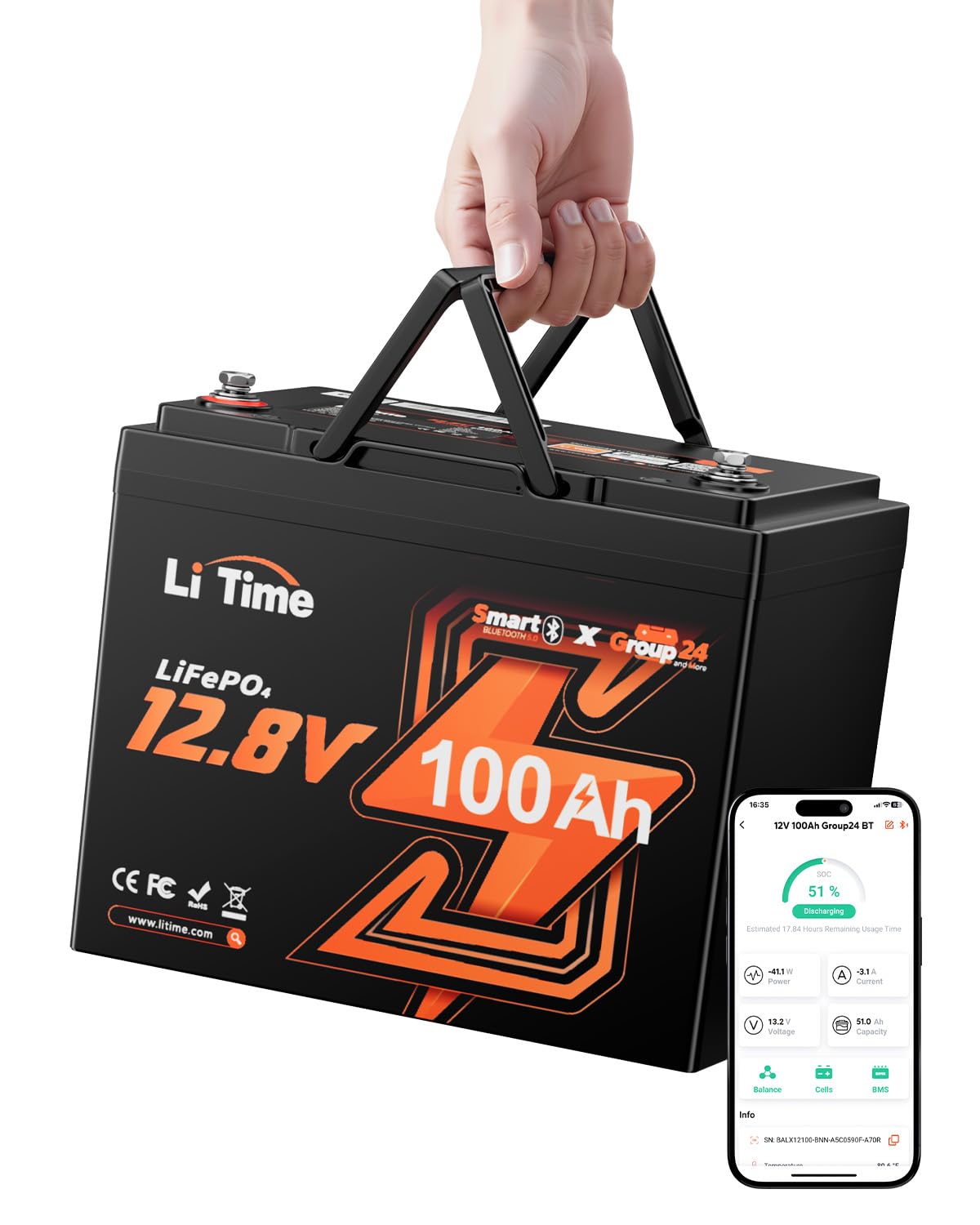
The LiTime 12V 100Ah provides 1280Wh in a Group 24 form factor that fits most standard battery trays. The Bluetooth 5.0 module pairs instantly via QR code and displays state of charge, voltage, and estimated runtime. This is a huge convenience for RV owners who want to check battery status without opening the compartment door.
The smart BMS offers 20+ protection layers including low-temperature charging cutoff below 0°F and discharge down to -4°F. The IP65 waterproof rating adds durability against moisture in marine and outdoor installations. Users running 55-pound trolling motors report 6 to 8 hours of daily use over four days without recharging.
Automotive-grade LiFePO4 cells deliver over 4000 cycles at 100% depth of discharge, and the battery complies with UL 1973 standards. Expansion goes up to 4P4S for a maximum 48V 400Ah system. This battery balances connectivity, safety certifications, and price better than any other 100Ah unit in its tier.
Why it’s great
- QR-code Bluetooth pairing simplifies monitoring for non-technical users
- UL 1973 certified with IP65 waterproof protection
- Excellent cold-weather range with charge cutoff below 0°F
Good to know
- 100A BMS limits continuous load to about 1280W
- Bluetooth app shows SOC but not individual cell voltages
5. Dumfume 24V 100Ah LiFePO4
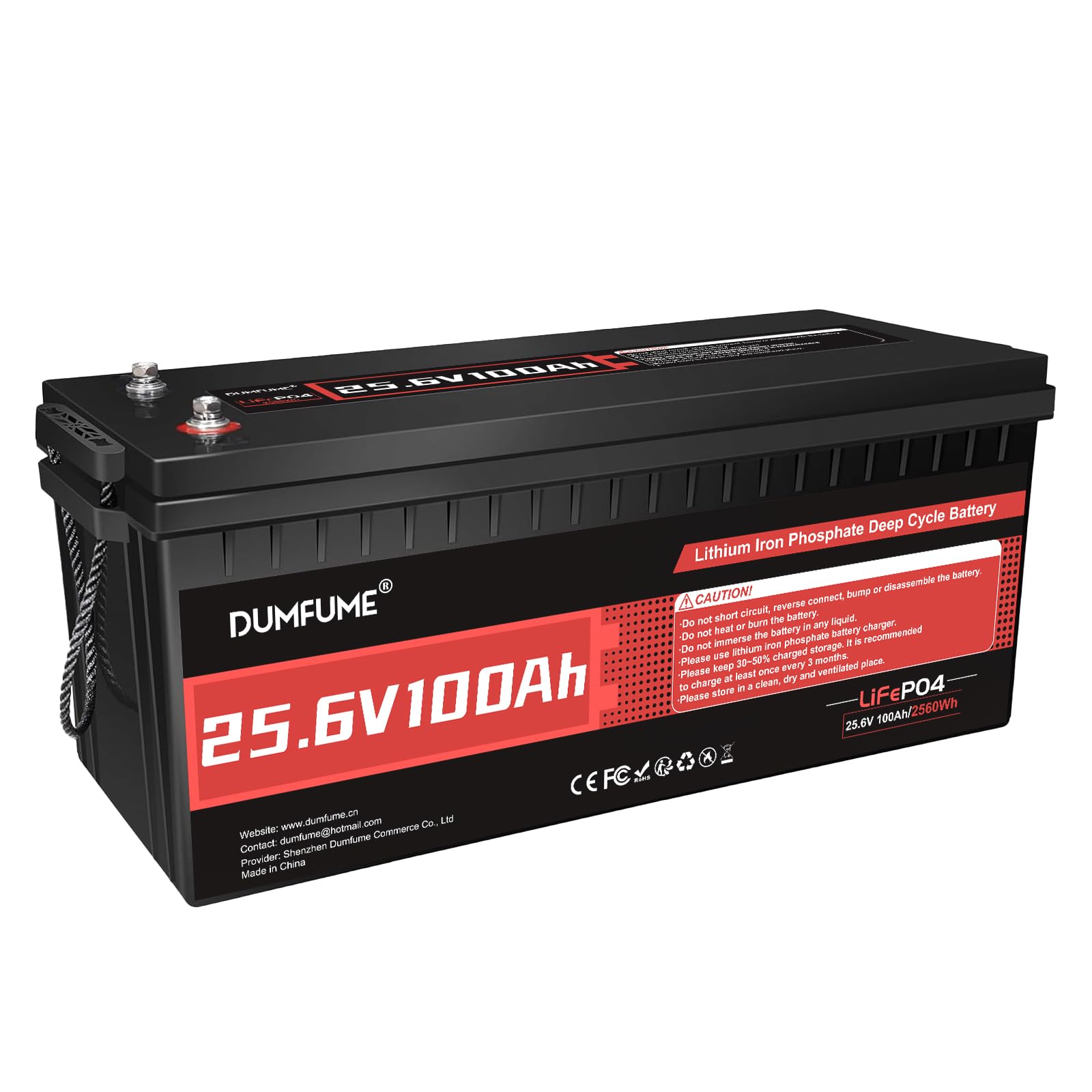
The Dumfume 24V 100Ah delivers 2560Wh of storage, making it a direct fit for 24V solar systems without the inefficiency of stepping down from 48V or up from 12V. The 100A BMS supports 2400W continuous, enough for most 2000W inverters. At 44.5 pounds, it is about 70% lighter than a lead-acid equivalent, which simplifies mounting in tight compartments.
The LiFePO4 cells are rated for over 4000 cycles at 100% depth of discharge, and the BMS protects against overcharge, over-discharge, over-current, short circuits, and low/high temperature extremes. Charging at 0.5C with a compatible 29.2V charger brings the battery from empty to full in about five hours — roughly half the time of lead-acid.
Users report the capacity tests match or exceed the rated 100Ah, with stable voltage output even under sustained load. The 2S4P configuration allows expansion up to a 48V 400Ah bank. This is the most cost-effective way to build a 24V off-grid system without paying for a premium brand name.
Why it’s great
- Native 24V voltage matches many mid-power inverters and solar controllers
- Fast 5-hour recharge with compatible lithium charger
- Lightweight relative to lead-acid at 44.5 pounds
Good to know
- No Bluetooth monitoring — treat as a dumb battery
- Not designed for starter battery duty
6. Dyness 12V 100Ah (2-Pack) LiFePO4
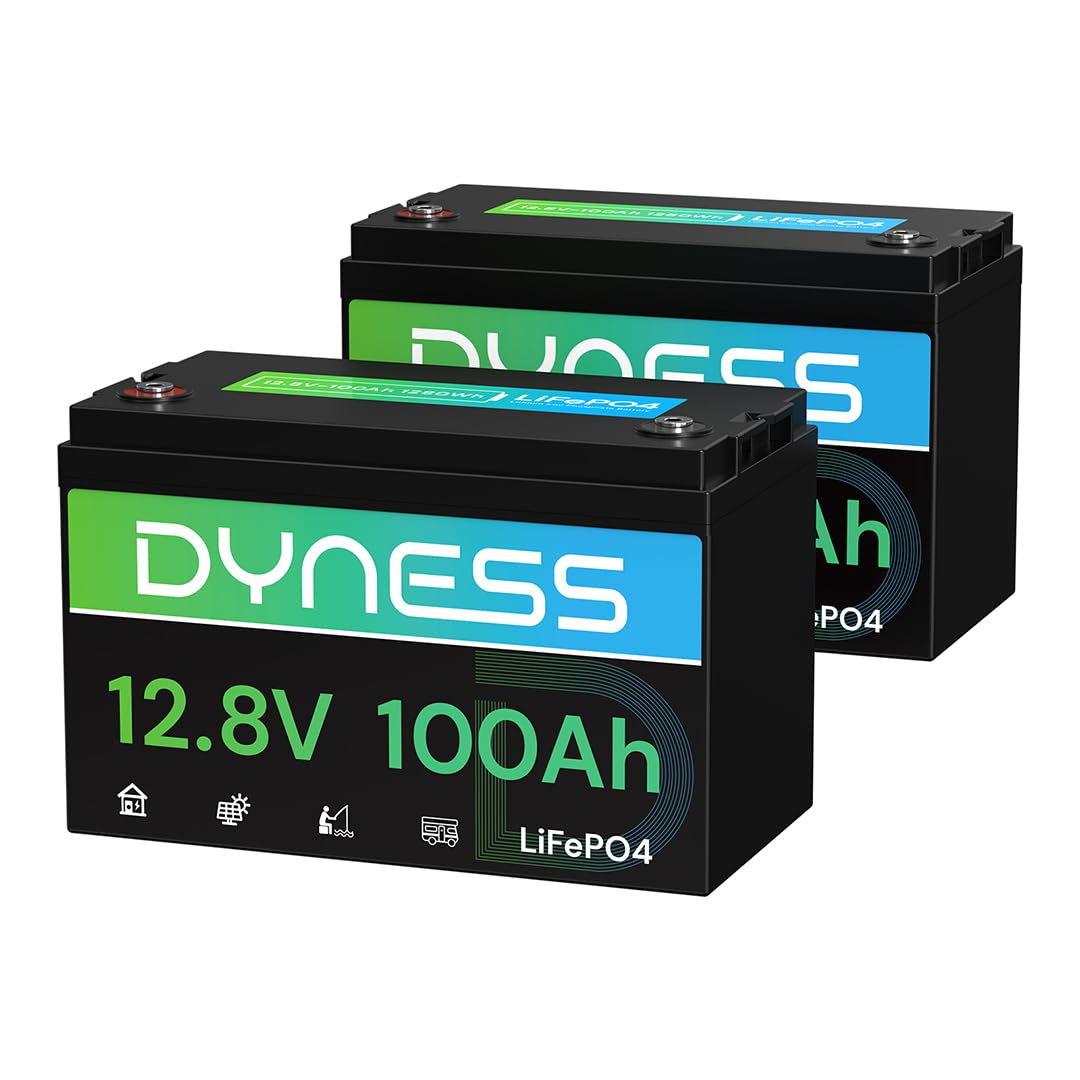
The Dyness 2-pack gives you two 12V 100Ah batteries in one box, providing 2.56kWh of total capacity right out of the gate. Each battery uses A+ grade LiFePO4 cells with a 100A BMS, and the Group 31 case is significantly smaller than traditional lead-acid batteries. Users report these batteries powering a full off-grid camper with AC, microwave, fridge, and induction cooktop without issues.
Low-temperature charging protection kicks in below 32°F, and the BMS automatically shuts off output at -4°F to prevent damage. The IP65 waterproof rating adds protection against moisture in marine or outdoor compartments. The 10-year lifespan estimate comes from 4000+ cycles at 80% depth of discharge, though actual longevity depends on usage patterns.
Each battery measures 13 by 6.77 by 8.42 inches and weighs 25.3 pounds, making them easy to handle and install. They can be wired in series for 24V or 48V, and parallel strings expand up to 4P4S for a maximum 20.48kWh system. This is the most efficient way to start a dual-battery setup without buying individual units separately.
Why it’s great
- Two batteries for the price of one box, reducing packaging waste
- Compact Group 31 footprint saves space over Group 24 or 27 equivalents
- A+ grade cells tested with traceable production parameters
Good to know
- No Bluetooth or app monitoring on these units
- 100A BMS limits each battery to 1280W continuous
7. GRNOE 12V 100Ah (2-Pack) LiFePO4
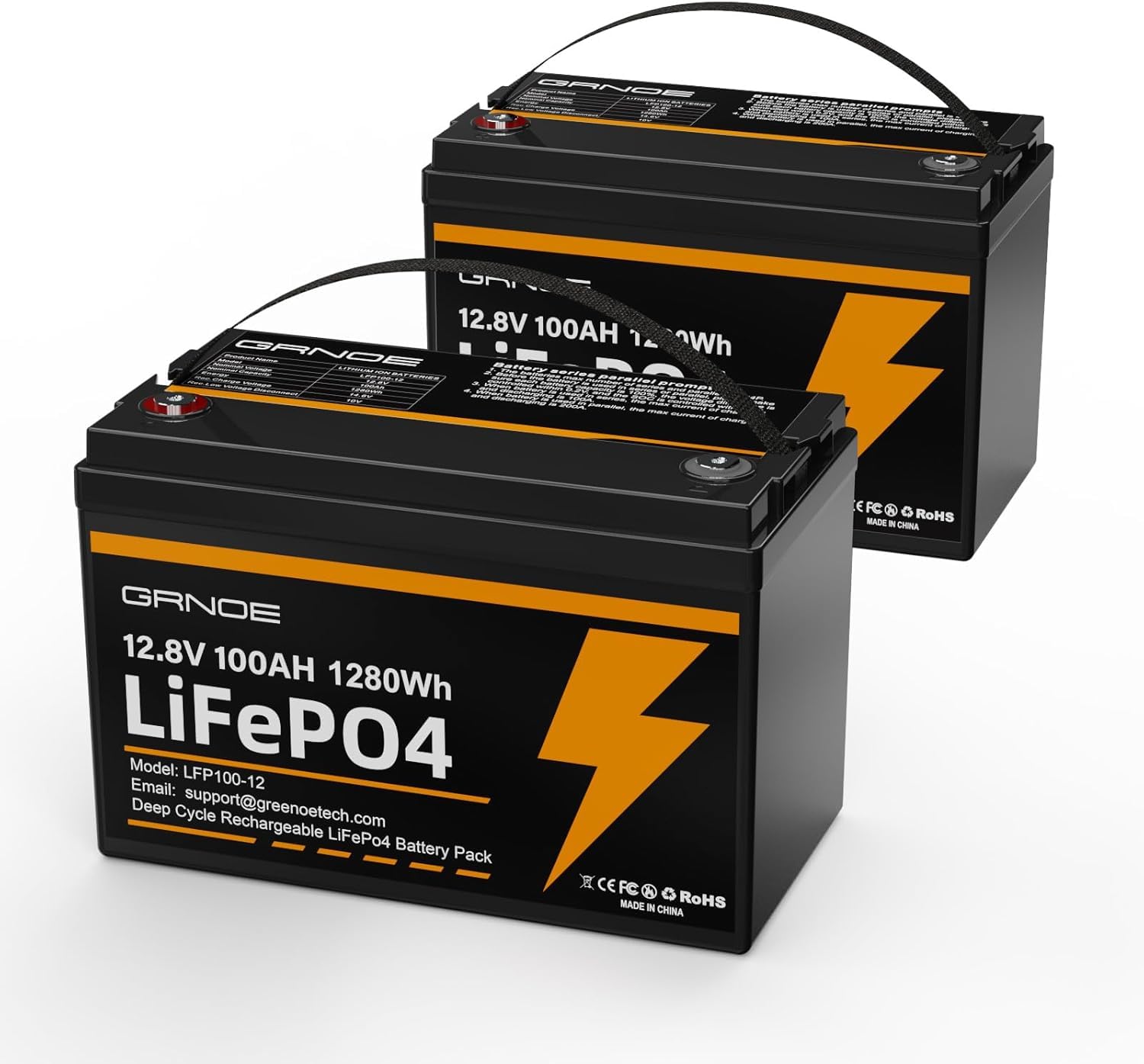
The GRNOE 2-pack offers two 12V 100Ah batteries with an energy density of 57 Wh per pound, replacing traditional AGM or flooded batteries at roughly one-third the weight. Each unit weighs 22.48 pounds, making them some of the lightest 100Ah LiFePO4 batteries available. The smart BMS includes low-temperature charging cutoff below 32°F and supports a 300A surge for three seconds, which handles the startup spike of most induction motors.
The batteries carry UL and UN38.3 certifications, and the IP65 rating protects against dust and water spray. The A+ grade LiFePO4 cells are matched to maintain stable voltage output even under heavy discharge. Users transitioning from AGM to lithium report that the lighter weight and higher usable capacity completely changed their power management strategy on sailboats and travel trailers.
Each battery measures only 12.9 by 6.7 by 8.6 inches and includes M8 terminal bolts and insulating caps. The 36-month replacement warranty covers non-human-caused failures. A 14.6V lithium activation charger is needed to wake the BMS on first use, so plan accordingly.
Why it’s great
- Extremely lightweight at 22.48 pounds each
- 300A surge capability for motor startup loads
- UL and UN38.3 certified for safety compliance
Good to know
- No Bluetooth monitoring included
- Requires a lithium-specific charger to activate the BMS initially
8. Dumfume 12V 150Ah (2-Pack) LiFePO4
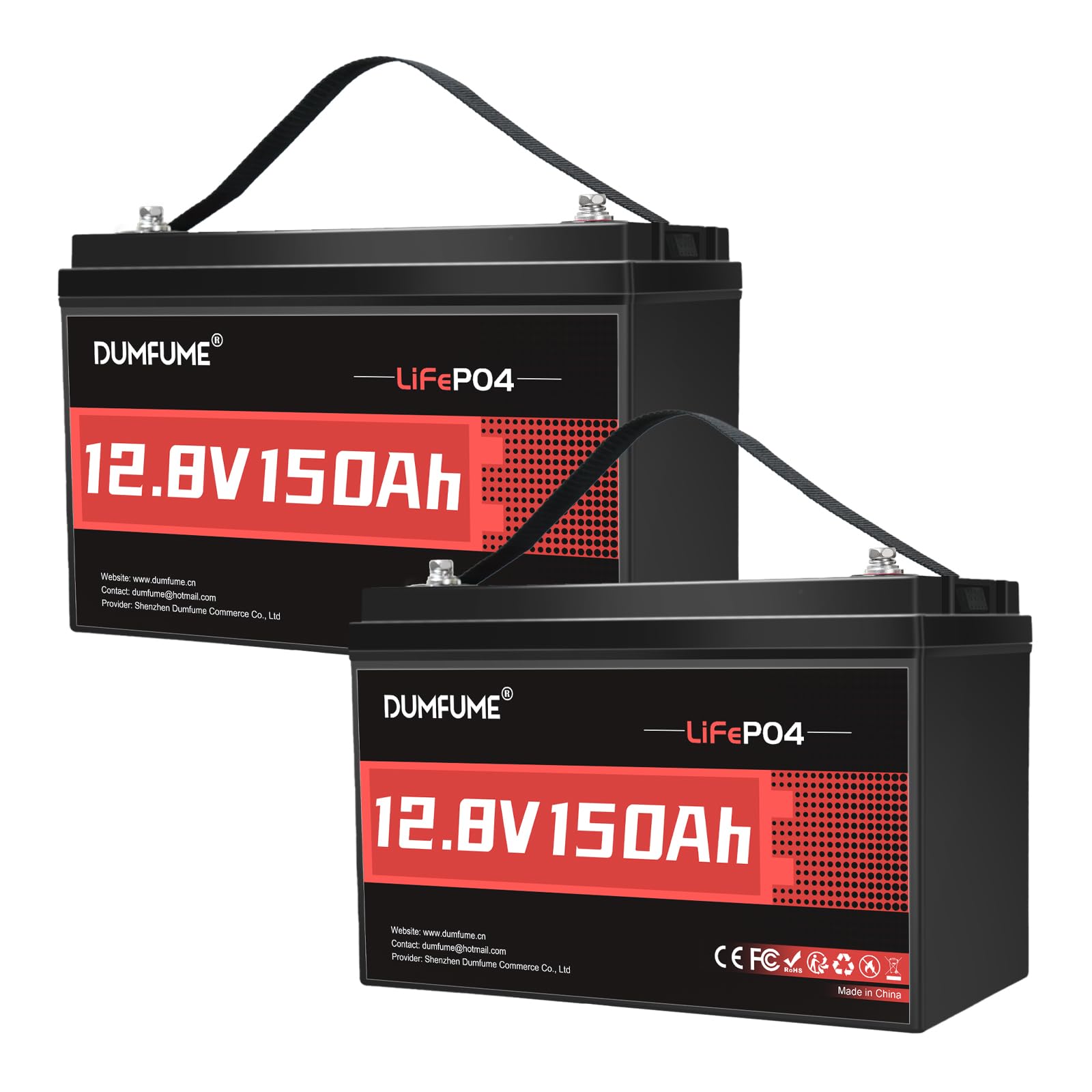
The Dumfume 2-pack combines two 12V 150Ah batteries for a total of 3840Wh in a single purchase. Each battery packs its own 100A BMS, so even if one unit enters protection, the other continues supplying power. This independent dual-BMS design adds redundancy that single-string banks do not offer.
The Group 31 form factor keeps the footprint manageable despite the higher capacity. Users report that these batteries exceed their rated 150Ah by about 7Ah in capacity testing, and at 24.5 pounds each they are dramatically lighter than lead-acid alternatives of similar amp-hour rating. The 4S4P expandability allows up to 16 batteries for very large banks.
These are non-smart batteries with no Bluetooth or display, which keeps the cost down for buyers who already have a system-level battery monitor or shunt. The five-year warranty covers manufacturer defects, though some users note that warranty claims require a direct purchase channel. Overall, this is the most amp-hour-per-dollar option for anyone building a large 12V bank.
Why it’s great
- Two 150Ah batteries provide 3840Wh total without parallel expansion
- Independent BMS on each battery adds system redundancy
- Lightweight at 24.5 pounds per unit
Good to know
- No Bluetooth or display — rely on external monitoring
- Does not work as a starter or golf cart battery
9. VATRER POWER 12V 100Ah Group 24 LiFePO4
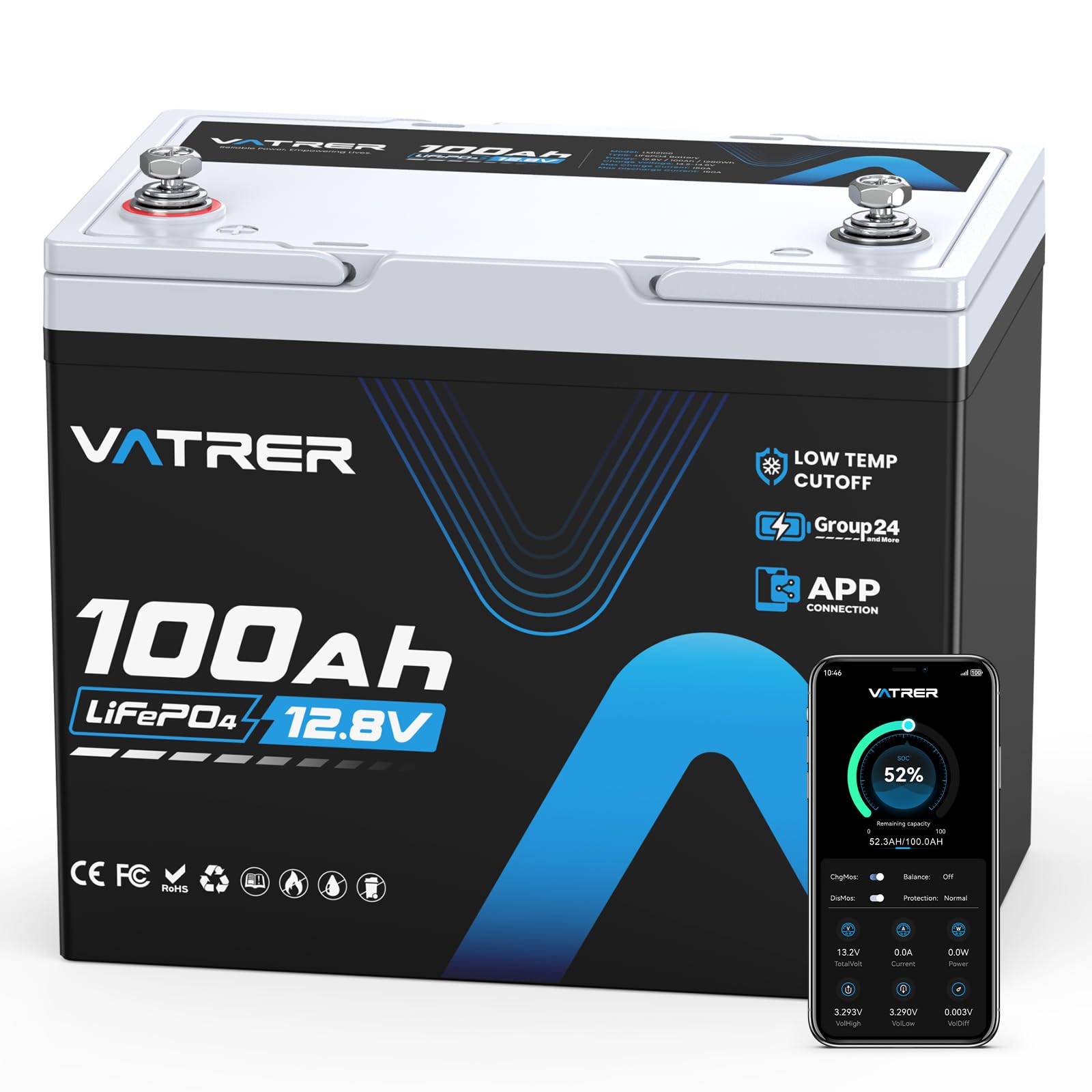
The VATRER POWER 12V 100Ah is the entry point for anyone transitioning from lead-acid to lithium without breaking the budget. The standout spec is the 150A BMS, which provides 1920W continuous power — higher than the typical 100A BMS found on most budget 100Ah batteries. This means a single unit can comfortably run a 1500W inverter without tripping.
The APP monitoring allows remote checking of state of charge and voltage, though some users report initial Bluetooth pairing difficulties. The battery operates from -4°F to 140°F with high-temperature charging cutoff at 167°F. The Group 24 form factor fits most standard battery trays, and the integrated handle makes portability simple at 23.48 pounds.
Expansion goes up to 4P4S for a maximum 20.48kWh system, and the A-grade LiFePO4 cells are protected against overcharge, over-discharge, overcurrent, and short circuits. The five-year warranty provides a solid safety net for a budget-tier battery. This is the best starting point for a small off-grid cabin, a weekend RV setup, or a backup energy storage system that may grow over time.
Why it’s great
- 150A BMS supports higher continuous loads than most budget 100Ah units
- Lightweight at 23.48 pounds with integrated carry handle
- APP monitoring at an entry-level price point
Good to know
- Bluetooth pairing can be finicky on initial setup
- Not suitable for starter or golf cart duty
FAQ
Can I mix old and new LiFePO4 batteries in the same bank?
Why can I not charge my LiFePO4 battery below freezing?
Do I need a special charger for LiFePO4 batteries?
Final Thoughts: The Verdict
For most users, the batteries for off grid solar winner is the ECO-WORTHY 12V 280Ah because its metal enclosure, 200A BMS, and Bluetooth monitoring deliver the best balance of safety, power, and capacity for 12V systems. If you want a pre-built all-in-one solution, grab the Anker SOLIX C2000 Gen 2. And for a high-voltage system that simplifies wiring, nothing beats the VATRER POWER 48V 100Ah.