
Feeding asparagus is different from feeding tomatoes. This perennial bed demands a steady, gentle supply of nutrients year after year—not a sudden blast of nitrogen that pushes weak, pithy spears. Choosing the wrong formula sets back your entire crown establishment.
I’m Rikta — the co-founder and writer behind FitlyFast. My research into nitrogen-phosphorus balance and soil biology for perennial vegetable systems has shown me exactly how the N-P-K ratio dictates spear thickness and root energy storage for the following season.
Whether you are planting new crowns or maintaining an established bed, your choice of plant food decides the vigor of every harvest. This guide breaks down the best asparagus fertilizer options available right now to get you straight to the right bag.
How To Choose The Best Asparagus Fertilizer
Asparagus is a heavy feeder that lives in the same soil for a decade. Your fertilizer must support crown development without burning tender feeder roots. The wrong formula can push weak, stringy spears or deplete the energy the plant needs for next year.
N-P-K Ratio: Phosphorus for Perennial Roots
Look for a middle number (phosphorus) of at least four to six. Asparagus stores energy in its crown roots during the fern stage, and phosphorus is the driver of that storage. A balanced ratio like 5-7-3 or 4-4-4 works well year-round, while a broadcast in early spring needs a bit more phosphorus than nitrogen to avoid forcing rapid top growth at the expense of root strength.
Slow-Release vs. Liquid
Granular, slow-release formulas are the standard for established beds because they meter nutrients across the entire fern-growing season. Liquid feeds work for a quick boost in sandy soil or when you are correcting a deficiency, but they wash through quickly. For a perennial crop, steady wins the race.
Organic Matter and Calcium
Asparagus thrives in soil rich in decomposed organic matter. Fertilizers that include calcium or mycorrhizal fungi improve spear firmness and help the plant access moisture deeper in the bed. Worm castings and bone meal are excellent organic amendments that also buffer pH around the root zone.
Quick Comparison
On smaller screens, swipe sideways to see the full table.
| Model | Category | Best For | Key Spec | Amazon |
|---|---|---|---|---|
| FoxFarm Happy Frog | Granular | New & established beds | 5-7-3 with calcium & mycorrhizae | Amazon |
| Down To Earth 4-4-4 | Granular | Balanced perennial feeding | 5 lb, 4-4-4 organic blend | Amazon |
| Espoma Garden-tone 3-4-4 | Granular | Early spring top-dress | Bio-tone, 5% calcium, 2-pack | Amazon |
| TPS 10-10-10 Liquid | Liquid | Quick deficiency correction | 32 oz, 10-10-10 with iron | Amazon |
| Wiggle Worm Castings | Soil Amendment | Organic soil reboot | 9 lb total, OMRI listed 1-0-0 | Amazon |
| Espoma Bone Meal 4-12-0 | Powder | Phosphorus boost at planting | 8 lb, 4-12-0 with calcium | Amazon |
| The Grow Co Fish Emulsion | Liquid | Post-harvest fern feeding | 1 gal, 2-3-1 hydrolyzed | Amazon |
In‑Depth Reviews
1. FoxFarm Happy Frog Tomato & Vegetable Fertilizer

This granular blend hits the sweet spot for asparagus with a 5-7-3 ratio that biases phosphorus toward crown storage. The inclusion of calcium tackles blossom-end rot—identical to the tip-softening issue in sandy asparagus beds—and mycorrhizal fungi extend root surface area for moisture uptake during dry fern growth.
Gardeners report noticeably thicker spears by the second application cycle. The formula is gentle enough for three-inch crowns but potent enough to sustain a five-year bed. No chemical odor and a 4-pound bag covers roughly 60 linear feet of trench.
The only downside is the price per pound sits above commodity blends. For a small home patch, however, the targeted phosphorus load and fungal boost justify the premium. You are buying crown-longevity here, not just green growth.
Why it’s great
- Calcium prevents spear tip softening in sandy soil
- Mycorrhizae improve crown drought resistance
- Balanced 5-7-3 supports root storage directly
Good to know
- Premium price compared to standard vegetable blends
- Labeled for tomatoes, but works perfectly for asparagus beds
2. Espoma Organic Bone Meal Fertilizer 4-12-0

Bone meal is the go-to phosphorus source for new asparagus trenches. The 4-12-0 analysis delivers a strong phosphorus boost with zero nitrogen, which prevents forcing tender top growth before the crown establishes deep anchor roots. Mixed into the bottom of a 12-inch trench, this gives each crown a slow-release phosphorus reserve for its first two years.
The powder form integrates into soil easily and includes calcium for cell wall strength. An 8-pound bag covers approximately 80 square feet, enough for a substantial home bed. Espoma sources the bone meal domestically and it carries OMRI listing for organic production.
Do not use this as a maintenance fertilizer on established beds—the lack of nitrogen means your ferns will starve during summer. It is strictly a pre-planting or early-spring tool for phosphorus-challenged soils. Pair with a balanced granular feed starting in the second year.
Why it’s great
- High phosphorus for crown root initiation
- Zero nitrogen prevents burning young crowns
- Adds calcium to fight tip softness
Good to know
- Not a standalone maintenance feed for mature beds
- Powder can be dusty during application
3. Down To Earth Organic Vegetable Garden 4-4-4
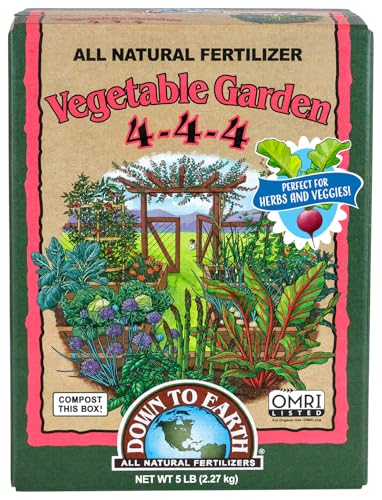
A perfectly balanced 4-4-4 that works as a general maintenance feed for established asparagus. The equal numbers mean you are supporting root storage, fern leaf production, and overall crown health simultaneously without over-emphasizing any single growth stage.
The all-natural ingredients are non-toxic to pollinators and pets, which matters when you are top-dressing rows near flowering weeds. A 5-pound box is a practical size for a 30-foot bed and the slow-release granules reduce the risk of nutrient leaching during heavy spring rains. Gardeners report steady, consistent spear size after switching from synthetic high-nitrogen formulas.
On the downside, the moderate nitrogen level may not be enough to green up pale ferns mid-season in sandy soil. You might supplement with a liquid fish feed if your ferns look chlorotic after the main harvest window closes.
Why it’s great
- Balanced NPK for perennial root and fern health
- Safe for pollinators and soil biology
- Slow-release format works with spring rains
Good to know
- Lower nitrogen may need a mid-season supplement in sand
- Pricing is competitive but not the cheapest per pound
4. The Grow Co Organic Fish Emulsion 2-3-1

Hydrolyzed fish emulsion is the traditional post-harvest feed for asparagus. This 2-3-1 liquid from The Grow Co delivers a gentle phosphorus lift alongside micronutrients and amino acids that help the fern rebuild crown energy after the picking season ends. The 1:100 dilution rate makes a gallon bottle stretch to more than 100 gallons of finished feed.
The smell is potent—real fish, not deodorized—so apply it to outdoor beds only and water it in immediately. Users with decades of organic gardening experience confirm this is the real thing for pushing fern height and thickness through August and September. The cold-pressed manufacturing preserves heat-sensitive vitamins that synthetic heat processes destroy.
Convenience is the limitation: you must mix each batch, and liquid fertilization requires more frequent application than granular. For a low-effort gardener, this is a supplement, not a replacement for a slow-release granular base.
Why it’s great
- Hydrolyzed process preserves amino acids for fern vigor
- Low NPK won’t burn roots even in hot soil
- Excellent for post-harvest fern rebuilding
Good to know
- Strong fish odor requires outdoor-only application
- Needs regular mixing and watering in
5. Espoma Organic Garden-tone 3-4-4

Garden-tone delivers a 3-4-4 analysis augmented with 5% calcium and Espoma’s proprietary Bio-tone microbes. For asparagus, this means a gentle spring application that feeds the soil biology while supplying phosphorus and potassium for root storage and disease resistance. The calcium content directly supports spear cell density to prevent hollow or split spears.
The 2-pack gives you a full season of monthly top-dressing for a 50-foot bed. Gardeners report superior spear texture and fern color in the second year of continuous use. The Bio-tone formula includes beneficial bacteria that help break down organic matter in the root zone, which is critical for asparagus growing in heavy clay soils.
The only complaint is the strong odor during application—a sign of active organic ingredients—but the smell dissipates after watering in. The per-bag cost is mid-range, making it a strong value for a dual-bag purchase.
Why it’s great
- 5% calcium improves spear firmness
- Bio-tone microbes aid nutrient cycling in clay soil
- Two-bag pack covers full season
Good to know
- Strong organic smell during application
- Lower nitrogen requires careful timing for fern growth
6. TPS Nutrients 10-10-10 Liquid Fertilizer
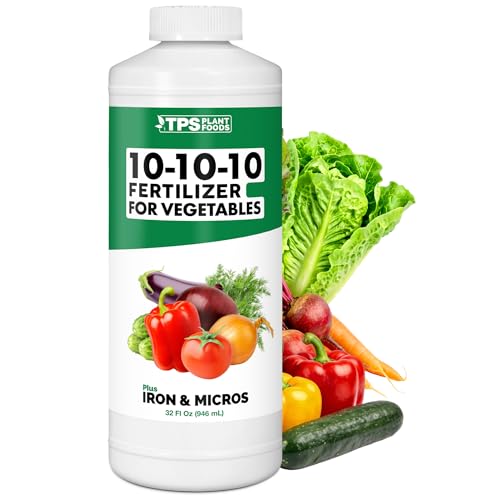
A balanced liquid feed with equal NPK plus iron and micronutrients. This is best reserved for correcting a visible nitrogen deficiency in asparagus ferns during the growing season—yellowing lower fronds or stunted spear regrowth after harvest. The liquid format delivers immediate results within days of application.
The 10-10-10 concentration is potent; you mix as little as 1 ounce per gallon of water. A 32-ounce bottle goes a long way for spot treatments. The iron content helps deepen green coloration in chlorotic ferns grown in high-pH soil where iron locks up.
The main downside is that liquid feeds wash through sandy beds quickly, so you need repeat applications every two weeks. It also lacks the organic matter that feeds the soil food web. Use this as a short-term corrective tool, not your default annual feed.
Why it’s great
- Fast-acting for mid-season fern chlorosis
- Iron addition helps high-pH soil gardens
- Concentrated bottle covers many applications
Good to know
- Requires frequent reapplication in sandy soil
- Synthetic-based, not ideal for organic-method beds
7. Wiggle Worm Pure Worm Castings 4.5 lb 2-Pack
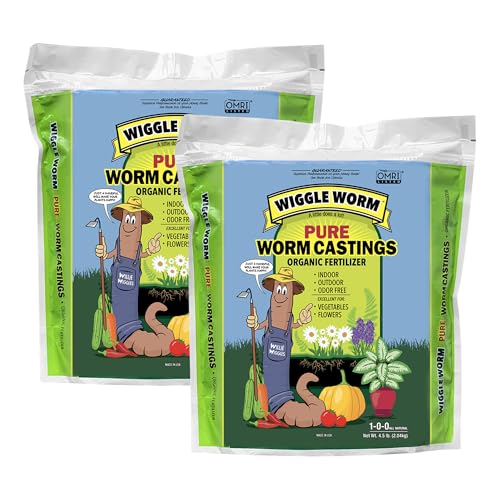
Pure worm castings are not a complete fertilizer—the NPK is negligible at 1-0-0—but they are the finest soil amendment for asparagus beds. The football-shaped particles improve soil aeration and water retention in the deep root zone where crowns live for years. Organic matter from castings feeds the bacteria and fungi that convert existing soil nutrients into plant-available forms.
This 2-pack provides 9 pounds total, enough for a top-dress on roughly 40 linear feet of trench. Gardeners apply a half-cup per crown at planting or a handful around each crown in early spring. The castings are OMRI listed, odorless, and non-toxic, making them safe for heavy-handed application.
The limitation is strictly nutrient density. Castings alone will not sustain heavy spear production. Use them as a foundational soil builder and pair with a balanced granular feed. If you want an all-in-one, skip this and go with the FoxFarm Happy Frog.
Why it’s great
- Improves soil porosity and moisture retention around crowns
- Feeds beneficial soil microbes for long-term fertility
- Odorless and impossible to over-apply
Good to know
- Very low NPK requires supplemental feeding
- 9 pounds may be small for large established beds
FAQ
Can I use the same asparagus fertilizer on my newly planted crowns and my established bed?
How often should I apply granular fertilizer to my asparagus patch?
Is fish emulsion a good standalone feed for asparagus?
Final Thoughts: The Verdict
For most users, the best asparagus fertilizer winner is the FoxFarm Happy Frog because its 5-7-3 ratio with calcium and mycorrhizae covers every stage from crown planting through established bed maintenance. If you want a high-phosphorus option for trench preparation, grab the Espoma Bone Meal. And for rebuilding fern vigor after the harvest season, nothing beats the The Grow Co Fish Emulsion as a supplemental liquid feed.