
Recovering from a fifth metatarsal fracture means every step counts — literally. The wrong brace can delay bone union, shift weight improperly onto the healing zone, or cause irritating shin splints that add new pain on top of an existing injury. The right brace, however, offloads the metatarsal head, restricts rotational torque, and lets you move through your day with less fear of re-injury.
I’m Rikta — the co-founder and writer behind FitlyFast. I break down joint-specific support mechanics, shell rigidity levels, and air compression adjustability so you can match the brace’s offloading profile to your surgeon’s weight-bearing restrictions.
Understanding the differences between short boots, tall boots, and air cam designs is critical when choosing the right brace for 5th metatarsal fracture recovery that fits your lifestyle and stage of healing.
How To Choose The Best Brace For 5th Metatarsal Fracture
Fifth metatarsal fractures — especially Jones fractures — are notoriously slow to heal due to the watershed blood supply at the metaphyseal-diaphyseal junction. Your brace needs to prevent rotational stress and offload the lateral column. Here’s what to prioritize.
Boot Height: Short vs. Tall
Short boots (ending below the calf) allow ankle mobility, which is useful for mid-foot fractures that don’t require rotational isolation. Tall boots extend up the calf and lock out ankle rotation, making them the standard choice for proximal fifth metatarsal fractures where every degree of supination can delay union.
Air Compression vs. Static Padding
Inflatable air bladders let you tighten compression specifically around the swelling-prone peroneal tendon region and the fracture site. Static foam liners provide consistent but non-adjustable pressure — fine for low-swelling avulsion fractures but less effective for post-surgical edema that fluctuates daily.
Rocker Sole Geometry
A properly rockered sole shifts the ground contact point posteriorly, reducing the bending moment across the metatarsal heads during push-off. Look for a sole with an aggressive rocker angle — a flat sole forces the metatarsal heads to dorsiflex, which directly stresses a healing fifth metatarsal base.
Quick Comparison
On smaller screens, swipe sideways to see the full table.
| Model | Category | Best For | Key Spec | Amazon |
|---|---|---|---|---|
| VELPEAU Short Walking Boot | Premium Short | Dual independent air compression | Dual air bags, heel wedges, semi-rigid shell | Amazon |
| Brace Direct Tall CAM Walker | Prem Tall | Doctor-recommended rotational control | Built-in air pump, low-profile rocker, tall frame | Amazon |
| Air CAM Walker (Brace Align XL) | Prem Tall | PDAC-approved for insurance reimbursement | Air pump, high-strength polymer, HCPCS L4361 | Amazon |
| Jewlri Tall Fracture Boot | Mid Tall | Lightweight alternative to Aircast | 5 straps, inflatable compartments, rocker bottom | Amazon |
| United Ortho Short Air Cam Walker | Mid Short | Steel-reinforced durability | Steel reinforcement, rocker sole, shock-absorbing insole | Amazon |
| Brace Direct CAM Walker Short | Mid Short | Open-toe ventilation for warm climates | Low-profile rocker, open toe, polymer frame | Amazon |
| Honarry Walking Boot | Budget Mid | Entry-level air walker with inflatable airbag | Inflatable airbag, 3-point straps, plastic shell | Amazon |
In‑Depth Reviews
1. VELPEAU Walking Boot for Broken Foot
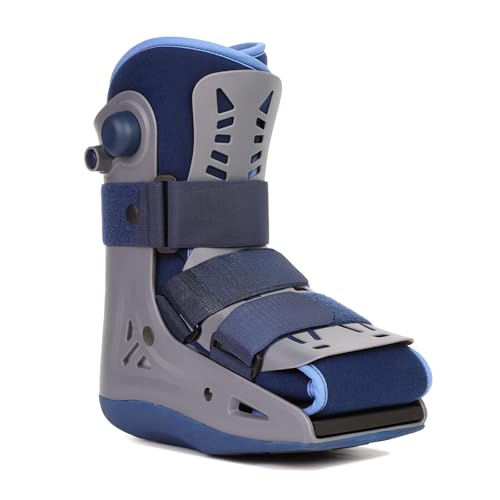
The VELPEAU short boot earns the top spot because of its dual independent inflatable airbags. Unlike single-chamber designs where compression is applied evenly across the limb, the dual bags let you dial in different pressure levels on the medial and lateral sides. For a fifth metatarsal fracture — where the lateral column needs rigid offloading without choking the dorsal arch — this is a major advantage that standard boots cannot replicate.
The semi-rigid external shell is paired with 12 heel wedges for four-phase gait retraining, so you can progressively increase weight-bearing as bone healing advances. The detachable liner is machine-washable, which matters during six-to-eight-week recovery windows. The anti-slip, shock-absorbing outsole reduces impact transferred up the kinetic chain — less jarring through the metatarsal head during heel strike.
User reviews consistently call out the secure fit and the ability to reduce shin irritation compared to taller boots. The widened toe pad also protects the forefoot from accidental bumps during post-surgical or post-fracture recovery. This is the most thoughtfully designed short boot for active healing phases.
Why it’s great
- Independent medial-lateral air compression for precise offloading
- 12 heel wedges for progressive weight-bearing stages
- Removable, washable inner liner for hygiene over long wear
Good to know
- Short boot design does not fully isolate ankle rotation — not ideal for comminuted proximal fractures
- Slightly heavier than basic foam-lined boots
2. Brace Direct Tall Air CAM Walker Fracture Boot
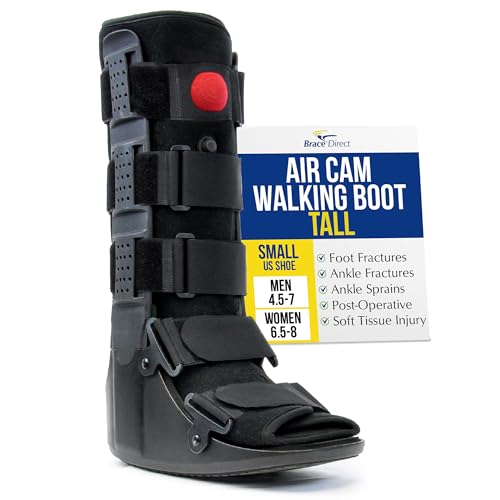
The Brace Direct Tall Air CAM Walker is the first tall boot on this list, and it earns that position by integrating a built-in air pump system that the patient can adjust throughout the day. As swelling in a fifth metatarsal fracture peaks and recedes over the first 72 hours, the ability to fine-tune compression without removing the boot keeps the fracture site stabilized and reduces the risk of displacement during the critical inflammation phase.
The slim, low-profile rocker bottom is key here. Unlike bulky hospital boots that create a clunky gait, this design promotes a natural walking motion that reduces hip and knee compensation. The open-toe construction improves airflow, which is a practical advantage during multi-week wear in warmer environments or for patients prone to perspiration.
The tall frame locks ankle supination and pronation, which directly protects the fifth metatarsal base from rotational stress during the stance phase. The included medial and lateral support pads provide additional custom fit for different foot volumes. This is a medical-grade choice that doctors frequently recommend for non-surgical fracture management.
Why it’s great
- Adjustable air pump for real-time swelling management
- Low-profile rocker sole reduces gait asymmetry
- Open-toe design enhances breathability during extended wear
Good to know
- Some users report the middle strap placement could be more secure for very high arches
- Tall boot may feel restrictive for those who prefer ankle mobility
3. Air CAM Walker Fracture Boot – Brace Align
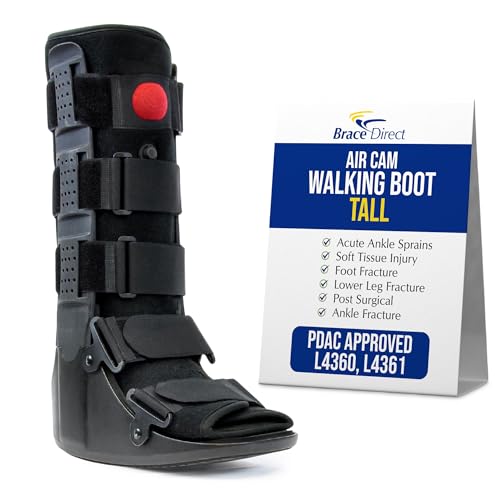
What sets this tall cam walker apart is its PDAC-approved HCPCS L4361 designation, which means it meets Medicare and private insurance coding requirements for reimbursement. For patients managing the high cost of a fifth metatarsal fracture recovery — especially those facing six weeks or more of immobilization — this can reduce out-of-pocket expense significantly.
The built-in air pump system works identically to the Brace Direct Tall version, with the same dial-in compression capability. The high-strength polymer frame supports up to the XL size, accommodating larger patients or those with extensive post-surgical bandaging. The medial and lateral support pads help center the foot within the boot, preventing the heel from sliding laterally during gait.
The flatter rocker profile on this boot works better for patients who experience pain with a highly rounded sole. Some users with Achilles or peroneal tendon involvement report that the flatter bottom feels more stable during early weight-bearing. The open-toe design keeps the forefoot visible for wound checks and allows ice pack access directly to the fracture site.
Why it’s great
- PDAC-approved — eligible for insurance reimbursement
- Air pump provides custom compression throughout healing
- Flatter rocker sole offers more stability for early gait training
Good to know
- Runs slightly small — size up if you have significant swelling
- Tall frame can be uncomfortable for shorter individuals
4. Jewlri Air Walking Boot, Tall Fracture Boot
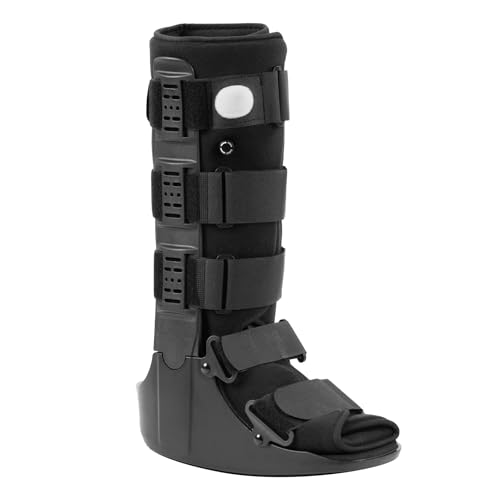
The Jewlri tall boot closely mirrors the build of premium Aircast boots but at a lighter overall weight — approximately 2.2 pounds compared to 2.9 pounds for the Aircast tall. This weight reduction is meaningful during full-day wear, especially for patients with proximal fifth metatarsal fractures who need the tall frame but feel fatigued by heavier orthopedic boots.
Five hook-and-loop straps and an inflatable compartment system provide customizable compression from the forefoot to the calf. The rocker bottom promotes a natural heel-to-toe gait, and user feedback specifically notes that the walking action feels more fluid than with Aircast boots. The long, wide toe bed accommodates bandaged or swollen forefeet without lateral pinching.
The main trade-off is the rubber sole coverage: the sole does not extend edge-to-edge, so traction on wet or uneven surfaces is slightly reduced. The full-length Velcro on the bottom straps can also be difficult to thread for patients with limited hand mobility — a small dab of glue on the strap tip solves this, but it’s worth knowing upfront.
Why it’s great
- Lighter than Aircast tall boot — easier for all-day wear
- Inflatable compartments deliver adjustable compression
- Wide toe bed fits post-surgical bandaging comfortably
Good to know
- Full-length Velcro on straps can snag and be hard to release
- Rubber sole lacks full edge coverage for maximum traction
5. United Ortho Short Air Cam Walker Fracture Boot

Steel-reinforced plastic uprights give the United Ortho Short Air Cam Walker a durability advantage over boots that rely solely on polymer or plastic shells. For a fifth metatarsal fracture, where the brace must resist bending forces during push-off, steel reinforcement provides a stiffer platform that reduces micro-motion at the fracture site — a critical factor for Jones fractures where non-union rates can exceed 20 percent.
The rocker sole and shock-absorbing insole work together to reduce forefoot load during the stance phase. The short boot design allows full ankle mobility, which is appropriate for avulsion fractures of the fifth metatarsal base or for patients who have transitioned past the acute immobilization stage and are entering functional bracing. Four comfort pads are included for customizing the fit around the malleoli and midfoot.
The inflation pump uses a separate bulb system that requires manual effort to pressurize. User feedback indicates the pump works well once dialed in, but the boot can be difficult to don alone — especially when compressing the air chamber while simultaneously tightening the straps. The included user guide is thorough and helps first-time orthopedic boot users get the fit right.
Why it’s great
- Steel-reinforced uprights provide maximum stiffness for fracture stability
- Shock-absorbing insole reduces impact through the metatarsal head
- Multiple comfort pads for tailored malleolar fit
Good to know
- Difficult to put on without assistance — air pump adds complexity
- Foam pads can wear and compress over extended use
6. Brace Direct CAM Walker Fracture Boot Short
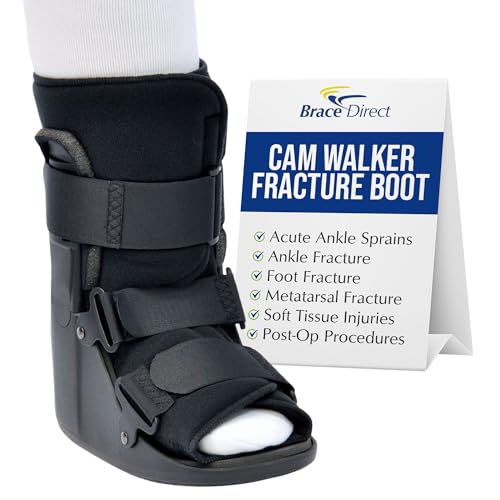
The Brace Direct Short CAM Walker is optimized for patients who prioritize ventilation and forefoot accessibility. The open-toe design keeps the metatarsal heads exposed, which allows unrestricted airflow and makes it easier to monitor skin condition or apply ice therapy directly to the fracture site without removing the entire boot. For non-displaced fifth metatarsal fractures where healing is expected to be straightforward, this simplicity is practical.
The low-profile rocker sole and non-skid tread provide reliable traction across indoor surfaces. The polymer frame is lightweight, and the hook-and-loop closure system adjusts easily over bandaging or fluctuating swelling. Brace Direct also offers a free video fitting session with a certified professional — a unique service for anyone unsure about sizing, especially when managing a healing fracture.
The trade-off for the short design is reduced rotational control. Patients with more unstable fracture patterns — particularly Jones fractures at the metaphyseal-diaphyseal junction — may find the ankle mobility allowed by a short boot introduces enough supination stress to delay union. This boot is best reserved for low-energy, non-displaced fractures or as a step-down device after tall boot immobilization.
Why it’s great
- Open-toe design provides maximum airflow and fracture-site access
- Free video fitting session for precise sizing
- Non-skid rocker sole for safe indoor walking
Good to know
- Short boot does not isolate ankle rotation — may not suit unstable fractures
- Lacks underfoot cushioning — some users report arch achiness after extended wear
7. Honarry Walking Boot for Broken Foot
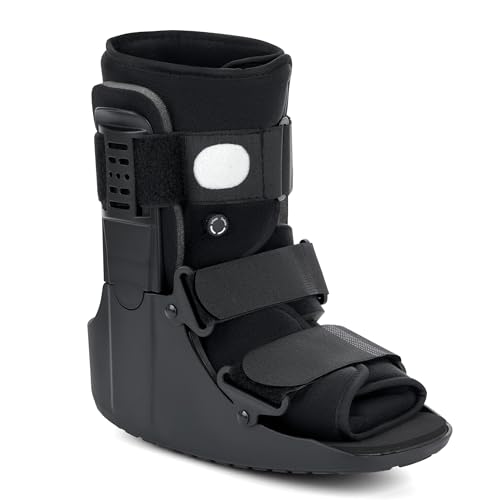
The Honarry air walking boot provides an inflatable airbag system at a notably accessible price point, making it a viable entry-level choice for patients who need basic fracture immobilization without the financial commitment of premium-tier braces. The airbag allows adjustable pressure around the foot, and the rigid plastic shell provides external protection against accidental contact — both relevant for stable fifth metatarsal fractures during early recovery.
The three-point hook-and-loop strap system offers a customized fit across the forefoot, midfoot, and calf, and the removable orthopedic insole provides pressure relief under the metatarsal heads. The boot is suitable for use at home, in the office, or during short errands — but users report that the build feels heavier and bulkier than mid-range options, which can cause fatigue over multi-hour wear.
Sizing attention is critical here: the boot tends to run long, and several female users with size 7.5 noted that their toes stopped two inches short of the boot’s toe. Consulting the size chart carefully and measuring foot length before ordering is essential to avoid a return. For a low-cost option that includes air compression adjustability, this works well for non-comminuted fractures with minimal soft tissue involvement.
Why it’s great
- Inflatable airbag provides adjustable compression at an accessible price
- Rigid plastic shell protects the fracture from accidental bumps
- Three-point straps allow personalized fit across the foot and calf
Good to know
- Sizing runs long — measure foot length carefully against the size chart
- Heavier and bulkier than similarly priced mid-range alternatives
FAQ
Can I wear a short boot for a Jones fracture of the fifth metatarsal?
How tight should the air compression be on my fracture boot?
Do I need an EvenUp shoe on the opposite foot when using a fracture boot?
How do I know if my fifth metatarsal fracture needs surgery or just a brace?
Final Thoughts: The Verdict
For most users, the best brace for 5th metatarsal fracture winner is the VELPEAU Short Walking Boot because its dual independent air chambers provide the most precise offloading control for forefoot fractures while maintaining ankle mobility for daily function. If your surgeon requires strict rotational isolation for a proximal fracture, grab the Brace Direct Tall Air CAM Walker — it offers doctor-trusted ankle lockout with an adjustable air pump. And for a lightweight tall boot alternative that improves gait fluidity, nothing beats the Jewlri Tall Fracture Boot.