
A poorly ventilated attic traps summer heat and winter moisture, undermining your insulation and forcing your HVAC system to work harder. The solution isn’t complex: installing rafter vents, or attic baffles, creates a dedicated air channel between your soffits and ridge vent, keeping insulation out of the way and airflow moving freely.
I’m Rikta — the co-founder and writer behind FitlyFast. I’ve spent years analyzing building science products and cross-referencing specs with real-world installation feedback to separate the durable designs from the flimsy ones.
Whether you are air-sealing a new build or retrofitting an existing attic, finding the best attic baffles means picking the right material, width, and air channel depth for your specific rafter spacing and roof pitch.
How To Choose The Best Attic Baffles
Selecting the right baffle involves more than just grabbing the cheapest pack. The three critical factors — rafter spacing, material durability, and air channel depth — determine whether your ventilation upgrade actually works or just creates new headaches.
Match Your Rafter Spacing Exactly
Attic baffles are sized for standard on-center spacing: 16 inches, 19.2 inches, or 24 inches. A baffle designed for a 22-inch wide bay won’t fit a 24-inch rafter span without gaps that let insulation spill into the air channel. Measure your actual rafter bay width — not the nominal spacing — before picking a product.
Choose Material Based on Your Climate and Installation Method
Rigid polyethylene baffles (like the SmartBaffle) resist crushing, tearing, and moisture absorption, making them ideal for deep insulation jobs. Foam or lightweight plastic options (like Durovent) are fine for new construction where you can staple before insulating, but they can tear or sag in tight retrofits. Aluminum vents are durable and pest-resistant but can corrode over time in humid environments.
Prioritize Air Channel Depth
The air channel — the gap the baffle creates between your roof deck and insulation — should be at least 2 inches deep for standard cathedralized or vented attics. A shallower channel restricts airflow and can lead to moisture condensation on the underside of your roof sheathing. Baffles that offer a full 2-inch clear channel without narrowing at the ends are the most effective.
Quick Comparison
On smaller screens, swipe sideways to see the full table.
| Model | Category | Best For | Key Spec | Amazon |
|---|---|---|---|---|
| SmartBaffle 24 | Polyethylene | 24″ rafter bays, deep insulation | 2″ air channel | Amazon |
| PreVent-It Soffit Vent | Plastic | Bathroom exhaust termination | 95% moisture displacement | Amazon |
| Durovent UDV2248 | Plastic | High-volume new construction | 48″ length, pack of 70 | Amazon |
| Durovent ABS Baffle | ABS | Retrofit in low-slope attics | User-formed baffle | Amazon |
| Durovent with Baffle | Foam | Garage or simple retrofits | Integrated baffle channel | Amazon |
| Air Vent 84226, 24-pack | Aluminum | Pest-resistant undereave vent | 16″ x 4″ louvered | Amazon |
| Vent Systems 4″ Vent Cover | Plastic | DIY soffit or wall exhaust | Built-in mesh screen | Amazon |
In‑Depth Reviews
1. SmartBaffle 24 Insulation Baffle – 30 Pack

This is the baffle that serious insulators and contractors reach for when they don’t want callbacks. Made from thick, corrugated polyethylene, the SmartBaffle 24 is engineered for 24-inch on-center rafter bays and delivers a full 2-inch air channel that won’t collapse under the weight of dense-packed cellulose or fiberglass batts. Users consistently highlight how it stays rigid even when shoved into tight spaces, and its side folds give enough flexibility to clear protruding roofing nails without tearing.
Installation is straightforward with a standard staple gun — the material holds staples firmly without the tearing issues common with polystyrene or thin plastic vents. The 30-pack covers roughly 200 square feet of attic floor, making it a practical buy for a whole-house project. Multiple verified buyers specifically mention that these baffles are superior to the flimsy box-store options that warp or sag after a season.
The only real friction point is the price: this is a premium product, and you’ll pay more per baffle than you would for a pack of foam or lightweight plastic alternatives. But if you value a permanent, sag-free installation that doesn’t shift or degrade, the SmartBaffle earns its cost through sheer build quality and peace of mind.
Why it’s great
- Extremely rigid polyethylene resists crushing, tearing, and moisture absorption
- Fits 24-inch rafter bays precisely with 2-inch side folds to clear nails
- Easy to cut, trim, and double up for deeper overhangs without sagging
Good to know
- Higher per-unit cost compared to foam or lightweight plastic baffles
- May be overkill for small attics where budget is the primary constraint
2. PreVent-It Soffit Vent – 1 Pack

Most soffit vents are just grilles that dump moist bathroom exhaust directly under the eave, where it can condense and cause rot. The PreVent-It solves this with a patented design that redirects air horizontally away from the soffit — verified by the seller to displace over 95% of moist air out into open space. This is not a general attic baffle; it’s a specialized termination point for bathroom exhaust fans (rated up to 110 CFM) that protects your roof decking and insulation from moisture damage.
The unit includes a built-in damper that seals shut when the fan is off, blocking backdrafts and pests. The removable front screen makes periodic cleaning simple, and the included screws get it mounted in minutes. Multiple reviewers note that the airflow is noticeably stronger and more directed compared to standard louvered vents, and the sturdy resin plastic feels substantial in hand.
A few users flagged that the plastic hinge pins on the internal flap may wear over time if the vent isn’t mounted perfectly flat. Also, for high-CFM fans exceeding 110 CFM, you may hear increased fan noise due to the restrictive nozzle. For standard residential bath fans, though, this is a purpose-built upgrade that outperforms generic soffit vents by a wide margin.
Why it’s great
- Patented nozzle redirects 95%+ of moist air away from the soffit
- Integrated damper blocks drafts and prevents pest entry when not in use
- Removable front screen for easy cleaning without dismounting
Good to know
- Rated for bath fans up to 110 CFM only; higher CFM units may restrict flow
- Internal damper pins may wear over time if installation is not perfectly flat
3. Durovent UDV2248 Rafter Ventilator – 70 Pack

When you need to vent a whole subdivision or a large attic addition on a tight budget, the Durovent UDV2248 delivers the sheer volume that makes the economics work. This pack includes 70 pieces of thin plastic rafter vents, each 48 inches long, designed to slip between rafters and provide a continuous air channel from the soffit to the ridge. The perforated center line lets you break the vent to match different heel heights, giving you some installation flexibility.
Experienced users confirm that installation is fast — staple one side, bend, staple the other — and the material, while lightweight, holds up fine during new construction where insulation isn’t being pushed against it aggressively. For the price per vent, this is the most economical way to meet code-required airflow in a large project. Several buyers with big attics or garages praised the value and ease of handling in bulk.
The trade-off is durability. Multiple reviewers describe the material as “brittle” and note that it can crack or tear if you over-staple or try to manipulate it in tight spaces. It’s not suited for deep retrofits where insulation will press against the vent, nor for anyone who needs a rigid, permanent channel. This is a volume play — fine for production framing, less ideal for a careful retrofit where a stiffer baffle is safer.
Why it’s great
- Excellent per-unit value for large-scale or multi-unit projects
- 48-inch length allows for tall heel heights when cut to length
- Lightweight and fast to staple in open rafters during construction
Good to know
- Thin plastic is brittle and can crack or tear under stress
- Not rigid enough for retrofits where insulation will press against the channel
4. Durovent ABS Attic Rafter Vent – 70 Pack (B018HIEQ38)

This version of the Durovent swaps the brittle standard plastic for ABS — a slightly tougher material that resists cracking better during installation. It’s still a flat sheet that you form into a baffle on site, making it uniquely suited for retrofit jobs where you’re sliding the vent above existing insulation. The 48-inch length provides good coverage: on a typical 5/12 pitch roof, it reaches about 18 inches up from the soffit.
Users who’ve installed it in low-to-moderate slope attics report that it slides behind existing batts without too much fuss, especially if you use a feeder panel to compress the insulation out of the way. The material holds staples better than the standard UDV2248 and doesn’t feel as fragile in hand. For bulk retrofits where you’re working inside an attic with limited headroom and existing fiberglass, this is a smart choice.
The main limitation is that ABS still lacks the rigidity of a pre-formed polyethylene baffle. It can tear on protruding nails if you push too hard, and it won’t stand up to dense-packed cellulose the way the SmartBaffle will. Also, forming the baffle shape yourself takes a bit more effort than just unfolding a pre-molded unit. If you’re comfortable with a little manual shaping, this is a strong mid-range option for retrofits.
Why it’s great
- ABS material is more flexible and less brittle than standard plastic vents
- Long length allows good coverage even on moderate roof pitches
- Excellent value for bulk retrofits in existing attics
Good to know
- Requires manual forming to create the baffle shape; not pre-molded
- Can still tear on sharp nails or when pushed against thick insulation batts
5. Durovent with Baffle Attic Vent Channel (UDVB2346)

This is the original Durovent with a built-in baffle channel, designed for one-step installation that eliminates the need for separate blocking material. The foam-based construction is lightweight, water-resistant, and blocks wind and rain from penetrating the attic. Its foldable design lets you position it against the roof deck and staple it into place quickly, making it a common choice for garage attics and simple new-construction applications.
Buyers who’ve used it for straightforward soffit-to-ridge venting in garages or sheds are generally satisfied, noting that it’s cheap enough to cover a large area without overthinking. The integrated baffle does create a clear air path, and the material is easy to cut with a utility knife for odd-sized bays. Several users mention that it’s effective for basic code compliance without breaking the bank.
The candid feedback, however, flags two consistent problems: the material tears easily — one reviewer compared it to a styrofoam egg carton — and staples can pull through without plastic washers if you’re not careful. It’s not suitable for dense insulation loads or attics where you need a rigid, permanent channel. For a temporary or low-stakes ventilation job, it works; for a long-term investment in attic health, look at the stiffer options.
Why it’s great
- Low per-unit cost makes it viable for large-area coverage on a budget
- Integrated baffle eliminates need for separate blocking material
- Lightweight and easy to cut with a utility knife for custom fits
Good to know
- Foam material tears easily; staples can pull through without reinforcement
- Not rigid enough for deep insulation or high-density cellulose applications
6. Air Vent 84226 Undereave Attic Vent – 24 Pack

These are not interior rafter baffles — they are exterior undereave vents designed to replace old or damaged soffit grilles. The 16-by-4-inch aluminum construction is louvered with a fine mesh bug screen on the back, making them an excellent choice for homes where birds, rats, or wasps are finding their way into the attic through large or missing soffit vents. The metal build is much tougher than plastic alternatives and won’t warp in summer heat.
Verified buyers repeatedly praise these vents as the solution for persistent pest problems. One user had finches nesting in their roof vents for years; these stopped the problem completely. The louvered design channels airflow while the mesh keeps even small insects out. Installation requires screws into the soffit (screws not included), and the clean profile looks more refined than many plastic grilles.
The only notable downsides are that aluminum can corrode in coastal or high-humidity environments after three or more years, and the sharp edges require careful handling during installation. Also, you’ll need a ladder and some patience to install them at height. For a durable, pest-proof exterior soffit vent that lasts, this is the pick.
Why it’s great
- Sturdy aluminum construction with integrated fine-mesh bug screen
- Effectively prevents birds, rodents, and wasps from entering attic
- Clean, low-profile appearance compared to plastic soffit vents
Good to know
- Aluminum can corrode over time in humid or coastal climates
- Sharp edges require careful handling; screws not included
7. Vent Systems 4″ White Vent Cover – Pack of 10
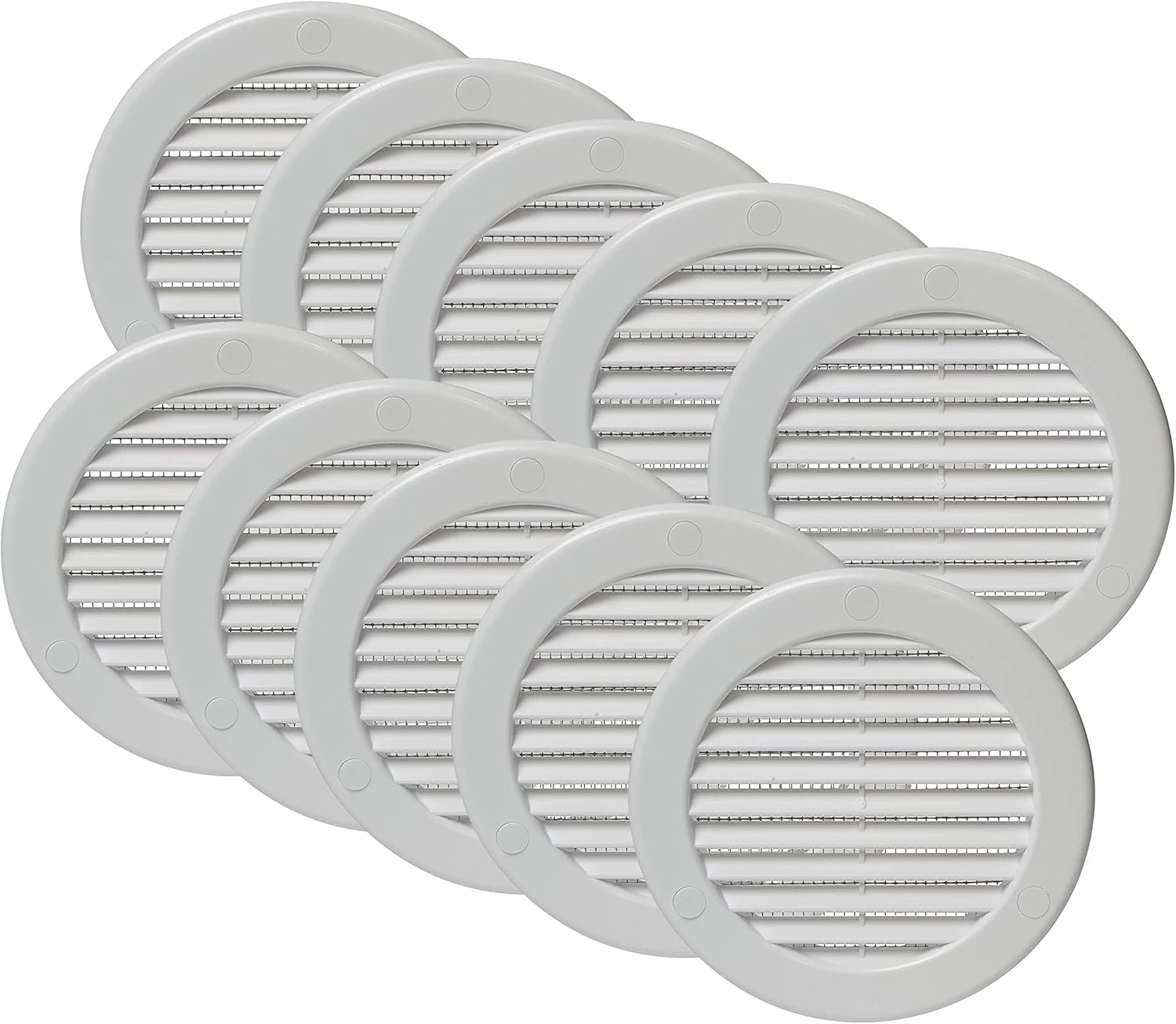
These are not attic baffles in the traditional sense — they are 4-inch circular louvered vent covers designed for terminating HVAC exhaust ducts or bathroom fan lines at the wall or ceiling. However, they serve a critical ventilation function in attics where you need to cap a duct run with a clean, debris-blocking grille. The built-in nylon mesh screen keeps dust, bugs, and insulation fibers out while maintaining free airflow.
The pack of 10 gives you plenty of spares for a whole-house project, and the lightweight plastic construction is weather-resistant within a temperature range of -4°F to 158°F. Pre-drilled mounting holes make installation simple with basic tools, and the screw caps give a tidy finish. Users have used these for everything from chicken coop ventilation to capping old water heater vents, and the consistent feedback is that they look clean and do the job.
Because these are not rafter baffles, they shouldn’t be used as a substitute for proper insulation baffles in vented attics. They also lack the UV stabilization of premium exterior vents, so extended direct sun exposure may cause yellowing or brittleness over time. For indoor or sheltered soffit locations, they’re a functional, budget-friendly choice for capping 4-inch duct openings.
Why it’s great
- Very affordable per-unit cost for a pack of 10 covers
- Integrated nylon mesh keeps dust, bugs, and debris out of duct openings
- Easy DIY installation with pre-drilled holes and included screw caps
Good to know
- Not a replacement for rafter baffles in a vented attic system
- Plastic may yellow or become brittle with prolonged UV exposure outdoors
FAQ
Do I need attic baffles in every rafter bay?
Can I install baffles from the attic side instead of the eave?
What happens if I skip baffles and just blow insulation over the soffit vents?
Final Thoughts: The Verdict
For most users, the best attic baffles winner is the SmartBaffle 24 because its rigid polyethylene construction and precise 2-inch air channel guarantee reliable, sag-free ventilation in 24-inch rafter bays. If you need a specialized solution for terminating bathroom exhaust, grab the PreVent-It Soffit Vent. And for a high-volume new-construction project where cost per vent matters, nothing beats the Durovent UDV2248 pack.