
Our readers keep the lights on and the weekend projects moving. As an Amazon Associate, I earn from qualifying purchases.
Uneven room temperatures turn a well-designed home into a daily frustration—one bedroom feels like a sauna while the thermostat room stays perfect, and no amount of damper adjustments seems to fix it. A battery-powered register booster fan is the targeted solution: it sits directly over a weak HVAC vent, pulls air from the duct, and pushes it into the room to normalize temperature swings without requiring hardwiring or duct modifications.
I’m Rikta — the co-founder and writer behind FitlyFast. I’ve spent years analyzing how small appliance categories like HVAC accessories solve real comfort gaps, and I benchmark every register booster fan against measurable airflow, noise suppression, and smart thermostat integration to separate effective designs from gimmicks.
This buying guide compares the best current models by actual duct-opening fit, CFM (cubic feet per minute) output, dBA noise ratings, and temperature-sensor accuracy so you can choose a battery powered register booster fan that delivers consistent room balance without wasting energy.
How To Choose The Best Battery Powered Register Booster Fan
Register booster fans look simple, but mismatching the size or ignoring the noise profile leads to returns and continued discomfort. Below are the three factors that separate a perfect-for-your-home booster from a frustrating near-miss.
Duct Opening vs Vent Cover — Measure the Hole, Not the Grille
Every single return headache in this category starts here. The manufacturer’s listed size (for example 4” x 10” or 4” x 12”) refers to the actual sheet-metal cutout in your floor, wall, or ceiling — not the dimensions of the decorative vent cover you see. Remove the old grille, measure the inner opening length and width, and compare those numbers to the product’s neck dimensions. A booster whose face is wider than the opening is fine, but if the neck cannot fit inside the duct, the fan simply will not sit flush.
CFM and Noise — The Airflow vs Sound Tradeoff
Higher CFM (cubic feet per minute) means more air moved, but every manufacturer publishes a best-case noise figure (often 16–18 dBA) that only holds at low speeds. At maximum speed the same fan may hit 35–40 dBA — audible white noise that some sleepers welcome and others find intrusive. Decide whether you need maximum boost for a dead-end bedroom (prioritize CFM) or a gentle assist in a quiet office (prioritize low dBA at mid-range speeds).
Thermostat vs Manual Mode
Temperature-sensor auto-mode turns the fan on only when the duct detects warm or cool air from the HVAC system, saving electricity and preventing the fan from running when the system is idle. Manual mode runs the fan continuously at a chosen speed regardless of duct temperature, which can improve general air circulation but uses more power. Homes with programmable thermostats and consistent HVAC cycles benefit most from auto-mode; rooms that need constant air movement (home gyms, sunrooms) are better served by manual speed control.
Quick Comparison
On smaller screens, swipe sideways to see the full table.
| Model | Category | Best For | Key Spec | Amazon |
|---|---|---|---|---|
| AC Infinity AIRTAP T4 | Premium Smart | Bluetooth + Temperature Curves | 130 CFM / 17 dBa | Amazon |
| Tjernlund RB12 | High-End | Squirrel-Cage Low Noise | 75 CFM / 1800 RPM | Amazon |
| Tjernlund RB10 | Durable Workhorse | Long-Term Reliability | 75 CFM / 6-ft Cord | Amazon |
| VIVOHOME 4×10 (Mesh) | Mid-Range Smart | Child Lock + Sleep Mode | 120 CFM / 18 dBa | Amazon |
| BIOWIND 4×12 | High CFM Value | Highest Airflow per Dollar | 140 CFM / 16 dBa | Amazon |
| VELLEE 4×12 | Budget Smart | Auto-Mode on a Budget | 120 CFM / 18 dBa | Amazon |
| VIVOHOME 4×10 (Louver) | Best Value | Oscillating Louvers + Memory | 120 CFM / 18 dBa | Amazon |
In‑Depth Reviews
1. AC Infinity AIRTAP T4

The AC Infinity AIRTAP T4 is the most technologically complete register booster in this class. Its dual 92 mm motors push 130 CFM while the CNC-machined anodized aluminum frame sits flush over a 4” x 10” duct opening. The critical difference here is the Bluetooth app — it unlocks advanced programming like heating/cooling trigger curves, timers, cycle modes, and alarm notifications that no manual remote can match.
Noise is rated at 17 dBA at low speeds; at maximum speed the fan produces a noticeable but tolerable whoosh that users typically describe as white noise. The memory function holds your last settings after a power outage, and the child lock prevents accidental changes. Multiple owners report dropping their second-floor room temperature by 8–10°F when used in auto-cool mode, with a corresponding reduction in their central AC runtime.
Installation is tool-free: slide the rear casing (3.93 x 9.76 in) into the duct opening, secure the faceplate, and plug the 12-foot cord into a wall outlet. The app interface is clean, but some users find the Bluetooth range limiting if the fan is in a far corner from the phone.
Why it’s great
- Bluetooth programming enables temperature-triggered curves that optimize HVAC cycling
- Anodized aluminum frame resists warping and looks premium
- Memory recall and child lock add family-friendly reliability
Good to know
- Only fits 4” x 10” duct openings — verify clearance before ordering
- Upper speeds produce fan noise that some light sleepers may notice
2. Tjernlund RB12 Register Booster Fan
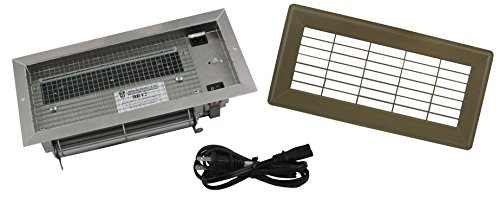
The Tjernlund RB12 takes a fundamentally different engineering approach from the propeller-blade fans above. It uses a squirrel-cage (centrifugal) blower wheel that generates higher static pressure, making it far more effective at pulling air through long, narrow, or partially obstructed duct runs. At 75 CFM the raw volume is lower, but the air moves with more force — this is the right choice for a bedroom at the end of a 40-foot flex-duct branch.
Noise is dramatically lower than propeller fans at equivalent useful output; multiple HVAC technicians and long-term owners describe it as “nearly silent” or “laptop-level.” The all-metal construction and screened blower wheel add durability, and the commercial-grade brown grille is paintable to match any flooring or wall. There is no temperature sensor or speed dial — a single on/off switch sits under the grille.
Owners who want automation pair the RB12 with a smart plug and a separate temperature sensor to achieve the same auto-mode effect. The 6-foot cord and flush-mount installation keep the profile low, but the unit requires at least 4 inches of duct depth — tight 90-degree duct bends directly under the vent can block the cage from rotating.
Why it’s great
- Squirrel-cage design produces highest static pressure in this comparison, ideal for long ducts
- Quiet enough for continuous 24/7 operation in a nursery or office
- Paintable grille blends into any room aesthetic
Good to know
- No built-in thermostat — requires external smart plug for auto-on/off
- On/off switch is located underneath the grille, making access awkward after installation
3. Tjernlund RB10 Register Booster Fan
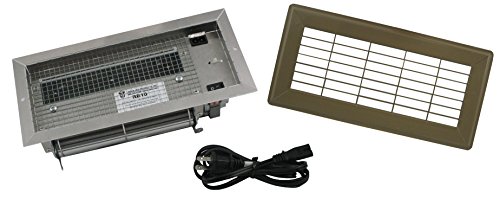
The Tjernlund RB10 is mechanically identical to the RB12 but sized for a 4” x 10” duct opening instead of 4” x 12”. The same squirrel-cage blower wheel, 75 CFM output, 1800 RPM motor, and 6-foot cord mean performance is identical — the only difference is the chassis dimensions.
Like the RB12, there is no thermostat, no remote, and no speed control. The simplicity is a feature for buyers who want a set-and-forget solution: plug it in, flip the switch, and let it run. Long-term owners report two-plus years of daily use with zero degradation in airflow or noise. The metal fan housing and commercial grille make it one of the few register boosters that feels genuinely built to outlast the HVAC system it supplements.
Installation requires the same depth clearance as the RB12 — at least 4 inches of straight duct below the vent opening. Users with shallow floor registers or tight 90-degree duct elbows should measure carefully before purchasing. The brown finish is utilitarian; owners in modern interiors often paint the grille to match their trim.
Why it’s great
- Decade-plus production history confirms long-term durability
- Centrifugal blower outperforms propeller fans in low-airflow scenarios
- Simple on/off operation requires no programming or batteries
Good to know
- No speed options — runs at full RPM whenever powered
- Switch position under the grille is inconvenient for daily use
4. VIVOHOME Quiet Register Booster Fan 4×10 (Mesh)
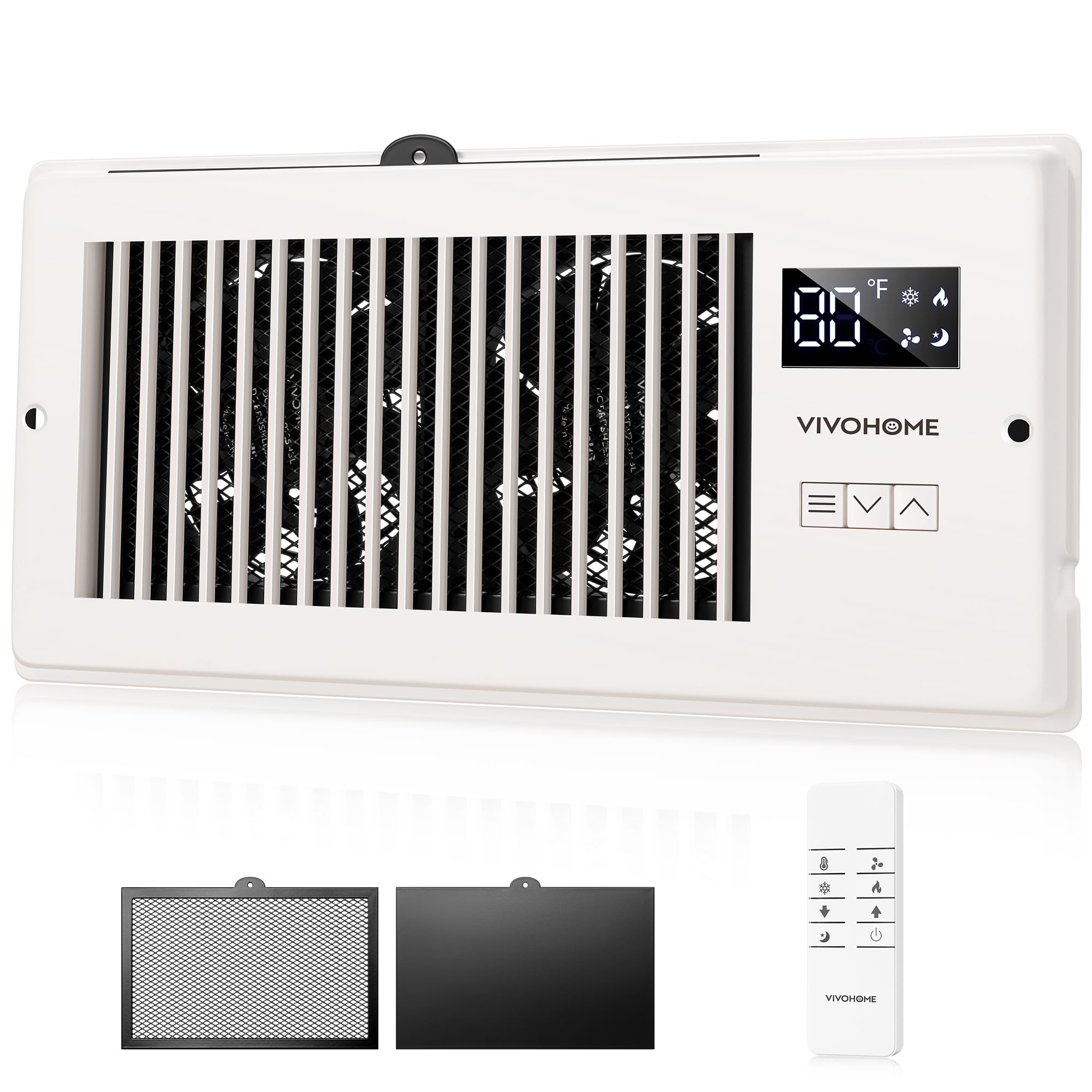
VIVOHOME’s 4×10 model with the removable dust-proof mesh and register blocker is the most child- and pet-friendly option in this roundup. The protective mesh screen prevents hair, toys, and debris from falling into the duct while still allowing full airflow up to 120 CFM. The bundled register blocker cuts airflow to unused rooms entirely, giving you zoning-like control without duct dampers.
The thermostat auto-mode uses a high-precision sensor to start the fan only when the HVAC system is actively heating or cooling. Sleep Mode locks the fan to a fixed Speed 3 regardless of room temperature, delivering a gentle breeze without the fan cycling on and off during the night. The remote control covers 10 speed levels, and the child lock prevents toddlers from changing settings.
Noise at low speeds is below 18 dBA — genuinely silent in a bedroom context. At speed 8–10 the fan becomes audible but remains less distracting than a box fan. A handful of users reported remote pairing failures; VIVOHOME’s customer service typically resolves these with a replacement unit under warranty.
Why it’s great
- Removable dust mesh and register blocker add practical family-friendly accessories
- Dedicated Sleep Mode runs fixed Speed 3 for uninterrupted rest
- Memory recall saves temperature, speed, and louver angle after power loss
Good to know
- Remote responsiveness issues reported in a minority of units
- Bulkier frame may not sit flush in very shallow floor vents
5. BIOWIND Quiet Register Booster Fan 4×12

The BIOWIND 4×12 pushes 140 CFM, making it the highest raw-volume booster in this lineup. The 2026 fan stability upgrade added dynamic balancing and motor start-up verification to reduce vibration and extend motor life. At low speeds the fan is rated at 16 dBA — the quietest published spec here — though users report that speed 10 is noticeably louder than the equivalent setting on the VIVOHOME units.
The controller uses an LED programmable interface with a high-precision temperature sensor. In auto-cool mode the fan only activates when the duct temperature rises above a set threshold, pulling the remaining cool air after the AC compressor cycles off. This “residual cool” feature can recover an extra 5–10 minutes of conditioned air per cycle, adding up to noticeable energy savings over a summer month.
Installation is plug-and-play: the anodized aluminum frame fits 4” x 12” duct openings with a neck insertion depth of 1.96 inches. The included power cord runs to a standard wall outlet. Some units shipped with missing remotes — check the package contents immediately upon arrival so the seller can send a replacement within the return window.
Why it’s great
- Highest published CFM (140) in this comparison for maximum airflow
- Residual-cool feature extends conditioned air delivery after HVAC shuts off
- Dynamic fan balancing reduces long-term vibration wear
Good to know
- Speed 10 is loud enough to be disruptive in a quiet office or nursery
- Remote control missing from some shipments — verify contents at delivery
6. VELLEE Quiet Register Booster Fan 4×12
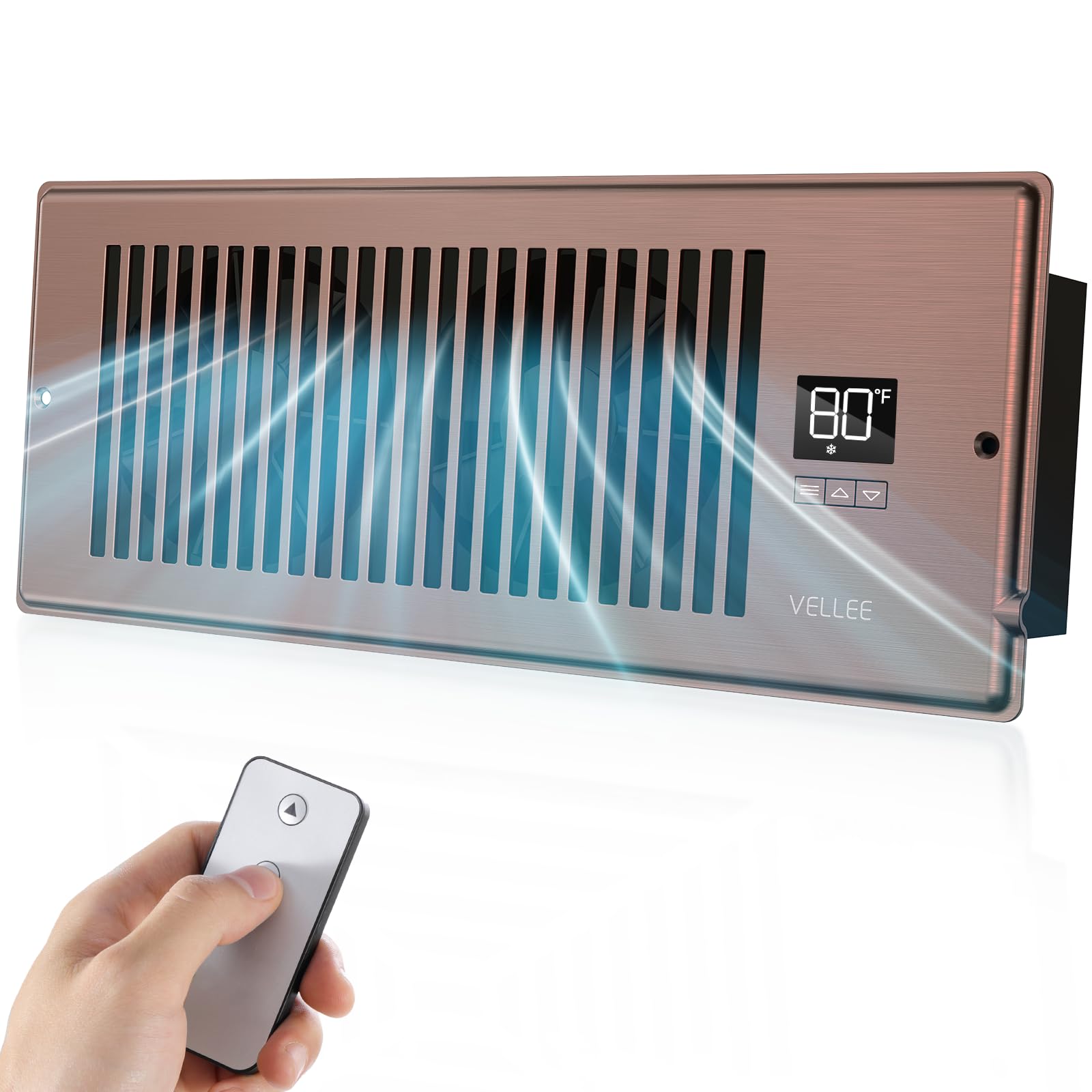
The VELLEE 4×12 offers auto-mode temperature control at a price point that undercuts the AC Infinity units by a wide margin. Its PWM (pulse-width modulation) motor delivers 120 CFM while keeping noise as low as 18 dBA at lower speeds. The 22-year-experienced engineering team behind this model focused on minimizing vibration, and users consistently note the fan runs smoother than earlier-generation boosters they previously owned.
The remote control avoids the overcomplicated LCD interfaces found on pricier fans — just speed up/down, mode select, and power. The built-in thermostat triggers the fan on and off based on the duct temperature, and the memory function recalls the last temperature and speed setting after a power interruption. The bronze matte finish and metal grate give it a more premium visual than the price would suggest.
Where the VELLEE falls short is consistency of the auto-mode logic. Several user reviews note that in auto-cool mode the fan sometimes runs continuously instead of cycling off when the duct temperature equalizes — the sensor threshold seems to have a narrower hysteresis band than competitors. The 12-foot wall adapter cord is generous, but the adapter itself is bulkier than the low-profile AC Infinity brick.
Why it’s great
- Aggressive price point for a fully featured thermostat-equipped booster
- PWM motor delivers smooth, vibration-free operation
- Memory function maintains settings after power loss
Good to know
- Auto-cool mode may run continuously instead of cycling based on duct temperature
- Wall adapter is physically large and may cover adjacent outlet spaces
7. VIVOHOME Register Booster Fan 4×10 (Louver)
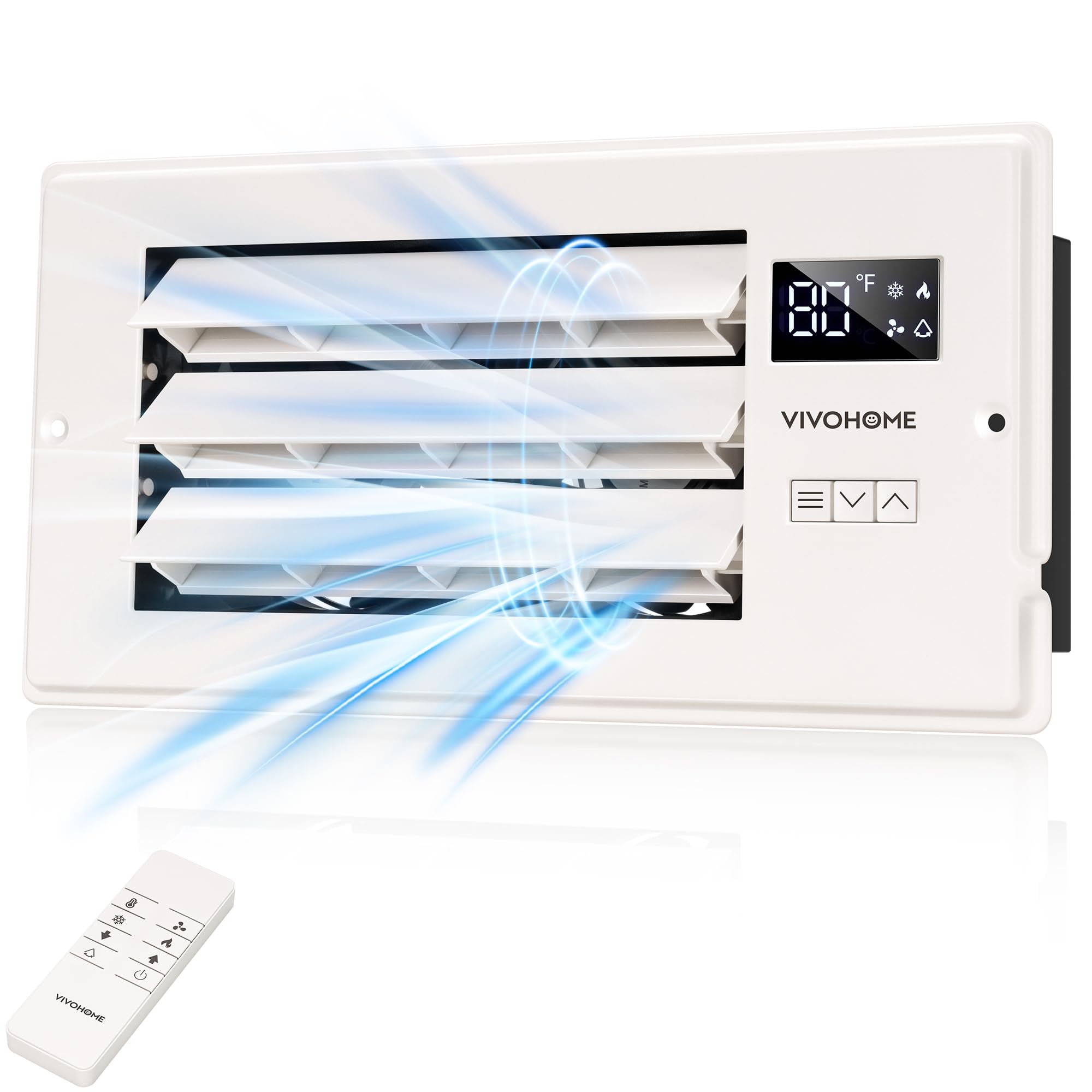
The VIVOHOME 4×10 with adjustable oscillating louvers is the most mechanically versatile model here. Instead of forcing air straight upward, the louvers sweep between 60° and 120°, redirecting conditioned air toward seating areas, desks, or beds. Two airflow modes — continuous sweep or fixed-angle — let you toggle between wide-area circulation and targeted delivery. This is the only unit in the comparison that actively directs air, not just boosts volume.
The built-in thermostat monitors room temperature and starts the fan automatically when the HVAC system is running. Ten fan speeds give fine-grained control, and the memory function recalls your louver angle, speed, and temperature settings after any power interruption. The EC motor is rated at 120 CFM while staying below 18 dBA at low speeds — quiet enough that users in the review stream report not noticing it during TV or conversation.
Installation is truly tool-free: fit the neck into the 4” x 10” duct opening, secure the screws, and plug into a wall outlet. At higher speeds (8–10) the oscillating louvers produce a gentle clicking sound as the gears change direction — not loud, but perceptible in a silent room. The aluminum-alloy and ABS build feels durable but the oscillating mechanism adds complexity that may wear faster than fixed-louver designs.
Why it’s great
- Oscillating louvers actively redirect air to specific room zones — unique in this category
- EC motor combines strong airflow with sub-18 dBa noise at low speeds
- Memory function preserves louver angle, speed, and temperature settings
Good to know
- Oscillating gears produce a faint clicking at higher speeds
- Bulkier than fixed-grille boosters; measure duct depth for clearance
FAQ
Will a register booster fan work with a battery-powered HVAC system or only with centrally ducted AC?
Can I install a register booster fan in a ceiling vent that is upside down?
How much does a register booster fan increase my electricity bill?
What happens if my duct opening is slightly smaller than the fan’s neck?
Can one register booster fan fix a hot room that is 100 feet away from the HVAC unit?
Final Thoughts: The Verdict
For most users, the battery powered register booster fan winner is the AC Infinity AIRTAP T4 because its Bluetooth app programming, 130 CFM airflow, and anodized aluminum build deliver the best balance of performance and control for standard 4” x 10” ducts. If you want squirrel-cage quietness and industrial reliability for a long duct run, grab the Tjernlund RB12. And for budget-conscious buyers who still want thermostat auto-mode and the unique ability to redirect air with oscillating louvers, nothing beats the VIVOHOME 4×10 Louver Fan.