
Our readers keep the lights on and the weekend projects moving. As an Amazon Associate, I earn from qualifying purchases.
The right adhesive for neoprene rubber needs to handle constant flexing, moisture exposure, and temperature swings without turning brittle or letting go. A weak bond here means peeled wetsuit seams, leaking gaskets, or failed craft projects that waste your time and materials.
I’m Rikta — the co-founder and writer behind FitlyFast. I’ve analyzed dozens of rubber-bonding formulas, looking at tensile strength, cure times, and heat resistance to find what actually holds neoprene in demanding real-world use.
After checking over a hundred customer reports and technical specs, I narrowed it down to the best performers. This guide covers the best adhesive for neoprene rubber across different job sizes and bond requirements.
How To Choose The Best Adhesive For Neoprene Rubber
Neoprene is a synthetic rubber valued for its flexibility, oil resistance, and closed-cell structure. Standard glues like white craft glue or super glue fail because they dry rigid or don’t penetrate the rubber’s surface. The right adhesive stays flexible after curing, resists moisture and heat, and forms a bond that moves with the material.
Contact cement vs. brushable cement
Contact cement is the gold standard. You apply it to both surfaces, let it dry until tacky, then press them together — the bond is immediate and permanent. Brushable liquid cements work for smaller repairs but require clamping and longer cure times. For seams, patches, and gaskets, contact cement is the better choice.
Water and heat resistance
Neoprene sees water exposure in wetsuits, dive gear, and marine seals. Look for adhesives explicitly labeled water-resistant or waterproof after curing. For applications near engines or in direct sunlight, check the heat rating. Some premium formulas handle up to 300°F, while standard contact cements top out around 180°F.
Viscosity matters
Thicker gel formulas are easier to control on vertical surfaces and don’t drip into the fabric’s open cells. Thin liquid cements soak in deeper but can make the neoprene stiff. For edge-to-edge bonding, a medium-viscosity paste gives you the best balance of penetration and hold without over-saturating the rubber.
Quick Comparison
On smaller screens, swipe sideways to see the full table.
| Model | Category | Best For | Key Spec | Amazon |
|---|---|---|---|---|
| 3M 1357 | Industrial Contact Cement | Heavy lamination & sheet metal | Heat resistant to 250°F | Amazon |
| 3M 1300 | Gasket Adhesive | High-heat gasket bonding | Heat resistant to 300°F | Amazon |
| Barge Contact Cement | All-Purpose Contact Cement | Shoe & foam repairs | Toluene-free, quick dry | Amazon |
| Trident Black Neoprene | Neoprene-Specific Cement | Dive gear & wetsuit repairs | Black color, waterproof | Amazon |
| S-18 All-Purpose | Multi-Material Adhesive | Rubber-to-metal bonding | 24-hour full cure | Amazon |
| HooTown Adhesive Strip | Self-Adhesive Sheet | Gasket pads & weather stripping | 1/8 inch thick, peel-and-stick | Amazon |
| HTJZWG Neoprene Sheet | Adhesive-Backed Sheet | Custom cut gaskets | 3.0mm self-adhesive sheet | Amazon |
In‑Depth Reviews
1. 3M Neoprene High Performance Contact Adhesive 1357
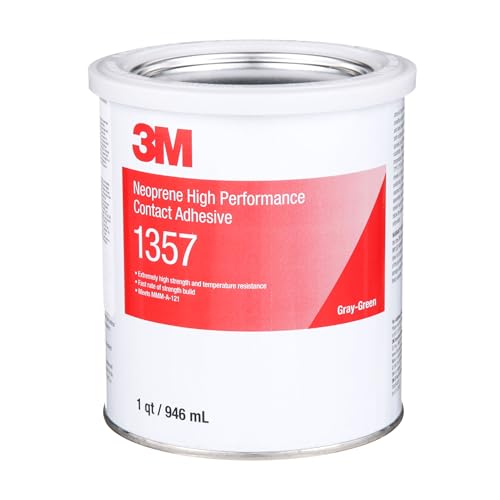
This 3M formulation is a laminating contact adhesive designed for industrial use. You apply a thin coat to both surfaces, let the solvent evaporate until the glue is tacky, then bring them together — the bond locks instantly and won’t let go. Users report excellent results bonding neoprene to metals like stainless steel and aluminum, as well as to plastics and wood veneers. The heat resistance up to 250°F makes it suitable for applications near engine compartments or hot machinery.
The liquid consistency spreads easily with a brush or roller, but you need to work in a very well-ventilated space because the solvent fumes are potent. The gray-green color dries slightly translucent, which some users note can be tricky to clean off tools and surfaces if not dealt with immediately. Follow the manufacturer’s open-air drying time carefully — rushing the tack stage reduces bond strength significantly.
One important distinction: 3M labels this for industrial and occupational use only, not for general consumer retail. That doesn’t mean a DIYer can’t use it, but you should treat it with the respect a solvent-based contact cement demands. If you need a heavy-duty, long-lasting bond for structural neoprene assemblies, this quart can delivers professional-grade performance that cheaper formulas simply can’t match.
Why it’s great
- Instant bond strength once tacky
- Excellent heat and moisture resistance
- Large quart can for major projects
Good to know
- Industrial grade, requires strong ventilation
- Gray-green color makes cleanup harder
- Expensive per ounce compared to smaller tubes
2. 3M Neoprene High Performance Rubber and Gasket Adhesive 1300
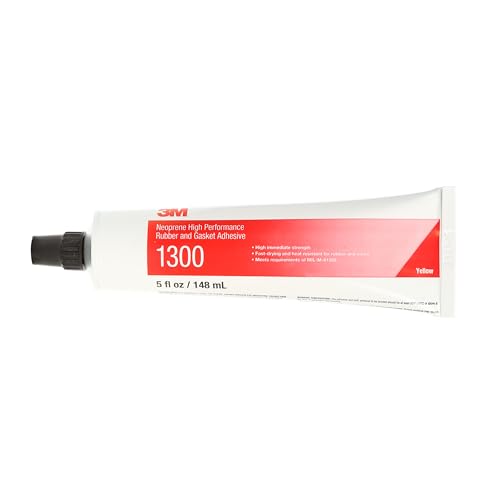
The 3M 1300 is the go-to when your neoprene bond will face sustained heat. Rated up to 300°F, it handles applications like dryer drum gaskets, automotive rubber seals, and industrial belt repairs where standard contact cement would soften and fail. The gel-like consistency stays where you put it, making overhead or vertical applications cleaner.
User reports confirm it works perfectly for attaching oven door gaskets and repairing power washer seals that see both heat and moisture. The yellow color helps you see coverage, but it dries to a clear, flexible film that doesn’t turn brittle with age. The small 5-ounce tube is convenient for specific repair jobs, though some users note the price per ounce is steep compared to bulk cans.
A word from experienced users: don’t apply it thick. A thin, even layer on both surfaces, left to dry until tacky, gives the strongest hold. Multiple thin coats are better than one heavy layer. The solvent is potent — work outdoors or with a respirator in a cross-ventilated space. If you need a high-heat connection that won’t degrade, this tube justifies its premium price.
Why it’s great
- Best-in-category heat resistance at 300°F
- Gel consistency reduces drips
- Trusted 3M industrial quality
Good to know
- Small tube is expensive per ounce
- Needs proper surface prep for full adhesion
- Strong solvent fumes require ventilation
3. Barge Contact Cement Adhesive with Pixiss Spreaders

Barge is a household name in contact cement, and this bundle pairs the classic formula with five Pixiss paste spreaders for smooth application. The cement is water-resistant, toluene-free, and dries clear, making it a solid choice for shoe repairs, neoprene wetsuit patches, and vinyl upholstery work. Users consistently praise it for fixing Birkenstock soles and separating sneaker uppers where other glues failed.
The quick-dry nature means you don’t wait long between application and bonding — usually just a few minutes until the surface loses its wet sheen. Once pressed together, the hold is immediate and remains flexible through repeated flexing. The included spreaders help you get an even coat without waste, though the 2-ounce bottle is reserved for smaller jobs.
There are two trade-offs. First, the chemical smell, while lower than toluene-based cements, is still noticeable and requires ventilation. Second, the thin liquid can be messy if you’re not careful with the bottle tip. But for a versatile, beginner-friendly contact cement that works on neoprene, rubber, leather, and EVA foam, this bundle offers excellent value and a lower chemical burden.
Why it’s great
- Toluene-free with lower odor
- Dries clear and remains flexible
- Includes spreaders for precise application
Good to know
- Small bottle size limits project scope
- Thin consistency can be messy
- Still needs good ventilation for fumes
4. Trident Black Neoprene Cement

Designed specifically for wetsuit and dive gear repairs, Trident’s Black Neoprene Cement keeps seams flexible and waterproof. The black pigment blends seamlessly with most neoprene fabrics, so patches and seam repairs are virtually invisible. Users rely on it for repairing spray skirts on kayaks, dive gloves, and wetsuit tears where a rigid repair would crack under constant water pressure and movement.
The adhesive applies thin and brushable, which means it can seep into torn edges and seal them without creating a hard ridge. One note from long-term users: newer batches seem thinner than older ones, requiring multiple coats for a robust seal. Let each coat dry fully before applying the next or before pressing the repair together.
There are some concerns about freshness. A few buyers received cans that appeared old, with the cement flaking instead of bonding. Check the manufacturing date when it arrives, and return it if the contents are too thick or separated. When fresh, this is purpose-made for neoprene water gear and outperforms generic adhesives in wet conditions.
Why it’s great
- Black color matches neoprene gear
- Stays flexible in water applications
- Purpose-formulated for neoprene
Good to know
- Freshness upon arrival can vary
- Thin formula may need multiple coats
- Limited to smaller repair can sizes
5. S-18 All-Purpose Adhesive, 4 oz Can
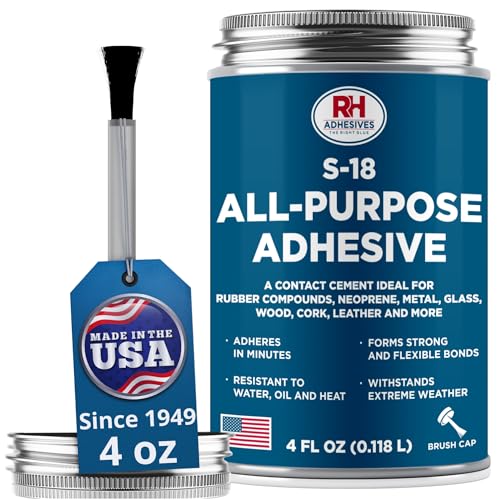
The S-18 from RH Adhesives is a made-in-America formula that bonds neoprene to metal, a notoriously tricky combination. It also handles ceramics, cork, fabric, felt, glass, and tile, making it a true all-purpose option for mixed-material projects. The off-white liquid dries strong and resists oil and water once fully cured after 24 hours.
Users report great success with leather boot repairs, but note that surface preparation is critical. Old glue residue needs to be removed and the area sanded for best adhesion. The adhesive holds well in normal conditions but struggled with outdoor exposure in heat and rain for one user who applied it for car hail protection. That suggests it’s best for indoor or sheltered applications where the bond isn’t continuously waterlogged.
Another practical point: the 4-ounce can is small, and the adhesive tends to thicken if stored for too long between uses. Buy the smaller can only if you have a single project; otherwise, a larger size is worthwhile. Ventilation is essential during application as the solvent fumes are strong. For a pocket-friendly option that bridges rubber and metal, the S-18 punches above its price.
Why it’s great
- Excellent neoprene-to-metal bond
- Heat and oil resistant after cure
- American-made since 1949
Good to know
- 24-hour cure time before full strength
- Not ideal for continuous outdoor exposure
- Small can size for project volume
6. HooTown Adhesive Solid Rubber Strips
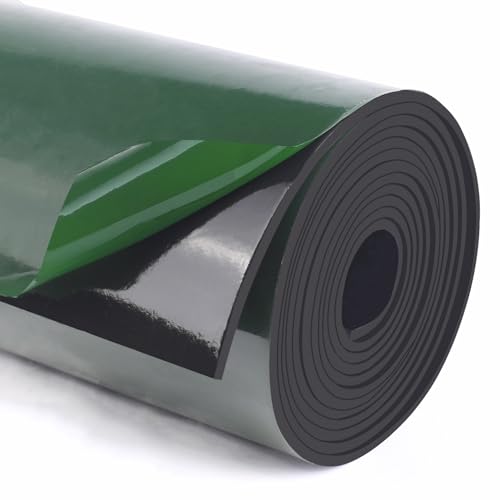
For gasket making, weather stripping, and vibration dampening, HooTown’s self-adhesive neoprene strips eliminate the need for separate glue. The 1/8-inch-thick solid rubber (not sponge or foam) has a pressure-sensitive adhesive layer on one side — peel, position, and press. Users value the strong initial tack that holds tight on car doors, garage seals, and even under-hood insulation.
The material cuts easily with a sharp utility knife for custom shapes and lengths. One experienced user noted an initial strong odor when unrolling the strip, likely from trapped manufacturing solvents, and recommended airing it out before installation. Once placed, the adhesive bond remains solid through temperature changes and vibration, as confirmed by multiple automotive applications.
This isn’t a repair glue — it’s a material with adhesive integrated. If you’re creating a gasket or pad, it saves the hassle of brushing on contact cement and waiting for tack. For sealing gaps or adding cushioning layers, the HooTown strip is a budget-friendly, ready-to-install solution.
Why it’s great
- No glue needed — peel and stick
- Solid neoprene compresses and recovers
- Easy to cut for custom shapes
Good to know
- Odor upon unrolling needs airing out
- Adhesive is one-time use
- Not a liquid repair adhesive
7. HTJZWG Neoprene Rubber Sheet with Adhesive Backing
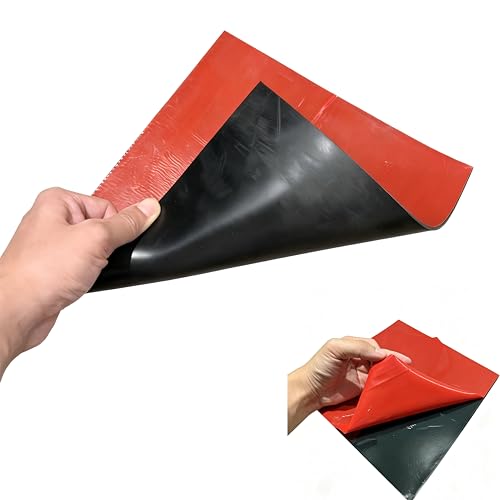
If you need to cut your own gaskets from scratch, the HTJZWG adhesive-backed neoprene sheet is a practical starting point. The 3.0mm thickness provides enough compression for a tight seal while maintaining flexibility for irregular surfaces. Users have successfully traced and cut replacement gaskets for vintage audio horn speakers, confirming the material’s versatility for custom restoration work.
The self-adhesive layer is protective-filmed, so you can cut your gasket shape first and peel the backing only when ready to install. The neoprene itself is oil-resistant, waterproof, and holds up to compression cycling, making it suitable for pipe flanges, pump seals, and weather sealing strips.
Keep in mind that the adhesive backing is a one-time application — position carefully, because repositioning reduces its grip. The 12×11-inch sheet is compact, so plan your cut layout carefully to minimize waste. For simple gasket projects where you want consistent thickness without mixing glue, this sheet delivers a clean and fast result.
Why it’s great
- Cut to exact shape with standard tools
- Oil and water resistant material
- Convenient self-adhesive backing
Good to know
- One-time adhesive positioning is critical
- Sheet size is small for large projects
- Not a liquid repair adhesive
FAQ
Can I use super glue on neoprene rubber?
How do I prepare neoprene before gluing?
Does contact cement work on neoprene wetsuits?
Final Thoughts: The Verdict
For most users, the adhesive for neoprene rubber winner is the Barge Contact Cement bundle because it combines a versatile, lower-odor formula with useful applicators for precise work. If you need extreme heat resistance for gasket or automotive repairs, grab the 3M 1300. And for large-scale laminating projects where instant bond and industrial strength are non-negotiable, nothing beats the 3M 1357.