
Stick welding with a standard household 120V outlet used to mean constant arc outages, cold welds, and a loud breaker box. The new generation of IGBT inverters changed that, packing enough inductance and hot-start force to burn 3/32″ rods smoothly without tripping a 15-amp circuit. Whether you are patching a gate, repairing farm machinery, or building a custom rack, a 120V stick welder that delivers stable current and real penetration changes what you can fix without calling in a pro.
I’m Rikta — the co-founder and writer behind FitlyFast. I’ve spent hundreds of hours analyzing inverter topologies, duty-cycle curves, and real-world rod compatibility across dozens of compact DC arc welders to identify the machines that actually perform on household power.
Shopping for a compact arc welder that runs on standard household current without breaking the bank means knowing which features separate a clean bead from a stuck rod. Our hands-on spec analysis and market research has now produced this definitive guide to the best 120v stick welder.
How To Choose The Best 120V Stick Welder
A 120V stick welder is fundamentally different from a traditional 240V shop machine. You are trading total weld penetration for portability and the convenience of plugging into any garage or outdoor outlet. The best units maximize that trade-off by delivering a stable arc at the 90A–150A range where 3/32″ rods perform best on thin to medium steel. Below are the concrete specifications that separate a usable portable welder from a frustrating one.
Amperage Range and Real-World Limits on 120V
A standard 15A household circuit delivers roughly 1,800 watts. After efficiency losses in the inverter, you get about 100A–120A of usable weld current. Units claiming 200A output on 120V are misleading — that peak is typically only achievable on 240V input. Look for a published 120V maximum between 90A and 150A, and prioritize smooth arc behavior in that band over inflated top numbers. Machines that trip breakers at 90A indicate poor power-factor correction or cheap IGBTs.
Hot Start, Arc Force, and Anti-Stick — The Practical Effect
Hot start gives a brief current spike when you scratch the rod to ignite the arc. Without it, a cold 7018 rod on a 120V machine will stick immediately. Arc force pushes extra current when the voltage drops during the weld puddle, preventing the rod from freezing into the base metal. Anti-stick detects a short circuit and drops current to zero so you can break the rod free without ruining the workpiece. Units with adjustable hot start and arc force offer noticeably better control on thin sheet metal versus gutters and auto-body panels.
Duty Cycle at Operating Amperage
Duty cycle tells you how many minutes out of ten you can weld continuously before the machine requires a cool-down period. A 120V welder that claims 60% duty cycle at 90A is usable for hobby repair. Many budget units drop to 20% at max amperage, meaning 2 minutes of welding followed by 8 minutes of waiting. For repairing gates, trailers, or equipment brackets, aim for at least 30% duty cycle at the amperage you will run most often.
Rod Compatibility — 6013, 7018, and 6010
On a 120V machine, 3/32″ (2.4mm) rods are the sweet spot. E6013 rods run easily at low amperage with minimal spatter, making them ideal for thin steel and beginners. E7018 rods require clean material and higher amperage but produce stronger, low-hydrogen welds for structural repair. E6010 rods are the hardest to run on 120V because they demand fast-freeze characteristics and high open-circuit voltage. Only premium inverters with adjustable arc force can handle 6010 reliably on a 120V circuit.
Quick Comparison
On smaller screens, swipe sideways to see the full table.
| Model | Category | Best For | Key Spec | Amazon |
|---|---|---|---|---|
| ARCCAPTAIN iControl ARC205 Pro | Premium | 6010 rods & app control | 205A peak / 150A on 120V | Amazon |
| YESWELDER 205A Stick Welder | Premium | Continuous production runs | 205A / 8.4 lbs / Lift TIG included | Amazon |
| Sefaspe ARC 200Pro | Mid-Range | Synergic beginner control | 200A / synergic display / VRD | Amazon |
| TOOLIOM 195A Stick Welder | Mid-Range | VRD safety & LCD panel | 195A / VRD / 5/32″ rod max | Amazon |
| DEKOPRO 160A 2-in-1 | Mid-Range | Budget dual-voltage starter | 160A / dual voltage / LCD | Amazon |
| Forney 298 Easy Weld 100ST | Value | All-metal durability in a 90A unit | 90A / all-metal case / 120V only | Amazon |
| Saker Portable Welder | Value | Lightweight handheld utility | 120A / 3.3 lbs / 5-speed dial | Amazon |
| Faiuot Portable Welding Machine | Value | Complete kit with goggles | 120A / kit includes helmet & gloves | Amazon |
| Lincoln Electric Weld-Pak 90i FC | Specialty | Flux-core wire for thin sheet metal | 90A / flux-core only / 15 lbs | Amazon |
In‑Depth Reviews
1. ARCCAPTAIN iControl ARC205 Pro Stick Welder
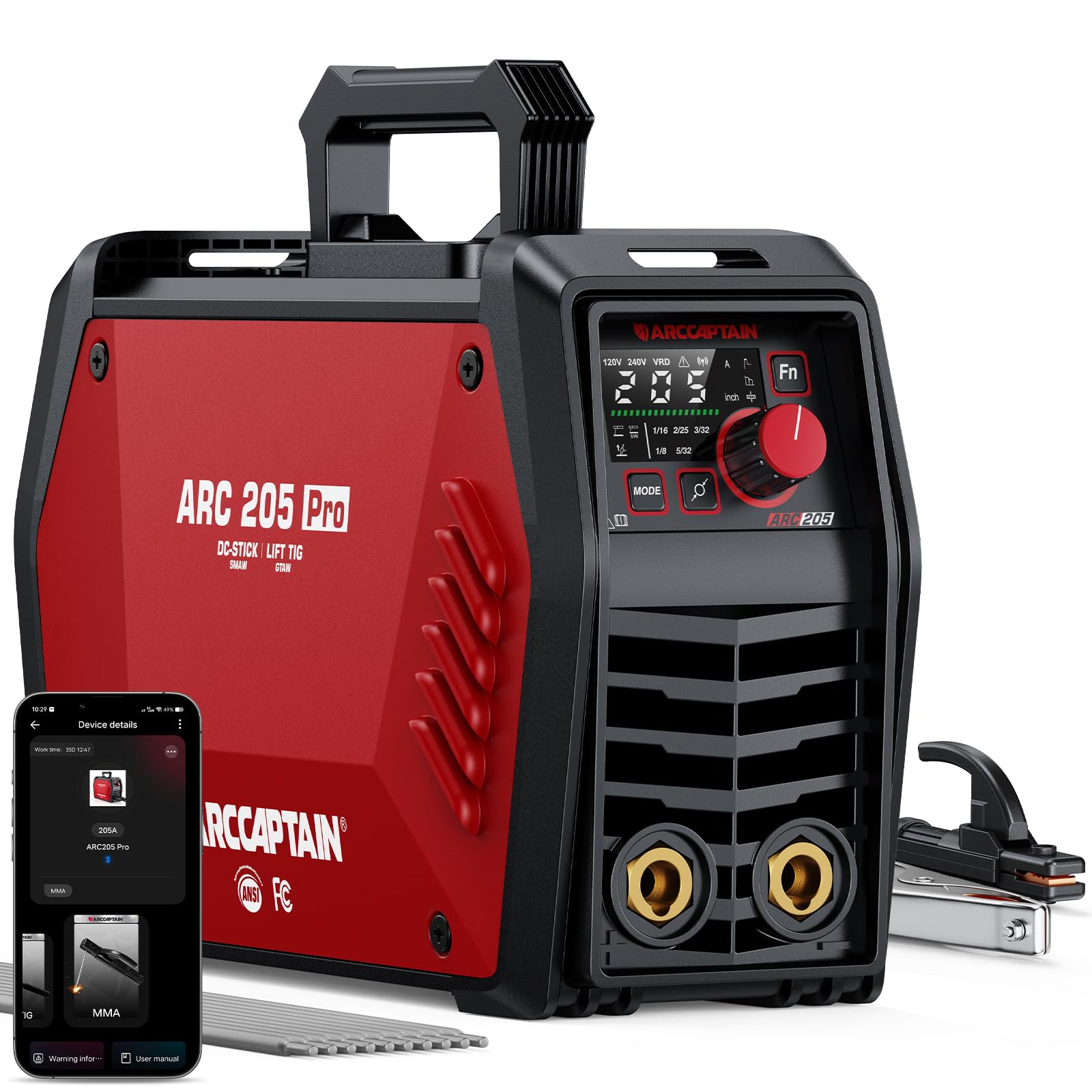
The ARCCAPTAIN iControl ARC205 Pro stands alone in this class for its ability to run E6010 rods reliably on a 120V circuit — a feat that most compact inverters simply cannot achieve. Certified welders in the user base confirm that with Hot Start set to 10 and Arc Force at 30, this unit burns 6010, 6011, 7018, and even 8010 with a stable, consistent arc. The smartphone app connectivity over 10 meters allows you to adjust parameters without removing your helmet, a genuine convenience during long repair sessions.
The dual-voltage capability delivers up to 150A on 120V and a full 205A on 240V, making it equally useful for home projects and future shop upgrades. The intelligent cooling fan and VRD safety function handle extended use without nuisance shutdowns. Weighing only 8.2 pounds with a shoulder strap and dust cover, this is the most complete portable package in the mid-premium bracket.
The supplied electrode holder and ground clamp use aluminum wire and Dinse 25 connectors, which some users upgrade to 2 AWG copper leads and Dinse 35 adapters for heavy-duty use. The stock setup works fine for 3/32″ and 1/8″ rods up to 120A, but professional welders pushing the machine to its limits will want aftermarket cables. Three-year warranty and FCC/ANSI certification add confidence.
Why it’s great
- Genuine 6010 capability on 120V with proper HS/AF tuning
- Smartphone app for real-time parameter monitoring and adjustment
- Ultra-portable 8.2 lbs with shoulder strap and dust cover
- 3-year warranty and FCC/ANSI certified
Good to know
- Stock electrode holder uses aluminum wire — upgrade recommended for sustained high-amperage use
- Lift TIG torch not included, requires separate purchase
2. YESWELDER 205Amp Stick Welder with Lift TIG
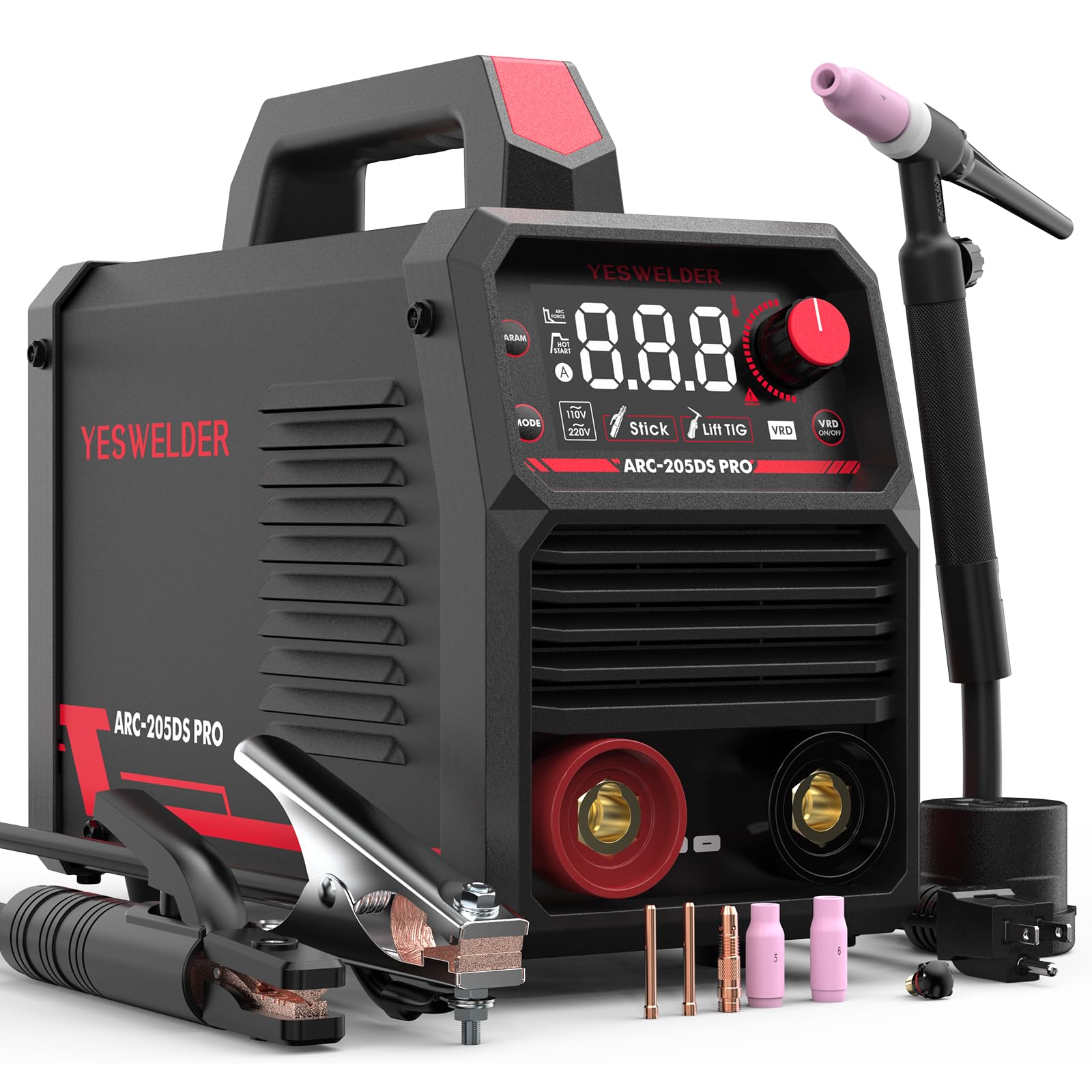
The YESWELDER 205A has proven its reliability in production environments where users run stick welding for 10-hour days across multiple units. The 205A peak output and proper hot start/arc force adjustment allow it to handle 6010, 6011, 6013, and 7018 rods competently, with experienced users reporting consistent penetration even on 120V input. The large LED display shows current, function mode, and welding mode clearly through a welding helmet without squinting.
What sets this unit apart is the included Lift TIG torch — most competitors sell the torch separately. You can switch between stick and TIG mode without buying additional hardware, making it a practical choice for thin stainless steel or mild steel sheet work. The dual-voltage adapter (110V/220V) comes in the box, and the machine auto-detects input voltage for hassle-free operation.
Customer support goes beyond expectations: one user whose 120V arc failed after four months received a proactive replacement after sending troubleshooting videos and even kept the original unit as a backup. The main compromises are the 10-foot leads, which are shorter than desirable for some garage layouts, and the metric-threaded connectors that make aftermarket cable upgrades slightly more involved.
Why it’s great
- Included Lift TIG torch adds MIG-like thin-metal capability at no extra cost
- Proven in 10-hour continuous production runs without shutdown
- Responsive customer support with replacement-unit policy
Good to know
- 10-foot leads are shorter than standard — plan your workspace accordingly
- Metric connectors complicate cable replacement for users wanting heavy-gauge upgrades
3. Sefaspe ARC 200Pro (Large LED Display)
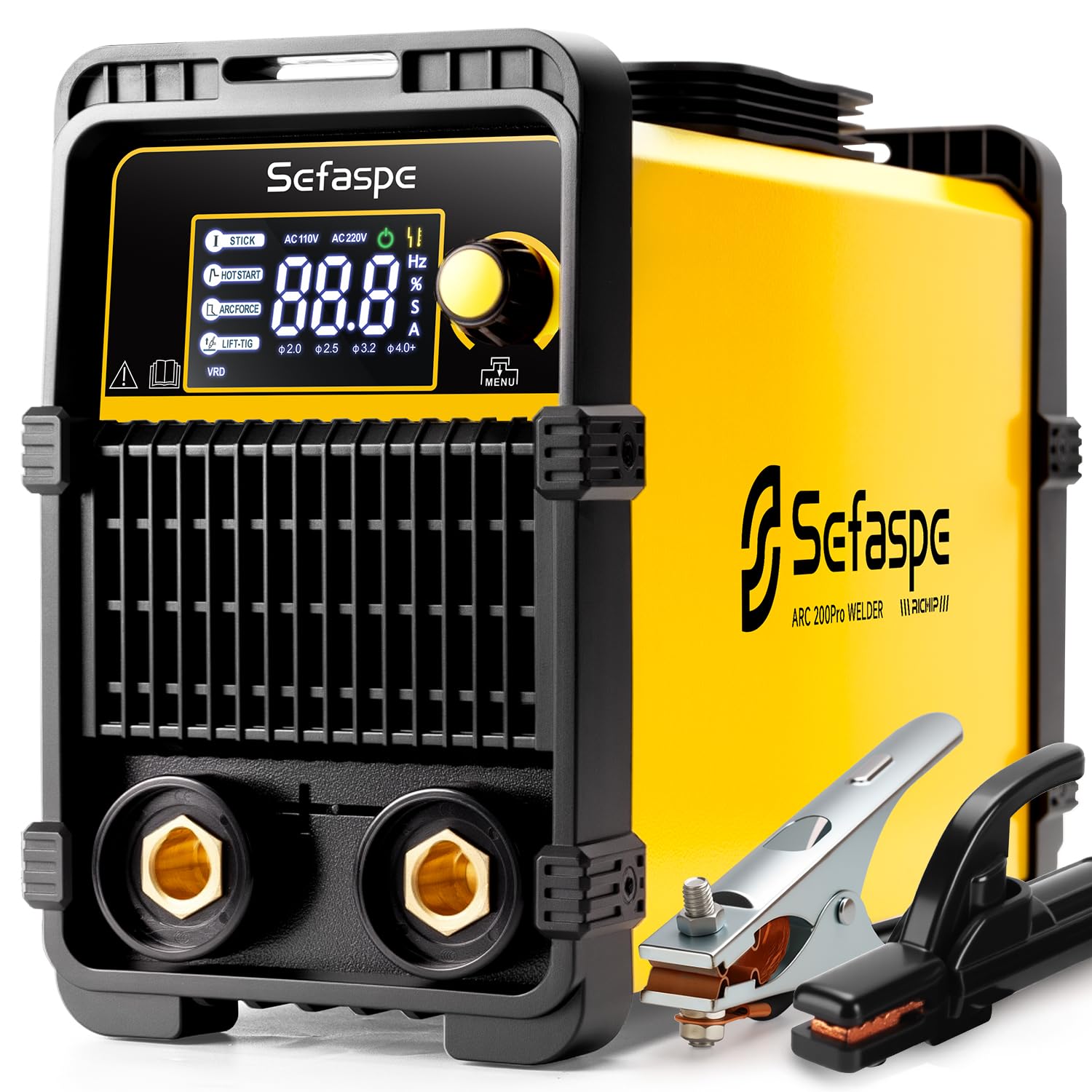
The Sefaspe ARC 200Pro introduces synergic control to the 120V welder class — a smart algorithm that displays the recommended electrode diameter on the LED screen based on the current you dial in. This removes the guesswork for beginners who are unsure whether 3/32″ 6013 or 1/8″ 7018 is appropriate for their project. The adjustable hot start (0-1 second duration, 1-10% current boost) and adaptive arc force (1-10%) give the user fine control over arc initiation and puddle fluidity.
The dual-voltage design supports 40-200A on 240V and a usable 40-150A on 120V, with the 200A peak handling 4.0mm electrodes when connected to a 240V outlet. The anti-stick function instantly drops current to zero during a short circuit, preventing the ruined rods and wasted time that plague lower-end machines. VRD safety lowers no-load voltage, making this a suitable choice for humid environments or outdoor repair work where electrical safety is a concern.
Experienced users note that the 120V performance is best capped at 75A to avoid tripping standard 15A breakers, especially when using longer extension cords. The unit welds 6013 beautifully but struggles with 6010 even on higher arc-force settings. The exhaust vents get warm during extended use — the half-bridge topology and 35A rectifier are well-constructed for the price point.
Why it’s great
- Synergic control automatically suggests correct rod diameter for set current
- Adjustable hot start (duration + intensity) for precise arc initiation
- VRD safety reduces shock risk in damp environments
Good to know
- 120V amperage should be limited to ~75A to avoid breaker trips on 15A circuits
- E6010 rods are not well supported — stick to 6013 for best results on 120V
4. TOOLIOM 195A Stick Welder 110/220V

The TOOLIOM 195A packs a 195A peak output, VRD safety switch, and an intelligent LCD panel into a mid-range price bracket. The VRD (voltage reduction device) can be toggled ON for anti-electric shock protection in wet conditions or OFF for easier arc starts when welding dry indoor steel. This flexibility is rare at this price point and makes the unit both safer for novices and more responsive for experienced welders.
On 120V input, the machine handles 3/32″ 6013 and 7014 rods satisfactorily, with enough arc force to maintain a stable puddle on 1/8″ mild steel up to 3/16″ thick. E7018 rods are usable but require a clean surface and careful rod angle — the 120V limit becomes apparent with low-hydrogen rods. On 240V, it burns 1/8″ rods easily and outperforms many older AC buzz-box transformers.
The 5/32″ (4.0mm) rod capacity is generous for a 195A machine, accommodating heavier industrial electrodes when paired with a 240V outlet. The automatic anti-stick function prevents electrode freezing, and the adjustable hot start makes arc strikes predictable. Some users report tripping a 20A breaker on 120V when pushing past 90A, which is consistent with the real-world limits of this class.
Why it’s great
- Toggable VRD for safety without sacrificing arc ease on dry jobs
- Supports up to 5/32″ rods, surpassing many competitors in this price tier
- Intelligent LCD panel simplifies current and mode selection
Good to know
- 120V performance with 7018 is marginal — best results come from 240V for this rod
- Tripping a 20A breaker is possible when exceeding 90A on 120V
5. DEKOPRO Stick Welder 160A 2-in-1

The DEKOPRO 160A is the most affordable dual-voltage stick welder that still delivers a usable 120V experience. The LCD digital display provides clear amperage readout, and the automatic compensation for voltage fluctuation keeps the arc stable even when plugged into a generator or a long extension cord. The hot start and under/over-voltage protection make this a forgiving machine for first-time stick welders.
On 120V input, the machine runs 3/32″ 6013 rods with a smooth, low-spatter arc suitable for appliance repair, light fence work, and hobbyist projects. Switching to a 240V outlet unlocks the full 160A output, allowing 1/8″ 7018 rods on 1/4″ steel with proper penetration. The IGBT inverter design keeps the weight at a manageable 11.4 pounds with a carry handle that fits through tight access panels.
Users who tested the machine after a 3-foot drop reported it survived without damage and continued welding correctly, which speaks to the build quality despite the low cost. The included ground clamp is functional but many users replace it with a brass unit for better conductivity. The Lift TIG function requires a separate torch purchase but adds versatility for thin metal work once acquired.
Why it’s great
- Lowest entry price for dual-voltage (120V/240V) stick welding
- Automatic voltage compensation maintains stable arc on generator power
- Survived documented drop test — rugged construction for the cost
Good to know
- 120V output is limited — 240V required for full amperage on 1/8″ rods
- Lift TIG torch sold separately; ground clamp is entry-level quality
6. Forney 298 Easy Weld 100ST

The Forney 298 is the only all-metal-cased welder in this roundup — built like a traditional shop tool but sized for 120V household outlets. With a maximum output of 90 amps, this machine intentionally limits its power envelope to stay reliable within a 15A circuit. It welds 5/64″ and 3/32″ 6013 rods beautifully at 45-60A on thin steel from 1/16″ to 3/16″, making it a specialist for light fabrication and automotive bodywork.
The LED indicator lights show power and thermal status, and the rubber handle makes carrying to job sites comfortable. Forney includes an 8-foot electrode holder and 8-foot ground clamp — shorter than some competitors but adequate for small workshops. Experienced welders returning to the hobby after decades report that this machine strikes and holds an arc more easily than the transformer-based units they used in trade school.
The 90A ceiling means you cannot weld 1/4″ plate in a single pass — multiple passes are required, and 1/8″ 7018 rods will struggle at the upper end of the amperage range. The unit also supports TIG welding with an optional torch, though the 90A limit restricts TIG to thin stainless and mild steel. Professional welders confirm the build quality justifies the higher cost for those who value durability over peak amperage.
Why it’s great
- All-metal case built for decades of workshop abuse
- Extremely clean arc on 6013 rods at 45-60A for thin metal
- TIG-capable with optional torch for added versatility
Good to know
- 90A peak limits use to light gauge material — not suitable for heavy structural welding
- On-off switch is small and hard to operate with welding gloves
7. Saker Portable Electric Welding Machine (110V)
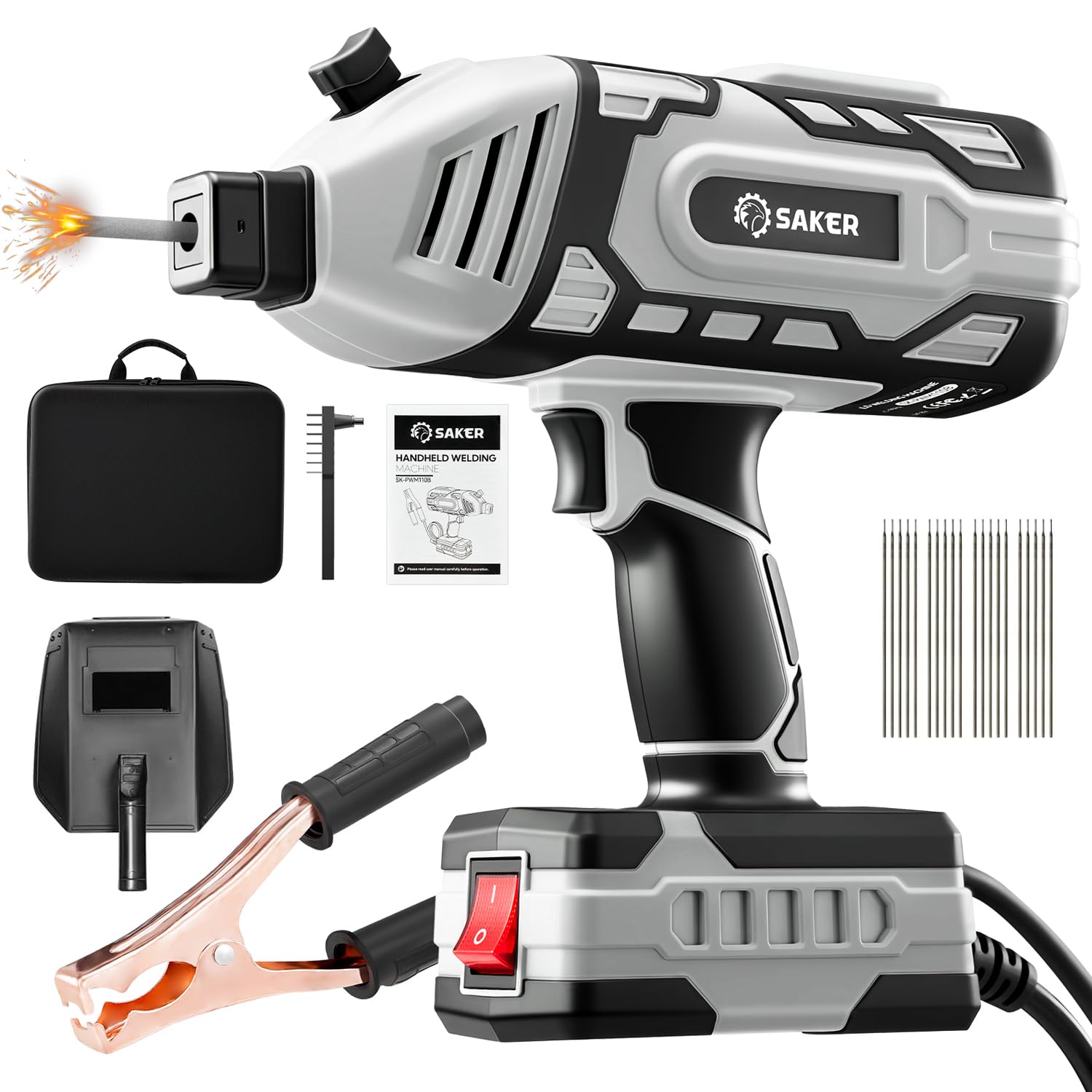
The Saker portable welder weighs only 3.3 pounds and measures 9.8 x 9.45 inches, making it the most compact handheld unit in this comparison. The IGBT inverter engine delivers 20-120 amps through a 5-speed knob, and the high no-load voltage assists arc starting even on rusty or painted surfaces. This is a purpose-built tool for quick repairs on rail fencing, farm equipment, and automotive brackets where carrying a full-sized machine is impractical.
The 360-degree cooling system and automated thermal management allow for extended use without overheating, despite the small chassis. Users running it off a gas generator report excellent performance with consistent arc stability, which speaks to the power-factor design. The 3/32″ rod compatibility covers the most common home-repair electrodes, and the hot start ignition function reduces the frustration of stuck rods for beginners.
The main trade-off for the ultra-light form factor is the limited duty cycle at high amperage — pushing 120A continuously will trigger the thermal protection after a few minutes. The included power cable is also shorter than ideal, requiring an extension cord for most garage setups. The lack of a digital display means you set current by a physical knob without precise amperage readout, but for fence and gate repair, this is rarely a limitation.
Why it’s great
- Extremely light 3.3 lbs — fits in a tool bag for mobile repairs
- Works dependably with gas generators for off-grid welding
- 360° cooling system prevents thermal shutdown during extended 90A runs
Good to know
- No amperage display — current set by 5-position physical knob
- Short power cord requires extension lead in most garage layouts
8. Faiuot Portable Welding Machine 110V with Auto-Darkening Goggles

The Faiuot welding kit is the only package in this list that includes an auto-darkening welding goggle, gloves, helmet, carrying case, 20 rods, and a brush alongside the handheld welder and ground clamp. For a beginner who owns none of the accessories, this represents a complete start-to-weld solution with no additional purchases required. The handheld gun form factor weighs 3.3 lbs and includes a wrist strap for one-handed operation in tight spaces or high-altitude work.
The 20-120A adjustable output with a 5-setting dial provides enough range for 3/32″ rods on steel up to 3/16″ thick. The IGBT inverter technology with current compensation creates a stable arc with reduced spatter, and experienced welders with 60 years of experience report being impressed by the weld depth and ease of use. The auto-darkening goggles adjust from shade #3 to #11 with UV/IR protection, though users note the transition back to light state is slower than premium welding helmets.
Multiple users confirm the included gloves are dangerously poor quality — one reported them catching fire during normal use. This is a serious safety concern, and buyers should immediately replace the gloves with proper welding gauntlets. The carrying case is basic but keeps the components organized, and the 3-year warranty provides reassurance given the low entry price. Some units arrive non-functional, with the seller’s return policy being a point of frustration for affected customers.
Why it’s great
- Complete start-to-weld kit — includes goggle, helmet, gloves, rods, and case
- Experienced welders confirm arc quality exceeds expectations for the size
- 3-year warranty for peace of mind on an entry-level investment
Good to know
- Included gloves are a fire hazard — discard and replace with proper welding gauntlets before first use
- Auto-darkening goggle has slow recovery speed; unit quality control is inconsistent
9. Lincoln Electric Weld-Pak 90i FC Flux Core Welder (K5255-1)

The Lincoln Electric Weld-Pak 90i FC is a flux-core wire-feed welder, not a stick welder, but it earns its place here because it solves the same problem — welding steel on a 120V circuit — with a completely different approach. Instead of scratching rods, you feed self-shielded flux-core wire through a gun trigger, which eliminates the need for arc striking skill. The infinite voltage dial (1-10) provides continuous adjustment for fine-tuning heat input to the material, offering a level of control that stepped settings cannot match.
This machine weighs only 15 pounds and comes with a shoulder strap and metal carrying case, making it the most portable option for on-site repairs. Users report it welds 14-18 gauge stainless steel tables with less spatter than traditional flux-core machines, and the inverter power source delivers a smoother arc than the older transformer-based Lincoln models. The included torch, nozzle, contact tip, and work clamp are high-quality — notably better than the entry-level components found on budget stick welders.
The 90i FC only accepts 1 lb spools, which limits wire capacity for large projects requiring continuous welding. It is flux-core only — there is no gas shield or MIG capability. The shoulder strap replaces a traditional handle, which some users find less convenient for carrying. For hobbyists restoring vintage cars or welding thin sheet metal, the unlimited duty cycle on low settings and the precise voltage control make this a better tool than a stick welder.
Why it’s great
- Infinite voltage dial (1-10) provides continuous fine-tuning for thin sheet metal
- High-quality Lincoln torch and cables — noticeably better than entry-level competitors
- Compact 15 lbs with metal case for true job-site portability
Good to know
- Flux-core only — not compatible with solid wire and shielding gas
- Limited to 1 lb spools; not designed for production-scale continuous welding
FAQ
Will a 120V stick welder trip my household breaker?
Can I weld 1/4-inch steel with a 120V stick welder?
What electrode is easiest for beginners on 120V?
What is the difference between Lift TIG and scratch-start TIG?
Why does my welder stick the rod to the metal?
Final Thoughts: The Verdict
For most users, the best 120v stick welder winner is the ARCCAPTAIN iControl ARC205 Pro because it uniquely delivers 6010 rod capability on 120V, smartphone-based parameter control, and a portable 8.2-pound build that outperforms machines costing twice as much. If you want a machine with a proven 10-hour workday track record and an included Lift TIG torch for thin-metal versatility, grab the YESWELDER 205A Stick Welder with Lift TIG. And for beginners who need synergic guidance to select the right rod and settings without guesswork, nothing beats the Sefaspe ARC 200Pro with its smart display and VRD safety.