
Our readers keep the lights on and the weekend projects moving. As an Amazon Associate, I earn from qualifying purchases.
The average kitchen sponge is a bacterial hotel, and the synthetic polymers that make up most scrubbers can shed microplastics into your dishwater and then into your meals. For health-conscious households, the search for a tool that scrubs hard without harboring germs or leaching chemicals is no longer optional — it is essential. The alternatives are out there, but knowing which material (cellulose, coconut husk, food-grade silicone, or bamboo fiber) actually delivers a clean you can trust takes some digging.
I’m Rikta — the co-founder and writer behind FitlyFast. I’ve spent hundreds of hours cross-referencing material safety data, analyzing user longevity reports, and studying the porous structure of natural fibers to separate genuinely safer scrubbers from those riding a green-washing wave.
From biodegradable cellulose sponges that dry fast enough to stunt bacterial growth to food-grade silicone brushes that never absorb a single drop of greasy water, this guide isolates the best and safest dish scrubber for your health based on material integrity, drying speed, and real-world durability.
How To Choose The Best And Safest Dish Scrubber for Your Health
The health safety of a dish scrubber comes down to three core factors: material composition, drying speed, and structural design. A scrubber that traps moisture or is made from synthetic polymers introduces two distinct risks — bacterial proliferation and potential chemical leaching into your dishwater. Here is what to look for in each category.
Material: Natural Fibers vs. Food-Grade Silicone vs. Synthetic Polymers
The safest category is plant-based cellulose paired with coconut husk. These materials are biodegradable and, critically, do not shed microplastics. Food-grade silicone is the only synthetic material that passes a strict health check because it is non-porous, does not absorb oils or soap residue, and can be boiled to sterilize completely. Standard polyurethane foams and polyester scrub pads should be avoided — they shed tiny plastic fibers with every use.
Drying Speed and Odor Resistance
Bacteria require moisture to multiply. A scrubber that fully air-dries within 2-4 hours is far safer than one that stays damp overnight. Natural cellulose sponges have a porous structure that promotes rapid evaporation, but only if they are stored in a well-ventilated area. Some silicone brushes and cotton-based scrubbers dry even faster because their bristles or fibers do not hold water internally.
Design Features That Prevent Germ Havens
A solid sponge with no drainage holes is a closed ecosystem for bacteria. Look for scrubbers with open structures, hanging holes, or suction-cup holders that lift the tool off the counter. The best designs allow airflow from all sides and never sit in pooled water. Brushes with removable, replaceable heads offer an additional hygiene advantage because you can sanitize or swap the bristle portion without discarding the entire handle.
Quick Comparison
On smaller screens, swipe sideways to see the full table.
| Model | Category | Best For | Key Spec | Amazon |
|---|---|---|---|---|
| Haakaa Silicone Cleaning Brush | Silicone Brush | Germ-free baby bottle cleaning | Food-grade silicone, non-porous | Amazon |
| DEBETOOL 6pc Bamboo Brush Set | Brush Set | Complete plastic-free kitchen | Bamboo handle + sisal/palm fiber | Amazon |
| hasumcol Natural Sponges 12pk | Cellulose Sponge | Compostable daily washing | Cellulose + coconut husk, fast-dry | Amazon |
| Kickleen Natural Sponge 12pk | Cellulose Sponge | Health-focused sponge with hanger | Porous structure, odor resistant | Amazon |
| Vigar Florganic Dish Brush | Eco Brush | Decorative countertop scrubbing | Rice husk handle, nylon bristles | Amazon |
| Skoy Scrub 4-Pack | Cotton Scrub | Cast iron and tough residue | Remnant cotton + non-toxic hardener | Amazon |
| Scrub Mommy 3-Pack | Polymer Foam | Non-scratch multi-surface | FlexTexture foam, temperature control | Amazon |
In‑Depth Reviews
1. Haakaa Silicone Cleaning Brush

From a material-safety standpoint, the Haakaa Silicone Cleaning Brush is the most sanitary option in this lineup. Its bristles are cast from 100% food-grade silicone — a non-porous material that cannot trap water, soap scum, or food particles inside. Unlike cellulose sponges that eventually degrade or polymer foams that shed microplastics, this brush can be boiled for sterilization without any structural compromise. The stainless steel handle adds heft without rust risk, and the replaceable brush head means you keep the handle indefinitely.
Designed initially for baby bottles and breast pump parts, the soft silicone bristles are firm enough to remove dried milk residue from narrow crevices but gentle enough to leave glass and non-stick coatings unscratched. Customers consistently report that the brush never develops that sour sponge smell — even after months of daily use — because the material simply does not absorb. The 10.5-inch length provides excellent reach into tall tumblers and deep pots, a clear ergonomic advantage over palm-sized sponges.
The primary limitation is that silicone bristles lack the aggressive abrasiveness needed for baked-on, carbonized messes on stainless steel or cast iron — you will need a secondary scrubber for that. Additionally, the brush works best on curved or cylindrical surfaces; flat skillets require a different scrubbing motion. But for the user whose top priority is zero bacterial retention and zero chemical leaching, this is the strongest choice.
Why it’s great
- Non-porous silicone eliminates bacterial growth and odors
- Boil-sterilizable for deep sanitation at any time
- Replaceable head reduces waste and extends handle life
Good to know
- Soft bristles are not effective on baked-on or carbonized residue
- Best suited for curved surfaces like bottles and mugs, not flat skillets
2. DEBETOOL 6pc Bamboo Dish Brush Set

The DEBETOOL 6-piece set is the rare kit that provides a full arsenal of plastic-free cleaning tools in one purchase. You get a long-handled dish brush, two short pot brushes (one with sisal fiber, one with palm fiber), a bottle brush, and a coconut-fiber sponge. Every handle is natural bamboo with a smooth ergonomic shape, and the bristles are plant-based — sisal for aggressive scrubbing, palm for lighter work — so there is zero polymer contact during washing. A hanging hole in each brush ensures airflow and rapid drying, the simplest defense against bacterial buildup.
Customer feedback highlights the durability of the coconut sponge and the comfortable grip of the long brush, which reduces hand fatigue during extended dish sessions. The sisal brush is noticeably stiffer and handles caked-on food on stainless steel and ceramic without scratching. Because all components are natural, the entire set can be composted at end of life — a rare claim for any kitchen tool. The packaging is also plastic-free, reinforcing the zero-waste ethos.
Two real-world caveats: the bottle brush bristles can shed after several uses, and the palm-fiber brush is less effective on greasy residue. The bamboo handles require thorough drying to prevent cracking over time (do not leave them soaking in a wet sink). But for a household committed to eliminating synthetic scrubbers entirely, this set delivers unmatched versatility with a health-first material profile.
Why it’s great
- Six-piece kit covers every scrubbing task without any plastic components
- Sisal fiber provides aggressive scrubbing on tough residue
- All-natural materials are fully compostable at end of life
Good to know
- Bottle brush bristles may shed after repeated use
- Bamboo handles must be dried upright to prevent cracking
3. hasumcol Natural Sponges 12 Pack

hasumcol’s sponge pack is built around a simple but powerful health advantage: the sponge half is biodegradable cellulose, and the scrubber half is coconut husk fiber. Neither material sheds synthetic microfibers, and the open-cell structure of the cellulose allows air to flow through the sponge rapidly. Customers note that even after weeks of daily use, the sponge does not develop the sour, musty odor that polyurethane sponges emit within days — a direct result of faster moisture evaporation. The dimensions (4.3 by 2.8 by 0.8 inches) fit comfortably in the hand without being bulky.
Performance-wise, the coconut fiber side handles most stuck-on food without scratching glass, ceramic, or non-stick surfaces. The cellulose side holds a thick lather with minimal soap, reducing the amount of detergent you use per wash cycle. The 12-pack pricing brings the per-sponge cost down to budget-friendly levels, making this an easy swap for families that go through scrubbers quickly. At end of life, you separate the two halves — the cellulose portion goes into the compost bin, and the coconut scrubber can be disposed of with minimal environmental impact.
The trade-off is lifespan: these sponges last about 2-3 weeks before the cellulose begins to break down, which is shorter than polymer sponges. Users who scrub aggressively on rough surfaces will accelerate the wear. Some customers also note that the sponge can hold residual food odors if not rinsed thoroughly after washing greasy pans. However, for pure material safety and compostability, this is one of the best values available.
Why it’s great
- 100% plant-based materials — no microplastic shedding
- Fast-drying porous structure resists bacterial odors
- Compostable at end of life with easy separation of layers
Good to know
- Shorter lifespan (2-3 weeks) compared to synthetic sponges
- Can retain food odors if not rinsed thoroughly after greasy washes
4. Kickleen Natural Kitchen Scrub Sponge with Suction Hanger 12 Pack
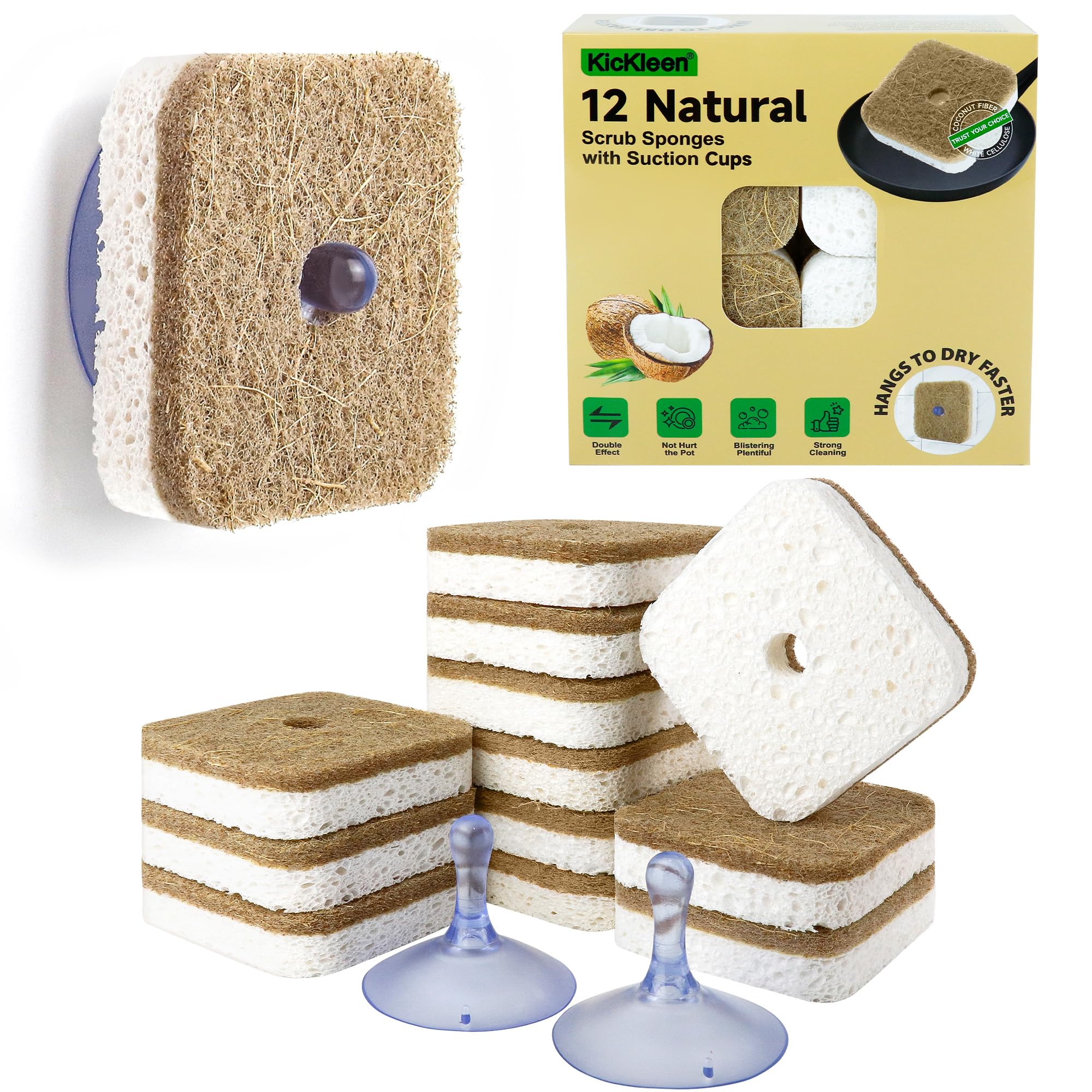
The Kickleen sponge differentiates itself from other natural cellulose options by including a dedicated suction-cup hanger in the package. This may sound trivial, but the ability to hang the sponge off the counter — rather than leaving it flat on the sink edge — dramatically improves airflow around the scrubber, accelerating dry time and further reducing the chance of bacterial proliferation. The sponge itself is made from the same cellulose-and-coconut-fiber formula that is standard in the natural category, but the Kickleen version has a slightly denser cellulose core that holds up to 7-8 wash cycles per day without disintegrating quickly, according to customer reports.
Users frequently praise the balance between the soft sponge side and the coconut scrubber. The abrasive layer feels scratchy initially but does not leave marks on glass, ceramic, or cast iron — even non-stick surfaces are safe. The included hanger has strong suction that stays attached to tile or stainless steel sinks for weeks. Customers also note that the sponge rinses clean easily and does not retain visible stains like synthetic sponges do.
One limitation is that the coconut scrubber is not stiff enough for heavy baked-on messes — a separate metal or sisal scrubber would be needed for burnt casserole dishes. And while the hanger is useful, some users found that the hook is slightly too small for the sponge’s hanging loop, requiring a gentle tug to fit. Still, for the buyer who wants the health benefits of a natural sponge plus a storage system that keeps it dry between uses, this combo works exceptionally well.
Why it’s great
- Included suction hanger keeps sponge lifted and drying rapidly
- Denser cellulose core withstands heavy daily use without early breakdown
- Non-scratch coconut fiber safe on glass, ceramic, and non-stick
Good to know
- Coconut scrubber lacks the stiffness for baked-on residue
- Hanger loop requires effort to fit over the hook
5. Vigar Florganic Dish Brush with Holder

The Vigar Florganic brush moves away from sponge-based cleaning toward a bristle brush format, which inherently dries faster and holds less bacteria than any foam. The body is made from a blend of rice husk and polypropylene — a substantial step up from all-plastic handles — and the vase-shaped holder keeps the brush upright so water drips down instead of pooling at the base. The nylon bristles are stiff enough to scrub away cooked-on grease but soft enough to avoid scratching ceramic and non-stick cookware. One hidden advantage: the brush includes an integrated scraper edge on the side for loosening stuck residue before the bristles finish the job.
Customer reviews consistently mention the longevity — several users report 4+ years of daily use with the same brush, including regular dishwasher cycles to sanitize the bristles. The decorative daisy shape and pink/orange color options make the brush a countertop-friendly tool that does not need to be stashed away in a cabinet. The lightweight ergonomic handle is particularly valued by users with arthritis or hand fatigue.
The catch is that the nylon bristles, while durable, are a synthetic material. They do not shed microplastics at the rate of a polyurethane sponge, but they are not fully biodegradable. Users who want a 100% plastic-free scrubber may prefer the DEBETOOL set. Also, the brush is best suited for general dish duty and sink scrubbing — it is less effective at cleaning inside narrow bottles or deep pots. Those niche tasks require a separate tool.
Why it’s great
- Integrated scraper edge handles stuck-on residue before scrubbing
- Upright drying design prevents moisture buildup and bacterial growth
- Durable construction with reports of 4+ years of daily use
Good to know
- Nylon bristles are synthetic and not fully biodegradable
- Not designed for narrow bottles or deep pot interiors
6. Skoy Scrub 4-Pack

The Skoy Scrub looks like a dense cotton pad, but it is reinforced with a non-toxic hardener that gives it the abrasive texture of a traditional scouring pad — without the metal shavings or synthetic fibers. Made from remnant cotton fibers from the towel industry, this scrubber is a resource-efficient alternative that performs exceptionally well on cast iron and stainless steel. Customers who use Le Creuset and All-Clad cookware report that the Skoy removes baked-on crud without stripping the seasoning from cast iron or scratching the enamel surface. The material is not absorbent, so soap stays on the surface of the scrub rather than soaking in, which also means the pad dries almost instantly after rinsing.
A major health advantage: because the Skoy Scrub is cotton-based and non-absorbent, it does not trap moisture or develop the mildew smell that plagues traditional sponges. It is also dishwasher safe — place it on the top rack for a full sanitization cycle. The 4-pack provides enough rotation to keep a clean scrubber available at all times, and the assorted colors add a small visual lift to the cleaning routine.
The downside is that the Skoy Scrub is not ideal for light, everyday dish duty on glass or non-stick surfaces — the texture is too aggressive for that. Users describe it as a specialist tool for tough messes on durable cookware. Some early users noted that the pad can fray slightly at the edges after many washes, though the scrubbing surface itself remains intact. For the health-conscious cook who regularly uses cast iron and wants a non-toxic, high-abrasion scrubber, this is the top pick.
Why it’s great
- Non-absorbent cotton dries instantly, preventing bacterial growth
- Abrasive enough for cast iron without scratching or stripping seasoning
- Made from remnant fibers — strong sustainability credentials
Good to know
- Too aggressive for everyday use on glass and delicate non-stick
- Edges may fray over time after repeated dishwasher cycles
7. Scrub Mommy Kitchen Sponges 3 Count

The Scrub Mommy introduces a temperature-reactive foam: FlexTexture stays soft in warm water (good for gentle wiping) and becomes firmer in cold water (good for scrubbing). This dual-response behavior reduces the need to switch between tools for different cleaning stages. The scrubber side uses ResoFoam, a non-scratch polymer that is safe on glass, stainless steel, and non-stick surfaces. The sponge is also odor- and stain-resistant — a direct result of the foam formulation, which resists bacterial colonization better than standard polyurethane. Customers report the sponge stays fresh and functional for up to 12 weeks with proper care, including regular dishwasher sanitization.
Ergonomically, the Scrub Mommy’s smile-face shape provides a comfortable palm grip and allows the “mouth” area to clean both sides of a utensil simultaneously. The sponge is thick enough to hold a rich lather, reducing the amount of soap needed per wash. It is a well-engineered product that genuinely outperforms generic yellow-green sponges in both longevity and cleaning efficiency.
From a health-safety perspective, the Scrub Mommy is a polymer product — it does shed microplastic fibers into wastewater over its lifespan, though at a lower rate than cheaper foam sponges. It is not biodegradable, and it cannot be composted. For the user who prioritizes zero plastic shedding above all else, a natural cellulose sponge is the safer direction. But for those who want a balance of durability, ergonomics, and effective cleaning without the quick deterioration of natural sponges, the Scrub Mommy remains a strong mid-range contender.
Why it’s great
- Temperature-reactive foam changes firmness for gentle or aggressive cleaning
- Odor- and stain-resistant for up to 12 weeks with proper dishwasher care
- Ergonomic shape provides comfort and 360-degree utensil cleaning
Good to know
- Polymer foam sheds microplastics into wastewater over its lifespan
- Not biodegradable or compostable at end of life
FAQ
What is the healthiest material for a dish scrubber?
How often should I replace a natural sponge for hygiene?
Final Thoughts: The Verdict
For most users, the best and safest dish scrubber for your health winner is the DEBETOOL 6pc Bamboo Dish Brush Set because it provides a complete plastic-free toolkit with sisal for tough jobs, palm for gentle washing, and a bottle brush for narrow containers, all in a fully compostable material profile. If you want the absolute highest sanitation standard with zero absorbency, grab the Haakaa Silicone Cleaning Brush — its food-grade silicone bristles and boil-sterilizable design eliminate the bacterial risk entirely. And for a budget-friendly, compostable daily sponge that outperforms synthetic options in drying speed and odor control, nothing beats the hasumcol Natural Sponges 12 Pack.