
Our readers keep the lights on and the weekend projects moving. As an Amazon Associate, I earn from qualifying purchases.
Upgrading to a mesh system is the single best step for eliminating dead zones and future-proofing your home for the bandwidth-hungry devices now hitting the market. The real leap comes with the 6GHz band, which opens a pristine stretch of airwaves entirely free from the congestion that chokes your old 2.4GHz and 5GHz networks.
I’m Rikta — the co-founder and writer behind FitlyFast. I’ve spent countless hours analyzing Wi-Fi chipset specs, backhaul designs, and firmware stability reports from real-world users to separate the mesh systems that truly leverage the 6E band from those that just slap a sticker on the box.
Choosing the right setup means balancing raw speed, coverage area, and the specific needs of your home’s construction and device count. This guide breaks down the top contenders on the market to help you find the best 6e mesh system for your home and budget.
How To Choose The Best 6E Mesh System
The promise of Wi-Fi 6E is the new 6 GHz band, but the actual performance you get depends on how a system handles its backhaul, its antenna design, and the quality of its software. Don’t let a single impressive spec like the maximum data rate distract you from the factors that matter for daily use.
Tri-Band vs. Dual-Band: The Backhaul Question
A dual-band system has a 2.4 GHz and a 5 GHz radio. When the satellite needs to talk to the main router, it uses one of those bands, which steals bandwidth from your devices. A true tri-band 6E system—with a dedicated 6 GHz radio for backhaul or at least a third band—keeps communication between nodes fast and separate from your device traffic. If you can’t run Ethernet cables, a tri-band system is almost mandatory for good performance.
Wired Backhaul: The Gold Standard
If your home is wired with Ethernet or coaxial cable (using MoCA adapters), you can enable wired backhaul. This frees up all wireless bands for your devices and provides the most stable and fastest connection possible between mesh nodes. Any system in this guide supports wired backhaul, but not all houses are wired for it. If yours is, you can consider a dual-band system with confidence.
Node Count and Coverage Realities
Manufacturers advertise coverage numbers like 7,000 square feet, but this is tested in ideal, open environments. In a real home with concrete walls, metal studs, or large appliances, the effective range is often halved. A 3-pack is usually the sweet spot for a typical 2,500 to 4,000 square foot home, allowing one node per floor or for covering extreme ends of a single-story layout.
Quick Comparison
On smaller screens, swipe sideways to see the full table.
| Model | Category | Best For | Key Spec | Amazon |
|---|---|---|---|---|
| ASUS ZenWiFi BT6 (3pk) | Tri-Band Wi-Fi 7 | Future-proofing & high density | 9.4 Gbps / 7,600 sq. ft. | Amazon |
| NETGEAR Orbi 770 (RBE773) | Tri-Band Wi-Fi 7 | Scaling to 100+ devices | 11 Gbps / 8,000 sq. ft. | Amazon |
| ASUS ZenWiFi ET9 (2pk) | Tri-Band Wi-Fi 6E | Integrated security & parental controls | 7,800 Mbps / 5,500 sq. ft. | Amazon |
| TP-Link Deco XE70 Pro (3pk) | Tri-Band Wi-Fi 6E | Large homes with concrete walls | 4.9 Gbps / 7,200 sq. ft. | Amazon |
| TP-Link Deco XE5300 (3pk) | Tri-Band Wi-Fi 6E | Budget-friendly tri-band setup | 5,300 Mbps / 7,200 sq. ft. | Amazon |
| Amazon eero 7 (3pk) | Dual-Band Wi-Fi 7 | Plug-and-play simplicity | 2.5 GbE ports / 6,000 sq. ft. | Amazon |
| NETGEAR Orbi 370 (RBE374) | Dual-Band Wi-Fi 7 | Budget Wi-Fi 7 mesh coverage | 5 Gbps / 8,000 sq. ft. | Amazon |
| Tenda Nova MX21 Pro (3pk) | Tri-Band Wi-Fi 6E | Value with manual control | 5,700 Mbps / 7,300 sq. ft. | Amazon |
| Google Nest WiFi Pro (3pk) | Tri-Band Wi-Fi 6E | Google Home ecosystem users | 2,200 sq. ft. per node | Amazon |
In‑Depth Reviews
1. ASUS ZenWiFi BT6 Tri-Band WiFi 7 Mesh (3-Pack)

The ASUS ZenWiFi BT6 is a forward-looking powerhouse that leverages Wi-Fi 7’s Multi-Link Operation (MLO) and 4K-QAM alongside the 6GHz band to deliver a staggering 9.4 Gbps aggregate speed. This 3-pack is rated for 7,600 square feet, and the seven internal antennas paired with high-power front-end modules are built to punch through dense home environments. The inclusion of 2.5G WAN ports on every node ensures your multi-gig fiber plan isn’t throttled.
Setup is handled through the intuitive ASUS app, giving you access to a wealth of features, including commercial-grade AiProtection Pro security from Trend Micro, advanced VPN support, and a dedicated IoT network via Smart Home Master SSIDs. This effectively segments your smart bulbs and switches from your main network traffic, a premium security touch. Users report seamless handoff across nodes and rock-solid stability after the initial firmware updates.
The minor but notable quirk is that some older devices may not immediately play nice with Wi-Fi 7’s new features, often requiring you to disable the newer protocols in favor of legacy support. Additionally, a small number of initial units required a factory reset after a crucial firmware patch to resolve intermittent DNS issues. For the tech-savvy user looking to truly future-proof, this is a stellar choice.
Why it’s great
- Exceptional Wi-Fi 7 speeds and coverage with 2.5G ports on each node.
- Comprehensive, subscription-free security and advanced parental controls.
- Flexible AiMesh expandability with other compatible ASUS routers.
Good to know
- Requires careful firmware management to ensure stability on early units.
- Some legacy IoT devices may struggle to connect, needing a separate 2.4GHz network.
2. NETGEAR Orbi 770 Series (RBE773) Tri-Band Wi-Fi 7

The NETGEAR Orbi 770 is built for the device-saturated household, confidently handling over 100 connected devices across its 8,000 square foot coverage area. Its tri-band configuration uses Wi-Fi 7’s speeds up to 11 Gbps and features NETGEAR’s Enhanced Backhaul technology to keep communication between the router and satellites fast and efficient, which is critical when dozens of phones, cameras, and consoles are competing for airtime.
Real-world users consistently praise the “set it and forget it” reliability, noting that after the initial 15-minute app setup, the system rarely requires any further interaction. The availability of multiple 2.5 Gigabit Ethernet ports on the main router and satellites allows for high-speed wired connections for gaming PCs and NAS drives. The elegant, high-performance antenna design provides 360-degree coverage, effectively eliminating dead zones in multi-story layouts.
One common criticism is the lack of advanced configuration options within the Orbi app, such as per-device prioritization, which some power users may miss. A few users reported that optimizing wired backhaul requires Cat 6 Ethernet cables, as older Cat 5e wiring can introduce instability. For those whose priority is a massive, reliable network without the need for constant tinkering, this system is a top contender.
Why it’s great
- Exceptional stability and handling of 100+ devices without slowdowns.
- Great wireless backhaul performance that maintains high throughput.
- Easy setup with reliable, consistent speeds throughout a large home.
Good to know
- Lacks granular per-device QoS and advanced settings in the app.
- Wired backhaul may require Cat 6 cabling to avoid instability.
3. ASUS ZenWiFi ET9 Whole-Home Tri-band Mesh WiFi 6E (2PK)

The ASUS ZenWiFi ET9 focuses on delivering a robust, secure, and feature-rich 6E experience. With speeds up to 7,800 Mbps, it uses the 6 GHz band for a superior, dedicated wireless backhaul, ensuring your satellite provides the same high performance as the main router. Its unique antenna placement is designed to push coverage to 5,500 square feet, and the inclusion of a 2.5G port on the WAN side allows it to handle faster-than-gigabit internet plans.
The standout feature is the subscription-free lifetime internet security powered by Trend Micro. The AiProtection suite, accessible via the ASUS app, provides a one-tap security scan, advanced parental controls with flexible content filters, and a one-click sharable VPN for protecting your privacy on public Wi-Fi. This makes it an excellent choice for families concerned with online safety without ongoing fees. Users report seamless integration with existing ASUS routers via AiMesh.
Setup is generally straightforward, though configuring the separate 2.4GHz band for finicky smart home devices like HomeKit accessories sometimes requires extra steps or even community guidance. Some users on older firmware experienced dropouts, an issue largely resolved by keeping the system updated. If you prioritize a secure, well-featured network over the absolute maximum raw speed, the ET9 is a compelling option.
Why it’s great
- Lifetime free network security and advanced parental controls.
- Dedicated 6 GHz backhaul for strong satellite performance.
- Expandable with other ASUS AiMesh routers for custom coverage.
Good to know
- May require extra steps to set up a separate 2.4GHz IoT network.
- Initial firmware updates are sometimes necessary to resolve early stability issues.
4. TP-Link Deco XE70 Pro AXE4900 Tri-Band WiFi 6E (3-Pack)

The TP-Link Deco XE70 Pro strikes an outstanding balance of performance, features, and value. This tri-band AXE4900 system serves up 4.9 Gbps of aggregate speed across 7,200 square feet, and the inclusion of a 2.5 Gbps WAN/LAN port on every unit is a rare treat at this price point. This allows for high-speed wired backhaul and future-proofing for multi-gig internet plans, a feature often reserved for far more expensive kits.
The mesh technology is enhanced by built-in AI-roaming, which learns your device movements to optimize connections as you walk through the home. This is a practical feature that reduces handoff lag during video calls. The Deco app is universally praised for its simple setup and clear interface, making it accessible to non-technical users. HomeShield, TP-Link’s premium security service, adds a layer of network and IoT protection that can be trialed and subscribed to for advanced features.
Customer reviews from owners in large, concrete-walled homes are particularly glowing, with the 6E signal managing to penetrate thick barriers that crippled previous routers. The primary complaint is the lack of an in-app speed test and a status light that cannot be adjusted for brightness, only toggled on/off. For a worry-free, high-performance upgrade that won’t break the bank, this is the system to beat.
Why it’s great
- 2.5 Gbps ports on each node for excellent wired backhaul and future-proofing.
- Excellent signal penetration through thick walls and difficult home layouts.
- Simplified setup and management through the highly intuitive Deco app.
Good to know
- Missing an in-app speed test tool for quick diagnostics.
- Unbrightable status light may be distracting in a bedroom.
5. TP-Link Deco XE5300 AXE5300 Tri-Band WiFi 6E (3-Pack)

The TP-Link Deco XE5300 is a workhorse that provides near-flawless 6E tri-band performance at a competitive price point. It offers the same 7,200 square feet of coverage as its XE70 Pro sibling, but tops out at 5,300 Mbps and uses standard Gigabit Ethernet ports rather than 2.5G. For homes with gigabit or sub-gigabit internet, this is not a practical limitation, and the tri-band design still ensures a high-performance wireless backhaul.
User feedback heavily emphasizes the reliability and ease of setup. The Deco app makes the process painless, and once running, the system provides a seamless mesh network with no handoff drops. Locking in a wired backhaul via a simple Ethernet switch is noted as a best practice that significantly boosts performance. The system is completely backward compatible, so older devices work without a hitch.
The primary trade-off for the lower price is the simpler software. The Deco app lacks some of the more granular configuration options found in ASUS or high-end Netgear systems, and its diagnostic tools are limited. One user reported that the network configuration was deleted in an app update, requiring a reinstall. For the vast majority of users who just want a fast, reliable network throughout their home, this is an excellent and straightforward recommendation.
Why it’s great
- Outstanding value for a true tri-band 6E mesh system.
- Very reliable performance and seamless roaming across the house.
- Simple setup and management via the user-friendly Deco app.
Good to know
- Limited to Gigabit ports, not ideal for multi-gig internet plans.
- Basic app lacks advanced diagnostics and customization options.
6. Amazon eero 7 Dual-Band Mesh Wi-Fi 7 (3-Pack)

The Amazon eero 7 is the epitome of simplicity, designed to deliver a reliable Wi-Fi 7 experience without any of the technical complexities. It’s a dual-band system, which means it doesn’t have the dedicated backhaul of a tri-band setup, but its Wi-Fi 7 support—including Multi-Link Operation (MLO)—allows it to use multiple bands at once for better performance than typical dual-band 6E systems. With coverage up to 6,000 square feet and support for 120+ devices, it’s a serious contender for the non-technical user.
The eero app is famously straightforward, guiding you through setup in minutes. The system’s TrueMesh software proactively manages your connection paths to ensure you’re always on the optimal channel. Each unit features two auto-sensing 2.5 GbE ports, allowing you to create a wired backhaul network if you have Ethernet jacks. The compact, unobtrusive design is a bonus for those who care about aesthetics.
User reviews note its incredible consistency and how it “just works” after initial setup, with several users reporting that it eliminated all Wi-Fi issues. The main drawback for power users is the simple dual-band architecture, which may not perform as well under extreme load as a tri-band system. Some units were noted to run warm, so ensuring adequate ventilation is important. For the user who values a hassle-free, future-ready network, the eero 7 is a top pick.
Why it’s great
- Incredibly simple setup and management with an excellent mobile app.
- 2.5 GbE ports on every unit for strong wired backhaul.
- Compact, clean design that blends into any room.
Good to know
- Dual-band design limits performance compared to tri-band alternatives.
- Units can run warm and require good airflow to prevent overheating.
7. NETGEAR Orbi 370 Series (RBE374) Dual-Band Wi-Fi 7
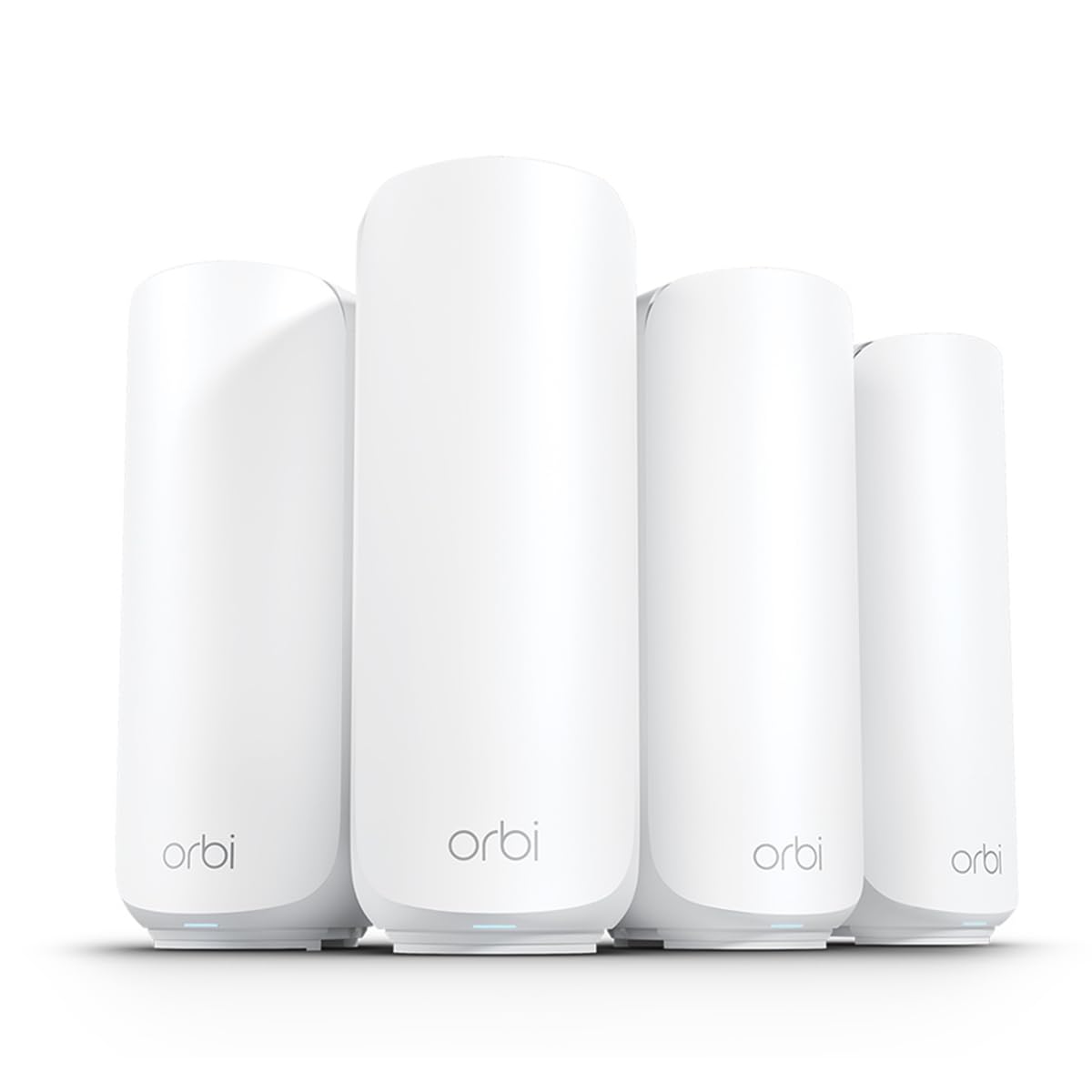
The NETGEAR Orbi 370 Series is a dual-band Wi-Fi 7 mesh system that focuses on providing massive coverage for a relatively low price. With a router and three satellites, it covers up to 8,000 square feet, making it an appealing option for those with a large, open home who want the latest Wi-Fi 7 standard without paying a premium. It uses Enhanced Backhaul to create a strong, reliable link between the router and its satellites.
The Orbi app makes setup painless, and the system is fully backward compatible, so all your older devices will work. The built-in security features, including automatic firmware updates and Advanced Router Protection, provide a good baseline for network safety. The inclusion of a 2.5 Gbps port on the main router allows it to connect to higher-speed internet plans.
Several long-term users, however, reported significant reliability issues. A pattern of units requiring daily to weekly restarts emerged after a few months of use, strongly suggesting a firmware memory leak problem. Another critical issue reported is that Wi-Fi calling can drop or suffer from poor quality when connected to the satellites, likely because the same 5 GHz band is used for both backhaul and client traffic. For a reliable connection, a tri-band or Wi-Fi 7 system with MLO is a safer bet.
Why it’s great
- Impressive stated coverage of 8,000 sq. ft. with four units.
- Entry-level price for Wi-Fi 7 mesh technology.
- Quick and easy initial setup through the Orbi app.
Good to know
- Significant long-term stability issues reported, requiring frequent reboots.
- Wi-Fi calling can be unreliable when connected to satellite nodes.
8. Tenda AXE5700 Nova MX21 Pro Wi-Fi 6E Mesh (3-Pack)

The Tenda Nova MX21 Pro is a powerhouse for those on a budget, offering true 6E tri-band performance at a price usually associated with entry-level systems. It uses a quad-core Broadcom chip and seven internal 3dBi antennas to push AXE5700 speeds across up to 7,300 square feet. This set provides the dedicated 6 GHz backhaul that makes a real difference for whole-home speed, a rarity in its price bracket.
A strong point is the level of control it offers. Unlike many mesh systems that hide settings, Tenda allows you to set separate SSIDs for the 2.4GHz, 5GHz, and 6GHz bands. This is a godsend for smart home enthusiasts who need to lock IoT devices onto a specific channel. The Tenda Wi-Fi app includes useful tools for network diagnosis, including measuring WiFi interference, ping rates, and connection quality.
User experiences are mixed. While those who configure it correctly report incredible value and performance, a significant number of users have had poor experiences, with the system failing to outperform even the ISP-provided router in some setups. The generally positive feedback for wired backhaul setups contrasts with reports of inconsistent wireless-only performance. It’s a fantastic choice for the user willing to fine-tune settings to get the absolute best value, but it may not be for everyone.
Why it’s great
- True tri-band 6E performance at a budget-friendly price point.
- Allows manual control of separate network bands and channels.
- Good performance with wired backhaul and solid hardware specs.
Good to know
- Wireless-only backhaul performance can be unreliable and inconsistent.
- Firmware updates and overall customer support are less robust than the competition.
9. Google Nest WiFi Pro 6E (3-Pack) – Snow

The Google Nest WiFi Pro is your best bet if you’re deeply integrated into the Google Home ecosystem. With tri-band 6E support, it automatically manages your network, prioritizing video calls and high-bandwidth tasks. The setup is famously simple via the Google Home app, and the system provides up to 2,200 square feet of coverage per node, so a 3-pack can cover a large home. The sleek, minimalist Snow design blends into any environment.
Its real strength lies in its self-managing nature. The Nest WiFi Pro monitors itself, diagnoses issues, and can even fix common problems automatically. It handles secure booting and automatic software updates to protect against router hacks. For the user who does not want to think about their network, this is a major advantage. The guest network feature is secure and easy to set up, and you can see and manage all connected devices from the app.
The system has one major, reproducible flaw that has turned many users away. In certain configurations, the mesh system can confuse devices about their geographical location relative to the router, causing them to stick to a weak signal rather than switching to a stronger one. This leads to terrible performance and disconnects for some users. Despite its excellent ecosystem and interface, this core functionality issue makes it a risky recommendation for those who don’t want to gamble.
Why it’s great
- Extremely easy setup and integration with the Google Home ecosystem.
- Self-managing network with auto-prioritization and diagnostic features.
- Clean, understated design that looks great in a living room.
Good to know
- Known flaw with mesh handoff causing devices to connect to a weak signal.
- Not compatible with older Google Wifi or Nest Wifi products.
FAQ
Do I need a 6E mesh system if I don’t have any 6E devices?
Can I use a 6E mesh system in a house with concrete walls?
What does ‘backward compatible’ mean for a 6E mesh system?
Final Thoughts: The Verdict
For most users, the 6e mesh system winner is the TP-Link Deco XE70 Pro because it delivers incredible tri-band performance, 2.5G ports for future-proofing, and excellent signal penetration at a price that represents outstanding value. If you want a massive, device-dense network with the latest Wi-Fi 7 technology, the NETGEAR Orbi 770 is the heavy lifter for your home. And for those who prioritize a secure, feature-rich experience with subscription-free antivirus and parental controls, the ASUS ZenWiFi ET9 is the perfect choice.