
Our readers keep the lights on and the weekend projects moving. As an Amazon Associate, I earn from qualifying purchases.
Every month you drop a hundred bucks or more for channels you rarely watch while the major networks—ABC, CBS, NBC, Fox, PBS—broadcast the same shows through the air for free. The only hardware standing between you and that freedom is a well-chosen antenna that actually pulls in the signals your location demands. This guide breaks down the real-world range, build quality, and installation realities of today’s top over-the-air antennas so you can cut the cord without cutting corners.
I’m Rikta — the co-founder and writer behind FitlyFast. I’ve analyzed dozens of antenna specifications, consumer reports, and field performance data to separate marketing claims from actual reception results for this guide.
After combing through hundreds of user experiences and technical specs across passive and amplified designs, I’ve narrowed the field to the seven models that define the current market for the antenna for local channels.
How To Choose The Best Antenna For Local Channels
Selecting the right antenna requires matching three variables: your distance to broadcast towers, the terrain and building materials between you and them, and the frequency bands your target channels use. A antenna aimed wrong in a signal-shadowed valley will perform worse than a model correctly aimed on a high eave. Start with your real distance—not the antenna’s claimed range—then evaluate the design type that fits your environment.
Know your VHF vs. UHF needs
Most local channels broadcast on UHF (channels 14–36), but many markets still carry major networks on VHF-Hi (channels 7–13) and occasionally VHF-Lo (channels 2–6). Flat indoor antennas and compact omnidirectional models often struggle with VHF signals because the wavelength requires longer elements. A Yagi antenna with distinct VHF elements will lock in those channels reliably, especially beyond 30 miles from the tower.
Amplifier: necessity or noise-maker?
Amplifiers boost weak signals but also amplify noise and overload in strong-signal areas. If you live within 25 miles of towers, a passive antenna often delivers cleaner reception. Beyond 40 miles, or when splitting the signal to multiple TVs, a pre-amplifier mounted at the antenna (not a cheap inline amp) is the correct tool. Beware of antennas with built-in amplifiers that cannot be bypassed—they can make reception worse in urban fringe zones.
Construction and weather resilience
Outdoor antennas face rain, wind, UV, and temperature swings. Look for aluminum elements, sealed coax connections, and UV-stable plastic or metal housings. Several mid-range models report corrosion or water ingress after two years outdoors; spending incrementally more on a design with gold-plated connectors or a sealed amplifier housing pays off. For attic installation, almost any build quality works, but the antenna still needs proper grounding to dissipate static buildup.
Quick Comparison
On smaller screens, swipe sideways to see the full table.
| Model | Category | Best For | Key Spec | Amazon |
|---|---|---|---|---|
| Antennas Direct ClearStream 2V | Premium Passive | Multi-directional suburban clarity | 60+ mi range; 31.4″ width | Amazon |
| PBD Amplified Motorized | Amplified Rotator | Sweeping for signals from all directions | 360° motorized rotation; 40ft RG6 | Amazon |
| 1byone Omni-Directional | Amplified Omni | Compact attic or urban installs | 100+ mi amp; 360° omnidirectional | Amazon |
| GE Outdoor 29884 | Mid-Range Passive | Reliable suburban attic mounting | 70 mi range; 3 lbs total weight | Amazon |
| Five Star Yagi | Budget Yagi | Deep fringe VHF reception | 8dB VHF gain; includes 40ft coax | Amazon |
| McDuory Yagi | Entry Yagi | Budget VHF-Hi capture near towers | 70+ mi range; 75 ohm impedance | Amazon |
| Arrasolt Melas Amplified | Budget Amplified | Quick window setup for strong urban signals | 38ft coax; slim indoor/outdoor | Amazon |
In‑Depth Reviews
1. Antennas Direct ClearStream 2V
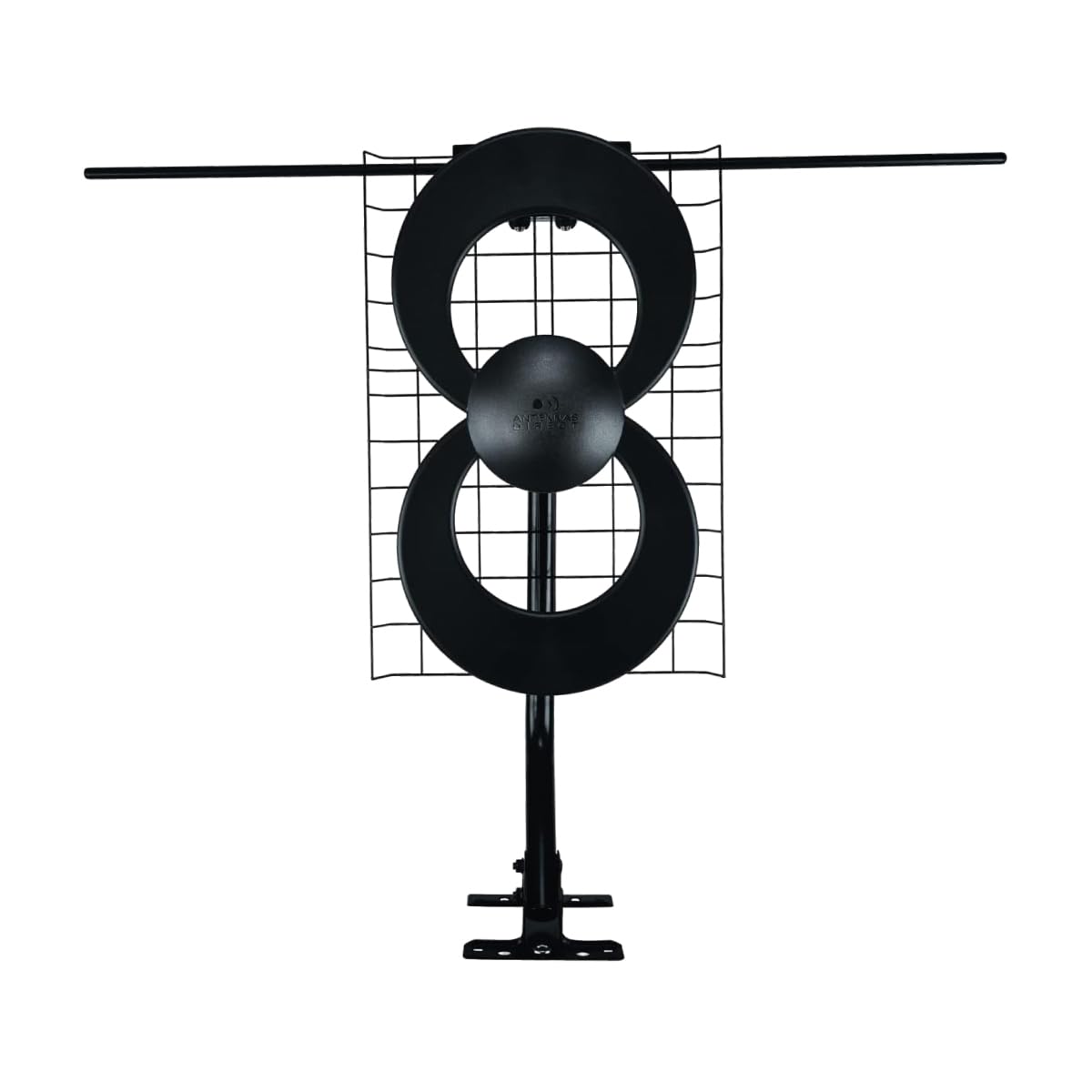
The ClearStream 2V from Antennas Direct is engineered with a balanced double-loop design that captures both UHF and high-VHF signals without an amplifier in many suburban settings. At 31.4 inches wide with a reflector, it focuses reception forward while still pulling in signals from the sides, which makes it forgiving for homes where towers sit in multiple directions. Users consistently report pulling 60 to 70 perfectly clear channels at ranges between 30 and 50 miles from the towers.
The included 20-inch mast with a pivoting base allows flexible mounting indoors, in an attic, or on an exterior wall, and the all-weather hardware is built for years of outdoor exposure. Unlike amplified antennas, this passive design introduces no noise floor, so users in strong-signal zones get cleaner pictures without pixelation. Several verified buyers noted that adding an optional preamp later extended their reach past 60 miles when needed.
Assembly is straightforward with the included instructions, though the antenna ships without a coaxial cable, so you will need to purchase RG6 separately. The lifetime manufacturer warranty on the antenna itself provides confidence, and the build quality—using UV-stable materials and metal reflector elements—exceeds what most mid-range competitors offer at similar price points.
Why it’s great
- Passive multi-directional design delivers clean signal without amplifier noise
- Durable all-weather construction with lifetime antenna warranty
- Wide 31.4-inch reflector captures VHF channels many compact antennas miss
Good to know
- No coaxial cable included in the box
- At 2 lbs it is lightweight but the 31-inch width requires adequate mounting space
2. PBD Amplified Outdoor with 360° Motorized Rotation

The PBD WA-2608 integrates a built-in high-gain amplifier with a motorized pivot controlled by a remote, letting you sweep the antenna across 360 degrees to lock onto towers in different directions. This feature is a genuine advantage in locations where broadcast towers are not clustered in one azimuth—common in rural and suburban fringe zones. Users report picking up 80 channels from 25 miles away and a substantial increase over fixed antennas in challenging multipath environments.
The weatherproof housing is rated for outdoor exposure, and the kit includes a 40-foot RG6 coaxial cable and mounting pole. Dual TV outputs let you feed two televisions without an external splitter, simplifying multi-room setups. The built-in LTE filter blocks interference from cellular signals, a growing problem as 5G towers proliferate. Many long-term reviewers noted excellent customer support from the manufacturer, including personalized channel maps.
Assembly is easy, but the included mounting hardware uses bolts that some users found prone to snapping if over-torqued, so a pre-drilled pilot hole is recommended. The motorized rotator relies on a separate power injector near the TV, which adds a small wiring step. For anyone trying to pull in stations from opposite sides of their home, this antenna solves a problem no fixed model can.
Why it’s great
- Remote-controlled 360° rotation lets you target towers in any direction
- Built-in amplifier with LTE filter improves fringe reception
- Dual TV outputs and NEXTGEN ATSC 3.0 ready
Good to know
- Mounting bolts can snap if installed without pilot holes
- Rotator mechanism adds complexity compared to passive fixed antennas
3. 1byone Omni-Directional Outdoor TV Antenna

The 1byone Omni-Directional antenna is a compact white cylinder that pulls signals from all directions simultaneously, eliminating the need for aiming or a rotator. Its built-in pre-amplifier with a 4G LTE filter boosts signals right at the source, and the moisture-proof, flame-retardant housing is suitable for attic or sheltered outdoor installation. Users in Manhattan and other dense urban environments have reported receiving 60 channels from a window placement, proving its effectiveness in multipath-rich environments.
The 32-foot RG6 coaxial cable included is sufficient for most attic-to-TV runs, and the no-tools assembly is genuinely plug-and-play. The amplifier is designed to auto-adjust gain based on incoming signal strength, which prevents overloading in strong-signal zones. Many users in suburban areas 30 miles from towers reported a full slate of major networks with crystal-clear HD quality and no pixelation.
Durability is the main concern—multiple reports of water ingress after two years of exterior mounting, with moisture corroding the amplifier and RF connector. Gold-plated connectors would mitigate this, but the current design works best in attic or under-eave locations. For those who want a clean look and zero-adjustment operation within 40 miles of towers, it is a compelling option.
Why it’s great
- True 360-degree reception requires no aiming or rotator
- Built-in pre-amplifier with LTE filter is effective up to 40 miles
- Ultra-compact, unobtrusive white cylinder for attic or window mount
Good to know
- Not fully weatherproof for exposed outdoor mounting over two years
- Supports only one TV without an external splitter
4. GE Outdoor HD Digital TV Antenna 29884
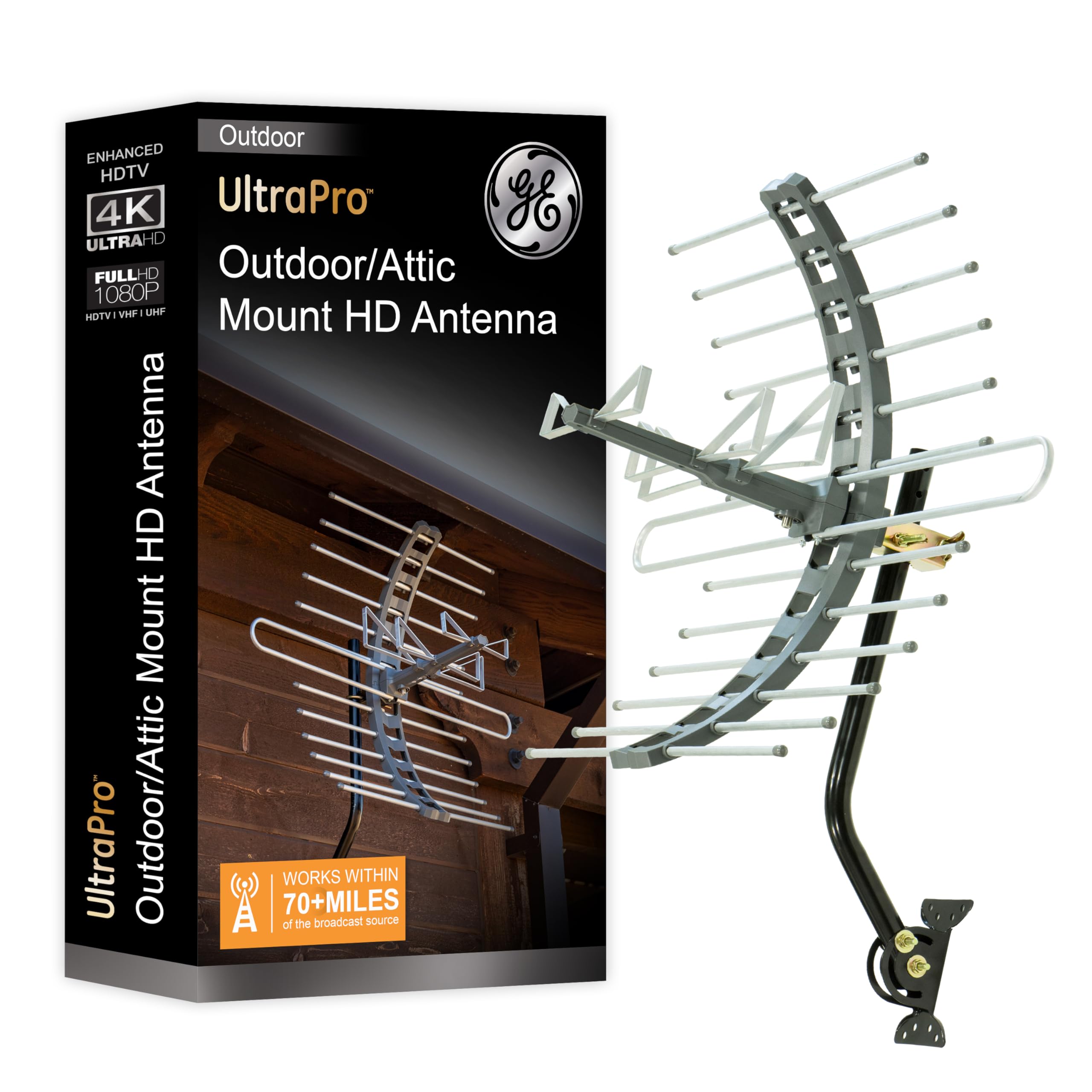
The GE 29884 is a passive outdoor/attic Yagi-style antenna that consistently outperforms expectations at its tier. With a stated 70-mile range and support for both VHF and UHF, it has been verified by users to pull in over 100 channels when mounted in an attic 60 miles from broadcast towers. The included J-mount and all-weather hardware are adequate for exterior mounting, though the plastic housing is better suited for attic installation to avoid long-term UV degradation.
Assembly involves snapping the aluminum elements into the plastic boom, and while the instructions are sparse, the process is intuitive for anyone with basic DIY comfort. Multiple reviewers reported replacing failed amplifiers with this passive antenna and receiving better results, particularly on high-VHF channels 8 and 19. The 75-ohm impedance is standard, so any RG6 coax works for the connection.
Users in windy areas have noted concern about the antenna flexing in gusts. For attic installations where weather is not a factor, it is arguably the best value in this comparison.
Why it’s great
- Exceptional real-world range with verified 100+ channel reception in attics
- Lightweight at 3 lbs with included J-mount for versatile installation
- Passive design avoids amplifier noise and overloading
Good to know
- Plastic housing is not durable for long-term exposed outdoor mounting
- Assembly instructions are minimal and may require YouTube support
5. Five Star Yagi Outdoor TV Antenna

The Five Star Yagi antenna uses a longer boom and more receiving elements than typical compact Yagis, delivering an measured 8dB gain on VHF and 12dB on UHF bands. This makes it a strong contender for fringe reception where high-VHF channels (7-13) are the target. Users report that it pulled in low-power digital channel 8 from an attic where a 108-inch old antenna failed, and increased total channel count from 54 to 65 when mounted on a chimney 25 miles from Chicago.
The kit includes a 40-foot RG6 coax cable and a 20-inch mounting pole, which simplifies the purchase. The pre-assembled elements require snapping together without tools. Build quality is solid for attic use, though the included mount is thin metal that users do not recommend for high-wind exterior installations. The passive design means no amplifier noise, but as reviewers noted, the advertised 200-mile range is physically impossible for a passive antenna; treating it as a capable 40-50 mile solution is realistic.
Assembly time is about 15 minutes, and the directional nature requires careful aiming toward the nearest broadcast cluster. The antenna does not include hardware for low-VHF (channels 2-6), so markets that still broadcast on those frequencies will need a separate solution. For cord cutters focused on network HD channels in suburban and exurban zones, this antenna delivers disproportionate value.
Why it’s great
- Higher measured gain (8dB VHF, 12dB UHF) than typical mid-range Yagis
- Includes both 40ft RG6 coax and mounting pole
- 15-minute tool-free assembly for quick setup
Good to know
- Advertised 200-mile range is not realistic; real-world sweet spot is 40-50 miles
- Includes RG-59 cable rather than RG6; replace for long runs
6. McDuory Outdoor Yagi Antenna

The McDuory UHD-3968 is a lightweight passive Yagi that punches above its price point for VHF-Hi reception. Multiple users reported that this antenna locked onto high-VHF channels 8 and 19 after two previous antennas failed, and all UHF channels came in with solid signal bars. When mounted in an attic 30 miles from towers, it delivered Fox, NBC, ABC, CBS, and PBS with full HD clarity and no dropouts.
The pre-assembled design requires only snapping a few loose elements into plastic sockets, and the weather-resistant construction includes lightning protection for outdoor mounting. Users recommend greasing all electrical connections with penetrox and sealing the coax connector to prevent corrosion. The 75-ohm impedance matches standard RG6, and the included hardware covers basic roof or mast mounting.
Assembly requires some physical force—elements must be fully inserted into the plastic holders to contact the metal spine; a rubber mallet helps. Some hardware may rust over time if not sealed. At under 40 dollars, it is the most affordable genuine Yagi option for someone who prioritizes VHF reception over amplification gimmicks, provided they are within 50 miles of the towers.
Why it’s great
- Excellent high-VHF reception where flat antennas and omnidirectional models fail
- Passive Yagi design delivers clean signal without amplifier noise
- Very affordable entry point for a genuine Yagi antenna
Good to know
- Element insertion requires significant force; instructions are minimal
- Hardware may rust; electrical connections need sealing
7. Arrasolt Melas Amplified TV Antenna
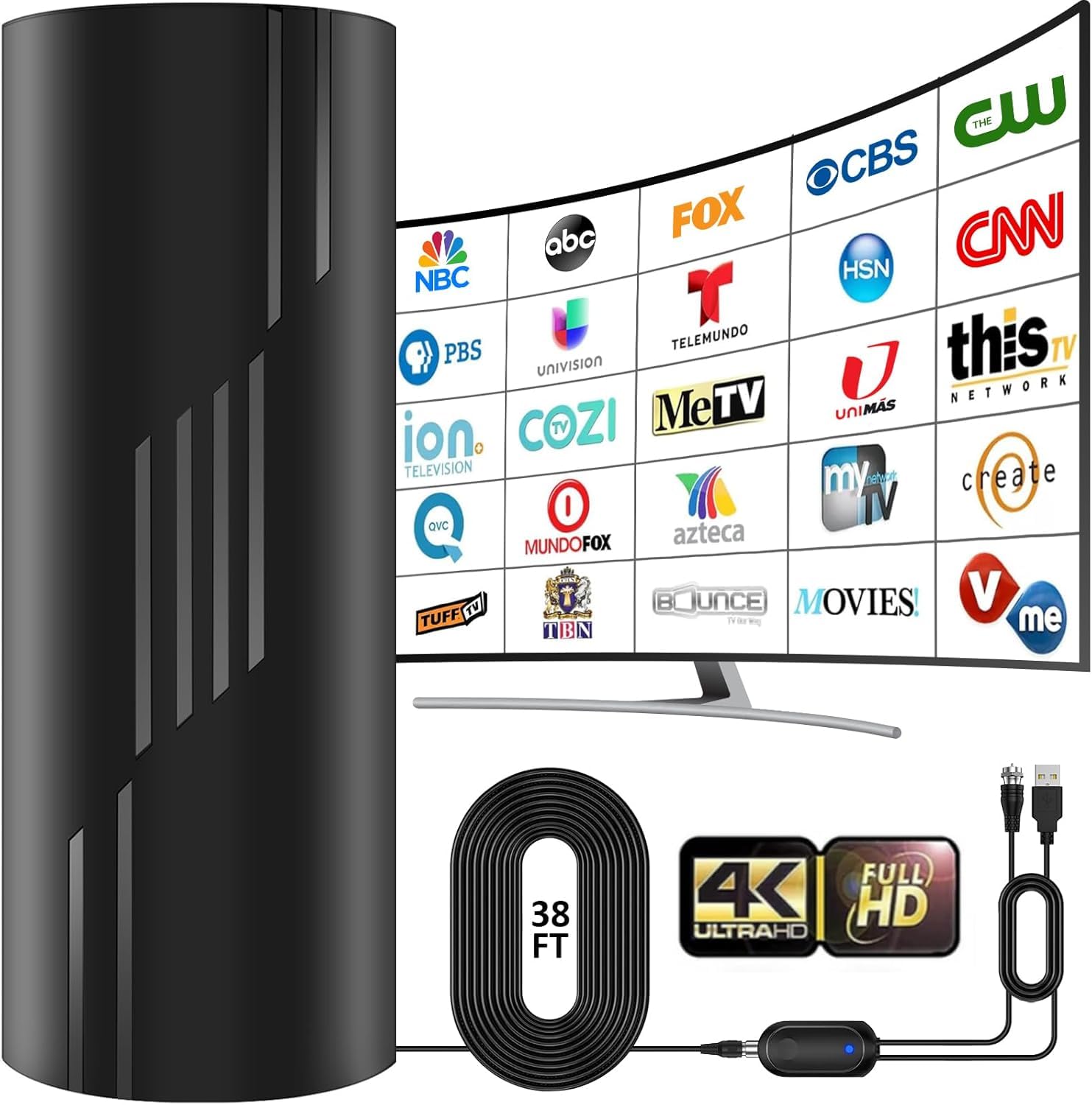
The Arrasolt Melas antenna is a slim amplified unit designed for indoor or outdoor mounting, with a built-in smart IC chip and amplifier that claims 5000-mile range. Real-world user reports place its effective range closer to 40 miles, but within that envelope it performs admirably. Suburban users reported consistent HD and 4K signal reception for all major networks, including crystal-clear ABC for NBA playoffs, with simple window placement using the included double-sided tape.
The package includes a 38-foot high-performance coaxial cable, adhesive strips, screws, and cable ties for flexible positioning. The slim 10-inch profile fits behind a TV or on a window without being visually intrusive. The amplifier requires a USB power source—either the TV’s USB port or a wall adapter—and the unit supports 720p through 4K and 8K resolutions. Setup is genuinely plug-and-play: mount, connect, and run a channel scan.
The primary limitation is the amplifier’s tendency to overload in strong-signal urban areas, causing pixelation on some channels. Users also noted that reception varies significantly based on window orientation and building materials; a south-facing window in a wood-frame house works best. For renters or anyone wanting a zero-drill, zero-permanent antenna solution for urban and suburban use, this is the easiest path to free local channels.
Why it’s great
- True plug-and-play installation with included double-sided tape and cable ties
- Slim profile fits behind a TV or on a window without tools
- Works reliably for urban and suburban users within 40 miles of towers
Good to know
- 5000-mile range claim is marketing; effective range is closer to 40 miles
- Amplifier can overload in very strong signal areas, causing pixelation
FAQ
Do I need an amplified antenna if I live 35 miles from towers?
Why does my indoor flat antenna miss VHF channels?
Can I mount an outdoor antenna in my attic instead of the roof?
Final Thoughts: The Verdict
For most users, the antenna for local channels winner is the Antennas Direct ClearStream 2V because it combines passive multi-directional reception, durable build quality, and a lifetime warranty in a package that works reliably for suburban and rural installations out to 50 miles. If you need motorized control to target towers in opposite directions, grab the PBD Amplified with 360° Rotation. And for budget-conscious buyers who need solid VHF reception without amplifier noise, nothing beats the McDuory Outdoor Yagi.