
Our readers keep the lights on and the weekend projects moving. As an Amazon Associate, I earn from qualifying purchases.
Nothing kills productivity or patience faster than a call that drops mid-sentence or a video that buffers endlessly. A reliable cellular signal is no longer a luxury—it’s a necessity for remote work, staying in touch with family, and accessing info on the go. That one-bar struggle in your living room, basement, or rural driveway has a solution that actually works.
I’m Rikta — the co-founder and writer behind FitlyFast. I’ve spent countless hours analyzing the technical specs, customer feedback, and real-world performance data across every major signal booster category to separate the amplifiers that genuinely extend coverage from those that just repeat marketing claims.
This guide breaks down the top-performing units by carrier compatibility, gain levels, and coverage area so you can find the best 5g signal booster for your home, vehicle, or office without wasting money on gear that underdelivers.
How To Choose The Best 5G Signal Booster
Choosing a signal booster isn’t about picking the most expensive box. It’s about matching the right technology to your specific dead zone. Carriers use different frequency bands, and a booster that works perfectly for a Verizon user in a basement may do nothing for an AT&T user in a metal-roofed workshop. You must know your carrier, the band they use in your area, and the square footage you need to cover before you even look at a product page.
Carrier-Specific vs. Universal Boosters
The most common mistake is buying a booster that doesn’t support your carrier’s primary frequency. Verizon’s 4G and 5G signals often ride on Band 13 (700 MHz), while AT&T and T-Mobile rely heavily on Bands 12/17 (700 MHz) and Band 2/4/66 (1900/1700 MHz). A “universal” booster that supports Bands 2, 4, 5, 12, 13, 17, and 25 gives you the flexibility to switch carriers or support multiple devices on different networks. Carrier-specific units (like those locked to Band 13 or Band 12/17) are cheaper but lock you into one provider.
Gain (dB) and Coverage Area
Gain, measured in decibels (dB), is the raw amplification power. Most home boosters range from 65 dB to 72 dB, which is sufficient for a single room or a small home (up to 2,000–4,500 sq ft). Premium commercial-grade units like the CEL-FI GO G41 hit 100 dB, covering up to 15,000 sq ft, but they cost significantly more. For most users, a 65–72 dB booster is the sweet spot for price and performance. Coverage area is always an estimate based on ideal conditions—a metal building or thick concrete walls will cut that number in half.
Vehicle vs. Home/Office Boosters
These are not interchangeable. A vehicle booster uses a magnetic-mount antenna for the roof and a small interior antenna, designed to boost signal within a few feet of the driver and passengers. Home boosters use a high-gain directional antenna mounted outside, connected via coaxial cable to a base unit inside that rebroadcasts the signal over a large area. Buying a home booster for a car means dealing with bulky cables and a unit not designed for 12V power. Buying a vehicle booster for a home means you get coverage for one corner of a room, not the whole house.
Quick Comparison
On smaller screens, swipe sideways to see the full table.
| Model | Category | Best For | Key Spec | Amazon |
|---|---|---|---|---|
| HiBoost 10K SL | Premium Home | App-monitored whole-home coverage | 70 dB Gain, 5,500 sq ft | Amazon |
| HiBoost 8K | Premium Home | Large homes with multiple users | 70 dB Gain, 8,000 sq ft | Amazon |
| CEL-FI GO G41 | Commercial Grade | Extreme coverage up to 15,000 sq ft | 100 dB Gain, 4th-gen chipset | Amazon |
| ZORIDA 5S Ultra | Mid-Range Home | Carrier-agnostic whole-home boost | 72 dB Gain, 4,500 sq ft | Amazon |
| ZORIDA Ace 5S | Mid-Range Home | Small homes with app-based setup | 72 dB Gain, 2,000 sq ft | Amazon |
| GAGBK Vehicle Booster | Vehicle | RVs, trucks, and car travel | 65 dB Gain, 6-band support | Amazon |
| GAGBK AT&T Booster | Budget Home | AT&T/T-Mobile Band 12/17 users | 65 dB Gain, 4,500 sq ft | Amazon |
| GAGBK Verizon Booster #1 | Budget Home | Verizon Band 13 users | 65 dB Gain, 5,000 sq ft | Amazon |
| FreeQueen Verizon Booster | Budget Home | Verizon Band 13 users | 65 dB Gain, 5,000 sq ft | Amazon |
In‑Depth Reviews
1. HiBoost 10K SL (6000 sq ft)

The HiBoost 10K SL hits the sweet spot between professional-grade hardware and user-friendly features. With a 70 dB gain and a range of 5,500 to 6,000 square feet, it supports all major US carriers on Bands 2, 4, 5, 12, 13, 17, and 25. The standout feature here is the Signal Supervisor app and the built-in LCD screen, which together let you monitor real-time signal strength, adjust gain settings, and optimize antenna placement without guesswork.
This booster is designed for homes and offices where signal is weak but not completely absent. Users in hurricane-prone areas and forested valleys have reported massive improvements—going from no usable data to 50+ Mbps download speeds on Verizon and T-Mobile. The AGC (Automatic Gain Control) prevents oscillation, which is a common killer of booster performance in tricky installations.
At a mid-to-premium price point, this unit delivers high-end performance without the commercial-grade price tag. The 3-year warranty and lifetime US-based tech support add significant value. Keep in mind it does not support Band 71 (600 MHz T-Mobile), so if you’re in a rural T-Mobile area relying on that extended-range band, you may need a different model.
Why it’s great
- Built-in LCD and app for real-time signal monitoring and tuning
- Covers up to 6,000 sq ft with 70 dB gain across all major bands
- Superior metal casing reduces interference and improves stability
Good to know
- Lacks support for T-Mobile Band 71 (600 MHz)
- Installation can be complex for multi-story homes with obstacles
2. HiBoost 8000 sq ft Booster

The HiBoost 8000 sq ft model takes coverage seriously, offering two indoor antennas—one built into the main unit and a separate panel antenna—to blanket up to 8,000 square feet with 70 dB of gain. This makes it an excellent choice for larger homes, multi-room offices, metal buildings, and rural cottages where single-antenna units leave dead zones in back rooms or basements.
Supporting all US carriers on bands 2, 4, 5, 12, 13, 17, and 25, this booster is carrier-agnostic by design. The AGC system eliminates manual adjustments, and the LCD display gives you a clear read on signal strength and gain. Customer feedback highlights reliable support from the US-based team, with one user noting that after adjusting antenna direction they went from 1-2 bars to 4-5 bars on T-Mobile Band 2.
This unit sits at a premium price point, justified by the dual-antenna setup and the higher coverage ceiling. Some users in multi-floor homes found that even 8,000 sq ft wasn’t enough to cover all three levels due to floor obstacles, so real-world performance depends heavily on your building’s layout and construction materials.
Why it’s great
- Dual indoor antennas for larger, irregular-shaped spaces
- 70 dB gain provides consistent 3-4 bar improvement in most homes
- US-based customer support with proactive follow-up
Good to know
- Actual coverage may be halved in multi-story homes with concrete floors
- Higher price point may be overkill for a single room or small apartment
3. CEL-FI GO G41 (2X Antenna with Grid)
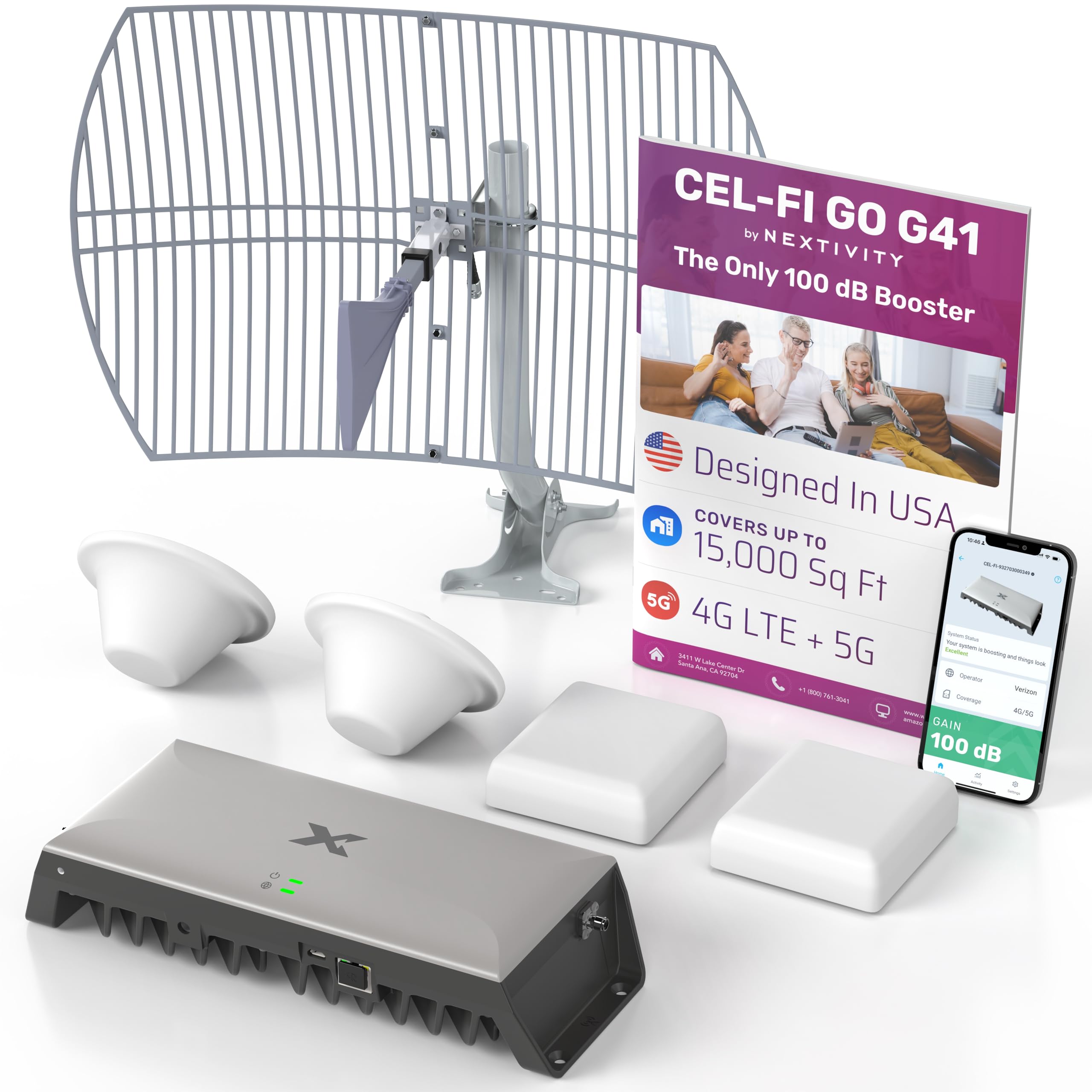
The CEL-FI GO G41 is the undisputed heavyweight champion of consumer signal boosters. With 100 dB of gain—30 dB more than typical home units—it can cover up to 15,000 square feet, which is more than enough for a large home, warehouse, or commercial space. It uses Nextivity’s 4th-generation IntelliBoost chipset and supports 5G NR, 5G-DSS, and 4G LTE, making it fully future-proof.
This kit includes two indoor antennas (both dome and panel types) plus one high-gain outdoor antenna with a pole mount. The included coaxial cables are substantial and designed for long runs without signal loss. Real-world user reports show dramatic improvements, with one rural customer going from -108 dBm (essentially no signal) to -75 dBm (full bars) after installation. The difference between this unit and a standard booster is night and day in truly remote areas.
The price tag is in the commercial range, but for users who live in areas with zero usable outdoor signal or need coverage across an entire property, it pays for itself by eliminating the need for satellite internet or expensive hotspot plans. The 3-year warranty and US-based support provide peace of mind. Be aware that installation is a full-day project requiring a ladder and careful antenna placement.
Why it’s great
- 100 dB gain covers up to 15,000 sq ft—more than 10 standard boosters combined
- 4th-gen IntelliBoost chipset with full 5G NR compatibility
- Includes both dome and panel indoor antennas for flexible deployment
Good to know
- Major investment in cost and installation time
- Carrier aggregation issues reported in areas served by multiple towers on different bands
4. ZORIDA 5S Ultra (4500 sq ft)
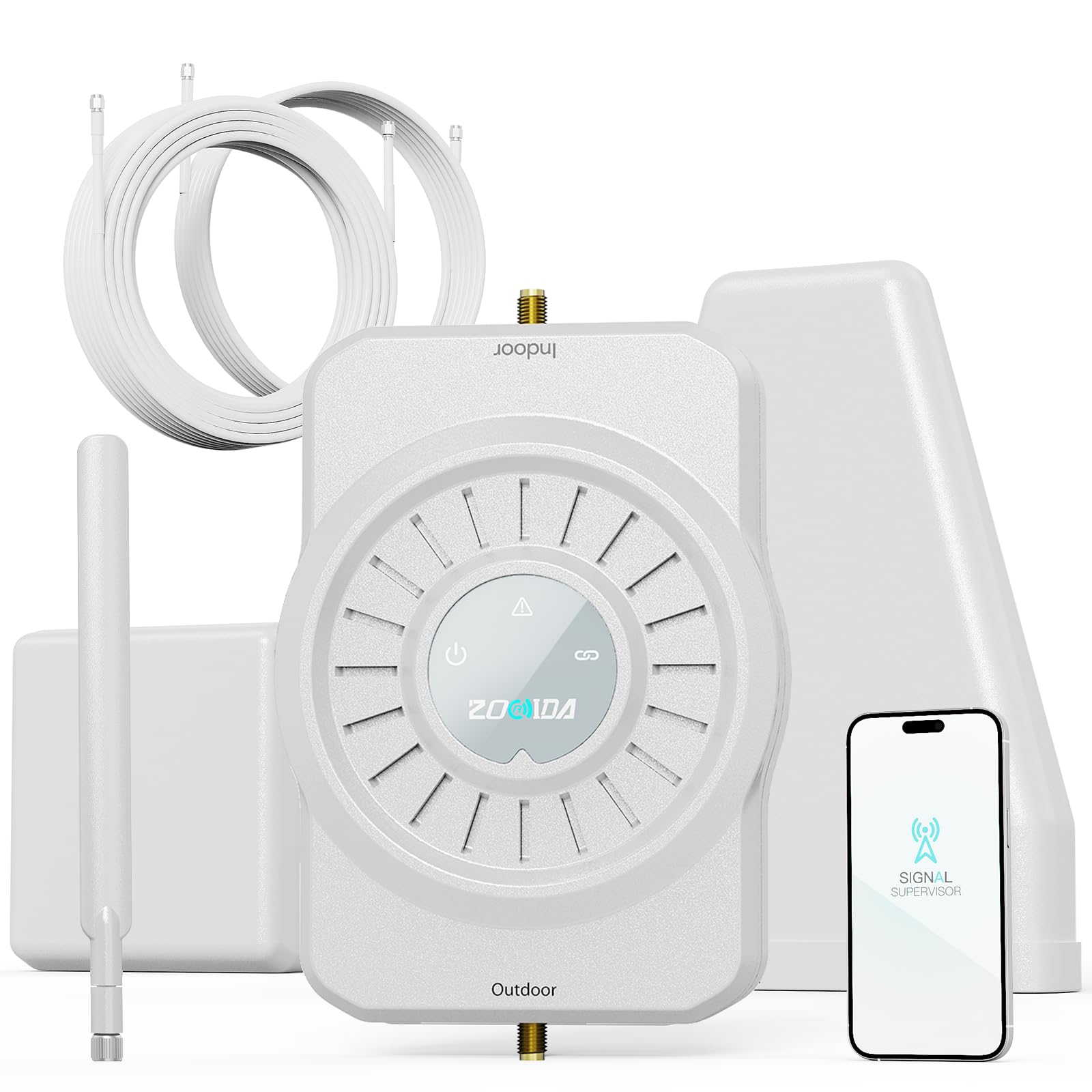
The ZORIDA 5S Ultra is a well-rounded mid-to-premium booster that covers up to 4,500 square feet with a powerful 72 dB gain. It’s carrier-agnostic, supporting Bands 12/17, 13, 5, 25, 2, and 4, which means it works seamlessly with Verizon, AT&T, T-Mobile, and all MVNOs. The off-white design is discreet enough for a living room, and the compact form factor fits on a shelf or table without looking like industrial equipment.
What sets this unit apart is the ZORIDA app, which provides step-by-step installation guidance with real-time signal measurements. Users in remote campgrounds and rural homes reported going from SOS/1-bar signal to 3-4 bars with 35-40 Mbps download speeds. The kit includes a 49.2-foot cable for the outdoor antenna, giving you plenty of room to place it in the best signal location.
This is an excellent choice for users who want a strong universal booster with app-based support but don’t need the extreme coverage of a unit like the HiBoost 10K or CEL-FI. The 3-year warranty and US-based tech support are solid. One consideration: the 72 dB gain is higher than many competitors, but if your outdoor signal is below one bar, no amount of gain will create a usable signal.
Why it’s great
- 72 dB gain is among the highest in the mid-range home booster category
- App-based installation with real-time signal guidance simplifies setup
- Supports all major US carriers across 7 frequency bands
Good to know
- Coverage of 4,500 sq ft assumes ideal conditions—metal roofs will reduce it
- Requires at least a faint 1-bar signal outside to function
5. ZORIDA Ace 5S

The ZORIDA Ace 5S is the compact, budget-friendly sibling of the 5S Ultra, designed for smaller spaces up to 2,000 square feet. Despite the smaller coverage area, it packs the same 72 dB gain and supports all US carriers on the same broad set of bands (12/17, 13, 5, 4, 2/25). This makes it an ideal solution for a studio apartment, a single room, a small office, or a garage where signal drops out.
The Ace 5S shares the same app-based installation system, which is a huge advantage for non-technical users. The app provides 1-on-1 video support, installation guides, and real-time signal data before and after setup. Customer feedback is overwhelmingly positive, with verified users in Northern Michigan reporting jumps from 2 bars of 4G to full 5G signal with crystal-clear calls and fast data.
This is one of the best value propositions in the market if you don’t need whole-house coverage. The mid-range price point is accessible, and the 3-year warranty plus lifetime US-based tech support add confidence. The only caveat is coverage: at 2,000 sq ft, it won’t reach a basement on the opposite side of a large home, so measure your space before buying.
Why it’s great
- 72 dB high-gain amplifier at a mid-range price point
- Comprehensive app support with real-time signal monitoring and video guides
- Compact size fits easily on a desk, shelf, or table
Good to know
- Coverage is limited to 2,000 sq ft—not suitable for whole-home in larger spaces
- Requires careful outdoor antenna placement for best results
6. GAGBK Vehicle Booster (6-Band)
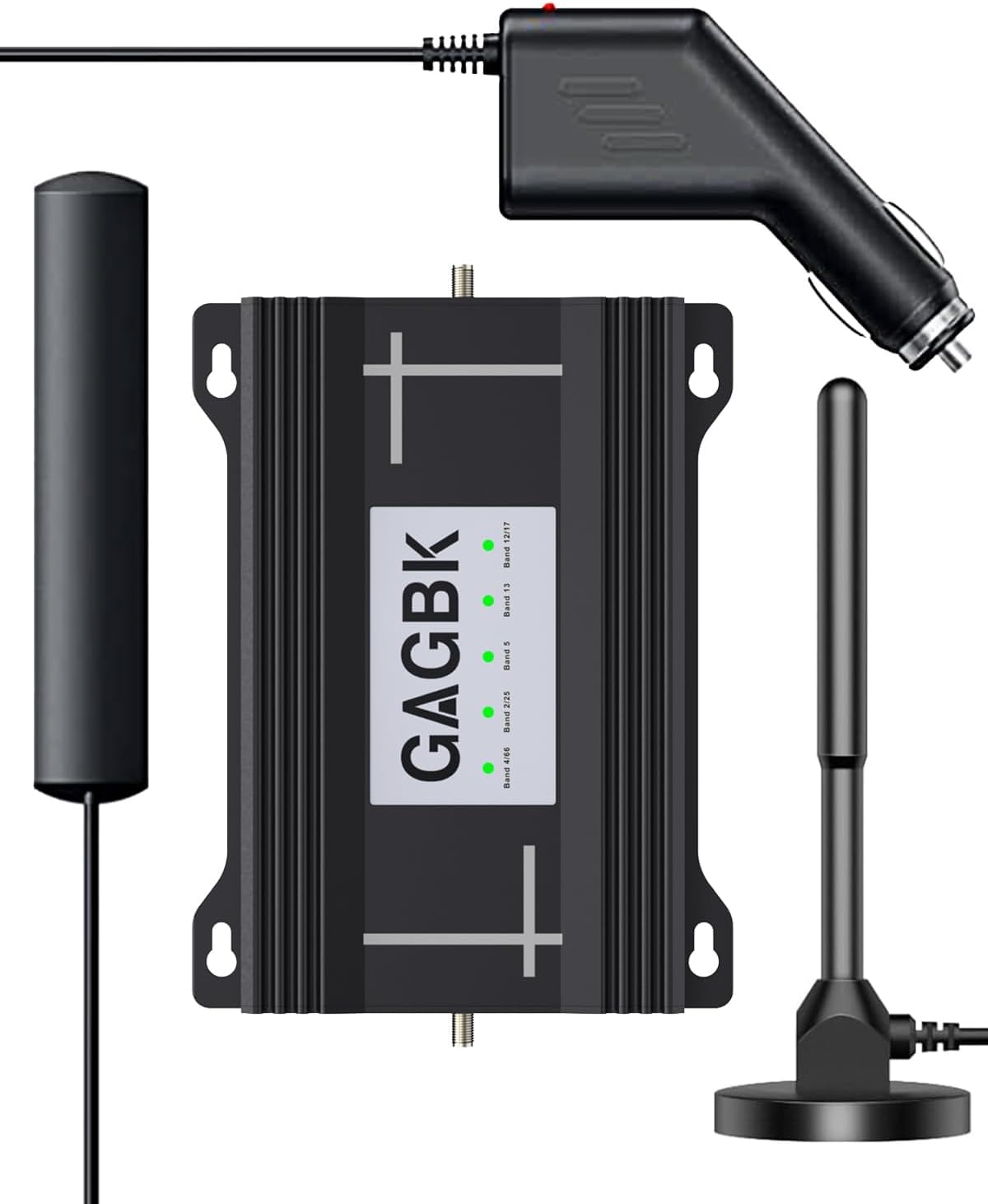
The GAGBK Vehicle Booster is purpose-built for life on the road. It supports all major US carriers across six critical bands (2, 4, 5, 12, 13, 17, 25, and 66), and is compatible with 5G signals. With 65 dB of gain, it amplifies weak signals up to 100 times, making it effective for RVs, trucks, vans, SUVs, and even boats. The kit includes a magnetic-mount outdoor antenna and an indoor patch antenna.
This unit is designed to boost signal for multiple devices simultaneously—ideal for a family on a road trip where everyone’s phone, tablet, and hotspot needs a reliable connection. The AGC, inactivity mode, and oscillation elimination features ensure the booster adapts as you drive through varying signal environments. The maximum communication range reaches up to 5-8 miles from a cell tower under ideal conditions.
At a mid-range price, this vehicle booster offers strong value for frequent travelers. The 3-year warranty and US-based technical support are reassuring for a device that sees harsh conditions (heat, cold, vibration). Note that the indoor antenna provides coverage primarily within the vehicle cabin—it’s not designed to extend signal to a campsite tent or outdoor area.
Why it’s great
- Supports all major carriers on 6 frequency bands including 5G
- Easy magnetic-mount antenna installation without drilling
- AGC and oscillation elimination adapt to changing signal while driving
Good to know
- Coverage is limited to the vehicle cabin—not for outdoor or tent use
- 65 dB gain is lower than home boosters, reflecting the compact vehicle design
7. GAGBK AT&T Signal Booster (Band 12/17)

The GAGBK AT&T Signal Booster is a focused, budget-friendly solution designed primarily for AT&T and T-Mobile users on Bands 12 and 17 (700 MHz). With a 65 dB gain and coverage of up to 4,500 square feet, this unit is ideal for homes, garages, and metal-roofed buildings where AT&T’s signal is weak but not absent. It also works with Cricket, Straight Talk, and U.S. Cellular.
The kit includes a high-gain directional outdoor antenna, a 50-foot coaxial cable, and an indoor whip antenna. Installation is straightforward, with AGC and self-oscillation elimination handling performance adjustments automatically. Verified users report going from 1 bar to 4 bars of AT&T service in rural areas after careful antenna placement. The inactivity mode puts the unit on standby when not in use, extending its lifespan.
At an entry-level price, this booster delivers good results for its intended carrier base. However, it’s carrier-locked to Band 12/17, so it won’t help Verizon users on Band 13 or anyone needing Band 4/66 support. Some users reported the unit stopped working after a few months, which is a risk at this price point. The 3-year warranty provides some protection, but support responsiveness varies.
Why it’s great
- Budget-friendly entry point for AT&T and T-Mobile users in rural areas
- 4,500 sq ft coverage is generous for the price
- AGC and standby mode improve efficiency and device longevity
Good to know
- Only supports Band 12/17—no compatibility with Verizon Band 13 or higher-frequency bands
- Some reports of units failing within the first 3 months
8. GAGBK Verizon Signal Booster (Band 13)

This GAGBK booster is tailored specifically for Verizon and Straight Talk users on Band 13 (700 MHz). It delivers 65 dB of gain and claims coverage of up to 5,000 square feet, making it a budget-friendly option for homes, basements, garages, and metal buildings where Verizon’s signal struggles to penetrate. The kit includes a directional outdoor antenna, an indoor omni whip antenna, and all necessary cabling.
The 65 dB gain is sufficient to boost a signal from 1-2 bars to 4-5 bars in most single-story homes. The AGC function automatically adjusts gain to prevent oscillation, and the LED indicator shows working status at a glance. Verified customers on the Boost network reported that the booster eliminated the need to go outside for calls, which was a significant quality-of-life improvement for their household.
The entry-level price makes this an accessible first step for anyone struggling with Verizon signal at home. However, the carrier-specific Band 13 limitation means it’s useless for AT&T or T-Mobile users. Some reviewers noted installation can be finicky—the outdoor antenna needs a clear line of sight to the cell tower, and placement on the phone significantly affects performance.
Why it’s great
- Very affordable entry point for Verizon users with weak home signal
- 65 dB gain is effective for boosting 1-2 bars to 4-5 bars
- Includes all necessary components for a complete installation
Good to know
- Only works with Verizon and its MVNOs on Band 13—not for AT&T or T-Mobile
- Some users reported units not working as expected, requiring refunds
9. FreeQueen Verizon Signal Booster (Band 13)
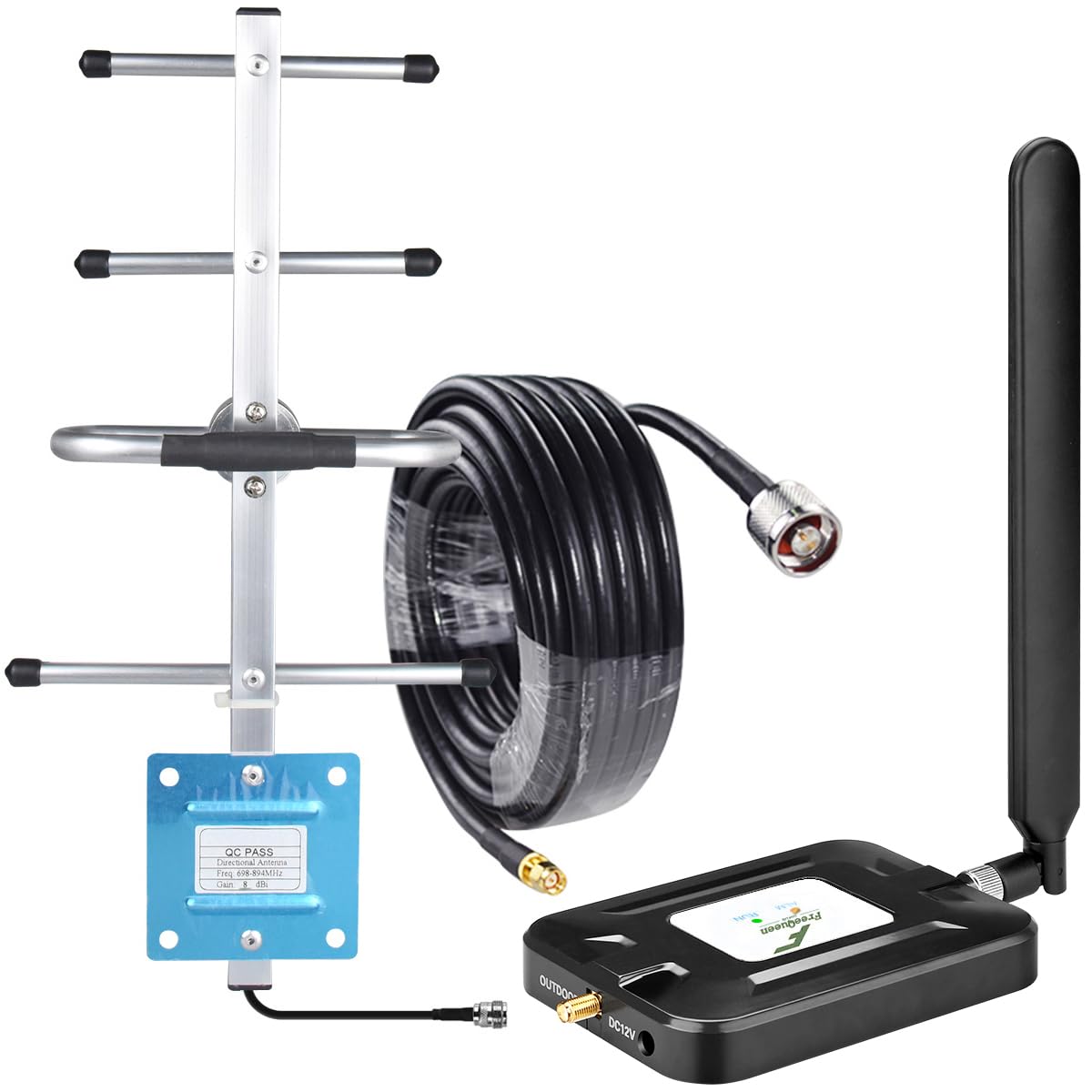
The FreeQueen Verizon Signal Booster is a near-identical alternative to the GAGBK Band 13 unit, offering the same 65 dB gain and 5,000 sq ft coverage for Verizon and Straight Talk users. It operates exclusively on Band 13 (700 MHz), the primary frequency for Verizon’s 4G LTE and 5G-DSS signals. The kit includes a high-gain directional Yagi outdoor antenna, a 50-foot N-SMA coaxial cable, and an indoor whip antenna.
The AGC technology automatically detects the existing signal strength and adjusts gain to prevent oscillation, while the compact booster unit has a sleep mode to reduce power consumption when not in active use. The LED indicator provides a clear visual of the device’s operating status. This unit is designed for the same use cases as the GAGBK: homes, garages, basements, cabins, and metal-roofed buildings where Verizon’s signal is weak.
Priced similarly to other entry-level units, this booster represents a straightforward solution for Verizon customers. The 30-day money-back guarantee and 3-year warranty offer basic protection. However, the carrier-specific band limitation is the same—it won’t help if you switch to AT&T or T-Mobile. Some customers reported the product required careful setup to achieve maximum power, and a few found it didn’t meet their expectations for coverage.
Why it’s great
- Budget-friendly option specifically optimized for Verizon Band 13
- Includes Yagi directional antenna for better outdoor signal capture
- AGC and sleep mode improve efficiency and prevent oscillation
Good to know
- Limited to Verizon and Straight Talk on a single band (13)
- Setup can be finicky, and performance depends heavily on antenna placement
FAQ
Will a 5G signal booster work if I have zero bars outside my house?
Can I use a home booster in my RV or car?
What does AGC (Automatic Gain Control) do in a signal booster?
How do I find which frequency band my carrier uses in my area?
Final Thoughts: The Verdict
For most users, the best 5g signal booster is the HiBoost 10K SL because it balances professional-grade app monitoring, strong 70 dB gain, broad carrier compatibility, and a mid-range price that won’t break the budget. If you need extreme coverage for a large home or remote property, go with the CEL-FI GO G41 for its unmatched 100 dB gain. And for a compact, affordable solution that covers a small home or apartment with all-carrier support, the ZORIDA Ace 5S delivers excellent value with its app-based setup and 72 dB amplifier.