
Our readers keep the lights on and the weekend projects moving. As an Amazon Associate, I earn from qualifying purchases.
Home blood pressure monitoring is a serious health habit, but finding a monitor that delivers clinical-grade accuracy without the premium price tag often feels like a guessing game. The wrong device can give inconsistent readings, fit poorly, or confuse you with complicated menus, turning a simple health check into a frustrating chore.
I’m Rikta — the co-founder and writer behind FitlyFast. My deep-dive research into home health hardware focuses on validating clinical accuracy claims, durability of cuff materials, and the real-world ease of use for seniors and multi-user households.
After cross-referencing specs and customer experiences, I’ve sorted the models that actually earn their spot on your nightstand. This is the practical guide to finding your next affordable blood pressure monitor without sacrificing reliability or essential features.
How To Choose The Best Affordable Blood Pressure Monitor
The market is flooded with budget-friendly cuffs, but not all of them are built to last or give you numbers you can trust. Here are the three critical areas to focus on when you are shopping on a tighter budget.
Clinical Accuracy & Validation
Price does not dictate precision. Look for monitors that mention clinical validation against recognized protocols like those from the Association for the Advancement of Medical Instrumentation or the European Society of Hypertension. Some brands publish their validation status on independent databases like validatebp.org. An affordable monitor that is clinically validated is far more trustworthy than a generic device with flashy packaging but no published accuracy data.
Cuff Fit & Comfort
The most common cause of wrong readings is a poorly fitting cuff. A standard cuff typically accommodates arms from about 8.6 inches to 16.5 inches in circumference. If you or a family member has a smaller or larger arm, seek models that include additional cuff sizes (small, extra-large) in the box. A monitor with a mismatched cuff is a waste, while a model with three cuffs can serve an entire family accurately.
Memory & Multi-User Support
Tracking trends is essential for managing hypertension. A monitor that stores at least 60-90 readings per user is ideal. Dual-user memory allows two people to log their data separately, which avoids confusion and helps each person monitor their own progress. Some monitors also calculate the average of your last three readings, giving you a more stable metric than a single isolated measurement.
Quick Comparison
On smaller screens, swipe sideways to see the full table.
| Model | Category | Best For | Key Spec | Amazon |
|---|---|---|---|---|
| AQESO 3-Cuff Monitor | Premium Multi-User | Large families with varied arm sizes | 3 cuffs: 7″-21″ / 1500 memory | Amazon |
| Andesfit Bluetooth | Premium Smart | Data tracking & doctor sharing | 6″ color screen / App sync | Amazon |
| Braun ExactFit 2 | Mid-Range | Comfort & gentle readings | Color-coded results | Amazon |
| Braun ExactFit 1 | Mid-Range | Simplicity & clinical validation | One-button operation | Amazon |
| Medline MDS4001 | Mid-Range | Medical-grade reliability | 90 reading memory | Amazon |
| Paramed B22S | Budget | Voice guidance for seniors | Voice broadcast + 120 memory | Amazon |
| Urion U87E | Budget | Compact size & USB-C power | 4” screen / Dual-user memory | Amazon |
In‑Depth Reviews
1. AQESO Blood Pressure Machine Upper Arm

The AQESO monitor sets itself apart by including three separate cuffs — small (7-9 inches), medium/large (9-17 inches), and extra-large (13-21 inches) — which means it can fit nearly any adult arm accurately. This eliminates the single biggest source of measurement error. The large, backlit LCD is easy to read in dim light, and the one-touch operation is straightforward for elderly users.
Storage capacity is generous: 500 readings per user for up to three users, totaling 1500 readings. This allows families to track long-term trends without worrying about memory filling up. The monitor also includes a WHO classification bar on the display, giving you a color-coded reference for your systolic and diastolic numbers at a glance.
The device supports dual power via AAA batteries or a USB-C cable, though it is not rechargeable — you must keep it plugged in when using the USB option. Some users note that removing the batteries or unplugging the device resets the date and time, which can erase stored data. Keep batteries in to maintain the memory.
Why it’s great
- Three cuff sizes cover 7 to 21 inch arms
- Large 1500-reading memory for three users
- Bright backlit LCD for low-light visibility
Good to know
- No internal battery backup; date resets if unplugged
- USB-C provides continuous power only, not charging
2. Andesfit Upper Arm Blood Pressure Monitor
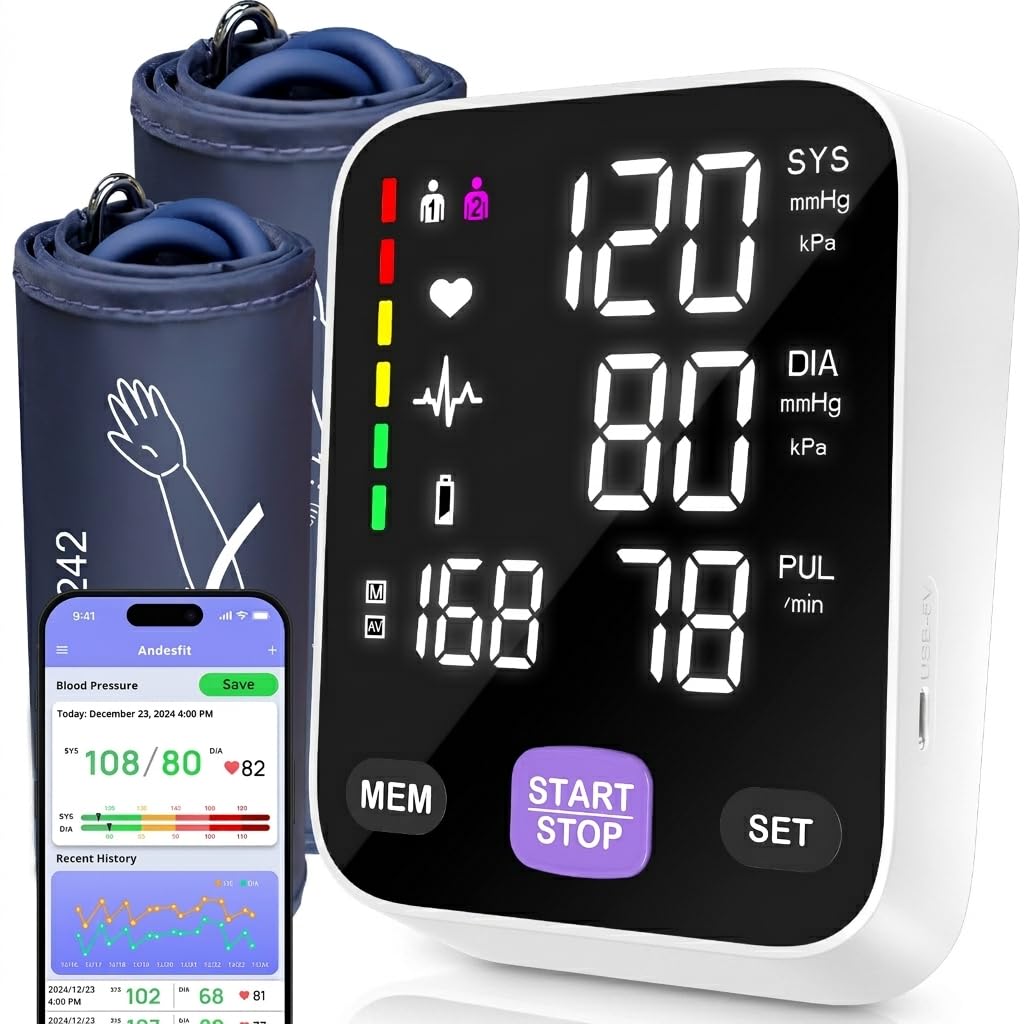
The Andesfit monitor brings smart connectivity to the affordable segment without overwhelming the user. It pairs with a free app via Bluetooth to sync readings to Apple Health and Google Fit, and it can export CSV files for sharing with your doctor. The app requires no login or personal data input, keeping your information private and stored locally on your device.
This model includes two cuff sizes — a standard 17-inch cuff and an extra-large 21-inch cuff — making it a strong option for plus-size users and larger individuals who often struggle with one-size-fits-all cuffs. The 6-inch color LED display is large and bright, ideal for seniors or anyone who wants to see numbers clearly without glasses. It also features dual-user mode with 199 readings stored per user on the device.
Power options are flexible: it runs on 4 AA batteries or can be plugged in via USB-C for continuous use (not charging). The Bluetooth connection is hassle-free, though you need to open the app before taking a reading if you want the data to sync automatically. Some users have reported occasional pulse inconsistency, so double-check pulse readings if that metric is critical for you.
Why it’s great
- Bluetooth syncs with Apple Health and Google Fit
- Extra-large 21-inch cuff included
- Large, bright color LED display
Good to know
- No date/time display on the monitor itself
- Must open app before reading for automatic sync
3. Braun ExactFit 2
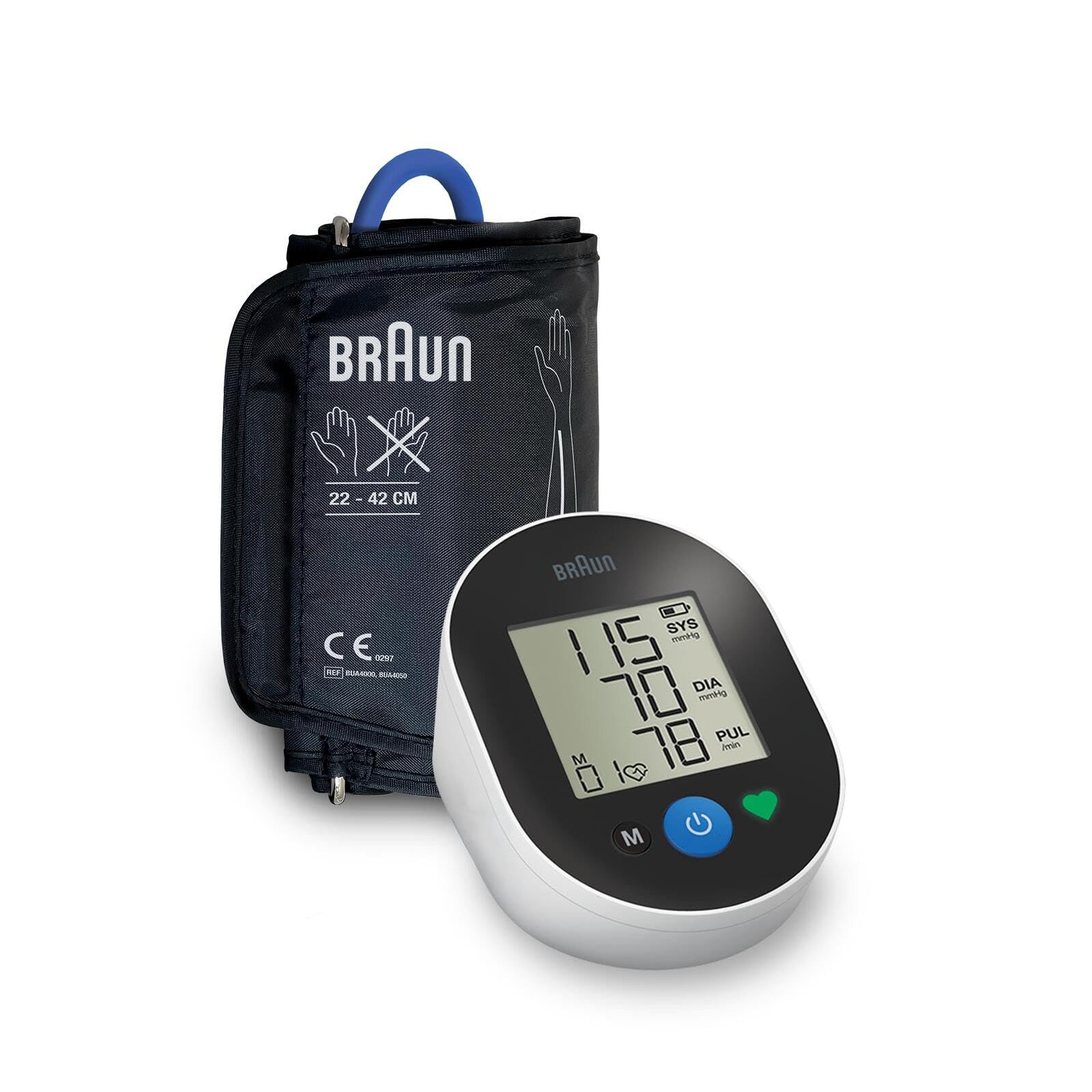
The Braun ExactFit 2 prioritizes user comfort with a unique inflation method: the cuff measures your blood pressure while it is still inflating and stops tightening as soon as it has enough data, then deflates quickly. This makes it noticeably gentler than many budget monitors that over-inflate before measuring. The universal cuff fits arms 8.6 to 16.5 inches.
Braun brings its clinical heritage here — the ExactFit 2 is clinically validated following international protocols, so you can trust the numbers. The color-coded indicator on the display instantly shows you how your systolic and diastolic values compare to normal ranges, removing any guesswork. The 30-slot memory is modest but sufficient for a single user tracking weekly trends.
The device requires 4 AA batteries (included) and has no USB power option. Some users report that the cuff positioning guide on the armband is not perfectly clear, so take a moment to ensure the cuff is placed at heart level before pressing start. The overall build feels solid and portable for travel.
Why it’s great
- Gentler inflation for a more comfortable experience
- Clinically validated accuracy
- Color-coded results are easy to interpret
Good to know
- 30-slot memory is limited for multi-user use
- Cuff placement graphics could be clearer
4. Braun ExactFit 1 BUA5000
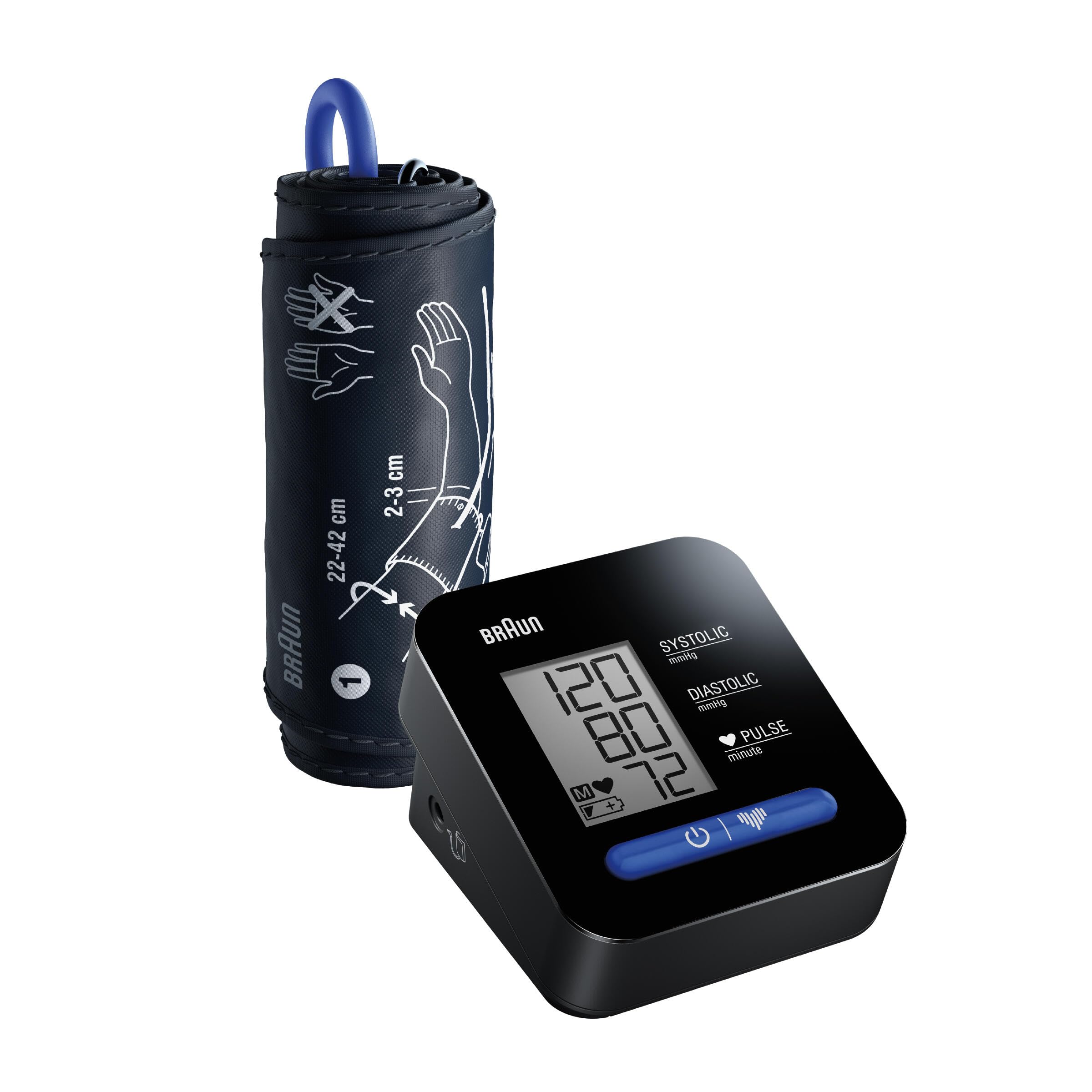
The Braun ExactFit 1 is the stripped-down sibling of the ExactFit 2, and it focuses purely on what matters: accurate readings and extreme simplicity. A single button starts the measurement, and the large display shows your systolic, diastolic, and pulse numbers in oversized digits. There is no color indicator, no Bluetooth, and no memory averaging — just raw data.
Despite its simplicity, this monitor holds clinical validation through its cousin models listed on validatebp.org, making it one of the most trustworthy options in the budget tier. The universal cuff fits arms 8.6 to 16.5 inches. Users consistently report that readings match doctor-office measurements closely, which is the ultimate test for any home monitor.
The memory function stores only the latest reading after each measurement, so you will need to manually log your data if you want a long-term trend. The cuff can be tricky to position correctly — the graphics on the armband are minimal, so you may need a few tries to get consistent placement. It runs on 4 AA batteries (included).
Why it’s great
- One-button operation is ideal for seniors
- Clinically validated accuracy via cousin models
- Readings closely match doctor visits
Good to know
- Only stores the most recent reading
- Cuff positioning graphics are minimal
5. Medline MDS4001

Medline is a well-known name in hospital-grade medical supplies, and the MDS4001 brings that institutional reliability into a home-friendly package. The device features a large digital readout of systolic and diastolic pressure plus pulse rate, with a colored reference scale printed beside the display to help you interpret results quickly. It stores up to 90 measurements per user, supporting two users total.
The cuff inflates with a single button press and uses advanced error detection to minimize inaccurate readings due to movement or improper placement. The included adult cuff fits arms 8.6 to 11.8 inches, which is on the smaller side compared to competitors. Users consistently praise the consistency of readings, noting that the MDS4001 matches doctor-office measurements far more reliably than off-brand alternatives.
One limitation is the cuff size range — at a maximum of 11.8 inches, it will not fit larger arms. If you or a family member has a larger upper arm circumference, this model will be too tight for accurate use. It runs on 4 AA batteries (included) and has a one-year warranty. No USB power option is available.
Why it’s great
- Medical-grade brand with consistent accuracy
- 90-reading memory for two users
- Color reference scale for quick interpretation
Good to know
- Cuff fits only 8.6 to 11.8 inch arms
- No USB or AC power option
6. Paramed B22S
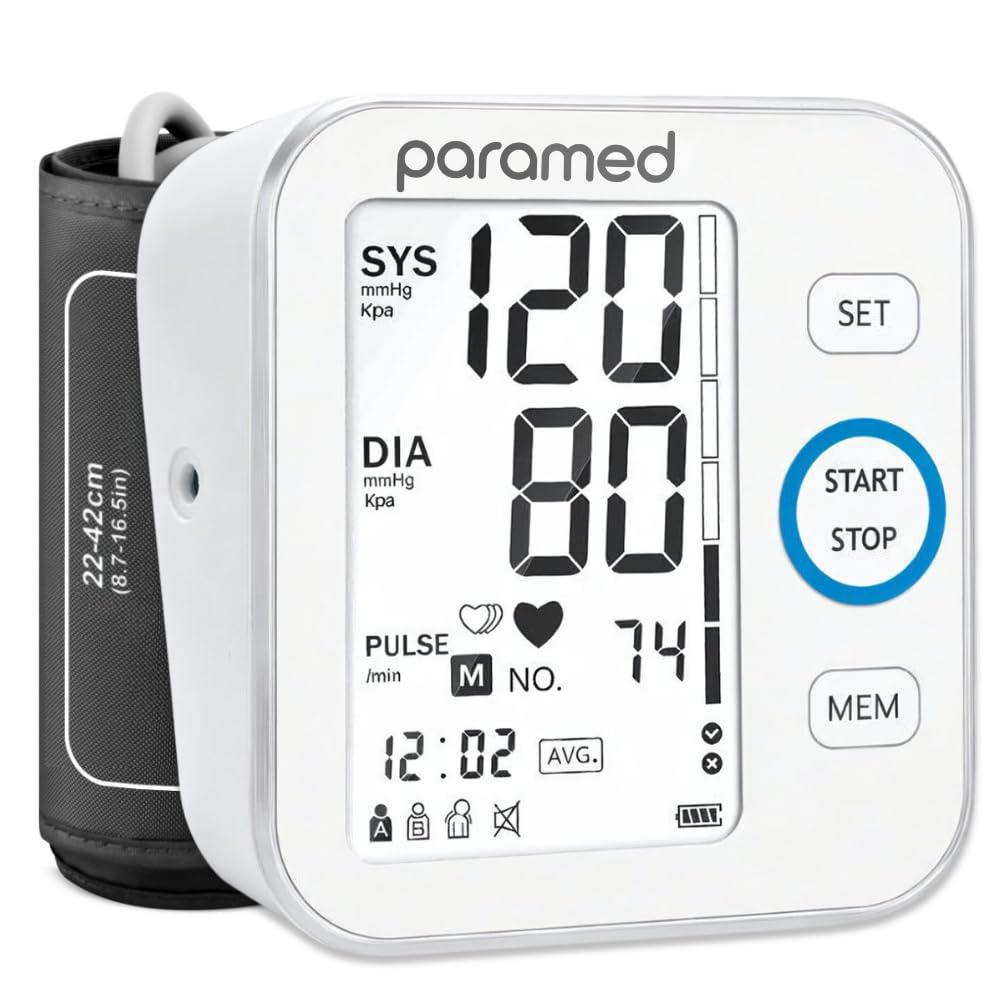
The Paramed B22S stands out for its voice broadcast feature, which announces your results aloud after each reading. This is very helpful for users with vision impairments or for those who want to hear the numbers without putting on reading glasses. The voice function can be switched off if you prefer silence, offering flexibility. The large LCD screen with oversized numbers and big buttons makes it easy for all ages to operate.
The self-checking universal cuff helps you get the fit right by verifying correct placement before measuring, reducing the chance of errors. It stores up to 120 readings between two user profiles, providing generous memory for two people tracking trends. A carrying bag and 4 AA batteries are included, so you can start monitoring right out of the box.
The device also plays a relaxing tune during measurement, which some users find pleasant and others find repetitive — you can turn this off along with the voice. The cuff fits arms 8.7 to 16.5 inches, covering most adult sizes. No USB or AC power option is available; it relies entirely on batteries. Some users note the screen numbers can appear slightly faded in certain lighting.
Why it’s great
- Voice broadcast announces results aloud
- Self-checking cuff helps ensure proper placement
- 120-reading memory for two users
Good to know
- No USB or AC power option
- Relaxation music can become repetitive
7. Urion U87E
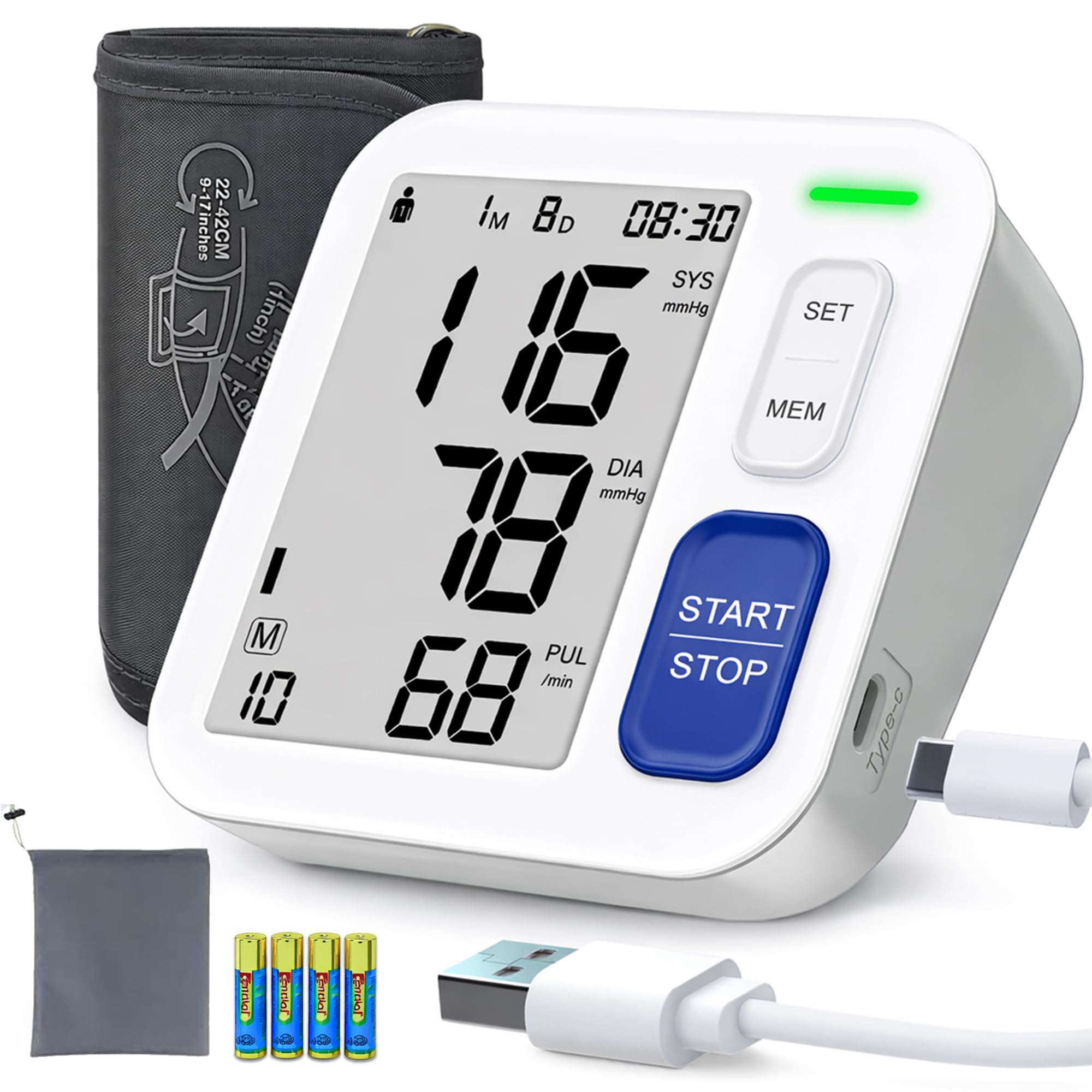
The Urion U87E is a compact, budget-friendly monitor that does not skimp on the essentials. It features a 4-inch LCD with large, bold digits that are easy to read without prescription glasses, plus an oversized start/stop button. The device uses an advanced algorithm for consistent readings and includes an irregular heartbeat indicator for added safety awareness.
Dual-user memory stores 90 readings per user (180 total), letting two people track their health separately. The color-coded BP level indicator (green, yellow, red) helps you interpret results instantly. A notable feature at this price point is the USB-C power option, which gives you flexibility to run the monitor without constantly buying batteries. The adjustable cuff fits arms 9 to 17 inches.
Some users upgrading from larger monitors find the U87E pleasantly compact for travel. The included storage bag keeps everything organized. The 3-minute auto shut-off helps preserve battery life. One minor trade-off is the lack of voice guidance, which may matter to users with visual impairments. Overall, this is a clean, no-surprises monitor for daily use.
Why it’s great
- Large 4-inch display with oversized digits
- USB-C power option reduces battery dependency
- Color-coded BP indicator for quick results
Good to know
- No voice guidance for audible results
- Memory is limited to 90 readings per user
FAQ
How do I verify if an affordable monitor is clinically accurate?
What is the correct way to position the cuff for accurate readings?
Can I use a blood pressure monitor if I have a large arm circumference?
Final Thoughts: The Verdict
For most users, the winner of the affordable blood pressure monitor category is the AQESO 3-Cuff Monitor because it solves the cuff-fit problem for the entire family and stores a massive amount of history for three users. If you want smart data tracking and app connectivity to share with your doctor, grab the Andesfit Bluetooth Monitor. And for pure simplicity and proven clinical accuracy at the lowest possible price, nothing beats the Braun ExactFit 1 BUA5000.