
Our readers keep the lights on and the weekend projects moving. As an Amazon Associate, I earn from qualifying purchases.
Every breath a newborn takes is a quiet miracle, and for many parents it’s the silence between those breaths that fuels the anxiety. Wearable sensor monitors slice through that fear by delivering real-time data on breathing motion, heart rate, and oxygen saturation directly to your phone or a dedicated parent unit—turning an abstract worry into a concrete number you can trust.
I’m Rikta — the co-founder and writer behind FitlyFast. After hundreds of hours digging into sensor accuracy, biocompatible materials, Bluetooth range, and alarm logic across nine distinct wearable and contactless sensor systems, this guide cuts through the marketing to help you choose the right baby monitor for your family’s peace of mind.
The core question is whether you prioritize continuous motion tracking or medical-grade pulse oximetry, and that trade-off defines every choice among the best baby monitors with wearable sensors on the market today.
How To Choose The Best Baby Monitors With Wearable Sensors
Not all wearable sensor monitors are created equal. Some clip to the diaper and track abdominal rise-and-fall exclusively; others wrap around the foot and measure pulse rate plus oxygen saturation. Your choice depends on whether you need respiratory movement data, clinical-grade vital signs, or both, and how much false-alarm tolerance you can live with.
Sensor Type: Clip-On vs. Wearable Sock vs. Under-Mattress Pad
Clip-on sensors like the Snuza and Sense-U Pro attach to the diaper and detect micro-movements of the abdomen. They are portable, battery-efficient, and require no base station, but only measure motion. Wearable socks like the Owlet Dream Sock and Sense-U Smart Sock use optical pulse oximetry to track heart rate and oxygen levels — a more clinical dataset — but demand a secure fit and periodic charging. Under-mattress pads are non-contact and cover the entire crib, but they can be triggered by external vibrations like fans or HVAC units.
Connectivity: Base Station vs. Bluetooth vs. Dedicated Monitor
A dedicated parent unit with its own screen (Babysense, Philips Avent) gives you a reliable connection that doesn’t depend on your home WiFi or phone battery. Bluetooth-only sensors (Sense-U Pro, Snuza) are simpler and more portable, but range is limited — generally 30-50 feet. WiFi-based systems (Nanit, iBaby, Owlet) allow remote viewing from anywhere, but introduce potential connectivity drops and require a stable 2.4 GHz network.
Alarm Logic: Vibration, Audible Alerts, and False Alarms
The best monitors vibrate to attempt arousal before sounding a full alarm. The Snuza and Sense-U Pro use a 15-second no-motion window before vibrating, then alarm after 20 total seconds. Sock-based monitors trigger alerts based on oxygen or heart rate thresholds. False alarms are the single most cited frustration — check reviews for sensitivity to loose fit, fan vibration, or baby positioning.
Quick Comparison
On smaller screens, swipe sideways to see the full table.
| Model | Category | Best For | Key Spec | Amazon |
|---|---|---|---|---|
| Owlet Dream Duo (Gen 3) | Sock + Camera | Medical-grade oxygen & heart rate | FDA-cleared pulse oximetry | Amazon |
| Philips Avent Premium Connected | Contactless Camera | Breathing tracking without wearables | SenseIQ pixel-based motion analysis | Amazon |
| Nanit Pro + Flex Stand | Breathing Band + Camera | Sensor-free breathing band | No electronics in band | Amazon |
| Sense-U Pro | Clip-On | Breathing + rollover + temperature | 15-sec arousal vibration | Amazon |
| Babysense True Sleep HD | Under-Mattress + Camera | Non-contact full crib coverage | Dual sensor pads | Amazon |
| Snuza Hero | Clip-On | Simple, portable breathing monitor | 6-month battery life | Amazon |
| iBaby i8 | Contactless Camera | Heart rate via facial optics | 1080p with 360° pan/tilt | Amazon |
| Sense-U Smart Sock + Camera | Sock + PTZ Camera | Heart rate + movement + 2.5K video | 2.5K PTZ camera included | Amazon |
| Babysense Video & Breathing Bundle | Under-Mattress + Video | Budget-friendly dual-sensor pack | 2.4-inch dedicated screen | Amazon |
In‑Depth Reviews
1. Owlet Dream Duo (Gen 3)
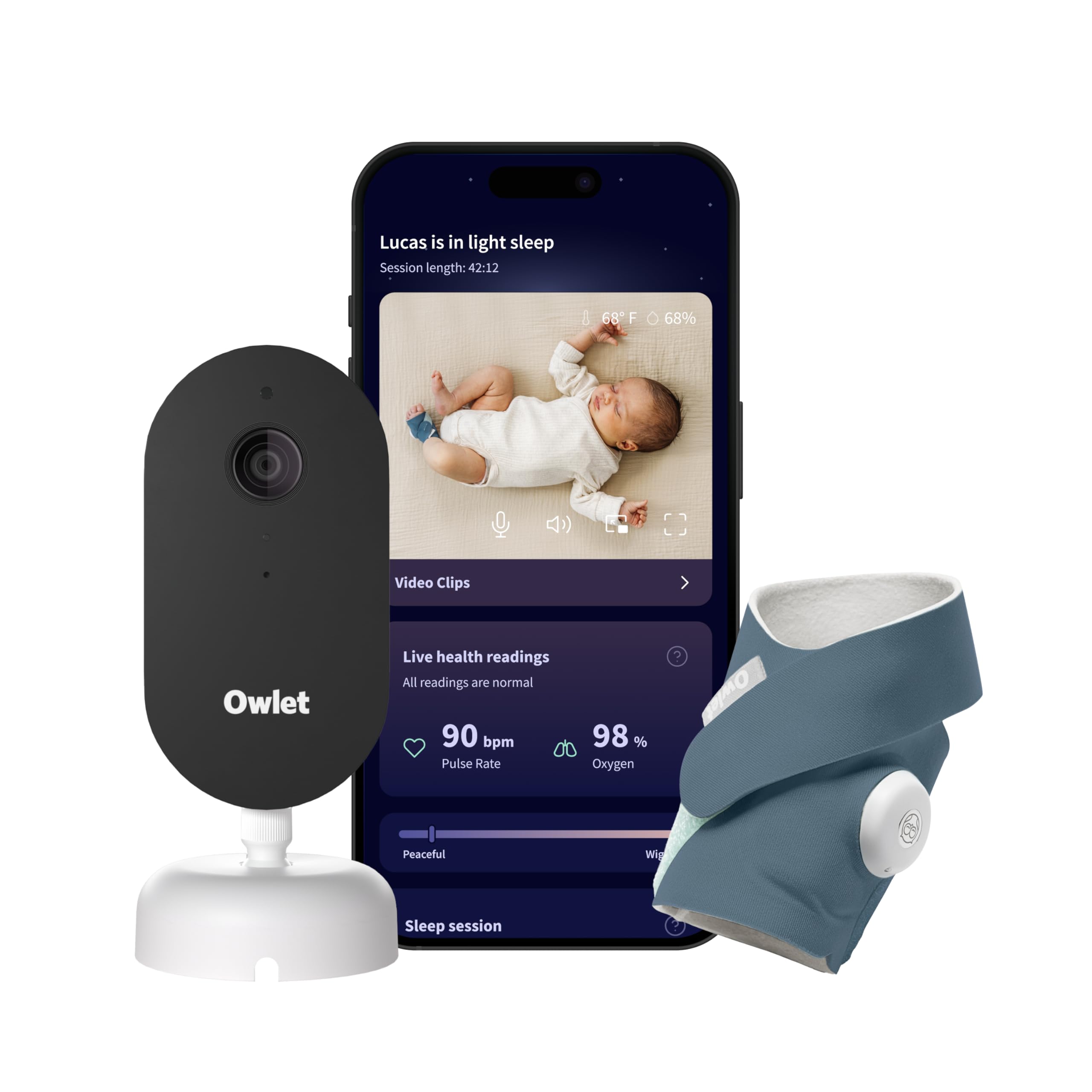
The Owlet Dream Duo combines the FDA-cleared Dream Sock — which uses medical-grade pulse oximetry to track oxygen saturation and pulse rate — with a 2K HD Dream Sight camera that streams crystal-clear video to the Owlet Dream App. This is the most clinically validated wearable sensor system available for home use, giving parents real-time alerts if readings leave preset safety zones. The sock fits babies 1-18 months (6-30 lbs) with four fabric sizes, and the base station extends range throughout the home.
What sets the Dream Duo apart is its dual-layer safety net: the sock provides vital sign data while the camera handles visual monitoring, room temperature, and humidity tracking. The Predictive Sleep Technology uses historical data to help establish optimal wake windows, a feature that 94% of surveyed parents reported improved their family’s sleep quality. The SGS Cybersecurity Mark and 256-bit encryption ensure that health data and video streams remain private.
The main trade-off is the premium investment and the requirement for a stable 2.4 GHz WiFi connection during setup. Some users report that the sock can feel snug on smaller babies, and the base station range can be limited in larger homes — going more than one floor away may cause disconnects. If you want medical-grade vital sign monitoring with a seamless camera integration, this is the gold standard.
Why it’s great
- FDA-cleared oxygen and heart rate tracking
- 2K HD camera with 130-degree wide-angle and 4x zoom
- Predictive Sleep Technology for better routines
- SGS Cybersecurity Mark for data safety
Good to know
- Requires 2.4 GHz WiFi for sock setup
- Can lose connection beyond one floor from base
- Premium price point
2. Philips Avent Premium Connected SCD973/37

The Philips Avent Premium Connected monitor uses SenseIQ Technology to track breathing rate and sleep patterns without any wearable — it analyzes millions of pixels per second to spot the tiniest chest movements through the camera feed. This is a contactless approach that eliminates the need to clip or strap anything to your baby. The bundle includes a 5-inch HD parent unit with a 1080p camera, a 2-in-1 wall and crib mount, and a Secure Connect System for fully encrypted private WiFi streaming.
Beyond breathing tracking, the monitor offers cry detection and translation using a scientifically proven algorithm that identifies five distinct cry types, plus a detailed sleep diary within the companion app. The parent unit provides up to 1300 feet of range, and the camera delivers crystal-clear video even at night. The contactless design means no lost socks, no charging wearables, and no cleaning required — just consistent, reliable data.
The cry translation feature is reported as occasionally inaccurate by users, and the advanced sleep and breathing analytics can be unreliable if your baby sleeps in a moving bassinet like the Snoo. Some parents find the premium cost hard to justify if they only use it as a basic camera. For families who want breathing data without touching their baby, this is a polished, high-performance system.
Why it’s great
- Completely contactless breathing and sleep tracking
- 5-inch HD parent unit with long range
- Cry detection and translation algorithm
- Secure Connect System for encrypted streaming
Good to know
- Cry translation accuracy varies by user
- Breathing tracking may struggle with moving cribs
- Premium price for full feature set
3. Nanit Pro + Flex Stand

The Nanit Pro uses a unique approach to breathing tracking — a sensor-free Breathing Band that contains no electronics. Instead, the overhead camera analyzes visual patterns on the band to determine breathing rate. The included Flex Stand makes the system portable for travel or toddler rooms, offering a 130-degree room view, two-way audio, and sound/motion notifications through the Nanit app. The 1080p HD video is crisp day or night, with excellent night vision clarity.
The app is polished and allows multiple users (both parents, grandparents) to view the stream simultaneously. Security is handled through 256-bit AES encryption and two-factor authentication. The camera also captures time-lapse videos and will track your baby’s growth over time. The Breathing Band is comfortable and soft, and since it has no wires or batteries, there’s nothing to recharge or replace.
Reliability is the biggest concern — some users report frequent disconnections where the camera drops offline up to 30% of the time. Customer service can be slow to respond to these issues. The camera must be mounted overhead for breathing tracking to work, which limits placement flexibility. If you get a stable unit, the Nanit is excellent; if you get a problematic one, it can be frustrating.
Why it’s great
- Completely passive breathing band with no electronics
- Excellent 1080p overhead video with night vision
- Polished multi-user app experience
- Time-lapse and growth tracking features
Good to know
- Frequent connection drops reported by some users
- Requires overhead mount for breathing tracking
- Customer service response can be slow
4. Sense-U Smart Sock + 2.5K PTZ Camera
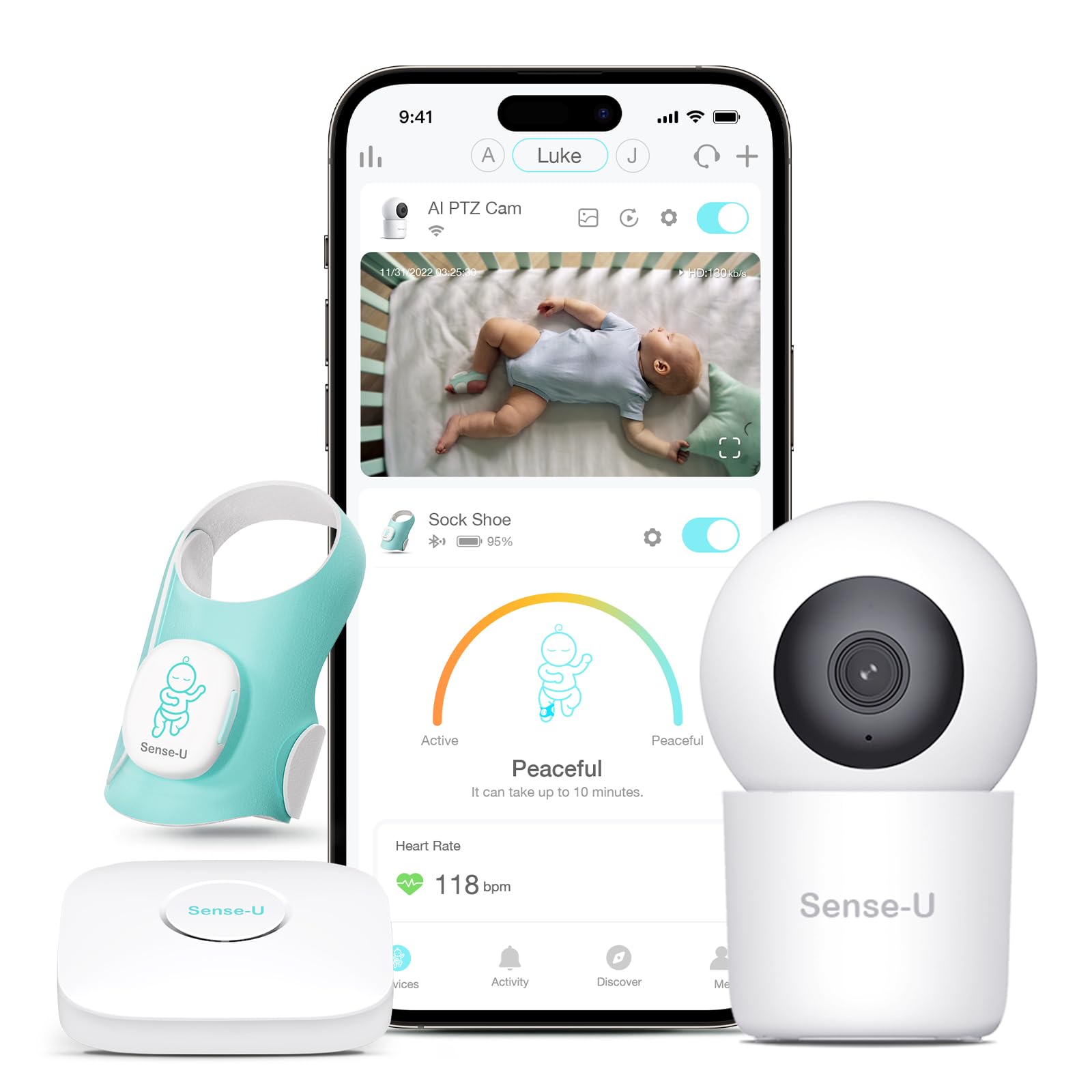
The Sense-U Smart Sock + Camera bundle pairs a shoe-style wearable sock with a 2.5K Pan-Tilt-Zoom (PTZ) camera for comprehensive monitoring. The sock uses optical sensors to track heart rate, sleep movements, and overall sleep patterns, sending data to a base station that relays to your phone from anywhere. The shoe-style design stays put better than traditional socks, with three size options covering 1-18 months.
The 2.5K camera is a significant upgrade over standard 1080p monitors, offering zoom capabilities without pixelation, motion detection, night vision, two-way talk, and a library of lullabies. No monthly subscription is required — you use a local SD card for recording, though optional cloud storage is available. The system supports twin monitoring with two socks and one base station.
Some users report that the sock can be finicky about fit, requiring precise positioning to get consistent heart rate readings. The battery life, while decent, could be better — expect to recharge every couple of days. A small number of users wish for SpO2 readings in addition to heart rate. For families who want a modern sock monitor with a pro-grade camera at a lower price than the Owlet Duo, this is a strong contender.
Why it’s great
- 2.5K PTZ camera with no subscription needed
- Shoe-style sock design stays on better than standard socks
- Supports twin monitoring with single base station
- Heart rate and sleep tracking from anywhere
Good to know
- Sock fit can be finicky for consistent readings
- No SpO2 measurement included
- Battery life could be longer
5. Sense-U Pro Clip-On Monitor
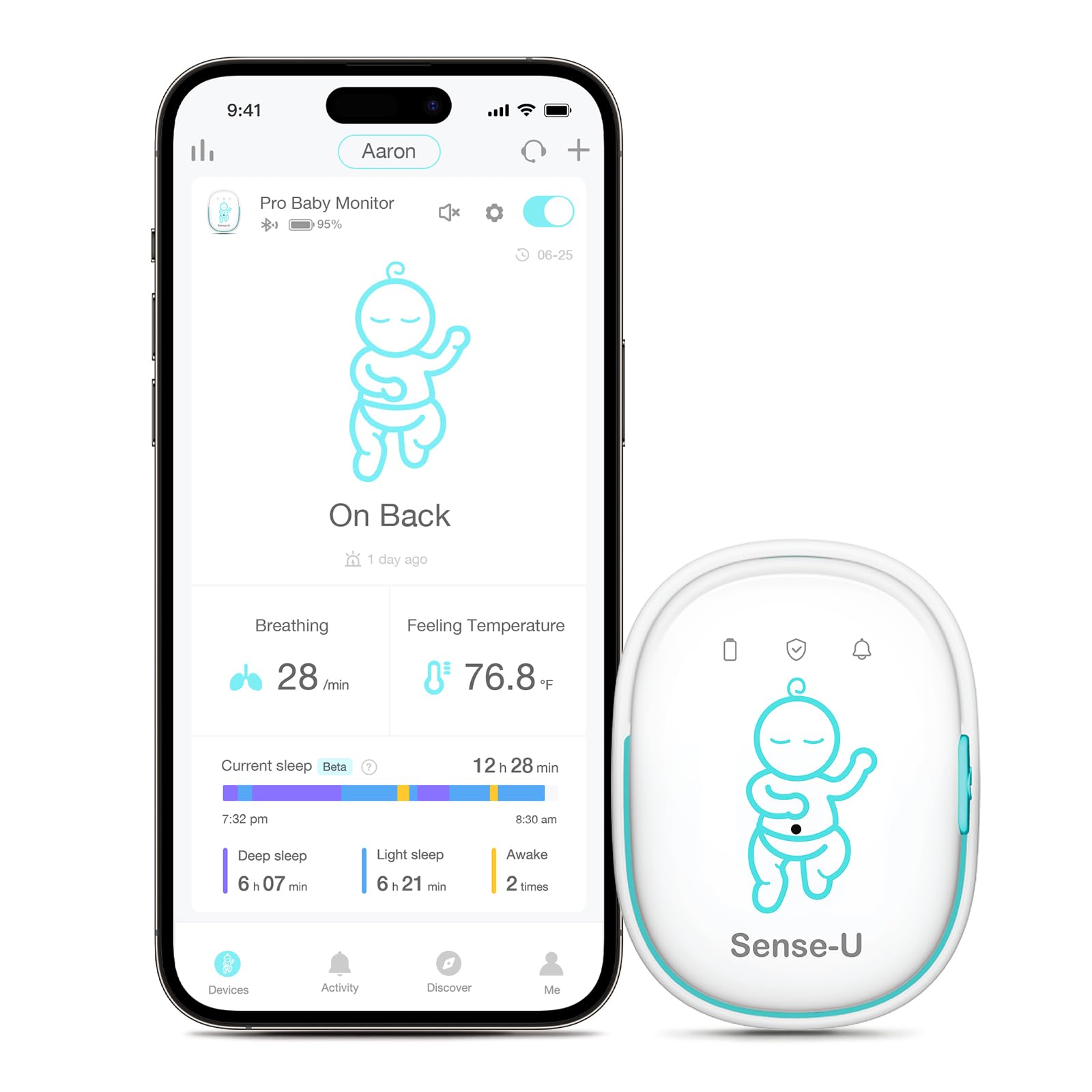
The Sense-U Pro is a clip-on sensor that attaches to the diaper and tracks abdominal breathing movement, stomach sleeping (rollover), and overheating. Its standout feature is the arousal vibration: if no movement is detected for 15 seconds, the device gently vibrates to stimulate the baby, and if movements still don’t resume, it triggers an audible alarm. This three-stage alert system minimizes false panic while still providing robust safety.
The device uses Bluetooth Low Energy (BLE 4.0+) with a radiation level 1/1000th of a smartphone, and can communicate up to 50 feet in open space. Battery life exceeds 7 days on a single charge, and the companion app provides detailed sleep analysis including deep/light sleep stages, awake times, and overall quality. The clip-on design is lightweight and portable, perfect for travel or naps in a different room.
The Bluetooth range is a limitation — you should stay in the same room for optimal connectivity. The device does not measure heart rate or oxygen, only movement. Some users note that the app interface could be more intuitive. For parents specifically concerned about breathing motion, rollover, and temperature, this is an excellent mid-range option with the vibration arousal feature being the key differentiator.
Why it’s great
- 15-second arousal vibration before full alarm
- Detects rollover and overheating in addition to breathing
- Excellent 7+ day battery life
- Low radiation BLE connectivity
Good to know
- Bluetooth range limited to 50 feet
- No heart rate or oxygen measurement
- App interface could be more polished
6. Babysense True Sleep HD

The Babysense True Sleep HD bundles the 5-inch HD Video Baby Monitor with PTZ camera and night light with the Babysense 7 Non-Contact Baby Movement Monitor. The under-mattress sensor pads detect micro-movements through the mattress without touching the baby, covering the entire crib area with two pads. The 5-inch parent unit provides crisp video, remote pan/tilt/zoom, two-way audio, lullabies, and temperature monitoring with alerts.
The combination of a dedicated parent screen with a separate movement monitor means you don’t need your phone or WiFi for any core function. The video monitor includes Eco Mode voice activation, sound-activated LED indicators, and multi-camera expandability up to four cameras. The separate movement monitor has enhanced sensitivity and uses Babysense’s patented non-contact technology that’s been trusted since 1992.
The sensor pads can be overly sensitive to external vibration — fans, HVAC units, or even someone walking heavily nearby can trigger false alarms. The parent unit screen has been noted as slightly too bright at night by some users. Also, the under-mattress pads are not recommended for use with pack-and-play or portable cribs. For families who want a dedicated screen plus non-contact movement monitoring in a standard crib, this is a reliable, well-integrated system.
Why it’s great
- 5-inch dedicated HD parent unit with PTZ camera
- Dual under-mattress pads for full crib coverage
- No WiFi or phone required
- Expands to 4 cameras
Good to know
- Sensor pads sensitive to external vibrations
- Parent unit screen bright at night
- Not for pack-and-play or portable cribs
7. iBaby i8 Smart Baby Monitor
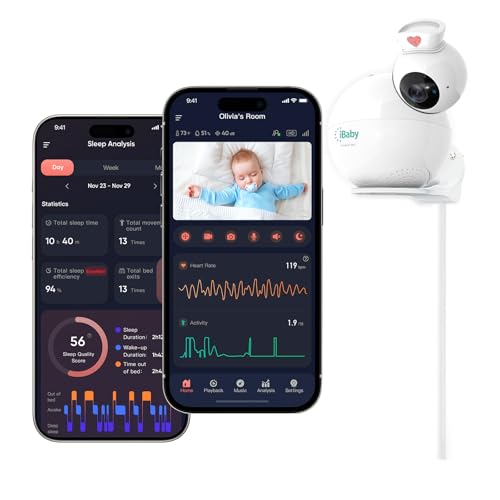
The iBaby i8 uses Yobi-PPG optical biosensing technology to track heart rate and sleep patterns contactlessly through the camera — no wearable required, no socks, no bands. The 1080p camera offers 360-degree horizontal rotation and 52-degree vertical tilt, with night vision that works in complete darkness. The system also monitors room temperature and humidity, with customizable alerts for head covering, crying, and heart rate deviations.
The two-way audio is crystal clear, and the built-in sound machine includes a library of lullabies plus educational audio content. The star and moon ceiling projection feature adds a calming visual element for bedtime. There are no subscription costs — video playback up to 48 hours is stored locally on a TF card (up to 1TB supported), and the heart rate data is displayed with a real-time waveform chart in the app.
The contactless heart rate tracking requires a clear view of the baby’s face — if the baby turns away or is covered, readings show “—” until visible again. Setup via the app can be frustrating, with some users reporting repeated pairing failures and no customer support to assist. The camera has no built-in battery and must remain plugged in. For a contactless heart rate solution, the iBaby i8 offers strong value if setup works smoothly.
Why it’s great
- Contactless heart rate tracking via facial optics
- 360-degree pan and tilt with night vision
- No monthly subscription for core features
- Built-in sound machine and ceiling projection
Good to know
- Heart rate requires clear face view
- App setup can be problematic
- No built-in battery — must stay plugged in
8. Snuza Hero SE

The Snuza Hero SE clips directly to the diaper and uses patented direct-touch sensor technology to detect breathing movements. It is completely WiFi-free, app-free, and cord-free — just clip it on and go. The device features a green indicator light that flashes with each detected breath, and you can optionally activate a ticking sound for audible reassurance. If no movement is detected for 15 seconds, it vibrates, followed by an audible alarm after 20 total seconds.
The battery lasts up to six months on a single replaceable battery, making it one of the lowest-maintenance wearable sensors available. The unit is made from medical-grade plastic and silicone, safe for sensitive skin. It comes with a protective carry case and is small enough to slip into a diaper bag for travel. Parents with post-partum anxiety consistently report this device as a lifeline for nap time and overnight sleep.
The device only detects movement — it does not track heart rate, oxygen, temperature, or rollover. False alarms can occur if the sensor shifts off the diaper. The alarm is audible but not exceptionally loud, so you may need to be in the same room or adjacent hall to hear it. For a simple, reliable, no-fuss breathing motion monitor with exceptional battery life, the Snuza Hero SE remains a classic choice.
Why it’s great
- 6-month battery life on one replaceable battery
- Medical-grade materials safe for sensitive skin
- No WiFi, apps, or cords required
- Compact and portable with carry case
Good to know
- Only detects movement — no heart rate or temperature
- False alarms if sensor shifts on diaper
- Alarm volume moderate; may not wake deep sleepers
9. Babysense Video & Breathing Movement Bundle

The Babysense Video & Breathing Monitor Bundle combines the V24R video baby monitor with a 2.4-inch screen and the Babysense 7 under-the-mattress movement monitor. The video unit uses 2.4GHz FHSS technology for secure, interference-free transmission and includes remote night light, temperature monitoring, Eco Mode, sound-activated LEDs, digital pan/tilt, and two-way audio with lullabies. The movement monitor includes two sensor pads that cover the entire crib area without touching the baby.
The bundle is one of the most affordable ways to get both video and non-contact movement monitoring in a single package. The V24R supports up to four cameras, making it easy to expand if you have multiple children. The under-mattress sensors are highly sensitive and reliably alarm when the baby is removed from the crib. The separate parent unit means no phone dependency and no WiFi configuration.
The sensor pads are famously sensitive — users report false alarms triggered by ceiling fans, HVAC drafts, or floor vibrations, especially in older homes or climates where fans run constantly. The 2.4-inch screen is smaller than modern standards, and the video quality is adequate but not exceptional. For families on a tighter budget who want both video and non-contact breathing monitoring in a traditional crib setting, this bundle delivers solid value.
Why it’s great
- Video and movement monitoring in one affordable bundle
- Dual under-mattress pads cover full crib area
- No WiFi or phone required
- Expandable to 4 cameras
Good to know
- Sensor pads sensitive to fan/HVAC vibration
- 2.4-inch screen is smaller than many competitors
- Video quality adequate but not premium
FAQ
Is an FDA-cleared baby sock monitor safer than a clip-on breathing sensor?
Can wearable sensor monitors prevent SIDS?
Why does my under-mattress sensor trigger false alarms with a ceiling fan running?
Final Thoughts: The Verdict
For most users, the baby monitors with wearable sensors winner is the Owlet Dream Duo (Gen 3) because it combines FDA-cleared pulse oximetry with a 2K HD camera in one cohesive app. If you want contactless breathing tracking without any wearable, grab the Philips Avent Premium Connected. And for portable simplicity with arousal vibration, nothing beats the Sense-U Pro.