
Our readers keep the lights on and the weekend projects moving. As an Amazon Associate, I earn from qualifying purchases.
Finding a game for a two-year-old that doesn’t involve tiny plastic pieces scattered across the floor is harder than it sounds. The best options ditch fragile cardboard for chunky wood, soft felt, or magnetic interactions that build fine motor skills without frustration.
I’m Rikta — the co-founder and writer behind FitlyFast. I’ve spent hundreds of hours analyzing early-childhood learning toys, comparing material safety, age ratings, and the specific mechanics that actually hold a toddler’s attention through multiple rounds.
After digging through customer experiences and technical specs, these are the board games for 2 year olds that deliver durable, screen-free engagement without overwhelming little learners.
How To Choose The Best Board Games For 2 Year Olds
Two-year-olds are in a unique developmental sweet spot — they’re ready for structured play but still mouth objects and drop things constantly. The right game balances safety, durability, and a learning mechanic that matches their short attention span.
Material Safety and Durability
Cardboard won’t survive enthusiastic toddler handling. Look for thick wood pieces with smooth, splinter-free edges or dense felt that can be washed. Non-toxic, water-based paint finishes are standard for quality toddler toys, and any game marketed for ages 1+ has passed safety lab testing for choking hazards.
Game Mechanics Suited for Toddlers
Two-year-olds cannot follow multi-step rules. The best games rely on simple actions: flipping a chip, stacking a block, or using a magnetic wand. Cooperative play (everyone wins together) works better than competitive formats, and open-ended free play extends the toy’s lifespan beyond the structured game itself.
Piece Size and Storage
Pieces should be large enough to grip but not so small they become choking risks. A storage bag or nesting box is a major bonus — it teaches cleanup habits and prevents lost parts. Games that come with their own carrying pouch are especially useful for travel or keeping the set together between plays.
Quick Comparison
On smaller screens, swipe sideways to see the full table.
| Model | Category | Best For | Key Spec | Amazon |
|---|---|---|---|---|
| Peaceable Kingdom Where’s Bear | Stacking Hide & Seek | Object permanence & spatial concepts | 6 nesting boxes, 1 wood bear | Amazon |
| HABA My Very First Games Building Site | Cooperative Building | Story-driven cooperative play | Includes toy dump truck | Amazon |
| Peaceable Kingdom Acorn Soup | Recipe Matching | Vocabulary & counting with recipe cards | 24 wood ingredients, 1 wood spoon | Amazon |
| Cottify Wooden Matching Game | Memory Circle Cards | Durable wood memory with 36 cards | Solid basswood, 18 pairs | Amazon |
| Peapod Play Felt Matching Game | Soft Felt Matching | Sensory-friendly first memory game | 16 felt cards (8 pairs) | Amazon |
| edutree Wooden Magnetic Fishing Game | Magnetic Fishing | Color sorting & fine motor with magnet | Frog base, 10 fish, 2 rods | Amazon |
| TOP BRIGHT Magnetic Bird Feeding | Magnetic Bird Game | Fine motor worm-catching action | Bird, stump, magnetic worms | Amazon |
In‑Depth Reviews
1. Peaceable Kingdom Where’s Bear

This game combines two toddler obsessions — nesting blocks and hide-and-seek — into a single durable package. The six boxes stack into a tower or nest inside each other, and the small wooden bear figurine hides under one of them. Parents and kids take turns hiding and finding, which reinforces object permanence and spatial vocabulary like “up,” “down,” “top,” and “bottom.”
Each box side is illustrated with a room from Bear’s house, turning the stacking itself into a matching and labeling activity. Early childhood educators praise this game for building language skills, and parents report that the open-ended nature keeps it fresh long after the structured game is mastered.
The wooden construction is sturdy and the boxes are large enough to avoid choking hazards. The bear figurine is solid wood with no small appendages, and the set includes a parent guide with five quick game variations to try as the child grows.
Why it’s great
- Teaches spatial concepts and object permanence through natural play
- Durable wood nesting boxes survive rough stacking and knocking over
- Multiple game modes extend the toy’s lifespan past age 2
Good to know
- Boxes can be bulky for small storage spaces
- Single-player game unless an adult joins the hide-and-seek
2. HABA My Very First Games Building Site

HABA’s cooperative format teaches that everyone builds the house together — there’s no winner or loser, just the satisfaction of completing the construction site. Players flip sturdy cardboard chips to see which building piece to move next, then use the included dump truck to transport blocks to the building site. The truck itself is compatible with the HABA Kullerbu track system, adding free-play value beyond the game.
The included story script guides parents through reading aloud before and during play, immersing toddlers in the narrative of building a house. The pieces are thick, the truck is solid plastic without cheap seams, and the blocks are large enough to be safe for two-year-olds. The cooperative mechanic means older siblings can join without dominating.
The game is designed for ages 2 and up, but many parents report adapting it for 18-month-olds by skipping the chip-flipping and just playing with the truck and blocks. The storage box keeps everything contained, and the open-ended nature means toddlers can simply dump and reload the truck for independent play.
Why it’s great
- Cooperative gameplay eliminates frustration from losing
- Dump truck works with Kullerbu track for extended play
- Story-driven design keeps toddlers engaged in the narrative
Good to know
- Requires adult facilitation for the full game experience
- Cardboard chips may show wear with frequent use
3. Peaceable Kingdom Acorn Soup

Acorn Soup turns pretend play into a structured game where toddlers help Squirrel prepare winter soups by following recipe cards. The set includes 24 chunky wooden ingredients, 8 double-sided recipe cards, and a wooden spoon for stirring. Kids roll a die to determine which ingredient to add, building turn-taking and counting skills in the process.
The wooden ingredients are painted in bright, non-toxic colors and are large enough for small hands to grasp. The recipe cards show the ingredient quantities visually, so non-reading toddlers can match by shape and color. The wooden spoon adds a tactile element that makes “feeding” the soup to parents a favorite post-game activity.
Parents report that the game grows with the child — at first it’s about identifying ingredients, then matching cards, then counting. The storage box is compact, and the ingredients fit neatly inside. The included parent guide offers tips for modifying the rules for younger players who aren’t ready for structured gameplay.
Why it’s great
- Visual recipe cards teach counting and matching without reading
- Wooden spoon and ingredients feel substantial and durable
- Pretend-play angle keeps kids engaged even outside the game
Good to know
- Some units may arrive with minor variations in piece count
- Recipe cards are thick cardboard, not coated for moisture resistance
4. Cottify Wooden Matching Game

This memory game ditches flimsy paper cards for 36 solid basswood circles, each 2.2 inches in diameter and 0.12 inches thick. The wooden tiles are silk-painted with vibrant animal illustrations — lion, monkey, elephant, and more — and every tile has a different colored background to help toddlers remember which pairs belong together. Unlike traditional memory games that crease or tear, these tiles are scratch- and water-resistant.
The set includes 18 pairs (36 tiles total) and a drawstring pouch for storage and travel. The tiles are large enough to avoid choking hazards and substantial enough that toddlers can manipulate them easily. Parents can start with simple face-up matching for younger players before moving to the traditional face-down memory format as the child’s skills develop.
The sustainable basswood construction ensures this game can survive multiple children and years of play. The pouch keeps the set together, and the 36-card count provides enough variety to stay interesting without overwhelming a two-year-old. Early childhood specialists appreciate the verbal skill development that comes from naming each animal during play.
Why it’s great
- Solid wood tiles are virtually indestructible compared to paper cards
- Water-resistant silk paint survives spills and messy hands
- Large 2.2-inch diameter tiles are easy for small hands to flip
Good to know
- Back pattern with three animal heads can confuse very young toddlers
- Pouch is functional but not structured for easy tile retrieval
5. Peapod Play Felt Matching Game
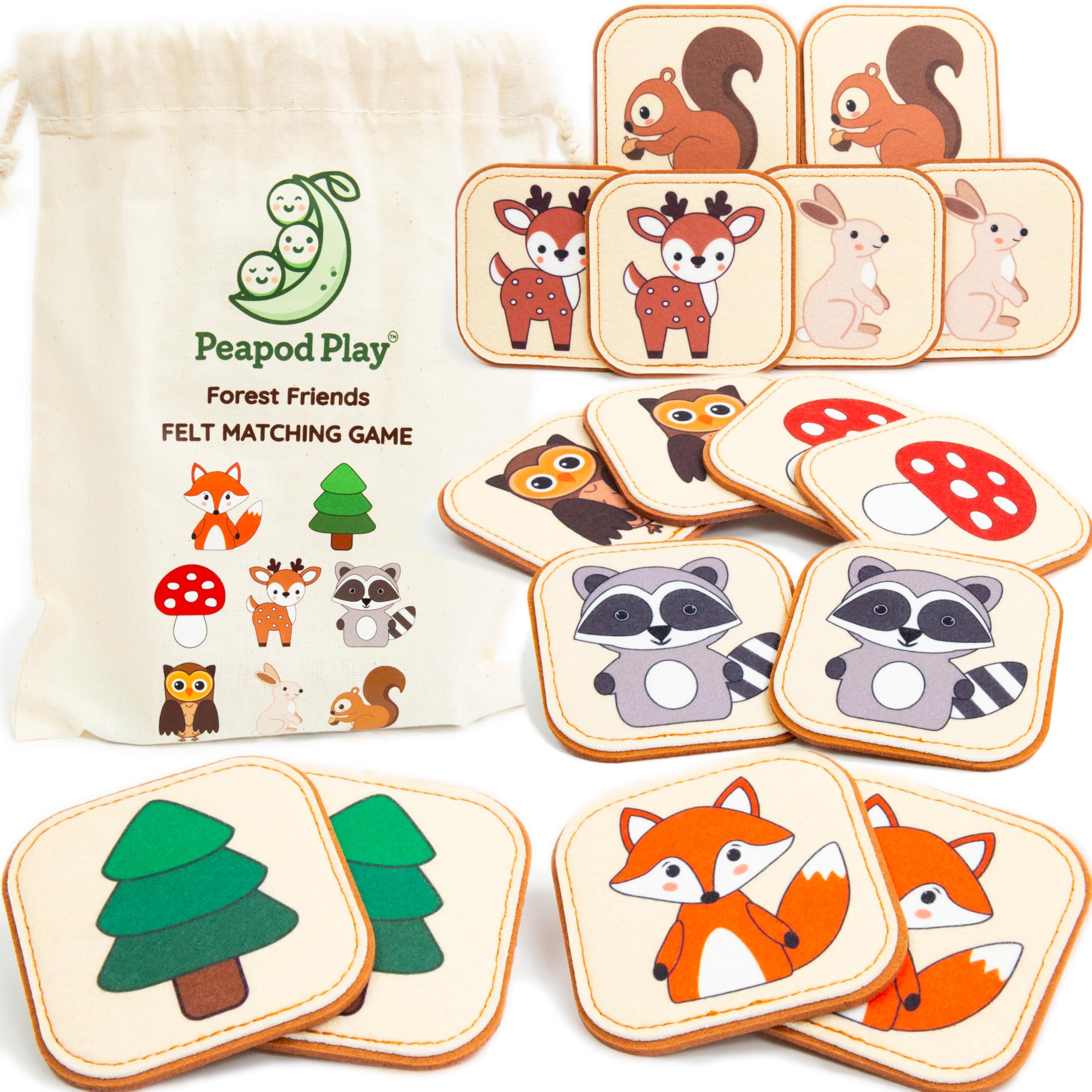
Standard memory cards are a disaster for toddlers — they crease, tear, and create choking hazards. Peapod Play replaces them with 3.5-inch square felt cards made from non-toxic polyester that is water-resistant, washable, and safety lab approved for ages 1+. The thick 0.25-inch felt provides a soft, quiet texture that is easy to grip and completely silent during play.
The set includes 16 cards (8 matched pairs) featuring woodland creatures — fox, raccoon, bunny, deer, squirrel, owl, evergreen tree, and mushroom. The woodland theme is consistent across the cards, and the neutral background helps toddlers focus on the animal itself. The included storage bag makes cleanup straightforward, and the cards fit easily into diaper bags for travel.
Montessori-inspired design emphasizes sensory play and independent discovery. Parents report using the cards as flash cards for younger toddlers before transitioning to matching games. The felt material is forgiving — it doesn’t slide around on the floor like paper cards, making it easier for toddlers to line up pairs. The 8-pair count is modest but intentional to avoid overwhelming first-time players.
Why it’s great
- Washable felt construction is ideal for messy toddlers
- Quiet play — no loud cardboard shuffling or dropping
- Gentle on hardwood floors and won’t scratch surfaces
Good to know
- Only 8 pairs, which limits replay for older or advanced toddlers
- Felt may pill or attract lint over extended use
6. edutree Wooden Magnetic Fishing Game
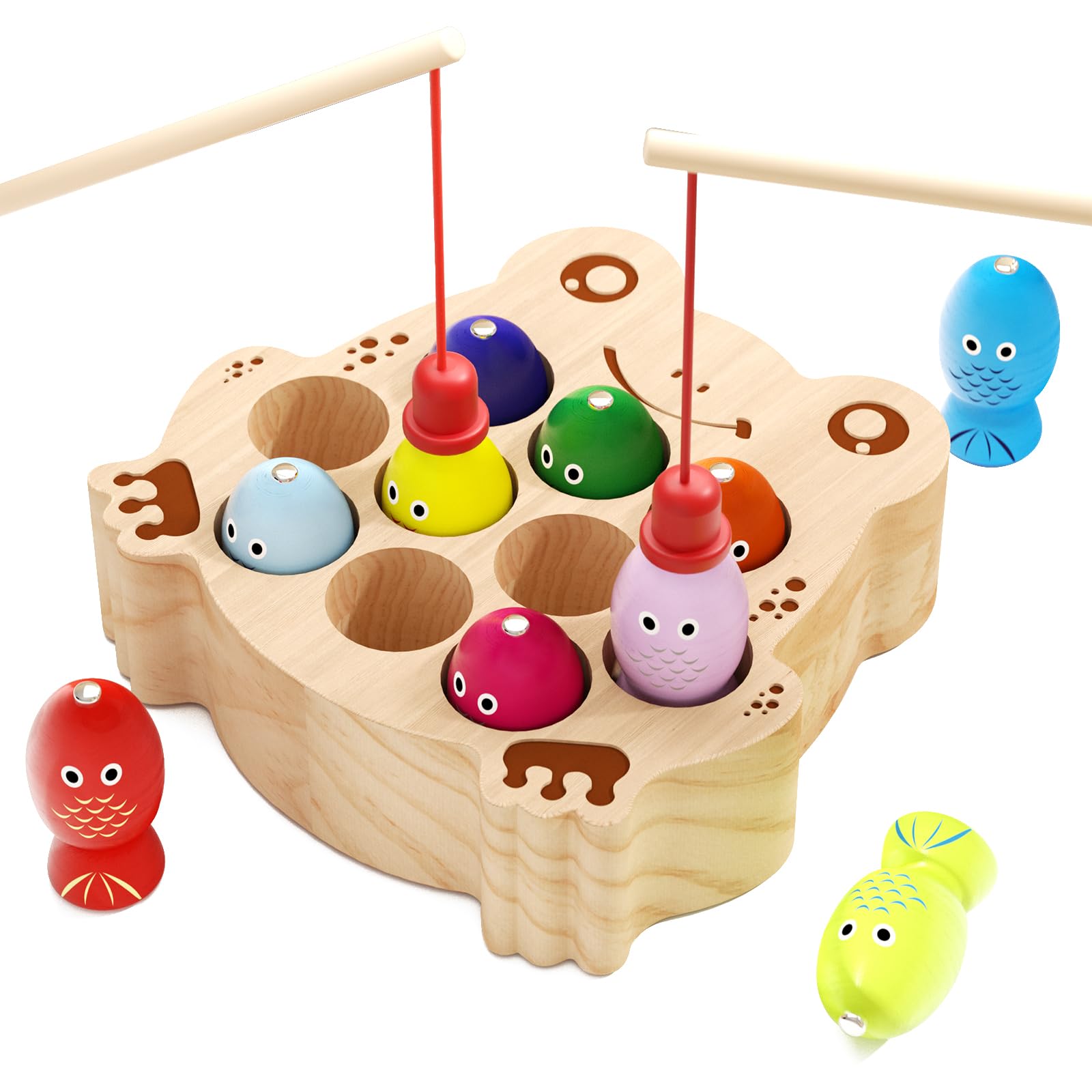
This magnetic fishing game replaces a traditional board game concept with a hands-on, fine-motor challenge. The wooden frog-shaped base serves as a “pond” that holds 10 fish in five bright colors. Two mini fishing rods with strong magnets let toddlers “catch” the fish by positioning the magnet correctly, building hand-eye coordination and color recognition with every catch.
The wood construction is smooth with rounded edges and coated in safe water-based paint. The magnets are strong enough to hold the fish securely but not so strong that they pinch little fingers. The two-rod design allows for parent-child interaction or sibling play, and the compact size (7 x 5.9 inches) makes it easy to store on a bookshelf or toss in a travel bag.
The game works on multiple levels — younger toddlers can simply pull the fish out of the pond, while older twos can sort by color or count their catch. The 180-day guarantee adds confidence, and parents report that the magnetic action is satisfying enough to hold attention for extended periods. The frog shape adds a whimsical element that toddlers find engaging.
Why it’s great
- Strong magnets provide satisfying “catch” feedback for toddlers
- Two rods enable cooperative or competitive play with a partner
- Compact size fits easily into a diaper bag for travel
Good to know
- No numbers or counting elements on the fish themselves
- Magnet precision may frustrate very young 18-month-olds
7. TOP BRIGHT Magnetic Bird Feeding

TOP BRIGHT takes the magnetic concept and turns it into a narrative — toddlers use a magnetic wand to “catch” worms and feed them to a baby bird. The mother bird has a soft rubber beak that prevents accidental bumps, and the hollow tree stump stores all the accessories (worms, wand, and birds) after play. The nature-themed design appeals to toddlers’ growing sense of imagination.
The magnetic action requires precise wrist control: toddlers must align the wand with the worm’s metal end to pick it up, then move it to the baby bird’s beak. This repeated motion builds fine motor skills, hand-eye coordination, and wrist strength. The bright, earthy colors keep visual interest high without overstimulation.
Parents report that toddlers love the cause-and-effect of “feeding” the bird, and the open-ended nature allows for free play beyond the structured game. The bird’s beak is large enough to accept multiple worms, so toddlers can practice counting as they feed. The compact storage in the stump keeps all pieces together, and the wood construction is smooth and durable enough for rough toddler handling.
Why it’s great
- Narrative-driven play keeps toddlers engaged in the feeding task
- Soft rubber beak prevents accidents during enthusiastic play
- Tidy storage design with all pieces fitting inside the stump
Good to know
- Number of pieces is limited; some parents wish for more worms
- Magnetic action may require adult demonstration initially
FAQ
Can a 2-year-old actually play a board game by the rules?
Are magnetic games safe for toddlers who still put things in their mouths?
How many pairs should a first matching game have?
What is the difference between cooperative and competitive games for toddlers?
Final Thoughts: The Verdict
For most families, the board games for 2 year olds winner is the Peaceable Kingdom Where’s Bear because it combines stacking, hide-and-seek, and object permanence in a single durable wooden set that grows with the child. If you want cooperative storytelling with a dump truck that works for free play, grab the HABA My Very First Games Building Site. And for a budget-friendly, washable sensory experience that is silent and travel-friendly, nothing beats the Peapod Play Felt Matching Game.