
Our readers keep the lights on and the weekend projects moving. As an Amazon Associate, I earn from qualifying purchases.
You are looking for a serious off-grid power solution, and a 400-watt panel is the sweet spot — enough to run a mini-fridge, charge a large power station, and keep your devices alive for days. But the market is flooded with panels that claim 400 watts yet deliver barely 300 in the real world, and the ones that do perform are often too heavy to actually take anywhere. The goal of this guide is to cut through the marketing and rank the panels that actually deliver measurable wattage, real portability, and a durable build that survives the outdoors.
I’m Rikta — the co-founder and writer behind FitlyFast. I’ve spent countless hours analyzing monocrystalline cell efficiency, VOC limits, connector compatibility, and fold-down dimensions across the current generation of 400-watt portable solar panels to separate the real performers from the inflated spec sheets.
Whether you’re equipping an RV for a cross-country trip or building a home emergency backup kit, choosing the right 400 watt portable solar panel comes down to real-world output, total weight, and how well it integrates with your existing power station gear.
How To Choose The Best 400 Watt Portable Solar Panel
The market for 400-watt portable panels is split between ultra-light blankets that fold down to backpack size and heavier, more rigid suitcase models that offer higher real-world energy capture. Your choice depends on whether you prioritize pack weight for overlanding or raw daily watt-hours for stationary RV setups. The three specs that separate the winners from the also-rans are conversion efficiency, open-circuit voltage compatibility, and the quality of the lamination and connectors.
Real-World Output vs. Advertised Rating
The “400W” rating is measured under Standard Test Conditions (STC) — a laboratory ideal that rarely exists outdoors. Real-world peak output for a quality panel during summer midday is usually 320-380W, dropping to 200-300W in hazy or moderately cloudy conditions. Look for panels that use N-Type solar cells with 16-busbar (16BB) technology, as they suffer less from Light Induced Degradation (LID) and maintain higher output in low-light or partial-shade scenarios. Panels that consistently deliver 90% or more of their rating in customer testing are the ones worth your money.
Voltage Compatibility — The Silent Panel-Killer
The single most destructive mistake buyers make is connecting a panel with an open-circuit voltage (VOC) that exceeds their power station’s maximum solar input. A 400W foldable panel typically has a VOC between 40V and 58V. If you plug a 58V panel into a power station that only handles 50V, you risk burning out the charge controller. Check your power station’s spec sheet (not the marketing page) for the max solar input voltage. For EcoFlow Delta series, stick to panels with VOC under 50V. For Anker SOLIX or Bluetti units with higher limits, a higher VOC panel can be fine and even beneficial for cold-weather performance (VOC rises as temperature drops).
Weight, Folded Size, and Build Material
Portable solar panels fall into three weight tiers: heavy-duty rigid or bifacial (30-50 lbs) that produce the most power per square foot but are hard to move; mid-weight suitcase panels (20-35 lbs) with rigid frames and kickstands; and ultra-light blankets (16-17 lbs) that sacrifice some peak output for unmatched packability. The best build materials are ETFE (ethylene tetrafluoroethylene) lamination on the front face, which offers 95%+ light transmission and is highly scratch-resistant, combined with an 840D Oxford cloth or fiberglass backing for tear resistance. Avoid panels that use standard PET lamination — they yellow and lose efficiency over time.
Quick Comparison
On smaller screens, swipe sideways to see the full table.
| Model | Category | Best For | Key Spec | Amazon |
|---|---|---|---|---|
| Renogy 400W Solar Blanket | Ultra-Light Blanket | Overlanding & Backpack Fit | 16.09 lbs, 25% N-Type, 16-fold | Amazon |
| Greenmagic 400W | Suitcase Foldable | Weight & Value Balance | 21.5 lbs, 21.5-23.5% efficiency | Amazon |
| OptiSolex 440W Solarbag | Split Blanket | Dual-Device Charging | 17.2 lbs, splits 2x220W | Amazon |
| Twelseavan 400W | Suitcase Foldable | Budget Mid-Range Pick | 22 lbs, 24% ETFE | Amazon |
| ZOUPW 450W | Premium Suitcase | High-Output & Large Stations | 29.5 lbs, 25% N-Type 16BB, IP68 | Amazon |
| Renogy ShadowFlux 200W 2-Pack | Rigid Glass Panels | Permanent RV Roof Mount | Anti-shading, 25%, 24V output | Amazon |
| JJN Bifacial 2-Pack 400W | Bifacial Rigid | Maximum Rooftop Energy | 94.6 lbs total, 25% bifacial | Amazon |
| EF ECOFLOW 400W | Premium Suitcase | EcoFlow Ecosystem Pairing | 35.3 lbs, IP68, tuned MPPT | Amazon |
| Anker SOLIX PS400 | Premium Suitcase | Anker Ecosystem & Build Quality | 35 lbs, IP67, 4-angle kickstand | Amazon |
In‑Depth Reviews
1. Renogy 400W Portable Solar Panel Blanket
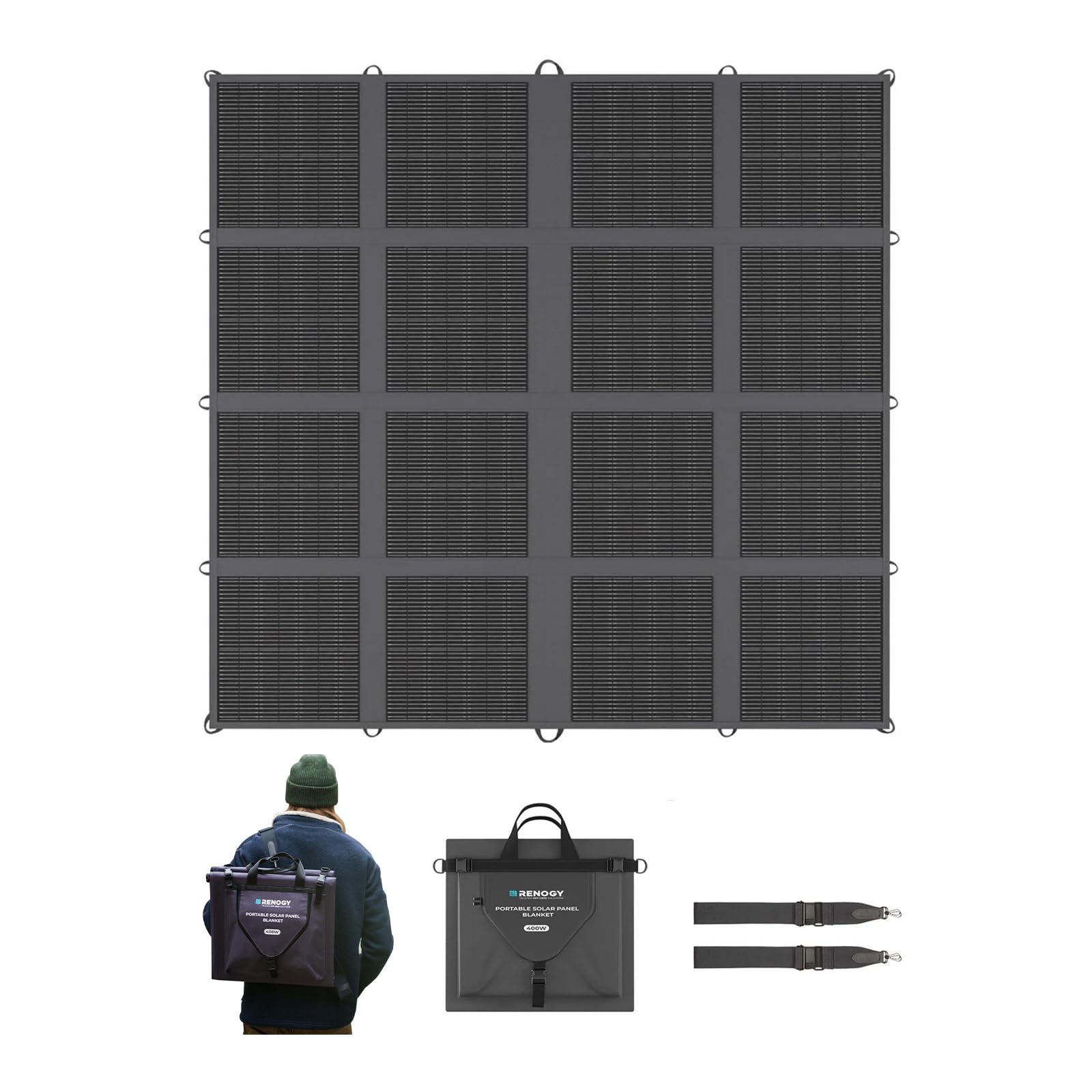
The Renogy 400W Solar Blanket redefines what portable means for this wattage class. At just 16.09 pounds, it is the lightest panel in this roundup by a wide margin, achieved through an innovative 16-fold design that collapses the unit down to a backpack-friendly 16.54 x 15.83 x 4.13 inches. This makes it the only true carry-on option for overlanding, where every pound and cubic inch of cargo space is fought over. The N-Type 16BB cell technology achieves a certified 25% conversion efficiency, and independent customer testing consistently shows real-world peaks of 380-385W when the panel is laid flat in direct sun — outperforming many heavier competitors.
The build quality includes military-grade ETFE lamination and reinforced stitching, earning it an IP65 rating that handles rain and dust without issue. The 10-foot cable is generous, and the included adjustable shoulder straps make transport genuinely easy. The panel is UL 61730 certified, adding a layer of safety assurance that many off-brand panels lack. One notable design win is the multiple eyelets around the perimeter, which let you hang the blanket vertically between trees or across a windshield to capture low-angle sun while creating shade underneath — a dual-purpose feature that overlanders and van-dwellers will use constantly.
The main trade-off is that this is a soft blanket, not a rigid case. It needs to be laid flat on a stable surface or hung; it cannot stand up on its own like suitcase-style panels with built-in kickstands. The connectors are IP68 solar connectors (MC4-compatible), but you will need an adapter cable for most power stations unless you are running a direct 12V/24V bank. The 2-year warranty is shorter than some premium competitors, though Renogy’s customer support and parts availability are well-established. For the buyer who prioritizes weight savings and packability above all else, this is the definitive choice.
Why it’s great
- Unmatched portability at 16.09 lbs with a 16-fold backpack-sized pack
- Real-world output consistently hits 380-385W, exceeding many rigid panels
- N-Type 16BB cells deliver 25% efficiency with excellent low-light performance
- Eyelets allow vertical hanging for optimal sun tracking and shade creation
Good to know
- Requires a flat surface or hanging — no built-in kickstand for self-support
- MC4 connectors only — adapter needed for most power station inputs
- Soft blanket construction may wear faster on rough ground than rigid cases
2. Greenmagic Portable 400 Watt Solar Panel
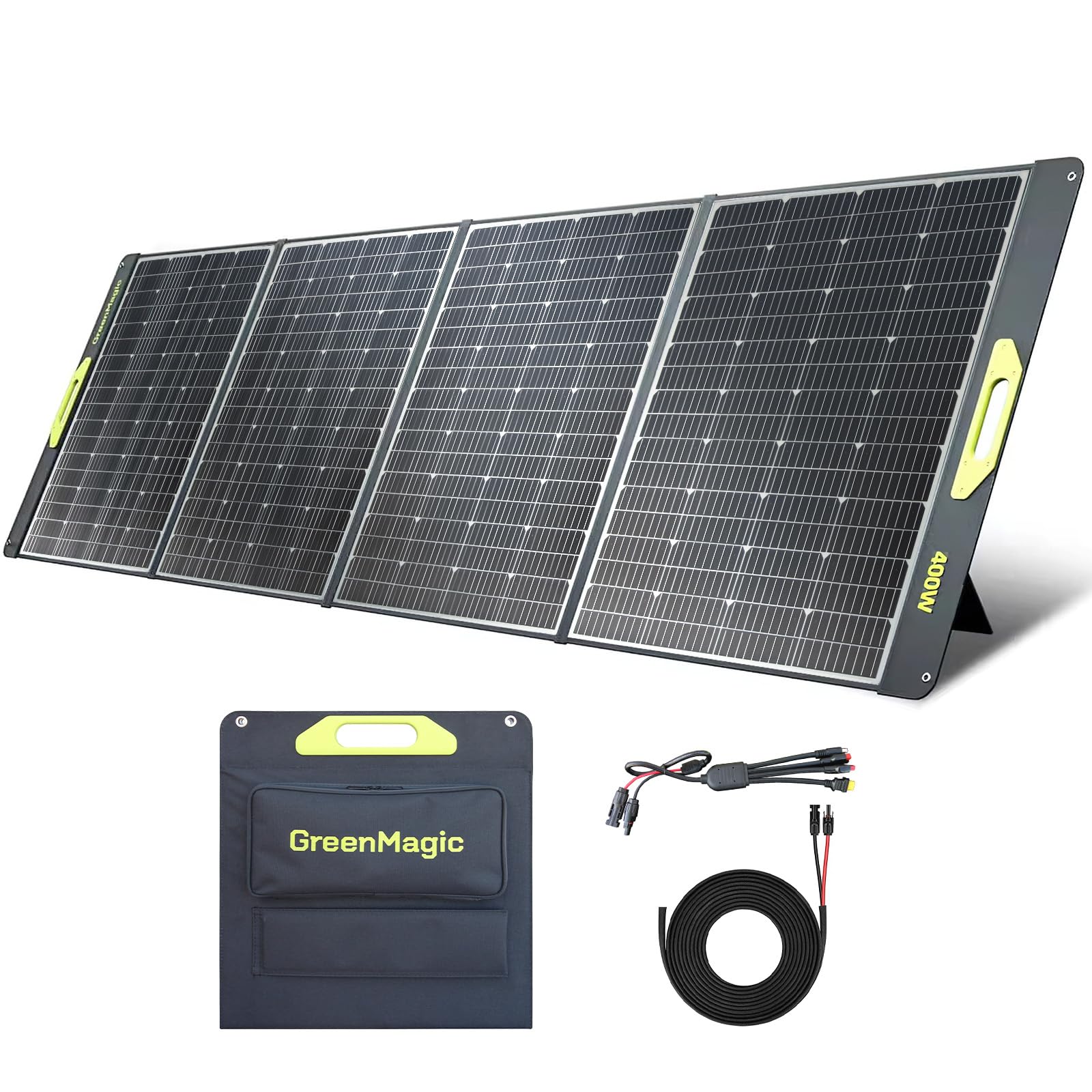
The Greenmagic 400W panel strikes the most compelling balance between price, weight, and real-world performance in the mid-range. Weighing 21.5 pounds and folding down to a briefcase-style 32 x 31.3 x 1.97 inches, it is about 5 pounds heavier than the lightest blankets but significantly lighter than the premium case models that push past 35 pounds. The monocrystalline silicon cells are rated at 21.5-23.5% efficiency, and customers consistently report real-world peaks between 280W and 330W, with some hitting 340-350W in optimal conditions. The 39V output makes it broadly compatible with most 40V-input power stations from Jackery, Goal Zero, EcoFlow, Bluetti, and Anker.
What sets the Greenmagic apart at this price point is the array of practical features that add up to real convenience. The four built-in adjustable kickstands let you angle the panel toward the sun in seconds, eliminating the need to prop it up with gear or find a perfectly flat surface. The 840D Oxford cloth backing combined with IP65 lamination provides genuine weather resistance — it survives splashes and dust without issue (though the junction box should not be submerged). The inclusion of four hanging loops around the edges means you can mount it on the side of an RV or hang it from a fence, giving it more installation flexibility than most suitcase panels.
The biggest limitation is that real-world output tends to hover around 75-82% of the 400W rating, which is normal for this class but means the Renogy blanket and premium options will outperform it in absolute wattage. Some users noted that the kickstands lack the stability of a single central pole, so the panel can wobble in wind. The 21.5-pound weight is light enough for one person to carry but not truly backpack-portable. Greenmagic offers solid customer support, and the 5-star review volume suggests consistency. For buyers who want a lightweight case panel with kickstands, wide compatibility, and a budget-friendly price, this is the strongest contender.
Why it’s great
- Excellent price-to-performance ratio with solid 21.5 lb build
- Four adjustable kickstands provide quick angle optimization
- 39V output compatible with most major power stations
- Hanging loops offer versatile mounting beyond ground placement
Good to know
- Real-world output typically 280-330W, below the 400W rating
- Kickstands can be unstable in windy conditions
- Junction box is not waterproof despite IP65 body rating
3. OptiSolex 440W Portable SolarBag
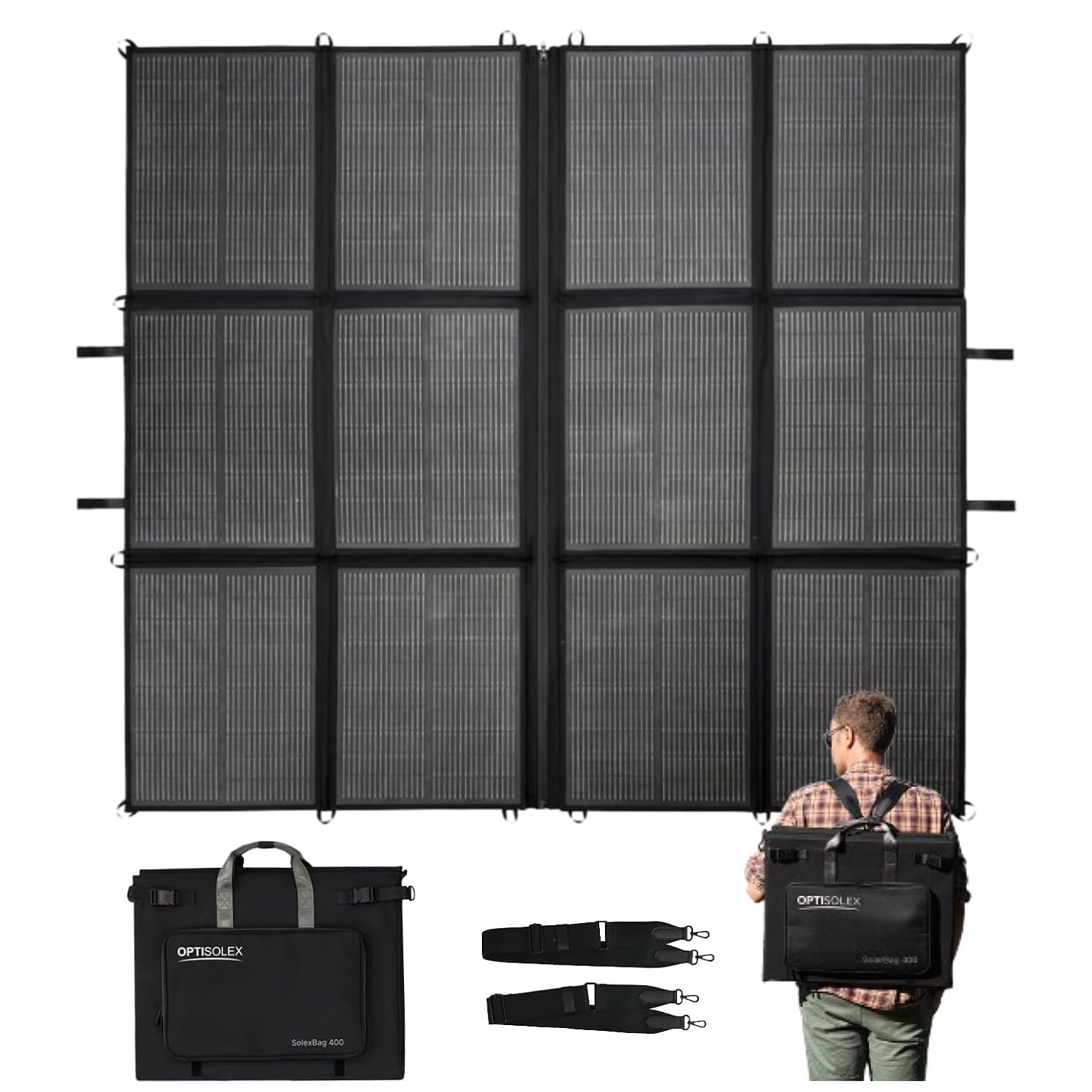
The OptiSolex 440W Solarbag is a genuinely innovative design that offers something no other panel on this list does: the ability to split into two independent 220W panels connected by a zipper. This lets you place one half on your RV roof while the other catches sun on the ground, or charge two separate power stations or a 12V battery bank simultaneously. Each half also integrates 6-port fast output (USB-C 45W, USB-A 18W, and USB-A 15W), meaning you can charge phones and small devices directly from the panel without needing a power station in the middle — a killer feature for ultra-light backpackers.
At 17.2 pounds, the Solarbag is only a pound heavier than the Renogy blanket, and its folded size of 21.06 x 17.16 x 4.53 inches is similarly backpack-friendly. The N-Type cells achieve up to 25% conversion efficiency, and real-world peak outputs of 390W have been reported on sunny days. The zipper-based split design is clever but requires careful handling to avoid damaging the internal wiring when separating and reconnecting the halves. The included carabiners and shoulder straps make it easy to hang or carry, and the ETFE lamination provides IP65-rated weather protection.
The durability trade-off comes from the zipper mechanism itself. Multiple reports indicate that the panels can delaminate at the folding points over time, and one customer reported a complete failure after three weeks with no response from support. The soft blanket nature means it lacks kickstands, so you must lay it flat or hang it. The 440W rating is slightly higher than standard 400W panels, providing about 10% more potential output in perfect conditions. For those who value the unique split-panel flexibility and direct USB charging, the Solarbag is unmatched, but buyers should consider the 3-year warranty as a safety net for potential reliability concerns.
Why it’s great
- Unique zipper-split design allows dual-device or two-location charging
- Built-in USB-C 45W and USB-A 18W ports eliminate need for power station
- Ultra-light 17.2 lbs with backpack-friendly folded size
- 25% N-Type efficiency with real-world 390W peaks
Good to know
- Zipper mechanism and folding points are potential durability weak spots
- No kickstands — requires flat surface or hanging setup
- Support responsiveness has been inconsistent in some user reports
4. Twelseavan 400W Portable Solar Panel
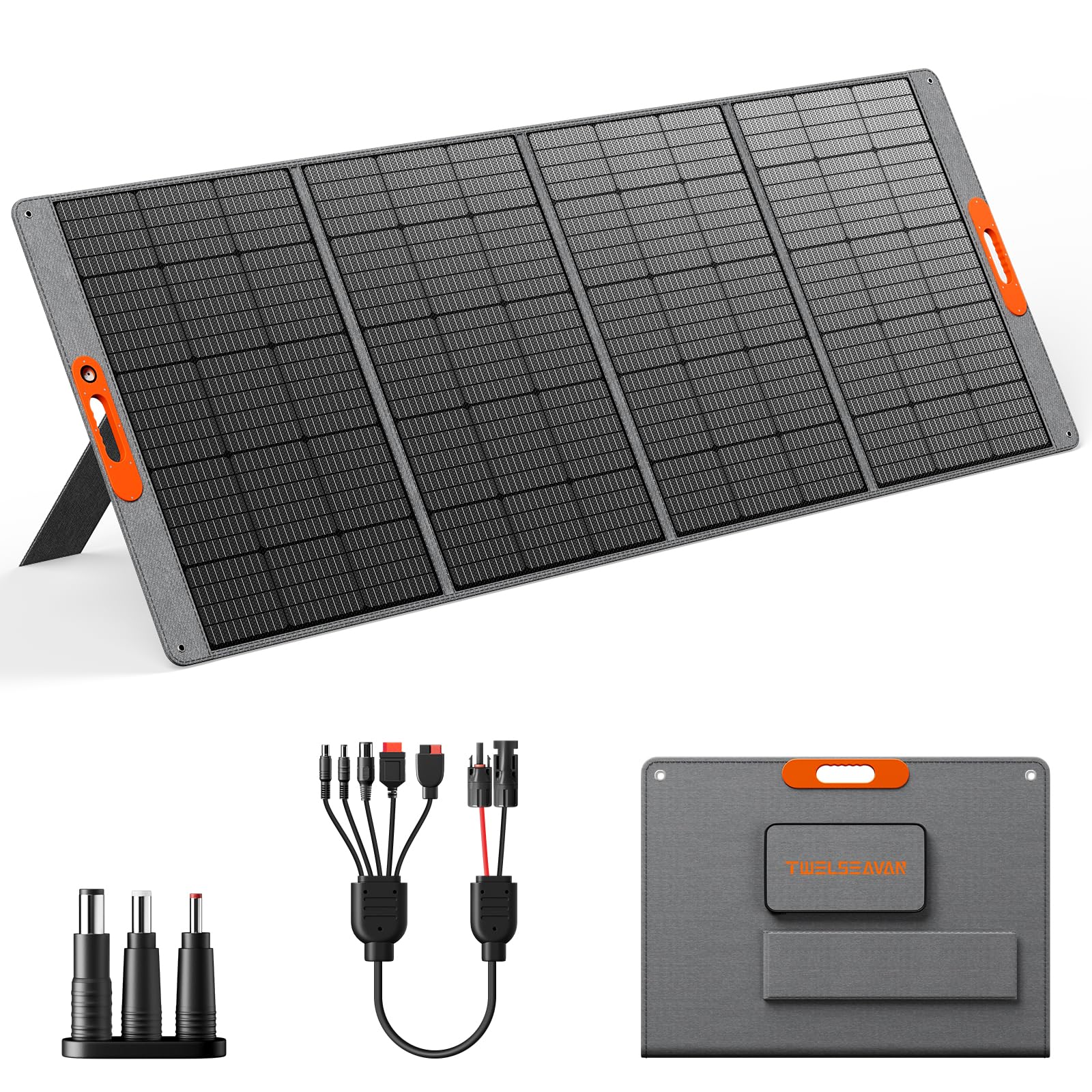
The Twelseavan 400W panel is the strongest entry-level option for those on a tight budget who still want a suitcase-style design with actual kickstands. Weighing 22 pounds with a folded size of 35.5 x 26 x 1.9 inches, it sits in the middle of the pack for portability. The A+ grade monocrystalline cells are laminated with ETFE, achieving a claimed 24% efficiency. Real-world testing from buyers shows consistent peaks of 367-385W in optimal east coast and northeast US sun, which is excellent for a mid-range panel. The 40V output is compatible with most 40-48V input power stations, and the included 8-in-1 MC4 converter (with 5 adapter heads plus 3 DC adapters) covers practically every connector standard on the market.
Build quality exceeds expectations for this tier. The fiberglass-reinforced frame and high-density polyester canvas backing have proven durable even after months on gravel and dirt, with no reports of fabric fraying or cell damage. The four adjustable kickstands are robust and allow angle tuning, though setup takes a minute longer than premium panels with simpler leg systems. The IP65 rating means it handles splashes and dust, but the open-circuit voltage of 46.9V is a critical spec to check — it is too high for small power stations with a 30V max input, so ensure your station can handle at least 48V.
The primary downside is the 22-pound weight, which is manageable but noticeably heavier than the 16-pound blankets. The magnetic handle is a nice touch for carrying, but the handle itself is not padded. Twelseavan backs the panel with a 2-year warranty and 30-day money-back guarantee, which provides reasonable peace of mind for the budget-conscious buyer. If your power station can handle the voltage and you want a genuine kickstand panel without spending premium dollars, the Twelseavan delivers exceptional value with real-world wattage that rivals panels costing considerably more.
Why it’s great
- Exceptional real-world output of 367-385W at an affordable price
- Included 8-in-1 MC4 converter covers nearly all power station connectors
- Durable fiberglass and ETFE build holds up well on rough surfaces
- Four adjustable kickstands provide good angle optimization
Good to know
- 46.9V open-circuit voltage incompatible with small 30V-input power stations
- 22 lbs is heavier than blanket-style competitors
- Kickstand setup takes slightly longer than premium leg systems
5. ZOUPW 450W Portable Solar Panel
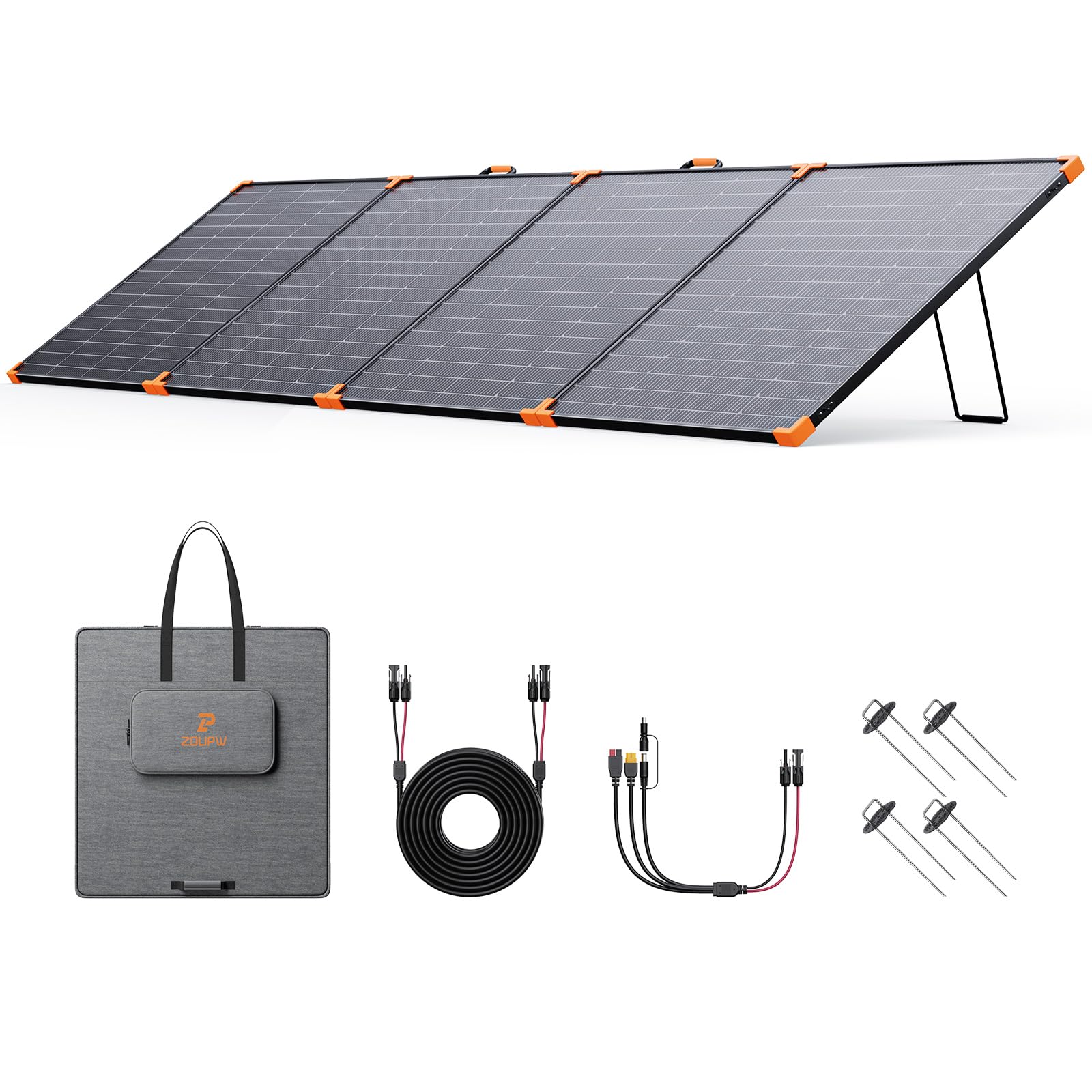
The ZOUPW 450W panel is built for the power user who owns a large-capacity power station (2kWh or more) and needs a foldable panel that can actually deliver on its high wattage rating. The 450W rating is not inflated — real-world tests consistently show peaks of 450-500W, with one customer in Trinidad reporting sustained outputs above 450W even in high heat. The premium N-Type 16BB cells achieve 25% efficiency and are specifically designed to resist the Light Induced Degradation that plagues older P-Type panels, meaning this panel will maintain its output over years of use. The 45.9V VOC is high, so this panel is strictly for power stations with a max input of at least 50V — it will destroy units like the Jackery 1000 that top out at 30V.
The build quality is genuinely robust. The aerospace-grade fiberglass integration keeps the weight at a manageable 29.5 pounds while providing a rigid feel that is stiffer than standard suitcase panels. The ETFE coating and fully sealed lamination achieve an IP68 rating — the highest water and dust protection in this category — though the connectors themselves should not be submerged. The four reinforced kickstands are longer than typical, providing excellent stability even on uneven ground, and they adjust to 45° for optimal sun angle. The Smart Bypass Diodes provide meaningful shade tolerance, though heavy shading over even a small portion of the panel will still cause voltage drops.
The 36-month warranty is best-in-class for portable panels, and the inclusion of a storage bag, ground stakes, and a versatile adapter cable (XT60, Anderson, DC7909, DC8020) means you have everything you need out of the box. The main trade-off is the 29.5-pound weight, which is manageable for one person but not something you want to carry far. Some users noted the kickstands are short for very uneven terrain and can be improved with spacers. For those with a compatible high-voltage power station who want the most real-world wattage per dollar in a foldable form factor, the ZOUPW 450W is the clear winner in its class.
Why it’s great
- Real-world output of 450-500W, genuinely exceeding its 450W rating
- IP68 rating provides best-in-class water and dust protection
- 36-month warranty is the longest in this roundup
- N-Type 16BB cells resist LID for consistent long-term performance
Good to know
- 45.9V VOC is incompatible with power stations under 50V input
- 29.5 lbs is heavy for extended carry distances
- Kickstands can be short for rough terrain without spacers
6. Renogy ShadowFlux 200W 2-Pack

The Renogy ShadowFlux 2-Pack is not a portable suitcase panel — it is a set of two 200W rigid glass panels designed for permanent or semi-permanent mounting on an RV roof, shed, or ground mount. But for buyers who need 400W of reliable power in shaded environments, these panels are a category unto themselves thanks to ShadowFlux anti-shading technology. Each panel integrates 28 bypass diodes that allow the panel to continue producing power even when partially covered by tree branches, roof vents, or debris. Standard panels lose most of their output from a single shaded cell; the ShadowFlux panels can lose only the shaded segment, maintaining 70-80% output in conditions that would cripple a standard panel.
The N-Type 16BB cells achieve 25% efficiency, and real-world tests show each 200W panel consistently delivering 183-202W in Michigan sun, with one user reporting 216W peaks on a good day. The open-circuit voltage of 36.5V per panel is well-suited for MPPT charge controllers, and the 24V output can be wired in series or parallel to match your system voltage. The panels are 7% smaller and 10% more compact than comparable PERC panels, making them easier to fit in tight roof spaces. The IP67 junction boxes and IP68 connectors ensure long-term weather resistance, and Renogy backs them with a 5-year material warranty plus a 25-year linear power output guarantee.
The obvious trade-off is that these are not portable. Each panel measures 49.7 x 30.1 x 1.2 inches and weighs about 24 pounds for the pair, plus the rigid tempered glass makes transport risky without proper crating. There are no kickstands, handles, or carrying cases. Installation requires drilling holes for mounting and running your own wiring. One customer reported a glass panel shattering during handling, with Renogy declining warranty coverage for accidental damage. If you need portable panels for camping, look elsewhere. But if you want a permanent, high-performance 400W roof array that handles partial shade better than almost anything else, the ShadowFlux 2-Pack is the right choice.
Why it’s great
- 28 bypass diodes per panel provide industry-leading partial shade tolerance
- 25% N-Type 16BB cells deliver 183-202W+ real-world per 200W panel
- 5-year material + 25-year linear output warranty offers long-term confidence
- Smaller footprint than PERC panels for easier roof fitment
Good to know
- Rigid glass panels are not portable; require permanent mounting
- No mounting hardware or wiring included in the package
- Glass is fragile during transport and handling
7. JJN Bifacial 2-Pack 400W
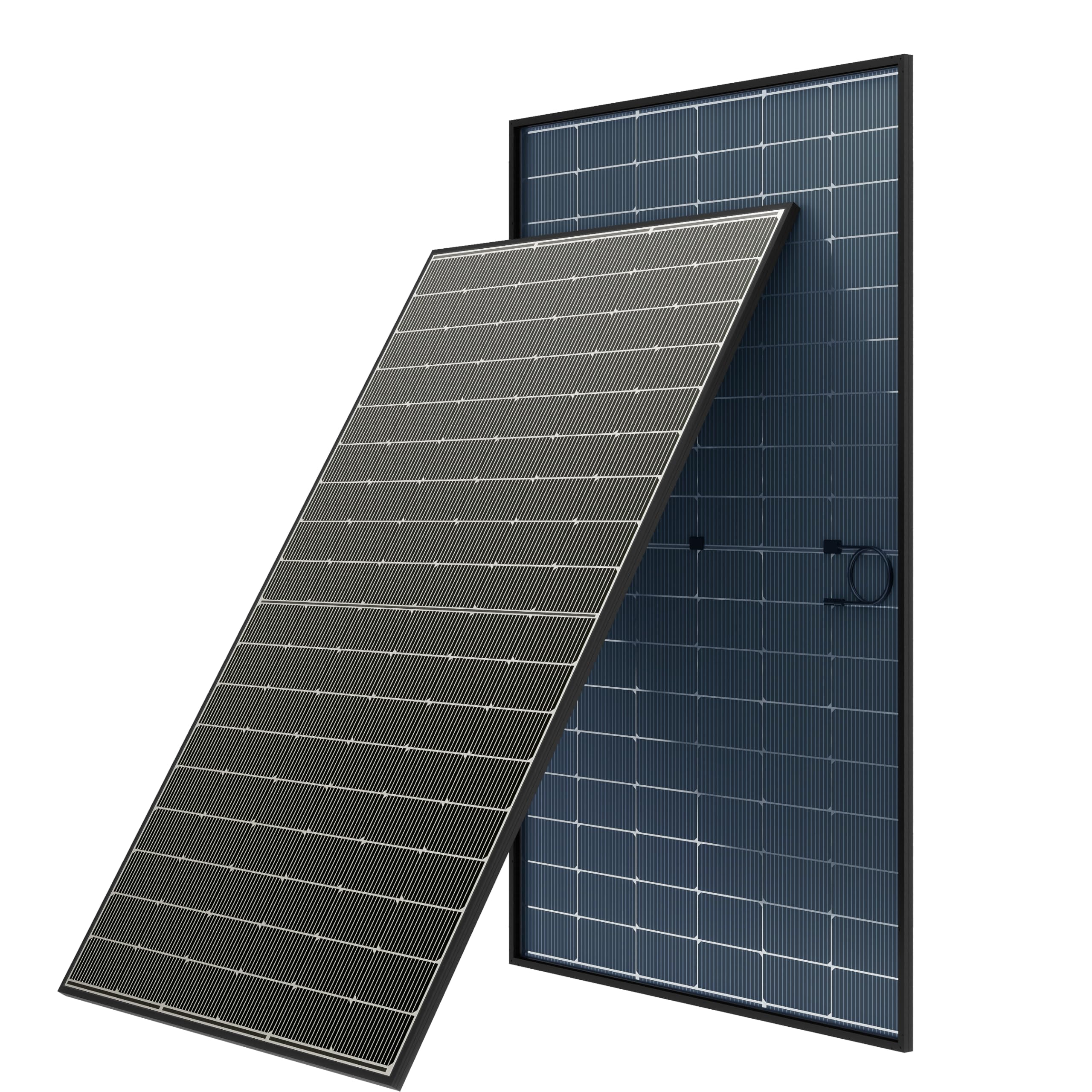
The JJN Bifacial 2-Pack is a permanent-installation solution that extracts more energy per square foot than any standard panel through its transparent backsheet design. These 400W bifacial panels generate electricity from both the front and the back, capturing reflected sunlight from the roof surface, the ground, or snow. In practice, this delivers 10-25% more total output than an equivalently rated monofacial panel, depending on the reflectivity of the mounting surface. The N-Type 16BB cells further reduce shading impact compared to older 9BB and 10BB designs, and the 25% front-side efficiency is competitive with the best monocrystalline panels on the market.
The build quality is designed for long-term outdoor exposure. The black corrosion-resistant aluminum frame withstands wind loads of 2400Pa and snow loads of 5400Pa — critical for RV roof mounting in winter climates. The IP65 junction box and IP68 connectors provide weatherproof connections, and the 30-year transferable power output warranty is the longest available, guaranteeing at least 80% output after 30 years. Customers report these panels often exceed their rated output, with one user seeing 1060W from a 1000W setup in 62°F conditions. The bifacial gain is particularly noticeable when mounted on a white RV roof or a light-colored ground surface.
The massive limitation is weight: each panel is 94.6 pounds total for the pair (approximately 47.3 lbs each). This is not a portable panel in any sense — it requires a permanent mount, and handling two 47-pound glass panels during installation is a two-person job. The rigid aluminum frame and tempered glass mean transport without a proper crate is risky. There are no connectors, adapters, or cables included beyond the panel itself. This is a component for a built-in system, not a grab-and-go camping accessory. For RV owners or homeowners who want the highest possible energy density from a fixed installation and are willing to invest in proper mounting and wiring, the JJN bifacial panels are a technically superior choice.
Why it’s great
- Bifacial design captures 10-25% more energy from reflected sunlight
- 30-year transferable output warranty is best-in-class
- N-Type 16BB cells provide superior shade tolerance over 9BB designs
- Rugged frame handles 2400Pa wind and 5400Pa snow loads
Good to know
- 94.6 lbs total weight makes handling and installation a two-person job
- Fragile tempered glass requires careful crating for transport
- No cables, adapters, or mounting hardware included
8. EF ECOFLOW 400W Portable Solar Panel

The EF ECOFLOW 400W panel is purpose-built for owners of EcoFlow power stations, particularly the Delta series. The key advantage here is the ecosystem integration: when paired with an EcoFlow Delta Pro or similar unit, the panel’s MPPT algorithm is tuned to maximize energy harvest automatically, eliminating the manual voltage matching that plagues general-purpose panels. Customers using this panel with the Delta Pro report consistent real-world peaks of 348-365W, even in hazy conditions, which is respectable for a 35.3-pound suit case panel. The monocrystalline cells with high-transparency lamination achieve a 23% conversion efficiency, and the IP68 waterproof rating (main body only) provides solid weather protection.
The build quality is heavy-duty. The panel is constructed from layers of flexible EVA and tough fiberglass, giving it a stout, durable feel that inspires confidence during setup and takedown. The included adjustable carry case doubles as a kickstand, allowing you to prop the panel at an angle without needing a separate stand. The MC4 connectors are standard, and the 23V output voltage is safe for all EcoFlow units. The panel unfolds to a large 93.1 x 41.7-inch surface area, which captures a lot of sun, but also means it requires significant ground space to deploy fully.
The weight is the biggest obstacle. At 35.3 pounds, this is the second-heaviest suit case panel in the roundup, and it is genuinely awkward for one person to carry any real distance. The case handles help, but the size and heft make it better suited for RV-side deployment than backpacking. The price point is premium, reflecting the integration value for EcoFlow users, but buyers outside the EcoFlow ecosystem pay for features they may not use fully. For a dedicated EcoFlow user who wants guaranteed compatibility and the best MPPT tuning available, the EF ECOFLOW panel is the logical choice. For everyone else, a more affordable and lighter alternative will serve as well.
Why it’s great
- MPPT algorithm tuned specifically for EcoFlow Delta series power stations
- IP68 main body rating provides excellent weather protection
- Robust EVA/fiberglass construction feels very durable
- Adjustable carry case doubles as an effective kickstand
Good to know
- 35.3 lbs is very heavy for portable use; impractical for carrying far
- Premium price includes brand integration premium
- 23V output is lower than many competitors, limiting compatibility with non-EcoFlow gear
9. Anker SOLIX PS400 Solar Panel

The Anker SOLIX PS400 is the highest-build-quality folding panel in this category, featuring an ETFE-coated exterior that resists scratches and dust, plus an internal advanced polymer composite that prevents cell cracking — a common failure point in cheaper panels. The monocrystalline cells achieve up to 23% conversion efficiency, and the smart sunlight alignment system uses four preset angles (30°, 40°, 50°, 80°) to match the sun’s position across seasons and latitudes. The IP67 waterproof rating means the panel itself can handle rainstorms without concern, and the stable MC4 connection minimizes energy loss compared to XT-60 connectors. Real-world customer testing shows 550W total from two PS400 panels in peak sun, or about 275W each — below the 400W rating but consistent with realistic outdoor performance.
The kickstand system is a standout feature. The four preset angles are controlled by a sturdy mechanical leg with clear detents, making it easy to switch between angles without fumbling. The panel includes two 9.8-foot MC4 extension cables and an MC4-to-XT-60 adapter, providing flexibility in placement relative to your power station. The overall build thickness is 1.97 inches when folded, which is slim for a case-style panel with rigid backing. The anodized aluminum frame adds rigidity and longevity without adding unnecessary weight, though the 35-pound total is still heavy.
The primary complaint is the flimsy handle, which multiple customers reported breaking when lifting the panel. The handle halves join at a central point that appears to be the weakest link in an otherwise excellent design. Anker’s customer service has not consistently resolved this issue, leaving some users to resort to duct tape repairs. The price is also premium, reflecting the Anker brand position. For buyers who prioritize build quality, the MC4 connection standard, and the precision kickstand angles, the PS400 is a top choice — just handle the panel by the frame rather than the handle, and the experience will be much better.
Why it’s great
- Exceptional build quality with ETFE coating and polymer crack prevention
- Four precise kickstand angles for optimal seasonal sun alignment
- IP67 waterproof rating handles rain without hesitation
- MC4 connectors with two 9.8-ft extension cables included
Good to know
- Carry handle is a noted weak point that can break during lifting
- 35 lbs is heavy for a portable panel
- Real-world output of ~275W per panel is well below the 400W rating
FAQ
Can I use a 400W panel with a small 300W power station?
How much power will I actually get from a 400W panel in real-world conditions?
Is a foldable solar blanket or a rigid case panel better for RV use?
What connector do I need for my Jackery, EcoFlow, or Bluetti?
Can I connect two 400W panels together for 800W?
Final Thoughts: The Verdict
For most users, the 400 watt portable solar panel winner is the Renogy 400W Solar Blanket because it delivers real-world output comparable to rigid panels while being light enough (16.09 lbs) and small enough to genuinely pack for overlanding, making it usable rather than just portable on paper. If you want maximum real-world wattage for a large power station, grab the ZOUPW 450W — its IP68 build and 450-500W peaks are unmatched for a foldable panel. And for the budget-conscious buyer prioritizing a case panel with kickstands, the Twelseavan 400W is the best value, offering 367-385W peaks at a price that undercuts most competitors by a meaningful margin.