
Our readers keep the lights on and the weekend projects moving. As an Amazon Associate, I earn from qualifying purchases.
The challenge with home blood pressure monitoring isn’t the device itself—it’s trusting the numbers you see on the screen. A reading that’s off by just a few mmHg can lead to unnecessary worry or, worse, a missed warning sign. After spending many hours analyzing the latest oscillometric technology, cuff designs, and connectivity features across dozens of models, I’ve narrowed down the units that deliver consistent, repeatable results you can actually rely on between doctor visits.
I’m Rikta — the co-founder and writer behind FitlyFast. My deep market research focuses on cross-referencing lab-validated accuracy claims with real-world user experiences to find the devices that truly earn their spot in your medicine cabinet.
Whether you’re managing hypertension for the first time or need a reliable monitor for daily check-ins, finding the best blood pressure monitor for home comes down to matching cuff size, memory capacity, and smart features to your specific health routine.
How To Choose The Best Blood Pressure Monitor For Home
Choosing a home blood pressure monitor is more than picking the one with the largest screen. The device’s internal pressure sensor, cuff fit, and memory management directly affect whether your readings are usable for your doctor. Let’s break down the three factors that separate a reliable monitor from a frustrating one.
Cuff Size and Fit
The most common source of inaccurate readings is a poorly fitted cuff. If the cuff is too small, your readings will show artificially high numbers. Most monitors now include a wide-range cuff that accommodates arms from 9 to 17 inches or more. For larger arms, look for models that include a separate XL cuff (up to 21 inches) to avoid the error that comes with squeezing a cuff that’s too tight.
Memory and Multi-User Support
If you’re monitoring your blood pressure daily, you need a device that stores more than just the last reading. The best home monitors store at least 90 to 500 readings per user. Dual-user memory is essential for households where two people need separate tracking—each user gets their own profile, and the device averages their last three readings for a clearer trend.
Smart Features and Connectivity
Bluetooth and voice guidance are not gimmicks—they serve real needs. Voice guidance helps visually impaired users or seniors who struggle to read small screens. Bluetooth sync lets you export readings to an app where you can share a PDF report directly with your doctor. Some premium monitors also detect Atrial Fibrillation (AFib), which adds a layer of cardiac screening beyond just pressure measurement.
Quick Comparison
On smaller screens, swipe sideways to see the full table.
| Model | Category | Best For | Key Spec | Amazon |
|---|---|---|---|---|
| OMRON Gold | Premium | AFib detection & app sync | AFib detection, 2-user memory | Amazon |
| Withings BPM Connect | Premium | Wi-Fi sync & rechargeable design | Wi-Fi + Bluetooth, 6-month battery | Amazon |
| A&D Medical Voice-Guided | Mid-Range | Visually impaired users | Voice guidance 3 languages | Amazon |
| FDA-Cleared U80A | Mid-Range | Large LED display for seniors | 4.5-inch LED, 2×199 memories | Amazon |
| Medline Plus Elite | Mid-Range | Dual cuffs for varied arm sizes | 2 cuffs, 90 readings storage | Amazon |
| AQESO 2-Cuff | Value | XL cuff for larger arms | 2 cuffs (up to 21″), 1000 memories | Amazon |
| Acenis AOJ-30F | Budget | Simple operation & clear display | Large color screen, 3-user memory | Amazon |
In‑Depth Reviews
1. OMRON Gold Blood Pressure Monitor
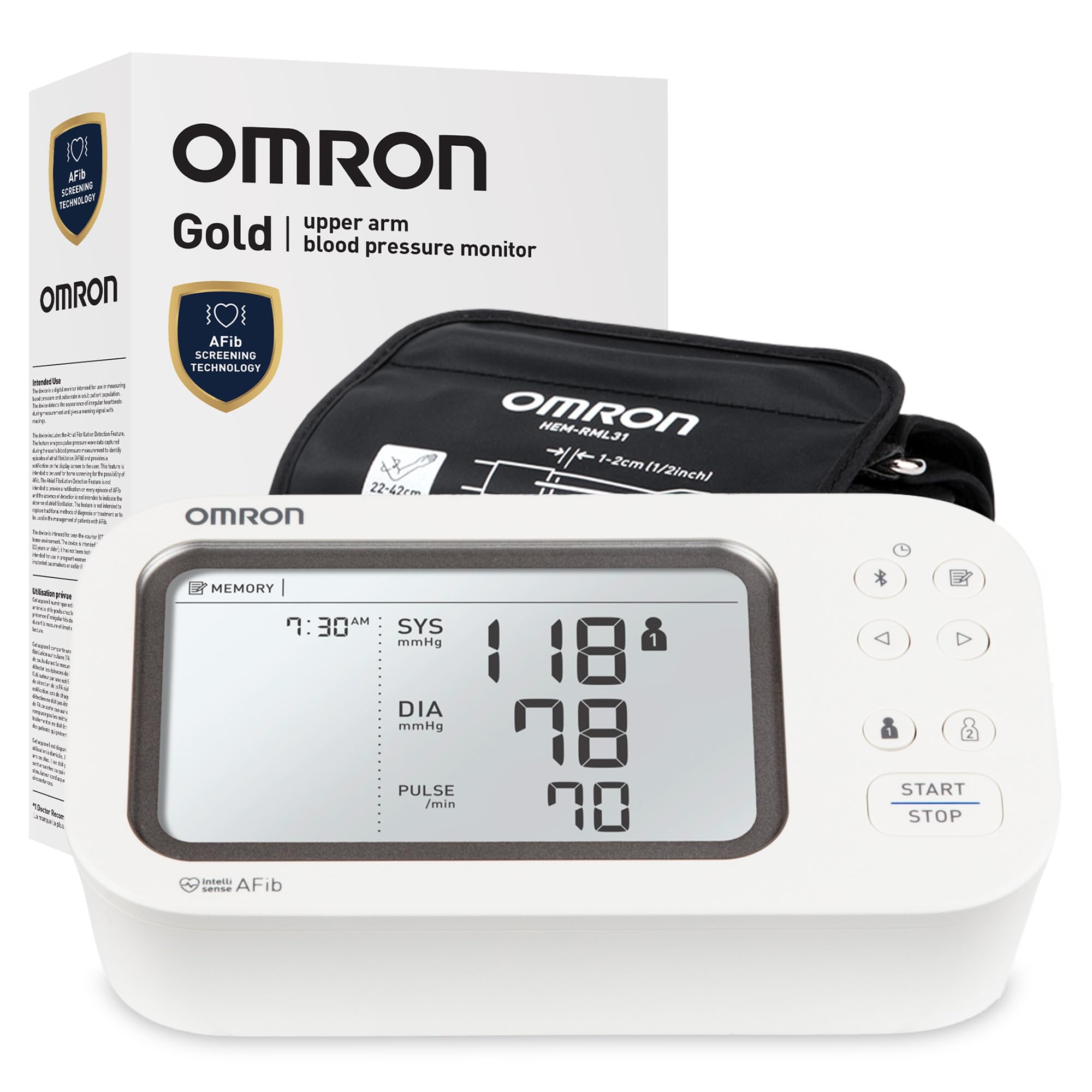
The OMRON Gold is the unit your cardiologist would recommend. It uses exclusive Atrial Fibrillation detection during every reading, flagging irregular heart rhythms that standard monitors miss entirely. The wide-range D-ring cuff fits arms from 9 to 17 inches, and the High Morning Average Indicator alerts you to dangerous morning blood pressure spikes—a key risk marker for cardiovascular events.
Bluetooth sync to the OMRON connect app is seamless, and the app stores unlimited readings for trend analysis. The monitor supports two user profiles, making it practical for couples. However, the AFib detection has a critical caveat: if you actually have atrial fibrillation, the monitor will refuse to display a blood pressure reading—it’s designed for screening, not monitoring known AFib.
Some users report accuracy issues when compared to their doctor’s office readings, though this is common across all home monitors if the cuff is not positioned correctly. Despite the premium price, the OMRON Gold delivers the most comprehensive heart health screening available in a home device.
Why it’s great
- AFib detection every reading
- Bluetooth sync with unlimited storage
- High Morning Average Indicator
Good to know
- AFib mode blocks BP reading for known AFib patients
- Some users find readings inconsistent with doctor’s office
2. Withings BPM Connect

The Withings BPM Connect stands out for its Wi-Fi sync—no need to open the app every time. The device automatically transmits readings to the Health Mate app, and the rechargeable battery lasts up to six months, eliminating the hassle of replacing AA batteries. The color-coded LED display gives immediate feedback: green for normal, yellow for elevated, red for high.
Accuracy is solid; one reviewer compared it to a clinical-grade WelchAllyn ProBP and found systolic within 2 points and diastolic within 4-5 points. The cuff wraps into a compact roll that’s travel-friendly. However, the screen faces outward when the cuff is on your arm, making it hard to read during measurement—you have to twist your arm awkwardly.
The initial setup can be finicky, and some users report difficulty pairing with Bluetooth initially. Also, the company does not accept returns on blood pressure cuffs, so be sure you’ve downloaded the app and verified compatibility before purchasing. For iPhone users who want seamless integration with Apple Health, this is the top choice.
Why it’s great
- Wi-Fi auto-sync, no app required
- Rechargeable battery lasts 6 months
- Compact travel-friendly design
Good to know
- Screen faces outward during use
- Initial Bluetooth pairing can be difficult
3. A&D Medical Voice-Guided UA-1040TBLE
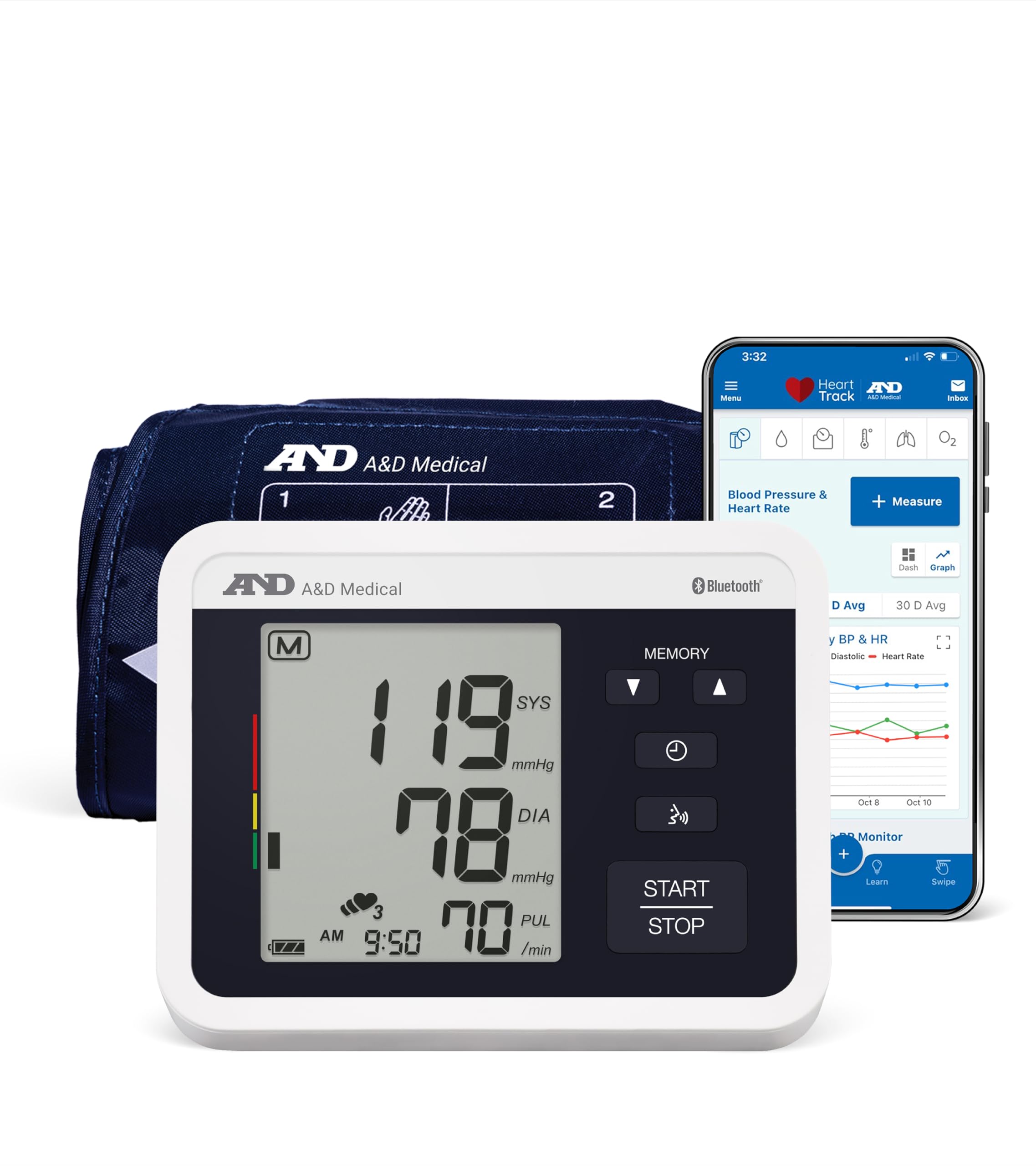
The A&D Medical UA-1040TBLE is specifically designed for visually impaired users. It offers voice guidance in English, Spanish, and French, reading the instructions and results aloud. The pre-formed cuff is easy to position correctly without help, and the optional TriCheck function automatically takes three consecutive readings and averages them for enhanced accuracy.
The companion A&D Heart Track App is surprisingly polished—it includes a cuff inflation meter to show correct positioning and syncs quickly via Bluetooth. The wide-range cuff fits 8.6 to 16.5 inches and is compatible with other A&D cuff sizes sold separately. The large digital LCD also has oversized numbers for those with partial vision.
One minor downside is that the voice guidance speaks every step, which might be frustrating for users who don’t need it after the first few uses. The voice cannot be turned off entirely without muting the device. Still, for anyone with visual challenges or elderly family members, this is the most accessible option on the list.
Why it’s great
- Voice guidance in 3 languages
- TriCheck mode for averaged readings
- Bluetooth app sync with cuff position meter
Good to know
- Voice cannot be fully disabled
- Higher price for voice feature
4. FDA-Cleared Blood Pressure Monitor U80A
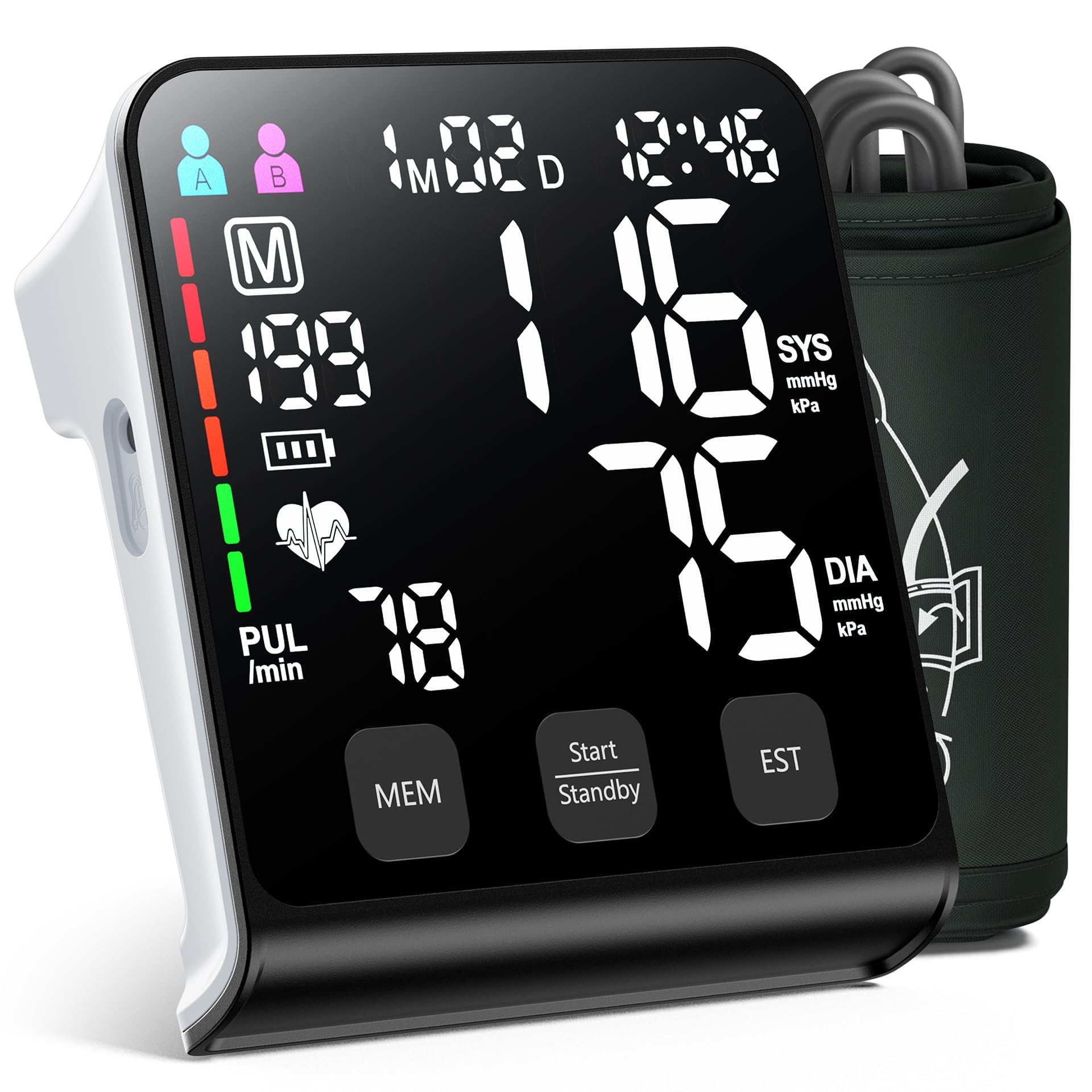
This monitor’s standout feature is a 4.5-inch bright LED screen with oversized digits—easily readable from across the room. The one-touch operation is genuinely simple: just wrap the cuff and press start. It stores up to 199 readings per user for two users, giving you a solid six-month tracking history before you need to export.
The intelligent pressure algorithm delivers results within ±3mmHg error margin, which is the standard for clinical validation. The adjustable cuff is comfortable and suitable for a range of arm sizes. An irregular heartbeat alert adds an extra layer of safety. The unit is also FSA and HSA eligible, so you can use pre-tax health dollars.
Some users note that the scratch-resistant acrylic panel is prone to fingerprints, though this doesn’t affect function. The USB power option is convenient for bedside use, but the monitor requires continuous power via USB—it doesn’t charge a built-in battery. For seniors who need a big, bright display with no complex menus, this is an excellent mid-range pick.
Why it’s great
- Large 4.5-inch LED display
- 199 memories per user for 2 users
- FSA/HSA eligible
Good to know
- USB power requires continuous connection
- Screen shows fingerprints easily
5. Medline Plus Elite Automatic Digital Monitor

The Medline Plus Elite comes with two cuffs right in the box: a standard adult cuff (8.6-11.8 inches) and a large adult cuff (11.5-16.5 inches). This is an immediate solution for households with both a smaller and larger arm user—no need to buy an extra cuff separately. The unit stores up to 90 measurements across three users, with an average of the last three readings displayed.
The colored scale next to the LCD display helps interpret results at a glance: green for normal, yellow for pre-hypertension, red for hypertension. Clinical accuracy is decent, with several users confirming that readings matched their doctor’s office. The carrying case makes it easy to take to appointments for comparison.
The main drawback is the display itself—it’s a basic digital LCD without a backlight, so reading it in low light is difficult. The 90-reading memory is also lower than newer models. However, for a proven, FDA-cleared monitor from Medline, a trusted healthcare brand, this is a reliable choice at a mid-range price point.
Why it’s great
- Includes both standard and large cuffs
- Colored BP classification scale
- Trusted Medline brand with 2-year warranty
Good to know
- No backlight on the LCD
- Only 90 readings total storage
6. AQESO 2-Cuff Upper Arm Monitor

The AQESO monitor solves the most common accuracy problem by including two cuffs: a Medium/Large cuff (9-17 inches) and an XL cuff (13-21 inches). This is rare at this price tier—most monitors offer only one wide-range cuff. The 1000-reading memory (500 per user for two users) is generous, allowing months of tracking without needing to export.
The large backlit LCD display is easy to read in any lighting, and the WHO classification bar gives you a quick visual reference for where your reading falls. One-touch operation is straightforward, and the USB Type-C power option means you can run it from a laptop power bank while traveling.
The device is not rechargeable—USB power requires a continuous connection. The build quality feels decent but not premium. Some users report that the cuff tube is a bit short for very large individuals. For households with one person who needs the XL cuff and another who doesn’t, this is a practical and affordable solution.
Why it’s great
- Includes XXL cuff (13-21 inches)
- 1000 reading memory total
- USB Type-C power option
Good to know
- Not rechargeable; USB requires continuous power
- Cuff tube could be longer
7. Acenis Automatic Blood Pressure Monitor AOJ-30F
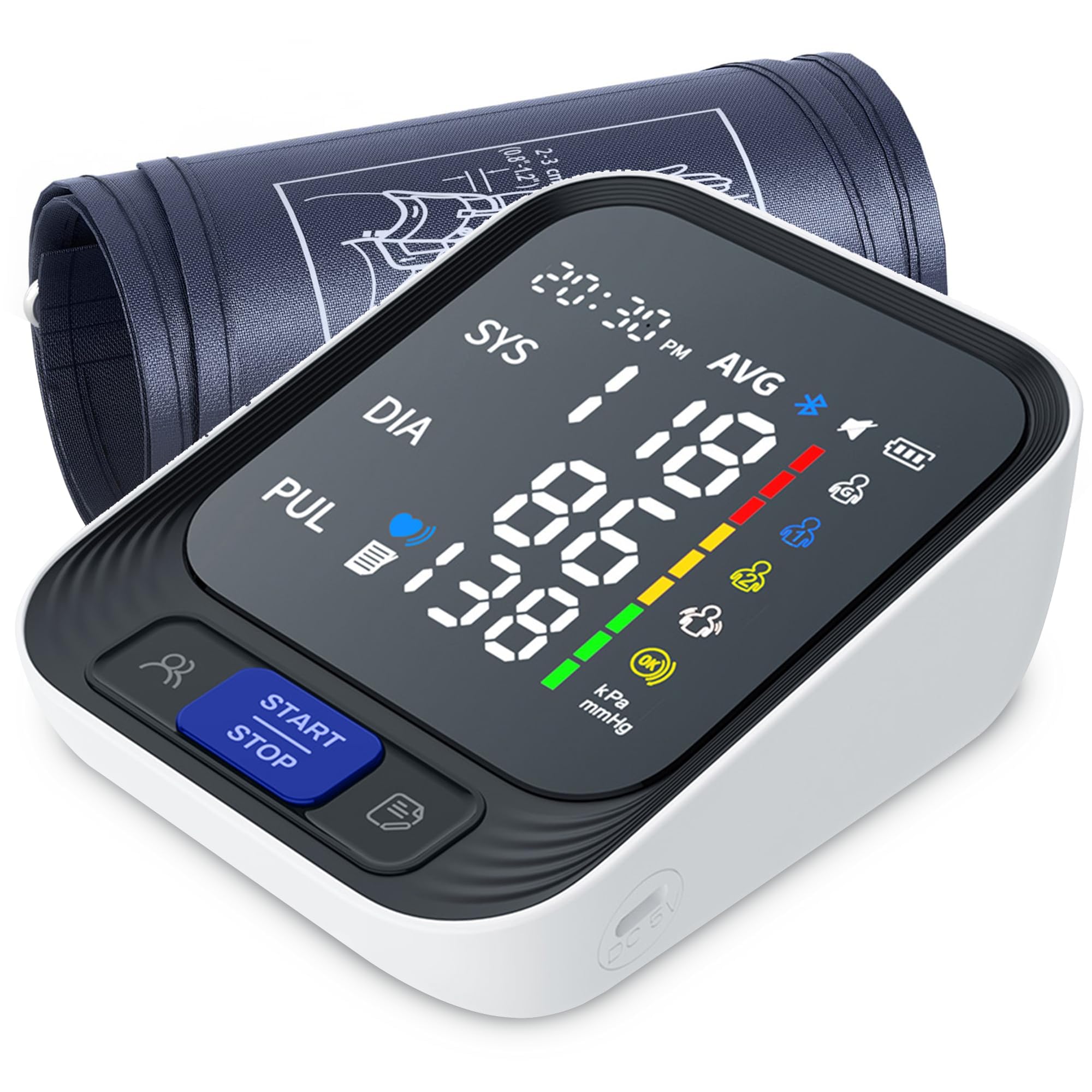
The Acenis AOJ-30F is a no-frills entry-level monitor that covers the essentials without overwhelming you with features. The large color screen is genuinely useful for seniors—numbers are big, clear, and easy to read. The one-touch operation delivers results in about 40 seconds, which is standard for this price bracket.
It supports up to three users, each with 2 reading memories—that’s very limited storage compared to other models. The cuff is adjustable and comfortable, and it comes with 4 AAA batteries included, plus a power cord. The unit tracks two readings per user, so you’ll need to manually log results if you want a long-term view.
The advanced oscillometric technology provides repeatable readings, but some users note that setting the date and time is a bit unintuitive. For someone who just wants a quick, reliable reading without app connectivity or complex menus, this is a solid budget-friendly choice.
Why it’s great
- Large color screen for easy reading
- Supports 3 users
- Batteries and power cord included
Good to know
- Only 2 readings storage per user
- Date/time setup is not intuitive
FAQ
How do I know which cuff size fits my arm?
Can I use a home blood pressure monitor if I have atrial fibrillation?
How often should I replace my home blood pressure monitor?
Final Thoughts: The Verdict
For most users, the best blood pressure monitor for home winner is the OMRON Gold because it combines AFib detection, Bluetooth app sync, and the reassurance of the #1 doctor-recommended brand. If you want a monitor with Wi-Fi sync and a rechargeable battery that eliminates cord clutter, grab the Withings BPM Connect. And for a visually impaired family member who needs voice guidance in multiple languages, nothing beats the A&D Medical Voice-Guided UA-1040TBLE.