
Our readers keep the lights on and the weekend projects moving. As an Amazon Associate, I earn from qualifying purchases.
A wobbly knee that gives out mid-stride or aches after standing for ten minutes doesn’t just slow you down — it rewrites your daily routine around avoidance. The right brace doesn’t just squeeze the joint; it introduces a mechanical intervention that controls unwanted shifting, offloads arthritic compartments, or locks out hyperextension depending on what your ligaments actually need.
I’m Rikta — the co-founder and writer behind FitlyFast. I’ve spent hundreds of hours cross-referencing medical-grade specs, hinge articulation mechanisms, and real-user durability reports across the entire support spectrum to identify which models deliver genuine stability rather than just compression.
Whether you need post-op immobilization, moderate-to-ligament support for sports, or a daily unloader for arthritis, this guide breaks down exactly how each model works so you can find the right brace for knee support without guessing.
How To Choose The Best Brace For Knee Support
A knee brace is a passive device until you match its mechanical design to your specific instability pattern. A brace built for a medial collateral sprain will not stop an arthritic knee from grinding, and an unloader brace does nothing for a torn ACL. The selection comes down to three variables: hinge type, strap architecture, and material density.
Identify Your Instability Pattern
If your knee buckles sideways (varus/valgus collapse), you need a brace with rigid bilateral hinges and a four-point leverage system. If the pain is a dull ache on one side of the joint that worsens with weight-bearing, you are looking at an unloader brace that uses a single upright frame to push the joint apart slightly and shift load away from the arthritic compartment. If your knee simply feels unstable and gives out forward (ACL deficiency), a brace with a hyperextension stop and a polycentric hinge that tracks the knee’s natural rollback is the correct choice.
Hinge Material and Motion Control
Geared steel hinges offer the most precise control because they engage tooth-to-tooth at specific flexion angles, preventing the knee from sliding into dangerous positions. Aluminum hinges are lighter but less durable under repeated heavy loading. Some braces use removable plastic hinges that allow the user to progress from full immobilization to free motion during recovery — these are ideal for post-operative use but offer limited resistance against high-force pivoting.
Strap Count and Anti-Migration Design
A brace with fewer than four straps tends to slide down the leg during activity, especially on the tapered thigh shape. Look for an upper strap that wraps circumferentially above the thigh bulge and a lower strap that anchors below the calf — these two points create a wedge that resists downward migration. Braces with silicone grippers on the inner lining add another layer of hold, but silicone alone cannot compensate for poor strap geometry.
Quick Comparison
On smaller screens, swipe sideways to see the full table.
| Model | Category | Best For | Key Spec | Amazon |
|---|---|---|---|---|
| Ovation Medical Game Changer | Unloader | OA pain relief | Single upright frame | Amazon |
| DonJoy BIONIC FULLSTOP | Performance | ACL / sports | Four-point leverage | Amazon |
| T TIMTAKBO 16-Inch Hinged | Tall Brace | Extended coverage | 1/8″ steel hinges | Amazon |
| Mathgetin Hinged ROM | Post-Op | Post-surgery immobilization | Adjustable lock 10°-105° | Amazon |
| ZEAZEN 5-Strap Wrap | Everyday | Daily walking / hiking | 5-strap 360° wrap | Amazon |
| Changenow Medical-Grade | Stabilizer | Meniscus / ACL support | 4 spring stays | Amazon |
| Comforband Hinged Brace | Recovery | Ligament injury rehab | Two-point geared hinges | Amazon |
In‑Depth Reviews
1. Ovation Medical Game Changer Unloader

The Ovation Medical Game Changer is the only brace on this list that actively unloads the arthritic compartment rather than simply stabilizing it. Its single upright frame uses a tension key that you turn to push the joint apart slightly on the affected side — medial or lateral — shifting weight off the worn cartilage and onto the healthier tissue. This mechanism is why users report immediate pain reduction during walking, not just at rest.
The open design leaves the inner knee completely free of metal or plastic, which matters if you have sensitive skin or need to wear two braces simultaneously. Push-button release buckles make application manageable even for hands with limited grip strength, and the gray low-profile aesthetic hides better under pants than most medical-looking devices.
It defaults to a right-knee configuration, so double-check before ordering if your affected side is left. Some users with smaller leg circumferences found the straps long enough to need trimming, and the included adjustment tool is large but functional. For anyone managing osteoarthritis or a degenerative meniscal tear, this brace represents a genuine functional upgrade over basic compression.
Why it’s great
- Adjustable offloading mechanism targets medial or lateral pain specifically
- Lightweight single-upright frame avoids inner-knee irritation
- Push-button buckles suit users with low hand dexterity
Good to know
- Default configuration is right knee — verify before purchase
- Smaller legs may need strap trimming
2. DonJoy Performance BIONIC FULLSTOP

The DonJoy BIONIC FULLSTOP is engineered for high-intensity pivoting sports where a single bad cut can re-tear an ACL graft or aggravate a meniscus repair. Its four-point leverage system applies opposing forces above and below the knee to dampen the hinge’s motion as the knee approaches full extension, training the user to stay out of the at-risk zone without relying solely on conscious awareness.
The sleeve uses compression and thermal regulation fabric that avoids the sauna-like effect of standard neoprene, and the anti-migration technology employs a textured inner surface combined with a contoured thigh cuff that resists sliding during lateral movement. Reflective strips add visibility for low-light training sessions or early-morning runs.
Some users with significant hypermobility (Ehlers-Danlos, extreme recurvatum) found that the bars do not physically block backward movement beyond a shallow range — this brace is designed for the moderate hyperextension common in ACL-deficient knees, not for severe ligamentous laxity. The strap system showed early wear in a small number of units, with reports of stitching unraveling within months under heavy weekly use. Still, for athletes returning to football, soccer, or skiing, the BIONIC FULLSTOP provides the most aggressive non-custom support available.
Why it’s great
- Four-point leverage system actively dampens hyperextension
- Breathable thermal regulation fabric reduces overheating
- Anti-migration design stays locked during high-speed cuts
Good to know
- Not designed for severe hyperextension beyond ~10°
- Strap durability may not survive multi-season heavy use
3. T TIMTAKBO 16-Inch Hinged Knee Brace

The 16-inch frame of the T TIMTAKBO brace extends further up the thigh and down the calf than most competitors, distributing stabilizing forces over a larger surface area. This is especially useful for users with long femurs or those who find standard braces too short to anchor effectively. The dual removable metal hinges are 1/8-inch thick alloy steel with gear technology that resists deflection under heavy squatting or lunging loads.
The front-opening wrap-around design uses four adjustable straps to dial in compression independently at the thigh and calf, accommodating a wide range of leg shapes without creating pressure points at the back of the knee. The 3D air spacer fabric is noticeably more breathable than standard neoprene, and the rebound spacer technology adds a slight spring that helps the brace conform to dynamic leg contours during movement.
A design caveat: the upper spandex strap on some units contracts when tightened, creating a cutting sensation that can restrict circulation and cause the brace to migrate down. Additionally, the hinges are non-lockable, so this brace provides passive support rather than controlled range-of-motion restriction. For users who need maximum coverage and breathability without the complexity of adjustable ROM locks, this is a solid mid-range pick.
Why it’s great
- Extended 16-inch frame provides superior anchor for long legs
- 3D air spacer fabric is highly breathable and quick-drying
- Front-wrap design allows easy donning for stiff or injured knees
Good to know
- Upper spandex strap may contract and cut into the thigh
- Hinges are non-lockable — no ROM control
4. Mathgetin Hinged ROM Knee Brace
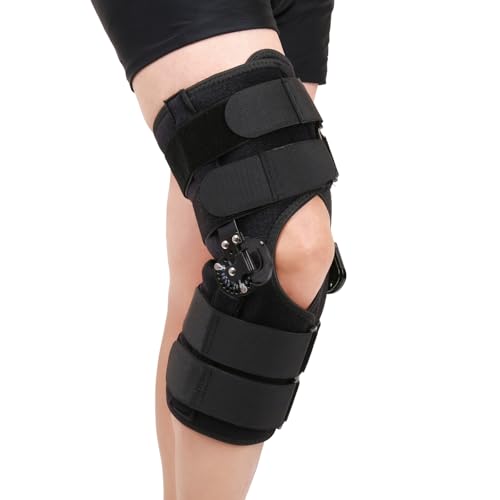
The Mathgetin ROM brace is built for the post-operative phase when the surgeon wants controlled mobilization — not full immobilization, but not free movement either. The dual adjustable lock knobs allow you to set a hard stop at any angle between 10 degrees (near-full extension) and 105 degrees (deep flexion), and the hinge clicks into place with audible feedback so you know the lock has engaged.
The removable side stabilizers give you the option to transition from a rigid immobilizer to a lighter support brace as healing progresses, extending the product’s useful life beyond the initial recovery window. Four adjustable straps with a hook-and-loop closure system allow fine tension tuning without causing bunching behind the knee, and the neoprene-nylon-polyester blend keeps the overall weight low enough for daily wear over clothing.
Users consistently note that this brace outperforms expensive prescription models in terms of comfort and breathability while delivering the same locking function. The design works best for straight-leg immobilization and early walking — deep squats or stair climbing may cause the hinges to shift slightly if the straps are not cranked tight. For anyone recovering from ACL reconstruction, meniscus repair, or patellar realignment, the Mathgetin offers surgical-level ROM control at a fraction of the clinical price.
Why it’s great
- Adjustable locking hinges restrict motion from 10° to 105°
- Removable side stabilizers allow progression from immobilizer to brace
- Lightweight and comfortable enough for extended post-op wear
Good to know
- Requires very tight strap tension to prevent hinge shift during stairs
- Bulky under clothing — better suited for wear over pants
5. ZEAZEN 5-Strap 360° Wrap Knee Brace
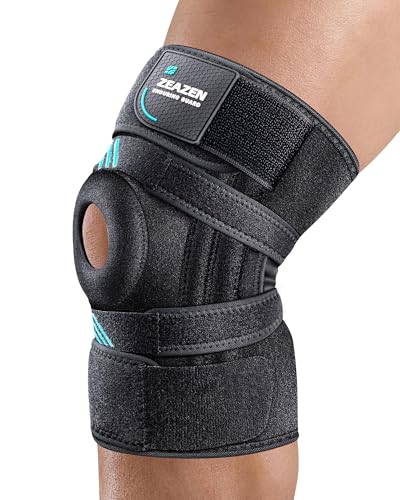
The ZEAZEN brace solves the most common complaint in the everyday-support category: braces that slide down the leg after ten minutes of walking. Its 5-strap 360° wrap distributes compression evenly around the knee, and the added upper stabilizing strap — absent in typical 4-strap designs — provides an extra anchor point above the thigh bulge to resist migration during repetitive motion.
The open patella system combines a supportive ring around the kneecap, a dynamic sub-patella stabilizer, and integrated side stabilizers to guide the patella through its tracking path without compressing the sensitive front of the knee. The comfort gap behind the knee eliminates the dreaded bunching that occurs when neoprene folds during deep bending, and the breathable neoprene blend keeps the joint cool during extended wear.
Users report that this brace fits comfortably under loose jeans and neutral black color avoids the medical-appliance look. The hook-and-loop straps are wide and durable, holding tension well over months of daily wear. The trade-off is that threading the brace over the foot can be challenging for users with limited hip mobility, and the moderate support level is not sufficient for ACL-deficient knees or significant ligament instability. For daily walking, housework, hiking, and light gym work, it hits the sweet spot.
Why it’s great
- Fifth upper strap prevents the sliding common in 4-strap designs
- Comfort gap behind the knee reduces irritation during bending
- Low-profile fit under jeans with neutral black aesthetic
Good to know
- Must be threaded over the foot — difficult for limited hip mobility
- Moderate support not intended for high-grade ligament injuries
6. Changenow Medical-Grade Knee Brace
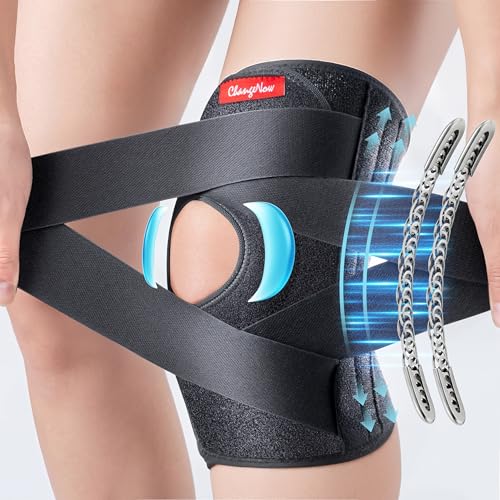
The Changenow brace positions itself as a medical-grade stabilizer with a shock-absorbing patella system that claims 50% pressure reduction on the front of the knee. Four spring support stays run along the sides to resist lateral collapse, while two crescent-shaped patella pads sit above and below the kneecap to absorb impact forces during squats and stair climbing.
The butterfly-shaped cut is a meaningful ergonomic detail — it contours around the back of the knee to prevent the fabric from digging in during flexion, a failure point that plagues many wrap-style braces. The dual V-shaped cross straps work with the wide Velcro base to create a 360° wrapping effect that feels noticeably more secure than inline strap designs. The multi-layer nylon-neoprene-polyester blend offers high compression without the suffocating feel of pure neoprene.
Users with post-replacement knees reported that this brace successfully prevents the joint from giving out during walking, though a twinge may persist. The sizing chart requires a thigh measurement 4 inches above the kneecap center — users between sizes should size down for more compression or up for comfort. The spring stays are supportive but not rigid, meaning this brace excels at moderate instability but cannot replace a hinged brace for full ligament control.
Why it’s great
- Shock-absorbing patella system reduces front-of-knee pressure
- Butterfly cut prevents behind-knee digging during deep bends
- Dual V-straps create 360° compression for a secure feel
Good to know
- Spring stays lack the rigidity of full hinges for ligament control
- Size down for compression — up for comfort if between sizes
7. Comforband Adjustable Hinged Knee Brace

The Comforband brace brings geared hinge technology to a price point typically occupied by non-hinged sleeves. Two-point geared hinges on both sides control flexion and extension by engaging tooth-to-tooth, providing medial and lateral stabilization that helps protect ACL, PCL, and MCL injuries during the early stages of rehab. The hinges sit in integrated pockets and can be removed when the user no longer needs that level of stabilization, effectively converting the brace into a compression support.
The 4-strap open structure uses narrower middle straps to reduce material squeeze behind the knee while wider top and bottom straps deliver reinforced compression. Premium-grade neoprene traps body heat to warm the muscles and joint, which reduces swelling and improves blood circulation — a meaningful benefit during the inflammatory phase of an injury. The open patella design with a stitched buttress helps track the kneecap and offloads pressure on the patellar tendon.
Users with thick thighs reported that the silicone grips and wide dual-ended Velcro bands keep the brace firmly in place throughout the day, with no behind-knee irritation. The terry cloth inner lining adds a soft layer against sensitive post-injury skin. The primary challenge is the initial donning process — the Velcro tends to catch on the inner lining before the brace is properly positioned, requiring patience and practice to get the straps settled without premature adhesion.
Why it’s great
- Geared two-point hinges provide genuine ligament protection at a low cost
- Removable hinges allow brace to grow with recovery phase
- Terry cloth inner lining and silicone grips prevent migration on large thighs
Good to know
- Velcro can prematurely stick to inner lining during donning
- Heat-retaining neoprene may feel too warm for some users
FAQ
Can I sleep with my knee brace on?
How do I know if I need a hinged brace or a sleeve?
Why does my brace slide down my leg?
Final Thoughts: The Verdict
For most users, the brace for knee support winner is the Ovation Medical Game Changer because it addresses the root mechanical issue of osteoarthritis by offloading the painful compartment rather than simply squeezing the joint. If you need maximum control for high-intensity sports, grab the DonJoy BIONIC FULLSTOP. And for precise post-operative range-of-motion management with surgical-level lockability, nothing beats the Mathgetin Hinged ROM Brace.