
Our readers keep the lights on and the weekend projects moving. As an Amazon Associate, I earn from qualifying purchases.
A flickering light goes out, your monitor goes dark, and hours of unsaved work vanish in an instant. That split-second power cut is exactly why a dedicated battery backup exists — not just to save your files, but to keep your modem, router, and critical home office gear alive through the entire outage. A reliable Backup UPS bridges that gap between a minor brownout and a major data disaster, and the right one depends on your load demand, runtime needs, and whether you need pure sine wave output for sensitive electronics.
I’m Rikta — the co-founder and writer behind FitlyFast. This guide is built from hundreds of hours comparing VA ratings, AVR performance, battery chemistries, and real-world runtime data to separate the units that actually deliver during a blackout from those that simply occupy a shelf.
The market is flooded with options, but finding the true best backup ups means understanding how simulated sine wave differs from pure sine wave, why Automatic Voltage Regulation matters more than raw VA, and which battery replacement policy saves you the most money over the unit’s lifespan.
How To Choose The Best Backup UPS
Choosing a backup UPS isn’t about grabbing the biggest VA number on the shelf. Real performance is defined by your specific equipment’s power draw, the shape of the AC waveform your gear needs, and how long you need to stay online when the grid goes down. Here are the critical factors to weigh before you buy.
Watt Rating vs. VA Rating — The True Capacity
VA (Volt-Amps) is the headline number on the box, but Watts are what actually power your devices. A 1500VA unit typically delivers around 900W. Add up the wattage of everything you plan to plug in — PC tower, monitor, router, modem, external drives — and ensure the UPS’s real Watt capacity exceeds that total by at least 20 percent. Undersizing leads to overload alarms and premature shutdown.
Simulated Sine Wave vs. Pure Sine Wave Output
Most budget and mid-range UPS units output a simulated (stepped approximation) sine wave when running on battery. This is perfectly fine for desktop computers, networking gear, and basic monitors. However, Active PFC (Power Factor Corrected) power supplies — common in high-end gaming PCs, workstations, and server equipment — can shut down or behave erratically on simulated sine wave. If your gear uses an Active PFC supply, you must select a pure sine wave UPS.
Automatic Voltage Regulation (AVR) and Runtime
AVR corrects undervoltage (brownouts) and overvoltage spikes without draining the battery, which extends the overall life of the UPS. Units without AVR switch to battery power far more often, wearing out the cells faster. Runtime is equally critical: a 600VA unit might give you 20 minutes at 100W load, but only 5 minutes at 300W. Always match the runtime to your worst-case scenario — long enough for an automatic safe shutdown, or long enough to finish the task and save your work.
Quick Comparison
On smaller screens, swipe sideways to see the full table.
| Model | Category | Best For | Key Spec | Amazon |
|---|---|---|---|---|
| CyberPower CP1500AVRLCD | Premium Tower | High-power workstation + network | 1500VA / 900W | Amazon |
| CyberPower AVRG900LCD | Mid-Range Compact | PC + home office + AVR stability | 900VA / 480W | Amazon |
| Eaton Tripp Lite OMNI1500LCDT | Premium Tower | Long runtime + server/security | 1500VA / 810W | Amazon |
| APC Back-UPS BE700G3 | Mid-Range Tower | Home office + USB-C charging | 700VA / 420W | Amazon |
| APC UPS BE600M1 | Entry-Level Compact | PC + Wi-Fi safe shutdown | 600VA / 330W | Amazon |
| Tripp Lite BC350 | Mini UPS | Modem/router light-duty use | 350VA / 180W | Amazon |
| SKE SK425 | Budget Compact | Small network + radio equipment | 425VA / 240W | Amazon |
In‑Depth Reviews
1. CyberPower CP1500AVRLCD

The CyberPower CP1500AVRLCD is the gold standard for anyone running a serious workstation or home lab. Its 1500VA / 900W rating provides enough headroom to power a high-end desktop PC, dual monitors, a modem, and a router simultaneously. The multifunction LCD panel displays real-time input voltage, load level, battery capacity, and estimated runtime — critical data when you’re deciding whether to finish your render or initiate a shutdown.
Automatic Voltage Regulation (AVR) handles brownouts and overvoltages between 85V and 150V without draining the battery, which measurably extends the sealed lead-acid battery’s life. Real-world user data shows a 165W load yields approximately 37 minutes of runtime, and a 175-200W load still provides 18-20 minutes — more than enough to bridge short outages or perform a graceful system shutdown. The simulated sine wave output works perfectly with standard desktop PSUs but not with Active PFC power supplies, so verify your computer’s PFC type before purchasing.
The 12-outlet layout (6 battery-backed, 6 surge-only) accommodates both critical and peripheral gear, and the right-angle NEMA 5-15P plug makes it easier to fit against furniture. At three years of battery life and a connected equipment guarantee, this unit offers premium protection without the premium price of pure sine wave alternatives. The software suite is functional, though some users report discovery issues; the LCD panel often makes the software unnecessary for everyday monitoring.
Why it’s great
- 900W real output handles multi-monitor workstation loads
- Detailed LCD shows runtime, load, voltage, and battery status
- AVR extends battery lifespan by minimizing discharge cycles
- connected equipment insurance provides robust coverage
Good to know
- Simulated sine wave — not compatible with high-end Active PFC power supplies
- Power button is easy to bump, potentially triggering accidental shutdown
- Laser printers may trigger false power-outage mode due to inrush current
2. CyberPower AVRG900LCD
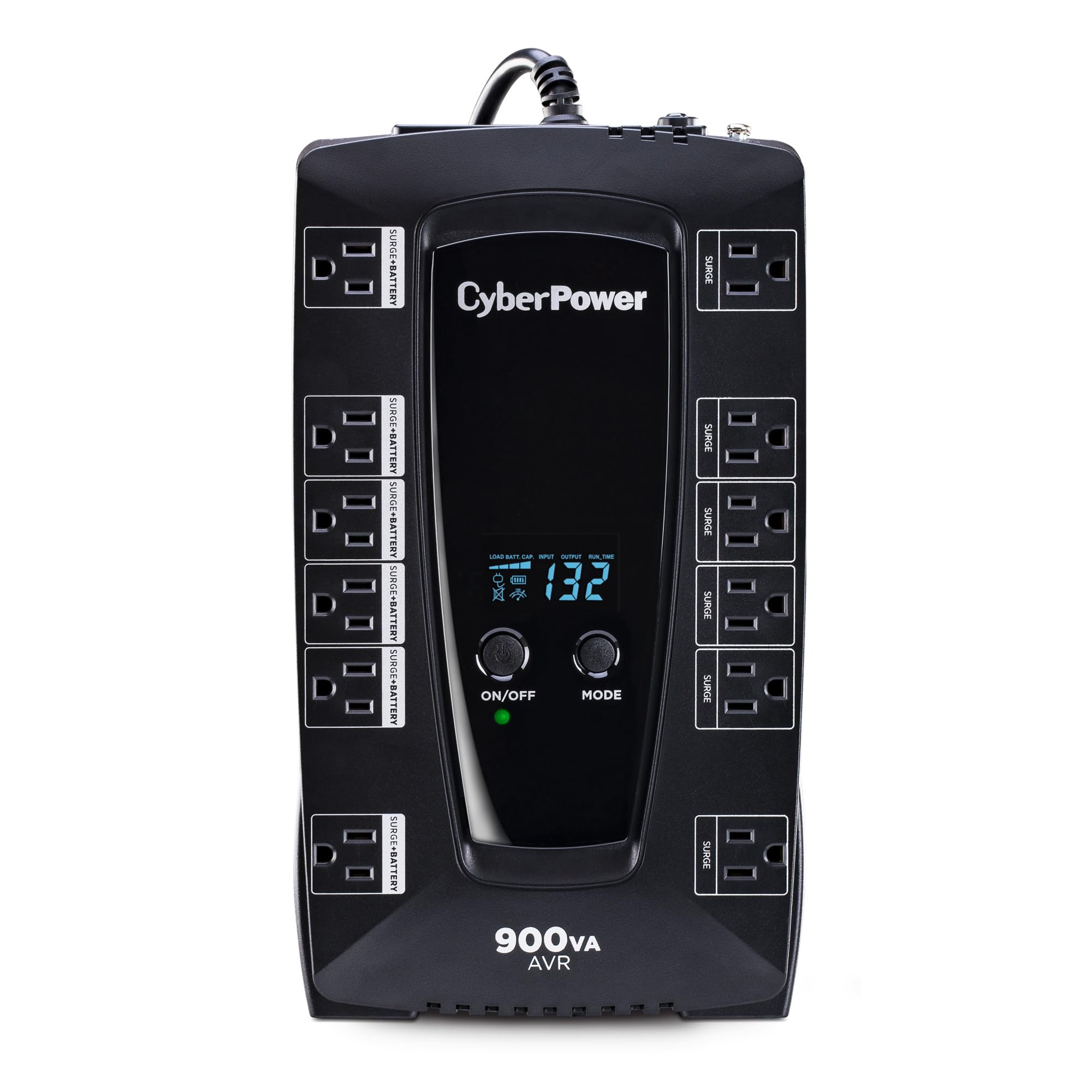
The CyberPower AVRG900LCD strikes an impressive balance between capacity and cost. At 900VA / 480W, it comfortably handles a desktop PC, monitor, and networking stack without breaking into the price territory of higher-end units. Its compact footprint — just 3.5 inches wide by 12.2 inches long — makes it one of the easier mid-range units to tuck under a desk or beside a network rack.
AVR correction is the headline feature here, stabilizing input between 85V and 150V without tapping the battery. Real-world testing shows a single PC with a 72W load delivers over 60 minutes of runtime, while a full workstation and laptop combo at 175-200W still provides 18-20 minutes. The 12-outlet design splits evenly between battery-backed and surge-only ports, giving you flexibility for devices that don’t need backup power. The LCD panel cycles through input voltage, output voltage, battery level, and load percentage — no software required for basic monitoring.
One genuine drawback is the simulated sine wave output, which disqualifies this unit for Active PFC power supplies. Additionally, the enclosure is plastic rather than metal, and some users report that initial setup using the mode button can be non-intuitive until you download the free PowerPanel software. For the price, however, the AVRG900LCD delivers robust AVR performance, UL certification, a three-year warranty including the battery, and connected equipment coverage.
Why it’s great
- Exceptional runtime — over 60 minutes at 72W load
- Full AVR protection stabilizes voltages without battery drain
- 12 outlets with clear battery/surge separation
- Three-year warranty including battery with equipment guarantee
Good to know
- Simulated sine wave incompatible with Active PFC power supplies
- Plastic enclosure feels less robust than metal alternatives
- Initial setup button logic confusing without software download
3. Eaton Tripp Lite OMNI1500LCDT

The Eaton Tripp Lite OMNI1500LCDT differentiates itself with user-replaceable batteries and a robust 810W continuous output. This is a unit built for longevity: when the internal sealed lead-acid battery ages out after a few years, you can swap in Tripp Lite’s RBC51 battery cartridge rather than tossing the whole unit. That alone makes it a smarter long-term investment than many sealed competitors.
AVR corrects brownouts between 92V and 150V back to 120V without draining the battery, and the 10 NEMA 5-15R outlets provide battery backup and surge protection for all ports simultaneously. Real-world user reports show a 16% load (tower, monitor, modem/router) yields approximately 50 minutes of runtime, while a full security camera setup can run for over three hours. The LCD screen cycles through input voltage, wattage load, AVR status, and estimated runtime — giving you useful data at a glance without needing software.
The major trade-off is the simulated sine wave output, which, like other units in this class, won’t support Active PFC power supplies. The bundled software is also widely reported as problematic, with device discovery failures and registry errors that can force an uninstall. For home offices and small network closets, however, the OMNI1500LCDT’s repairability, solid runtime, and equipment insurance make it a compelling long-term contender.
Why it’s great
- Easy user-replaceable battery extends service life beyond 5+ years
- 810W output with 50+ minutes runtime at typical home office loads
- AVR correction range (92V–150V) handles extreme voltage fluctuations
- All 10 outlets provide both battery backup and surge protection
Good to know
- Simulated sine wave — not compatible with Active PFC power supplies
- Bundled monitoring software is unreliable and may cause registry issues
- Initial burn-in period may produce a strong electronics smell
4. APC Back-UPS BE700G3

APC’s Back-UPS BE700G3 modernizes the traditional UPS design by adding a USB-C and USB-A port, both providing 5V/3A shared charging that stays active even during an outage. This is a practical evolution for the home office — it means your phone and tablet can charge from the UPS itself, not just from your computer. The 700VA / 420W rating provides sufficient margin for a typical work-from-home setup: a laptop dock, external monitor, Wi-Fi router, and desk lamp.
Runtime reaches up to 29 minutes at a 100W load, which comfortably covers brief blips and allows for a safe shutdown of connected computers. The six outlets split into four battery-backed and two surge-only, and the included wall-mount option is genuinely useful for apartments or dorms where floor space is limited. The clear indicator lights and audible alerts give immediate feedback on UPS status — no software necessary for basic awareness.
A notable design concern is that the battery is not designed for easy user replacement — several user reports note that replacement requires DIY disassembly and four internal screws, unlike older APC models where the battery compartment was tool-free. Some units have also been reported as failing out of the box, with rapidly draining batteries even under very light load. For the price and feature set, however, the BE700G3’s integrated USB-C charging and compact form factor make it a strong choice for the modern workspace.
Why it’s great
- Built-in USB-C and USB-A ports charge devices directly during outages
- 29-minute runtime at 100W load covers most home office needs
- Wall-mountable design saves desk space in compact work areas
- equipment protection with 3-year warranty
Good to know
- Battery replacement requires internal disassembly — not truly user-friendly
- Some units have experienced premature battery drain out of the box
- 420W capacity limits the unit to lighter workstation configurations
5. APC UPS BE600M1

The APC BE600M1 is the entry-level powerhouse that does exactly what it promises: keeps your computer, Wi-Fi router, and modem running long enough for a graceful shutdown. Its 600VA / 330W rating is modest but highly practical — at a 100W load, it delivers 23 minutes of runtime, which is more than enough for saving documents, closing applications, and powering down the system safely. The PowerChute software automates this shutdown process so you don’t have to be at the desk when the power goes.
Surge protection is built in across all seven outlets, with five providing battery backup and two providing surge-only protection for less critical peripherals. The integrated 1.5A USB port stays active during battery operation, letting you charge a phone or tablet while the PC is shutting down. One of the BE600M1’s strongest features is the user-replaceable battery (APC RBC154) — when the sealed lead-acid cells wear down in a few years, you swap the cartridge in minutes rather than replacing the entire UPS.
The compact form factor fits easily under most desks, and the recessed on/off button prevents accidental bumps from turning off your backup power. The simulated sine wave output is standard for this class and works flawlessly with standard desktop power supplies. For a budget-conscious buyer who prioritizes safe shutdowns and battery longevity over raw runtime, the BE600M1 remains a consistently reliable choice.
Why it’s great
- User-replaceable battery extends UPS life for years
- 23-minute runtime at 100W load ensures safe shutdown
- Compact, recessed button design prevents accidental power-off
- PowerChute software automates system shutdown during outages
Good to know
- 330W capacity limits use to a single computer and networking gear
- Simulated sine wave — not suitable for Active PFC power supplies
- No AVR means the unit switches to battery more frequently during brownouts
6. Tripp Lite BC350

The Tripp Lite BC350 is purpose-built for the single most common UPS use case: keeping your modem and router alive during a power outage to maintain internet connectivity. With a 350VA / 180W rating, it has no business powering a desktop computer — but it doesn’t need to. Real-world user reports confirm that this unit can run a fiber-to-RJ45 converter and a Wi-Fi router for over 12 hours on a fresh battery, making it an exceptional choice for keeping your home network online all day.
The design prioritizes simplicity and silence. It remains completely silent in both AC and battery modes, with an alarm that only sounds to warn of low battery or fault conditions. The six outlets are widely spaced to accommodate bulky wall warts, with three offering UPS battery backup and surge protection and three offering surge protection only. The bottom mounting tabs allow wall installation, and the internal battery is easily replaceable when it eventually ages out.
Output is sine wave in AC mode and PWM sine wave in battery mode, which is perfectly adequate for networking equipment but not recommended for active PFC power supplies. The 316-joule surge suppression rating is modest, so pairing this unit with a higher-rated surge protector downstream is a sensible approach for valuable equipment. For its intended purpose — bridging brief outages that would otherwise reset your router and kill your connection — the BC350 is remarkably effective and reliable.
Why it’s great
- Exceptional runtime — over 12 hours for modem and router
- Completely silent operation in normal and battery mode
- Widely spaced outlets accommodate bulky power adapters
- User-replaceable battery and wall-mountable form factor
Good to know
- 180W capacity too low for desktop computers or monitors
- 316-joule surge rating is lower than standalone surge protectors
- Some units have had defective outlets out of the box
7. SKE SK425

The SKE SK425 is the dark horse of this comparison — a budget-friendly unit that includes Automatic Voltage Regulation and a full LCD display, features typically found on mid-range models. At 425VA / 240W, it’s positioned for small electronics and networking gear rather than full desktop computers, but the inclusion of AVR is a real differentiator at this level. AVR stabilizes incoming voltage between fluctuations without draining the battery, which is a genuine advantage over similarly priced units that lack it.
Real-world user reports demonstrate strong performance: a radio setup drawing 51W ran for over 30 minutes with no RF interference, and a home office stack of three PCs plus networking gear maintained operation through a 45-minute outage. The LCD display shows input voltage, output voltage, battery capacity, and load level — useful monitoring usually absent at this price point. The six outlets split into four battery-backed and two surge-only, and the included management software supports automatic system shutdown.
Some users note that the unit’s surge sensitivity can cause it to trip off during minor power spikes, which protects gear but can be slightly inconvenient for those in areas with frequent small glitches. The metal enclosure adds a feeling of durability that plastic-bodied competitors lack. For buyers on a tight budget who still want AVR protection and an LCD display, the SK425 represents a remarkably well-rounded value proposition.
Why it’s great
- AVR and LCD display at a competitive entry-level price point
- 45-minute runtime with three PCs and networking equipment
- Metal enclosure provides better durability and heat dissipation
- Included management software enables automated safe shutdowns
Good to know
- 240W capacity limits use to smaller electronics and network stacks
- Surge sensitivity may cause more frequent tripping during minor spikes
- Simulated sine wave output — not compatible with Active PFC supplies
FAQ
Can I use a Backup UPS with a gaming PC that has an Active PFC power supply?
How long does a typical sealed lead-acid battery last before needing replacement?
What does Automatic Voltage Regulation actually do during a brownout?
Final Thoughts: The Verdict
For most users, the best backup ups winner is the CyberPower CP1500AVRLCD because its 900W real output, informative LCD, and robust AVR protection handle everything from a home office to a workstation-class PC without demanding pure sine wave pricing. If you want user-replaceable batteries and exceptional long-term value, grab the Eaton Tripp Lite OMNI1500LCDT. And for keeping your network alive all day on a tight budget, nothing beats the Tripp Lite BC350.