
Our readers keep the lights on and the weekend projects moving. As an Amazon Associate, I earn from qualifying purchases.
Bird photography lives and dies by reach, but hauling a 10-pound prime through a marsh is a surefire way to miss the shot. The real challenge is balancing focal length, image stabilization, and portability without emptying your savings account. Most birders agonize over f/stop numbers when the actual bottleneck is shutter speed discipline and a lens that doesn’t feel like a boat anchor after an hour of handheld shooting.
I’m Rikta — the co-founder and writer behind FitlyFast. I’ve spent hundreds of hours cross-referencing MTF charts, real-world user reports, and stabilization specs across telephoto zoom lenses to find the ones that deliver feather detail in the field, not just on a lab bench.
We analyzed 11 models from up to and found the ones that actually solve the birder’s core equation: enough reach to fill the frame, enough stabilization to shoot handheld at dawn, and light enough to carry all day. This guide breaks down the best bird watching lens for every mirrorless system and budget.
How To Choose The Best Bird Watching Lens
Choosing a birding lens means prioritizing reach, stabilization, and weight in that order — but the tradeoffs between them are where most buyers get tripped up. Here’s what actually matters in the field.
Reach and Crop Factor
Full-frame shooters need at least 400mm to frame a medium-size bird at a respectful distance. On APS-C, a 300mm lens behaves like 450mm; on Micro Four Thirds, 200mm delivers a 400mm equivalent field of view. The real test is usable reach — a lens that goes soft past 300mm is worse than a shorter prime that holds contrast edge-to-edge.
Stabilization and Shutter Speed
Optical image stabilization (OIS) in the lens combined with in-body stabilization (IBIS) can turn a dim forest understory into a shootable scene. Look for at least 5 stops of correction if you plan to handhold. Without stabilization, you’ll need a shutter speed of 1/focal length — meaning 1/600th at 600mm — which demands high ISO and good light.
Weight and Handleability
A sub-3-pound lens is comfortable for a full day hike. Internal zoom lenses maintain balance and keep dust out, but they’re heavier. Extending barrels save weight but the lens grows longer as you zoom — and that changes the center of gravity. Test the zoom action before buying if you can.
Quick Comparison
On smaller screens, swipe sideways to see the full table.
| Model | Category | Best For | Key Spec | Amazon |
|---|---|---|---|---|
| Sony FE 200-600mm f/5.6-6.3 G OSS | Premium Telephoto Zoom | Sony full-frame wildlife shooters | 600mm internal zoom, 4.66 lbs | Amazon |
| Nikon NIKKOR Z 180-600mm f/5.6-6.3 VR | Premium Telephoto Zoom | Nikon Z-system birders | 600mm VR, 5.5-stop stabilization | Amazon |
| Fujinon XF100-400mmF4.5-5.6 R LM OIS WR | Premium Telephoto Zoom | Fujifilm X-mount enthusiasts | 609mm equiv., 5-stop OIS | Amazon |
| Panasonic Leica DG 100-400mm f/4.0-6.3 II | Mid-Range Premium | MFT birders wanting Leica glass | 800mm equiv., dust/splash/freeze-proof | Amazon |
| OM SYSTEM Olympus 100-400mm f/5.0-6.3 IS | Mid-Range Premium | MFT shooters with teleconverter plans | 800mm equiv., weather-sealed | Amazon |
| Sony E 70-350mm f/4.5-6.3 G OSS | Mid-Range APS-C | Sony APS-C hiking/travel | 525mm equiv., 22 oz, OSS | Amazon |
| Tamron 70-180mm f/2.8 VC VXD G2 | Mid-Range Fast Zoom | Low-light bird / woodland | f/2.8 constant, VC stabilization | Amazon |
| Nikon NIKKOR Z 28-400mm f/4-8 VR | Value Travel Zoom | All-in-one travel / casual birding | 14.2x zoom, 1.6 lbs, 5-stop VR | Amazon |
| Canon RF 100-400mm f/5.6-8 IS USM | Mid-Range Value | Canon R-series budget birding | 400mm, 5.5-stop IS, Nano USM | Amazon |
| Canon RF 600mm f/11 IS STM | Specialty Fixed Aperture | Sunny-day birders wanting 600mm | 600mm prime, 2 lbs, DO optics | Amazon |
| Tamron 70-300mm f/4.5-6.3 Di III RXD | Entry-Level Telephoto | Budget Sony mirrorless beginners | 300mm, 19 oz, moisture-resistant | Amazon |
In‑Depth Reviews
1. Sony FE 200-600mm f/5.6-6.3 G OSS Super Telephoto Zoom Lens

The Sony 200-600mm G OSS is the benchmark for full-frame birding zooms. Its internal zoom mechanism keeps the lens balanced at every focal length — a critical advantage when you’re on a gimbal head tracking a swallow in flight. Five ED elements and Nano AR coating deliver contrast that holds up even against backlit subjects, and the Direct Drive SSM focus motor is near-silent.
Optical SteadyShot stabilization is excellent, and on Sony bodies with IBIS you can handhold at 1/200th at 600mm with practice. The tripod collar lacks Arca-Swiss compatibility out of the box, which is a minor annoyance that a third-party foot solves for roughly . Weight at 4.66 pounds is significant but reasonable for a 600mm internal-zoom lens.
On the a7R IV, the 60MP sensor lets you crop to an effective 900mm without a teleconverter while retaining printable detail. The 1.4x teleconverter (sold separately) pushes you to 840mm with negligible sharpness loss; the 2x is usable in good light but shows softness. For dedicated Sony birders, this lens is the default answer.
Why it’s great
- Internal zoom keeps balance constant
- Excellent contrast and sharpness across the zoom range
- Fast, quiet autofocus with DDSSM
- 1.4x teleconverter compatible with minimal IQ loss
Good to know
- Tripod foot lacks Arca-Swiss — plan for a replacement
- Heavy for extended handheld shooting
- Bokeh can look busy at certain distances
2. Nikon NIKKOR Z 180-600mm f/5.6-6.3 VR

Nikon’s answer to the Sony 200-600mm is the Z 180-600mm VR, and it matches up on nearly every front while adding 5.5 stops of Vibration Reduction that pairs with Z-body IBIS for rock-solid handheld shooting. The 70-degree zoom throw from 180mm to 600mm is unusually fast — you can reframe an erratic subject without taking your eye off the finder.
Minimum focus distance of 4.27 feet at 180mm gives you a 0.25x reproduction ratio, handy for larger subjects at close range. The lens is compatible with both TC-1.4x and TC-2.0x teleconverters, pushing reach to 840mm or 1200mm respectively. The 2x teleconverter does soften fine feather detail in flat light, but at 1200mm equiv. the image is still usable for web sharing.
The fluorine coating on the front element makes cleaning easier after a morning in marshy conditions, and the internal zoom design minimizes dust intrusion — a real-world advantage over extending-barrel rivals. At 4.7 pounds it’s heavy, but the included quick-release tripod foot and strap eyelet make it manageable with a monopod.
Why it’s great
- 5.5-stop VR + IBIS for exceptional handheld stability
- Fast 70° zoom throw for tracking
- Fluorine coating resists water and smudges
- Sharp across the range with good color rendering
Good to know
- Heavy at 4.7 lbs — tripod recommended for long sessions
- AF slows noticeably in low light
- Tripod foot is not Arca-Swiss compatible
3. Fujinon XF100-400mmF4.5-5.6 R LM OIS WR
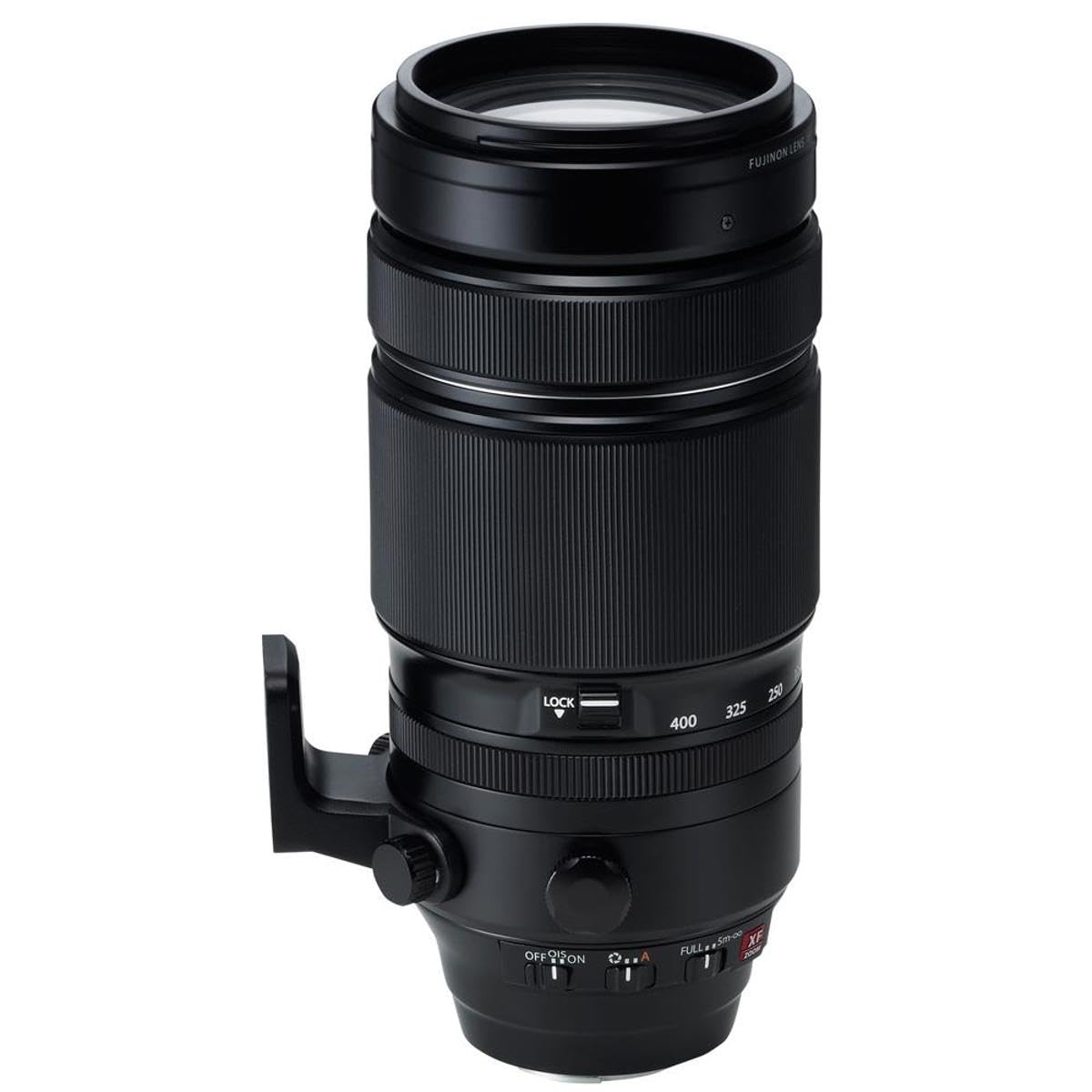
For Fujifilm shooters, the XF100-400mm is the only native zoom that reaches 400mm, delivering a 609mm full-frame equivalent on X-mount bodies. Five ED elements and one Super ED element keep chromatic aberration minimal, and the 5-stop OIS system pairs well with X-H1 and X-T5 IBIS for handheld birding at dawn.
The linear motor focuses fast and quietly enough for birds in flight, though the focus ring is noticeably stiff. The tripod collar is threaded for Arca-Swiss out of the box — a small but appreciated detail that saves you . The lens extends as you zoom, shifting the center of gravity forward, but the locking mechanism at 100mm prevents creep when you’re carrying it.
Image quality is outstanding from 100-300mm, with a slight softness beyond 300mm that’s correctable in post. The 1.4x teleconverter pushes you to 852mm equiv. with good results; the 2x is not recommended. At just over 3 pounds, it’s the lightest lens in its reach class among the premium tier.
Why it’s great
- Arca-Swiss tripod foot included
- Excellent 5-stop OIS + IBIS compatibility
- Lightweight at 3.03 lbs
- 1.4x TC compatible with good IQ retention
Good to know
- Softens slightly past 300mm
- Focus ring is stiff out of the box
- Zoom lock only at 100mm position
4. Panasonic LUMIX Leica DG Vario-Elmar 100-400mm f/4.0-6.3 II

The Panasonic Leica 100-400mm II delivers an effective 200-800mm field of view on Micro Four Thirds bodies, and it’s built to the same dust, splash, and freeze-resistant standard as Lumix S-series pro lenses. The Mark II update improved autofocus speed and aperture smoothness for video, but still relies on manual focus clutch for precise control — welcome for birders who want fast override.
Image quality is tack-sharp across the entire zoom range, with the f/4.0 aperture at 100mm offering a useful advantage over f/5.0 rivals in low light. The Power O.I.S. provides up to 5 stops of stabilization, and on Panasonic bodies with Dual I.S. 2, you can handhold at 1/80th at 400mm with consistent results.
The 1.3-meter minimum focus distance and 0.5x magnification (35mm equiv.) make it capable of semi-macro shots of butterflies between bird sightings. The lens hood uses a bayonet mount that’s secure and quick to deploy, though some users report it loosens slightly after months of use. At 2.2 pounds, it’s the lightest premium 800mm-equivalent lens available.
Why it’s great
- Tack sharp across the zoom range — compares to pro primes
- f/4.0 at wide end for slightly better low light
- Dust, splash, and freeze-proof to -10°C
- Dual I.S. 2 provides rock-solid stabilization
Good to know
- Bayonet hood can loosen with extended use
- Heavier than the Panasonic 100-400mm Mark I
- No lens collar rotation lock
5. OM SYSTEM Olympus M.Zuiko Digital 100-400mm F5.0-6.3 IS

The Olympus 100-400mm IS offers an 800mm equivalent reach at a price that undercuts the Panasonic Leica by nearly while still delivering impressive sharpness. In-lens image stabilization provides 3 EV steps at 800mm equiv., which is modest compared to Panasonic’s Dual I.S., but on OM-System bodies with Sync IS you can handhold well enough for static subjects.
The MC-14 1.4x teleconverter pushes reach to 1120mm equiv. with surprisingly good sharpness retention. The MC-20 2x converter introduces noticeable softening and is best reserved for sunny days. Autofocus speed is adequate for perched birds but struggles with fast-moving subjects in flight — this is a lens for the shooter who waits for the bird to settle.
Weather sealing matches Olympus’s pro-grade IPX1 rating, and the minimum focus distance of 1.3 meters is identical to the Panasonic. The zoom ring and focus ring are smoother than the Panasonic’s, making manual fine-tuning more pleasant. At around , it’s a compelling entry point into super-telephoto MFT birding.
Why it’s great
- Excellent value for 800mm equiv. reach
- MC-14 teleconverter works well for 1120mm equiv.
- Smooth zoom and focus rings
- Weather-sealed for field use
Good to know
- AF is slow for birds in flight
- MC-20 teleconverter softens noticeably
- Only 3 EV stops of in-lens stabilization
6. Sony E 70-350mm f/4.5-6.3 G OSS Lens

The Sony E 70-350mm G OSS is the lightweight king of the APS-C telephoto range at just 22.1 ounces. On a Sony a6000-series body, the combination is under 2 pounds total — you can carry it all day without fatigue. The 525mm full-frame equivalent is enough for medium-size birds at moderate distances, and the XD linear motor locks focus fast enough for swallows.
Optical SteadyShot stabilization works well with the a6600’s IBIS, giving you usable results at 1/250th at 350mm. The G Lens label means sharp corners and good contrast, and the 70mm wide end makes it a usable landscape lens between sightings. The ED elements control fringing effectively.
It’s not ideal for low light — at f/6.3 at the long end, you’ll be at ISO 3200 or higher by late afternoon. And the 70mm wide end means you can’t zoom out for a quick environmental shot without switching lenses. But for daylight hiking and travel birding, it’s the best lens-to-weight ratio in Sony’s APS-C lineup.
Why it’s great
- Incredibly lightweight at 22 oz
- Fast, quiet XD linear AF motor
- Good OSS + IBIS sync
- Versatile for both birds and landscapes
Good to know
- f/6.3 at long end limits low-light use
- No weather sealing
- AF can hunt on close objects like fences
7. Tamron 70-180mm F/2.8 Di III VC VXD G2 for Sony E-Mount

The Tamron 70-180mm f/2.8 G2 is the reverse of a typical birding lens — it trades raw reach for a constant f/2.8 aperture that lets you shoot in forest understory at ISO 800 instead of ISO 6400. On an APS-C body like the a6700, it gives you an effective 270mm at the long end with the same bright aperture, and the VC stabilization is very effective for handheld shooting.
The VXD linear motor provides snappy autofocus that keeps up with erratic movement, and the moisture-resistant construction with fluorine coating gives you some weather protection. The minimum focus distance of 0.3 meters at 70mm opens up close-up opportunities for larger birds at close range.
It’s not a replacement for a 400mm-plus birding lens. For woodland birding where the action is 20-50 feet away, the bright aperture compensates for the shorter reach. On full-frame, the 180mm top end requires you to crop aggressively for anything smaller than a heron. But for the birder who also shoots in low light and wants one lens for both, it’s a smart compromise.
Why it’s great
- Constant f/2.8 for low-light birding
- Excellent VC stabilization
- Fast, precise VXD autofocus
- Moisture-resistant and fluorine-coated
Good to know
- 180mm reach is short for most birding
- Extending barrel can collect dust
- Lens warms slightly during extended AF tracking
8. Nikon NIKKOR Z 28-400mm f/4-8 VR

The Nikon Z 28-400mm VR is the ultimate single-lens travel solution, covering 28mm wide-angle to 400mm telephoto in a 1.6-pound package. The built-in VR delivers 5-stop stabilization, and synchro VR with compatible Z bodies adds another half stop for effective handheld shooting at the long end.
The lens uses a linear MF motor for smooth focus, and the minimum focus distance of 0.2 meters at 28mm allows for creative close-ups. On the Z50 (APS-C), the effective range becomes 600mm equiv., making it a surprisingly capable birding option for casual shooters. The focus is sharp across most of the zoom range, though the f/8 aperture at 400mm means you’ll be working at high ISO in anything less than bright sun.
The extending barrel design changes the center of gravity as you zoom, and the lens is not weather-sealed. Autofocus slows in dim light — it’s a fair-weather lens. But for the birder who wants one lens for a weekend trip where birding is just one activity among many, this is the most versatile option available.
Why it’s great
- Incredible 14.2x zoom range
- Very lightweight for the reach
- 5.5-stop synchro VR with Z bodies
- Smooth linear MF for video use
Good to know
- f/8 at 400mm limits low-light performance
- Not weather-sealed
- AF slows noticeably in low light
9. Canon RF 100-400mm f/5.6-8 IS USM

The Canon RF 100-400mm IS USM is the budget telephoto that punches above its price. The 5.5-stop optical image stabilization is class-leading, and when paired with an EOS R body with IBIS, you get up to 6 stops of correction — enough to reliably handhold at 1/125th at 400mm. The Nano USM motor drives autofocus that is fast, smooth, and silent enough for bird videos.
Minimum focus distance of 2.89 feet at 200mm gives a 0.41x maximum magnification, allowing you to fill the frame with a small bird at close range. On an APS-C R-series body (like the R7), the effective reach is 640mm, which is plenty for medium-size birds at 30 feet. The compact build (just over 1.5 pounds) makes it easy to carry.
The f/8 aperture at 400mm is the biggest compromise — in overcast conditions you’ll need ISO 6400+ to keep shutter speeds up. There’s no weather sealing, so you’ll want a rain sleeve if you’re caught in drizzle. But for the price, this lens delivers image quality and stabilization that outperform its cost by a wide margin.
Why it’s great
- 5.5-stop OIS — best in class for its price
- Nano USM AF is fast and silent
- Very light and compact
- Good close focus at 200mm for small subjects
Good to know
- f/8 at 400mm is very slow
- No weather sealing
- 400mm is marginal for small birds on full-frame
10. Canon RF 600mm f/11 IS STM

The Canon RF 600mm f/11 IS STM is a lens that demands you understand the exposure triangle. The fixed f/11 aperture is two stops darker than a typical f/5.6 zoom, but the lens weighs just 2 pounds and collapses to a length that fits in a small daypack. The gapless double-layer diffractive optics (DO) keep chromatic aberration to a minimum, and the optical IS provides 5 stops of shake correction.
In bright daylight, you can shoot at ISO 400-800 and get sharp results. Paired with an EOS R6 II’s IBIS, you can handhold at 1/60th — a remarkable achievement for a 600mm lens. The STM autofocus is not the fastest in Canon’s lineup, but on stationary or slow-moving birds it works well. Use servo AF for birds in flight.
This lens is not for pros shooting in a rainforest at dusk. It’s for the enthusiast who wants 600mm reach for under and understands that the aperture limit can be managed with technique. The extending/retracting barrel locks securely, and the build quality is solid for a non-L-series lens. It’s a niche tool, but within its niche — bright sun, stationary or slow-moving subjects — it delivers results that rival lenses costing three times as much.
Why it’s great
- Unbeatable weight-to-reach ratio at 2 lbs
- Excellent 5-stop IS + IBIS sync
- Sharp results in good light
- Collapsible design for compact storage
Good to know
- f/11 aperture limits use to bright light
- STM AF is slow compared to USM or XD motors
- Not weather-sealed
11. Tamron 70-300mm f/4.5-6.3 Di III RXD for Sony E-Mount
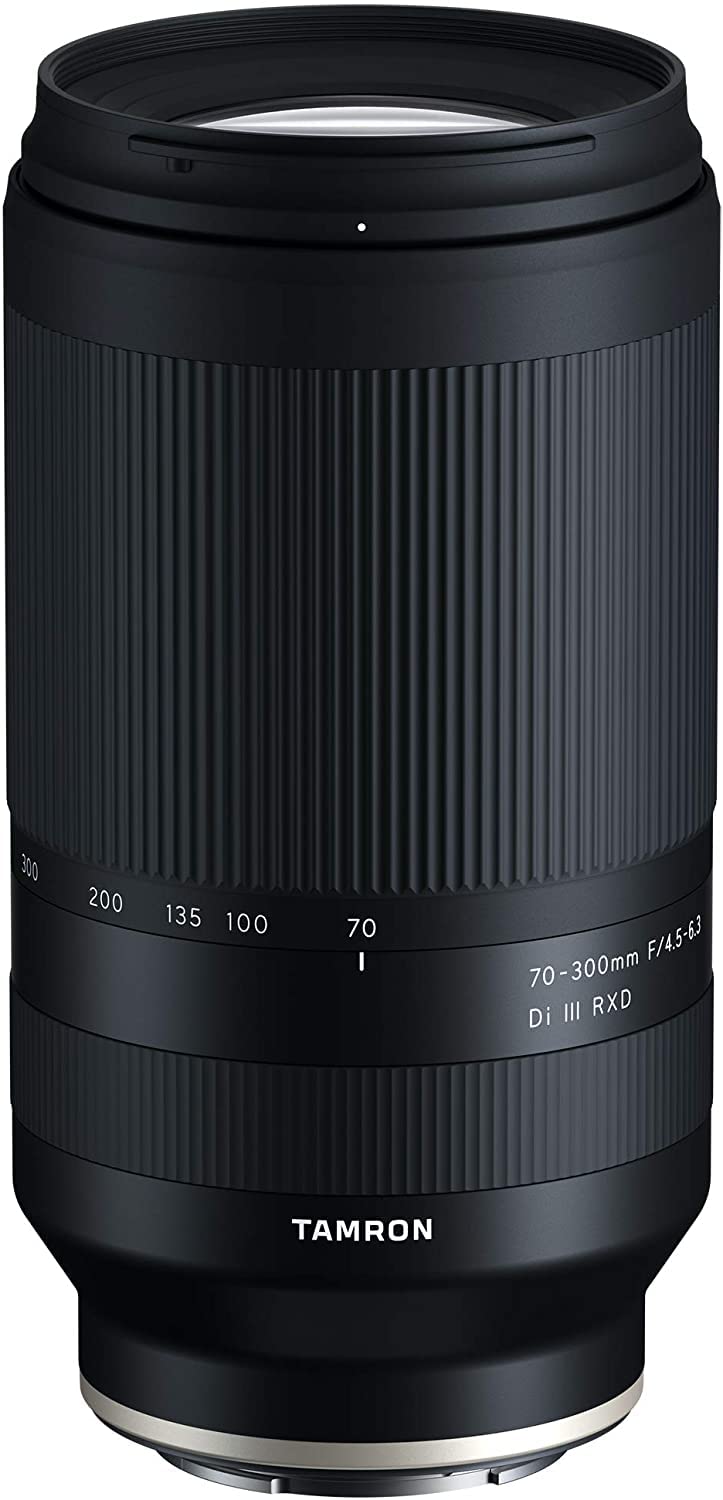
The Tamron 70-300mm RXD is the lightest telephoto zoom in this guide at 19 ounces, and it’s the most affordable entry point for Sony E-mount birders. The 15-element, 10-group design delivers surprisingly sharp images for the price point, with contrast that holds up to moderate cropping. The RXD stepping motor is near-silent and fast enough for slow-moving subjects.
The minimum focus distance of 31.5 inches at 70mm and 59.1 inches at 300mm allows for decent subject isolation, and the moisture-resistant construction adds a layer of protection against morning dew. On an APS-C body, the effective reach is 450mm, which is enough for larger birds at reasonable distances.
The lack of optical image stabilization is the biggest drawback — you need IBIS or a fast shutter speed. At 300mm with no stabilization, you need at least 1/500th to avoid blur from camera shake. The 70mm wide end is tighter than most kit zooms, so you’re limited to telephoto-only shooting. For the beginner birder on a tight budget, this lens offers the best compromise between sharpness, weight, and cost.
Why it’s great
- Very affordable entry price
- Lightest lens in the guide at 19 oz
- Good sharpness and contrast for the price
- Moisture-resistant construction
Good to know
- No optical image stabilization
- 300mm reach is short for small birds
- No lens lock switch
FAQ
What is the minimum reach I need for bird photography?
Should I prioritize a fast aperture or longer reach for birding?
How do teleconverters affect image quality on birding lenses?
Can I use a full-frame lens on an APS-C camera for birding?
What does the crop factor mean when choosing a birding lens?
Final Thoughts: The Verdict
For most users, the best bird watching lens winner is the Sony FE 200-600mm f/5.6-6.3 G OSS because it offers the ideal balance of reach, internal zoom balance, and sharpness for the dedicated birder. If you shoot Nikon Z, grab the Nikon NIKKOR Z 180-600mm f/5.6-6.3 VR for its 5.5-stop stabilization and teleconverter support. And for a lightweight, budget-friendly entry into the 400mm-plus range, the Canon RF 100-400mm f/5.6-8 IS USM delivers exceptional stabilization at a great price.