
Our readers keep the lights on and the weekend projects moving. As an Amazon Associate, I earn from qualifying purchases.
The heart of any home theater or high-fidelity music system is the component that drives it all. An amplifier receiver must deliver clean power, decode modern audio formats, and switch between multiple sources without introducing noise or lag. Getting the balance wrong means sacrificing either dynamic range or dialogue clarity—a compromise no serious listener should accept.
I’m Rikta — the co-founder and writer behind FitlyFast. I’ve spent months analyzing the specs, customer feedback, and real-world performance data across dozens of models to find the units that genuinely deliver on their promises without hidden drawbacks.
Whether you are building a dedicated home theater or upgrading a two-channel stereo setup, finding the best amplifier receiver means weighing power output, room correction capability, and connectivity options to match your specific speakers and space.
How To Choose The Best Amplifier Receiver
Picking the right unit starts with understanding your speaker impedance, room size, and how many channels you actually need. A 5.1-channel receiver may be overkill for a stereo-only music setup, while a budget two-channel amp will leave a 5.1.4 Atmos theater completely flat. Match the amplifier’s channel count and power output to your speaker configuration and listening habits.
Power Delivery vs. Rated Wattage
A receiver rated at 100 watts per channel but powered by a lightweight switching supply will clip sooner than a 70-watt unit with a robust toroidal transformer and high-current output stages. Look for the total power consumption spec—it reveals the true muscle behind the advertised numbers. Denon’s PMA-600NE draws 185 watts total, which explains why its 70-watt rating feels stronger than many 100-watt budget receivers.
Room Correction and Calibration
Your room’s dimensions, furniture, and wall materials color every sound the receiver produces. Systems like Dirac Live (Onkyo TX-NR7100, TX-RZ50) measure multiple listening positions and apply precise filters to flatten frequency response and tighten bass. Yamaha’s YPAO and Denon’s Audyssey are solid alternatives that require less setup time. For critical listening or challenging rooms, Dirac is the gold standard.
HDMI 2.1 and Gaming Features
If you connect a PlayStation 5, Xbox Series X, or a high-end PC, confirm the receiver supports 4K/120Hz passthrough, Variable Refresh Rate (VRR), and Auto Low Latency Mode (ALLM). Most 2021-and-later models from Yamaha, Denon, and Onkyo offer these features, but check firmware updates—some units needed patches to enable full 40 Gbps bandwidth.
Quick Comparison
On smaller screens, swipe sideways to see the full table.
| Model | Category | Best For | Key Spec | Amazon |
|---|---|---|---|---|
| WiiM Amp Ultra | Streaming Amp | Hi-Fi Music Streaming | 100W/ch, ESS ES9039Q2M DAC | Amazon |
| Denon AVR-S970H | AV Receiver | Mid-Size Home Theater | 90W x 7, 8K HDMI | Amazon |
| Yamaha RX-A4A | AV Receiver | Premium Build & Sound | 7.2-ch, Surround:AI | Amazon |
| Onkyo TX-RZ50 | AV Receiver | Serious Home Theater | 120W/ch, Dirac Live, THX | Amazon |
| Sony STR-AZ3000ES | AV Receiver | Reference-Level Audio | 9.2-ch, 360 SSM | Amazon |
| Onkyo TX-NR7100 | AV Receiver | Dirac Live on a Budget | 100W/ch, 9.2-ch, THX | Amazon |
| Yamaha RX-V6A | AV Receiver | Solid 7.2 All-Rounder | 7.2-ch, 8K/60 HDMI | Amazon |
| Denon PMA-600NE | Integrated Amp | Pure 2-Channel Stereo | 70W/ch, Analog Mode | Amazon |
| Yamaha RX-V4A | AV Receiver | Compact 5.2 System | 5.2-ch, MusicCast | Amazon |
In‑Depth Reviews
1. WiiM Amp Ultra

The WiiM Amp Ultra redefines what a streaming amplifier can achieve at this size and price point. Its dual TI TPA3255 amps and ESS SABRE DAC deliver ultra-low distortion figures around -106 dB, meaning your music comes through with studio-level clarity and separation. The built-in RoomFit EQ uses the microphone to measure your space and adjust the frequency response automatically—no complicated manual calibration required.
Connectivity covers every modern source: Wi-Fi 6, Bluetooth 5.3 with LE Audio, HDMI ARC for TV integration, optical, and RCA inputs. The 3.5-inch touchscreen display shows album art and system settings, and the included voice remote handles playback control. Multi-room sync via WiiM, Alexa, or Google speakers works reliably, and streaming services like TIDAL, Qobuz, and Spotify are supported natively.
One limitation to note: this unit does not support AirPlay, so Apple users will need to stream via Chromecast or a wired connection. For a compact, high-fidelity streaming hub that drives 100 watts per channel cleanly, the Amp Ultra is a serious contender that outperforms its modest footprint.
Why it’s great
- Exceptional DAC and amplifier combo with very low distortion
- RoomFit EQ calibrates sound to your specific environment
- Compact footprint with modern touchscreen interface
Good to know
- No AirPlay support limits Apple ecosystem streaming
- Bluetooth source switching can introduce audio delay
2. Denon AVR-S970H

The Denon AVR-S970H delivers a balanced mix of power and features for a moderate-sized home theater. Its 90 watts per channel across seven channels fill a medium room with authority, and the eight HDMI inputs include three that handle 8K/60Hz and 4K/120Hz with VRR, ALLM, and QFT for smooth gaming. The on-screen setup wizard and guided Audyssey calibration make configuration straightforward even for first-time owners.
Built-in HEOS multi-room streaming lets you send music to Denon Home speakers in other rooms, and the phono input accommodates turntable connections. The onboard DAC processes high-resolution audio files up to 24-bit/192kHz, and the amplifier runs relatively cool compared to earlier Denon models. Dual subwoofer outputs provide flexibility for bass management.
Note that using powered Zone 2 reduces the main zone to 5.2 channels, so if you need a dedicated second zone alongside a full 7.2 theater, plan accordingly. The remote lacks a dedicated TV power button, but the HEOS app covers most control needs. For a versatile, gaming-ready receiver that pairs well with Klipsch or similar speakers, the S970H is a strong choice.
Why it’s great
- Full HDMI 2.1 support for 8K/60Hz and 4K/120Hz gaming
- HEOS multi-room streaming and phono input included
- User-friendly setup with Audyssey room calibration
Good to know
- Zone 2 operation reduces main zone to 5.2 channels
- Remote lacks dedicated TV power button
3. Denon PMA-600NE

The Denon PMA-600NE is a two-channel integrated amplifier designed for listeners who prioritize pure stereo sound over surround processing. Its divided circuitry architecture allows you to disengage the digital stage completely, turning off Bluetooth and the internal DAC to run in Analog Mode—eliminating any potential digital noise from the signal path. The result is a warm, spacious presentation with excellent instrument separation.
Rated at 70 watts per channel into 4 ohms, the PMA-600NE uses Denon’s Advanced High Current (AHC) push-pull circuit to maintain stable power delivery even with demanding speakers. Input options include two optical, one coaxial, and a phono input for turntables, plus Bluetooth for casual streaming. The subwoofer output lets you integrate a powered sub without needing a separate crossover.
Some users note the remote control volume adjustment feels laggy and coarse, and the lack of a loudness control may disappoint vintage enthusiasts. But for a dedicated stereo system built around a quality pair of bookshelf or floor-standing speakers, the PMA-600NE offers a level of refinement that outshines many multi-channel receivers in the same price tier.
Why it’s great
- Analog Mode bypasses digital circuits for cleaner sound
- High-current power supply drives 4-ohm speakers confidently
- Phono input and subwoofer output add versatility
Good to know
- Remote volume control feels slow and imprecise
- No loudness compensation circuit included
4. Yamaha RX-V6A

The Yamaha RX-V6A bridges the gap between entry-level and mid-range performance with a 7.2-channel configuration that supports Dolby Atmos and DTS:X. Its seven HDMI inputs include three that handle 8K/60Hz and 4K/120Hz, making it suitable for next-gen consoles and high-resolution video sources. YPAO R.S.C. with multipoint measurement provides solid room correction without the complexity of Dirac Live.
MusicCast multi-room streaming integrates seamlessly with Yamaha wireless speakers, and the receiver supports Spotify Connect, AirPlay 2, TIDAL, and Amazon Music HD. The improved DSP processing delivers a noticeable step up in soundstage width and dialogue clarity compared to the RX-V4A. Dual subwoofer outputs give you flexible low-frequency management.
Setup can be finicky, especially with HDMI-CEC interactions across different brands, and some units required firmware updates to stabilize HDMI 2.1 operation. The remote control is functional but packed with small buttons. For a 7.2 receiver that handles Atmos, 8K video, and multi-room audio without breaking the bank, the RX-V6A delivers consistent value.
Why it’s great
- Three 8K/60 and 4K/120 HDMI inputs for modern sources
- Dolby Atmos and DTS:X decoding with height virtualization
- MusicCast multi-room ecosystem offers broad streaming support
Good to know
- HDMI-CEC can behave unpredictably across brands
- Firmware update may be required for full HDMI 2.1 stability
5. Onkyo TX-NR7100
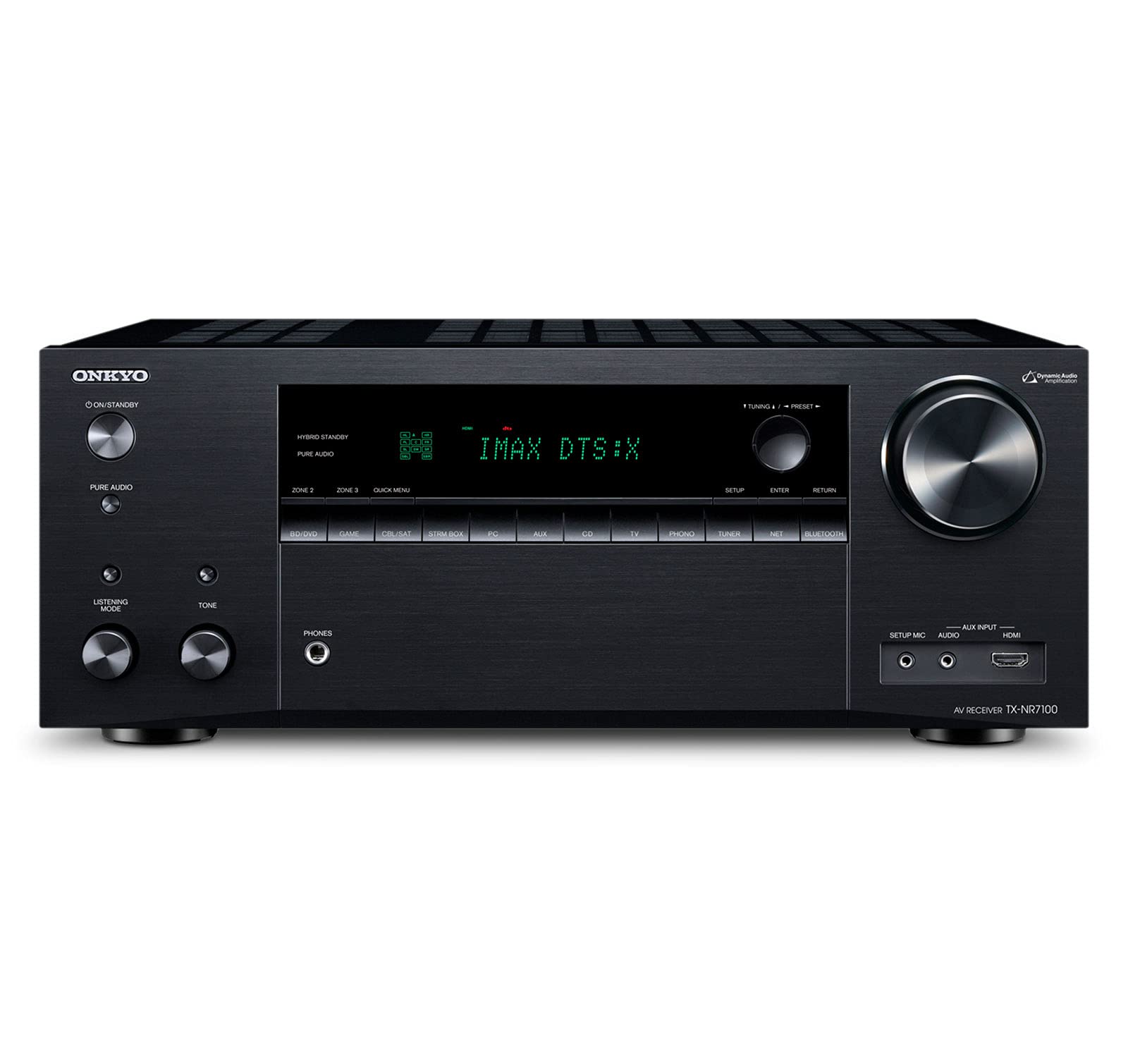
The Onkyo TX-NR7100 brings Dirac Live room correction to the sub-premium price tier, a feature typically reserved for far more expensive units. The included microphone and smartphone app measure your room from multiple positions, then apply corrections that tighten bass, smooth frequency response, and improve imaging dramatically. The 9.2-channel processing supports 5.1.4 or 7.1.2 Atmos setups with 100 watts per channel.
HDMI 2.1 connectivity covers all the gaming essentials: 4K/120Hz, VRR, ALLM, and QFT. The THX certification guarantees a minimum level of performance across power, noise, and distortion. Works with Sonos certification allows seamless integration with Sonos Ports for multi-room audio, and bidirectional Bluetooth streams to headphones via aptX HD.
A minority of units have reported HDMI or wireless card defects, and the remote lacks a backlight. The Dirac setup process is more involved than YPAO or Audyssey, requiring a laptop or dedicated measurement session. For the ability to fix room acoustic issues at a price that undercuts competitors, the TX-NR7100 is an outstanding value.
Why it’s great
- Dirac Live included—transforms sound in problematic rooms
- THX Certified ensures consistent performance standards
- Full HDMI 2.1 gaming features and bidirectional Bluetooth
Good to know
- Dirac setup requires more time and a laptop for best results
- Some units experience wireless card or HDMI issues
6. Yamaha RX-A4A AVENTAGE

The Yamaha RX-A4A sits in the AVENTAGE line, Yamaha’s top-tier series built with premium internal components and a rigid, vibration-resistant chassis. Its Surround:AI technology analyzes scene content in real time and adjusts the sound field to emphasize dialogue, effects, or ambient cues automatically—a genuinely useful feature that goes beyond simple EQ presets. The 7.2-channel configuration includes pre-outs for adding external amplification.
All seven HDMI inputs support 8K60 and 4K120 at 40 Gbps, with Dolby Vision, HDR10+, and HLG passthrough. YPAO R.S.C. with 3D and multipoint measurement provides accurate room calibration, and the MusicCast platform handles multi-room streaming. A built-in phono input and Roon Tested certification appeal to serious music enthusiasts.
The firmware update process requires a USB flash drive, which feels outdated compared to network updates. Setup menus are numerous, and the sheer depth of configuration options can overwhelm less experienced users. Once dialed in, the A4A delivers a spacious, detailed soundstage that scales beautifully with high-quality speakers and external amplification.
Why it’s great
- Surround:AI dynamically optimizes sound based on content
- AVENTAGE build quality with vibration-resistant design
- All HDMI inputs support 8K/60 and 4K/120 at full bandwidth
Good to know
- Firmware updates require a USB drive, not network-based
- Extensive menu system can be overwhelming to configure
7. Onkyo TX-RZ50

The Onkyo TX-RZ50 is a 9.2-channel powerhouse with 11.2 channels of processing, meaning you can build a 7.2.4 Atmos system while using an external amplifier for the extra channels. Dirac Live is included out of the box, and the THX Certification ensures the amplifier adds nothing and subtracts nothing from the source material. At 120 watts per channel, this receiver drives demanding speakers with authority and headroom.
HDMI 2.1 inputs support 8K/60Hz and 4K/120Hz with VRR, ALLM, and QFT. The Klipsch Optimize Mode automatically applies correct crossover values for Klipsch Reference and Reference Premiere speakers, simplifying setup for that popular brand. Works with Sonos certification, bidirectional Bluetooth with aptX HD, and built-in streaming services round out the connectivity suite.
Some users report that the Onkyo app is less polished than competitors, and the subwoofer outputs are not independently adjustable. A minor number of units have experienced WiFi card failures, though warranty service covers the issue. For an immersive, room-corrected home theater that handles complex speaker configurations, the TX-RZ50 is a top-tier contender.
Why it’s great
- 11.2-channel processing for true 7.2.4 Atmos setups
- Dirac Live and THX Certification ensure precise, clean sound
- High 120W per channel with robust power supply
Good to know
- Onkyo app feels less refined than competitors’ offerings
- Subwoofer outputs share the same signal, not independently adjustable
8. Yamaha RX-V4A

The Yamaha RX-V4A offers a cost-effective entry point into the world of surround sound receivers without sacrificing core features. Its 5.2-channel configuration is ideal for small to medium rooms where a full 7-channel setup is unnecessary. The four HDMI inputs support 4K/60Hz and one input handles 8K/60Hz and 4K/120Hz, giving you future-proofing for next-gen consoles.
MusicCast provides multi-room audio, AirPlay 2, Spotify Connect, and voice control via Alexa or Google Assistant. YPAO automatic room calibration optimizes the sound for your space in minutes. The receiver handles Dolby TrueHD and DTS-HD Master Audio, and the 5-way binding posts accommodate banana plugs for clean speaker connections.
Some users have reported HDMI switching issues, particularly when mixing 4K sources with 1080p displays. The setup menus and remote control have a learning curve that may frustrate casual users. For a compact, well-connected 5.2 receiver that opens the door to Yamaha’s excellent MusicCast ecosystem, the RX-V4A is a sensible starting point.
Why it’s great
- Affordable entry into the MusicCast multi-room system
- HDMI 2.1 input supports 8K/60 and 4K/120 for gaming
- YPAO calibration improves sound quality in most rooms
Good to know
- Some units experience HDMI switching inconsistencies
- Setup menus and remote are not the most intuitive
9. Sony STR-AZ3000ES

The Sony STR-AZ3000ES represents the pinnacle of consumer AV receiver engineering from Sony’s ES series. Its 9.2-channel configuration delivers 120 watts per channel, but the real magic lies in 360 Spatial Sound Mapping, which creates phantom speakers to fill gaps in your layout—a 5.1.2 system can sound like a 7.1.4 setup. Digital Cinema Auto Calibration IX measures the room with precision and optimizes the output accordingly.
HDMI 2.1 inputs support 8K/60Hz and 4K/120Hz, with Dolby Vision, HDR10, HLG, and IMAX Enhanced passthrough. The receiver integrates with Sonos systems, supports Chromecast built-in, Apple AirPlay, and Spotify Connect. The front USB port provides 5V power, and the remote includes backlit buttons for dark room use.
The unit runs very hot in operation—a cooling fan is strongly recommended for rack installations. It lacks HDR10+ support, which may be a consideration for certain projectors and displays. For a reference-grade home theater receiver that uses sophisticated spatial processing to create an immersive soundfield, the STR-AZ3000ES is the definitive choice.
Why it’s great
- 360 Spatial Sound Mapping creates phantom channels for wider soundstage
- Digital Cinema Auto Calibration IX delivers precise room correction
- Backlit remote and front USB port enhance daily usability
Good to know
- Runs hot and may require external cooling in confined spaces
- Does not support HDR10+ format
FAQ
Do I really need a separate amplifier if my receiver already has pre-outs?
What does HDMI eARC do that regular ARC cannot?
Why does my receiver’s sound change when I switch between Pure Direct and standard modes?
Can I mix different speaker brands across channels?
Final Thoughts: The Verdict
For most users, the amplifier receiver winner is the WiiM Amp Ultra because it combines a premium ESS DAC, 100 clean watts per channel, and RoomFit EQ in a compact streaming-focused package that outperforms its price tier. If you want full HDMI 2.1 gaming support and a 7.2-channel theater foundation, grab the Denon AVR-S970H. And for a dedicated two-channel music system with pure analog signal path, nothing beats the Denon PMA-600NE.