
Our readers keep the lights on and the weekend projects moving. As an Amazon Associate, I earn from qualifying purchases.
Capturing the fine geometry of a vintage coin, a mechanical gear, or a custom jewelry piece demands a scanner that resolves detail under 0.1mm — anything less and you rework your CAD model from scratch. The wrong scanner introduces noise, loses tracking on small surfaces, and wastes hours in post-processing.
I’m Rikta — the co-founder and writer behind FitlyFast. I’ve spent hundreds of hours analyzing point-cloud density, structured-light vs. laser architecture, and alignment algorithms across every major consumer 3D scanner to find the units that actually hold sub-millimeter detail on objects under 300mm.
This guide cuts through the marketing noise to rank only the models that deliver usable, printable scans on small-scale subjects. You’re about to see the top contenders for the best 3d scanner for small objects — ranked by real-world accuracy, not spec-sheet hype.
How To Choose The Best 3D Scanner For Small Objects
Scanning a 30mm gear is not the same as scanning a human torso. Small objects magnify every tracking error and expose low-resolution sensors instantly. You need a scanner purpose-built for short working distances and high point density.
Accuracy vs. Precision — Know the Number
Manufacturers often quote “precision” as a marketing number (0.02mm), but single-shot accuracy tells you how close the scan is to the real object’s dimensions. For small objects, look for accuracy at or below 0.1mm — anything higher will deform fine features like screw threads or gemstone facets.
Structured Light vs. Multi-Line Laser
Structured light (blue or infrared LED) projects a pattern and works well on matte, light-colored surfaces. Multi-line laser scanning cuts through reflective and dark surfaces without spray, but often requires a stable hand or tripod. Some mid-range units combine both modes — ideal for mixed materials.
Minimum Object Size and Working Distance
A scanner that needs 300mm of clearance will miss fine interior detail on a 20mm object. Look for a recommended working distance under 300mm and a stated minimum object size of 30mm or less. Desktop turntable-based scanners often outperform handheld units here because the object stays stationary relative to the sensor.
Software Ecosystem and PC Requirements
Your scanner is only as good as its alignment and meshing software. Free lifetime updates, auto-alignment, and hole-filling tools separate usable units from frustrating ones. Most sub-0.05mm scanners demand a powerful PC (i7 Gen8+ or M1+ with 16GB RAM and a dedicated GPU). Budget for a computer upgrade if yours is older than three years.
Quick Comparison
On smaller screens, swipe sideways to see the full table.
| Model | Category | Best For | Key Spec | Amazon |
|---|---|---|---|---|
| Creality Raptor Pro | Premium Laser | Sub-0.02mm industrial detail | 0.02mm accuracy / 60fps | Amazon |
| Revopoint INSPIRE 2 Premium | Hybrid Laser/Light | No-spray scanning on dark surfaces | 0.03mm precision / 190g | Amazon |
| EinScan SP V2 | Desktop Pro | Ultra-precise turntable scans | 0.05mm accuracy / turntable | Amazon |
| Revopoint POP3 Plus | Mid-Range Handheld | Versatile medium/small objects | 0.04mm precision / 18fps | Amazon |
| Shining 3D Einstar | Mid-Range Handheld | Detail-enhanced body & object | 0.1mm point distance / 14fps | Amazon |
| EinScan SE V2 | Desktop Value | Small object fixed/auto scanning | 0.1mm accuracy / turntable | Amazon |
| Revopoint INSPIRE 2 Standard | Mid-Range Handheld | Entry-level hybrid scanning | 0.03mm precision / 190g | Amazon |
| Shining 3D Einstar Vega | All-in-One Wireless | Standalone scanning with built-in PC | 2 modes / 512GB SSD | Amazon |
| Creality Ferret Pro | Budget Handheld | Beginner wireless scanning | 0.1mm accuracy / WiFi 6 | Amazon |
| 3DMakerpro Seal Lite | Budget Handheld | Affordable small-format detail | 0.02mm accuracy / blue LED | Amazon |
| Matterport Pro3 | Pro LiDAR | Large space / architectural scans | ±20mm @10m / 100m range | Amazon |
In‑Depth Reviews
1. Creality CR-Scan Raptor Pro

The Raptor Pro combines 22 crossed blue lasers and 7 parallel blue lasers with NIR structured light, hitting a genuine 0.02mm volume accuracy that rivals industrial units many times its price. At 60fps laser capture, it quickly resolves a 5mm gear tooth or a 4000mm car bumper without breaking tracking. The anti-shock algorithms and wireless handle make handheld operation stable even when your hands are not perfectly steady.
It handles black metals and up to 71% transparent glass without spray powder — a serious time saver for reverse engineering. The 24-bit RGB camera delivers true-color textures that mesh cleanly into Geomagic, SolidWorks, or ZBrush. You will need a reasonably modern PC (i7 Gen10 with 8GB VRAM) to process the point clouds at full speed.
Some users report that the Creality software suite feels unfinished compared to the hardware’s potential, but the V3 and V4 packages are workable and regularly updated. For anyone who needs measurement-grade scans of tiny mechanical parts or artistic miniatures, this is the unit that delivers professional results without a k budget.
Why it’s great
- True 0.02mm volume accuracy captures screw threads and micro-textures
- No spray needed on black, metallic, or semi-transparent surfaces
- Scales from 5mm to 4m objects with dual laser modes
Good to know
- Requires a powerful PC (i7 Gen10, 32GB RAM, 8GB VRAM) for smooth operation
- Software has a learning curve and occasional bugs; community forums help
2. Revopoint INSPIRE 2 Premium
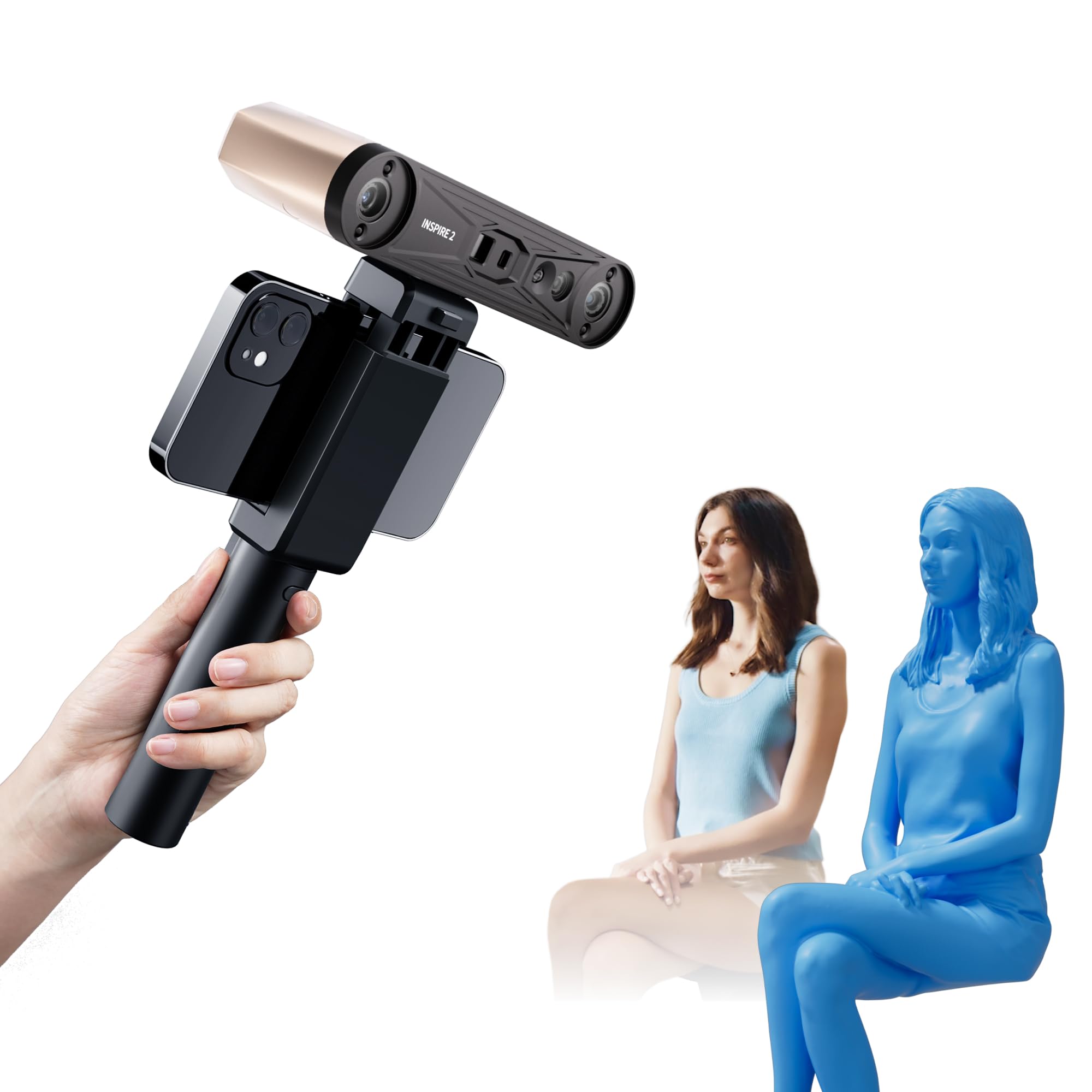
The INSPIRE 2 Premium packs infrared structured light and 11 multi-line lasers into a 190g body, giving you two scanning modes in one device. The structured light mode handles matte surfaces with ease, while the laser mode cuts through reflective and dark objects without spray. The dual-mode flexibility makes it a strong contender for scanning mixed-material small objects like electronic PCBs or painted miniatures.
Its adjustable optical zoom (1.5x and 2x magnification) concentrates the projected light to capture higher surface detail on small items — useful for coins, stamps, or small mechanical parts. The included high-precision calibration board boosts point cloud accuracy by 75%, and the Revo Metro software offers solid post-processing tools. Wireless scanning via WiFi 6 works smoothly with iOS, Android, Windows, and macOS.
Users praise the customer support and the ease of getting a quality color scan on the first attempt. A few note that the calibration dots included in the package do not stay stuck, so consider buying a separate set of high-adhesion markers. The learning curve is moderate — expect a few calibration runs before you dial in the settings.
Why it’s great
- Hybrid structured light + laser handles reflective and dark surfaces without spray
- Optical zoom captures fine detail on very small objects
- Cross-platform wireless scanning (iOS, Android, Win, macOS)
Good to know
- Included calibration dots may need replacing with stronger adhesive markers
- Requires a powerful PC for full-resolution laser mode on Windows
3. EinScan SP V2 Desktop 3D Scanner

The EinScan SP V2 is a desktop turntable-based scanner that achieves 0.05mm single-shot accuracy with a 0.17–0.2mm point distance. It is designed specifically for small objects as tiny as 30mm³, making it one of the best options for jewelry designers, model makers, and engineers who scan mechanical parts. The fixed scan mode with a turntable captures a full 360-degree model in under 45 seconds, and the auto-alignment stitches scans together with minimal manual cleanup.
It exports in OBJ, STL, ASC, PLY, and 3MF — compatible with all major CAD and slicer software. The 1.3MP camera captures decent color textures, though you will want good ambient lighting for color accuracy. The recommended PC spec is relatively modest: i5 Gen8 with 16GB RAM and a GTX 660 or better.
Some users report that shiny surfaces still require baby powder or scanning spray, and the bundled software interface feels dated compared to newer handheld options. The USB connection can be finicky — make sure your USB port delivers stable power. For repeatable, high-accuracy scans of small stationary objects, this desktop unit outperforms many handhelds at a lower price point.
Why it’s great
- 0.05mm accuracy with automated turntable scanning
- Handles objects as small as 30mm³ with good repeatability
- Works with a modest PC and exports to all standard CAD formats
Good to know
- Struggles with shiny surfaces without baby powder or spray
- Software interface is dated; USB connection can be finicky
4. Revopoint POP3 Plus

The POP3 Plus refines the previous generation with 20% more accuracy (0.04mm precision) and a new photolithographic calibration board that keeps the scanner within 20 microns of true dimensions. A 1.5x and 2x optical zoom concentrates the structured light for 30% more point cloud detail on small surfaces — ideal for intricate parts under 50mm. It scans at up to 18fps with a 9-axis IMU that stabilizes shaky handheld movement.
The class 1 infrared light is eye-safe, so you can scan body parts or animals without concern. The free Revo Scan software supports marker tracking, auto-alignment, and exports in PLY, OBJ, STL, ASC, 3MF, GLTF, and FBX. WiFi 6 and USB Type-C connectivity make it compatible with iOS, Android, Windows, and macOS. Revopoint backs it with a 2-year warranty and 24/7 customer support.
Not every user achieves perfect scans out of the box — the learning curve is real, and some find the software buggy on custom PC builds. A few reviews mention that achieving a high-quality scan of a simple object took many attempts. Plan for a practice week before expecting production-ready results.
Why it’s great
- Optical zoom provides 30% more point detail on sub-50mm objects
- Eye-safe infrared allows scanning of people and animals
- Comes with a 2-year warranty and free Revo Scan software
Good to know
- Steep learning curve — requires practice to get reliable results
- Some users report software instability on custom PC configurations
5. Shining 3D Einstar
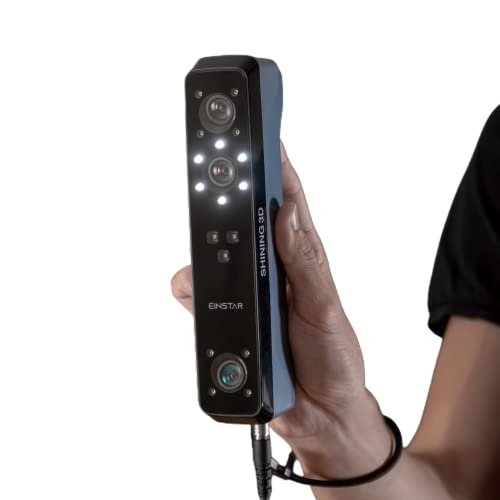
The Einstar uses three infrared VCSEL projectors and two stereo depth cameras to collect high-density point cloud data at 14fps with a 0.1mm point distance. Its built-in Detail-Oriented Enhancement Technology optimizes point cloud data during scanning, which helps capture small features like engraved text or surface wear on a coin. The “Hair Mode” is a unique addition that improves tracking on hair for full-body scans, but the core strength remains small- to medium-object detail.
It connects via a single USB-C cable for both data and power — no separate power supply needed. The EXstar software provides automatic alignment and a data quality indicator that tells you in real time if your scan is good enough. It handles outdoor conditions up to bright shade without losing tracking. Export formats include OBJ, STL, PLY, ASC, 3MF, and P3.
Users consistently rate the tracking reliability higher than similarly priced Revopoint units, especially on dark gray and lightly reflective surfaces. The downside is the larger size (3.08 pounds) compared to sub-200g handhelds, and the lack of an integrated turntable means you must manually rotate small objects. The learning curve is moderate — practice the correct scanning distance and angle before critical projects.
Why it’s great
- Excellent tracking on dark and lightly reflective surfaces without spray
- Detail enhancement and data quality indicators guide better scans in real time
- Single USB-C cable for power and data simplifies setup
Good to know
- Heavier (3.08 lbs) than most handheld competitors
- No integrated turntable — requires manual rotation for small objects
6. EinScan SE V2 Desktop 3D Scanner

The EinScan SE V2 is a stationary desktop scanner with dual-mode scanning — Auto Scan with the turntable for fast capture, and Fixed Scan for detailed single-shot alignment. It delivers <0.1mm single-shot accuracy with a point distance of 0.17–0.2mm, suitable for objects as small as 30mm. The ExScan software handles automatic calibration with one-click scanning and includes post-processing tools like hole-filling and sharpening.
It is plug-and-play compared to most handhelds — place the object on the turntable, press scan, and the software stitches the model in minutes. This makes it ideal for beginners or production scanning of multiple small parts. It exports directly to Sketchfab and most 3D printers via auto-meshing to watertight data.
Some users report that the unit arrives with calibration issues or that the included software is not intuitive for advanced users. A few have received units that appeared used or had loose components inside. The support from Shining 3D is reported as inconsistent. For the price, it is a capable machine but buy from a retailer with a good return policy just in case.
Why it’s great
- One-click turntable scanning requires minimal manual effort
- Automatic calibration and hole-filling simplify post-processing
- Exports watertight meshes ready for direct 3D printing
Good to know
- Some units arrive with calibration or assembly issues
- Customer support response times and quality vary
7. Revopoint INSPIRE 2 Standard
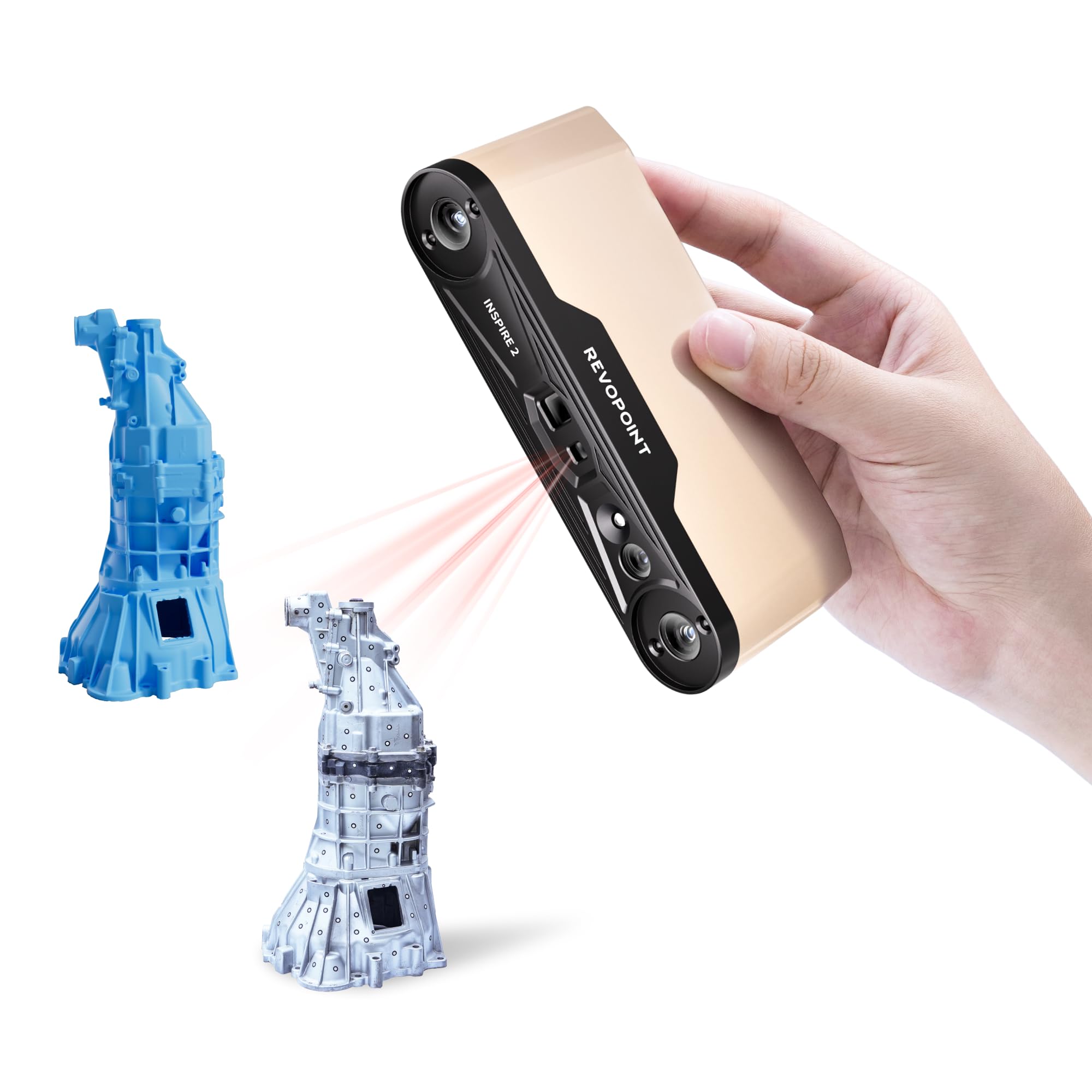
The standard version of the INSPIRE 2 shares the same dual-mode hardware (infrared structured light + 11 multi-line lasers) and 0.03mm precision as the Premium, but comes without the extended accessory package. It is a great entry point into hybrid scanning — you get both structured light for matte objects and laser lines for reflective or dark surfaces in one compact 190g body.
The adjustable optical zoom (1.5x and 2x) is present here too, letting you capture fine detail on small items by concentrating the projected light. The Revo Metro software handles alignment and post-processing, and you can upgrade to Revo Design for scan-to-CAD workflows (paid, Windows only). Wireless scanning via WiFi 6 works with iOS, Android, Windows, and macOS.
Several users report achieving high-quality color scans on the first attempt using default settings, while others hit frustrating software errors on custom PCs with high-end components. The sticky dots for calibration markers are a recurring complaint — most users recommend buying a separate pack of high-adhesion markers. For the price, it is the most capable hybrid scanner under .
Why it’s great
- Hybrid structured light and laser capture reflective/dark objects without spray
- Optical zoom boosts surface detail on sub-30mm objects
- Cross-platform wireless scanning over WiFi 6
Good to know
- Bundled calibration markers have weak adhesive — buy better ones separately
- Occasional software instability on high-end PC builds
8. Shining 3D Einstar Vega

The Einstar Vega is the first true all-in-one wireless 3D scanner in this price range — it packs an 8-core 2.4GHz CPU, 32GB RAM, and a 512GB SSD directly into the handheld unit. You do not need a PC to scan. The bright 6.4-inch 2K AMOLED touchscreen shows real-time previews, and you can save and process data right on the device. It uses VCSEL projectors for fast scanning of medium-to-large objects and MEMS projectors for high-detail scanning of small objects down to 100mm.
HD Mode offers a 100–350mm working distance and up to 15fps capture with 0.1mm-level detail suitable for intricate mechanical parts. It supports 12mm marker alignment for large objects and hybrid alignment for enhanced tracking. The infrared light is safe for eye exposure and handles dark surfaces without spray. You can also screen-cast to a second monitor or transfer data via the SHINING 3D Cloud.
Users find the Vega impressive for a standalone device, but the battery life is limited to around 1 hour of active scanning, which may not be enough for large projects. Like most 3D scanners, it struggles with shiny and transparent objects without spray. A few buyers have reported accuracy issues on certain small, dark plastic objects. For field work or scanning in remote locations without a laptop, it is unmatched.
Why it’s great
- Fully standalone — built-in PC, screen, and storage eliminate need for a laptop
- Dual scanning technology covers small and large objects without configuration
- Wireless screen casting and cloud transfer for remote collaboration
Good to know
- Battery lasts about 1 hour, limiting extended scanning sessions
- Struggles with shiny and transparent surfaces without spray
9. Creality CR-Scan Ferret Pro

The Ferret Pro is Creality’s entry-level wireless scanner, offering 0.1mm accuracy with full-color 24-bit scanning and anti-shake tracking. Weighing only 105g, it is one of the lightest options available — easy to carry and use for extended sessions. It connects to Windows, macOS, Android, and iOS via WiFi 6 or USB, making it incredibly flexible for cross-platform workflows.
The recommended object size range is 50mm to 2000mm, so it can pull small objects like a pen or a toy but struggles with very small or highly detailed items under 30mm. The included kit comes with a WiFi box, tripod, power bank, phone holder, and carrying case — everything you need to start scanning out of the box. It exports in OBJ, STL, and PLY formats.
Users note that the software (especially on mobile) has a steep learning curve and limited functionality compared to the PC version. Black and red objects often fail to scan, and tracking loss is common on the first few sessions. It requires patience and practice, but the build quality and portability make it a strong budget-friendly option for hobbyists.
Why it’s great
- Ultra-light 105g design — fully wireless and portable
- Complete kit includes WiFi box, tripod, and carrying case
- Cross-platform wireless scanning (Win, Mac, iOS, Android)
Good to know
- Struggles with black, red, and highly detailed objects under 30mm
- Mobile software is limited and has a steeper learning curve than PC
10. 3DMakerpro Seal Lite
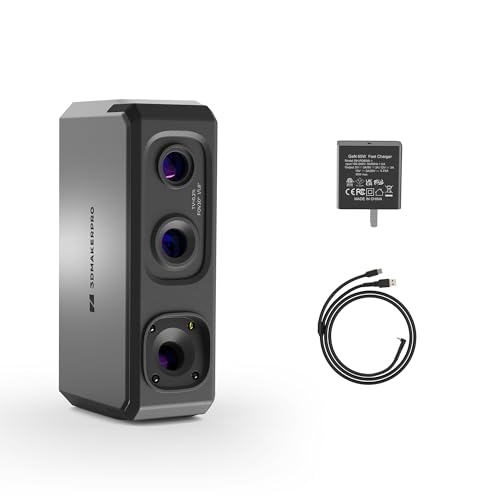
The Seal Lite uses a short-wavelength blue LED light source (400–500nm) to project finer structured light, achieving a stated 0.02mm accuracy on objects 10mm to 300mm. It is specifically designed for small-format scanning with a recommended working distance of 180–280mm. The scan-back and anti-shake features help reduce frame errors from handheld movement, though it only captures mono texture (grayscale, not color).
The free JMStudio software provides visual tracking, error correction, and auto-alignment, with exports in OBJ, STL, PLY, and ASC. It is compatible with both Windows and macOS and offers lifetime free software updates. The package includes the scanner, 65W charger, and data cable. An optional smart grip and turntable can improve stability.
Reviews are split — some call it a quality affordable scanner with solid accuracy after the learning curve, while others find it nearly unusable on black objects, tiny items (like a 0.5-inch flag), and reflective surfaces. The software documentation is sparse, making the initial trial-and-error phase frustrating. It requires a powerful PC and tethered power — it is not portable. For the price, the blue LED accuracy is impressive, but the unit is finicky and best used only on matte, light-colored small objects.
Why it’s great
- Blue LED technology achieves 0.02mm accuracy on small matte objects
- Free JMStudio software with lifetime updates and auto-alignment
- Optimized for objects in the 10–300mm small-format range
Good to know
- Struggles badly with black, shiny, and very small objects
- Documentation is sparse — expect a steep trial-and-error learning curve
- Requires tethered connection to a powerful PC; no wireless mode
11. Matterport Pro3 3D Lidar Camera
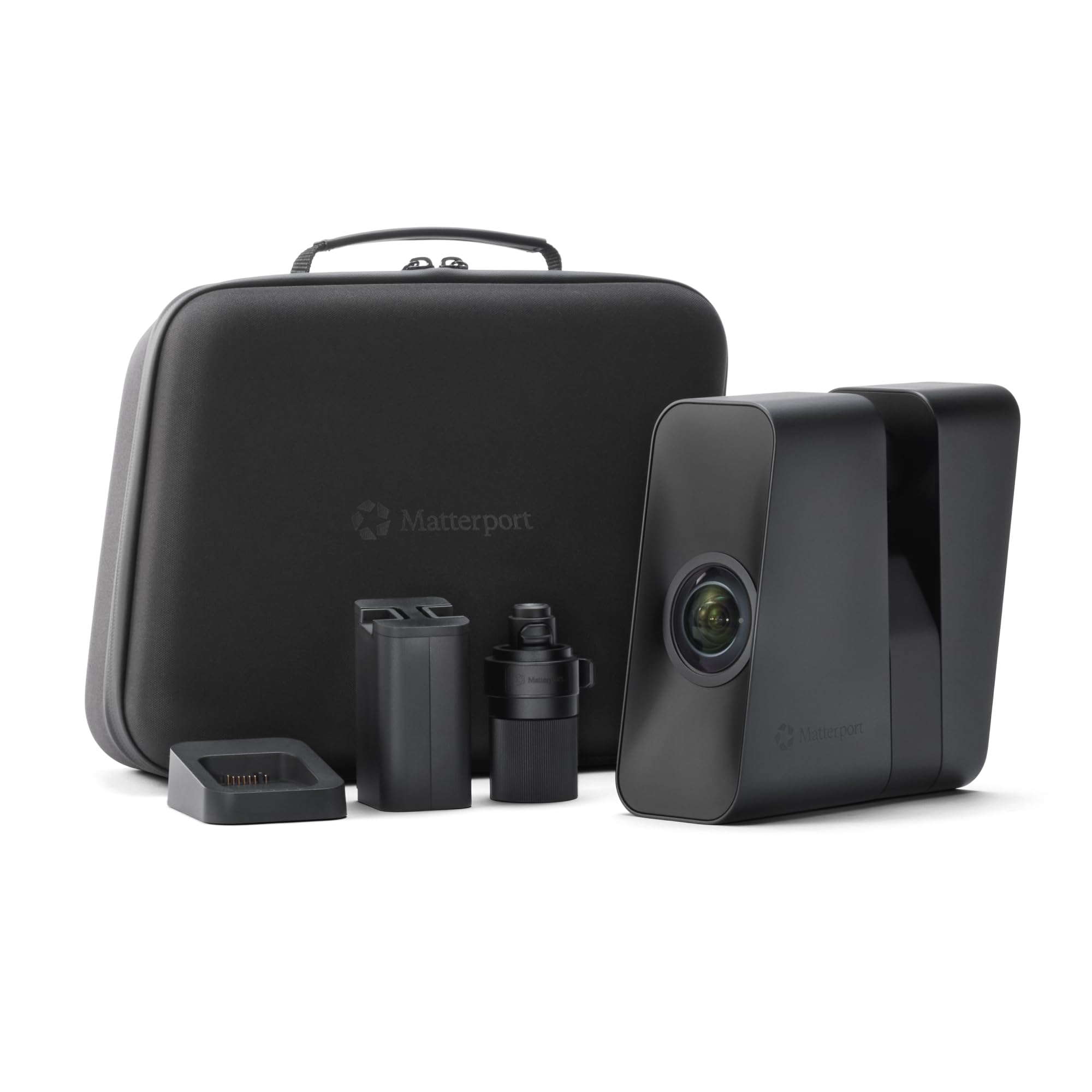
The Matterport Pro3 is not designed for scanning a 30mm gear or a jewelry piece — it is a LiDAR-based camera that captures 360-degree virtual tours of indoor and outdoor spaces up to 100 meters away. It delivers a precision of ±20mm at 10 meters, which is too coarse for small-object detail but perfectly adequate for architecture, real estate, construction documentation, and heritage site preservation.
It completes each 360-degree sweep in under 20 seconds and captures 100K points per second. The removable battery allows continuous scanning as long as you have spare packs. The Pro3 requires a Matterport Professional or Business subscription to unlock full features — it is not compatible with the free tier. A tripod is sold separately.
Users who need architectural-grade scans of rooms, buildings, or large landscapes swear by it — the Pro3 is quieter, faster, and more robust than the previous Pro2. For small-object scanning, however, look elsewhere. This unit is included in the list to provide a clear contrast: the right tool for large spaces is the wrong tool for detailed small-object capture.
Why it’s great
- Unmatched LiDAR range (100m) for large spaces and outdoor scans
- Sweeps in under 20 seconds with high point density (100K pts/sec)
- Professional-grade accuracy (±20mm @10m) for architectural use
Good to know
- Not suitable for scanning small objects under 200mm — detail is too coarse
- Requires paid Matterport subscription for full functionality
FAQ
Can I scan a 10mm object with a handheld 3D scanner?
Why does my 3D scan have holes or missing data?
Do I need a powerful PC to run these scanners?
What is the difference between 0.02mm accuracy and 0.1mm accuracy for small objects?
Final Thoughts: The Verdict
For most users, the best 3d scanner for small objects winner is the Creality CR-Scan Raptor Pro because its 0.02mm volume accuracy and 60fps capture rate set a professional benchmark without requiring a second mortgage. If you want a compact hybrid that handles reflective surfaces without spray, grab the Revopoint INSPIRE 2 Premium. And for precision turntable scanning of tiny mechanical parts where repeatability matters most, nothing beats the EinScan SP V2 Desktop Scanner.