
Our readers keep the lights on and the weekend projects moving. As an Amazon Associate, I earn from qualifying purchases.
The leap to a native or pixel-shifted 4K projection system is the single most transformative upgrade a home theater can make, but the space between a washed-out, pixelated image and a truly cinematic, deep-contrast experience is a minefield of marketing claims. You’re here because you want that big-screen magic without burning your budget on a unit that chokes on fast motion or delivers muddy blacks.
I’m Rikta — the co-founder and writer behind FitlyFast. I’ve spent countless hours cross-referencing ANSI lumen ratings, contrast ratios, laser lifespan data, and real-world input lag figures to separate the true contenders from the overpriced also-rans in this specific price tier.
Whether you prioritize razor-sharp gaming response times, rich HDR color for movie marathons, or a versatile light cannon for multi-purpose rooms, this deep-dive guide to the 4k projector under $2000 will arm you with the knowledge to make a confident, future-proof purchase.
How To Choose The Best 4K Projector Under $2000
Choosing a projector in this competitive bracket requires balancing brightness, contrast, color accuracy, and gaming features against your specific room conditions and viewing habits. Ignore one spec, and you’ll end up with a unit that looks great on paper but disappointing on your wall.
Brightness (Lumens) vs. Ambient Light
The raw lumen count determines how well the image holds up with some lights on, but more isn’t always better. In a dedicated dark theater room, a hyper-bright 3500-lumen unit can wash out black levels and cause eye strain. For living rooms with ambient light, you want at least 2500 ANSI lumens. Look for units that offer a low-power or eco mode to dial down brightness for critical movie viewing.
Light Source: Laser vs. Lamp
Traditional lamp-based projectors (like those in the mid-range) offer a lower upfront cost but require bulb replacements every 3,000–5,000 hours. Laser projectors in this price range typically deliver 20,000–30,000 hours of consistent brightness without degradation. If you plan to use the projector daily for years, the laser premium pays for itself in convenience and eliminates the hassle of buying and installing new lamps.
Contrast and Black Levels
Stated contrast ratios (e.g., 100,000:1) are often marketing numbers measured differently by each brand. What matters is real-world black level performance. DLP projectors with a dynamic iris or laser dimming can create deep blacks, while 3LCD models (like those from Epson) use advanced auto-iris systems to suppress stray light. For the best cinematic experience, prioritize models with a dynamic contrast system or a laser dimming feature.
Gaming Performance: Input Lag and Refresh Rate
If you play competitive games, input lag under 20ms at 4K/60Hz is non-negotiable. Many projectors in this tier offer a “game mode” that disables some image processing to achieve 4-16ms lag times. For fast-paced shooters or racing games, a high refresh rate (120Hz or 240Hz) at 1080p can provide a smoother experience than 4K/60Hz. Make sure the projector has an HDMI 2.0 or 2.1 port to support these higher bandwidths.
Quick Comparison
On smaller screens, swipe sideways to see the full table.
| Model | Category | Best For | Key Spec | Amazon |
|---|---|---|---|---|
| BenQ TK700 | DLP Lamp | Console Gaming | 16ms lag at 4K/60Hz | Amazon |
| NexiGo TriVision Ultra | Tri-LED-Laser | Studio Color Accuracy | 110% BT.2020 color gamut | Amazon |
| Epson 3800 | 3LCD Lamp | Rainbow-Free Viewing | 3,000 Lumens color/white | Amazon |
| Optoma UHZ36 | DLP Laser | Bright Room Cinema | 3,500 ANSI Lumens | Amazon |
| ViewSonic PX701-4K | DLP Lamp | PC Desktop/Sim Racing | 4.2ms lag at 1080p/240Hz | Amazon |
| NEBULA Cosmos 4K SE | LED+Laser | Portable Smart Setup | 1,800 ANSI Lumens | Amazon |
| BenQ TK710 | DLP Laser | Living Room Gaming | 4ms lag at 1080p/240Hz | Amazon |
| ViewSonic LS901-4K | DLP Laser | Large Venue (150”+) | 5,500 ANSI Lumens | Amazon |
| LG HU810PW | Dual Laser | Smart TV Integration | 97% DCI-P3 Color | Amazon |
| Valerion VisionMaster Pro2 | Triple Laser | High-End Cinema | 15,000:1 Native Contrast | Amazon |
| Epson LS11000 | 3LCD Laser | Ultimate Contrast/Blacks | 1,200,000:1 Dynamic Contrast | Amazon |
In‑Depth Reviews
1. BenQ TK710

The BenQ TK710 bridges the gap between fast-paced gaming and serious home cinema with a durable laser light source rated for thousands of hours. Its 3200 ANSI lumens punch through ambient light in a living room, while the 4ms response time at 1080p/240Hz makes it a genuine competitor for competitive console and PC gaming. The unit also features a 1.3x optical zoom and vertical lens shift, rare at this price, giving you far more installation flexibility than most fixed-lens gaming projectors.
HDR performance is handled via HDR10 and HLG support, and BenQ’s Dynamic Function rapidly adjusts the laser output to improve perceived contrast in dark scenes. Owners upgrading from older lamp-based BenQ models consistently praise the immediate jump in brightness and color vibrance, noting the image is sharp and text remains readable even at larger throw distances. The grey/white chassis looks clean in a media room or on a mobile cart.
Potential drawbacks include a standard-throw lens that requires about 8 feet for a 100-inch image, so it won’t fit tight spaces. The touch control panel on the unit can be finicky, and the speaker is basic—plan to use an external audio system. For the gamer who also wants a capable movie-watching machine, this is the laser-powered sweet spot in the mid-premium tier.
Why it’s great
- Sub-5ms lag at 1080p/240Hz ideal for fast shooters
- Laser source eliminates lamp replacement for the life of the unit
- Vertical lens shift and 1.3x zoom make installation forgiving
Good to know
- Standard throw requires more distance than short-throw alternatives
- Built-in speaker is weak; external sound is necessary
- No built-in smart OS—you’ll need a streaming stick or console
2. NexiGo TriVision Ultra

The NexiGo TriVision Ultra is a standout for color purists, using a unique Tri-LED-Laser hybrid engine that achieves 110% of the BT.2020 color space with no laser speckle. Each unit ships with a factory color calibration report showing a Delta E of less than 1, meaning the colors you see are virtually identical to the source. It supports Dolby Vision, HDR10+, and HLG, and with a 100,000:1 dynamic contrast from its Full Fade to Black feature, it delivers deep, cinematic blacks in dark scenes.
Gamers aren’t left out—the TriVision Ultra offers a 4.2ms to 8ms input lag range and supports 4K at 120Hz input through its three HDMI 2.1 ports, making it one of the most future-proofed options at this level. The built-in 30W speakers with Dolby Audio and DTS Virtual:X produce genuinely immersive sound without an external bar for casual viewing. The hidden Fire TV storage slot in the chassis is a thoughtful touch for keeping setups clean.
On the downside, the 2600 ANSI lumens may feel a bit dim compared to high-lumen competition if used in a very bright room. Some users report that the auto focus can leave the outer corners slightly softer than the center, although manual adjustment usually corrects this. It’s a premium, portable unit that rewards those who value color fidelity above raw brightness.
Why it’s great
- Factory-calibrated Delta E < 1 for true-to-source color
- Dolby Vision & HDR10+ support with Full Fade to Black
- Low input lag and 4K@120Hz via HDMI 2.1
Good to know
- Brightness is adequate but not a light cannon for very sunny rooms
- Auto-focus can have slight edge softness on first run
- Premium price positions it at the high end of the bracket
3. Epson Home Cinema 3800

The Epson Home Cinema 3800 is the champion for viewers sensitive to the rainbow effect (RBE) common on single-chip DLP projectors. Its 3LCD 3-chip design displays 100% of the RGB color signal simultaneously, delivering smooth, artifact-free images. The pixel-shifting 4K PRO-UHD system is remarkably effective—many owners with 150-inch screens report that the image is indistinguishable from native 4K, with excellent detail and no visible screen-door effect.
With 3000 lumens of both color and white brightness and a 100,000:1 dynamic contrast ratio via its auto-iris, the 3800 excels in rooms with some ambient light while maintaining deep black levels in a dark theater. It also supports 18 Gbps HDMI 2.0 for full 4:4:4 color at 60Hz, built-in 10W stereo speakers for basic audio, and active 3D playback for those who still enjoy that format.
The primary trade-off is size and noise—this is a large lamp-based unit, and the dynamic iris can be audible during quiet scenes. Some units have arrived with minor cosmetic imperfections (lens scratches or dust specs), though Epson’s customer support is generally responsive. If you prioritize a natural, rainbow-free image and a proven 3LCD color engine, the 3800 remains a benchmark at this price.
Why it’s great
- Zero rainbow effect thanks to 3LCD 3-chip design
- Deep, film-like blacks with dynamic auto-iris
- High color and white brightness handle ambient light well
Good to know
- Large chassis requires substantial shelf or ceiling space
- Auto-iris and lamp fan produce noticeable noise
- Lamp-based, so you’ll need to replace the bulb every few years
4. Optoma UHZ36
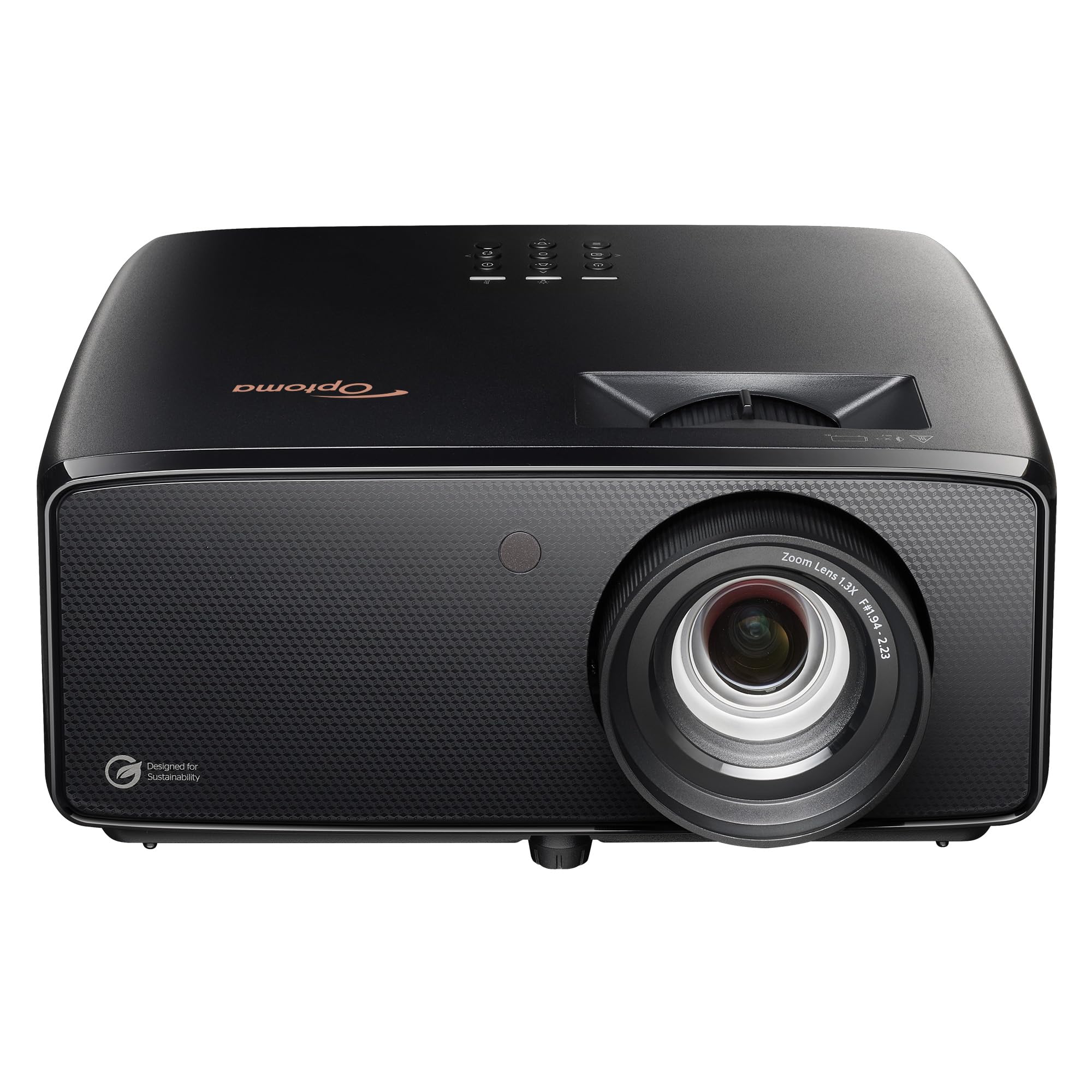
The Optoma UHZ36 is a laser-powered DLP unit built to deliver a blindingly bright image—3,500 ANSI lumens—making it a top choice for rooms where you can’t black out all the windows. Its 1,500,000:1 dynamic contrast ratio (achieved through laser dimming) allows it to produce surprisingly deep blacks for a high-lumen projector, and it features a dedicated Filmmaker Mode that preserves the director’s original color grading and frame rate without extra processing.
Owners upgrading from older Epson or Optoma models consistently praise the clarity, sharpness, and excellent shadow detail. The physical setup is straightforward with a manual keystone and a solid, professional build quality.
Weaknesses include a lack of built-in smart streaming—you’ll need an external device for Netflix or Disney+—and the sound is poor, making an external audio system a requirement. A few owners have reported random HDMI connection drops, though this may be unit-specific. For the buyer who needs a reliable, maintenance-free laser projector with extreme brightness for flexible room conditions, the UHZ36 delivers fantastic value.
Why it’s great
- 3500 ANSI lumens deliver a usable image in bright ambient light
- 30,000-hour laser source means zero lamp replacements
- Filmmaker Mode offers accurate, director-intended color
Good to know
- No built-in smart OS—requires external streaming hardware
- Poor built-in speaker; external sound is necessary
- Some units have HDMI handshake issues under certain conditions
5. ViewSonic PX701-4K

The ViewSonic PX701-4K has become a community favorite for hitting a remarkable balance of brightness, low latency, and affordability—all without sacrificing usable features like auto keystone and 4-corner adjustment. With 3,200 ANSI lumens and a 240Hz refresh rate at 1080p, it works equally well as a home theater projector and as a competitive gaming monitor substitute. The 4.2ms input lag at 1080p/240Hz is genuinely impressive for this class.
The image quality is detailed and punchy, especially with HDR content, thanks to SuperColor technology that expands the color gamut. The flexible installation options—1.1x optical zoom, H/V keystone, and curved screen support—make it forgiving for non-expert setups. Owners who have used it for 3+ years report it still performs flawlessly, which is a strong reliability indicator for a lamp-based projector.
Be aware that the lamp life rating is generous; some owners have reported needing a replacement after 1.5-2 years of heavy use. The built-in speaker is weak, and the remote feels dated. However, at its price point, the PX701-4K punches so far above its weight that it remains the default recommendation for anyone seeking a do-it-all 4K projector without stretching their budget into laser territory.
Why it’s great
- Exceptionally low 4.2ms input lag perfect for competitive gaming
- 3200 lumens and SuperColor produce a bright, vibrant image
- Flexible auto keystone and 4-corner adjustment ease setup
Good to know
- Lamp-based—bulb life may be shorter than advertised under heavy use
- Built-in speaker is underpowered for movie immersion
- Remote control feels low-quality compared to competitors
6. NEBULA Cosmos 4K SE

The NEBULA Cosmos 4K SE is a compact hybrid LED-laser projector designed for maximum out-of-the-box convenience. It runs Google TV with native 4K Netflix support, so you can start streaming immediately without an external stick. The IEA 4.0 intelligent setup handles autofocus, keystone, obstacle avoidance, and screen fit in seconds, making it the easiest projector to set up for users who don’t want to fiddle with manual adjustments. Dolby Vision support is a major plus at this level.
With 1,800 ANSI lumens and HybridBeam technology, the image is bright enough for a dimly lit living room or a bedroom. Owners consistently praise the sharpness and color quality, noting that the laser engine’s 50,000-hour lifespan eliminates long-term maintenance worries. The built-in Anker-tuned speakers provide surprisingly good audio, and the form factor is genuinely portable.
Brightness is the main compromise—1,800 lumens is not enough for a fully lit room or a very large screen (best kept to 100-120 inches). The single HDMI port can be limiting if you want to connect a soundbar and a gaming console simultaneously. It’s also not optimized for serious competitive gaming due to higher input lag. For the user who values a compact, smart, hassle-free 4K movie experience, this is an excellent choice.
Why it’s great
- Built-in Google TV with native 4K Netflix for instant streaming
- Hybrid LED-Laser source rated for 50,000 hours
- Auto-everything setup (focus, keystone, screen fit) works brilliantly
Good to know
- 1800 lumens limit screen size and ambient light tolerance
- Only one HDMI port restricts multi-device setups
- Not a gaming-first projector due to higher input lag
7. BenQ TK700

The BenQ TK700 is purpose-built for console gaming, offering a 16ms input lag at native 4K/60Hz that feels responsive and snappy. It projects a 100-inch image from just 8.2 feet, making it a strong standard-throw option for gamers with a dedicated space. The 3,200 lumens HLG brightness ensures you can see every detail even with some ambient light, and it includes Dolby Atmos passthrough for immersive audio when paired with an eARC-compatible soundbar.
Image quality is crisp and clear from the native 4K DLP chip, with good HDR handling that brings out detail in both bright highlights and dark shadows. Owners who have ceiling-mounted the TK700 and paired it with a PS5 or RTX GPU report a night-and-day improvement over previous 1080p projectors, with no visible blur during fast motion. The white chassis blends into most media environments easily.
The main reliability concern is that some owners have reported dead pixels developing after 3 years of use, and BenQ’s support can be inconsistent for out-of-warranty issues. The menu system is also dated and the manual setup is cumbersome for non-tech-savvy users. For a serious console gamer who wants a crisp, low-lag 4K image today, the TK700 delivers—just be aware of its long-term durability track record.
Why it’s great
- Fast 16ms input lag ensures responsive console gaming
- Short 8.2ft throw distance for a 100-inch image
- Bright 3200 lumens maintain visibility in ambient light
Good to know
- Potential reliability concerns after 2-3 years of heavy use
- Manual keystone required for non-flat installations
- Menu system is dated and not user-friendly
8. ViewSonic LS901-4K

The ViewSonic LS901-4K is a specialty unit for buyers who absolutely need extreme brightness—5,500 ANSI lumens—from a laser source. This projector is equally at home in a large living room, a church sanctuary, or a commercial simulation setup (it includes a dedicated Golf Mode). It offers a 1.7x optical zoom, 360-degree projection capability, and a 21:9 aspect ratio for ultra-wide cinematic content or simulators. The 3,000,000:1 dynamic contrast ratio keeps black levels respectable despite the massive lumen output.
Gamers will appreciate the 4.2ms input lag at 1080p/240Hz, and the 4K image is sharp and bright even on screen sizes up to 150 inches. The SuperColor engine handles HDR/HLG content well, and the 1.7x zoom gives you a huge range of placement options—you can get a 100-inch image from anywhere between 7 and 13.1 feet. Owners using it with golf simulators and on 240-inch outdoor screens are uniformly impressed.
It does not have a built-in smart platform, so you’ll need a streaming device or PC. The unit is also heavy and large, designed for permanent installation rather than portability. A few owners note it requires more manual calibration than average to get the picture perfectly dialed in. For the niche user who needs a light cannon with laser reliability and low latency, the LS901-4K is a hidden gem.
Why it’s great
- Massive 5500 lumens punch through any ambient light
- 1.7x optical zoom and 360-degree rotation for flexible placement
- Dedicated Golf Mode and ultra-wide 21:9 support
Good to know
- No built-in smart features require external streaming
- Large, heavy chassis is not portable
- Manual calibration needed for optimal image quality
9. LG HU810PW

The LG HU810PW stands out with its Dual Laser light engine that achieves 97% of the DCI-P3 color gamut, delivering rich, cinematic colors without the speckle artifacts some single-laser DLP units produce. It runs LG’s webOS 5.0 smart platform, giving you access to streaming apps without an external dongle. The 2,000,000:1 contrast ratio, combined with Dynamic Tone Mapping, handles HDR10 and HLG content with impressive brightness control that preserves shadow detail and highlight punch simultaneously.
The physical design is clean and the motorized lens shift is a significant convenience for precise alignment without moving the whole projector. Owners report the fan noise is pleasantly low, which is critical for a living room or bedroom where silence matters. Image quality remains consistent well past 6,000 hours of use, confirming the laser source’s longevity advantage over lamps. AirPlay 2 and Miracast make wireless casting effortless for Apple users.
Input lag is a substantial weakness—around 50ms at 4K/60Hz—making it a poor choice for any action gaming. Additionally, some owners have reported dead or stuck pixels appearing after the first year, and LG’s warranty support can be frustrating to navigate. Keystone correction also degrades image quality, so it’s best used with a perfectly aligned placement. For the movie and TV enthusiast who prioritizes color and ease of use over gaming, it’s a strong smart option.
Why it’s great
- 97% DCI-P3 coverage produces vibrant, movie-like color
- Smart webOS 5.0 with AirPlay 2 for easy streaming
- Motorized lens shift allows precise image alignment
Good to know
- High 50ms input lag makes it unsuitable for gaming
- Potential stuck pixel issues reported after 1-2 years
- Keystone adjustment reduces picture quality
10. Valerion VisionMaster Pro2

The Valerion VisionMaster Pro2 is a triple-laser RGB projector that pushes well beyond typical mid-range expectations. Its 15,000:1 native contrast ratio (enhanced with EBL technology) delivers deep, inky blacks that rival higher-end JVC and Sony models, and its 110% Rec.2020 color gamut coverage is among the widest available at any price. Every unit is ISF-certified for color accuracy, and it supports Dolby Vision and HDR10+ with Dynamic Tone Mapping for per-frame HDR optimization. The 0.9-1.5x optical zoom (OpticFlex Lens System) offers excellent placement freedom.
Gamers get a 4ms input lag mode at 1080p/240Hz support, along with custom picture modes for FPS, RPG, and RCG genres. The built-in Google TV+ interface is snappy thanks to the AI-SoC MT9618 chipset with 4GB RAM and 128GB storage—no lag in menu navigation. Owners transitioning from older Epson 5040UB or BenQ models universally describe the picture as “stunning” and “reference-grade,” with particularly strong HDR brightness that rivals high-end OLED TVs in a dark room.
The major catch is that this projector pushes the upper boundary of the under-$2000 budget. It requires a longer throw distance than some alternatives, and the fan noise is noticeable during quiet scenes (though quieter than many lamp-based units). The included Google TV remote is decent, but the projector settings menu is somewhat buried. For the absolute best picture quality under $2000—especially for movies and HDR content—this is the new standard.
Why it’s great
- 15,000:1 native contrast delivers elite black levels
- 110% Rec.2020 coverage with ISF calibration out of the box
- Low 4ms lag and 240Hz refresh for serious gaming
Good to know
- Priced at the very top of the under-$2000 bracket
- Requires careful physical alignment for best image
- Fan noise is present during action-heavy scenes
11. Epson LS11000

The Epson LS11000 is the ultimate expression of 3LCD laser projection, offering a dynamic contrast ratio exceeding 1,200,000:1 through its advanced Laser Array Light Source and Precision Shift Glass Plate technology. It delivers 3840 x 2160 resolution via pixel shifting, but the image quality—especially in terms of deep blacks, shadow detail, and HDR performance—rivals many native 4K projectors. The motorized lens with 4-way lens shift, zoom, and focus makes installation a breeze for any room configuration.
It handles HDR with aplomb, supporting HDR10+ and HLG with real-time 16-step HDR curve adjustment, allowing you to fine-tune brightness on a per-scene basis. The 120Hz refresh rate and 18 Gbps HDMI 2.1 compatibility make it a strong performer for casual gaming, though input lag isn’t advertised at competitive levels. Owners upgrading from the Epson 5050UB or 3800 describe a massive leap in brightness, contrast, and color uniformity, with no screen-door effect even on 150-inch screens.
The main limitation is brightness—at 2,500 lumens, it’s optimized for a dedicated dark theater room rather than a bright living space. Some units have experienced “snow” on startup or HDMI handshake issues, and the laser array, while rated for 20,000 hours, may not match the lifespan of competitors’ laser units. It also lacks 3D processing. For the dedicated home theater enthusiast who wants the best image quality for movies in a controlled environment, the LS11000 is the top-tier choice if you can stretch the budget slightly.
Why it’s great
- Over 1,200,000:1 dynamic contrast for extraordinary black levels
- Motorized 4-way lens shift and zoom for perfect placement
- Real-time HDR curve adjustment optimizes every scene
Good to know
- 2500 lumens favor a dark theater room over a bright living room
- Some units have HDMI handshake or startup “snow” issues
- No 3D support and laser life lower than some competitors
FAQ
Do I need a screen for a 4K projector under $2000?
What is rainbow effect and which projectors avoid it?
Should I buy a lamp or laser projector for long-term use?
Can I connect a soundbar to these projectors?
How do I calculate the right throw distance for my room?
Final Thoughts: The Verdict
For most users, the 4k projector under $2000 winner is the ViewSonic PX701-4K because it delivers an unbeatable combination of high brightness, ultra-low input lag for gaming, and flexible setup features at a price that leaves room for a quality screen. If you demand the absolute best picture quality for HDR movie viewing and have a dedicated dark room, grab the Valerion VisionMaster Pro2 for its elite contrast and color accuracy. And for a zero-hassle, portable smart projector that streams out of the box, nothing beats the NEBULA Cosmos 4K SE.