
Our readers keep the lights on and the weekend projects moving. As an Amazon Associate, I earn from qualifying purchases.
The catch? The ”360-degree” claim is where most antennas fail, either by requiring a motorized rotator or by dropping fringe VHF signals from your most-watched network. The best 360-degree outdoor TV antenna must deliver true omnidirectional reception without sacrificing gain on either UHF or VHF bands, so you don’t spend every stormy night readjusting aim.
I’m Rikta — the co-founder and writer behind FitlyFast. I’ve spent hundreds of hours isolating the critical specs that separate a real 360-degree antenna from a 360-degree rotator, comparing amplifier gain, LTE/5G filtering, and weather sealing across dozens of models to help you cut the cord for good.
A true omnidirectional antenna eliminates the need for climbing, pointing, or motorized guessing games—and after analyzing build quality, range claims versus real-world reception, and channel counts from verified buyers, I’ve narrowed the field to the seven models that define the best 360 degree outdoor tv antenna for every home and budget.
How To Choose The Best 360 Degree Outdoor TV Antenna
Not every antenna that claims ”360-degree” delivers the same experience. The real difference comes down to whether the antenna uses a true omnidirectional element design or relies on a motorized rotator to spin toward the signal source. Understanding the following factors will help you buy an antenna that works from day one without constant adjustments.
True Omnidirectional vs. Motorized 360° Rotation
A true omnidirectional antenna uses a fixed-element array that captures signals from every direction simultaneously. These models have no moving parts, meaning less wear, no motor noise, and immediate channel acquisition. A motorized 360° antenna uses a single directional element mounted on a rotating base. It requires a remote control and manual adjustment to find each station. For viewers receiving signals from multiple towers at different compass points, a true omnidirectional design is far more convenient. If all your local towers cluster in one direction, a motorized rotator can work fine, but you’ll still be climbing down to fine-tune when the wind shifts a branch.
UHF vs. VHF Reception
Most local broadcasters transmit on UHF (channels 14–36) or VHF (channels 2–13). Many 360-degree antennas are optimized for UHF and either neglect VHF-Hi (7–13) or completely ignore VHF-Lo (2–6). If your favorite network affiliate broadcasts on channel 7 or 11, a UHF-only antenna will leave you with a blank screen. Check the product specification for UHF (470–860 MHz) and VHF (170–230 MHz) coverage. The best models explicitly support both bands.
Amplification, Filtering, and Range Reality
An amplifier can help compensate for signal loss over long cable runs and splitters, but excessive gain can overload your TV tuner and cause pixelation. Look for an amplifier with intelligent gain control, such as Televes’ TForce system, that adjusts amplification based on real-time signal strength. Also crucial is LTE/5G filtering. Without it, cellular interference can wipe out UHF channels. As for range, ignore 150- or 200-mile claims. Real-world reception depends on line-of-sight, local terrain, tower power, and obstacles. Expect stable reception from 30 to 60 miles under typical conditions. A 50-mile-rated antenna from a reputable brand like Channel Master or Televes often outperforms a 200-mile-rated budget model.
Quick Comparison
On smaller screens, swipe sideways to see the full table.
| Model | Category | Best For | Key Spec | Amazon |
|---|---|---|---|---|
| Televes DiNova Boss Mix | Premium | Long-range fringe reception with intelligent gain | 34 dBi UHF / 29 dBi VHF gain | Amazon |
| Channel Master Omni+ 50 | Mid-Range | True 360° omni for urban/suburban use | 50+ mile true omni range | Amazon |
| Five Star 200 Mile Antenna | Mid-Range | Budget-friendly multi-directional with J-pole | 200-mile long-range claimed | Amazon |
| CeKay Motorized 150-Mile | Budget | Remote-controlled motorized rotation | 150-mile long-range claimed | Amazon |
| Yeceny 200 Mile 360° Rotator | Budget | Value motorized rotator with long coax | 150-mile real range (packaging) | Amazon |
| 1byone Omni-Directional 100+ Mile | Budget | Compact stick design for attic/RV | 100+ mile claimed | Amazon |
| Winegard A3-2000 Air 360 | Budget | RV/motorhome dome replacement | 50-ohm impedance dome | Amazon |
In‑Depth Reviews
1. Televes DiNova Boss Mix 144286

The Televes DiNova Boss Mix is a directional Yagi-style antenna with a 360-degree signal-clearing capability thanks to its TForce intelligent gain control, which automatically adjusts amplification per band (29 dBi on High VHF, 34 dBi on UHF) to prevent overload while maximizing weak-signal capture. Its integrated FM/LTE/4G/5G filtering removes the cellular noise that plagues most suburban UHF channels, and the weather-resistant ABS radome with Zamak mounting hardware makes it suitable for attic, rooftop, or pole installation without any assembly required.
Verified buyers consistently report that this Televes picks up distant network affiliates — one received a CBS affiliate 90 miles away with a clear picture — and the low-profile white housing passes the spouse-acceptance test for HOA-governed neighborhoods. The dual-output power inserter allows you to run the amplifier from inside your home and maintain a passive signal path if the power is interrupted.
One caveat: the 50-mile official range rating is conservative for a directional that can actually pull 60+ miles under favorable conditions, but its directional nature means you’ll need to aim it at the tower cluster once. For a home willing to invest in maximum reception quality with premium filtering, this is the benchmark.
Why it’s great
- Intelligent gain control prevents signal overload and weak-signal dropouts automatically
- Integrated 5G/LTE/4G filtering ensures UHF channel clarity where cellular towers crowd the spectrum
- Robust all-weather radome with no assembly required — just mount and aim
Good to know
- Directional design requires a one-time aim toward the broadcast towers
- Official range is 50 miles, though real-world reports exceed it
- Premium price reflects Spanish engineering and high-end components
2. Channel Master Omni+ 50

The Channel Master Omni+ 50 is one of the few antennas in this category that delivers true 360-degree omnidirectional reception without a motor — its fixed-element array uses separate UHF (omnidirectional) and VHF (adjustable dipole) components to capture signals from all compass points simultaneously. Built with a 75-ohm impedance and a weather-tight black housing, it ships with a mounting bracket for wall, mast, or satellite-dish pole attachment, making it equally at home on a roof, attic, or RV.
Verified owners in metropolitan areas report signal strength improvements from 60% to 95% and a significant reduction in pixelation during storms. The design is lightweight (about 2.7 pounds) and relatively compact, so it doesn’t dominate the roofline like a traditional Yagi. It also handles VHF-Low effectively, pulling in channel 13 and other difficult frequencies that many omni antennas miss.
The 50-mile official range is realistic for flat suburban terrain; it’s not designed for fringe rural areas beyond 35 miles. If you need to split the signal to a second TV, you can add a preamplifier, but the base unit works best as a single-TV solution in medium-range signal zones.
Why it’s great
- True 360° omnidirectional reception with no motor or remote needed
- Effective VHF-Low performance for channels 2–6, rarely matched by competitors
- Easy 15-minute assembly and mounting with included bracket
Good to know
- 50-mile max range limits its utility in deep rural or fringe zones
- Does not include a preamplifier; may need one for long cable runs or splitters
- Mast not included in the box
3. Five Star 200 Mile Outdoor HDTV Antenna

The Five Star 200 Mile Antenna is a multi-directional (not fully omnidirectional) design that uses an elongated, 46-inch element array to capture signals from multiple directions with a claimed 200-mile range. It comes packed with installation hardware: a J-pole mount, bracket, TV splitter, and 40 feet of RG6 coax, making it one of the most complete kits in the mid-range tier. It is ATSC 3.0 (NextGen TV) ready, which future-proofs it for the next generation of over-the-air broadcasts.
Real-world reception from verified buyers shows that the 200-mile claim is aggressive. Users 45 miles from the towers with significant mountain obstructions still pulled in 60+ channels, including lower-power stations. The extended element length provides notably stronger VHF reception than shorter omni designs. The splitter supports up to 4 TVs, though signal degradation on long cable runs (e.g., 175 feet) was noted for weaker stations.
The antenna is fairly large (46 x 28 x 25 inches) and requires clear line of sight in at least one main direction. Assembly is straightforward but the instructions can be unclear regarding the VHF vibrator alignment. For cord-cutters on a tighter budget who want a complete kit with ATSC 3.0 readiness, it’s a strong contender.
Why it’s great
- Complete kit with J-pole, splitter, and coax reduces hidden installation costs
- ATSC 3.0 ready for future-proofing against next-gen broadcasts
- Extended 46-inch element length delivers robust VHF reception from 45+ miles
Good to know
- Multi-directional, not true omni — you still choose a primary aim
- Bulky size may be obtrusive on smaller rooflines
- Assembly instructions lack clarity on element alignment
4. CeKay Motorized 150-Mile HD TV Antenna
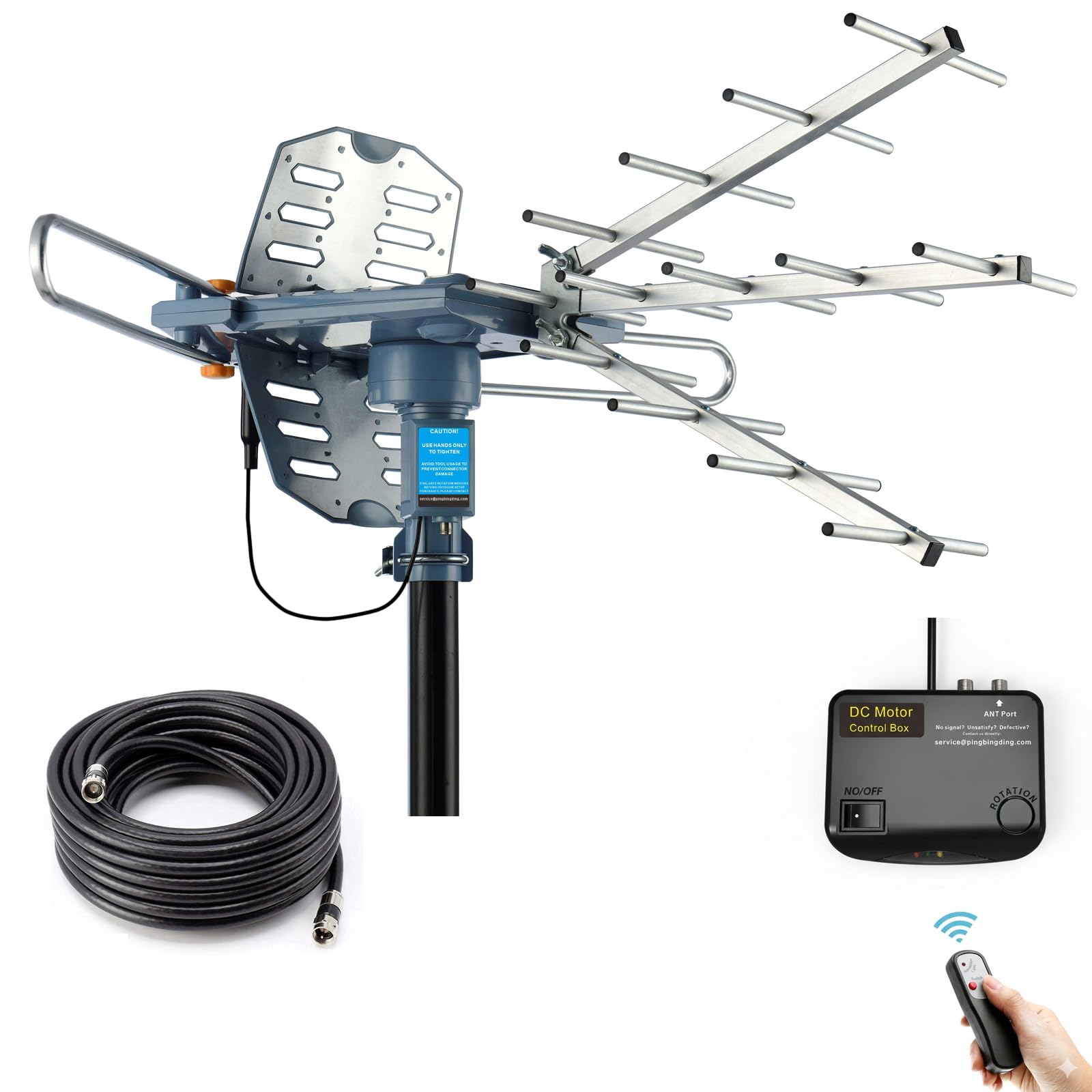
The CeKay Motorized antenna uses a DC motor and wireless remote to rotate a single directional element 360 degrees, letting you steer toward the strongest signal from the comfort of your couch. The included 40-foot RG6 cable is sufficient for most attic and roof installations, and the built-in low-noise amplifier (LNA) boosts UHF and VHF signals into the tuner. The design includes a non-tangling cable arrangement, which solves a common complaint of older motorized antennas that would wrap the coax around the mast.
Verified owners within 50 miles of broadcast towers report receiving 70–79 channels with clear HD picture quality, including some stations that were previously unscannable with fixed antennas. The remote gives you instant left/right control, and the control box is compact enough to mount near your TV. Splitter placement is critical — the amplifier must feed the first splitter, not the other way around.
The imprecise direction control (it rotates in coarse steps rather than continuous fine increments) means you may need to use a smartphone Facetime call to someone watching the TV while you rotate. The auto-rotate feature is also absent, so you’ll need to manually re-find each station. It’s a practical solution for homes where all towers aren’t in a single cluster, but not as effortless as true omni.
Why it’s great
- Wireless remote lets you rotate the antenna without climbing onto the roof
- Non-tangling cable system keeps the coax clean during rotation
- Strong channel count (70+) in suburban zones at 50-mile range
Good to know
- Motorized rotation only covers one direction at a time — not true omnidirectional
- Direction control is coarse, making fine adjustments tedious
- The amplifier must be placed before any splitters for proper function
5. Yeceny 200 Mile 360° Rotator Antenna

The Yeceny antenna is the most affordable motorized 360-degree model in this lineup, bundling a wireless remote, a 60-foot RG6 coaxial cable, and a rotator base for around the entry-level price point. It supports dual TV output via a built-in splitter, saving you from buying an additional component. The antenna itself is silver-finished plastic with snap-on elements that require no tools — a 30-minute assembly is typical.
User experiences are mixed but informative. Many report excellent reception of 40–80 channels once the direction is dialed in, with a clear picture and no pixelation. However, the 200-mile claim is contradicted by the packaging, which reads “150+ miles,” eroding trust. The control box is also a weak point: some units ship with a defective motor controller (red light but no rotation), and the lack of a direct manufacturer contact number on Amazon makes warranty support uncertain. A failing control box can leave you with a fixed-direction antenna.
The plastic build feels cheap to the touch but has survived several seasons in moderate climates according to users. For extreme bargain hunters who are willing to replace the control box if necessary, it can work; but the reliability concerns push it down the list for anyone who wants a set-and-forget installation.
Why it’s great
- Lowest entry price among motorized 360 antennas in this comparison
- Includes 60ft RG6 coax, longer than most budget kits provide
- Dual TV output without needing a separate splitter
Good to know
- Control box quality is inconsistent — some units fail within weeks
- Range claim conflicts: Amazon says 200 miles, packaging says 150 miles
- Plastic construction feels less durable than metal alternatives
6. 1byone Omni-Directional 100+ Mile Antenna

The 1byone Omni is a small, white stick-style antenna designed for true 360-degree omnidirectional reception without a motor. Its “Smart pass” amplifier technology claims to improve signal reliability in windy or rainy weather, while the built-in 4G/LTE filter blocks mobile network interference. The unit includes a 39-foot RG6U cable and is marketed for outdoor, attic, and RV use, with a two-year manufacturer warranty that is rare in this price tier.
User reception is highly location-dependent. In urban areas like Manhattan, it pulled in 60+ channels after a quick 15-minute scan, including CBS, NBC, FOX, PBS, though ABC was missing. In suburban zones, placement near a window facing the broadcast towers was critical, with some users catching 28 channels inside and 58 after moving near a window. The amplifier is best used when the cable run exceeds 20 feet; for short runs, it can overload the tuner.
A significant reliability concern: two years of outdoor use in Reno led to water ingress that flooded the preamp and corroded the RF connector. The seam and screw holes are not sealed from the factory, so DIY weatherproofing with silicone caulk is advisable if you mount it outdoors. For attic or indoor mounting, this is a compact, effortless solution. For exposed outdoor use, plan on adding sealant.
Why it’s great
- True omnidirectional stick design — no motor, no remote, no rotation needed
- Two-year warranty provides peace of mind that budget models often lack
- Compact white profile blends well on an attic beam or RV ladder
Good to know
- Not weather-sealed from the factory — water ingress can kill the preamp outdoors
- Range varies dramatically by placement; interior window placement works best
- Supports only one TV without an aftermarket splitter
7. Winegard A3-2000 Air 360
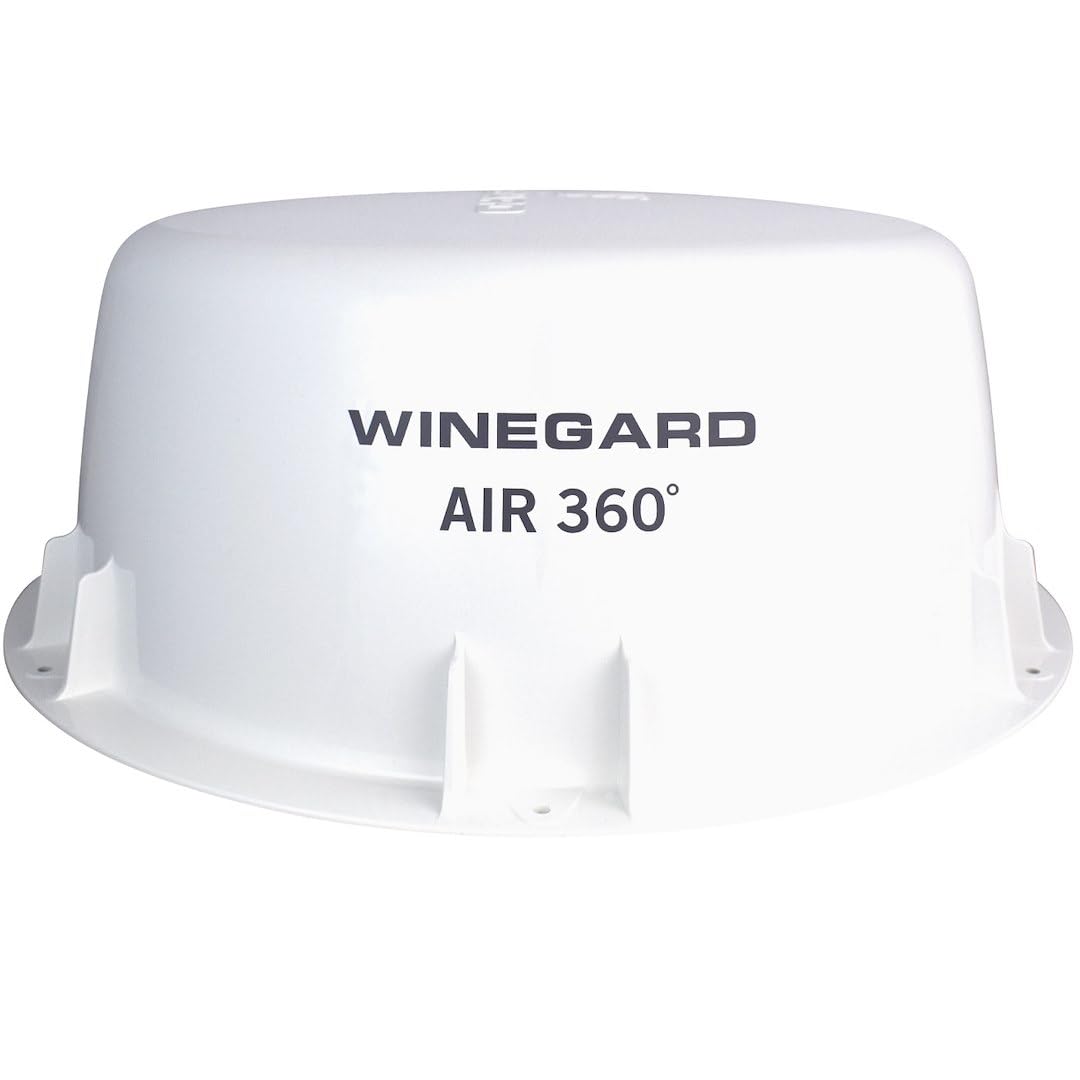
The Winegard A3-2000 is the only dome-style antenna in this roundup, purpose-built for RV, marine, and motorhome use. Its low-profile white dome houses two separate antennas: one for TV (UHF/VHF/Hi-VHF) and one for AM/FM radio, both fed by a single powered wall plate. The 50-ohm impedance is RV-standard, and the dome construction resists tree branch strikes, wind vibration, and weather ingress better than exposed-element designs. The included powered wall plate supplies 12V to the amplifier inside the dome.
Verified RV owners report that the Air 360 outperformed their old batwing crank-up antennas, pulling in 63 clear digital channels in suburban dead zones where the previous antenna only managed 22. The lack of a raise-and-rotate mechanism saves time at each campsite, and the dome’s ability to withstand low-hanging branches is a frequent praise point. The AM/FM radio antenna is an added bonus for road trippers who want music without a separate unit.
The trade-off is that fixed-dome omnidirectional reception is often weaker than a directional antenna aimed at a known tower. Users saw a drop from 17 directional channels to 13 when switching to the dome. It also requires a powered connection to function; without power, it passes no signal. Installation on an RV roof requires removing the old antenna sealant, but the included hardware makes it straightforward for a DIY owner.
Why it’s great
- Durable dome design withstands highway speeds, branches, and weather without damage
- Integrated AM/FM antenna eliminates the need for a separate radio aerial
- Quick installation on RV roof with existing hole – no crank-up mechanism
Good to know
- Not as powerful as a directional antenna – channel count may drop in fringe areas
- Requires 12V power; no signal passthrough when unpowered
- RV-specific form factor not ideal for stationary home roof use
FAQ
What is the real difference between a motorized 360 antenna and a true omnidirectional antenna?
Can a 200-mile antenna really work at 200 miles?
Do I need a preamplifier if I buy an antenna with a built-in amplifier?
Final Thoughts: The Verdict
For most users, the best 360 degree outdoor tv antenna winner is the Channel Master Omni+ 50 because it delivers true omnidirectional reception without a motor, supports both UHF and VHF bands, and performs reliably at 30–50 miles — which covers the vast majority of suburban cord-cutters. If you need maximum range in a difficult signal environment with intelligent gain control and advanced filtering, the premium Televes DiNova Boss Mix is the clear upgrade. And for an RV owner who wants a durable dome that survives highway travel, the Winegard A3-2000 Air 360 is the perfect specialized choice.