
Our readers keep the lights on and the weekend projects moving. As an Amazon Associate, I earn from qualifying purchases.
Plastic repairs often fail because most glues can’t chemically grip the slick, non-porous surface of common plastics like polypropylene, polyethylene, or acrylic. A standard super glue might form a brittle surface bond that shatters under stress, leaving you back at square one with a broken part and a wasted afternoon.
I’m Rikta — the co-founder and writer behind FitlyFast. My approach to this guide involved cross-referencing technical data sheets, analyzing tensile strength ratings, and studying real-world repair outcomes to find the formulations that actually solve the plastic-to-plastic bonding challenge.
Whether you’re fixing an auto bumper, a cracked kayak, or a 3D-printed project, finding the right adhesive for plastic to plastic means understanding solvent cements, toughened epoxies, and specialized instant adhesives that chemists designed specifically for this stubborn substrate.
How To Choose The Best Adhesive For Plastic To Plastic
The first step is identifying the plastic type you’re bonding. Look for a recycling code on the part (PP, PE, ABS, Acrylic). Each plastic family requires a different adhesive chemistry: solvent cements work on acrylic and ABS, toughened epoxies handle mixed plastics and fill gaps, while specialized cyanoacrylates bond rubberized and low-energy plastics like polypropylene.
Match the Adhesive to the Plastic Type
Solvent cements like Weld-On physically melt the plastic surface layers together, creating a molecular weld. This is ideal for acrylic and ABS but won’t work on polypropylene or polyethylene. Two-part epoxies like J-B Weld and West System G/flex offer gap-filling strength on nearly any rigid plastic, including nylons and fiberglass-reinforced composites. Instant adhesives from 3M are formulated with surface modifiers to bond low-energy plastics but require clean, tight-fitting joints.
Consider Cure Time and Working Time
Fast-setting adhesives cure in seconds or minutes, which is perfect for small repairs where parts can be held in place. For large or complex assemblies, a longer working time allows you to position pieces before the bond sets. Epoxies generally offer adjustable working times (15–60 minutes), while instant adhesives set in under 30 seconds. Know your pace before choosing.
Quick Comparison
On smaller screens, swipe sideways to see the full table.
| Model | Category | Best For | Key Spec | Amazon |
|---|---|---|---|---|
| J-B Weld Plastic Bonder Black | Two-Part Epoxy | Rigid repairs with gap filling | Tensile Strength: 3770 PSI | Amazon |
| 3M Scotch-Weld PR100 | Instant Adhesive | Small fast fixes on rubbery plastics | Handling Time: < 20 seconds | Amazon |
| WEST SYSTEM G/flex Epoxy | Toughened Epoxy | Waterproof & flexible joints | Full Cure Time: 2 days | Amazon |
| WELD-ON 16 Acrylic Cement | Solvent Cement | Acrylic and plexiglass bonding | Working Time: 5-6 minutes | Amazon |
| Loctite Vinyl, Plastic & Fabric | Contact Adhesive | Flexible repairs like vinyl seats | Full Cure Time: 24 hours | Amazon |
| DAP Weldwood Contact Cement | Contact Cement | Laminate and linoleum repairs | Full Cure Time: 2.5 hours | Amazon |
| 3M Scotch-Weld PR1500 | Gel Instant Adhesive | Polypropylene and gap filling | Viscosity: Gel (no drip) | Amazon |
In‑Depth Reviews
1. J-B Weld Plastic Bonder Black 2-Pack
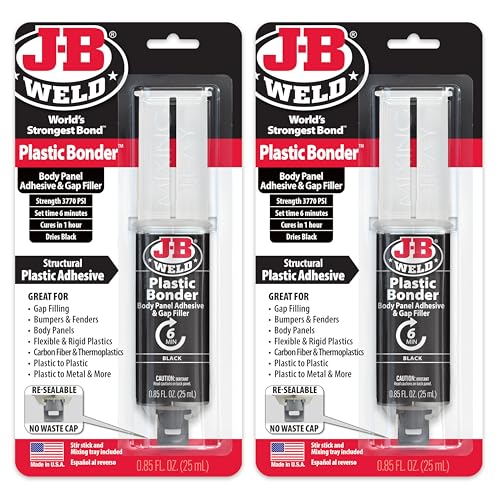
This two-part urethane adhesive brings serious mechanical strength to the table with a tensile rating of 3770 PSI. The syringe delivers a 1:1 mix ratio directly into the included tray, and the paste-like consistency stays where you put it, making it ideal for vertical bumper repairs and filling dents in rigid thermoplastics like ABS.
Real-world users report successful repairs on scooter steering components, cracked wiper covers, and even intake hose fittings. The 15-minute set time gives you just enough window to position parts, while the 30-hour full cure delivers a bond that sands and paints like the original plastic. The black color blends well with dark interior trim and automotive parts.
One caveat: it struggles on polypropylene and polyethylene — you’ll need a plastic primer or a different adhesive for those substrates. The chemical smell is noticeable, so ventilate your workspace. For rigid plastic repairs where strength matters most, this is the benchmark choice.
Why it’s great
- Extremely high tensile strength (3770 PSI)
- Gap-filling paste works on vertical surfaces
- Sands and paints after curing
Good to know
- Not recommended for polypropylene or polyethylene
- Chemical smell requires ventilation
2. 3M Scotch-Weld Plastic & Rubber Instant Adhesive PR100

3M’s PR100 is a specialized cyanoacrylate formulated to bond difficult substrates like EPDM rubber, Santoprene, plasticized PVC, and even some silicone. The low-viscosity formula wicks into tight joints, creating a thin bond line that reaches handling strength in under 20 seconds — ideal for gasket attachment and small electronics repairs.
Users report fantastic results bonding silicone to silicone (with the appropriate primer), fixing radiator leaks that saved thousands in replacement costs, and repairing blender pitchers that survived dishwasher cycles. The flexible container allows precise drop-by-drop application, though the bottle tip is short — a separate syringe helps for deep work.
The biggest trade-off is cost: at roughly for a 0.7-ounce bottle, it’s expensive per unit volume compared to standard super glues. It also requires careful storage in the refrigerator to extend shelf life. For specialized rubber-to-plastic bonds where nothing else holds, this is the professional-grade solution.
Why it’s great
- Bonds silicone, EPDM, and plasticized PVC
- Handling strength in under 20 seconds
- Precise drop-by-drop application
Good to know
- Small bottle size for the price
- Requires refrigeration for long-term storage
3. WEST SYSTEM G/flex Epoxy (2 x 4 oz)

The G/flex 650 is a toughened epoxy engineered for permanent waterproof bonding. Unlike brittle epoxies, this formula maintains flexibility after curing, allowing it to absorb stress and vibration without cracking. It adheres tenaciously to fiberglass, ceramics, metals, and difficult-to-bond plastics like ABS and nylon.
Real-world use cases include repairing a cracked Old Town kayak, fixing a ceramic fountain basin with fiberglass cloth reinforcement, and patching a snowboard for a full season of riding. The long pot life (before mixing) gives you ample working time, and the two-day full cure produces a bond that remains watertight and structurally sound.
It’s not a quick fix — the slow cure requires patience and the parts need to be clamped or held for the duration. The bottles are relatively small at 4 ounces each (resin and hardener), and the initial investment sits at the higher end of the spectrum. For demanding outdoor and marine-grade plastic repairs, this epoxy delivers unmatched durability.
Why it’s great
- Flexible bond resists vibration and impact
- Excellent for outdoor and underwater repairs
- Works on damp and difficult-to-glue woods
Good to know
- Full cure takes two days
- Higher price per ounce than other options
4. WELD-ON 16 Acrylic Plastic Cement

WELD-ON 16 is a solvent-based cement that chemically fuses acrylic (plexiglass) pieces into a single monolithic unit. The medium-bodied, fast-setting formula has a 5–6 minute working window, during which you can position and clamp parts. It also bonds rigid PVC, ABS, styrene, butyrate, and polycarbonate to each other and to porous surfaces.
Users consistently report strong, clear, fast-drying bonds on cast acrylic sheets, 3D-printed PLA and PETG parts, and even 20-year-old polycarbonate filter housings. The precision applicator tip makes it easy to control the flow on vertical surfaces and in small model-making assemblies. The low-VOC formulation is a welcome improvement over older solvent cements, though adequate ventilation remains necessary.
It’s runny — the thin consistency can be a challenge for beginners and may require practice to avoid over-application. The 5 fl oz tube goes quickly on larger signage or fabrication projects. For anyone working with acrylic sheeting or 3D-printed filaments, this is the go-to welding solution.
Why it’s great
- Creates a molecular weld for acrylic and ABS
- Low VOC formulation
- Precision applicator tip for controlled flow
Good to know
- Very runny; requires practice to apply cleanly
- Small tube size for larger projects
5. Loctite Vinyl, Plastic, and Fabric Adhesive 2-Pack

Loctite’s formula is a flexible contact adhesive designed specifically for vinyl, fabric, and soft plastics. It remains pliable after curing, making it suitable for reattaching padding to lawn mower seats, fixing fabric blinds to vinyl frames, and repairing vinyl bar stools where some give is required.
Users appreciate the clear finish and easy application, though they caution about stringing if you pull the nozzle away too quickly. The 24-hour full cure delivers a durable bond that holds up through temperature changes and regular use. The two-pack offers good value for multiple small projects.
It’s not a high-strength structural adhesive — expect it to hold well on flexible repairs but don’t rely on it for load-bearing or impact-prone rigid plastic joints. The paste form can be messy if applied too liberally. For soft vinyl and fabric-to-plastic repairs around the house, this is a reliable go-to.
Why it’s great
- Remains flexible after curing
- Clear finish for discreet repairs
- Good value with two tubes
Good to know
- Can string during application
- Not suitable for rigid, load-bearing plastic joints
6. DAP Weldwood Original Contact Cement 3-Pack
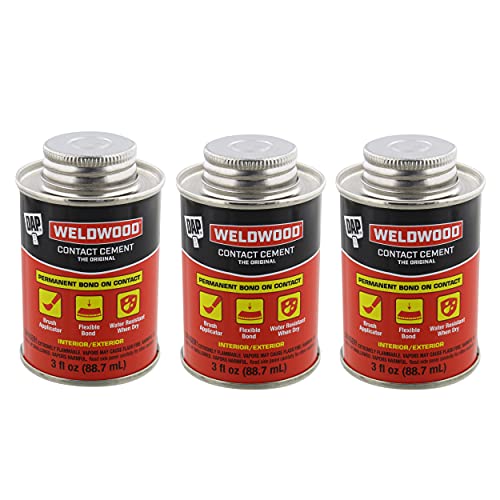
DAP Weldwood is a classic solvent-based contact cement that bonds on contact after the solvent flashes off. It’s the go-to for reattaching linoleum strips, repairing shoe soles, and bonding laminates to countertops. The low-VOC waterborne formulation is nonflammable and safer for indoor use.
Users report excellent results on porous and nonporous materials, including wood, paper, cloth, suede, leather, plastic, and rubber. The key technique is applying to both surfaces, waiting 15 minutes for solvent evaporation, then pressing together for an instant bond. The 3-pack of 3 oz cans provides good quantity for multiple projects.
It’s not ideal for gap-filling or rigid structural plastic repairs — contact cement requires close-fitting parts and works best in peel-resistant applications. The bottles can thicken over time as solvent evaporates. For laminate, linoleum, and fabric bonding, this remains a trusted staple.
Why it’s great
- Instant bond on contact after solvent evaporation
- Low VOC and nonflammable
- Works on a wide range of materials
Good to know
- Requires large surface area for best results
- Bottles thicken over time as solvent evaporates
7. 3M Scotch-Weld Plastic & Rubber Instant Adhesive PR1500

The PR1500 is the medium-viscosity gel sibling to the PR100, designed for applications where drips and run-off must be avoided. The gel consistency stays put on vertical surfaces and fills small gaps, making it a strong candidate for bonding low-surface-energy plastics like polypropylene and polyethylene.
Users report successful repairs on polypropylene tanks, car sidewalls (even a slashed tire sidewall that held air long enough to drive home), pool liners, and rubber-to-plastic car parts. The flexible pinched container allows precise bead application, and the gel formulation gives you a few extra seconds of positioning time compared to thin cyanoacrylates.
The higher viscosity means it’s less effective at wicking into hairline cracks than the PR100. It’s also the most expensive option by volume in this guide at nearly per 20-gram bottle. For bonding polypropylene and other challenging plastics where runny glues fail, this gel delivers a permanent grip.
Why it’s great
- Gel formula stays put on vertical surfaces
- Bonds polypropylene and polyethylene
- Fills small gaps without dripping
Good to know
- Very small bottle for the high price
- Less effective at wicking into thin cracks
FAQ
What is the strongest adhesive for bonding polypropylene plastic?
Can I use super glue (cyanoacrylate) on all types of plastic?
How do I prepare plastic surfaces before applying adhesive?
Final Thoughts: The Verdict
For most users, the adhesive for plastic to plastic winner is the J-B Weld Plastic Bonder because its 3770 PSI tensile strength and gap-filling paste handle the widest range of rigid plastic repairs, from automotive bumpers to appliance parts. If you need a waterproof flexible bond for outdoor gear or kayak repairs, grab the WEST SYSTEM G/flex Epoxy. And for bonding low-surface-energy plastics like polypropylene where other adhesives fail, nothing beats the 3M Scotch-Weld PR1500 gel.