
Our readers keep the lights on and the weekend projects moving. As an Amazon Associate, I earn from qualifying purchases.
The weld that fails under vibration isn’t just annoying — it’s why your custom battery pack sagged, sparked, or stopped working entirely. A battery spot welder has one job: fuse nickel strip to a cell terminal with enough penetration to carry current without burning through the can. The difference between a pack that lasts years and one that falls apart mid-ride comes down to pulse capacitance, gear granularity, and whether the machine can maintain consistent output across a hundred welds without drifting.
I’m Rikta — the co-founder and writer behind FitlyFast. I’ve analyzed dozens of capacitor and battery-powered spot welders across the -to- spectrum, cross-referencing customer weld tests, real output consistency data, and thermal behavior under load to find which units actually deliver reliable bonds for 18650 and LiFePO4 pack building.
This guide focuses exclusively on portable units that can handle 0.2mm pure nickel and nickel-plated steel in real workshop conditions, with the full selection of best battery spot welder options ranked by pulse stability and build quality rather than marketing wattage claims.
How To Choose The Best Battery Spot Welder
Selecting a spot welder for battery pack assembly requires understanding three interconnected variables: energy storage type, pulse control resolution, and thermal management. Beginners often overvalue peak power numbers while ignoring whether the machine can deliver consistent energy on every weld across an entire pack build.
Capacitor vs Battery Power — Which energy store delivers consistent welds?
Supercapacitor welders store energy from the wall outlet and release it in a controlled pulse, giving you repeatable weld energy regardless of the pack’s state of charge. Battery-powered units rely on internal lithium cells that gradually sag as the charge depletes, causing weld inconsistency toward the end of a build. Capacitor machines also eliminate the risk of over-discharging the internal battery during long sessions — a common failure point in handheld units.
Gear count and power curve linearity
A welder with 250 gears sounds more precise than one with 99 gears, but the real question is whether those gears map linearly to weld energy. Many budget units cluster the first 20 gears tightly and then jump significantly at the top, making it difficult to dial in a perfect weld for 0.15mm pure nickel. Look for user feedback that confirms consistent step changes rather than marketing gear numbers alone.
Duty cycle and thermal protection thresholds
Building a 13S pack requires approximately 120 welds. A welder that thermally throttles after 50 welds forces you to pause and wait for capacitors to cool, extending a 30-minute job to over an hour. Machines with active cooling fans and higher thermal mass can maintain full power for longer weld runs — critical for anyone building packs larger than four cells.
Quick Comparison
On smaller screens, swipe sideways to see the full table.
| Model | Category | Best For | Key Spec | Amazon |
|---|---|---|---|---|
| AWithZ P20B | Premium Capacitor | High-volume pack building | 14.6kW dual capacitor | Amazon |
| AWithZ UF20B | Premium Capacitor | Three-mode versatility | 10.5kW supercapacitor | Amazon |
| SEESII 10KW | Capacitor AC | Thick nickel welding | 250 precision gears | Amazon |
| UKF10 | Battery Capacitor | Entry-level pack repair | 99 gear smart pen | Amazon |
| Docreate 3000F | Farad Capacitor | Small battery projects | 120 gear LCD screen | Amazon |
| AWithZ UK3 10000mAh | Battery Powered | Portable light-duty work | 100 gears rotary knob | Amazon |
| ARCCAPTAIN MIG205 Pro | Multi-Process AC | Full workshop welding | 205A MIG/Spot welder | Amazon |
In‑Depth Reviews
1. AWithZ P20B 14.6kW Capacitor Spot Welder

The AWithZ P20B sits at the top of the capacitor welder hierarchy for good reason — two built-in supercapacitors deliver 14.6kW of pulse power, enough to weld 0.3mm pure nickel sheets and 0.6mm nickel-plated steel without breaking a sweat. The 999 adjustable gears give real fine-tuning capability, and experienced users consistently report that settings around gear 100 produce perfect bonds on 0.2mm pure nickel for tool battery rebuilds. The flexible 60cm copper leads stay cool during extended use, and the included 15A charger recharges capacitors rapidly between weld bursts.
What separates the P20B from cheaper capacitor units is thermal stability. The quiet fan and large capacitor bank allow continuous weld runs without the machine throttling down. Multiple customers who started with battery-powered welders reported that the P20B delivered stronger, more consistent bonds immediately after switching, with one user calling it “the one you’ve been looking for” after returning three cheaper machines. The build quality using a metal housing and the included 18650 battery holder jig add to the professional feel.
The main downside is the learning curve from a sparse manual — users need to experiment with gear settings to avoid over-penetrating thin nickel. The foot pedal feels less premium than the main unit, and you must keep the machine plugged into AC power because the capacitors discharge within minutes of unplugging. For serious pack builders who want one purchase that does everything from 18650 phone batteries to large LiFePO4 banks, this welder justifies its premium positioning through raw capability and consistency.
Why it’s great
- 14.6kW dual capacitor bank handles thick nickel and even 0.2mm copper sheets
- 999 gear resolution allows precise dialing for different material stacks
- Flexibe 60cm leads stay cool with minimal heat transfer during long runs
- Comprehensive kit includes nickel strip, jig, and three replacement pin pairs
Good to know
- Requires constant AC connection — capacitors drain fully in under two minutes unplugged
- Manual provides very little practical guidance on gear-to-material matching
- Foot pedal build feels less robust than the main aluminum housing
2. AWithZ UF20B 10.5kW Capacitor Spot Welder
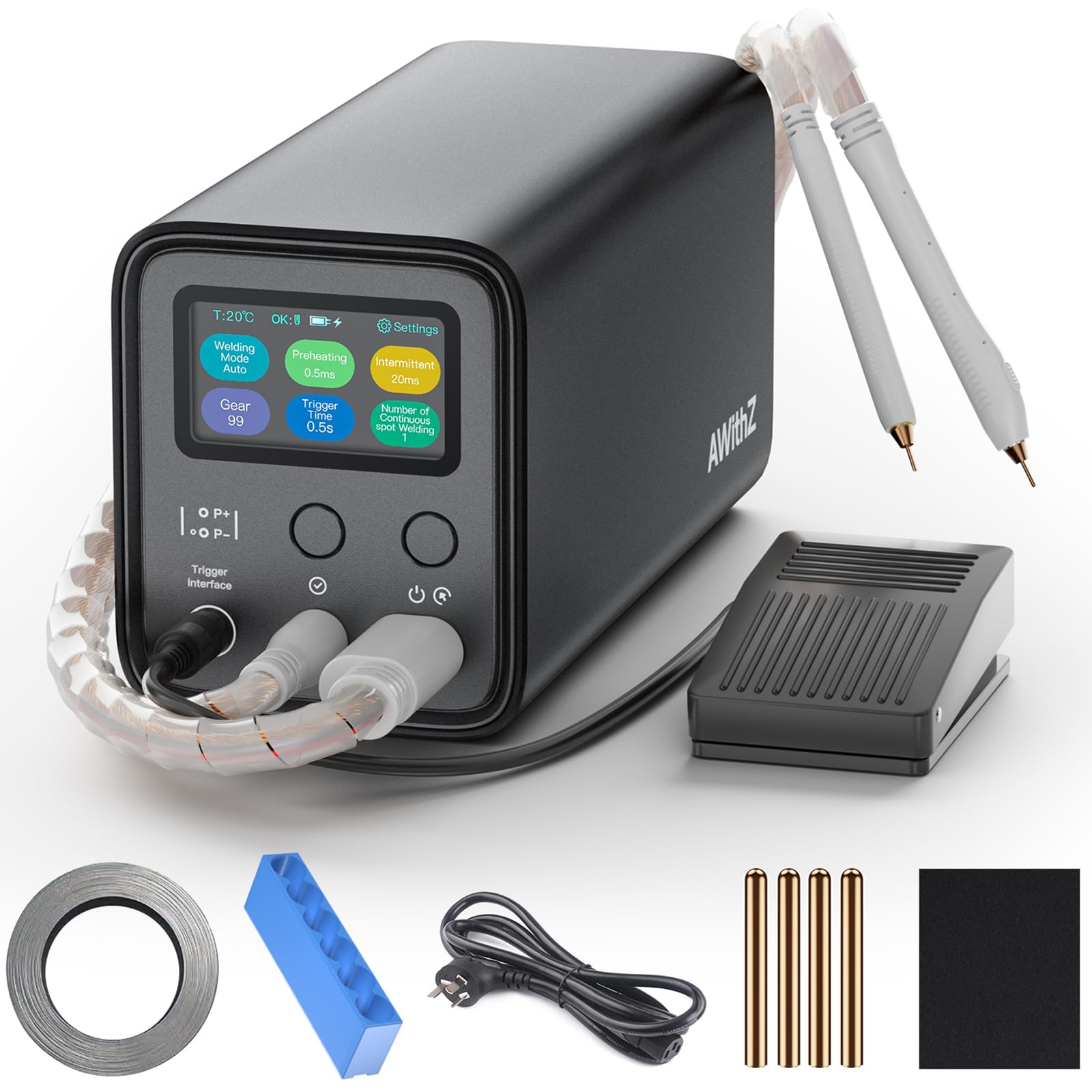
The UF20B brings the same capacitor-based design principles as the P20B but in a 10.5kW package with three distinct operation modes — automatic, manual trigger, and foot pedal. This flexibility lets you choose your workflow: use automatic mode for high-speed production of identical welds, manual mode for precision when positioning probes on tight cell clusters, and foot pedal for hands-free operation during long pack assemblies. Users report welding 0.2mm pure nickel strips at gear setting 20 with excellent bond strength, and the 99-gear system provides enough granularity for most hobbyist applications.
Build quality stands out with a rounded aluminum alloy shell that feels premium and resists scratching during workshop use. The machine reaches spot-weld-ready status within five minutes of plugging in, and the 15A high-current adapter ensures quick capacitor recovery between welds. Customer feedback consistently praises the weld consistency — one user who previously owned a cheaper battery-powered 10kW unit found the UF20B significantly more powerful when trying to weld 0.4mm nickel-plated strips for battery pack terminals.
The most common criticism targets documentation quality, which is minimal and leaves users guessing about optimal gear settings for different nickel thicknesses. The leads are shorter than many competitors at 40cm, which can be restrictive when working on larger pack configurations. While the UF20B can operate briefly on capacitor reserve after unplugging, it primarily needs wall power — making it less portable than battery-powered alternatives but far more consistent for bench work.
Why it’s great
- Three welding modes (auto, manual, foot pedal) adapt to different assembly workflows
- Aluminum alloy housing with rounded corners for workshop safety and durability
- Consistent weld output from capacitor storage prevents the power drift of battery units
Good to know
- Short 40cm leads can be restrictive for larger battery pack layouts
- Manual lacks clear gear-to-material recommendations for first-time users
- Primarily AC-dependent — capacitor-only operation lasts only a couple of minutes
3. SEESII 10kW Capacitor Spot Welder
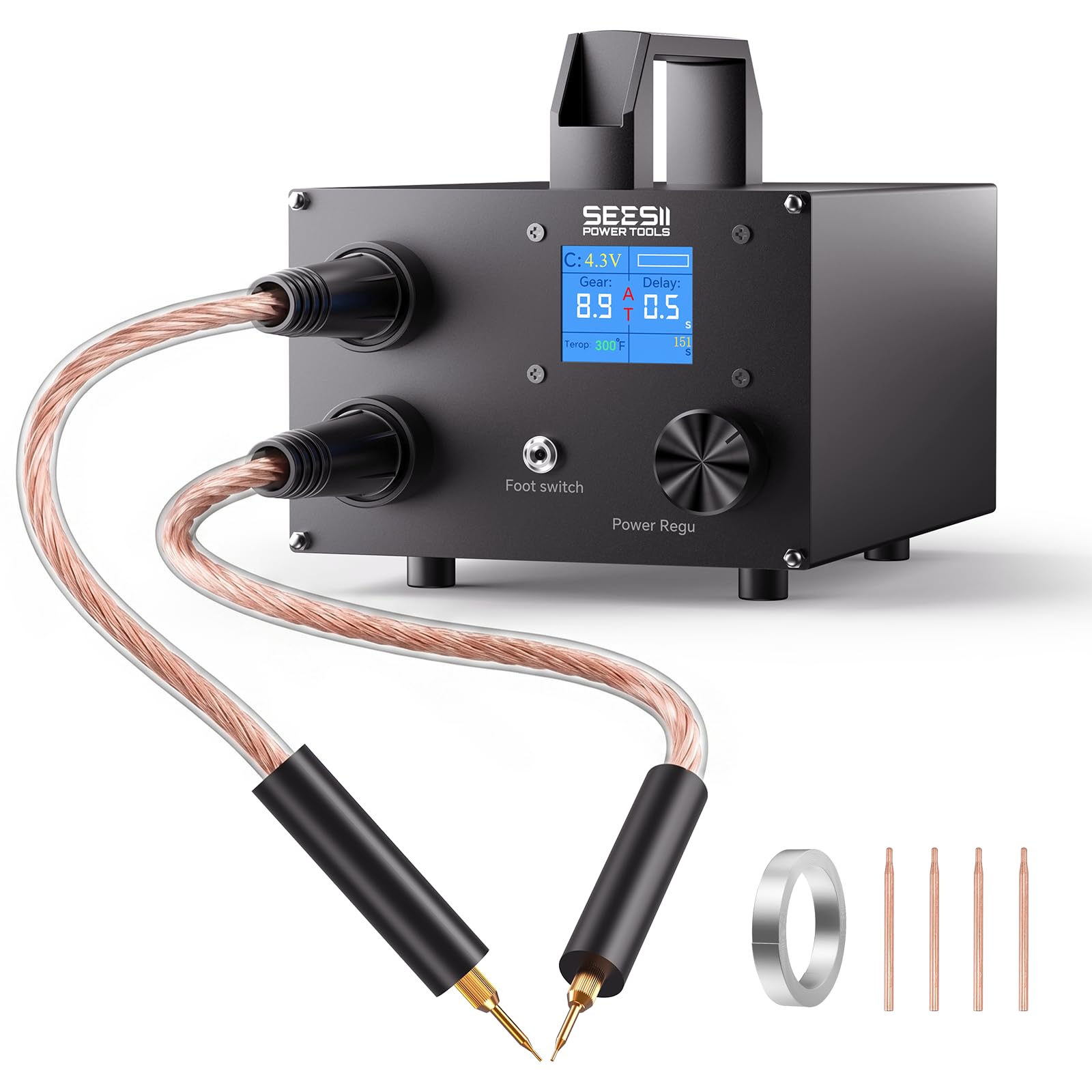
The SEESII 10KW uses supercapacitor energy storage with 250 adjustable gear levels, providing fine control across a wide range of nickel thicknesses. It handles up to 0.3mm nickel-plated sheets and 0.2mm pure nickel, and users report that gear setting 3.5 perfectly welds 0.1mm pure nickel with clean penetration. The integrated metal housing offers outstanding impact resistance, making this a good choice for workshop environments where tools get bumped around. The high-definition display provides clear real-time parameter feedback for fast adjustments.
Dual welding modes — automatic continuous and foot pedal — give flexibility for both batch production and precision work. The intelligent dual safety protection system includes a power balance circuit and active cooling fan to manage heat during extended sessions. Users upgrading from cheaper handheld welders note a night-and-day improvement in weld consistency, particularly on 0.15mm pure nickel where the SEESII produces strong, uniform bonds without the sputtering common in battery-powered units.
Reliability concerns appear in the data — some units failed within six months, and the power supply can struggle to keep capacitors fully charged during rapid-fire welding sequences. The 12V 3A supply runs hot during continuous use, and internal capacitors are held in place with foam rather than proper brackets, which raises concerns about durability if the unit is transported frequently. The gear increments are not perfectly linear, making it harder to predict settings for unfamiliar materials without testing.
Why it’s great
- 250 gear resolution provides wide adjustment range for diverse nickel thicknesses
- Rugged integrated metal construction resists workshop impacts and deformation
- Capacitor-based storage delivers consistent pulse energy without battery sag
Good to know
- Multiple reports of units failing within months of purchase
- Internal capacitors secured with foam rather than brackets — fragile during transport
- Power supply runs hot and cannot keep up with rapid-fire welding sequences
4. UKF10 Super Capacitor Spot Welder

The UKF10 offers a well-balanced entry point into capacitor welding with three operation modes — automatic, smart hand-control, and foot pedal — all managed through a simple control panel. The upgraded smart hand-control pen uses thick 6-gauge copper wire for responsive triggering, and customers confirm that gear setting 45 (out of 99) produces consistent, secure welds on 0.15mm pure nickel for Dewalt battery pack repairs. The unit handles 0.2mm pure nickel and 0.35mm nickel-plated steel with enough penetration for most tool battery rebuilds.
Safety features include the brand’s Dynamic Balance Protection and Intelligent Stop-Charging technology, which prevents overcharging the supercapacitors and extends their 500,000-cycle lifespan. The 2.55-pound package is notably lighter than many capacitor competitors, making it easy to move between workstations. Users new to spot welding report that the UKF10 produces reliable welds on the first attempt with minimal practice — a significant advantage over machines that require extensive tuning before producing acceptable bonds.
The tradeoff for compact size is power — the UKF10 struggles with 0.3mm pure nickel, and multiple reviews note that it fails completely on 0.3mm thick strips. Marketing materials suggest professional-grade capability, but real-world performance maxes out at light-duty hobbyist packs. The included documentation is incomplete, leaving users to figure out the mode switching and gear selection through trial and error. TSA confiscated one user’s unit at airport security, confirming that the built-in lithium polymer batteries make this unsuitable for air travel.
Why it’s great
- Smart pen with heavy 6-gauge copper wire for responsive trigger control
- Lightweight 2.55-pound design with three operation modes for flexibility
- Dynamic Balance Protection extends capacitor lifespan beyond 500,000 cycles
Good to know
- Cannot reliably weld 0.3mm pure nickel — power ceiling is lower than competitors
- Incomplete manual requires self-guided learning for optimal gear selection
- Built-in lithium polymer batteries prevent air travel through security checkpoints
5. Docreate 3000F Farad Capacitor Spot Welder

The Docreate 3000F occupies an interesting middle ground — it uses 3000 farad capacitors rather than batteries for energy storage, placing it above pure battery welders in consistency but below premium capacitor units in peak power. The 120 adjustable gears and OLED display give clear visibility into capacitor voltage and temperature, helping you avoid overheating. Users have successfully welded 0.1mm copper foil with 0.1mm nickel-plated steel at power level 80, and the screen eliminates the guesswork of machines with only numbered gear indicators.
Setup requires a 20-minute initial charge before first use, and the quick-release pen design allows easy tip replacement. The automatic mode with memory function remembers your last settings, reducing adjustment time between sessions. For small battery projects like robot lawn mower packs or flashlight battery replacements, the Docreate performs admirably — one user fixed their mower battery on the first try. The five-minute automatic power-off provides a useful safety net for absent-minded workshop sessions.
The clear weakness is thermal management — the machine overheats after roughly 100 consecutive welds, forcing a cooldown break mid-way through a full pack build. It struggles with high-discharge applications like ebike batteries where copper-nickel sandwiches are required, with one user reporting failure even on single 0.2mm pure nickel strips. The lead cables are shorter than ideal, and the battery-powered internal cells eventually limit the total weld count before needing a recharge, making this better suited for occasional repair work than production runs.
Why it’s great
- OLED display shows capacitor voltage and temperature for informed gear selection
- Successfully welds copper-nickel sandwich stacks at power level 80
- Memory function retains settings between sessions for consistent workflow
Good to know
- Thermal throttling after ~100 welds interrupts larger pack building sessions
- Not suitable for high-discharge ebike packs requiring thick nickel or copper
- Short lead cables and recharge cycle limit production efficiency
6. AWithZ UK3 10000mAh Battery Spot Welder
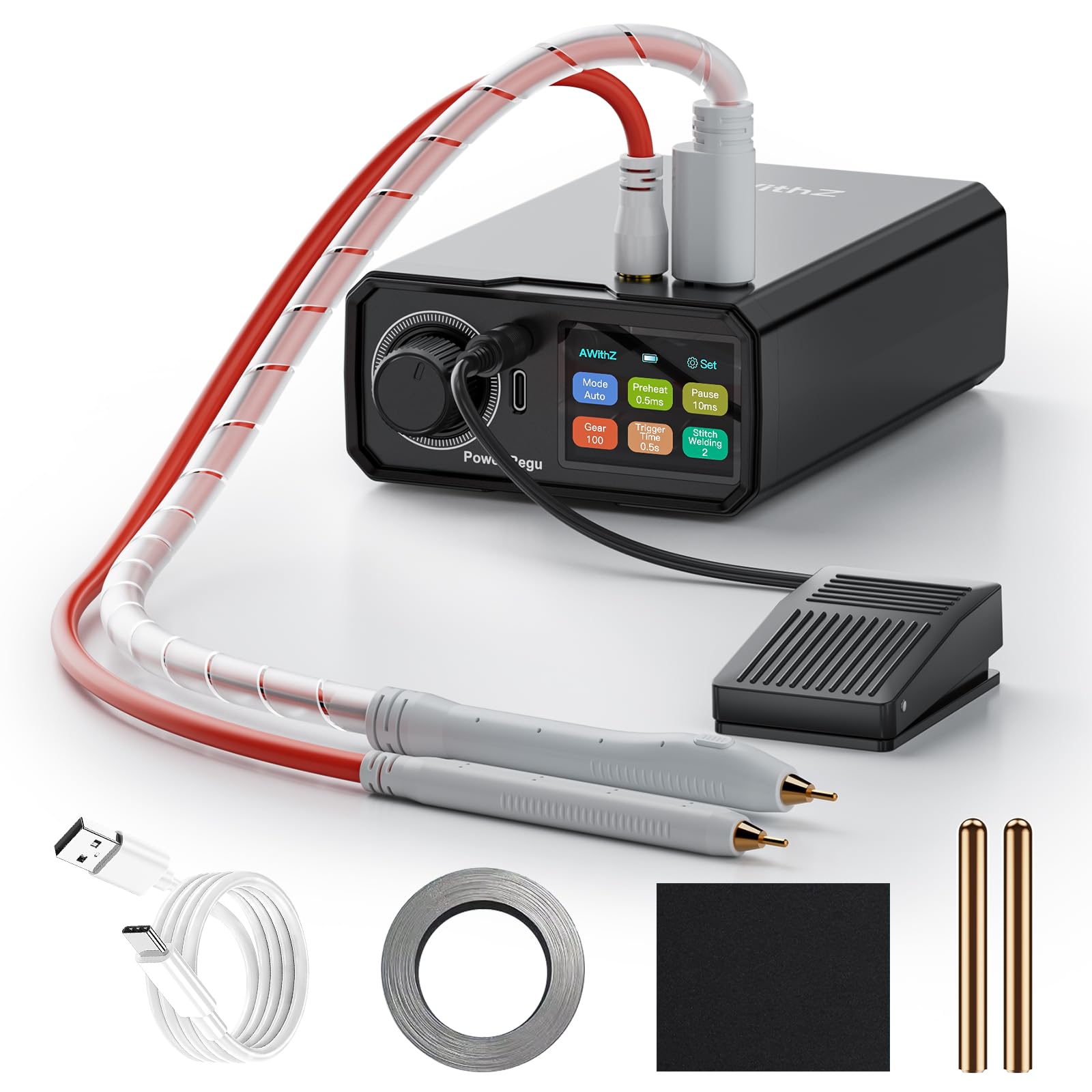
The UK3 is a genuinely portable battery-powered spot welder — no wall outlet required, just charge the internal 10000mAh lithium polymer pack and weld wherever your workbench sits. The 100-gear rotary knob controls pulse energy, and users report success welding 0.15mm pure nickel and 0.2mm nickel-plated steel at mid-range gear settings. The three trigger modes — automatic, foot pedal, and hand trigger — give you the same operational flexibility found in more expensive capacitor units, all running from a self-contained battery that delivers approximately 300 welds on a single charge at highest gear.
The package includes nickel-plated sheet metal, a foot switch, welding pens, and a charging cable, making it genuinely ready-to-use out of the box. The thermal protection system monitors capacitor temperature and automatically halts welding if internal components overheat, with an eight-minute auto shutoff for safety. Multiple customers completed three or more battery pack builds on a single charge, with one user noting the welder performed perfectly on their first attempt with zero prior spot welding experience.
Consistency is the UK3’s Achilles’ heel — the battery voltage sags as the charge depletes, causing weld power to drift across a session. Users report that welds at the start of a pack look different from those at the end, forcing manual gear compensation as the battery drains. The internal lithium polymer cells get hot during extended use, and the 1.9-pound unit can overheat after 150 continuous welds. For maximum portability at the cost of weld consistency, the UK3 works for occasional projects, but serious pack builders will outgrow it quickly.
Why it’s great
- Fully portable with 10000mAh internal battery — no AC power required for operation
- Three trigger modes (auto, foot, hand) provide flexibility despite battery power
- Complete kit includes nickel strip, foot switch, and charging cable for immediate use
Good to know
- Weld power drifts as battery voltage sags through a session
- Overheating after ~150 welds requires cooldown breaks during larger builds
- Cannot weld thick nickel or pure nickel reliably — best for thin nickel-plated steel only
7. ARCCAPTAIN MIG205 Pro 6-in-1 Welder
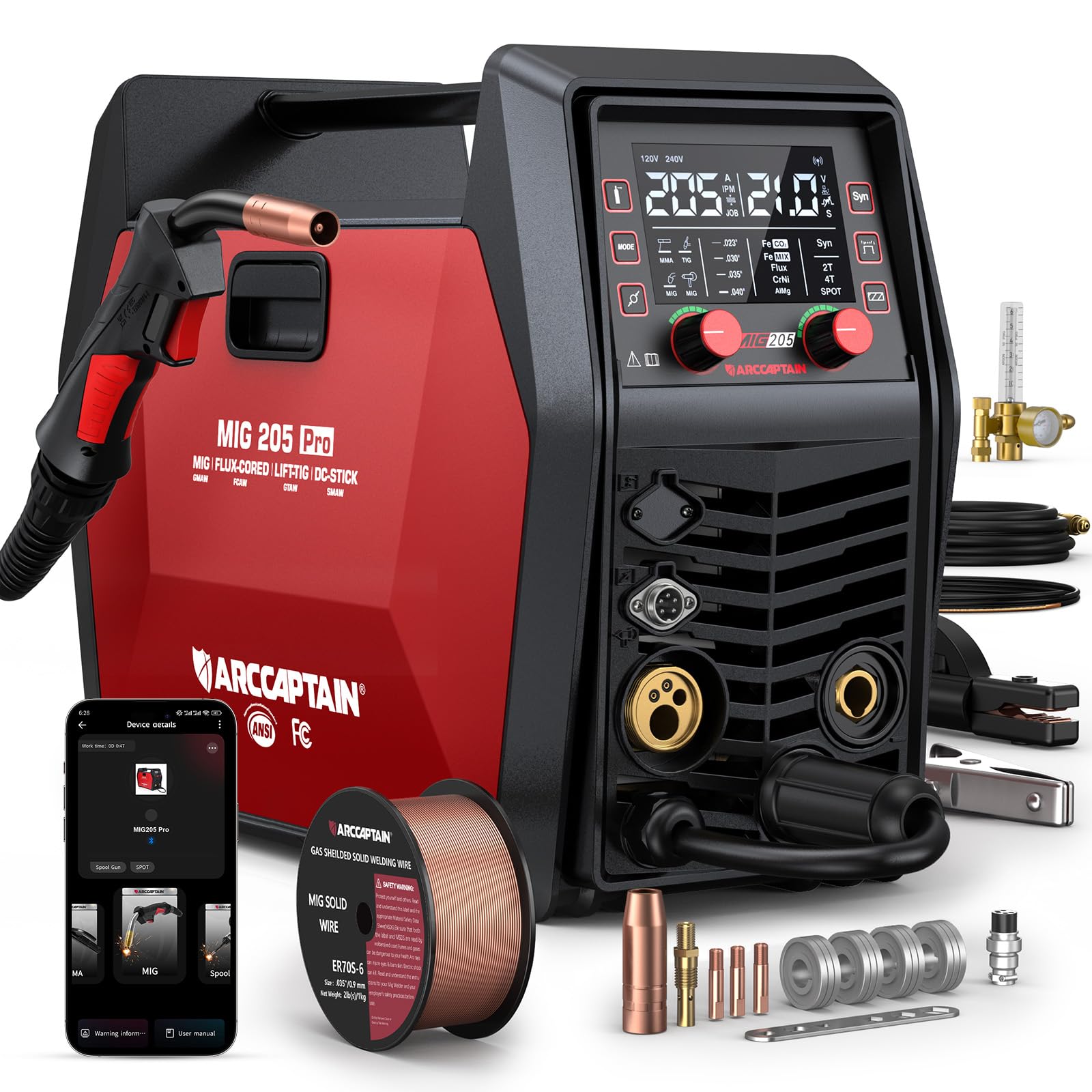
The ARCCAPTAIN MIG205 Pro is an entirely different class of machine — a full 205A MIG welder with six processes including gas MIG, flux core, stick, lift TIG, spool gun aluminum, and spot welding. If you need a workshop welder that can also do battery tab welding as one of its many functions, this unit delivers the broadest capability set of any machine in this guide. The spot welding mode operates with adjustable spot time from 0.5 to 5 seconds, and the 2T/4T trigger modes provide standard MIG control alongside the spot function.
The synergic mode automatically matches wire feed speed to current when you select wire diameter and gas type — a significant help for beginners learning MIG welding. The large LED display shows all parameters clearly, and the app control allows remote adjustment and storage of favorite settings for different materials. Real-world user feedback praises the smooth wire feed, clean 1/8-inch steel MIG welds, and good 6013 stick beads, with multiple welders noting this machine competes with established brand units at a lower investment point.
The critical caveat is that this is NOT a dedicated battery spot welder — it’s a multi-process welding machine that includes spot welding as a secondary feature. The spot welding function works best for sheet metal tacking in automotive or fabrication contexts, not for the precise low-energy pulses needed for 18650 battery terminals. The 10-pound weight and AC-only power requirement eliminate portability, and the 205A output is far more power than needed for battery work. Choose this only if you need an all-around welder and plan to build battery packs as a small part of a larger welding workflow.
Why it’s great
- Six welding processes from a single machine — covers MIG, stick, TIG, and spot needs
- Synergic mode auto-matches wire speed to current for beginner-friendly MIG welding
- App control for remote parameter adjustment and custom preset storage
Good to know
- Spot welding mode designed for sheet metal, not precision battery cell tab welding
- 10-pound weight and AC-only operation eliminate portability for workshop hopping
- Overkill for battery pack work — 205A far exceeds the energy needed for nickel strips
FAQ
Can a capacitor spot welder weld pure nickel to battery terminals?
How many welds can a battery-powered spot welder do before recharging?
What nickel thickness requires a capacitor welder over a battery welder?
Is a 999-gear welder more precise than a 99-gear welder?
Final Thoughts: The Verdict
For most users, the best battery spot welder winner is the AWithZ P20B because its 14.6kW dual capacitor bank delivers consistent welds on pure nickel up to 0.3mm without voltage sag across long pack builds. If you want three-mode operational flexibility in a more affordable capacitor package, grab the AWithZ UF20B. And for complete workshop weld capability where battery pack building is just one of many tasks, nothing beats the ARCCAPTAIN MIG205 Pro with its six welding processes and app-based parameter control.