
Our readers keep the lights on and the weekend projects moving. As an Amazon Associate, I earn from qualifying purchases.
The difference between a balance board that collects dust and one that becomes a daily habit comes down to the specific wobble mechanism and the weight capacity it promises. A flimsy board can actually teach your ankles the wrong muscle-memory patterns, while a properly designed platform delivers the exact proprioceptive feedback your body needs for rehab, sports training, or just surviving a standing desk shift without locked knees.
I’m Rikta — the co-founder and writer behind FitlyFast. I’ve spent countless hours analyzing the load-test data, platform dimensions, and material density specs that separate a well-engineered balance board from a wobbly toy, so you can make a confident buying decision without guessing.
This guide walks you through seven carefully researched models, from physical-therapy rockers to multi-mode surf trainers, to help you find the best balance board for adults that matches your skill level, body weight, and intended use-case.
How To Choose The Best Balance Board For Adults
Choosing the right balance board for adults means looking past the marketing photos and focusing on the specific mechanics that affect your training. The most important factors are the type of instability the board offers, the materials and build quality, the weight limit, and the size of the platform relative to your height and shoe size. Each of these elements directly determines whether the board will feel too easy, too dangerous, or just right for your body.
Rocker, Wobble, or Roller — Pick Your Instability
Rocker boards move along a single plane, usually forward-and-back or side-to-side, making them ideal for physical therapy and gentle standing-desk fidgeting. Wobble boards (often round or cross-shaped) allow 360-degree tilt, which challenges multiple stabilizer muscles at once. Roller boards, which combine a flat deck with a separate cylindrical roller, demand the highest level of dynamic control and most closely mimic the feel of surfing or snowboarding. Beginners should start with a rocker or a controlled wobble board before advancing to a roller-based system.
Weight Capacity and Material Density
Most cheap plastic boards max out around 250 pounds, which can feel unstable or even crack under heavier adult use. Premium boards made from Canadian maple, birch, or lauan hardwood plywood typically support 350 to 450 pounds, providing a solid, confidence-inspiring platform. The board’s weight also matters — lighter boards are portable but can slide on smooth floors, while heavier boards stay put and absorb vibration better.
Surface Texture and Footing Security
Non-slip surfaces come in several forms: EVA foam padding, textured wood grain, rubberized coatings, or honeycomb patterns. EVA foam provides the most comfortable barefoot experience and reduces foot fatigue during long standing-desk sessions, but it can wear down over time. Textured hardwood offers a grippier bare-foot feel that holds up for years, while rubberized mats add cushioning at the cost of slightly less direct proprioceptive feedback.
Quick Comparison
On smaller screens, swipe sideways to see the full table.
| Model | Category | Best For | Key Spec | Amazon |
|---|---|---|---|---|
| Sportneer 7 Modes | Premium/Multi-Mode | Athletes & progressive training | 450-lb weight capacity, 7 modes | Amazon |
| Mobo Board | Premium/Specialty | Foot strength & plantar fasciitis | 14.72″ x 13.9″ bamboo platform | Amazon |
| XCMAN Surf Trainer | Premium/Surf-Style | Surfing & skateboarding practice | 28.5″ long, roller-based system | Amazon |
| Gaiam Evolve | Mid-Range/Standing Desk | Office & fatigue relief | 27″ x 12″ rocker platform | Amazon |
| Fitlaya Fitness | Mid-Range/Roller | Youth sports & family fun | 29.1″ maple deck + roller | Amazon |
| StrongTek Advanced | Mid-Range/Wobble | Rehab & controlled wobble | 17.5″ cross-base 360° wobble | Amazon |
| Theraband Rocker | Budget/Clinical | PT & controlled rehab | 18″ x 15″ plastic rocker | Amazon |
In‑Depth Reviews
1. Sportneer Balance Board 7 Modes

The Sportneer Balance Board delivers the widest progressive challenge range of any board in this lineup, thanks to its seven distinct modes that incorporate a roller, a 2.8-inch ball, and four magnetic adjustable stoppers. The birch-wood platform supports a massive 450 pounds, making it a rare option for larger athletes who want a board that won’t flex or crack under serious load. The textured EVA surface provides reliable grip even during sweaty training sessions, and the roller and ball are made from dense rubber that glides smoothly without scratching hardwood floors.
What sets this board apart is the tool-free stopper system — you can snap the half-circle fences into magnetic positions to limit the board’s range of motion, allowing beginners to start with a small tilt radius and gradually open it up as their stability improves. The included ball adds a challenging free-motion dimension that mimics surf-style instability, making this board suitable for snowboarders, surfers, and anyone doing functional strength training.
Users consistently praise the board’s build quality, noting that it feels solid enough for family use and that the adjustable modes keep the workout fresh for months. The only minor complaint is that the half-circle rail pieces can be a bit difficult to remove when you want to reconfigure them, but the magnetic attachment is secure during use.
Why it’s great
- Seven distinct challenge modes accommodate every skill level from beginner to expert.
- 450-pound weight capacity surpasses nearly every competitor, built from dense birch wood.
- Magnetic adjustable stoppers enable tool-free range-of-motion control.
Good to know
- Half-circle fence pieces can be tricky to detach when reconfiguring modes.
- Narrower than some full-width decks, but fine for most foot sizes up to size 10.
2. Mobo Board

The Mobo Board takes a fundamentally different approach to balance training by focusing on the foot’s internal architecture. Its patented Toe Box Technology and Anatomical Axis are designed to work with your foot’s natural structure, building a stable arch and strengthening the intrinsic muscles that control your toes and ankles. This is particularly valuable for runners suffering from plantar fasciitis, as the board targets the big-toe flexor and the posterior tibial tendon, which are often weak points in overuse injuries.
The 14.72-inch by 13.9-inch bamboo platform has a smooth, warm feel underfoot, and the rocker pieces allow both side-to-side and forward-backward movement. It supports up to 300 pounds and packs completely flat for easy travel. The included exercise guide, developed by biomechanics expert Jay Dicharry, offers specific exercises for rehabbing common foot and ankle issues, making this board a clinical tool as much as a fitness accessory.
Reviews from competitive dancers, aging runners, and post-surgery patients all point to noticeable improvements in foot strength and pain reduction within weeks. The main drawback is that the rocker pieces lack a rubberized grip on their bottom surface, which can cause slight sliding on polished wood floors if you’re not using it on a rug or mat.
Why it’s great
- Science-backed design specifically strengthens foot arches and big-toe flexors for plantar fasciitis relief.
- Bamboo construction folds flat for travel and stores easily in a backpack.
- Developed by a leading sports-medicine clinician, with targeted rehab protocols included.
Good to know
- Rocker base pieces can slide slightly on smooth hardwood floors without a mat.
- Premium pricing reflects the specialized clinical design, not general-purpose fitness use.
3. XCMAN Surf Balance Board Trainer
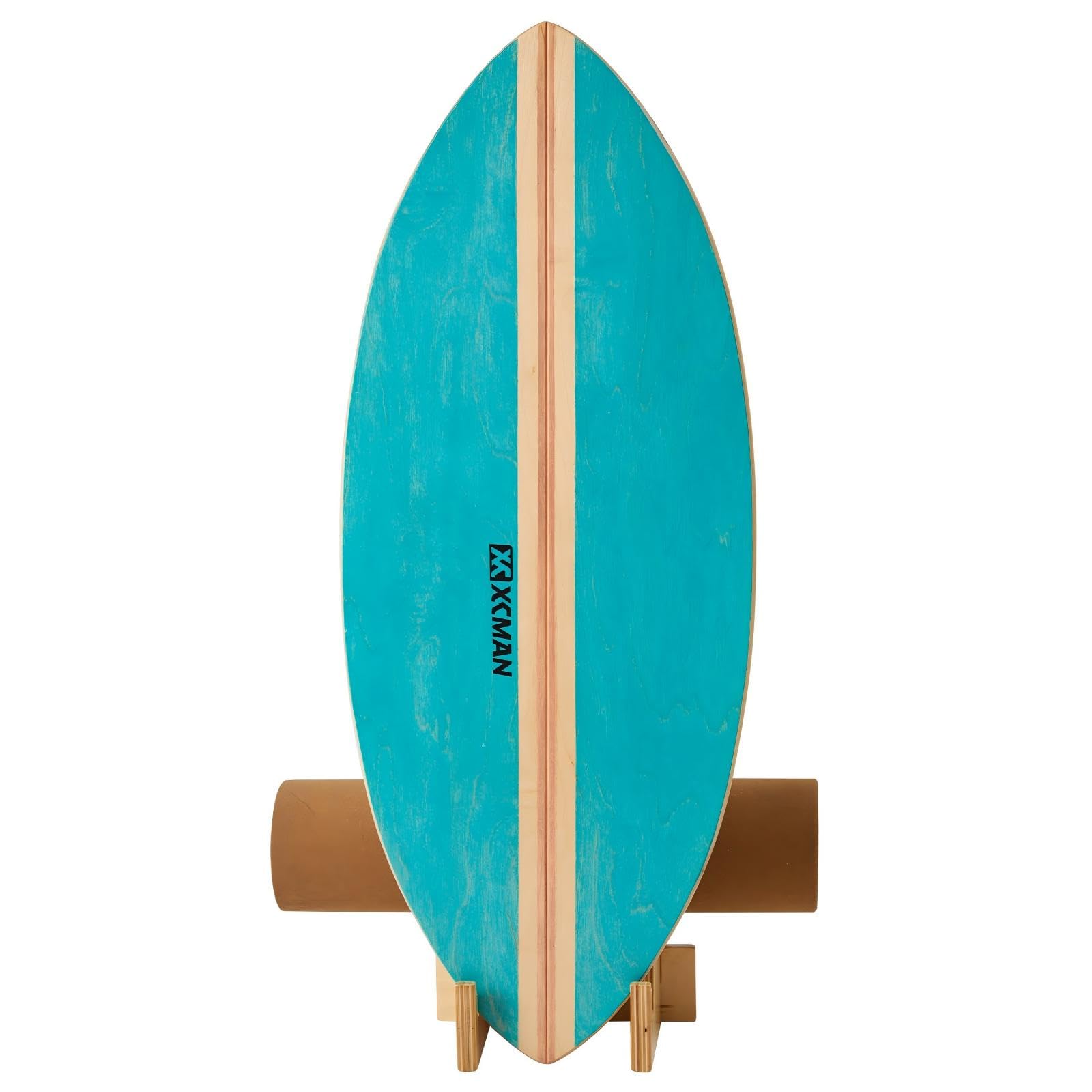
The XCMAN Surf Balance Board Trainer combines a 28.5-inch wooden deck with a separate roller, creating a dynamic platform that closely replicates the feeling of riding a wave or carving a turn on a snowboard. The heavy-duty wood construction supports up to 350 pounds, and the roller is made from solid rubber that glides noise-free across hardwood, carpet, or concrete without leaving marks. The matte-textured surface provides reliable grip without feeling abrasive, and the board comes with a roller holder for controlled practice.
Weighing just 6.6 pounds, this board is lightweight enough to carry to the office or pack for a weekend trip, yet it feels solid underfoot. The roller is well-weighted, giving it a natural momentum that helps you find your center of gravity rather than wobbling erratically. It works equally well for surfers honing their pop-up mechanics, skateboarders working on board control, or anyone who wants a playful but effective core workout.
Customer feedback consistently highlights the board’s value relative to pricier brands, with many users noting that the build quality rivals boards costing twice as much. The only area for improvement is that the board is offered in two shapes (arch and flat), and some users wish the distinction were clearer in the product listing before purchase.
Why it’s great
- Long deck and weighted roller provide authentic surf and snowboard simulation.
- Lightweight design at 6.6 pounds makes it genuinely portable for office or travel.
- Solid rubber roller protects floors and operates quietly on any surface.
Good to know
- Arch versus flat board shapes can be confusing — double-check the product images before ordering.
- Some users wish the deck were slightly wider for larger foot sizes.
4. Gaiam Evolve Balance Board Standing Desk
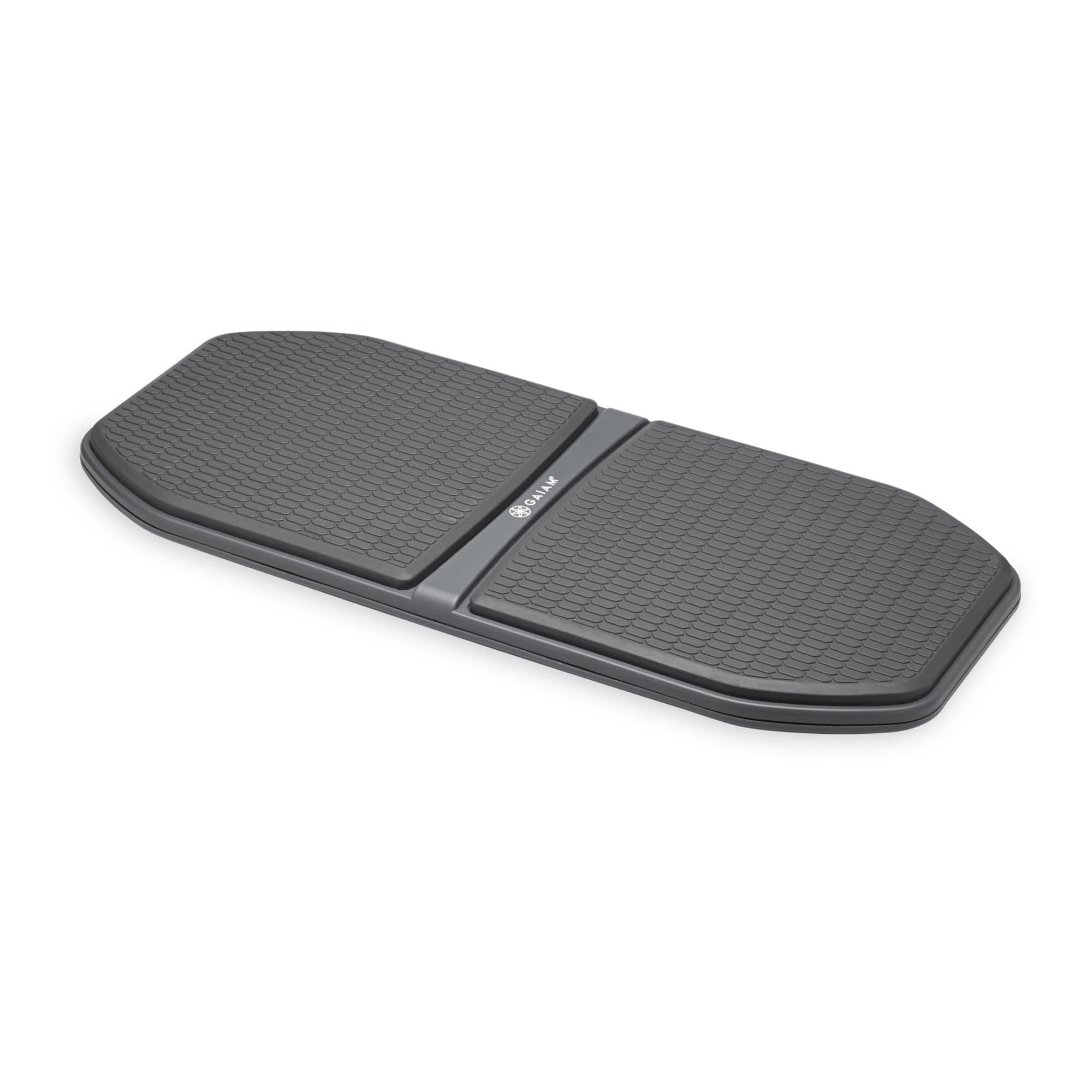
The Gaiam Evolve is purpose-built for the standing-desk crowd, offering a low-profile rocker that allows subtle micro-movements without the dramatic tilt of a full wobble board. Its 27-inch by 12-inch platform is wide enough to accommodate natural stance shifts, and the PU, PVC, and TPR construction provides a cushioned surface that reduces foot fatigue during long standing sessions. The honeycomb non-slip texture keeps your feet planted securely on both hard floors and carpet.
The rocker mechanism permits both forward-backward and side-to-side movement, which engages your core, leg, and ankle stabilizers without pulling your focus away from work. Some users report that the top cushion layer can peel slightly near the center after extended use, but the board’s overall construction holds up well under daily office routines. It adds about 3.65 inches of height, so you may need to adjust your standing desk height accordingly.
Reviews from office workers and retail associates highlight how the board prevents the annoying knee-locking sensation that comes from standing still for hours. One caveat: after roughly two months of heavy use, a small number of users noticed a creaking sound during rocking, which may be disruptive in a quiet open-plan office.
Why it’s great
- Low-profile rocker encourages micro-movements ideal for maintaining focus during work.
- Wide cushioned platform reduces foot and back fatigue compared to standing on a hard mat.
- Honeycomb non-slip surface works well on both hardwood and carpet.
Good to know
- Weight capacity of 250 pounds may feel less stable for heavier adults.
- Some boards develop a creaking sound after a few months of daily use.
5. Fitlaya Fitness Balance Board Trainer

The Fitlaya Fitness Balance Board combines a 29.1-inch maple-wood deck with a 17.8-inch roller, offering a classic roller-board experience that translates well to action sports training. The Canadian maple construction feels dense underfoot and supports up to 350 pounds, while the anti-slip surface keeps your feet secure during dynamic movements. The board is handcrafted, which gives it a consistent wood grain and smooth edges that are comfortable to grip if you step off the center.
This board is a hit among families, with multiple reviews mentioning that kids as young as 8 years old pick it up quickly and stay engaged for hours. The roller has a natural glide that works well on carpet and hard floors, and the board’s length provides plenty of room for adjusting your stance — a plus for taller users. The included roller tube has plastic end caps that some users report popping off after extended use, though they can be pressed back on easily.
For the price, the Fitlaya offers a solid entry into roller-board training without sacrificing build quality. It’s a great option for anyone who wants to practice surf or snowboard movements at home without spending premium-tier money, and the fun factor makes it a board that actually gets used rather than stored away.
Why it’s great
- Long 29.1-inch maple deck accommodates taller users and wide stances easily.
- Handcrafted wood construction feels premium and provides a smooth, comfortable edge.
- Engaging for kids and adults alike, making it a true family fitness tool.
Good to know
- Plastic end caps on the roller tube can detach over time and need reattachment.
- Maximum weight capacity limited to 350 pounds, not the 450 found on more premium boards.
6. StrongTek Wooden Balance Board with 360° Wobble

The StrongTek Advanced Balance Board bridges the gap between basic rocker boards and full round-base wobble boards by using a cross-shaped base that provides 360-degree directional tilt with a larger floor-contact area for better control. The 17.5-inch by 13.5-inch lauan hardwood platform is sturdy enough for daily use, supporting up to 350 pounds, and the textured top surface offers strong grip in bare feet or shoes. This cross-base design makes it more approachable than a traditional round wobble board while still offering a challenging multi-directional workout.
It’s ideal for post-surgery physical therapy, as the controlled wobble radius lets you gradually increase your range of motion without sudden instability. The board is compact enough to store on its side, and at just under 5 pounds, it’s easy to move around the house. Several reviews from post-knee-surgery patients confirm that this board helped them regain balance confidence and prepare for hiking and other outdoor activities.
The most common quality complaint involves the corner edge protectors, which have adhesive backing that can peel off over time. This is a minor annoyance that doesn’t affect the core function of the board, but it prevents the overall experience from being flawless. For the price, the StrongTek offers a well-thought-out middle step between an entry-level rocker and a full wobble board.
Why it’s great
- Cross-base design provides 360-degree wobble with more stability than a round base.
- Compact dimensions and light weight make it easy to store and transport.
- Effective for post-surgery rehab and gradual balance progression.
Good to know
- Adhesive corner protectors tend to peel off after some use — a known material issue.
- Smaller platform size may feel restrictive for users with larger feet or wider stances.
7. Theraband Rocker Balance Board
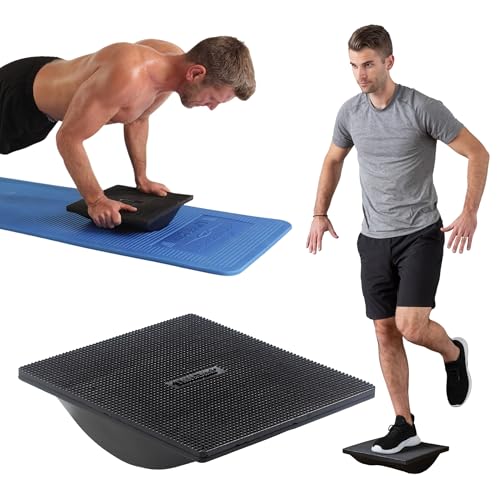
The Theraband 23300 Rocker is the clinical standard for physical therapy offices, and for good reason. This molded plastic board offers a controlled 30-degree angle of deflection along a single plane, allowing precise forward-backward or side-to-side movement without the instability of a multi-axis wobble board. The tactile top surface provides reliable grip, while the anti-skid bottom keeps the board planted on tile, wood, or low-pile carpet — a critical safety feature for rehab patients with compromised balance.
Weighing just 3.5 pounds and measuring 18 inches by 15 inches, it’s lightweight enough to toss in a gym bag and take with you to appointments or on trips. The included illustrated guide covers over 37 exercises, ranging from simple ankle circles to advanced single-leg holds, making it useful for both targeted rehab and general conditioning. The one-plane instability is perfect for isolating specific muscle groups, particularly for plantar fasciitis, ankle sprains, and post-surgical recovery.
Users consistently note that the board feels much more solid than its plastic construction would suggest, and physical therapists frequently recommend it for home rehab programs. The only real trade-off is that the plastic material, while durable, doesn’t absorb impact as well as wood, so it may feel a bit hard underfoot during barefoot use. For its intended clinical purpose, however, the Theraband Rocker remains a reliable and proven tool.
Why it’s great
- Industry-standard choice for PT clinics, with proven reliability and safety.
- Controlled 30-degree single-plane motion is ideal for targeted rehab and injury prevention.
- Lightweight, compact design with an illustrated guide containing over 37 specific exercises.
Good to know
- Plastic surface feels harder underfoot than wood — better suited for use with shoes.
- Only supports single-plane movement; not suitable for multi-directional training needs.
FAQ
What is the difference between a rocker board and a wobble board?
Can I use a balance board if I weigh over 300 pounds?
How often should I use a balance board to see improvement?
Is a roller balance board better than a wobble board for surf training?
Final Thoughts: The Verdict
For most users, the balance board for adults winner is the Sportneer 7 Modes Wobble Board because its combination of a 450-pound weight capacity, seven adjustable challenge modes, and tool-free stopper system offers unmatched versatility for athletes, rehab patients, and beginners alike. If you want a science-backed board specifically designed to strengthen your feet and relieve plantar fasciitis, grab the Mobo Board. And for a lightweight, affordable standing-desk companion that keeps your body moving while you work, nothing beats the Gaiam Evolve.