
Our readers keep the lights on and the weekend projects moving. As an Amazon Associate, I earn from qualifying purchases.
A dead fridge, a dark living room, and a router that won’t boot—that’s the reality of a blackout without a proper backup battery for home. Whether it’s a seasonal storm or a grid failure, the difference between inconvenience and disaster comes down to one decision: the capacity, chemistry, and inverter quality of your backup power source. This guide cuts through the marketing fluff to match you with a unit that actually keeps your essentials running when the grid goes dark.
I’m Rikta — the co-founder and writer behind FitlyFast.
After cross-referencing capacity ratings, cycle life claims, and recharge speeds, I have selected what I consider the absolute best backup battery for home options on the market right now.
How To Choose The Best Backup Battery For Home
Selecting a home backup battery is not just about the biggest number on the box. The real calculation involves your specific load requirements, the battery’s cycle life, recharge speed, and how seamlessly it integrates into your existing electrical setup. Ignoring these factors can leave you with a brick that either runs out of power too fast or cannot even start your refrigerator’s compressor.
Battery Chemistry: LiFePO4 vs. NMC vs. Lead-Acid
Lithium Iron Phosphate (LiFePO4) is the dominant chemistry in this category for a reason: it offers 3,000 to 4,000 charge cycles before dropping to 80% capacity, far outlasting the 500-1,000 cycles of Nickel Manganese Cobalt (NMC) or the 200-500 cycles of sealed lead-acid. LiFePO4 is also thermally stable, making it much safer for indoor use. NMC batteries pack more energy density (lighter for the same capacity), but their shorter lifespan and higher fire risk make them less ideal for a permanent home backup role. Lead-acid units are budget-friendly but heavy, slow to charge, and will need replacement every few years.
Inverter Wattage vs. Capacity (Watts vs. Watt-hours)
Watt-hours (Wh) tell you the total energy stored—like the size of your fuel tank. Inverter wattage tells you the maximum power it can deliver at any moment—like the size of the engine. You need enough inverter wattage to start motor-driven appliances (refrigerators, sump pumps) which can draw 2-3 times their running wattage during startup. A common mistake is buying a unit with huge capacity (e.g., 2,000Wh) but a low inverter (e.g., 1,000W) that cannot start a fridge. Always check both numbers.
UPS Switchover Speed
Not all home backup batteries can protect sensitive electronics. The transfer time from grid power to battery power is measured in milliseconds. A standard UPS switches in under 10ms, which is fast enough for computers and network gear. Some portable power stations switch in 20-30ms, which can cause a reboot cycle for sensitive power supplies. If you plan to keep your PC, server, or medical device running during the transition, look for a sub-10ms or sub-20ms rated unit with a pure sine wave output.
Recharge Speed and Solar Compatibility
After an outage, you need the battery to recharge fast before the next blackout hits. Units with high AC input rates (1,800W to 2,400W) can top off a 2kWh battery in under an hour. For off-grid or extended backup, solar input matters: look for an MPPT controller and high voltage/power input ratings (400W to 1,200W) so you can refill during daylight. A unit that takes 8 hours to recharge via AC or has a weak solar controller limits your emergency readiness.
Expansion Capability
A fixed-capacity unit might cover your needs today, but your power requirements can grow. The best backup batteries offer modular expansion via external battery packs (e.g., BLUETTI’s B300K or Segway’s BTX-1000). This allows you to start with a 2kWh core and add capacity up to 5kWh or more without buying a whole new system. If you plan to power a full-size refrigerator, freezer, and lights for more than 24 hours, expansion capability is a must-have feature.
Quick Comparison
On smaller screens, swipe sideways to see the full table.
| Model | Category | Best For | Key Spec | Amazon |
|---|---|---|---|---|
| BLUETTI AC200L | Station | Scalable home backup | 2048Wh / expandable to 8192Wh | Amazon |
| Anker SOLIX C2000 Gen 2 | Station | Fast recharge & lightweight | 2048Wh / 2400W (4000W peak) | Amazon |
| Jackery Explorer 2000 v2 | Station | Lightest 2kWh unit | 2042Wh / 2200W / 39.5 lbs | Amazon |
| Segway Cube 2000 | Station | Modular expansion & IP56 | 2048Wh / expandable to 5kWh | Amazon |
| DJI Power 2000 | Station | Ultra-quiet operation | 2048Wh / 3000W / <30 dB | Amazon |
| AFERIY P210 | Station | 16-port versatility | 2048Wh / 2400W (4800W surge) | Amazon |
| Jackery HomePower 3000 | Station | Whole-home essential backup | 3072Wh / 3600W (7200W surge) | Amazon |
| EF ECOFLOW Delta 3 Classic | Station | Portable camping & home | 1024Wh / 1800W (<10ms UPS) | Amazon |
| EBL Acc2400 | Station | High-capacity on a budget | 1843Wh / 2400W (3500 cycles) | Amazon |
| GOLDENMATE 1500VA | UPS | Dedicated UPS for electronics | 296Wh / 1000W (LiFePO4 / 10yr) | Amazon |
| Champion 2500W Inverter | Generator | Gas-powered high endurance | 1850W run / 2500W start / 39.7 lbs | Amazon |
In‑Depth Reviews
1. BLUETTI AC200L

The BLUETTI AC200L sits at the sweet spot of the home backup market. It packs 2,048Wh of LiFePO4 capacity with a 2,400W pure sine wave inverter (3,600W Power Lifting for surges), and critically, it is expandable up to 8,192Wh by adding multiple B300K or B300 battery packs. This means you can start with a single unit and scale it to power a full-size refrigerator, freezer, and network equipment for days.
The AC200L supports a 45-minute fast recharge from 0-80% via 2,400W AC input, and it can accept up to 1,200W of solar input through its MPPT controller. The 30A RV port is a rare inclusion at this price tier, allowing direct 30-amp hookup to RVs or transfer switches. With a sub-10ms UPS switchover time, it protects sensitive electronics during a grid dropout.
Owner feedback consistently praises the AC200L’s build quality and reliability in real outages. Users report running security systems, large OLED TVs, and full-size refrigerators for up to 10 hours on the expanded configuration. The 5-year warranty and 10-plus-year battery life provide a long-term ownership experience that justifies its position at the top of this list.
Why it’s great
- Expandable to 8,192Wh with modular battery packs
- 45-minute 0-80% recharge via 2,400W AC input
- 30A RV port and sub-10ms UPS switch
Good to know
- Heavy at 61 pounds — requires planning for permanent placement
- Proprietary expansion cables add cost
2. Anker SOLIX C2000 Gen 2

The Anker SOLIX C2000 Gen 2 is engineered for speed. It can fully recharge its 2,048Wh LiFePO4 battery from AC power in just 58 minutes via a 2,400W input rate, and it supports 800W alternator charging for vehicle-based refills. The unit delivers 2,400W continuous output (4,000W peak) and can expand to 4kWh with an optional expansion battery.
Anker claims this unit can run a dual-door fridge for up to 32 hours on a single charge, a figure verified by owners who have used it during multi-day outages. At 41.7 pounds and a compact 18.1 x 9.8 x 10.1-inch footprint, it is one of the most space-efficient 2kWh stations in this class. The standby power consumption is just 9W, making it efficient for always-on home backup scenarios.
Owners highlight the six recharge methods (AC, solar, car, alternator, generator, and dual AC/solar hybrid) as a key differentiator. The app-based control works reliably over Bluetooth and Wi-Fi, allowing remote monitoring of charge status and usage history. A few users note the lack of a printed manual, but the fast-charging capability and compact design make the C2000 Gen 2 a top-tier choice for those who value rapid recovery after an outage.
Why it’s great
- Full recharge in 58 minutes — fastest in its capacity class
- 800W alternator charging for on-the-go top-ups
- Very low standby power consumption (9W)
Good to know
- Expansion battery sold separately and proprietary
- No integrated wheels or trolley for transport
3. Jackery Explorer 2000 v2

Jackery’s Explorer 2000 v2 is a showcase of CTB (Cell-to-Body) technology borrowed from the EV industry, allowing a 2,042Wh LiFePO4 battery to be packed into a chassis that weighs only 39.5 pounds — 41% lighter than typical 2kWh competitors. It delivers 2,200W of pure sine wave AC power and offers a sub-20ms UPS switchover, UL1778 certified for protecting sensitive electronics.
The unit charges from 0-80% in 66 minutes via AC and includes a silent charging mode that operates at under 30 dB — quiet enough for use in a bedroom during an overnight outage. The built-in LED light with dim/bright/SOS modes adds utility for emergency scenarios. Owners report running a full-size refrigerator for over 21 hours on a single charge without issue.
Buyers consistently praise the unit’s portability and the intuitive LCD display that shows real-time input, output, and battery percentage. The main drawback noted is the barrel-style solar input connectors, which several owners report feel less robust than Anderson-style connectors. Despite this, the Explorer 2000 v2 is a strong mid-range option for anyone who needs a truly portable 2kWh backup that won’t stay in a single corner.
Why it’s great
- Lightest 2kWh unit at 39.5 pounds — easy to move
- UL1778 certified UPS with sub-20ms switchover
- Silent charging mode under 30 dB
Good to know
- Solar input uses barrel connectors — less rugged than MC4/Anderson
- Bluetooth connection can be inconsistent for app control
4. Segway Cube 2000
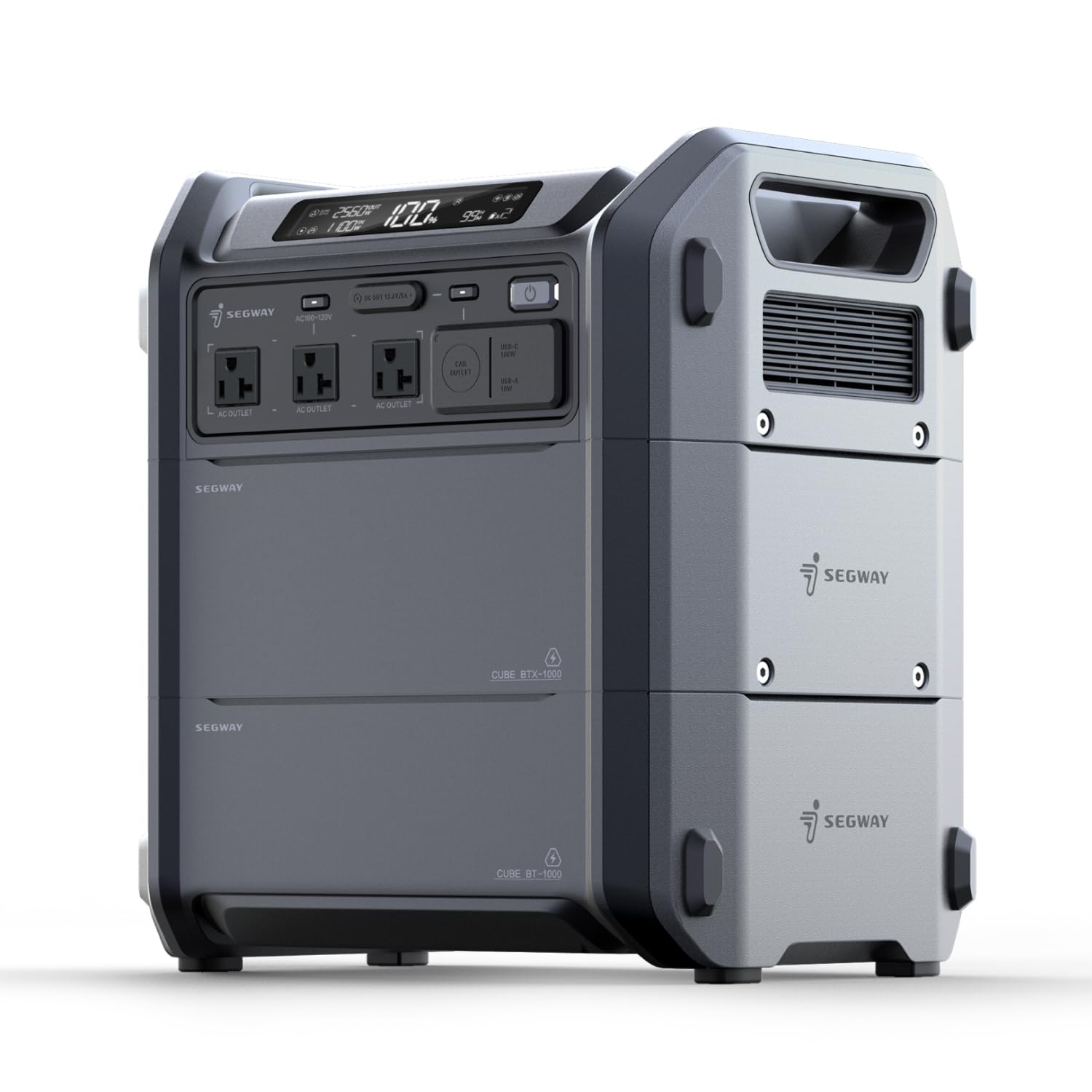
The Segway Cube 2000 stands out for its modular design and physical ruggedness. It offers 2,048Wh of LiFePO4 capacity with a 2,200W pure sine wave inverter (expandable to 4,400W with R-drive). The real headline is its cordless expandability: you can stack up to three BTX-1000 expansion batteries for a total of 5kWh without any messy external cables.
The IP56 rating — rare in this category — means the Cube 2000 is protected against water splashes and dust ingress, making it suitable for outdoor use, garage workshops, or damp basements during storms. It charges to full in 1.8 hours via AC and accepts solar input with MPPT technology achieving up to 97% conversion efficiency. The dual 100W USB-C ports are a welcome feature for charging high-draw laptops simultaneously.
Owner reviews highlight its ability to run a refrigerator for over 11 hours on a single unit and the convenience of the app-based monitoring. Some users report the unit arriving dead after storage, which suggests the battery management system may drain the cell if left at 100% charge for extended periods. The 5-year warranty provides peace of mind, but buyers should plan to store the unit at around 50-70% charge.
Why it’s great
- Cordless modular expansion up to 5kWh
- IP56 water and dust resistance rating
- 97% MPPT solar conversion efficiency
Good to know
- App required for initial activation
- Some units have lost charge during long storage periods
5. DJI Power 2000
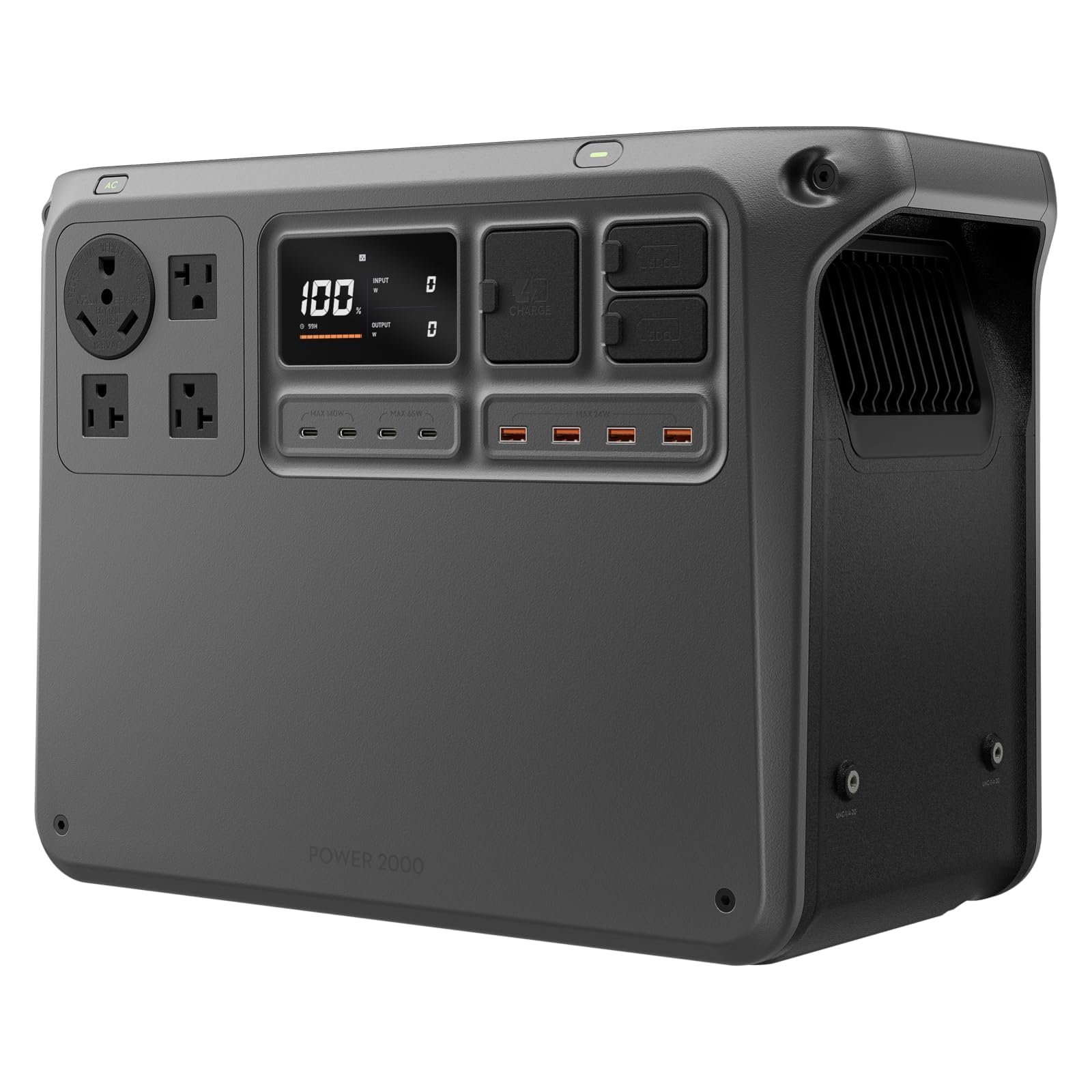
DJI, best known for drones, brings its engineering pedigree to the home backup category with the Power 2000. It houses a 2,048Wh LiFePO4 battery and a 3,000W continuous inverter (4,000W peak) — notably high wattage for its capacity class. The sub-10ms UPS switchover and sub-30 dB noise level make it one of the quietest and fastest-switching units available.
Its compact dimensions (17.64 x 8.86 x 12.76 inches) and 21.72 kg weight are smaller than many 2kWh rivals, thanks to a high-density battery pack and efficient thermal design. The unit includes 15 ports, including four AC outlets, four USB-C ports (two at 140W), and dual SDC ports for expansion up to 22.5kWh — enough to power essential home devices for 4-6 days. DJI claims a 4,000-cycle lifespan with 70% capacity retention.
Owner feedback is overwhelmingly positive, with particular praise for the power-to-size ratio and silence during operation. Some users have reported receiving gray-market units set to 50 Hz rather than 60 Hz, a logistics defect that DJI support eventually resolved. The proprietary charging connectors (SDC ports) limit third-party expansion options. The 5-year warranty and 4,000-cycle battery make the Power 2000 a premium long-term investment.
Why it’s great
- 3,000W continuous output — highest power-to-capacity ratio
- Under 30 dB operation during charging and discharge
- 4,000-cycle LiFePO4 battery with 10+ year lifespan
Good to know
- Proprietary SDC ports limit third-party battery expansion
- App required for UPS mode and advanced settings
6. AFERIY P210

The AFERIY P210 targets users who need to power many devices at once. Its 2,048Wh LiFePO4 battery feeds a 2,400W (4,800W surge) pure sine wave inverter through 16 ports: six AC outlets, two USB-A, four USB-C (including a 100W PD port), two DC5521 ports, one car outlet, and one XT60 DC port. This configuration is ideal for home backup scenarios where you need to keep a fridge, some lights, a router, and multiple phones/laptops running simultaneously.
The unit features a sub-10ms UPS switchover and operates at less than 30 dB under normal loads, making it quiet enough for bedside use during overnight outages. The LiFePO4 battery is rated for 3,500 cycles with a 10-year service life. The AFERIY app allows remote monitoring and energy management, though some users report the app interface could be more intuitive.
Owners in food trucks and small businesses praise the P210 for running all their equipment reliably. A known issue involves the display screen blacking out after solar charging, requiring a multi-button reset to restore. However, the 7-year extended warranty is longer than industry standard and signals confidence in the build quality. The 16-port count and 48.5-pound weight make it a strong mid-range value for heavy multi-device home backups.
Why it’s great
- 16 output ports including six AC and four USB-C
- Sub-10ms UPS switchover protects sensitive gear
- 7-year extended warranty
Good to know
- Display can black out after solar charging — requires reset
- Battery capacity is non-expandable
7. Jackery HomePower 3000
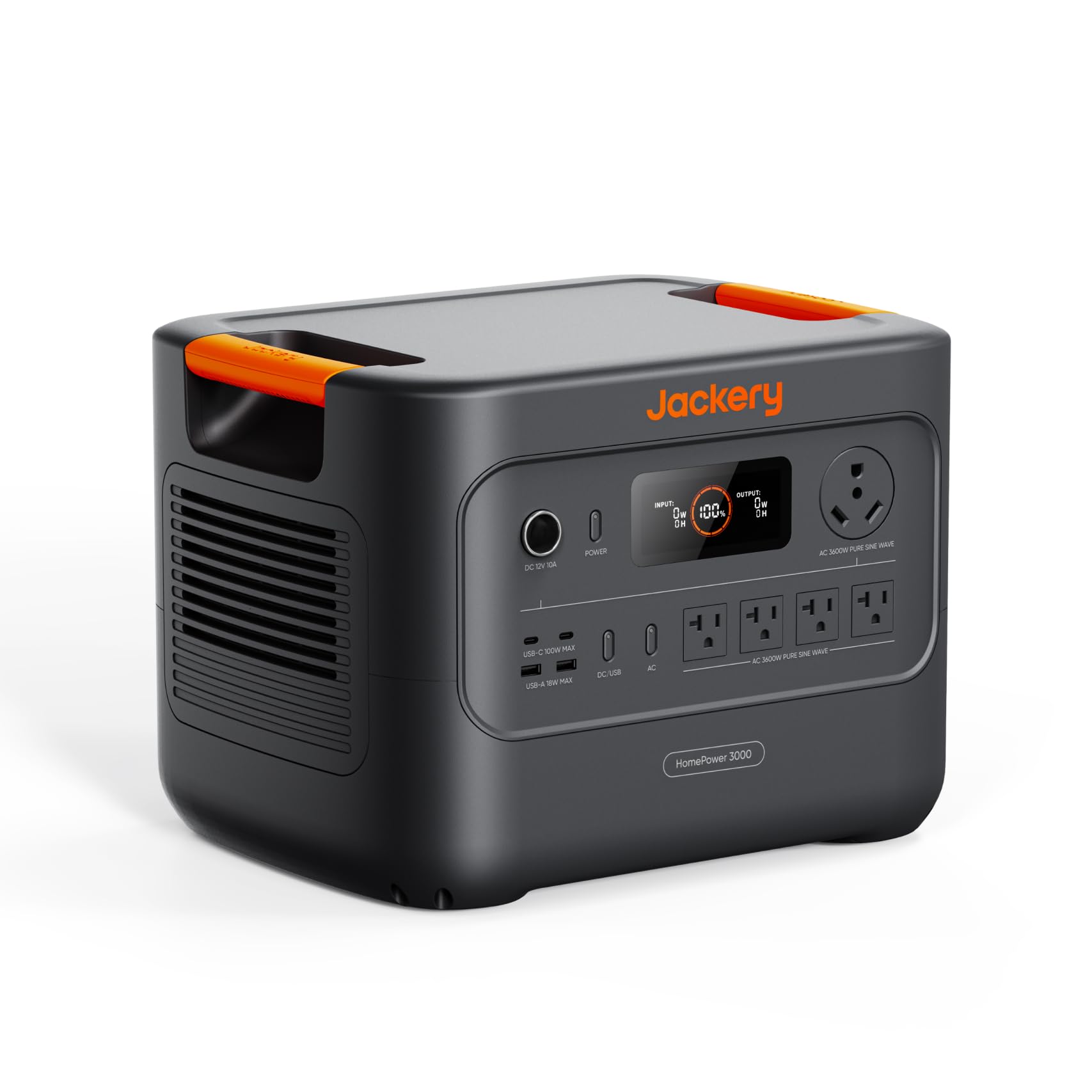
The Jackery HomePower 3000 is the largest unit in this lineup, packing 3,072Wh of LiFePO4 capacity and a 3,600W inverter capable of 7,200W surge — enough to handle startup loads from multiple motor-driven appliances simultaneously. It is designed as a true whole-home essential backup, capable of powering a refrigerator, lights, a fan, a router, and even a small window AC unit for an extended period.
The unit charges fully in 1.7 hours via hybrid AC/DC input or 2.2 hours via AC alone. Jackery’s ChargeShield 2.0 AI algorithm manages the charging profile to extend battery life, and the LiFePO4 cells are rated for 4,000 cycles at 70% capacity retention. The included TT-30 RV port allows direct plug-and-play connection to RVs or small transfer switches, making it a versatile unit for both home backup and camper power.
Owner feedback from RV and camper users is excellent, with reports of running a 30-foot travel trailer’s AC, microwave, and TV for multiple days. However, the fan noise is notable — some owners report around 60 dB when the unit is under load, which is too loud for a bedroom UPS. The 60-pound weight also makes it a permanent-placement device rather than a portable solution. The warranty policy requiring direct purchase from Jackery is a point of contention for some buyers.
Why it’s great
- 3,072Wh capacity and 7,200W surge for heavy loads
- TT-30 RV port for direct 30A hookup
- 4,000-cycle LiFePO4 with ChargeShield 2.0
Good to know
- Fan can reach 60 dB under moderate load
- Warranty requires purchase directly from Jackery
8. EF ECOFLOW Delta 3 Classic
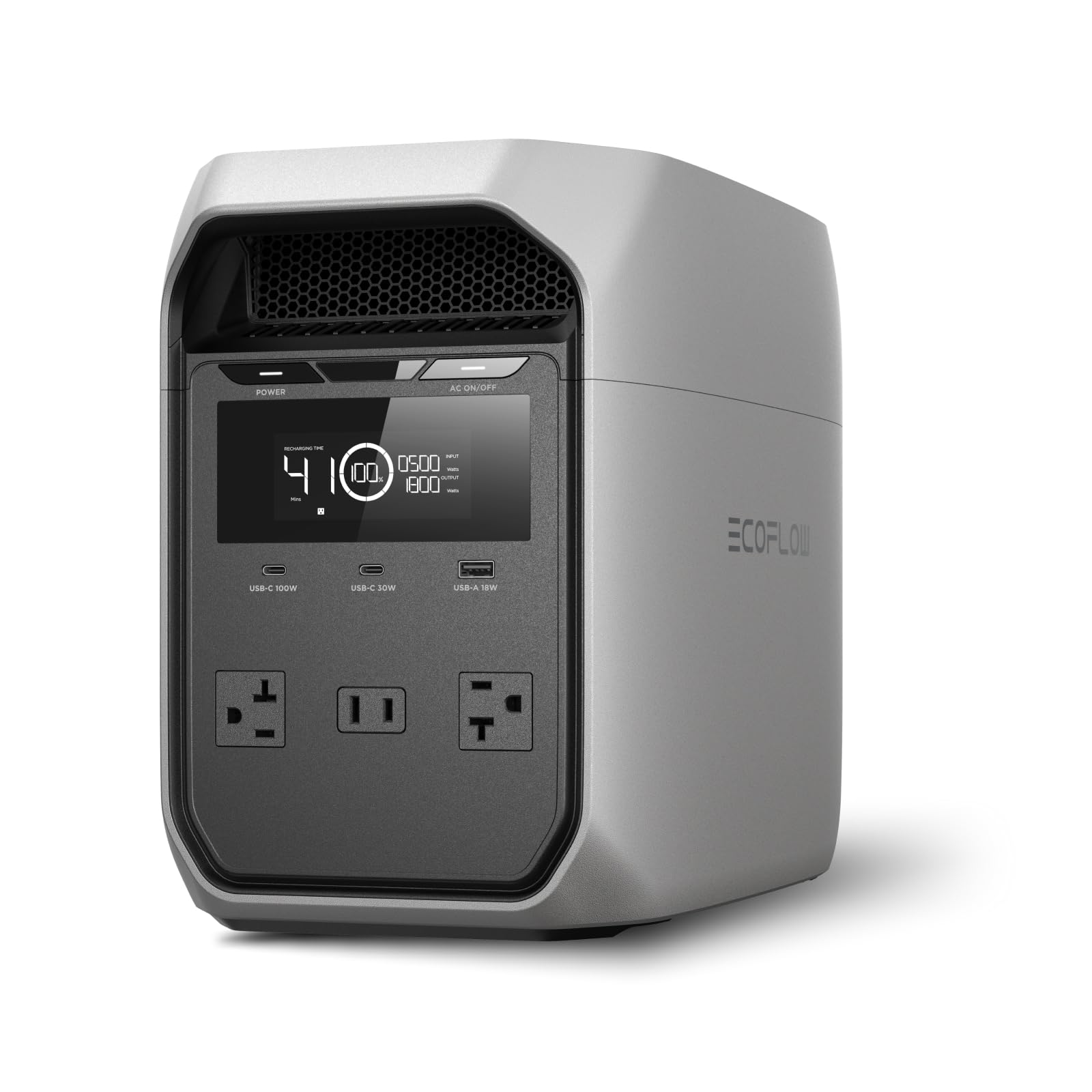
The EF ECOFLOW Delta 3 Classic is a compact 1,024Wh LiFePO4 power station with an 1,800W inverter (3,600W surge via X-Boost). Its primary strength is its sub-10ms UPS switchover — fast enough to protect PCs, servers, and medical equipment without a hiccup. This makes it a strong dual-purpose unit: a portable camping power station during the day and a dedicated UPS for critical electronics at home.
It charges from 0-80% in just 45 minutes via X-Stream AC charging, and it supports up to 500W solar input for a 2.5-hour recharge with sufficient panels. The 15-pound weight and compact 7.9 x 11.1 x 15.7-inch form factor make it genuinely portable. The EcoFlow app offers smart control features, including Storm Alert and Self-Powered Mode, which automatically sets the unit to recharge from solar when bad weather is forecast.
Owner reviews consistently mention the excellent build quality and the seamless UPS switchover during power dips. Users have run a 65-inch TV for 4-5 hours and two CPAP machines for two nights on a single charge. The main limitation is the 1,024Wh capacity — sufficient for a few hours of essential backup, but not for multi-day outages. It is an ideal entry point for those who want a lightweight, fast-switching backup battery that can also serve as a portable power station.
Why it’s great
- Sub-10ms UPS switchover for sensitive electronics
- 0-80% charge in 45 minutes
- Only 15 pounds — truly portable
Good to know
- 1,024Wh capacity — best for short-duration backup
- Not compatible with Delta 2 or Delta 3 expansion batteries
9. EBL Acc2400
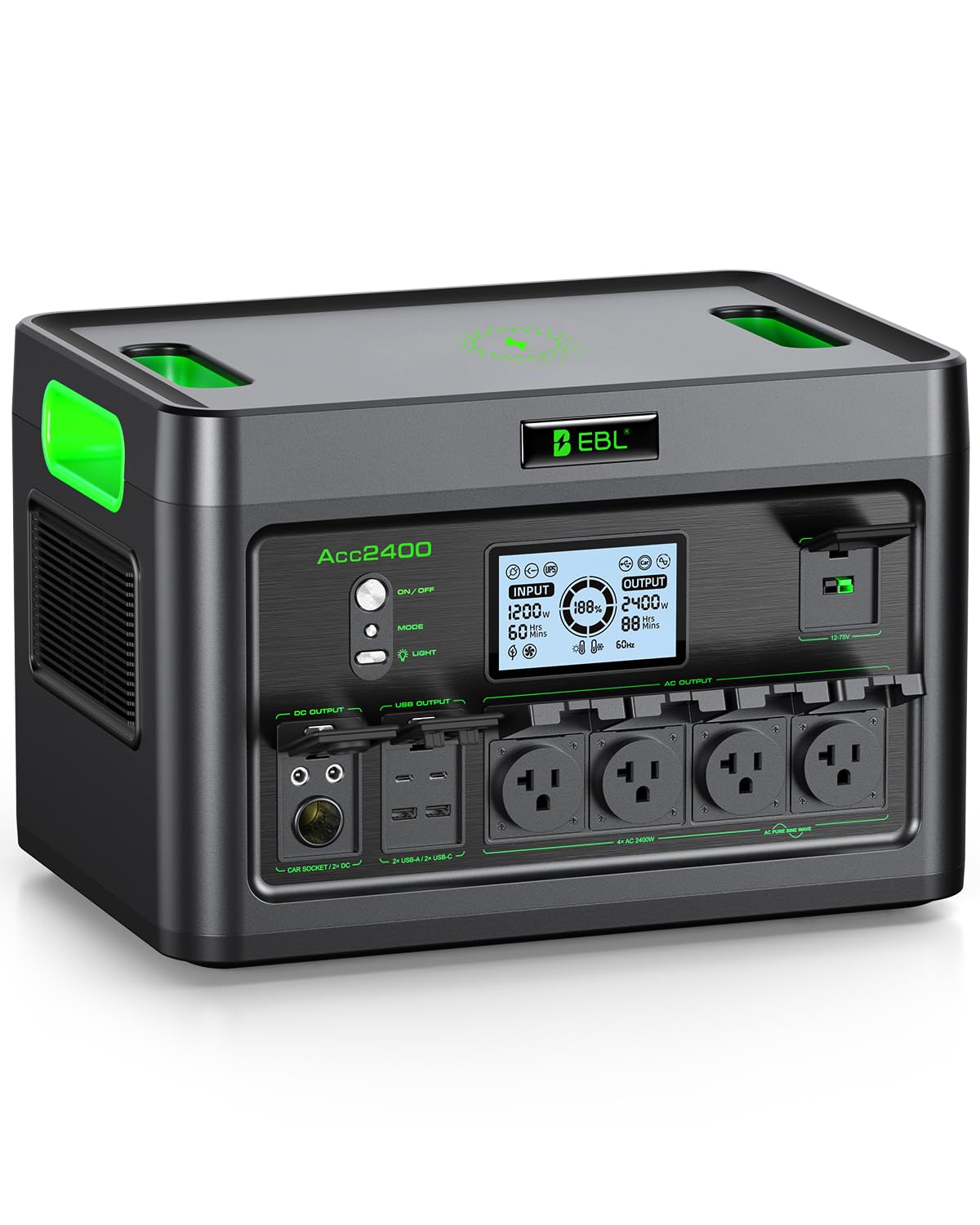
The EBL Acc2400 offers 1,843Wh of LiFePO4 capacity at a price point significantly below competing 2kWh stations. It provides a 2,400W pure sine wave inverter, 12 output ports (including four AC, two USB-A, two USB-C with PD, one car port, two DC ports, and a wireless charging pad), and a claimed 0.1-second UPS switchover for emergency power during outages.
The unit’s LiFePO4 battery is rated for 3,500 charge-discharge cycles with a 10-plus-year service life. The dual-side handles and 55-pound weight make it manageable to move around the home. A built-in 4-mode LED light adds utility for camping and blackout scenarios. The unit also supports up to 500W solar input, though a buyer’s review notes compatibility issues with some 100W solar panels.
Owner experiences are mixed. Positive reviews from CPAP users and small business vendors praise the unit for running a fan on high for 4 hours with significant battery remaining. However, negative feedback points to a defective unit that dropped from 80% to 0% in minutes and an 8-hour recharge time that contradicts the claimed 2-hour spec. The wireless charging pad also wastes energy when idle. For budget-conscious buyers willing to accept some risk in quality control, the Acc2400 offers high capacity per dollar spent.
Why it’s great
- 1,843Wh capacity at a budget-friendly price
- 12 ports including wireless charging pad
- 4-mode LED light for emergencies
Good to know
- Inconsistent QC — some units arrive defective
- Actual recharge speed can be slow (~8 hours)
10. GOLDENMATE 1500VA/1000W

The GOLDENMATE 1500VA is not a portable power station — it is a dedicated Line-Interactive UPS designed to protect sensitive electronics. It uses a 51.2V, 5.8Ah (296Wh) LiFePO4 battery pack rated for over 3,000 charge cycles and a 10-year service life, a massive improvement over the typical lead-acid UPS batteries that need replacement every 2-3 years. The pure sine wave inverter delivers 1,000W continuous power.
It features Automatic Voltage Regulation (AVR) that corrects brownouts and overvoltages without switching to battery, extending battery life. The eight NEMA 5-15P outlets provide both surge protection and battery backup. The LCD display shows real-time battery percentage, load level, and input voltage. The front-panel USB charging ports (Type-C and Type-A, 10W total) can keep a smartphone charged during an outage.
Owner reviews note the superior build quality compared to APC and CyberPower units, with a metal case and quality outlets. Users have successfully run an Alienware desktop with a 1,000W PSU and two monitors during blackouts. The unit is large and heavy due to the 51.2V transformer, and the USB connection only reports battery level to Windows (not power data). The beeping alarm during battery operation can be muted. For protecting a computer, network rack, or server during short outages, this UPS is a long-term value that outperforms traditional lead-acid alternatives.
Why it’s great
- LiFePO4 battery with 10-year service life — no lead-acid replacement needed
- Pure sine wave output and AVR for clean power delivery
- Metal enclosure with premium outlet spacing
Good to know
- 296Wh capacity — designed for short-duration electronics backup, not whole-home use
- Large and heavy due to high-voltage battery transformer
11. Champion 2500W Inverter Generator

In a list dominated by battery-powered stations, the Champion 2500W Inverter Generator represents the gas-fueled alternative for those who need long-run-time backup without worrying about recharge. It produces 1,850 running watts with a 2,500 starting watt peak, enough to power a refrigerator, a freezer, several lights, and a router. The 79cc 4-stroke engine runs up to 11.5 hours on a full tank at 25% load.
At 39.7 pounds, it is one of the lightest 2,500W inverter generators on the market. The unit operates at 53 dBA from 23 feet, making it quieter than a standard conversation. It produces clean electricity with less than 3% total harmonic distortion (THD), safe for sensitive electronics. The parallel-ready capability allows connection with a second Champion 2500W inverter to double the output. The CO Shield auto shutoff system cuts the engine if carbon monoxide levels rise to unsafe levels.
Owner feedback over a year of use is solid. Users report powering a fridge, freezer, laptops, and lights for 26-30 hours on a single tank of fuel, and the unit starts on the first or second pull even after months of storage. The main trade-offs are the ongoing cost of gasoline, the need for ethanol-free fuel to prevent carburetor issues, the exhaust smell, and the noise level (53 dBA is quiet for a generator but still audible). The Champion is a budget-friendly, high-endurance option for extended outages where battery capacity would run out and solar recharge is unavailable.
Why it’s great
- Up to 11.5 hours run time on a single tank of gas
- 39.7 pounds — lightest in its wattage class
- Clean power (<3% THD) safe for sensitive electronics
Good to know
- Requires gasoline — ongoing fuel cost and exhaust emissions
- 53 dBA noise level — quieter than traditional generators but audible
FAQ
Can a backup battery for home power a refrigerator?
What is the difference between a UPS and a portable power station for home backup?
How long does a 2kWh backup battery last during a power outage?
Can I leave my backup battery plugged in all the time?
Why do some backup batteries use proprietary expansion connectors?
Final Thoughts: The Verdict
For most users, the best backup battery for home is the BLUETTI AC200L because it offers the best balance of capacity (2,048Wh), inverter power (2,400W), expansion capability (up to 8kWh), and fast recharge speed (45 minutes to 80%) at a price that undercuts many competitors. If portability and ultra-fast recharge are your priorities, grab the Anker SOLIX C2000 Gen 2 — its 58-minute full recharge and 41.7-pound weight make it the most practical unit for active use. And for a dedicated electronics UPS that eliminates lead-acid battery replacement forever, nothing beats the GOLDENMATE 1500VA with its 10-year LiFePO4 battery and pure sine wave output.