
Our readers keep the lights on and the weekend projects moving. As an Amazon Associate, I earn from qualifying purchases.
A gas engine that stalls on damp grass, or an electric battery that dies before your back fence—every bagging lawn mower buyer hits a moment of truth when the capacity of the collection bag and the torque of the motor collide. The difference between a single-pass finish and a half-hour of frustrated stops often comes down to the bushel rating of the bag and the cubic centimeters behind the blade.
I’m Rikta — the co-founder and writer behind FitlyFast. I’ve spent countless hours cross-referencing engine displacement, bushel volumes, cutting deck construction, and real-world runtime data to sort which bagging mowers actually hold up season over season.
Whether you manage a half-acre slope or a postage-stamp city lawn, knowing the difference between a 144cc push mower and a 201cc self-propelled unit with a 2.0-bushel bag can save you from buying twice. This guide cuts through the noise to find the best bagging lawn mower for your property.
How To Choose The Best Bagging Lawn Mower
Three specs separate an afternoon chore from a season-long frustration: bag capacity, engine class, and drive system. Ignore color schemes and focus on how each component moves grass from the blade to the bag without clogging.
Bag Capacity and Airflow Design
The bushel rating of the collection bag tells you how many square feet of yard you can mow before dumping. A 1.7-bushel bag works for a quarter-acre lot, but a 2.0-bushel bag cuts trips by nearly 20 percent on larger properties. Airflow matters just as much—look for a vented deck or vortex tunnel that keeps clippings moving upward instead of clumping inside the chute.
Engine Displacement vs. Battery Voltage
Gas engines in the 144cc to 170cc range handle standard residential yards. Jump to a 201cc mill when you face thick St. Augustine or wet spring growth that fills the bag fast. On the electric side, 40V systems from WORX and 56V systems from EGO deliver brushless torque comparable to a 150cc gas engine, but runtime on a single charge can dip below 30 minutes under full bagging load.
Self-Propelled Type and Terrain Fit
Front-wheel drive pulls the mower forward and pivots easily around flower beds. Rear-wheel drive bites into slopes and uneven ground without losing traction. For bagging on hills, rear-wheel drive with a CVT or variable-speed transmission lets you match pace to the terrain without slowing the blade speed.
Quick Comparison
On smaller screens, swipe sideways to see the full table.
| Model | Category | Best For | Key Spec | Amazon |
|---|---|---|---|---|
| EGO Power+ LM2123SP-2 | Electric Self-Propelled | Large quiet yards | 80-minute total runtime | Amazon |
| SENIX 22″ 201cc | Gas Self-Propelled | Tough terrain | 8.8 ft-lb torque | Amazon |
| YARDMAX YG2860 | Gas Self-Propelled | CVT speed control | 6-speed CVT transmission | Amazon |
| BILT HARD 21″ 201cc | Gas Self-Propelled | Durable workhorse | 9.0 ft-lb torque | Amazon |
| PowerSmart 22″ 170cc | Gas Self-Propelled | Slope traction | 60L bag capacity | Amazon |
| SENIX 21″ 170cc | Gas Self-Propelled | Overgrown grass | 1.7-bushel bag | Amazon |
| WORX WG752 | Cordless Push | Lightweight electric | 7-position deck height | Amazon |
| BILT HARD 21″ 144cc | Gas Push | Budget simplicity | 10-position cutting height | Amazon |
| STEELITE 40V Combo | Cordless System | Multi-tool value | 40L bag capacity | Amazon |
In‑Depth Reviews
1. EGO Power+ LM2123SP-2

The EGO LM2123SP-2 pairs a 56V brushless motor with Touch Drive self-propulsion, delivering instant speed adjustment from your palm. It ships with both a 6.0Ah and a 4.0Ah battery plus a rapid charger, offering a combined runtime of roughly 80 minutes under mixed conditions. The 21-inch stamped steel deck accepts a two-bushel grass bag that fills evenly thanks to the high-lift blade design.
Real-world bagging on a 10,000-square-foot lot consumes about 40 minutes from the 6.0Ah pack under load, meaning the second battery covers the finish without a recharge pause. The mulching performance is decent but slightly less uniform than a dedicated high-end gas deck because the blade speed varies with battery state. Owners consistently praise the IPX4 weather resistance and the bright LED headlights for dusk mowing.
The trade-off is price—you are paying for premium battery platform compatibility across EGO’s entire tool line. If you already own EGO gear, this mower integrates seamlessly. For first-time buyers, evaluate whether 80 minutes of total runtime covers your entire property before committing to the ecosystem.
Why it’s great
- Touch Drive self-propel with variable speed dial
- Two included batteries give real-world 80-minute headroom
- LED headlights and weather-resistant build
Good to know
- Requires a special blade for optimal bagging
- Premium price reflects the battery ecosystem
2. SENIX 22″ 201cc Self-Propelled
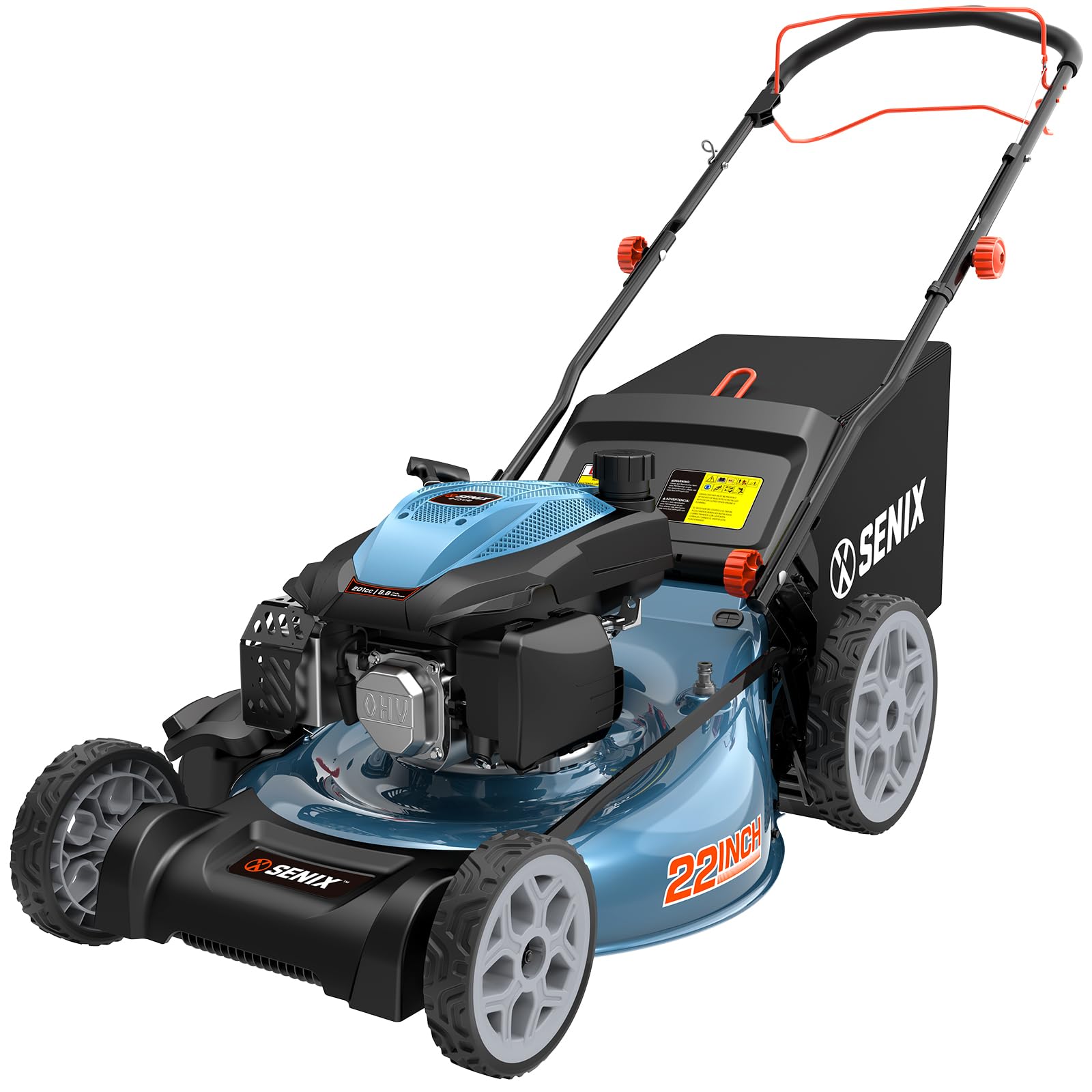
SENIX equips this 22-inch mower with a 201cc OHV engine producing 4.7 HP and 8.8 ft-lb of torque, making it one of the strongest bagging platforms in the mid-range price tier. The rear-wheel single-speed self-propel reaches 2.9 MPH and handles uneven terrain without bogging. The DC04-06 low-carbon steel deck with vortex tunnel airflow actively pushes clippings into the bag, minimizing clogging in wet grass.
Owners report first- or second-pull starting even after winter storage, thanks to the automatic choke system. The 6-position height adjustment spans 1.25 inches to 4 inches, accommodating everything from a tight Bermuda cut to tall fescue. At 61.7 pounds the mower feels solid but not unmanageable for a self-propelled unit.
The grass bag attachment is a mechanical clip-in system that some users find finicky until the tabs break in. Replacement parts availability from SENIX has been slower than from legacy brands, so factor that into long-term ownership. For the torque-per-dollar ratio, this mower punches above its weight.
Why it’s great
- High-torque 201cc engine cuts through thick growth
- Vortex tunnel deck reduces bag clogging
- Automatic choke for reliable cold starts
Good to know
- Single-speed self-propel lacks variable control
- Some owners report finicky bag attachment
3. YARDMAX YG2860 22″ CVT
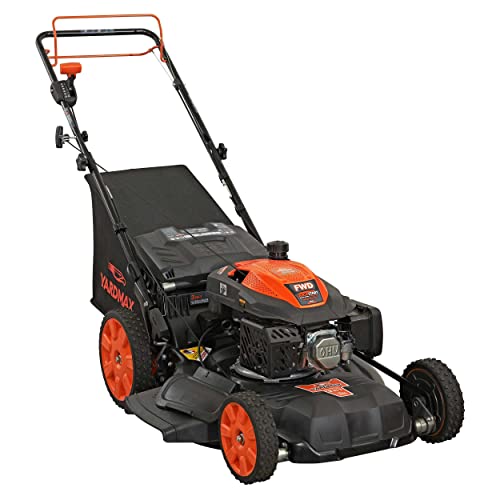
The YARDMAX YG2860 stands out for its Select PACE 6-speed CVT transmission, which lets you dial in ground speed without losing blade momentum. The 201cc engine starts via an automatic choke—no priming or manual choking required. Aggressive spiked tread tires on the front wheels provide surprising traction on damp slopes, and the high-wheel design rolls over thick grass without dragging.
Bagging performance benefits from the 22-inch cutting width and a deck cleanout port that lets you hose debris away after each mow. Owners consistently mention that the CVT feels intuitive: you shift into the pace that matches your walk and it holds steady. The 84-pound curb weight is noticeable during manual pushing, but the self-propel system handles the effort on flat ground.
The front-wheel drive design draws criticism on steep inclines where the drive wheels sometimes lose traction if the grass is wet. The bagger mounts securely but the plastic chute can warp if left in direct sun. For mostly flat or rolling terrain with a need for variable speed, the YARDMAX delivers a driving experience closer to a tractor than a standard walk-behind.
Why it’s great
- 6-speed CVT matches your walking pace
- Deck cleanout port simplifies maintenance
- Automatic choke for hassle-free starting
Good to know
- Front-wheel drive slips on wet steep slopes
- Heavy at 84 pounds when self-propel is off
4. BILT HARD 21″ 201cc Self-Propelled
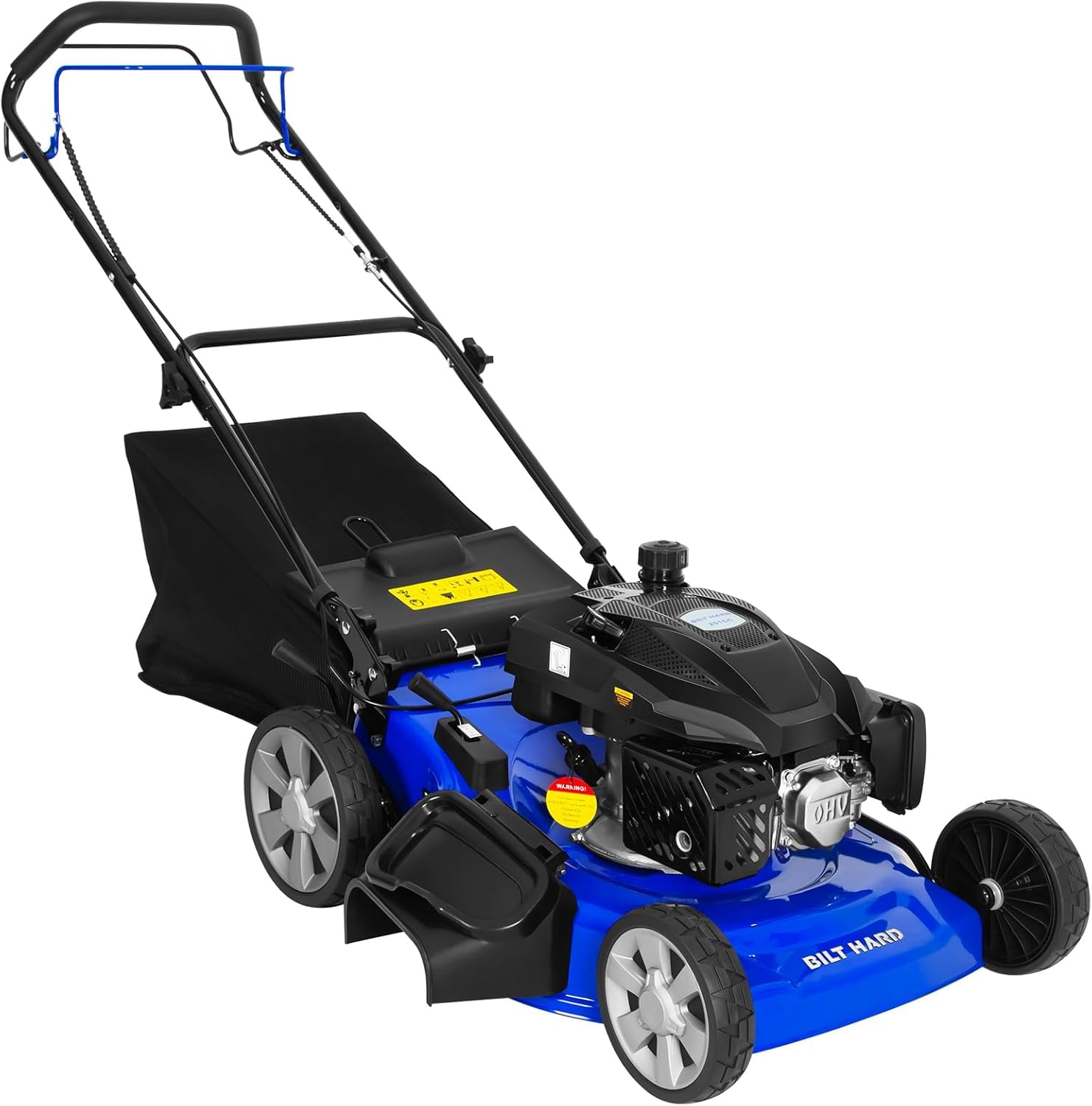
BILT HARD’s 21-inch self-propelled mower packs a 201cc OHV engine rated at 9.0 ft-lb of torque—more than most competitors in this class. The rear-wheel drive system with single-speed propulsion climbs moderate slopes without the front-end wander common on FWD units. The 8-position height adjustment lever synchronizes all four wheels from 1.2 to 3.75 inches.
The steel deck supports 3-in-1 functionality including bagging, and the no-choke/no-primer design means you pull the cord and go. Owners highlight how easily it starts on the first or second pull after sitting for weeks. The foam-wrapped angled handle reduces vibration fatigue during longer mowing sessions.
Build quality reports are mixed: a subset of users experienced wheel detachment or drive shaft vibration within the first season. The warranty support from BILT HARD’s US-based team is responsive, but consistency in assembly quality control is a known variable. For buyers willing to inspect hardware and tighten fasteners, the torque-to-price ratio is compelling.
Why it’s great
- Highest torque (9.0 ft-lb) in this price bracket
- Rear-wheel drive climbs slopes effectively
- No-choke starting with foam comfort handle
Good to know
- Quality control varies between units
- Some owners report wheel hardware loosening
5. PowerSmart 22″ 170cc Self-Propelled
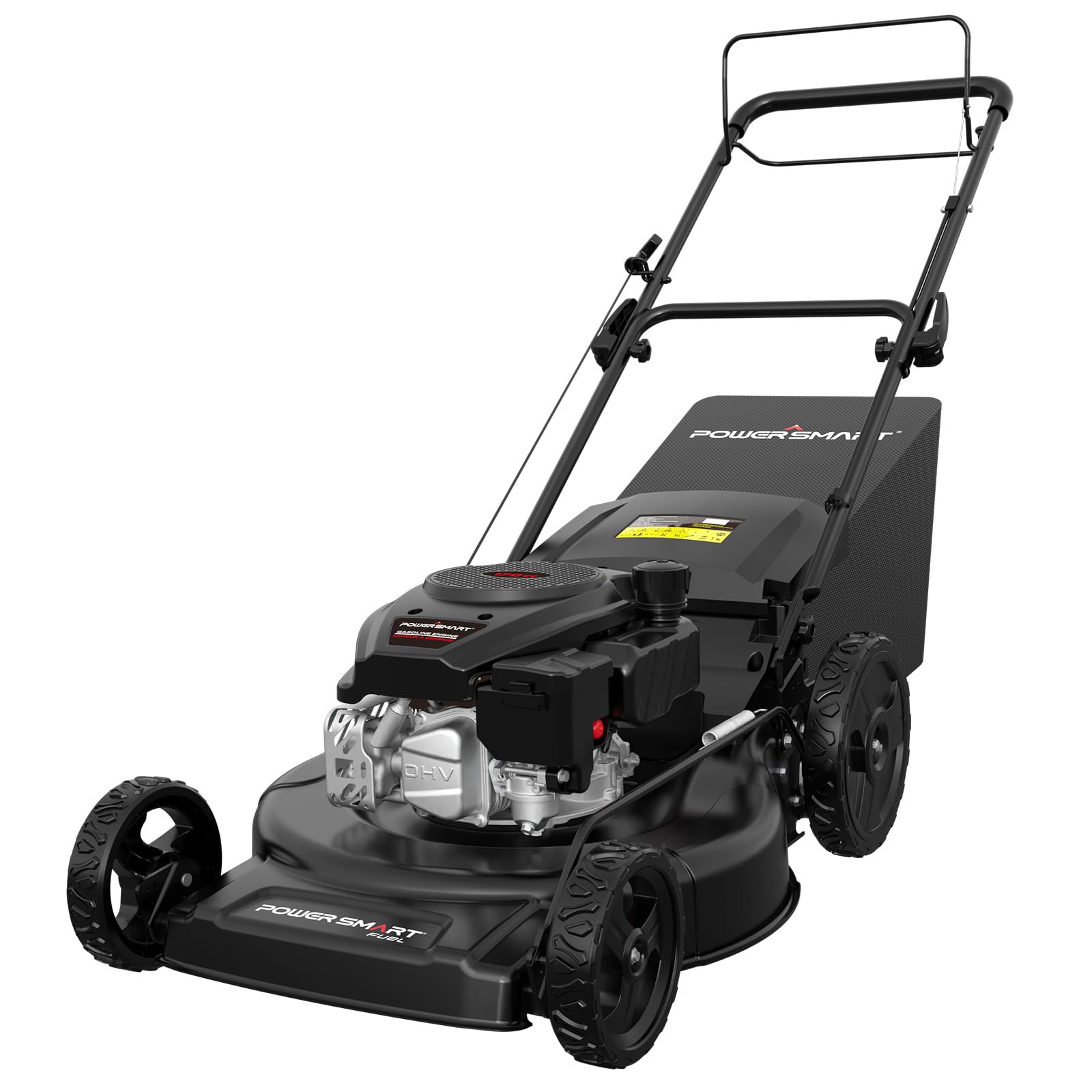
PowerSmart’s 22-inch mower uses a 170cc OHV engine with rear-wheel drive, a combination that grips hills better than many front-drive alternatives at this price. The 60-liter (approximately 1.7-bushel) grass bag captures a full mow of a quarter-acre lot before needing a dump. The all-steel deck with a heavy-duty blade delivers clean cuts in mixed grass types.
Assembly takes about 10 minutes out of the box, and the auto-choke system helps the engine fire on the first or second pull. Owners note that the mower feels lighter than its 68-pound spec suggests, partly because the weight distribution sits low. The 6-position rear-wheel height adjustment ranges from 1.5 to 3 inches, which is adequate for most warm-season grasses but limited for cool-season lawns that need a taller cut.
The rubber rear flap and mulching chute can wear or detach over time, and replacement parts from PowerSmart are not widely stocked at big-box retailers. The stiff primer bulb requires several pumps before a cold start. For a budget-conscious buyer on sloped terrain, the rear-wheel drive and large bag are the standout features.
Why it’s great
- Rear-wheel drive provides solid slope traction
- 60L bag covers most of a quarter-acre mow
- Light feel despite 68-pound curb weight
Good to know
- Height adjust maxes at 3 inches
- Replacement parts availability is limited
6. SENIX 21″ 170cc Self-Propelled
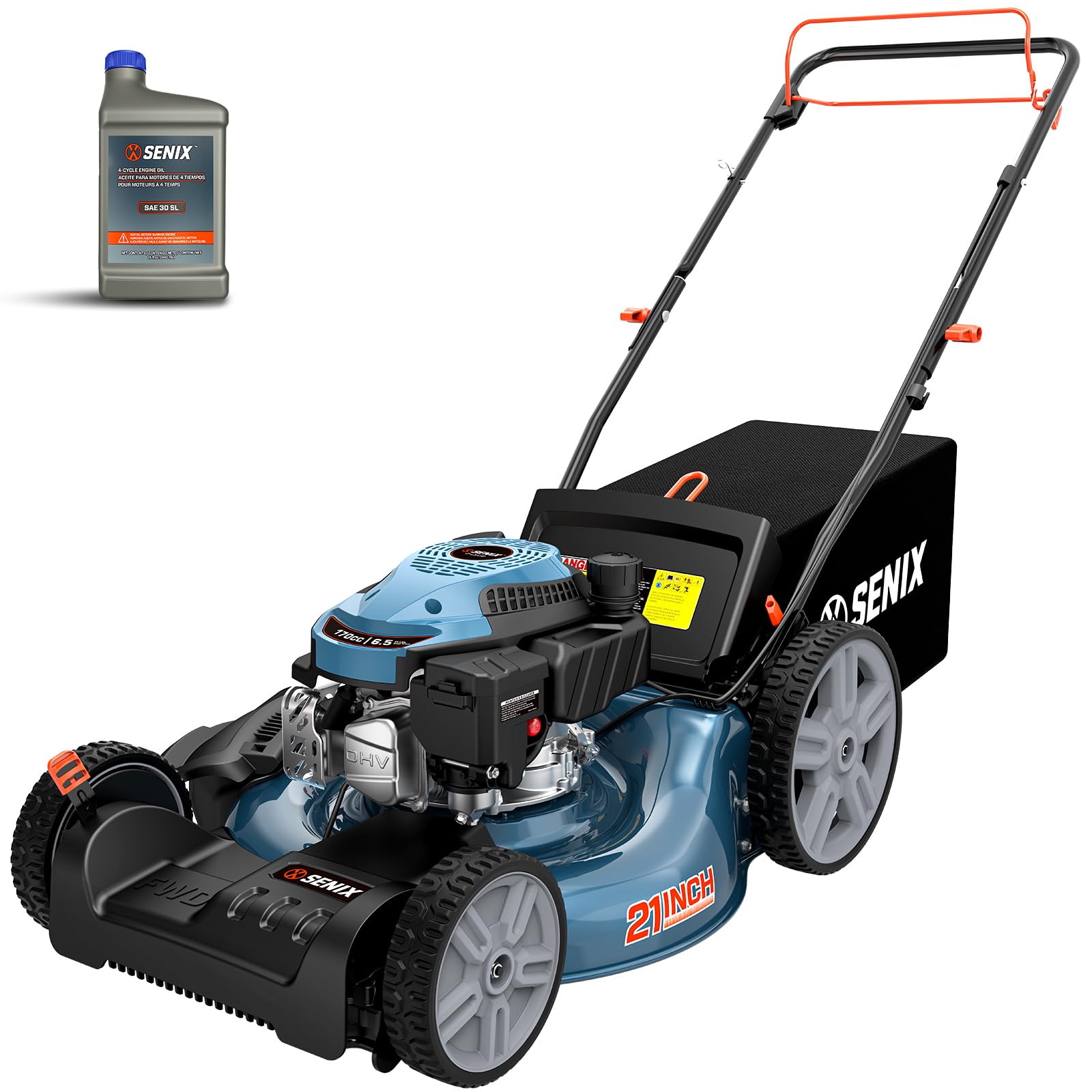
The SENIX 21-inch self-propelled mower pairs a 170cc OHV engine with a 1.7-bushel bag and a dual-lever 6-position height adjustment. The front-wheel drive system pulls the deck forward and makes pivot turns around trees and garden beds effortless. Owners tackling overgrown 18-inch grass report that the engine powers through without stalling, a testament to the 6.5 ft-lb torque rating.
Assembly is straightforward, and the pre-filled oil lets you start cutting within minutes of unboxing. The 3-in-1 system swaps between bagging, mulching, and side discharge using the included plug and chute. The 61.7-pound weight keeps the mower planted during self-propelled operation while remaining light enough to lift for transport.
Reliability is the primary concern here: several owners describe engine failure after minimal hours, including drivetrain noise followed by a complete shutdown. The plastic height adjustment mechanism feels less substantial than the metal levers on higher-tier models. For buyers on a strict budget with a flat yard under a third of an acre, the initial performance is strong, but long-term durability is a gamble.
Why it’s great
- Front-wheel drive pivots easily around obstacles
- Engine handles overgrown 18-inch grass without bogging
- Quick assembly with pre-filled oil included
Good to know
- Long-term reliability reports are inconsistent
- Height adjustment uses plastic components
7. WORX WG752 Nitro 40V Cordless

WORX’s WG752 is a 40V push mower with AeroDeck technology that vents the cutting chamber to reduce clogs and boost bag fill. The brushless motor 2.0 delivers 40 percent more power than the previous generation, with IntelliCut sensors that automatically increase blade speed in thick grass and conserve battery in thin areas. Two 20V 5.0Ah PowerShare Pro batteries and a dual charger are included.
The 21-inch deck with 7-position height adjustment (1.5 to 4 inches) covers a half-acre on a single charge, with owners reporting about 50 minutes of runtime under normal residential conditions. The lightweight 55.6-pound frame makes it one of the easiest mowers to push uphill when the battery is still full. Vertical storage with the collapsible handle saves significant garage floor space.
The bag capacity is not specified in bushels but the collection bag holds a moderate load that requires emptying roughly every 1,500 square feet on dense grass. Replacement blades were initially hard to find at launch, though aftermarket options are now appearing. The self-propelled feature is absent, so this is strictly a push mower—a consideration for large or hilly lawns.
Why it’s great
- AeroDeck reduces bag clogs in damp grass
- IntelliCut auto-adjusts power to grass density
- Light enough to push on mild slopes with no self-propel
Good to know
- No self-propelled drive option
- Aftermarket blades needed initially
8. BILT HARD 21″ 144cc Push Mower
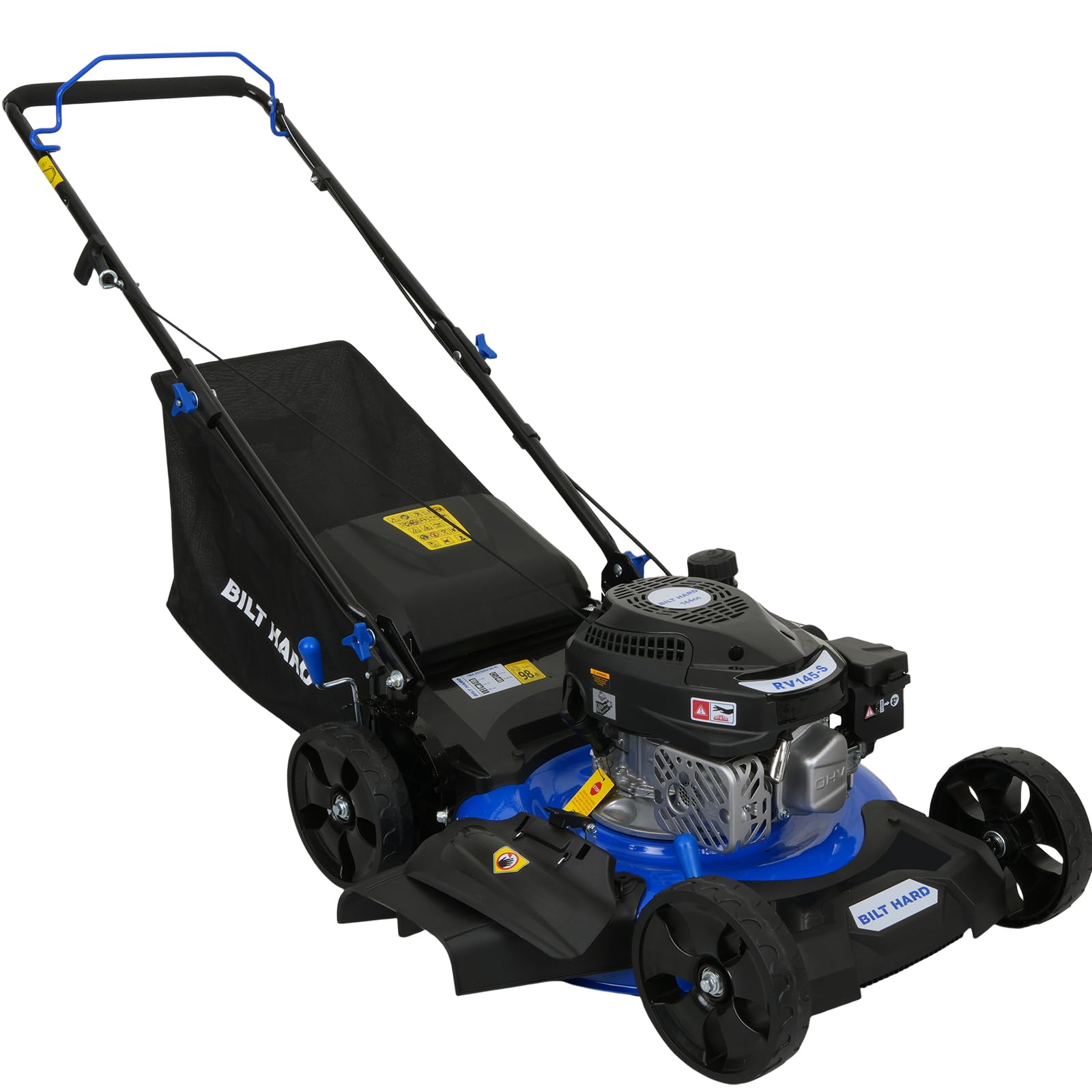
The BILT HARD 21-inch push mower runs a 144cc 4-cycle engine rated at 3.4 HP and 5.75 ft-lb of torque. It offers 10 cutting positions from 1.2 to 3.75 inches via a single-lever height adjustment—more granularity than most mowers at this tier. The 3-in-1 system includes rear bagging, mulching, and side discharge, all powered by a 27.1-ounce fuel tank that covers a quarter-acre yard without refueling.
Owners consistently note that it starts on the first pull and handles tall grass without bogging, making it a strong performer for the price. The steel deck feels solid during use, and the oil is included in the box for the initial fill. The 9.5-inch front and rear wheels roll smoothly over uneven ground without digging in.
The height adjustment lever has a tendency to slip out of position on some units, requiring a zip-tie fix to hold it steady. More critically, a few owners reported severe vibration from a bent driveshaft that caused plastic components to detach and, in one case, hot oil to spray from a cracked dipstick housing. Inspect the unit carefully after the first few uses and confirm the driveshaft runs true.
Why it’s great
- 10 cutting positions give fine-tuned height control
- Strong 144cc engine starts first pull
- Includes oil for immediate assembly
Good to know
- Height adjust lever may slip on some units
- Driveshaft defects reported in a small number of machines
9. STEELITE 40V 17″ Cordless Combo
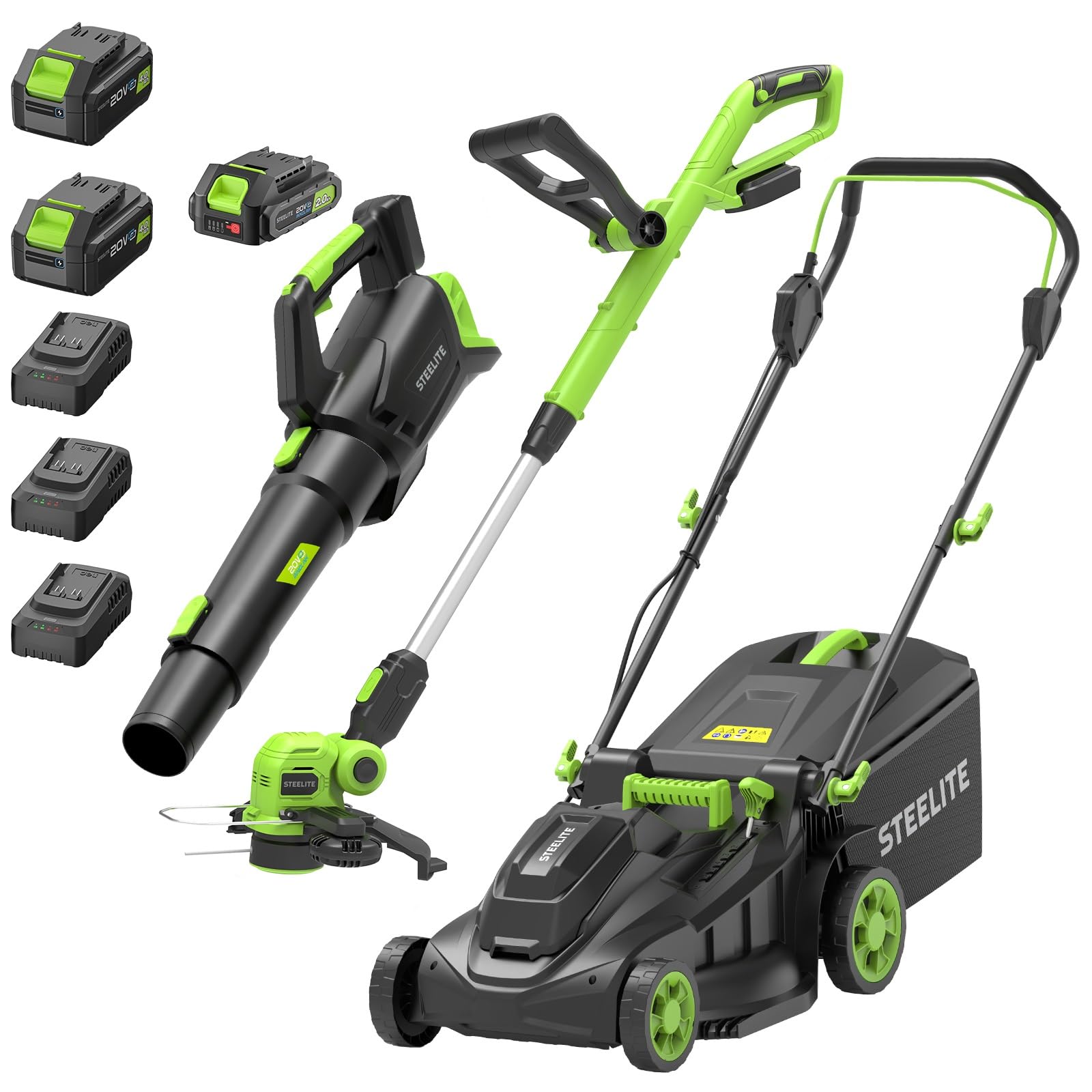
STEELITE bundles a 17-inch cordless mower, a 12-inch string trimmer, and a 500 CFM leaf blower into one kit powered by three 20V 4.0Ah batteries (two for the mower, one for the trimmer/blower). The mower’s 3400 RPM brushless motor and 2-in-1 bagging/mulching design make it suitable for small yards under a quarter acre. The 40L collection bag is proportioned to the 17-inch deck, so it fills fast but empties easily.
The 6-position height adjustment ranges from 0.98 to 2.95 inches, which is shallow for tall fescue but fine for Bermuda or Zoysia. At 30 pounds, the mower is genuinely lightweight and can be carried one-handed. The folding handle and compact footprint allow it to stand vertically in a corner of the garage.
Battery runtime is the critical limitation: owners report 20 to 25 minutes per charge on the mower, which often requires both batteries to finish a small front yard, leaving nothing for the trimmer or blower. The 3+ hour recharge time means you cannot cycle through tools in a single afternoon without buying extra packs. As a system for a tiny flat lawn with the convenience of tool compatibility, this combo works. For anyone with grass thick enough to fill a 40L bag quickly, the battery math falls short.
Why it’s great
- Complete yard system (mower, trimmer, blower) in one box
- Lightweight 30-pound mower is easy to carry
- Folding handle and vertical storage
Good to know
- Batteries run 20–25 minutes before needing a 3-hour recharge
- 17-inch deck is small for medium or large lawns
FAQ
How often do I need to empty a 1.7-bushel bag compared to a 2.0-bushel bag?
Does a larger engine displacement guarantee better bag filling?
Can I convert a mulching mower to bagging by adding a bag?
Final Thoughts: The Verdict
For most users, the best bagging lawn mower winner is the SENIX 22″ 201cc because its 8.8 ft-lb of torque and vortex tunnel deck deliver consistent bag fill without the premium price of a legacy brand. If you value quiet operation and a complete battery ecosystem, grab the EGO Power+ LM2123SP-2. And for budget-conscious buyers needing rear-wheel drive on slopes, nothing beats the PowerSmart 22″ 170cc.