
Our readers keep the lights on and the weekend projects moving. As an Amazon Associate, I earn from qualifying purchases.
The difference between a responsive system and a frustrating stutter-fest often comes down to a single M.2 slot. Whether you are loading massive game worlds on a PS5, rendering 8K timelines in an editing workstation, or running AI inference models locally, the exact M.2 2280 NVMe drive you choose dictates how long the loading bar stares back at you. Raw bandwidth, random IOPS, and thermal throttling behavior are no longer abstract specs—they define your daily workflow ceiling.
I’m Rikta — the co-founder and writer behind FitlyFast. My deep market research and analysis of over two dozen 2TB M.2 SSD models across multiple controller generations, NAND flash types, and real-world thermal profiles drives the recommendations in this guide.
After analyzing sequential and random performance metrics from Gen4 flagships all the way to the latest Gen5 powerhouses, you will walk away knowing exactly which 2tb m.2 ssd matches your hardware and workload demands without overpaying for unused speed.
How To Choose The Best 2TB M.2 SSD
Choosing the right 2TB M.2 SSD means balancing your motherboard’s PCIe generation, your typical workload (gaming vs. content creation vs. general productivity), and your thermal budget. A Gen5 drive in a Gen3 slot wastes potential; a budget Gen4 drive under sustained writes may throttle on a hot laptop. Here is how to navigate the trade-offs.
PCIe Generation: Gen4 vs Gen5
A Gen4 SSD pushing 7,000-7,450 MB/s is more than enough for PS5 expansion, DirectStorage titles, and even prosumer video editing. Gen5 drives (10,000-14,900 MB/s) excel at reducing transfer times for ultra-large files and heavy random workloads like AI training datasets. However, Gen5 requires a compatible motherboard with a dedicated Gen5 M.2 slot and often a heatsink with active airflow to avoid thermal throttling.
NAND Type and Cache Strategy
TLC (Triple-Level Cell) NAND is the sweet spot for performance and endurance in this capacity class. QLC drives offer lower cost but suffer from reduced write endurance and slower sustained write speeds once the pSLC cache fills. Pay attention to whether the drive uses a dedicated DRAM cache (beneficial for boot drives and heavy multitasking) or Host Memory Buffer (HMB) technology, which uses system RAM—fine for gaming but less ideal for professional workstation tasks.
Endurance and Thermal Management
Check the rated TBW (Total Bytes Written) to match the drive’s lifespan to your usage. For a boot drive with daily writes, look for at least 1,200 TBW. Physical thermal solutions matter: some drives include graphene or copper heatsinks, while bare drives depend entirely on your motherboard’s M.2 shield. Sustained sequential writes generate significant heat; drives that throttle at 75°C will not maintain peak speeds during large file transfers.
Quick Comparison
On smaller screens, swipe sideways to see the full table.
| Model | Category | Best For | Key Spec | Amazon |
|---|---|---|---|---|
| BIWIN Black Opal NV7400 | Gen4 | High-speed value boot drive | 7450 MB/s read | Amazon |
| FANXIANG S880E | Gen4 | PS5 expansion & NAS | 7100 MB/s read | Amazon |
| Kingston NV3 | Gen4 | No-nonsense daily driver | 6000 MB/s read | Amazon |
| SABRENT Rocket 4 | Gen4 | Low-heat sustained writes | 7450 MB/s read | Amazon |
| Samsung 9100 PRO | Gen5 | AI computing & heavy workstations | 14700 MB/s read | Amazon |
| Crucial P510 | Gen5 | Future-proof gaming & editing | 10000 MB/s read | Amazon |
| PNY CS2150 | Gen5 | AI-ready workloads | 10300 MB/s read | Amazon |
| Corsair MP600 Elite | Gen4 | High endurance PC builds | 7000 MB/s read | Amazon |
| WD_BLACK SN8100 | Gen5 | Peak speed for pros & enthusiasts | 14900 MB/s read | Amazon |
In‑Depth Reviews
1. BIWIN Black Opal NV7400 2TB

The BIWIN Black Opal NV7400 achieves a peak sequential read speed of 7450 MB/s and a random read/write throughput of up to 1000K IOPS, placing it at the ceiling of Gen4 performance. This drive uses 3D TLC NAND selected through automated binning, paired with a PCIe Gen4×4 controller that also supports Host Memory Buffer (HMB) technology. The integration of a composite PMIC (Power Management IC) improves power distribution efficiency, which directly extends the longevity of the NAND cells under sustained load.
Thermal management is handled by a 0.5mm graphene-aluminum heatsink laminated directly onto the controller and NAND package. This thin profile means the NV7400 fits into most PS5 expansion bays and compact laptops where thicker copper heatsinks cause clearance issues. Real-world user reports indicate idle temps around 42°C when used as an OS drive, and the drive maintains peak transfer rates during prolonged file copy operations without throttling.
The included BIWIN Intelligence software adds value for users who want to monitor drive health, perform firmware updates, and migrate existing data. For a Gen4 drive that hits the maximum achievable bandwidth of the interface, the NV7400 offers a compelling mix of raw speed, thermal efficiency, and software support that makes it a top contender for both gaming and productivity builds.
Why it’s great
- Full Gen4 bandwidth at 7450 MB/s read
- Graphene-aluminum heatsink keeps temps low in tight spaces
- PMIC design improves power efficiency
Good to know
- DRAM-less design relies on HMB for cache
- BIWIN is a smaller brand for some users
2. FANXIANG S880E 2TB

The FANXIANG S880E delivers sequential read speeds up to 7100 MB/s and write speeds up to 5300 MB/s, making it fully compatible with the PS5’s Gen4 requirement. It uses a PCIe Gen4×4 controller with NVMe 2.0 support and built-in 3D NAND flash. One standout detail for PS5 users is the thermal solution: the drive sticker incorporates a graphite-coated copper foil layer and an aluminum foil layer designed to dissipate heat effectively inside the console’s confined M.2 bay without requiring an additional aftermarket heatsink.
This drive is also an excellent choice for NAS applications. Verified user reports show it integrates seamlessly into Ugreen NAS enclosures, outperforming older SATA SSDs by roughly 5x during large file transfers via rsync. The S880E includes hardware encryption support, which is a useful feature for sensitive data storage in networked environments. Note that the drive is not officially supported for macOS, so Windows, Linux, and PS5 are the intended ecosystems.
FANXIANG backs the S880E with a 5-year after-sales service and lifetime technical support, which provides peace of mind for a brand that is less established in the North American market. For a Gen4 drive that balances high sequential throughput with an integrated thermal solution specifically tailored for PS5 and NAS use, the S880E is a strong performer at its price point.
Why it’s great
- Graphite-copper thermal sticker works inside PS5
- Excellent performance in NAS environments
- 5-year warranty with lifetime technical support
Good to know
- Not compatible with macOS
- Thick heatsink sticker may not fit all laptops
3. Kingston NV3 2TB

The Kingston NV3 is a Gen4×4 NVMe drive rated at 6000 MB/s sequential read and features 3D TLC NAND. It is designed as a high-speed, low-power storage solution ideal for desktop and laptop upgrades. Kingston is a household name in memory, and the NV3 benefits from rigorous compatibility testing across a wide range of systems, from older Thinkpads to modern Mac Studio hubs.
User feedback highlights consistent real-world performance: on an older platform limited to PCIe Gen3, the NV3 still delivered over 1300 MB/s read speeds—a massive uplift from older SATA SSDs. The drive runs cool and stable, with no reported throttling issues even in systems without dedicated M.2 heatsinks. The 2TB capacity gives ample room for game libraries and project files without the premium cost of Gen5 hardware.
Where the NV3 sits in the market is as a no-fuss, reliable upgrade for users who need a substantial capacity boost with good Gen4 performance but do not require the absolute ceiling speeds of 7450 MB/s drives. It is a safe, proven choice for anyone building a budget-conscious system or refreshing an older machine where compatibility and stability are the primary concerns.
Why it’s great
- Trusted brand with broad compatibility
- Low power draw ideal for laptops
- Runs cool without dedicated heatsink
Good to know
- 6000 MB/s is below the Gen4 ceiling
- Modern controller platforms may deliver higher value
4. SABRENT Rocket 4 2TB

The SABRENT Rocket 4 reaches up to 7450 MB/s sequential read and 6400 MB/s sequential write speeds, placing it in the top tier of Gen4 performance. It achieves 1000K/950K random IOPS while maintaining a notably low thermal output, which Sabrent attributes to the copper enclosure material acting as a passive heatsink. This drive is single-sided, ensuring compatibility with slim laptops, docking stations, and the PS5 without clearance issues.
Random IOPS performance is a standout metric here: 1000K read and 950K write IOPS make the Rocket 4 exceptionally snappy for operating system tasks, game level loading, and multi-threaded applications. User reviews confirm it runs “slightly cooler than others” without additional heatsinks, a direct benefit of the copper-based thermal design. It is widely used as a read cache drive in NAS systems because of the high TBW rating, which indicates strong endurance for mixed workloads.
The Rocket 4 includes broad OS support, firmware update availability via Sabrent’s website, and a straightforward installation process. For users who want a Gen4 drive that stays cool under sustained load without requiring an aftermarket heatsink, the Rocket 4 is a strong choice that does not sacrifice peak sequential speeds for thermal efficiency.
Why it’s great
- Full Gen4 speed with low thermal output
- High random IOPS for OS responsiveness
- Single-sided design fits all systems
Good to know
- Some users report formatting required before use
- Premium tier pricing within Gen4
5. Samsung 9100 PRO 2TB

The Samsung 9100 PRO is a PCIe 5.0 x4 NVMe drive that delivers sequential read speeds up to 14,700 MB/s and write speeds up to 13,400 MB/s, effectively doubling the bandwidth of Samsung’s own 990 PRO. It achieves random read/write IOPS of 1,850K and 2,600K respectively, which directly benefits AI applications, heavy multi-tasking, and professional content creation workflows. The 5nm controller improves power efficiency by up to 49% compared to the previous generation, reducing thermal strain in high-performance systems.
Thermal management is handled by an advanced control system, and Samsung recommends pairing the drive with a motherboard that has an active or high-quality passive M.2 heatsink. User reports show temperatures stabilizing at 46-57°C under load when a heatsink is used, and no throttling was observed even during sustained writes. The 2TB variant ships with a 2GB DRAM cache, which is critical for maintaining consistent random write performance under heavy multitasking.
Samsung’s Magician Software provides firmware updates, drive health monitoring, and hardware encryption management, keeping the drive performing optimally over its lifespan. For users building a Gen5-capable workstation or high-end gaming rig who need the absolute fastest storage available and are willing to invest in proper cooling, the 9100 PRO sets the benchmark for consumer-grade NVMe performance.
Why it’s great
- Industry-leading 14,700 MB/s sequential read
- 2,600K random write IOPS for AI workloads
- 49% power efficiency improvement over Gen4
Good to know
- Requires Gen5 motherboard for full speeds
- Runs warm; needs a good heatsink
6. Crucial P510 2TB

The Crucial P510 is a PCIe Gen5 NVMe SSD rated at up to 11,000 MB/s sequential read and 9,500 MB/s sequential write speeds, built on Micron’s advanced G8 NAND technology. It uses a dynamic pSLC cache to maintain burst performance while the TLC NAND ensures high endurance. Notably, Crucial bundles Acronis True Image cloning software and a one-month Adobe Creative Cloud All-Apps subscription, adding immediate utility for creative professionals migrating from an older drive.
The P510 supports backward compatibility with Gen4 systems, making it a future-proof upgrade for users who plan to move to a Gen5 platform later. User reviews highlight that it noticeably improves game loading times and Windows boot performance even on current Gen4 boards, though it will only hit its peak speeds in a native Gen5 slot. The drive runs reliably under load with standard motherboard heatsinks, and no throttling issues have been reported in real-world use.
For users who want Gen5 performance at a more accessible entry point than flagship models like the Samsung 9100 PRO or WD_BLACK SN8100, the Crucial P510 offers a compelling combination of speed, bundled software, and Micron’s manufacturing pedigree. It is an excellent choice for gamers and home users looking to future-proof without stepping into the highest pricing tier.
Why it’s great
- Fast Gen5 speeds with G8 NAND
- Includes Acronis cloning and Adobe CC subscription
- Backward compatible with Gen4 systems
Good to know
- 10,000 MB/s read is below Gen5 ceiling
- Micron reportedly shifting focus from consumer SSDs
7. PNY CS2150 2TB

The PNY CS2150 uses a PCIe Gen5 x4 interface to deliver sequential read speeds of 10,300 MB/s and write speeds of 8,600 MB/s. It is built with 3D NAND and includes TCG Opal 2.0 hardware encryption, a feature rarely seen at this price tier that provides enterprise-grade data security. PNY markets the CS2150 as AI-ready, meaning it is designed to handle the high random IO demands of real-time image generation and deep learning model loading.
Thermal performance is a key consideration: one user reported idle temperatures around 47°C before adding a dedicated M.2 NVMe heatsink purchased separately. After adding a standard heatsink, idle temps dropped to roughly 30°C and load temps stabilized around 40°C, indicating that the drive benefits significantly from aftermarket cooling. The drive is compatible with Microsoft DirectStorage, which reduces game load times by allowing the GPU to decompress data directly from the SSD.
PNY backs the CS2150 with a 5-year limited warranty and 24/7 US-based technical support. For professionals and enthusiasts who require hardware-level encryption, high Gen5 bandwidth, and DirectStorage support for the latest game engines, the CS2150 delivers a solid feature set at a competitive price point within the Gen5 market.
Why it’s great
- TCG Opal 2.0 encryption included
- DirectStorage compatible for faster game loads
- 5-year warranty with US-based support
Good to know
- Reports of 1.81TB formatted capacity
- Needs a quality aftermarket heatsink
8. Corsair MP600 Elite 2TB

The Corsair MP600 Elite is a Gen4×4 NVMe SSD that achieves sequential read speeds of 7,000 MB/s and sequential write speeds of 6,500 MB/s. It uses high-density 3D TLC NAND and is rated for up to 1,200 TBW (Total Bytes Written), making it one of the most endurance-capable Gen4 drives available. This rating means it can handle daily drive writes of roughly 650 GB over five years, an excellent margin for boot drives, game installs, and heavy workstation use.
The drive is built on the NVMe 1.4 protocol and is compatible with the PS5, though its form factor is designed specifically for desktop PCs. User reviews consistently praise its ease of installation, with the drive recognized immediately by Windows Disk Management and ready for formatting. Corsair’s reputation for build quality carries forward here, with multiple users reporting zero issues over extended use periods.
For builders who prioritize longevity and reliability over chasing the highest sequential bandwidth, the MP600 Elite’s 1,200 TBW rating provides a clear advantage. It is a suitable choice for a primary OS drive in a desktop system where the drive will handle frequent writes from application caches, virtual memory, and game updates over multiple years.
Why it’s great
- Rated for 1,200 TBW endurance
- Solid Gen4 speeds for daily use
- Easy plug-and-play installation
Good to know
- Sits at the premium end of Gen4 pricing
- Not the fastest Gen4 drive available
9. WD_BLACK SN8100 2TB
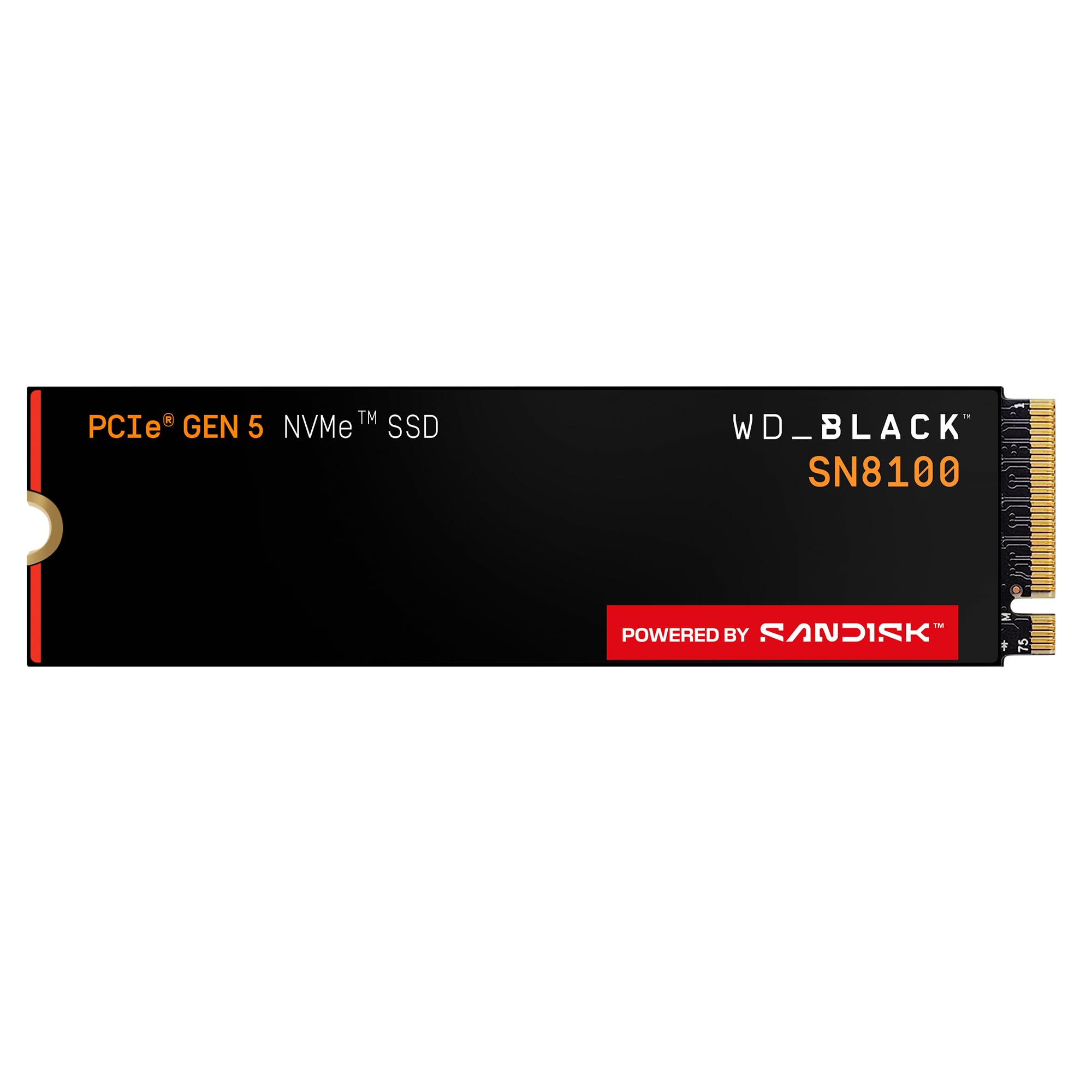
The WD_BLACK SN8100 is the fastest consumer-grade NVMe SSD currently available, achieving sequential read speeds up to 14,900 MB/s and write speeds up to 14,000 MB/s on the 2TB model. It is built on PCIe Gen5 x4 interface and uses Western Digital’s latest TLC 3D CBA NAND, delivering random performance exceeding 2,300,000 IOPS. The drive is designed for AI applications, professional video editing, and demanding game workloads that benefit from the highest possible bandwidth.
Power efficiency is a highlight: the SN8100 operates at an average of 7.5W or less, offering over 100% better power efficiency than Western Digital’s previous Gen4 drive. This allows the drive to achieve its massive throughput without generating excessive heat inside a system chassis. User reports confirm that in a proper Gen5 slot with a heatsink, thermals stabilize around 82°F under load, and Windows boot times are reduced to roughly three seconds.
The drive is backed by SanDisk Dashboard software (Windows only) for health monitoring and performance optimization, plus Acronis True Image for data migration. For power users, content creators, and workstation builders who genuinely benefit from Gen5 bandwidth and refuse to compromise on the absolute fastest sequential and random speeds, the SN8100 represents the current peak of consumer M.2 SSD performance.
Why it’s great
- Fastest consumer SSD at 14,900 MB/s read
- Over 100% better power efficiency than Gen4
- Excellent random performance for AI workloads
Good to know
- Requires Gen5 motherboard and heatsink
- Sandisk Dashboard is Windows-only
FAQ
Can I use a PCIe Gen5 M.2 SSD in a Gen4 slot?
Does a 2TB M.2 SSD need a heatsink for PS5 use?
What is the real-world difference between 6000 MB/s and 7450 MB/s in games?
How much formatted capacity will a 2TB M.2 SSD show in Windows?
Why do some 2TB M.2 SSDs cost significantly more than others?
Final Thoughts: The Verdict
For most users, the 2tb m.2 ssd winner is the BIWIN Black Opal NV7400 because it delivers the full ceiling of Gen4 performance with excellent thermal efficiency and valuable management software, making it the best all-around value for gaming and productivity builds. If you want PCIe Gen5 performance at a more accessible price point, grab the Crucial P510, which includes useful bundled software and Micron-quality NAND. And for users building a Gen5 workstation who need the absolute fastest sequential and random speeds available, nothing beats the WD_BLACK SN8100, the current speed leader in consumer M.2 storage.