
Our readers keep the lights on and the weekend projects moving. As an Amazon Associate, I earn from qualifying purchases.
The jump from a smartphone or crop-sensor camera to a full-frame body changes everything about your images — the background separation, the low-light clarity, and that three-dimensional pop you simply cannot fake with software. For new photographers, that upgrade path used to require a serious budget and a steep learning curve. Today, you have more choices than ever, from compact mirrorless hybrids to rugged DSLR workhorses, all designed to help you grow without punishing your wallet.
I’m Rikta — the co-founder and writer behind FitlyFast. I have spent countless hours cross-referencing sensor specs, autofocus coverage maps, lens ecosystems, and real-world sample galleries to cut through the marketing noise and identify the bodies that actually deliver for a beginner stepping into full-frame territory.
best beginner full frame camera picks balance image quality, ease of use, and long-term value.
How To Choose The Best Beginner Full Frame Camera
Full-frame sensors measure roughly 36mm by 24mm, the same dimensions as a single frame of 35mm film. That larger surface area captures significantly more light than APS-C or Micro Four Thirds sensors, which translates directly into cleaner high-ISO performance, shallower depth of field, and richer tonal gradation in your files. For a beginner, choosing a first full-frame body is really about deciding how much priority to assign to portability, autofocus intelligence, lens library breadth, and future-proofing features like 4K video or high-megapixel resolution.
Sensor Resolution and Low-Light Handling
Megapixel counts in the full-frame beginner bracket range from 24MP to 33MP, with a couple of high-resolution outliers at 36MP and even 46MP. For a newcomer, 24MP offers a sweet spot — plenty of detail for large prints or heavy cropping, with larger individual pixels that generally produce less noise at high ISO settings. A 33MP sensor like the one in the Sony Alpha 7 IV gives you a bit more cropping flexibility for sports or wildlife, while a 46MP sensor like the Nikon Z 7II demands more rigorous shooting technique and larger file storage. Match the sensor to your primary subject: low-light portraiture favors lower megapixel counts with better noise performance, while landscape and product work can exploit higher resolution.
Autofocus System Complexity
Beginner full-frame cameras today pack autofocus technology that would have cost several times the price a few years ago. The key specs to compare are autofocus point count, coverage percentage of the frame, and subject-detection algorithms (Eye AF for humans, animals, or vehicles). Cameras with phase-detection pixels spread across most of the sensor, like the Canon R8 with Dual Pixel CMOS AF II or the Sony a7 III with 693 points, lock onto moving subjects faster and hold focus more reliably in low light. Beginners benefit most from models that handle the autofocus decision-making automatically, letting you concentrate on composition rather than fiddling with focus points.
Lens Ecosystem and Upgrade Path
The body is only half the equation. Sony’s E-mount has the largest third-party lens selection, including affordable primes from Tamron and Sigma that make full-frame entry less expensive. Canon’s RF mount has fewer third-party options but works with older EF lenses via an adapter, giving you access to decades of used glass. Nikon’s Z mount is growing rapidly and also accepts F-mount lenses via the FTZ adapter. Panasonic’s L-mount alliance with Leica and Sigma provides another solid path, though the native lens library is smaller. A beginner should pick the system that either offers the lenses they need now or the adapter compatibility to use budget-friendly older glass while they grow.
Quick Comparison
On smaller screens, swipe sideways to see the full table.
| Model | Category | Best For | Key Spec | Amazon |
|---|---|---|---|---|
| Canon EOS R8 | Mirrorless | Best Overall Value | 24.2MP, 4K60p, Dual Pixel AF II | Amazon |
| Sony Alpha 7 IV | Mirrorless | Best Hybrid Stills/Video | 33MP, 4K60p 10-bit, BIONZ XR | Amazon |
| Nikon Z 6II | Mirrorless | Best Low-Light Hybrid | 24.5MP, 4K60p, 273 AF points | Amazon |
| Canon EOS R6 Mark II | Mirrorless | Best for Action/Sports | 24.2MP, 40fps, 6K oversampled 4K | Amazon |
| Panasonic LUMIX S5II | Mirrorless | Best Video Capabilities | 24.2MP, Unlimited 4:2:2 10-bit, Active I.S. | Amazon |
| Sony Alpha 7 IV Kit | Mirrorless | Best Versatile Kit Bundle | 33MP, 759 AF points, S-Cinetone | Amazon |
| Sony a7 III | Mirrorless | Mid-Range All-Rounder | 24.2MP, 693 AF points, 10fps burst | Amazon |
| Canon EOS RP | Mirrorless | Best Travel-Friendly | 26.2MP, 4K crop, <0.5 kg body | Amazon |
| Panasonic LUMIX S9 | Mirrorless | Best Social Media Creator | 24.2MP, Open Gate, LUT integration | Amazon |
| Nikon D610 | DSLR | Best Budget DSLR | 24.3MP, 39 AF points, 6fps | Amazon |
| Sony Alpha 7 II | Mirrorless | Best IBIS Value | 24.3MP, 5-axis IBIS, 117 AF points | Amazon |
| Nikon D810 (Renewed) | DSLR | Best High-Res Budget | 36.3MP, 51 AF points, No OLPF | Amazon |
| Nikon Z 7II | Mirrorless | Best High Resolution | 45.7MP, 493 AF points, 10fps | Amazon |
In‑Depth Reviews
1. Canon EOS R8

The Canon R8 packs the same 24.2MP sensor and DIGIC X processor found in the R6 Mark II into a body that weighs just 461 grams — about the same as a bottle of water. Dual Pixel CMOS AF II covers nearly 100 percent of the frame with 1,053 zones, delivering fast, reliable subject detection for people, animals, and vehicles. You get uncropped 4K60p video oversampled from 6K, Canon Log 3 for color grading, and 180fps high-frame-rate 1080p for slow motion.
The electronic shutter fires at 40fps with full autofocus tracking and minimal rolling shutter, making it surprisingly capable for action or wildlife on a budget. The mechanical shutter tops out at 6fps, and the camera lacks in-body stabilization, so you will rely on lens-based IS for handheld video. The LP-E17 battery returns around 350 shots per charge, so carrying a spare is mandatory for a full day out.
For beginners, the R8 offers the cleanest path into Canon’s RF ecosystem at the lowest weight. The kit lens (RF 24-50mm f/4.5-6.3) is compact but slow; budgeting for an RF 35mm f/1.8 or an EF adapter to use older glass will unlock the low-light performance the sensor is capable of. Overheating at 4K60p occurs around the 30-minute mark, but for most hybrid work, this is a non-issue.
Why it’s great
- R6 II sensor and AF in an ultra-light body
- Uncropped 4K60p with Canon Log 3
- 40fps electronic shutter with full tracking
- Affordable entry to RF mount
Good to know
- No in-body image stabilization
- Small battery, under 400 shots typical
- Single UHS-II SD card slot
- 4K60p can overheat after 30 minutes
2. Sony Alpha 7 IV

The Sony Alpha 7 IV represents a meaningful step up in resolution from the a7 III, pairing a 33MP Exmor R back-illuminated sensor with the BIONZ XR processor for roughly eight times the processing power of the previous generation. Real-time Eye AF for humans, animals, and birds is incredibly sticky even in challenging light, and the 693 phase-detection points cover 94 percent of the frame. You also get 4K60p video in 10-bit 4:2:2 with full pixel readout from 7K oversampling in 4K30p.
The build quality feels more premium than the a7 III, with a deeper grip, a fully articulating touchscreen, and dual card slots (one CFexpress Type A, one UHS-II SD). The S-Cinetone color profile inherited from Sony’s cinema line produces pleasing skin tones straight out of camera, reducing the need for heavy grading. Continuous shooting runs at 10fps with AF/AE tracking, which is adequate for most action scenarios.
Where the a7 IV demands patience is in its menu system, which remains dense despite Sony’s menu redesign. Beginners should budget time to customize the function buttons and Fn menu. The 33MP files require more storage and processing power than 24MP, so ensure your computer can handle the larger RAW files. The kit lens (28-70mm f/3.5-5.6) is functional but soft; the real power of this body is unlocked with a fast prime like the Sigma 35mm f/1.4 DG DN.
Why it’s great
- Excellent 33MP resolution for cropping
- Real-time Eye AF is class-leading
- 4K60p 10-bit with S-Cinetone
- Dual card slots and robust build
Good to know
- Menu system requires customization
- Larger RAW files need fast storage
- Kit lens is average; budget for better glass
- No full-frame 4K60p without crop
3. Nikon Z 6II

The Nikon Z 6II uses a 24.5MP BSI sensor that excels in low light, with native ISO up to 51,200 and excellent dynamic range at base ISO. The 273-point phase-detection autofocus covers 90 percent of the frame, and Eye AF works reliably for people and animals.
Video capabilities include 4K UHD at 60p with full pixel readout, 10-bit N-Log output via HDMI, and a flat picture profile for grading. The in-body stabilization is rated at 5 stops, working well for handheld video and static shots at slower shutter speeds. Dual card slots accept CFexpress/XQD and UHS-II SD, giving flexibility for redundancy or high-speed workflows.
The body feels solid with a deep grip and well-placed controls, though the screen is a fixed tilt design rather than fully articulating, which limits self-recording. The autofocus tracking is reliable but not as tenacious as Sony or Canon systems in cluttered scenes. The Z 6II shines for portrait, landscape, and general hybrid work, and the growing Z lens lineup includes excellent options like the Z 24-70mm f/4 S and Z 50mm f/1.8 S.
Why it’s great
- Class-leading low-light performance
- 5-stop in-body stabilization
- Dual card slots (CFexpress + UHS-II SD)
- Excellent Z lens ecosystem
Good to know
- AF tracking less aggressive than Sony/Canon
- Tilt screen, not fully articulating
- No built-in flash
- Battery life average for mirrorless
4. Canon EOS R6 Mark II

The Canon EOS R6 Mark II brings professional-grade autofocus and speed to a body that still fits comfortably in a beginner’s hands. The 24.2MP sensor captures 6K oversampled 4K60p video with no crop, and the Dual Pixel CMOS AF II detects people, animals, horses, trains, and aircraft automatically. The electronic shutter fires at 40fps with full autofocus and exposure tracking, making it one of the fastest full-frame cameras available for capturing decisive moments.
In-body image stabilization delivers up to 8 stops of correction, allowing handheld shots at impossibly slow shutter speeds. Video recording reaches 6 hours in full HD without overheating, and the 4K60p mode is practically unlimited in normal ambient temperatures. The vari-angle touchscreen, fast 120fps EVF refresh rate, and Bluetooth 5 connectivity make day-to-day operation intuitive and responsive.
For a beginner who plans to shoot action, sports, or unpredictable subjects like pets and children, the R6 II’s autofocus speed and burst rate will dramatically increase keeper rates compared to slower bodies. The single downside is the price, which sits at the top of the beginner full-frame bracket. However, the camera grows with you — it is entirely capable as a professional hybrid tool for years to come.
Why it’s great
- 40fps electronic shutter with full AF
- 8-stop in-body stabilization
- 6K oversampled 4K60p video
- Wide subject detection (including trains/horses)
Good to know
- Premium price for the category
- No built-in flash
- Single SD card slot
- Battery life adequate but not exceptional
5. Panasonic LUMIX S5II
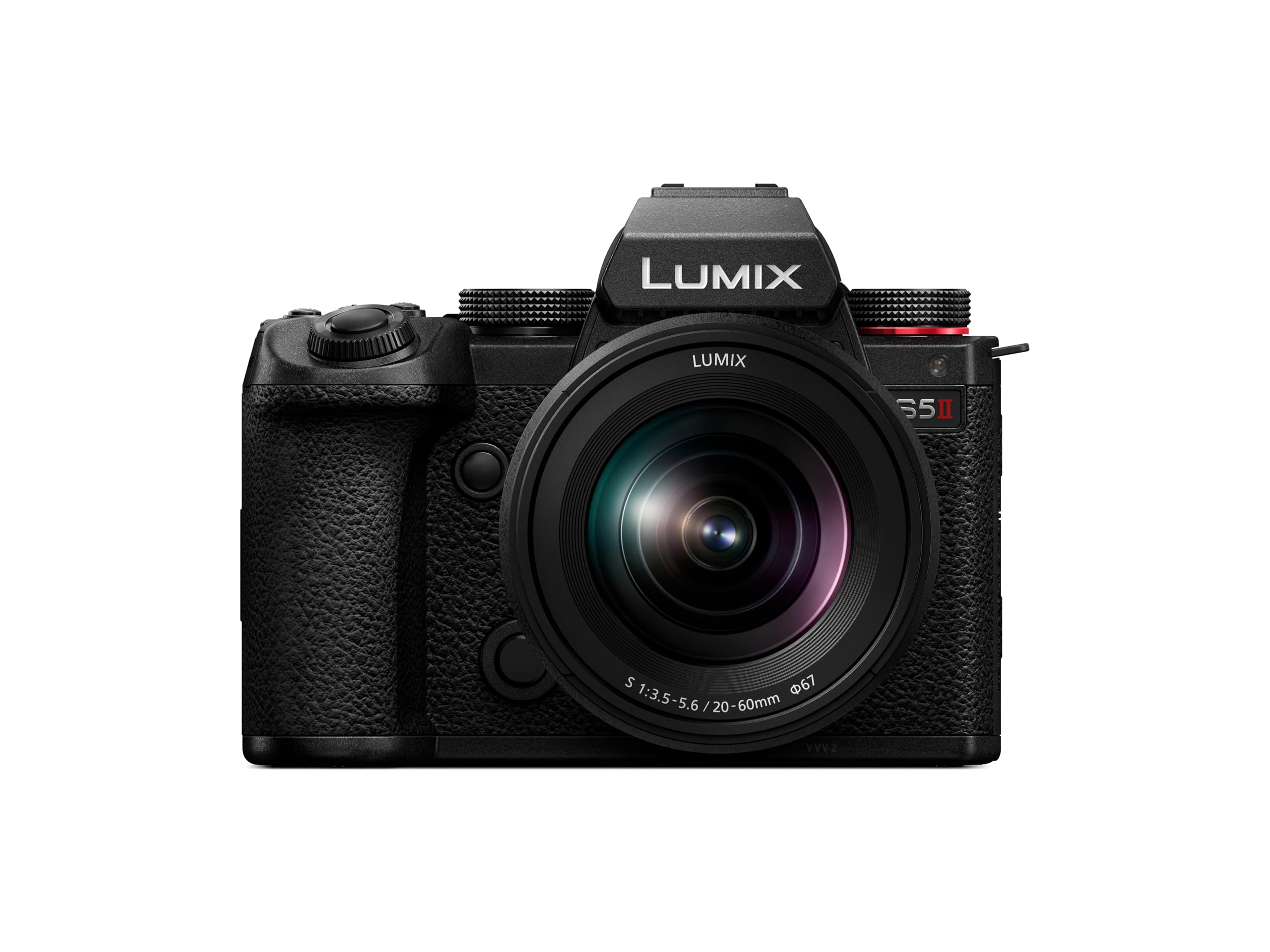
Panasonic’s S5II marks the brand’s adoption of phase-detection autofocus, finally eliminating the contrast-detect hunting that frustrated previous users. The 24.2MP full-frame CMOS sensor is paired with a dedicated engine for subject detection and metering, enabling fast, accurate tracking for both stills and video. The camera records unlimited 4:2:2 10-bit video internally, supports 6K Open Gate recording for flexible framing, and includes a built-in fan that practically eliminates overheating concerns during long takes.
The Active I.S. system is among the best in class, smoothing out walking shots effectively enough that many users can leave the gimbal at home for casual work. The 14+ stop V-Log/V-Gamut capture provides tremendous dynamic range for color grading, and the Real Time LUT feature lets you bake in looks directly in-camera for quick social media output. The 20-60mm kit lens is a unique pairing that covers a very useful wide-angle range straight out of the box.
Where the S5II falls short for beginners is the ecosystem — L-mount lens availability is thinner than Sony E or Canon RF, though the alliance with Sigma and Leica is growing steadily. The body is larger and heavier than the Canon R8, and the menu system, while logical for video shooters, can feel overwhelming for someone new to interchangeable-lens cameras.
Why it’s great
- Phase-detect AF finally solves old Panasonic issues
- Unlimited 4:2:2 10-bit video with fan cooling
- Excellent Active I.S. for handheld video
- 6K Open Gate and V-Log capture
Good to know
- L-mount lens library smaller than competitors
- Body is heavier than average
- Menu is dense and video-oriented
- Battery life is only average
6. Sony Alpha 7 IV Kit

This kit bundles the Sony Alpha 7 IV body with the FE 28-70mm f/3.5-5.6 OSS zoom lens, providing a versatile standard zoom range that covers everything from casual group shots to travel landscapes. The lens includes optical SteadyShot stabilization, which helps compensate for the body’s IBIS at longer focal lengths. For a beginner, having a single lens that covers wide to short telephoto reduces the complexity of deciding which prime to buy first.
The a7 IV body itself remains one of the most balanced full-frame mirrorless cameras on the market, with 33MP resolution, 759 phase-detection points with AI-based subject recognition, and 4K60p video in 10-bit 4:2:2. The fully articulating screen and large EVF make composing from awkward angles straightforward. The BIONZ XR processor ensures snappy menu navigation and quick startup times.
While the 28-70mm lens is a practical starter optic, it is optically modest — expect some softness at the edges and a variable aperture that limits low-light performance. Most users will want to add a fast prime like the FE 35mm f/1.8 or the Sigma 24-70mm f/2.8 DG DN within the first year. The kit is a convenient one-box solution, but the real value of the a7 IV is unlocked with better glass.
Why it’s great
- One-box solution with standard zoom lens
- Excellent body with 33MP and advanced AF
- Lens includes OSS stabilization
- Covers wide to short telephoto for general use
Good to know
- Kit lens is optically average
- Variable aperture limits low-light use
- Budget for a fast prime soon
- Body menus still complex for beginners
7. Sony a7 III

The Sony a7 III remains a benchmark entry point into full-frame mirrorless, even years after its release. Its 24.2MP BSI sensor delivers 15 stops of dynamic range, and the 693 phase-detection autofocus points cover 93 percent of the frame, providing reliable tracking for most shooting situations. The 10fps burst with silent or mechanical shutter is still competitive, and battery life is exceptional for mirrorless at roughly 710 shots per charge.
Video recording tops out at 4K30p with full pixel readout and no crop, plus 1080p at 120fps for slow motion. The 5-axis IBIS provides about 5 stops of stabilization, effective enough for handheld video with wide-angle lenses. The body is weather-sealed, the grip is comfortable for extended use, and the dual SD card slots (one UHS-II) offer redundancy or overflow capacity.
Against newer models, the a7 III shows its age in two areas: the menu system is the older Sony layout (tabs and nested pages), and the rear LCD is a lower 0.92-million-dot resolution screen that lacks the fully articulating design of its successor. For a beginner on a tighter budget, the a7 III still takes excellent photos and video, and the vast selection of affordable third-party E-mount lenses makes it a very cost-effective system to build around.
Why it’s great
- Excellent dynamic range and ISO performance
- Large, affordable third-party lens ecosystem
- Long battery life for mirrorless
- 10fps burst with silent option
Good to know
- Older, denser menu system
- Rear LCD is low resolution and not articulating
- No 4K60p video
- Micro USB port, not USB-C
8. Canon EOS RP

The Canon EOS RP is the lightest full-frame mirrorless camera on this list at just 485 grams with battery and card, making it an ideal travel companion for someone who wants full-frame image quality without the backpack strain. The 26.2MP sensor produces pleasing color science and good dynamic range, and the Dual Pixel CMOS AF provides reliable phase-detect autofocus across 88 percent of the frame width. The RF 24-105mm f/4-7.1 STM kit lens adds 5 stops of optical stabilization and covers a very useful zoom range.
The 1080p mode is clean and well-stabilized, making it a better choice for video beginners. The battery uses the same LP-E17 cell as the R8, returning around 350 shots, so a spare is essential for a full day.
The RP is the most accessible full-frame camera for someone transitioning from a smartphone or entry-level APS-C body. The menu system is Canon’s user-friendly GUI, and the vari-angle touchscreen makes waist-level or overhead compositions easy. The trade-off is an older processor and slower burst rate (5fps), but for landscape, portrait, and general walk-around photography, the image quality punches well above its price class.
Why it’s great
- Very light and compact for full-frame
- Pleasing Canon color science
- Vari-angle touchscreen with intuitive menus
- Accessible RF mount entry point
Good to know
- Heavy crop in 4K video mode
- 4K uses contrast-detect AF (slower)
- 5fps burst limits action shots
- Small battery, spare recommended
9. Panasonic LUMIX S9

The Panasonic LUMIX S9 is built for the social media generation, pairing a compact retro-styled body with a set of video-first features aimed at quick content creation. The 24.2MP full-frame sensor records Open Gate video that captures the full sensor width, allowing you to extract vertical 9:16, square 1:1, or traditional 16:9 crops from a single clip — a massive time-saver for repurposing content across TikTok, Instagram Reels, and YouTube Shorts. The built-in LUT integration lets you apply and bake in color grades in-camera, bypassing the editing step entirely.
The camera connects to your phone through the Lumix Lab app with a fast, reliable Wi-Fi connection that auto-transfers photos and videos as you shoot. The 18-40mm retractable kit lens collapses to an incredibly compact size, making the whole package small enough to slip into a coat pocket. The S9 includes 5-axis IBIS and a 3-inch vari-angle touchscreen, and the body is finished in attractive color options.
The trade-offs are significant for traditional photography: the S9 has no hotshoe, no built-in flash, and no electronic viewfinder. The screen is bright enough outdoors but can be hard to see in direct sunlight. The autofocus uses Panasonic’s Depth From Defocus technology, which has improved but still can hunt in low-contrast conditions compared to phase-detect systems. This is a specialized tool for creators who prioritize quick sharing over traditional viewfinder shooting.
Why it’s great
- Open Gate video for all aspect ratios
- In-camera LUT integration for quick grading
- Ultra-compact with retractable kit lens
- Fast Wi-Fi auto-transfer to phone
Good to know
- No hotshoe, flash, or EVF
- Screen difficult in bright sunlight
- Autofocus can hunt in low contrast
- Requires extra grip for one-handed use
10. Nikon D610

The Nikon D610 is a DSLR that represents the most affordable way to get into a full-frame Nikon system. Its 24.3MP FX-format sensor delivers the same excellent dynamic range and color depth that made the D600 series famous among landscape and portrait photographers. The 39-point AF system includes 9 cross-type sensors, and the 100 percent viewfinder coverage makes composing accurately. The body is weather-sealed against dust and moisture, with a durable shutter rated for 150,000 cycles.
Continuous shooting at 6fps is modest by modern standards, but it is sufficient for general use and slow-moving subjects. The 2,016-pixel RGB metering sensor provides accurate exposure evaluation across a wide range of lighting conditions. Dual SD card slots give you overflow or backup options, and the built-in flash can serve as a wireless commander for off-camera speedlights — a nice bonus for learning studio lighting on a budget.
The D610 is a pure optical-viewfinder experience. You lose the benefits of an EVF like real-time exposure preview and focus peaking. Video recording is limited to 1080p at 30fps with contrast-detect autofocus, so it is not a hybrid video tool. But for a beginner who wants to learn photography fundamentals with an optical finder and a massive library of affordable F-mount lenses (both new and used), the D610 remains a very capable choice.
Why it’s great
- Very affordable full-frame entry point
- Excellent image quality and dynamic range
- Dual SD slots and weather sealing
- Huge library of used F-mount lenses
Good to know
- No EVF, no video features
- 6fps burst is slow by current standards
- 39-point AF is basic compared to modern systems
- Larger and heavier than mirrorless options
11. Sony Alpha 7 II

The Sony Alpha 7 II was the world’s first full-frame camera with 5-axis in-body image stabilization, and that feature alone makes it a compelling budget option for beginners who want to use unstabilized legacy glass. The 24.3MP sensor produces excellent detail, and the improved grip and ergonomics over the original A7 make it more comfortable for extended shooting sessions. The 117-point phase-detection AF system is 30 percent faster than the original A7, providing decent performance for general photography.
The camera records 1080p XAVC S video at up to 60Mbps with S-Log gamma profiles, which was competitive when released and still usable for casual filmmaking. The EVF is a 0.5-inch OLED with 2.36 million dots, providing a clear view of your scene. The body is built around a metal lens mount and includes a customizable button layout that rewards time spent learning the system.
Where the a7 II shows its age is in autofocus performance — it is slower and less reliable than any modern Sony body, especially in low light. The battery life is poor, often requiring three batteries for a full day of shooting. There is no 4K video, no silent shutter mode, and the menu system is from the early Sony mirrorless era. For a beginner who wants IBIS on a strict budget and is willing to navigate these trade-offs, the a7 II can still produce beautiful images.
Why it’s great
- 5-axis IBIS stabilizes all lenses
- Affordable entry to Sony full-frame
- Customizable buttons and improved grip
- S-Log video profile for grading
Good to know
- AF is slow and unreliable in low light
- No 4K video recording
- Poor battery life (3+ needed for full day)
- Menu is dated and cluttered
12. Nikon D810 (Renewed)

The Nikon D810 is a high-resolution full-frame DSLR that originally commanded a premium price but is now available at a fraction of its launch cost through renewed listings. The 36.3MP sensor lacks an optical low-pass filter, delivering exceptionally sharp, detailed files that retain detail even after aggressive cropping. The EXPEED 4 processor handles the large image files well, and the native ISO range of 64 to 12,800 (expandable to 51,200) provides excellent dynamic range across the sensitivity range.
The 51-point Multi-CAM 3500FX autofocus system includes 15 cross-type sensors and is reliable for portraits, landscapes, and studio work. The 3.2-inch 1,229k-dot LCD provides sharp image review, and the magnesium alloy body is extensively weather-sealed. The optical viewfinder offers 100 percent frame coverage with a bright, large view. Full HD 1080p video at 60/30/24fps is included, though the autofocus in video mode is contrast-detect and slower than modern systems.
Buying a renewed D810 carries two important caveats. First, the warranty situation can be complicated — some units are imported models not covered by Nikon USA warranties, so verify with the seller before purchase. Second, the D810 is large and heavy (about 980 grams with battery), and handling ten-year-old camera technology means accepting slower burst rates (5fps) and older ports (USB 3.0, no USB-C). For a beginner who values resolution above all else and is comfortable with a DSLR workflow, the D810 is a tremendous value.
Why it’s great
- 36.3MP without OLPF for maximum sharpness
- Excellent dynamic range at base ISO
- Weather-sealed magnesium body
- Huge F-mount lens library available used
Good to know
- Renewed unit may lack USA warranty
- Heavy and bulky compared to mirrorless
- 5fps burst is slow for action
- Video autofocus is sluggish
13. Nikon Z 7II

The Nikon Z 7II is a high-resolution mirrorless camera that offers 45.7MP of resolving power — enough to capture every detail in a landscape or product shot and retain sharpness after a 75 percent crop. The 493-point phase-detection AF system covers 90 percent of the sensor area, and the body features dual card slots (CFexpress/XQD and UHS-II SD) for flexible storage. The 5-axis in-body stabilization provides up to 5 stops of correction, helping to manage the high-res sensor’s sensitivity to camera shake.
Video recording includes 4K UHD at 60p with full pixel readout, and the camera supports N-Log and 10-bit HDMI output for external recorders. The built-in intervalometer and in-camera timelapse with exposure smoothing produce flicker-free sequences across changing light conditions. The Z 7II is compatible with the growing line of NIKKOR Z lenses and also accepts F-mount lenses via the FTZ adapter, providing access to a broad range of proven optics.
For a beginner, the Z 7II is overkill unless you specifically need 46-megapixel files for large prints or heavy cropping. The file sizes demand fast memory cards and ample storage. The autofocus, while much improved over the original Z 7, is not as tenacious as Sony’s or Canon’s newest systems for tracking fast-moving subjects. Battery life is average for mirrorless, and the high resolution punishes camera shake more than lower-megapixel bodies, requiring good technique or a sturdy tripod.
Why it’s great
- 46MP resolution with incredible detail retention
- 5-axis IBIS helps manage high-res stability
- Dual card slots for flexible workflow
- Great dynamic range at base ISO
Good to know
- Large files require fast media and storage
- AF tracking not as aggressive as competitors
- Battery life is average
- High resolution punishes poor handholding technique
FAQ
Should a beginner buy a full-frame camera or start with APS-C?
What is the most affordable lens kit for a beginner full-frame camera?
Can I use my old DSLR lenses on a new mirrorless full-frame camera?
How important is 4K video for a beginner full-frame camera?
Final Thoughts: The Verdict
For most users, the best beginner full frame camera winner is the Canon EOS R8 because it delivers the same sensor and autofocus technology as the much more expensive R6 Mark II in a lightweight, affordable body that removes barriers to daily use. If you want higher resolution and more advanced hybrid video features, grab the Sony Alpha 7 IV. And for a beginner who needs exceptional low-light performance and a durable, well-rounded hybrid body, nothing beats the Nikon Z 6II.