
Our readers keep the lights on and the weekend projects moving. As an Amazon Associate, I earn from qualifying purchases.
The biggest mistake new stargazers make is buying a scope based on a magnification number printed on the box. That number is often a marketing gimmick. What actually determines what you see—sharp lunar craters, Saturn’s rings, Jupiter’s cloud bands—is aperture size and optical quality. The right entry-level refractor balances a big enough objective lens, a stable mount, and accessories that work without frustration.
I’m Rikta — the co-founder and writer behind FitlyFast. I’ve spent hundreds of hours cross-referencing technical optical specifications, decoding marketing claims, and analyzing real owner experiences across the full spectrum of beginner refractors to find which models actually deliver on their promises.
This guide breaks down the nine best models currently available to help you find the right astronomical telescope for beginners. We’ll examine aperture size, mount stability, accessory value, and real-world usability so you can make a confident choice.
How To Choose The Best Astronomical Telescope For Beginners
Choosing a first telescope comes down to three variables: the size of the main lens (aperture), the type of mount, and the quality of the included accessories. A cheap scope with fuzzy optics and a wobbly tripod will kill any budding interest in astronomy. The models below represent the sweet spot where price, optical quality, and ease-of-use collide.
Aperture and Focal Length
The aperture is the diameter of the primary objective lens measured in millimeters. For beginners, 70mm is the bare minimum to see moon craters and Jupiter’s moons. 80mm offers noticeably better light collection. 90mm is the sweet spot in the budget-to-mid-range market, giving you enough light to resolve Saturn’s rings and Jupiter’s cloud bands. Focal length determines magnification range and field of view; longer focal lengths (800-900mm) pair well with high-power eyepieces.
Mount and Tripod Stability
The mount is the unsung hero. A flimsy tripod turns every breeze into a blurry mess. Look for stainless steel legs over aluminum, and an altazimuth (AZ) mount with slow-motion controls for smooth manual tracking. Avoid cheap equatorial mounts on budget models—they require precise polar alignment that beginners should not have to deal with.
Accessories That Actually Matter
Ignore the “450x” claims. Real usable magnification for a 90mm scope tops out around 180-200x on a steady night. Instead, look for at least two good-quality Kellner eyepieces (25mm and 10mm), a 2x or 3x Barlow lens, and a functional finder scope. A smartphone adapter is a fantastic bonus for sharing the view, but a moon filter is even more useful for comfortable lunar observation.
Quick Comparison
On smaller screens, swipe sideways to see the full table.
| Model | Category | Best For | Key Spec | Amazon |
|---|---|---|---|---|
| Celestron Inspire 100AZ | Refractor | Built-in smartphone adapter | 100mm aperture, 660mm FL | Amazon |
| Celestron StarSense LT 80AZ | Refractor | App-guided sky navigation | 80mm aperture, 400mm FL | Amazon |
| Gskyer 600x90mm AZ | Refractor | Versatile eyepiece set | 90mm aperture, 600mm FL | Amazon |
| Hawkko 90mm 900mm | Refractor | High-contrast multi-coating | 90mm aperture, 900mm FL | Amazon |
| HETEKAN 90mm 900mm | Refractor | Maximum magnification kit | 90mm aperture, 900mm FL | Amazon |
| MEEZAA 90mm 800mm | Refractor | Quick assembly, solid kit | 90mm aperture, 800mm FL | Amazon |
| Dianfan 90mm 800mm | Refractor | Compact travel scope | 90mm aperture, 800mm FL | Amazon |
| HUGERSTAR 90mm 800mm | Refractor | Moon filter included | 90mm aperture, 800mm FL | Amazon |
| Gskyer 70mm 400mm | Refractor | Lightweight and portable | 70mm aperture, 400mm FL | Amazon |
In‑Depth Reviews
1. Celestron Inspire 100AZ Refractor Telescope

Celestron’s Inspire 100AZ is the most thoughtfully engineered beginner scope on this list. The 100mm aperture is a meaningful step up from the 90mm competitors, gathering significantly more light for brighter, sharper views of the Moon, Jupiter’s cloud bands, and Saturn’s rings. The 660mm focal length (f/6.6) provides a good balance between wide-field sweeps of star clusters and high-power lunar detail.
The asymmetrical mount design is remarkably stable for its weight class, and the folding accessory tray makes setup genuinely tool-free in under two minutes. A built-in smartphone adapter is integrated directly into the lens cap—a clever touch that eliminates the flimsy clip-on adapters found on cheaper models. The red LED flashlight stowed in the mount head is a practical bonus for preserving night vision while adjusting eyepieces.
Owner reports consistently praise the ease of assembly and the quality of the included Kellner eyepieces. The StarPointer red dot finderscope makes initial alignment intuitive. At this price point, the Inspire 100AZ represents the best combination of aperture, build quality, and beginner-friendly features available today.
Why it’s great
- Largest aperture (100mm) for superior light gathering
- Tool-free foldable tripod setup
- Integrated smartphone adapter in lens cap
- Red LED flashlight for night vision
Good to know
- Basic 20mm and 10mm eyepieces leave room for upgrade
- Slide bracket for tripod legs lacks a positive stop
2. Celestron StarSense Explorer LT 80AZ

The StarSense Explorer LT 80AZ solves the single biggest frustration for beginners: finding objects in the night sky. Celestron’s patented StarSense technology uses your smartphone’s camera to analyze star patterns and display on-screen arrows guiding the telescope to celestial targets. It effectively turns your phone into a celestial navigation system, eliminating the need for star charts or prior knowledge.
The 80mm aperture is adequate for bright lunar features, Jupiter’s four Galilean moons, Saturn’s rings, and the Orion Nebula. The 400mm focal length (f/5) delivers a wide field of view ideal for scanning star clusters and large nebulae. The mount includes a manual altitude slow-motion rod for smooth tracking once you’ve locked onto a target. The tripod is lightweight and the entire setup is highly portable.
While the 80mm aperture is smaller than many competitors, the app guidance system makes this scope uniquely accessible. For absolute beginners who want to see interesting objects on the first night without frustration, the StarSense LT 80AZ is unmatched. The build quality from Celestron’s long-established engineering team provides peace of mind that budget brands cannot match.
Why it’s great
- Patented StarSense app for automated object location
- Lightweight and highly portable
- Excellent for finding deep-sky objects quickly
Good to know
- 80mm aperture is less capable for high-power planetary detail
- Requires a charged smartphone to operate
- Finder scope quality is basic
3. Gskyer 600x90mm AZ Refractor Telescope

Gskyer’s 600x90mm model brings a 90mm aperture and three eyepieces (24x, 60x, 120x) plus a 3x Barlow lens, offering a wide range of magnifications. The 600mm focal length (f/6.7) provides a moderate wide-field capability while still delivering enough power for detailed lunar views and Jupiter’s moons. The fully coated optics produce bright, contrasty images that punch above the price point.
The adjustable aluminum tripod extends from 31.5 to 49 inches, which is taller than many budget tripods—a practical advantage for adult users. Setup requires no tools, and the reflex finder scope helps beginners get oriented quickly. Owner feedback highlights clear moon detail and the ability to resolve Jupiter’s cloud bands on steady nights, which is impressive for this class of instrument.
Some users report the altazimuth mount has noticeable backlash and the focus adjustment can feel stiff. The 17.4-pound weight makes it heavier than many 90mm alternatives, so portability is average. However, the three-eyepiece kit and the generous tripod height make this a strong value package for beginners who want a wider range of magnification options out of the box.
Why it’s great
- Three eyepieces plus Barlow for varied magnification
- Taller tripod at 49 inches maximum height
- Fully coated optics deliver bright views
Good to know
- Mount has noticeable altitude backlash
- Heavier build at 17.4 pounds for its size
- Focus mechanism can feel imprecise
4. Hawkko 90mm 900mm Refractor Telescope

Hawkko’s 90mm f/10 refractor is optimized for high-contrast planetary and lunar observation. The 900mm focal length paired with professional-grade full multi-layer coating (FMC) significantly reduces internal reflections and glare, producing sharp, well-corrected images with minimal chromatic aberration. This is the optical path that matters most for detail on the Moon and planets.
The stainless steel AZ mount provides smooth 360-degree rotation and stable tracking. Owner reviews specifically mention seeing Jupiter’s cloud bands and Saturn’s rings clearly with the 10mm eyepiece, and the Moon shows sharp crater detail across the terminator. The included smartphone adapter works reliably for casual astrophotography, and the accessory tray keeps eyepieces organized in the dark.
Assembly is straightforward with the included manual, and the carrying bag makes transporting the scope to darker skies practical. The f/10 focal ratio means the field of view is narrower than shorter-tube designs, so sweeping for star clusters requires more patience. For viewers primarily interested in lunar and planetary detail, the Hawkko delivers excellent optical performance at a competitive price point.
Why it’s great
- Full multi-layer coatings for high contrast
- Sharp views of lunar craters and planetary detail
- Stable stainless steel tripod
Good to know
- f/10 design yields a narrower field of view
- Eyepieces are basic Kellner designs
5. HETEKAN 90mm 900mm Refractor Telescope
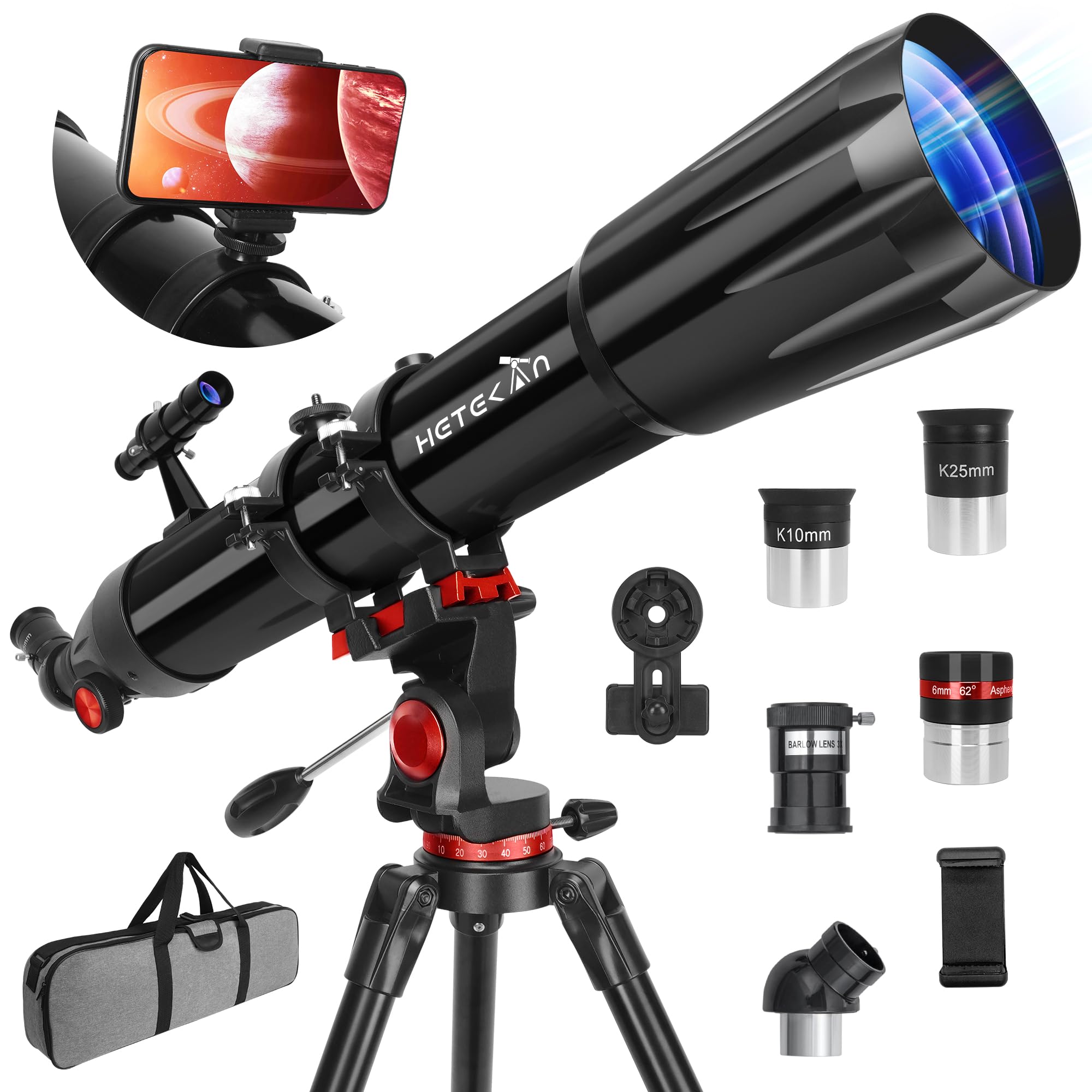
The HETEKAN 90mm scope aims to impress with a 450x magnification claim, but the real value lies in the three-eyepiece set (25mm, 10mm, 6mm) plus a 3x Barlow lens. The 900mm focal length (f/10) is identical to the Hawkko above, providing similar planetary potential. The 6mm eyepiece delivers high native magnification, and the 90mm aperture gathers enough light for bright, detailed views of the Moon and brighter planets.
Owner feedback indicates sharp lunar images and the ability to see Jupiter’s cloud bands and Saturn’s rings at 180x magnification. The tripod is adjustable from 29 to 46 inches, though some taller users report having to crouch or set the scope on a platform to see through the eyepiece comfortably. The included smartphone adapter and phone mount work well for capturing images through the eyepiece.
The Barlow lens quality is noted as entry-level plastic construction, and the finder scope requires careful alignment. At maximum claimed magnification, image degradation is noticeable due to atmospheric limitations and the optical quality of the 6mm eyepiece. This scope is best kept at 90-180x for consistent results. It is a good choice for beginners who want multiple eyepieces to experiment with different magnifications.
Why it’s great
- Three eyepieces provide useful magnification range
- 90mm aperture delivers bright planetary views
- Stable tripod with accessory tray
Good to know
- Tripod legs too short for taller users
- Barlow lens construction is basic
- 450x claim is unrealistic for this aperture
6. MEEZAA 90mm 800mm Refractor Telescope

MEEZAA’s 90mm refractor is engineered for beginners who value a fast, frustration-free setup. The package includes a detailed paper manual that guides assembly in about 10 minutes, and the stainless steel tripod adjusts from 28 to 46 inches. The 800mm focal length (f/8.88) sits between the shorter f/6.7 and longer f/10 designs, providing a good all-around balance for lunar, planetary, and some deep-sky observation.
The fully multi-coated optics produce bright, crisp images of the Moon and allow users to clearly see Jupiter’s moons, Saturn’s rings, and star clusters. The 25mm and 10mm Kellner eyepieces paired with a 3x Barlow lens offer magnification from 32x to 240x. Owner reviews consistently note the excellent build quality, with a metal tube and smooth focuser that exceeds expectations at this level.
The included carry bag keeps all accessories organized, making this scope easy to take to darker locations. The tripod requires occasional tightening of the leg locks, and the finder scope is basic but functional. For a beginner who wants a complete kit, easy assembly, and reliable optics, the MEEZAA 90mm is a well-rounded choice that delivers consistent satisfaction.
Why it’s great
- Fast 10-minute assembly with clear manual
- Metal tube construction feels premium
- Smooth focuser and stable stainless steel tripod
Good to know
- Tripod leg locks need periodic tightening
- Finder scope quality is entry-level
7. Dianfan 90mm 800mm Refractor Telescope

Dianfan’s 90mm refractor mirrors the MEEZAA in aperture and focal length but adds a 45-degree zenith mirror for correct-image terrestrial viewing. This makes it equally effective for daytime birdwatching or wildlife observation as it is for nighttime astronomy. The 90mm fully coated objective gathers ample light, and the 800mm focal length supports sharp views of lunar features and planetary detail.
The lightweight design and included carry bag make this an ideal travel companion for camping trips or visits to darker skies. Assembly takes about 15 minutes with clear instructions. The stainless steel tripod provides stable support, and the Smartphone adapter allows easy image capture. Owners report seeing moon craters clearly and distinguishing Saturn’s rings as a distinct shape at moderate magnification.
At higher magnifications beyond 120x, image brightness drops noticeably, and the straight-through finder scope can be awkward to align. The dual-purpose (terrestrial and astronomical) design is a genuine advantage for casual users who want one scope for daytime and nighttime use. This model is a strong pick for families or beginner astronomers who value versatility and portability.
Why it’s great
- Correct-image diagonal for terrestrial viewing
- Lightweight and portable with carry bag
- Good dual-purpose use for day and night
Good to know
- Image dims noticeably at higher magnification
- Straight-through finder scope can be awkward
8. HUGERSTAR 90mm 800mm Refractor Telescope

The HUGERSTAR 90mm scope comes with a moon filter—a small but meaningful accessory that significantly improves lunar observation by reducing glare and revealing finer detail along the terminator. The 90mm aperture and 800mm focal length (f/8.89) are well-matched for bright, high-contrast lunar and planetary views. The fully multi-coated lenses minimize reflections and maintain good image clarity.
The stainless steel tripod adjusts from 28.7 to 46.4 inches and includes an accessory tray for secure eyepiece storage. The phone adapter is included for sharing views via smartphone, though some users note that the eyepiece neck can interfere with phone cases that have side power buttons. Tool-free assembly is straightforward, with most users reporting setup in under 10 minutes.
Views of the Moon are described as crisp with a 3D-like quality, and Jupiter’s moons and Saturn’s rings are visible at 80-120x magnification. The finder scope requires careful alignment to be useful. For a beginner primarily interested in the Moon and brighter planets, the HUGERSTAR delivers excellent value with the added benefit of a moon filter for comfortable extended observing sessions.
Why it’s great
- Moon filter included for comfortable lunar observation
- Crisp, high-contrast lunar and planetary views
- Sturdy stainless steel tripod with accessory tray
Good to know
- Phone adapter can be difficult with some phone cases
- Finder scope requires careful alignment
- Basic Kellner eyepieces are functional but not premium
9. Gskyer 70mm 400mm Refractor Telescope

Gskyer’s 70mm 400mm refractor is the most affordable entry point in this guide, designed specifically for young children and total beginners on a limited budget. The 70mm aperture is the bare minimum for astronomical observation, providing clear views of the Moon’s craters and Jupiter’s four Galilean moons under reasonably dark skies. The 400mm focal length (f/5.7) offers a wide field of view suitable for scanning the night sky.
The kit includes a wireless camera remote and a smartphone adapter, which is generous at this price point. The aluminum alloy tripod is lightweight and adjustable, and the included carry bag makes storage and transport easy. Owners report that an 8-year-old can use the scope with minimal adult assistance, and the moon detail is surprisingly good for the size.
Real limitations include a short tripod that requires crouching, and the 70mm aperture collects significantly less light than 90mm models, making faint deep-sky objects like nebulae and galaxies invisible. Experienced users note that the finder scope is difficult to align and the mount can feel flimsy in windy conditions. This scope is best viewed as a low-cost introduction for a curious child or as a travel scope where portability trumps performance.
Why it’s great
- Very affordable entry point for kids and beginners
- Includes wireless remote and smartphone adapter
- Lightweight and portable for travel
Good to know
- 70mm aperture limits deep-sky viewing significantly
- Short tripod requires bending or table setup
- Mount feels less stable in breeze
FAQ
Is a 70mm telescope good enough for a beginner?
What does the magnification number on the box really mean?
Should I get a telescope with a smartphone adapter?
Can I use my telescope for daytime birdwatching?
How important is a finder scope?
Final Thoughts: The Verdict
For most users, the astronomical telescope for beginners winner is the Celestron Inspire 100AZ because its 100mm aperture, tool-free setup, and integrated smartphone adapter provide the best overall balance of performance and ease of use. If you want app-guided sky navigation that eliminates the learning curve, grab the Celestron StarSense Explorer LT 80AZ. And for a budget-friendly entry point for kids or casual travel, the Gskyer 70mm 400mm will get you started without a major financial commitment.