
Our readers keep the lights on and the weekend projects moving. As an Amazon Associate, I earn from qualifying purchases.
The moment your first drone lifts off, two things fight for your attention: the view descending on the screen and the quiet panic that it might never come back. Learning to fly should be about mastering the sticks, not gambling with a hundred-dollar investment that can vanish over a treeline or drift away in a breeze. A proper beginner drone for adults solves this by pairing forgiving flight dynamics with safety nets that actively prevent flyaways, letting you focus on the fun instead of the fear.
I’m Rikta — the co-founder and writer behind FitlyFast. For this guide, I pored over the technical specs, customer flight logs, and real-world performance data of the most popular entry-level drones to find the options that genuinely deliver a stress-free learning curve.
Whether you want to frame vacation memories from above or just enjoy a new weekend hobby, the right machine can mean the difference between a thrilling experience and a frustrating one. This is your complete resource for finding the perfect best beginner drone for adults that fits your skill level and budget.
How To Choose The Best Beginner Drone For Adults
Finding a drone that balances capability with safety features is the key to a good first experience. The options on the market span a wide range of capabilities, so narrowing down what matters most will save you time and money.
GPS and Auto Return to Home
This is the single most important safety feature for a new pilot. A GPS module allows the drone to lock its position and altitude, then automatically fly back to its takeoff point if the signal drops or the battery runs low. Without it, a simple loss of orientation or a gust of wind can end your flying session permanently.
Camera Quality and Stabilization
Most beginner drones now advertise 4K video, but the real differentiator is how stable that footage actually is. Electronic Image Stabilization (EIS) works well in calm conditions, while a physical 3-axis gimbal provides superior smoothness in wind. For learning photography and video, a 90-degree adjustable camera angle is a practical feature.
Weight and FAA Registration
Drones under 250 grams (0.55 lbs) are exempt from FAA registration and Remote ID requirements when flown recreationally. This makes them incredibly convenient to pack and fly without bureaucratic prep. Heavier drones offer more robust features but require a sticker and an online registration number on the airframe.
Flight Time and Battery Configuration
Real-world flight time for most entry-level drones falls between 15 and 35 minutes per battery. The most common and effective way to extend your time in the air is to buy a model that includes multiple batteries in the box. Two or three batteries in the kit transform a 30-minute session into a full hour of practice.
Quick Comparison
On smaller screens, swipe sideways to see the full table.
| Model | Category | Best For | Key Spec | Amazon |
|---|---|---|---|---|
| Oddire HK11 | Mid-Range | Budget-friendly GPS feature set | 48 mins total (2x 1800mAh) | Amazon |
| SIMREX G29 | Mid-Range | Compact travel companion | 40 mins total, 2296ft range | Amazon |
| REDRIE HK33 | Mid-Range | Lightweight practice platform | 45 mins total (2x 1800mAh) | Amazon |
| Potensic ATOM SE | Premium | Balanced performance and value | 62 mins total (2x 2500mAh) | Amazon |
| Gleesfun G11PRO | Premium | 3-axis gimbal smoothness | 70 mins total (2x 3200mAh) | Amazon |
| PLEGBLE | Premium | Built-in controller screen | 70 mins total (2x 2700mAh) | Amazon |
| DJI Mini 3 | Premium | Industry-leading camera stability | 38 mins per battery, 10km range | Amazon |
| Bwine F7MINI | Premium | Extended flight with 3 batteries | 96 mins total (3x 2200mAh) | Amazon |
| Ruko | Premium | Complete all-in-one bundle | 96 mins total (3x 2200mAh) | Amazon |
In-Depth Reviews
1. Potensic ATOM SE

The Potensic ATOM SE is the clear benchmark for what a modern entry-level drone should deliver. It packs a genuine Sony 1/3-inch CMOS sensor that records 4K at 30fps with EIS, and its 2500mAh intelligent batteries provide a generous 62 minutes of total flight time across two packs. The 4KM PixSync 2.0 transmission system is a significant step above the Wi-Fi solutions found on cheaper models, offering stable video feedback even at moderate distances.
New pilots will appreciate the SurgeFly flight control system, which includes a dedicated Beginner Mode alongside Video, Normal, and Sport settings. The Sport Mode pushes the drone to 16m/s, though this is a feature you’ll grow into rather than use immediately. GPS positioning is precise, and the Auto Return function triggers reliably on low battery or signal loss, building confidence from the first flight.
Build quality is solid for the class, though the micro SD card slot is essential since there is no internal storage. The controller includes three adapter cables (Micro, Type-C, Lightning) to fit most phones, and the foldable arms collapse small enough for a jacket pocket. Minor gripes include the lack of optical zoom and reports that the maximum transmission range under real-world conditions is around 1,200 to 2,000 feet, not the advertised 13,000 feet.
Why it’s great
- Superior Sony sensor for crisp, stable 4K footage
- Excellent beginner-friendly flight modes with progressive difficulty scaling
- Generous 62-minute total flight time from two intelligent batteries
- Under 249g, no FAA registration required for recreational flying
Good to know
- Real-world transmission range is significantly less than the 4KM advertised
- No optical zoom feature available
- Some units have reported motor clicking noises at lower speeds
2. Gleesfun G11PRO

The G11PRO elevates the beginner drone segment by integrating a true 3-axis brushless gimbal — a feature typically reserved for models costing twice as much. This hardware stabilization keeps the 4K/30fps footage remarkably smooth, even during turns and in moderate winds. The GQ2.0 digital transmission system carries video up to 10,000 feet with noticeably less latency than standard Wi-Fi connections, making it a strong candidate for pilots who want cinematic results early on.
Battery performance is a standout feature here. The GL2.0 Smart Battery Management System supports fast charging in about 2.5 hours and delivers up to 35 minutes per pack, with two batteries included for a total of 70 minutes. The Cruise Control feature locks the flight path, allowing you to focus entirely on framing shots — a brilliant feature for learning aerial composition without struggling with the controls.
The trade-off is weight and regulatory requirements. At over 249g, this drone requires FAA registration and Remote ID compliance, adding a small administrative step before flying. The 40-piece accessory kit is generous, including two sets of manuals, eight propeller blades, and a well-organized carrying case. Customer support from Gleesfun is consistently praised for responsiveness, which is reassuring for first-time buyers.
Why it’s great
- 3-axis brushless gimbal delivers professional-grade smooth footage
- Excellent 10,000ft digital transmission with low latency
- Fast-charging batteries with 70 minutes total flight time
- Cruise Control mode simplifies cinematic filming for beginners
Good to know
- Heavier than 249g, requires FAA registration and Remote ID
- Larger folding footprint than sub-250g competitors
3. PLEGBLE 4K Drone with Screen
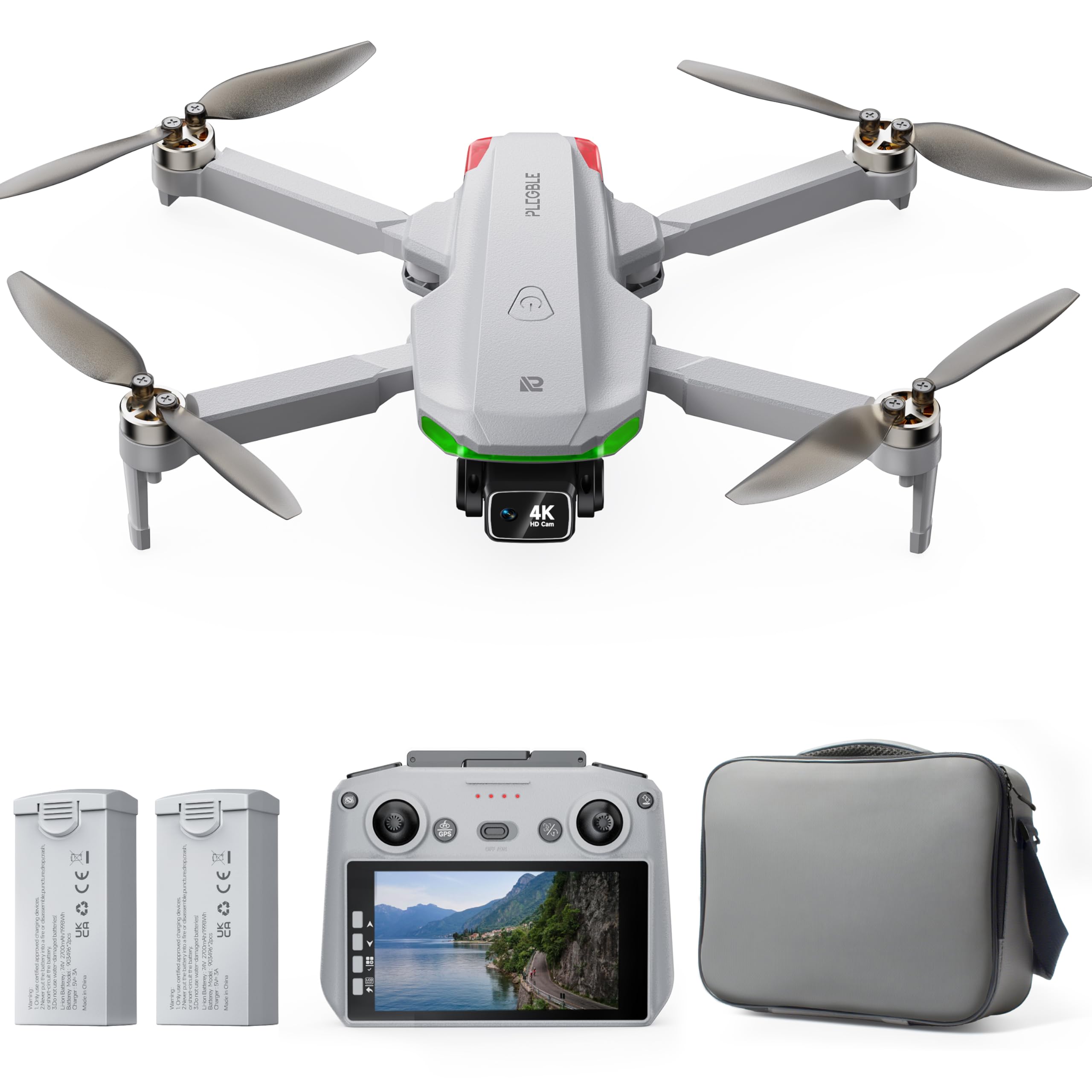
This drone solves one of the biggest friction points for new pilots: the requirement to tether a smartphone to the controller. The built-in 5.0-inch HD screen delivers a crisp, lag-free FPV feed without any app setup, cable management, or screen brightness concerns. It also allows direct preview and format of SD card content, which is a small but appreciated convenience when you’re out in the field.
The 4K camera with 130-degree wide-angle lens and 90-degree adjustable tilt is paired with EIS stabilization and optical flow positioning. While the lack of a mechanical gimbal means footage isn’t as smooth as the G11PRO’s, the video quality is still very good for sharing on social media. The AI Track and Orbit modes work reliably for automated shots, and the 70-minute total flight time from two 2700mAh batteries provides plenty of practice time without rushing.
Weighing under 249g, this unit is FAA-exempt and folds down to a compact 8.66 x 7.05 x 2.22 inches. Real-world reviews note a maximum range around 0.5 miles, which is adequate for learning but below the claims of some competitors. The slow charging speed is a common point of feedback, so planning your charging cycle between flights is necessary.
Why it’s great
- Built-in 5-inch controller screen eliminates the need for a phone
- Under 249g for FAA-exempt recreational flying
- Smart AI Track and Orbit modes for creative automated footage
- Solid 70-minute total flight time from two batteries
Good to know
- No mechanical gimbal; relies on EIS and optical flow for stabilization
- Batteries charge slowly
- Maximum range is closer to 0.5 miles in real-world conditions
4. DJI Mini 3

The DJI Mini 3 is the gold standard for image quality in the sub-250g category. Its 1/1.3-inch sensor with Dual Native ISO Fusion captures 4K HDR video with exceptional dynamic range, handling both bright skies and dark shadows in the same frame. The 3-axis mechanical gimbal provides the smoothest footage of any drone on this list, eliminating the rolling shutter and jello effects that plague EIS-only systems.
True Vertical Shooting is a standout feature for content creators targeting social media platforms like Instagram and TikTok. The camera rotates 90 degrees to capture native 9:16 footage without cropping, preserving the full field of view. The 38-minute standard battery offers substantial single-flight endurance, though the Intelligent Flight Battery Plus extends this to 51 minutes at the cost of pushing the weight over 249g.
The 10-kilometer OcuSync 2.0 transmission system is in a different league from the Wi-Fi solutions used by budget brands, maintaining a stable connection at distances that would cause signal dropout on lesser systems. The main drawbacks are the higher entry price and the lack of obstacle avoidance sensors, which means beginners still need to develop good spatial awareness. The DJI Fly app provides excellent in-app tutorials to accelerate the learning curve.
Why it’s great
- Superior 4K HDR video with 3-axis mechanical gimbal stabilization
- True Vertical Shooting for native social media content
- Industry-leading 10km OcuSync transmission range
- Sub-250g with standard battery; no FAA registration for recreational use
Good to know
- No obstacle avoidance sensors; pilot must maintain awareness
- Premium price point compared to other beginner options
- Non-removable battery; charging requires the drone to be docked
5. Bwine F7MINI
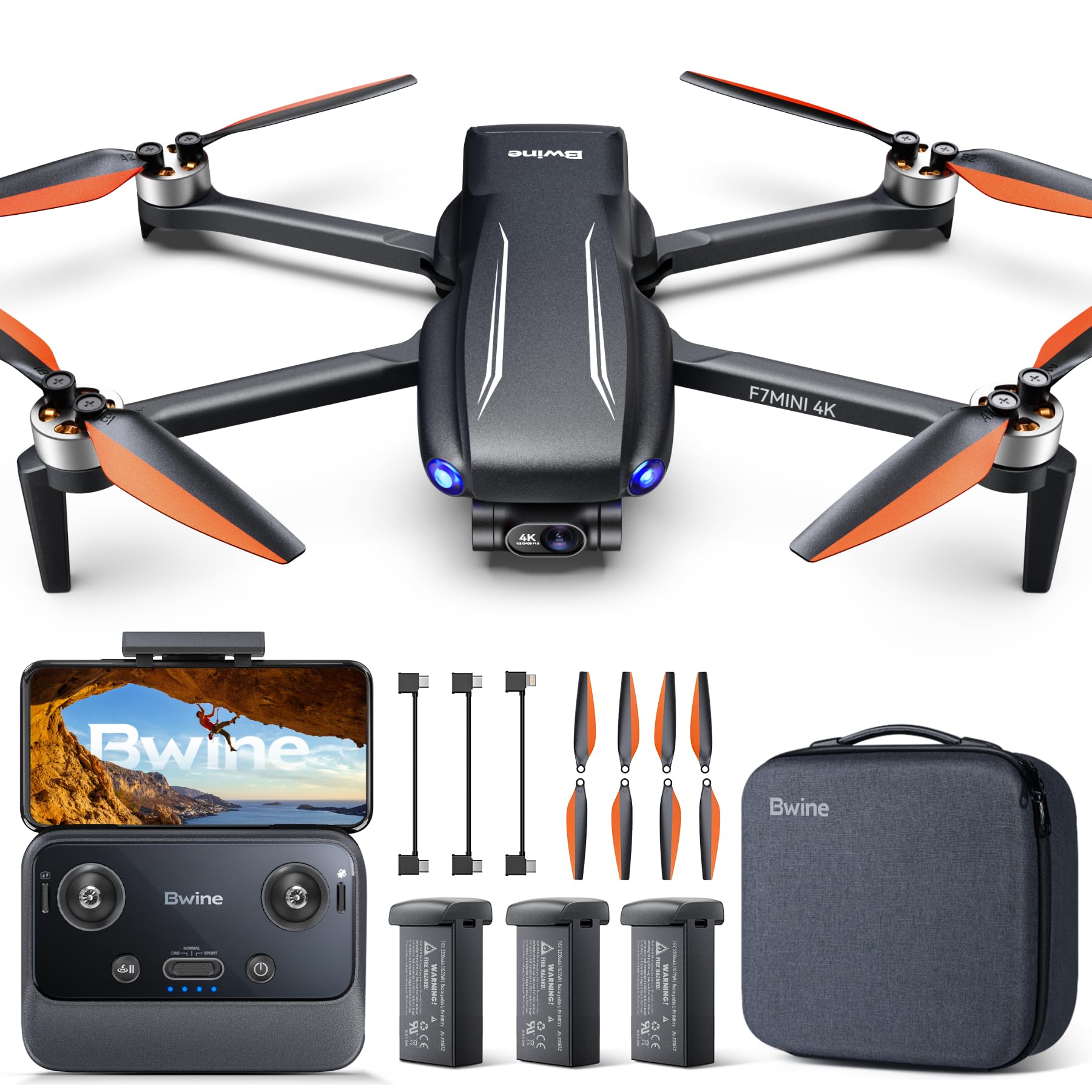
The Bwine F7MINI delivers an impressive total of 96 minutes of flight time straight out of the box, thanks to three 2200mAh lithium-ion batteries. Each pack runs for about 32 minutes, and they support PD 3.0 fast charging, which significantly reduces downtime between flights. This is the best pick if you want to spend a full afternoon learning without worrying about battery management.
The camera setup includes a 1/2-inch 48MP CMOS sensor that captures 8K photos and 4K/30fps video, paired with a 3-axis stabilized gimbal. The gimbal’s real-time compensation for pitch, roll, and yaw means that even in Level 5 wind resistance, the footage remains smooth and usable. The RC3 Smart Controller features a built-in 5.5-inch touchscreen, removing the need for a phone entirely and providing a bright, clear display even in sunlight.
At 249g, it sits right at the FAA exemption threshold, making it a hassle-free travel companion. The GPS system includes smart RTH, a dynamic home point, and a 120dB locator buzzer — the latter being a thoughtful safety feature for recovering a downed drone in tall grass or brush. The 6KM digital transmission is another strong point, though real-world range typically settles closer to 2 kilometers in suburban environments.
Why it’s great
- 96-minute total flight time with three fast-charging batteries
- 3-axis gimbal with 48MP sensor for sharp, stable footage
- Built-in 5.5-inch touchscreen controller; no phone needed
- Under 249g with loud locator beeper for recovery
Good to know
- Real-world transmission range is shorter than the 6KM claim
- Controller has a learning curve due to dense button layout
6. Ruko Drone (F13)

The Ruko drone is a feature-dense package that aims to be the complete beginner solution. It includes three intelligent batteries for a total flight time of 96 minutes, a 3-axis brushless gimbal for gimbal-stabilized 4K footage, and an 8K photo mode from its 48MP 1/2-inch CMOS sensor. The R2 digital transmission system promises 20,000 feet of range with low latency, making it a strong competitor in the upper-mid-range segment.
Safety features are comprehensive for a beginner model. The AI Takeoff/Landing system combines quadruple positioning — GPS, barometric altitude hold, TOF sensors, and optical flow — to ensure a stable launch and recovery even without a strong GPS lock. The built-in beeper is loud enough to locate the drone in dense foliage, and the three-tier Auto Return system covers one-click, low-battery, and signal-loss scenarios.
The bundle is impressively complete, with the drone, three batteries, a hard carrying case, spare propellers, and a full accessory kit. Ruko’s customer service is frequently highlighted for its responsiveness, with reports of quick replacements for defective batteries or crash-related damage. The trade-off is the weight — at under 249g, it sits just below the FAA threshold, though the joysticks are quite sensitive and may require some fine-tuning for absolute beginners.
Why it’s great
- 96-minute total flight time from three intelligent batteries
- 3-axis gimbal with 48MP sensor for gimbal-stabilized 8K photos
- AI-assisted takeoff and quadruple positioning for ultra-safe launches
- Complete bundle with hard case, extra props, and full accessory kit
Good to know
- Sensitive joysticks require some fine-tuning for smooth control
- Some units have reported battery or propeller defects, though support resolves quickly
7. Oddire HK11

The Oddire HK11 offers a remarkably broad feature set for its price point. The GPS module supports Auto Return, Follow Me, Waypoint Flight, and Orbit modes — the same smart flight features found on models costing substantially more. The 4K camera with 110-degree wide-angle lens and 90-degree remote tilt adjustment captures serviceable footage that looks good on social media, though the effective video resolution is 2048x1088P rather than true 4K.
With two 7.7V 1800mAh batteries, the total flight time reaches 48 minutes, which is adequate for a full session. The brushless motors provide Level 5 wind resistance and quieter operation than brushed alternatives, and the 249g weight keeps it FAA-exempt. The 5G Wi-Fi transmission is rated at 1,640 feet (500 meters), though real-world performance in urban areas with interference typically caps closer to 300-400 meters.
Customer reviews frequently note that the drone is durable and easy to fly, surviving crashes that would ground more fragile units. The main caveat is the app experience — the primary app mentioned in the manual is reportedly broken, and users need to download “XDRONE GO” instead. This is a minor hurdle but worth knowing before the first flight. The compass calibration process is not well explained in the manual, so watching a quick YouTube tutorial is recommended.
Why it’s great
- Excellent GPS feature set (Auto Return, Follow, Waypoint, Orbit) at a budget price
- Durable build that survives beginner crashes
- Brushless motors for quieter, more powerful flight
- Under 249g with 48 minutes total flight time from two batteries
Good to know
- Effective video resolution is lower than the advertised 4K
- App selection requires downloading “XDRONE GO” instead of the listed app
- Calibration process is poorly documented in the manual
8. SIMREX G29

The SIMREX G29 is designed with portability as its primary strength. The foldable arms collapse to just 7.87 x 7.68 x 3.23 inches and the entire unit weighs only 0.5 pounds, making it one of the most packable options for hikers, travelers, and spontaneous flyers. Despite its small size, it includes a 90-degree electrically adjustable 4K camera and Optical Flow positioning for stable indoor hovering without GPS.
The GPS system provides reliable Auto Return, Follow Me, Waypoint Flight, and Circle Around modes that work well in open outdoor spaces. The 5G Wi-Fi FPV transmission is rated at 2,296 feet, and the 40-minute total flight time from two batteries is sufficient for most casual outings. Beginners will benefit from the Headless Mode and Altitude Hold features, which simplify orientation and height management during early flights.
The camera delivers decent 4K stills and HD video that holds up in good lighting, though low-light performance is limited by the small sensor. The controller includes a phone dock for live FPV viewing, and USB-C charging for the batteries is a welcome modern convenience. Some users note that the build feels slightly less robust than heavier alternatives, so careful handling during the first few flights is wise.
Why it’s great
- Extremely compact and lightweight for maximum portability
- 90-degree electrically adjustable camera for flexible framing
- Optical Flow positioning enables stable indoor flight
- USB-C charging for batteries and controller
Good to know
- Build quality feels less substantial than heavier drones
- Low-light camera performance is limited
- Real-world transmission range is shorter than the 2,296ft claim in urban areas
9. REDRIE HK33
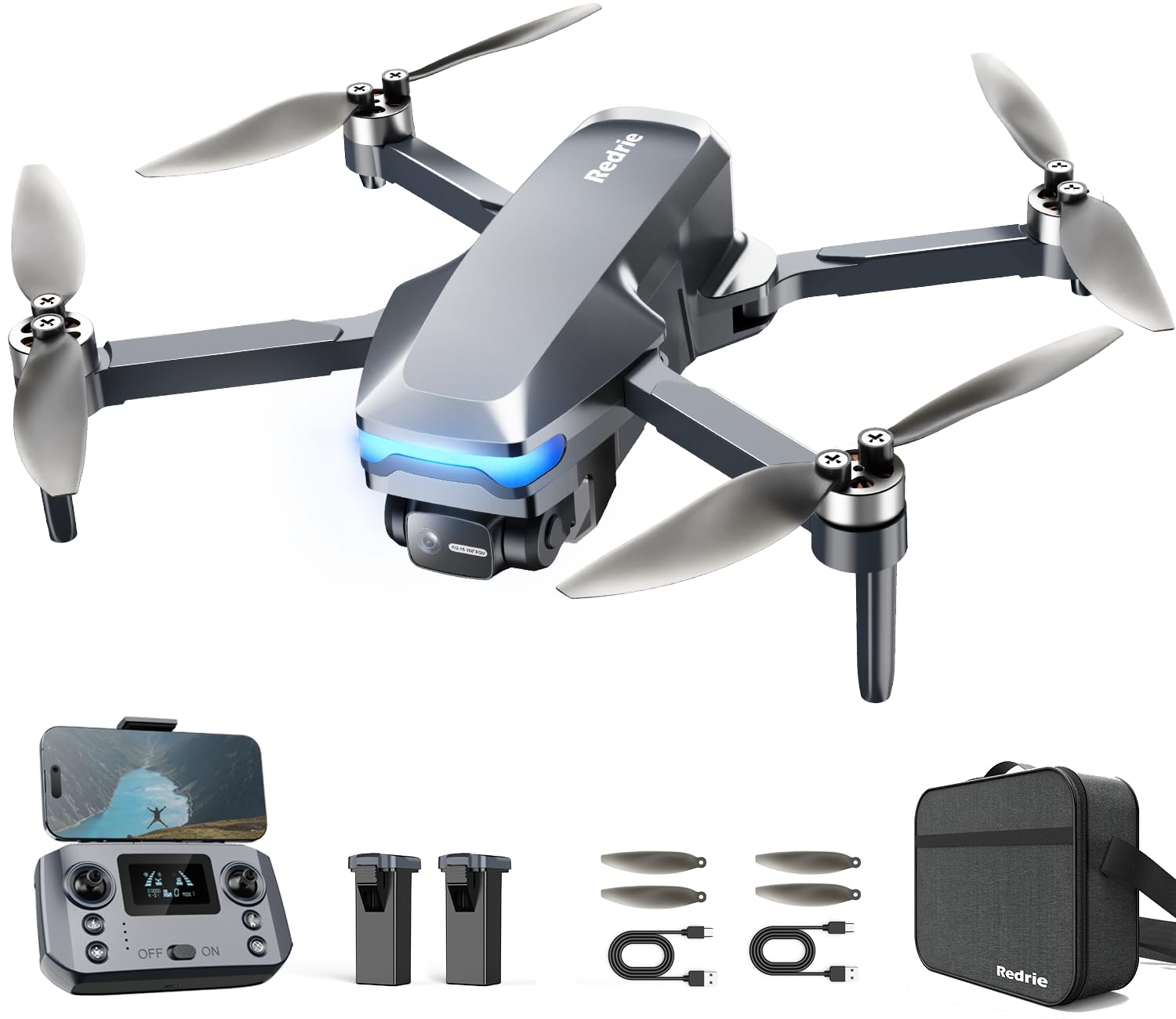
The REDRIE HK33 is a straightforward, no-frills entry into the GPS drone space. It features a 4K camera with a 110-degree wide-angle lens and physical Anti-Shake technology, delivering better-than-basic stills and video for its bracket. The two 1800mAh batteries provide a combined 45 minutes of flight time, and the 5G Wi-Fi transmission keeps a stable FPV connection up to about 985 feet (300 meters) with the repeater extending to 1,640 feet (500 meters).
GPS functions are standard for the category: Auto Return on signal or battery loss, Follow Me, Route Planning, and Fly Around. The brushless motors provide good power and Level 5 wind resistance, helping the drone hold its position in moderate breezes. The included hard carrying case is a practical addition that protects the drone during transport and storage.
Weighing under 249g, it avoids FAA registration requirements. The main points of feedback from buyers are that the cell phone holder on the controller is somewhat flimsy and that video stabilization is more average than exceptional. For the price, it delivers the core GPS safety features and enough flight time to learn the basics, making it a solid starting point for someone who wants to test the waters without a larger investment.
Why it’s great
- Physical Anti-Shake camera for improved still image clarity
- Full GPS suite (Auto Return, Follow, Route) for safe learning
- Under 249g with 45 minutes flight time from two batteries
- Includes a protective hard carrying case
Good to know
- Cell phone holder on controller feels flimsy
- Video stabilization is only average compared to gimbal-equipped models
- Limited 300-500 meter real-world FPV range
FAQ
Do I need an FAA license to fly a beginner drone?
Why do most beginner drones advertise 4K but the video looks worse than my phone?
How important is a brushless motor for a beginner drone?
Final Thoughts: The Verdict
For most users, the best beginner drone for adults winner is the Potensic ATOM SE because it delivers a genuine Sony sensor, reliable GPS safety features, and 62 minutes of flight time in a sub-249g package that avoids FAA registration. If you want the smoothest possible video with a 3-axis gimbal without jumping to the DJI price tier, grab the Gleesfun G11PRO. And for the most well-rounded bundle with three batteries, a gimbal camera, and exceptional customer support, nothing beats the Ruko Drone.