
Our readers keep the lights on and the weekend projects moving. As an Amazon Associate, I earn from qualifying purchases.
Power outages don’t announce themselves. They arrive without warning, mid‑workday or in the dead of night, and the only thing standing between your data, frozen food, and internet connection is a silent box under your desk. Choosing the wrong battery backup means either buying too little capacity for your home office or lugging around a heavy lead‑acid unit that ages out in three years.
I’m Rikta — the co-founder and writer behind FitlyFast. I’ve spent hundreds of hours analyzing battery chemistry, inverter waveforms, and runtime data to build a guide that actually helps you match capacity to your real‑world home load.
Whether you need a compact UPS for a PC and router or a whole‑home power station that can run a fridge through a storm, this analysis of the battery backup for home market separates capacity claims from real runtime.
How To Choose The Best Battery Backup For Home
Home battery backups fall into two distinct camps: traditional UPS units designed for short‑duration power bridging (safe shutdowns, internet uptime) and portable power stations built for extended home backup over hours or days. Knowing which camp you need starts with your critical load — the total wattage of the devices you cannot afford to lose.
VA vs. Watts — The Spec That Trips Everyone Up
A 1500VA unit doesn’t deliver 1500 watts. The watt rating (typically 60‑70% of the VA rating) is the real usable power your devices draw. Always match the continuous watt rating to the sum of your connected equipment. A gaming PC drawing 600W needs a UPS rated for at least 750W continuous.
Sine Wave Shape — Simulated vs. Pure
Active PFC power supplies in modern computers and networking gear can buzz, reboot, or fail on simulated sine wave backup power. Pure sine wave output replicates utility‑grade current — essential for gaming rigs, NAS systems, and any device with a motor or sensitive switching supply.
Battery Chemistry — Lead‑Acid vs. LiFePO4
Traditional UPS units use sealed lead‑acid batteries that last 3‑5 years and must be replaced. LiFePO4 (lithium iron phosphate) packs deliver 10‑year service life with 3000‑5000 charge cycles, weigh half as much per kWh, and tolerate partial state‑of‑charge better. The upfront cost is higher, but the total cost of ownership over a decade is lower.
Quick Comparison
On smaller screens, swipe sideways to see the full table.
| Model | Category | Best For | Key Spec | Amazon |
|---|---|---|---|---|
| CyberPower CP1500PFCLCD | Pure Sine Wave UPS | Gaming PCs & Active PFC Equipment | 1500VA / 1000W Pure Sine Wave | Amazon |
| BLUETTI AC200L | Power Station | Whole‑Home Backup & RV | 2048Wh LiFePO4, Expandable to 8192Wh | Amazon |
| Anker SOLIX C2000 Gen 2 | Power Station | Fridge & Multiple Appliances | 2048Wh LiFePO4, 4000W Peak | Amazon |
| AFERIY P210 | Power Station | Server‑Level UPS & Silent Use | 2048Wh LiFePO4, <10ms Switchover | Amazon |
| Jackery Explorer 2000 v2 | Power Station | Portable & Lightweight Backup | 2042Wh LiFePO4, 39.5 lbs | Amazon |
| GOLDENMATE 1000VA | LiFePO4 UPS | Long‑Life Desktop & Network Backup | 1000VA / 600W Pure Sine Wave, LiFePO4 | Amazon |
| Amazon Basics 1500VA | Line Interactive UPS | Budget Home Office Protection | 1500VA / 900W Simulated Sine Wave | Amazon |
| CyberPower AVRG900LCD | AVR UPS | Medium Load & Voltage Fluctuation Areas | 900VA / 480W, 12 Outlets, AVR | Amazon |
| APC BE600M1 | Compact UPS | Router/Modem & Single PC Graceful Shutdown | 600VA / 330W, 7 Outlets | Amazon |
In‑Depth Reviews
1. CyberPower CP1500PFCLCD Pure Sinewave UPS

The CP1500PFCLCD is the gold standard for anyone running modern electronics with Active PFC power supplies. Its pure sine wave output eliminates the random reboots and buzzing that plague simulated wave UPS units on high‑end PCs, networking gear, and NAS systems.
Twelve outlets split evenly between battery backup and surge‑only protection. The color LCD panel tilts for easy viewing and displays voltage, load in watts, runtime, and event logs — no app required. AVR corrects minor brownouts without draining the battery, preserving lifespan for when you truly need it.
Users report 15‑25 minutes of runtime on a gaming desktop plus monitor, and over an hour on network gear alone. The 3‑year warranty includes the battery, backed by a connected equipment guarantee. For pure sine wave reliability at a mid‑range price, this unit is the benchmark.
Why it’s great
- True pure sine wave output compatible with Active PFC supplies
- Multifunction color LCD with real‑time load data
- AVR preserves battery during minor fluctuations
Good to know
- Heavier than entry‑level UPS models
- Initial odor from new unit fades after a day
2. BLUETTI AC200L Portable Power Station

The AC200L takes home backup beyond the desktop. With 2048Wh of LiFePO4 capacity expandable to 8192Wh with additional B300K or B300 batteries, this unit can run a fridge, security system, modem, and lights for hours — not minutes.
Eleven output ports include a 30A RV outlet and a 48V DC port for efficient RV battery charging. The 2400W AC inverter supports 3600W Power Lifting, allowing it to start a 12000 BTU air conditioner or a well pump. Turbo charging via a 2400W input fills the battery to 80% in 45 minutes.
The UPS mode switches in under 10ms, fast enough to keep a desktop computer running through a flicker. The companion app provides real‑time monitoring via Wi‑Fi or Bluetooth. For extended home backup that can scale with your needs, the AC200L is a serious contender.
Why it’s great
- Massive expandable capacity up to 8192Wh
- 30A RV outlet and 2400W AC output
- Fast 45‑minute recharge to 80%
Good to know
- Proprietary power cord for AC charging
- 61 lbs — not designed for frequent carrying
3. Anker SOLIX C2000 Gen 2 Power Station

The C2000 Gen 2 solves the recharge bottleneck that frustrates many power station owners. Full charge in 58 minutes via AC input means you can drain it overnight running a fridge and have it ready again by morning. The 2400W rated output (4000W peak) handles multiple appliances simultaneously.
At 41.7 lbs and 18 inches long, it’s 25% lighter than similar 2kWh units. The standby power draw is only 9W — critically low for a device that stays plugged in as a whole‑home UPS. Expansion batteries bring capacity to 4kWh for extended outages.
Users report powering a 30‑quart fridge for 5‑7 days on a single charge, and the companion app provides granular usage prediction. The 20ms UPS switchover keeps sensitive gear online through utility glitches. For fast turnaround and low idle draw, this is a standout mid‑range power station.
Why it’s great
- Full recharge in under 60 minutes
- Very low 9W standby consumption
- Runs most window AC units with 4000W peak
Good to know
- No paper manual included in the box
- Heavy at 41.7 lbs despite lightweight design
4. AFERIY P210 Portable Power Station

The P210 is a 2048Wh LiFePO4 station with a true server‑grade UPS capability. The sub‑10ms transfer time is fast enough for the most sensitive network equipment, including switches and routers that reboot on slower backup units.
Sixteen ports cover every scenario: six 20A AC outlets, USB‑A, USB‑C up to 100W, DC5521, XT60, and a car port. The internal inverter is pure sine wave with a 2400W continuous rating and 4800W surge. Noise levels sit below 30 dB at full load — quieter than a library.
The AFERIY app manages energy consumption and automation settings. Seven‑year extended warranty exceeds the industry standard. For a quiet, powerful home backup that doubles as a server‑room UPS, the P210 delivers exceptional value in the mid‑range power station tier.
Why it’s great
- Silent operation below 30 dB
- Sub‑10ms UPS switchover for sensitive electronics
- Seven‑year extended warranty
Good to know
- Display screen reported to black out in some units
- Missing scheduled charging feature in app
5. Jackery Explorer 2000 v2 Power Station

Jackery’s Explorer 2000 v2 is the lightest 2kWh portable power station on the market at 39.5 lbs — 41% lighter than typical units. This is made possible by CTB (Cell‑to‑Body) technology borrowed from EV manufacturing, which integrates cells directly into the chassis for better space efficiency.
Three AC ports deliver 2200W total with a 20ms UPS switchover for seamless backup during outages. The USB‑C PD 100W port charges laptops directly without a separate adapter. AC fast charging reaches 80% in 66 minutes, while the app‑controlled Emergency Super Charging mode fills the battery in 102 minutes.
Silent Charging mode operates at under 30 dB, making it suitable for overnight use in bedrooms or hotel rooms. Users report running a fridge for over 21 hours on a single charge. For portable, everyday backup you can actually carry, the Explorer 2000 v2 is the lightest option in the premium power station class.
Why it’s great
- Lightest 2kWh unit at 39.5 lbs
- Silent Charging mode under 30 dB
- Fast 66‑min recharge to 80%
Good to know
- Bluetooth connection can be inconsistent
- Solar barrel ports flex inward when plugged in
6. GOLDENMATE 1000VA Lithium UPS

The GOLDENMATE 1000VA bridges the gap between a traditional UPS and a modern LiFePO4 power station. It packs a 153.6Wh LiFePO4 battery with pure sine wave output — a combination rarely seen at this price point. The 5000‑cycle lifespan and 10‑year service life reduce total cost of ownership by over 40% compared to lead‑acid equivalents.
Eight NEMA outlets provide surge protection, and the intelligent LCD panel displays real‑time battery and power conditions. The buzzer can be muted with a single button press, a thoughtful detail for bedroom or office placement. The BMS actively balances cells and prevents over‑discharge.
Users note the unit is noticeably lighter than lead‑acid UPS units of similar VA rating. The 20ms switchover is adequate for most desktops and network gear, though some sensitive equipment may prefer the sub‑10ms switch of higher‑end units. For a compact desktop UPS with LiFePO4 longevity, this is a smart mid‑range choice.
Why it’s great
- LiFePO4 battery with 5000‑cycle lifespan
- Pure sine wave output for clean power
- Lightweight and compact desktop form factor
Good to know
- No USB or network port for automated PC shutdown
- Outlets spaced tightly — large adapters may overlap
7. Amazon Basics 1500VA UPS

The Amazon Basics 1500VA is a line‑interactive UPS that delivers 900W of simulated sine wave backup for standard home office setups. Ten outlets split into five battery‑backed and five surge‑only ports, providing flexibility for prioritizing critical gear like a PC and monitor over speakers or printers.
AVR corrects minor voltage sags without engaging the battery, extending the lead‑acid pack’s life. The mini tower design with a 6‑foot power cord fits comfortably under a desk. At half load (450W), runtime sits around 10 minutes — enough for graceful shutdown of a desktop computer and a modem.
Users highlight the straightforward setup and the reliable bridging capability during brief flickers. Battery replacement is possible but requires opening the tower. For entry‑level home office protection where pure sine wave isn’t required, this is a budget‑friendly option that covers the basics.
Why it’s great
- Strong 1500VA capacity for multiple devices
- AVR extends battery life during brownouts
- Compact tower design fits under desks
Good to know
- Simulated sine wave may not suit Active PFC supplies
- Battery life reported to decline after ~5 years
8. CyberPower AVRG900LCD Intelligent LCD UPS
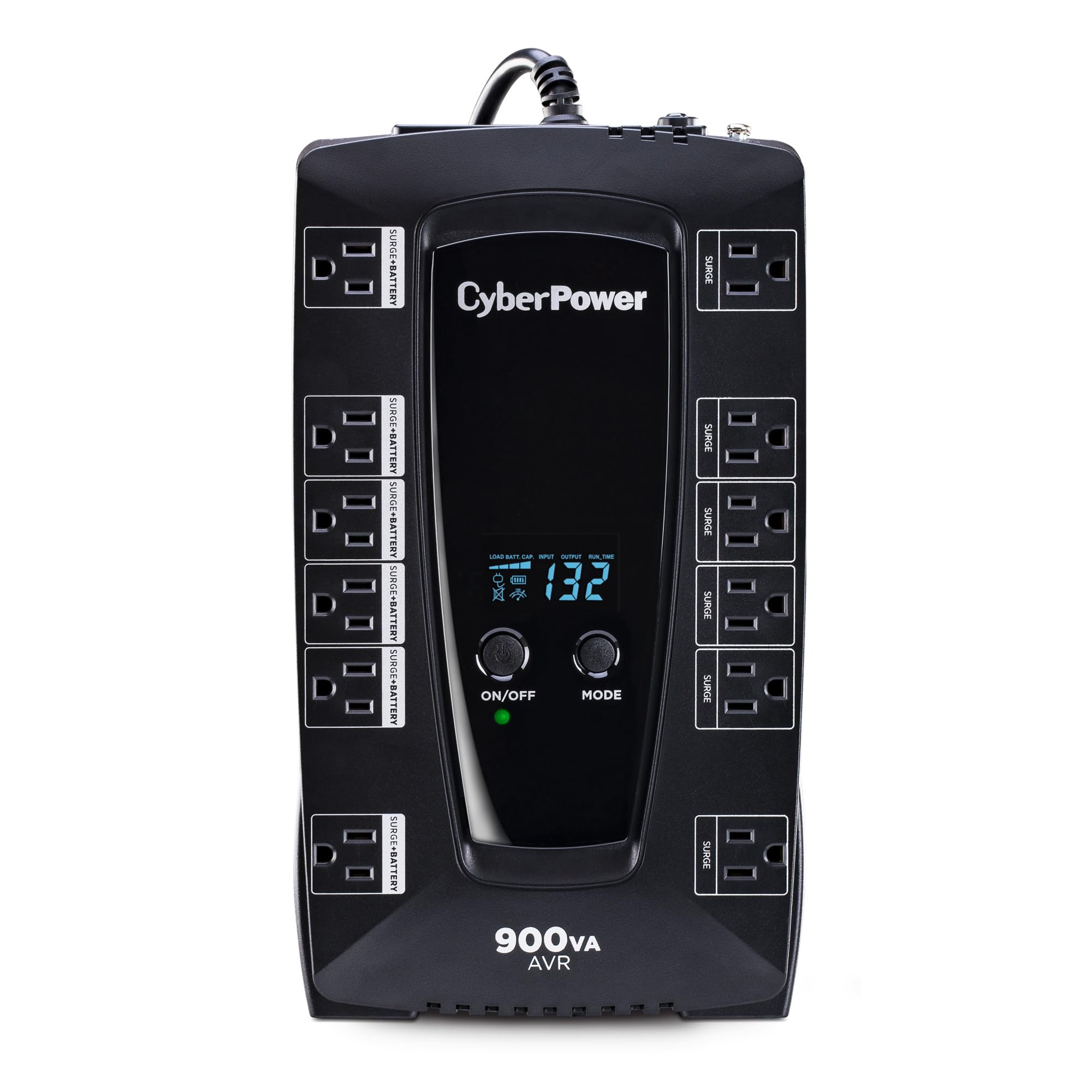
The AVRG900LCD is a 900VA/480W UPS that packs 12 outlets — more than any other UPS at this price bracket. Six outlets provide battery backup and surge protection while six are surge‑only, giving you room to protect a full home office including a PC, two monitors, a printer, and networking gear.
AVR is the standout feature here. It corrects voltage fluctuations as low as 89V without draining the battery, which is critical for homes on unstable grid power or in areas with frequent brownouts. The LCD display shows input voltage, battery level, and load wattage at a glance.
Data line protection for telephone lines prevents surges traveling through wired connections. Users report 18‑20 minutes of runtime on a desktop PC plus two monitors — enough to bridge a generator startup gap. For medium‑density home offices in areas with dirty power, the AVRG900LCD is a reliable mid‑range UPS.
Why it’s great
- 12 outlets — most in its class
- AVR corrects minor voltage dips without battery use
- Data line protection for telephone connections
Good to know
- Setup using the mode button can be unintuitive
- Some units arrive with battery disconnected
9. APC BE600M1 UPS Battery Backup

The APC BE600M1 is the entry‑level UPS that keeps your Wi‑Fi router and a single computer running through brief outages. At a 100W load (router plus modem), it delivers 23 minutes of runtime — enough to maintain internet connectivity through most blackouts.
Seven outlets include five with battery backup and surge protection plus two surge‑only for printers or speakers. A built‑in 1.5A USB port charges phones during outages. The battery is user‑replaceable (APC RBC154), extending the unit’s life beyond the standard three‑year lead‑acid window.
Users consistently praise the compact footprint, quiet operation, and the recessed power button that prevents accidental shutoff. The PowerChute software automates safe PC shutdown. For a budget‑friendly, reliable UPS that protects a home office’s internet lifeline, the BE600M1 is the classic choice.
Why it’s great
- Compact footprint fits easily on a desk
- User‑replaceable battery reduces waste
- 23‑minute runtime on low‑power gear
Good to know
- 330W limit restricts connected device wattage
- 10‑hour full recharge time is slow
FAQ
What load should I use to calculate runtime for a home UPS?
Can I plug a power strip or surge protector into a UPS?
Final Thoughts: The Verdict
For most users, the battery backup for home winner is the CyberPower CP1500PFCLCD because it delivers pure sine wave protection for gaming and office PCs at a mid‑range price with excellent runtime. If you want whole‑home backup that can run a fridge and sump pump for hours, grab the BLUETTI AC200L. And for a budget‑friendly desktop UPS that keeps your Wi‑Fi alive, nothing beats the compact and reliable APC BE600M1.