
Our readers keep the lights on and the weekend projects moving. As an Amazon Associate, I earn from qualifying purchases.
An AV amplifier is the nervous system of your home theater. It decides whether dialogue cuts through a crowded soundstage, whether the bass hits clean or muddy, and whether your 4K sources actually pass through without handshake headaches. The wrong pick leaves expensive speakers underpowered and essential features like room correction or HDMI 2.1 locked away behind a paywall you didn’t know existed. This breakdown sorts the signal from the noise across eleven models so you match the right amp to your room and your gear.
I’m Rikta — the co-founder and writer behind FitlyFast. My analysis here draws from hundreds of hours digging into factory specs, owner forums, and third-party bench measurements to separate genuine performance gains from marketing theater.
A good av amplifier must balance real amplifier headroom with modern HDMI requirements and room calibration depth, because a receiver with all the right ports but weak current delivery will leave a 5.1.2 system sounding flat in a medium room.
How To Choose The Best AV Amplifier
Choosing the right AV amplifier requires looking past the headline wattage figure. A receiver that can’t deliver current into low-impedance speakers or lacks proper room correction will leave you underwhelmed no matter how many HDMI ports it carries. Let’s break down the three factors that separate a great purchase from a future regret.
Channel Count and Speaker Configurations
The channel number tells you how many physical speakers the receiver can power. A 7.2 channel unit can run a standard 5.1.2 Atmos layout (five ear-level, one sub, two height) or a 7.1 setup without heights. If you want a 5.2.4 or 7.2.4 system with four ceiling speakers, you need a 9-channel or 11-channel receiver. Count your planned speakers first, then buy the channel count that leaves room for one future expansion.
HDMI 2.1 and Bandwidth Requirements
HDMI 2.1 is essential if you own a PlayStation 5, Xbox Series X, or an 8K television. The key spec is the bandwidth: 40Gbps supports 4K at 120Hz with 10-bit color, while 48Gbps supports full 12-bit 4K/120 or 8K/60 uncompressed. Look for VRR and ALLM support if you game competitively. Older HDMI 2.0 receivers can still work for 4K/60 content, but you lose future-proofing for high-refresh-rate gaming.
Room Correction and Calibration Depth
Room correction software adapts the amplifier’s output to your specific room’s acoustics — speaker distances, boundary gain, and frequency nulls caused by furniture placement. Budget-tier systems like YPAO (basic) adjust only distance and level. Mid-tier systems like Audyssey MultEQ XT32 adjust frequency response across multiple points. Premium options like Dirac Live Full Bandwidth allow you to set a custom target curve for both time domain and frequency domain corrections. Better room correction makes a bigger audible difference than upgrading from 90W to 110W in most rooms.
Quick Comparison
On smaller screens, swipe sideways to see the full table.
| Model | Category | Best For | Key Spec | Amazon |
|---|---|---|---|---|
| Onkyo TX-RZ70 | 11.2 Channel | Reference-level home theater with Dirac | 110W per channel (tested 170W) | Amazon |
| Marantz Cinema 50 | 9.4 Channel | Hi-fi music and high-end cinema blend | 110W per channel, 9 HDMI inputs | Amazon |
| Sony STR-AZ1000ES | 7.2 Channel | 360 Spatial Sound Mapping immersion | 100W per channel, 6-in/2-out HDMI | Amazon |
| Marantz Cinema 60 | 7.2 Channel | Phono stage, HDAM circuitry, music priority | 100W per channel, Audyssey MultEQ XT32 | Amazon |
| Yamaha RX-A4A | 7.2 Channel | Surround:AI and Auro-3D enthusiasts | Surround:AI, YPAO R.S.C. with 3D | Amazon |
| JBL MA9100HP | 9.2 Channel | Slim-profile white finish with Class D | 140W per channel (Class D) | Amazon |
| Sony STR-AN1000 | 7.2 Channel | Works with Sonos integration | 165W (6 ohms, 1ch), DCAC IX | Amazon |
| Denon AVR-S970H | 7.2 Channel | Phono input, gaming VRR/ALLM | 90W per channel, 8 HDMI inputs | Amazon |
| Onkyo TX-NR6100 | 7.2 Channel | THX Select certified budget build | 210W per channel (dynamic), THX Select | Amazon |
| Denon AVR-S770H | 7.2 Channel | Entry-level with excellent sound character | 75W per channel, HEOS multi-room | Amazon |
| Yamaha RX-V6A | 7.2 Channel | Reliable mid-range with MusicCast | 100W per channel (8 ohms, 2ch) | Amazon |
In-Depth Reviews
1. Onkyo TX-RZ70
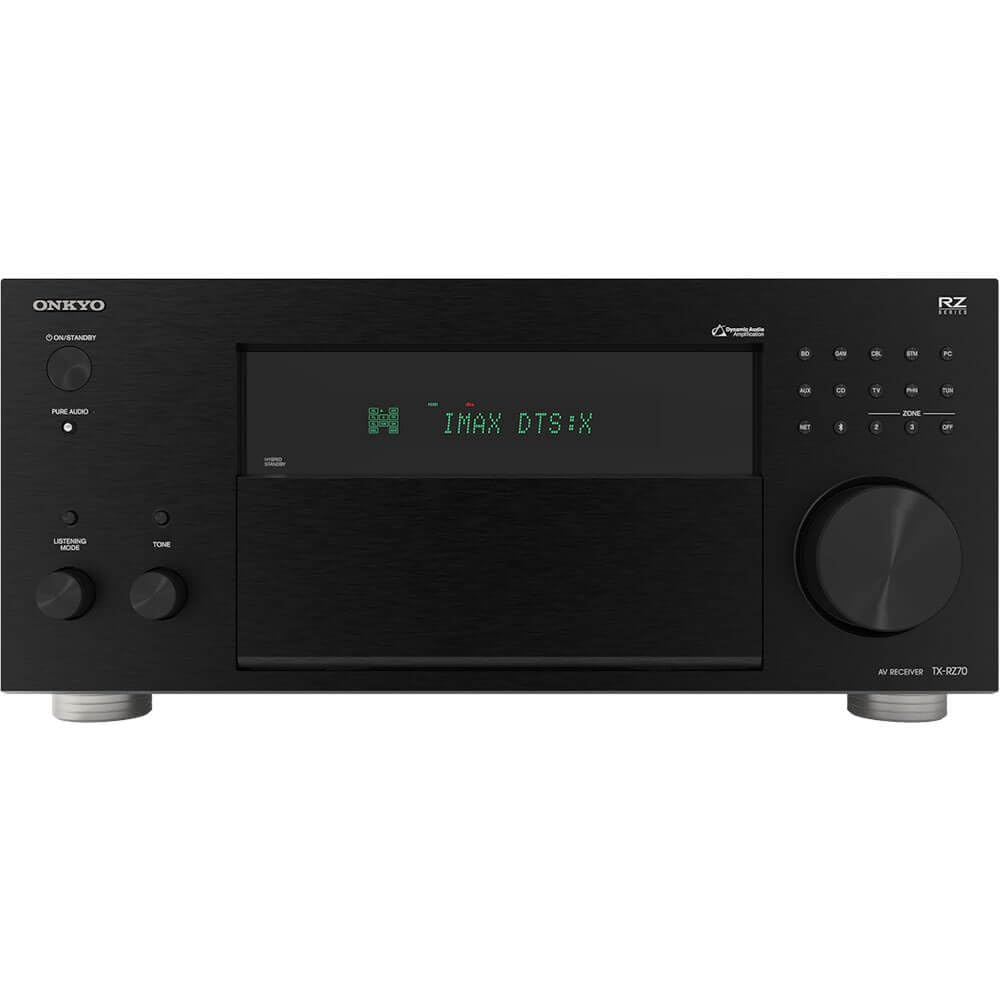
The Onkyo TX-RZ70 is the flagship that checks every box for a serious home theater builder. With 11 channels of amplification rated at 140W per channel and bench-tested at 170W, it powers a full 7.2.4 Atmos layout without needing external amps. The inclusion of Dirac Live Full Bandwidth out of the box means you get professional-grade room correction that addresses both frequency response and impulse response — a feature usually reserved for units costing far more.
ESS Sabre DACs handle digital conversion with excellent clarity, and the THX Select certification guarantees consistent performance across all listening modes. The receiver also offers Roon Ready support for audiophile streaming and Klipsch Optimize Mode that automatically sets crossovers for compatible speakers. HDMI 2.1 inputs handle 4K/120Hz with VRR flawlessly, with no handshake issues reported in owner testing.
The main trade-offs are physical size and the remote. At nearly 58 pounds and 24 inches deep, the TX-RZ70 requires a substantial AV cabinet. The included remote feels cheap compared to the build quality of the chassis itself. But for anyone building a reference-grade system under the cost of separates, this Onkyo delivers Dirac, power, and HDMI 2.1 stability in one package.
Why it’s great
- Dirac Live Full Bandwidth included — no upgrade fee
- ESS Sabre DACs deliver genuine audiophile-grade sound
- Runs cool even at high volume levels
Good to know
- Extremely large and heavy — measure your cabinet before buying
- Remote control feels budget-grade for this class
2. Marantz Cinema 50

The Marantz Cinema 50 is a 9.4-channel receiver built for enthusiasts who want high-quality music playback and movie immersion in equal measure. Its 110W per channel rating is backed by Marantz’s HDAM discrete circuitry and current feedback topology, which produces a warm, detailed sound signature that pairs well with reference speakers like Klipsch Reference Premiere or Bowers & Wilkins. The Audyssey MultEQ XT32 room correction is a significant step up from standard MultEQ, offering multi-point measurement and subwoofer EQ integration.
Connectivity is generous: nine HDMI ports (six inputs, three outputs) with full 8K/60Hz and 4K/120Hz support, plus VRR, ALLM, and QMS for gaming. Four subwoofer outputs give flexibility for dual-sub configurations, and the phono input handles a turntable directly. Owners consistently praise the intuitive on-screen setup and the reliable HDMI-CEC behavior — a rarity among mid-range receivers.
Audyssey MultEQ XT32 is powerful but some users find the phone app necessary for fine-tuning the target curve. The unit runs warm in normal operation, so leave ventilation clearance. If you want a receiver that excels with both two-channel music and multichannel cinema while offering room for expansion, the Cinema 50 is the balanced choice.
Why it’s great
- HDAM discrete circuitry provides genuinely musical sound quality
- Four subwoofer outputs for advanced bass management
- Reliable HDMI-CEC and ARC functionality
Good to know
- Audyssey app required for full calibration control
- Runs warm — needs at least 5 inches of overhead ventilation
3. Sony STR-AZ1000ES

The Sony STR-AZ1000ES belongs to Sony’s premium ES line, which focuses on build quality and proprietary audio processing. Its standout feature is 360 Spatial Sound Mapping, a technology that creates additional phantom height channels and widens the soundstage beyond your physical speaker layout. Paired with Digital Cinema Auto Calibration IX, the receiver measures multiple points and adjusts timing, EQ, and phase to create a convincing overhead bubble even without in-ceiling speakers.
With 100W per channel into 8 ohms, the AZ1000ES has solid headroom for medium to large rooms. It supports Dolby Atmos, DTS:X, and IMAX Enhanced, plus Works with Sonos for easy integration into a Sonos multi-room ecosystem. The backlit remote and front-panel cover plate give it a polished, integrated feel that less expensive Sony models lack. Owners also report the calibration mic and stand are well-designed for accurate measurements.
The biggest limitation is the channel count: 7.2 channels mean you max out at a 5.1.2 layout. If you want 7.1.4 or 5.2.4, you need to step up to the AZ5000ES or a different brand. The receiver also runs very hot, and owners strongly recommend an external cooling fan like the AC Infinity Aircom T10 for long sessions. If you prioritize virtual height immersion and Sony’s processing ecosystem over channel expansion, this is a standout pick.
Why it’s great
- 360 Spatial Sound Mapping creates convincing virtual height channels
- Backlit remote and premium ES build quality
- Works with Sonos out of the box
Good to know
- Limited to 7.2 channels — no 9-channel expansion
- Runs very hot; cooling fan recommended for extended use
4. Marantz Cinema 60

The Marantz Cinema 60 brings the brand’s signature HDAM circuitry and current feedback amplification to a 7.2-channel format at a lower entry point than the Cinema 50. It delivers 100W per channel and includes Audyssey MultEQ XT32 for detailed room calibration across multiple seating positions. The sound signature leans warm and musical, making it a strong choice if you split listening time equally between movies and stereo music.
Inputs include six HDMI ports with 8K/60Hz and 4K/120Hz pass-through, plus a dedicated phono stage for turntables. HEOS multi-room streaming covers Spotify, TIDAL, and Pandora. Owners upgrading from older Yamaha or Denon units consistently notice clearer dialogue and better instrument separation. The remote is more thoughtfully designed than Onkyo’s flagship remote, with a clean layout and good button feel.
The channel count limits you to 5.1.2 Atmos or 7.1 surround, and the Audyssey app is required to tweak the target curve for finer control. The Cinema 60 also lacks the pre-outs and four subwoofer outputs of its bigger sibling. If you plan to stay at 7 channels and want Marantz’s musical character without paying for unused expansion, this receiver offers genuine value.
Why it’s great
- HDAM circuitry delivers warm, detailed sound for music
- Phono input included for vinyl listeners
- Audyssey MultEQ XT32 room correction performs well
Good to know
- Limited to 7.2 channels — no expansion path
- No pre-outs for future external amplification
5. Yamaha RX-A4A

The Yamaha RX-A4A is the entry point into Yamaha’s premium AVENTAGE line, which focuses on build quality, anti-vibration design, and advanced audio processing. Its headliner is Surround:AI, a technology that analyzes each scene in real time and adjusts surround parameters to prioritize dialogue, effects, or ambiance depending on the content. The YPAO R.S.C. room correction with 3D and multipoint measurement provides fine-grained EQ across multiple listening positions.
Support for Dolby Atmos, DTS:X, and Auro-3D makes this one of the few receivers that handles all three immersive formats. The phono input, front-panel USB, and seven HDMI inputs with 8K/60Hz and 4K/120Hz (40Gbps) keep you connected for years. Owners note that the MusicCast app is reliable for multi-room streaming, and the unit handles 4 ohm speakers without strain.
The setup process is more involved than competitors — firmware updates require a USB flash drive rather than straight in-app updates, and the initial menu system has a learning curve. The 7.2 channel count also means you max out at 5.1.2 without adding external amplification. For users who want Yamaha’s intelligent surround processing and Auro-3D compatibility, the RX-A4A is a beautifully built workhorse.
Why it’s great
- Surround:AI dynamically optimizes audio per scene in real time
- Supports Dolby Atmos, DTS:X, and Auro-3D
- Premium AVENTAGE chassis with anti-vibration design
Good to know
- Firmware update process requires a USB flash drive
- Setup menus are dense and not immediately intuitive
6. JBL MA9100HP
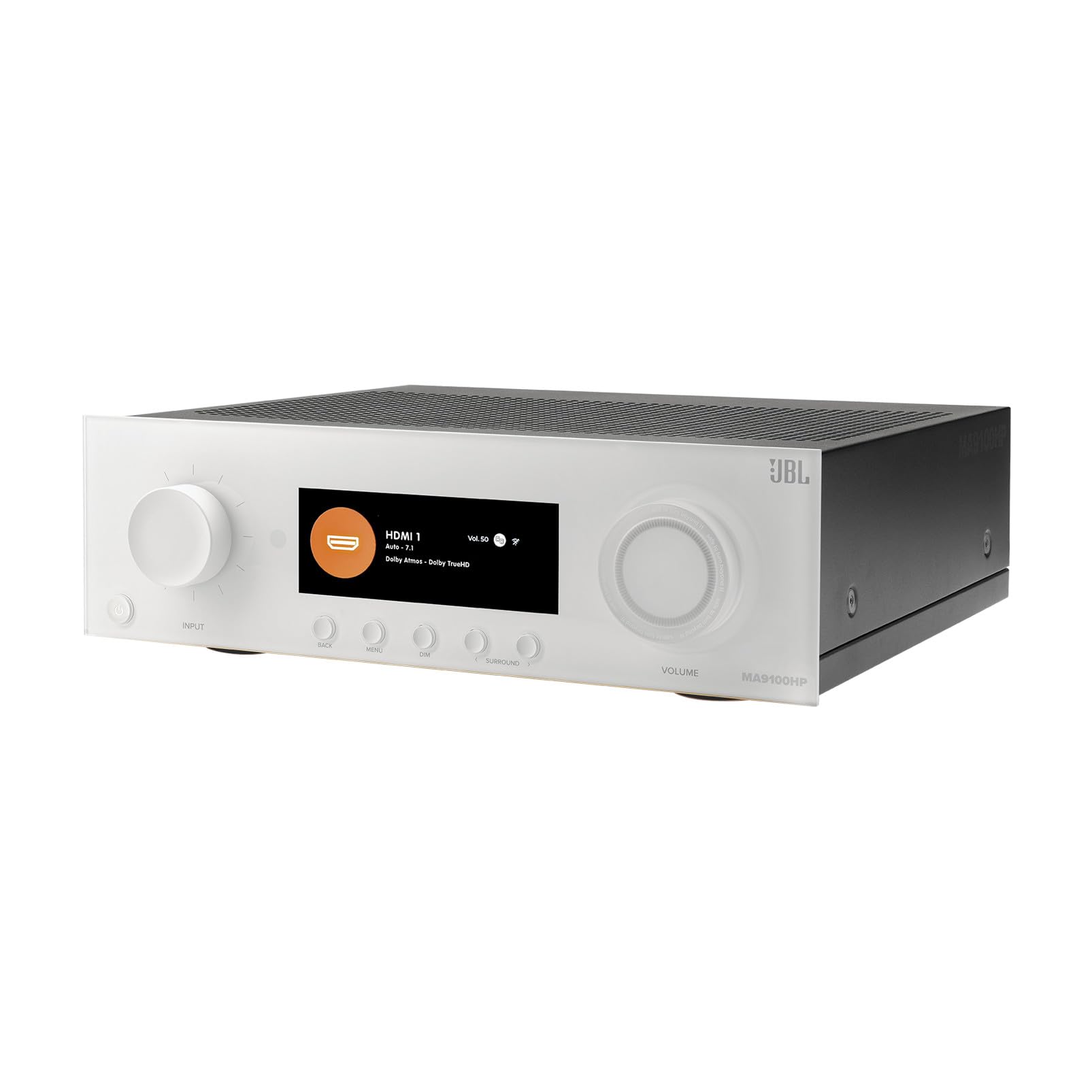
The JBL MA9100HP stands out visually with its white finish and slim 5.3-inch chassis depth, making it one of the few high-power receivers that fits into standard media consoles without overhang. It uses Class D amplification rated at 140W across nine channels, enough for a 5.1.4 or 7.1.2 Atmos layout. The low-noise Class D design runs cooler than typical Class A/B receivers while delivering clean power to demanding speakers.
Streaming is handled by Bluetooth, Apple AirPlay 2, and Google Chromecast built-in. The six HDMI inputs and two outputs support 8K/60Hz passthrough and eARC. Owners praise how the receiver drives in-wall speakers and towers like Polk ES60 with authority, and the on-screen setup menu simplifies the configuration process compared to other receivers in this class.
The remote lacks backlighting, which owners find frustrating in dark theater rooms. There is also a notable limitation: the MA9100HP does not downmix DTS-HD Master Audio to stereo for 2.1 systems, so DTS-HD Blu-rays will not play correctly on setups without surround speakers. If you have a full surround system and like the slim white aesthetic, this JBL delivers strong value.
Why it’s great
- Slim 5.3-inch depth fits standard AV cabinets
- Class D amplification stays cooler than traditional designs
- 9 channels support 5.1.4 or 7.1.2 Atmos layouts
Good to know
- Remote is not backlit — hard to navigate in the dark
- Does not downmix DTS-HD Master Audio to 2.1
7. Sony STR-AN1000

The Sony STR-AN1000 is designed for users who want a modern 7.2-channel receiver with Works with Sonos certification, allowing seamless integration into an existing Sonos ecosystem. Its Digital Cinema Auto Calibration IX system measures and corrects for speaker distance, size, and frequency response across multiple seating positions. The 360 Spatial Sound Mapping technology creates a wider soundstage by analyzing the room acoustics and generating phantom speakers.
HDMI connectivity includes 6 inputs and 2 outputs with 8K/60Hz and 4K/120Hz support, plus Dolby Atmos and DTS:X decoding. The receiver also supports Zone 2 and Zone 3 distribution for multi-room audio. Owners who upgraded from older Sony receivers report noticeably cleaner dialogue and more dynamic surround effects in movies like Blade Runner and Ghostbusters: Frozen Empire.
There is no phono input, so vinyl listeners need an external preamp. Some owners also note that the calibration mic measured subwoofer distance incorrectly by about 12 feet, requiring manual adjustment. For a living room setup that integrates with Sonos speakers and delivers crisp, immersive sound, the STR-AN1000 is a smart middle-ground option.
Why it’s great
- Works with Sonos for easy multi-room expansion
- DCAC IX calibration is intuitive and effective
- 360 Spatial Sound Mapping widens the perceived soundstage
Good to know
- No phono input for turntables
- Auto-calibration may mis-measure subwoofer distance
8. Denon AVR-S970H

The Denon AVR-S970H is a well-rounded 7.2-channel receiver that adds a phono input and gaming-specific HDMI 2.1 features to Denon’s proven S-series formula. At 90W per channel, it has more headroom than the entry-level S770H, and the inclusion of VRR, ALLM, and QFT ensures smooth, tear-free gameplay at 4K/120Hz. Audyssey MultEQ (not XT32) handles room calibration, and the on-screen setup assistant makes first-time configuration straightforward.
HEOS multi-room streaming is built in, supporting Spotify, TIDAL, and Amazon Music HD. Owners praise the sound quality with Klipsch and ELAC speakers, describing it as clear and powerful for both movies and music. The phono stage is serviceable for a mid-range turntable, making this a rare option in the sub- tier for vinyl enthusiasts.
Powered Zone 2 uses the rear surround channels, so a 5.2 configuration is necessary if you want both Zone 2 and full surround. Audyssey MultEQ (non-XT32) is a step down from the MultEQ XT32 found in Denon’s X-series. If you need a phono input and HDMI 2.1 gaming support without climbing to the X-series price point, the S970H hits a sweet spot.
Why it’s great
- Phono input for vinyl at a mid-range price
- HDMI 2.1 with VRR and ALLM for gaming
- Easy on-screen setup assistant
Good to know
- Powered Zone 2 reduces surround channels to 5.1
- Audyssey MultEQ (non-XT32) is less advanced than competitors
9. Onkyo TX-NR6100
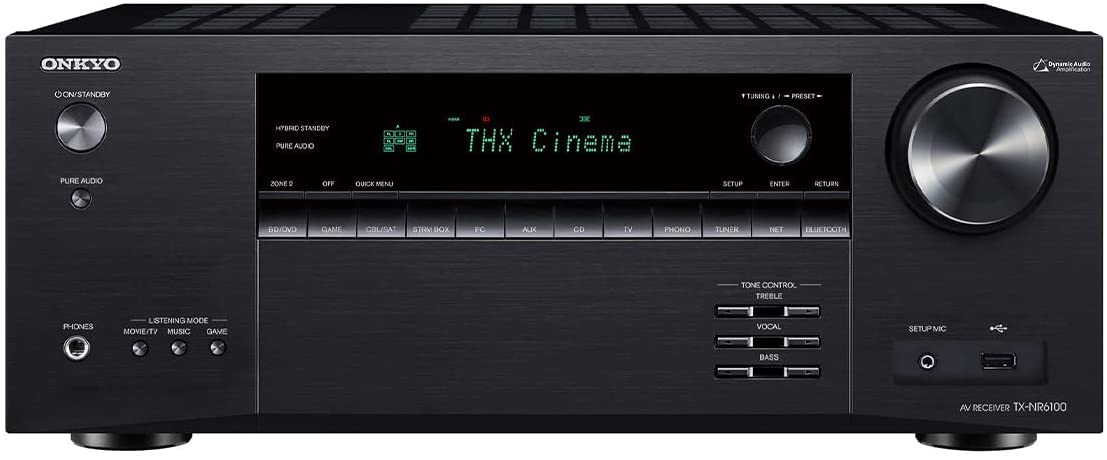
The Onkyo TX-NR6100 brings THX Select certification and high dynamic power to a competitive price point. Its 210W per channel dynamic rating provides substantial headroom for transient peaks, and owners report it runs significantly louder than Denon’s X1700 when driving Klipsch Reference speakers. The 8 HDMI inputs include three 40Gbps HDMI 2.1 ports for 4K/120Hz gaming, and the receiver supports Dolby Atmos with up to 5.2.2 configurations.
THX Select certification means the receiver has passed rigorous testing for consistent performance in rooms up to 2,000 cubic feet. The built-in calibration tailors output to specific speaker models, and the Onkyo Controller app offers convenient control. Owners upgrading from 2018-era Onkyo units praise the crisp HDR handling and clear channel separation.
The remote is not backlit, and inputs 4-6 are 4K-only (not 8K-capable). Bi-amping the front speakers consumes two channels, limiting your system to 5.1 without surround back speakers. There is also a known risk of defective units from third-party sellers due to chip supply issues during the pandemic. For THX certification and raw power output at a mid-range price, it is a strong contender.
Why it’s great
- THX Select certification for consistent performance
- High dynamic power (210W/ch) for demanding speakers
- 8 HDMI inputs with 3 HDMI 2.1 ports
Good to know
- Non-backlit remote is hard to use in the dark
- Risk of defective units from third-party sellers
10. Denon AVR-S770H

The Denon AVR-S770H is the entry-level 7.2-channel receiver that consistently surprises owners with its sound quality despite a modest 75W per channel rating. It supports Dolby TrueHD, DTS Neural:X upmixing, and Dolby Atmos Height Virtualization, which creates a convincing overhead effect without physical height speakers. The HEOS platform enables multi-room audio over Wi-Fi with services like Pandora, TIDAL, and Spotify.
Owners upgrading from soundbars or older budget receivers describe the sound as warm and detailed, with some noting that it outperforms more expensive receivers they have owned in terms of clarity and speaker control. The on-screen setup assistant walks you through speaker detection, distance calibration, and input labeling, making it accessible for first-time AV receiver buyers.
Reported firmware issues include random volume drops and startup picture loss that require a power cycle. The remote layout is also criticized as cluttered. The 75W rating means this receiver is best suited for smaller to medium rooms with efficient speakers (88dB sensitivity or higher). If you want Denon’s reliable feature set and HEOS streaming at the lowest entry point, the S770H is a capable start.
Why it’s great
- Warm, detailed sound that outperforms its power rating
- HEOS multi-room streaming is reliable and easy
- On-screen setup assistant ideal for first-time buyers
Good to know
- Some units experience firmware-related glitches
- 75W/ch limited with low-sensitivity speakers
11. Yamaha RX-V6A

The Yamaha RX-V6A is a 7.2-channel receiver that has become a staple for users wanting a reliable, feature-rich mid-range unit. It offers seven HDMI inputs with HDCP 2.3 and eARC, including three 8K60 and 4K120 capable ports at 40Gbps bandwidth. The MusicCast system provides multi-room audio with support for Spotify, TIDAL, Amazon Music HD, and SiriusXM, plus AirPlay 2 and Bluetooth.
Dolby Atmos and DTS:X decoding are supported, along with Dolby Vision and Hybrid Log-Gamma for HDR video. Owners consistently report a 10-year expected lifespan based on Yamaha’s reputation for durability, and they note that the setup process takes about 20 minutes without requiring a smartphone app. The YPAO calibration system automatically adjusts speaker distances and levels with decent accuracy.
The eARC implementation can be finicky — some owners report the receiver not auto-waking with certain TV brands, requiring manual power-on. The remote is also less intuitive than Denon or Sony alternatives. For a proven, no-surprises receiver with MusicCast streaming and sufficient HDMI 2.1 support for current-gen consoles, the RX-V6A remains a deservedly popular choice.
Why it’s great
- Proven Yamaha reliability with long lifespan
- MusicCast multi-room supports major streaming services
- Three 8K/4K120 HDMI 2.1 inputs
Good to know
- eARC auto-wake can be inconsistent with some TVs
- Remote control layout is less intuitive than competitors
FAQ
How many channels do I need for Dolby Atmos?
What is the difference between Audyssey MultEQ and MultEQ XT32?
Will a 7.2 receiver power 4 ohm speakers?
Final Thoughts: The Verdict
For most users, the av amplifier winner is the Onkyo TX-RZ70 because it delivers Dirac Live Full Bandwidth, robust 11-channel power, and flawless HDMI 2.1 support in a single chassis. If you want Marantz’s HDAM musicality and four subwoofer outputs, grab the Marantz Cinema 50. And for a slim, cool-running 9-channel solution with a unique white finish, nothing beats the JBL MA9100HP.