
Our readers keep the lights on and the weekend projects moving. As an Amazon Associate, I earn from qualifying purchases.
Specs are compiled from manufacturer listings and verified buyer reviews and can change over time — please confirm the key details on the product page before buying.
You want a travel camera you will actually carry all day, pull out in a crowd, and trust to get the shot without a backpack of lenses. The cameras here are compact all-in-ones that give you real optical zoom, solid video, and easy handling. Each pick is weighed against published specs and what verified buyers actually report, so you see the real strengths and trade-offs, not marketing spin.
I’m Rikta — the founder and writer behind FitlyFast. This guide is built by comparing the manufacturers’ published specifications and the patterns across verified customer reviews, so you get each pick’s real strengths and trade-offs instead of marketing spin.
The key is matching a useful zoom range with a sensor that handles dim light, all in a body that does not drag down your day bag. These five cameras cover that balance in an affordable travel camera for most budgets and trips.
Quick Picks
- Panasonic LUMIX FZ80D Point and Shoot Digital Camera 4K Photo/Video Recording — Top Performer
- Sony ZV-1F Vlog Camera for Content Creators and Vloggers Black — Best Value
- Panasonic LUMIX TZ/ZS99 Point and Shoot Camera, Compact Camera for Travel with 30x Zoom — Traveler’s Pick
- Kodak PIXPRO Astro Zoom AZ528-BK 16 MP Digital Camera with 52x Optical Zoom — Budget Champion
- Canon PowerShot V10 Compact Vlogging Camera, 1″ CMOS Sensor, 4K Video Streaming — Pocket Vlogger
How To Choose The Best Affordable Travel Camera
A travel camera needs to handle sunlight, shade, distance, and spontaneity. These specs decide whether it will deliver on the road or just take up space in your bag.
Optical Zoom is Not Optional
Ignore digital zoom. It just crops and blurs the image. What matters is optical zoom, the number on the lens barrel. A 30x or 60x optical zoom lets you fill the frame with a distant mountain or a bird without moving, while a fixed wide-angle lens (like a 20mm or 19mm) is better for tight interiors and vlogs at arm’s length.
Sensor Size and Aperture Rule Low Light
A bigger sensor (1-inch type) and a wider aperture (lower f-number like F1.8 or F2) let in more light. Your evening market shots and indoor restaurant photos stay sharp without needing the flash. Smaller sensors work fine in bright daylight but get noisy and grainy indoors.
Weight and Battery Life Set Your Day
A camera over a pound feels heavy on a neck strap after a few hours. Look for a body under about 12 oz if you plan to carry it all day. Battery life matters too. Several models drain quickly with heavy zoom use, so a spare battery is a smart travel companion.
Quick Comparison
| Model | Best For | Optical Zoom | Sensor / Megapixels | Weight | Amazon |
|---|---|---|---|---|---|
| Panasonic LUMIX FZ80D | Wildlife & distant subjects | 60x | 16 MP | ~21 oz | Amazon |
| Sony ZV-1F Vlog Camera | Vlogging & content creation | None (fixed 20mm wide) | 1-inch / 20 MP | ~8.6 oz | Amazon |
| Panasonic LUMIX ZS99 | Pocket-friendly travel zoom | 30x | — | ~11 oz | Amazon |
| Kodak PIXPRO AZ528 | Budget superzoom beginners | 52x | 16 MP BSI CMOS | ~19 oz | Amazon |
| Canon PowerShot V10 | Ultra-compact vlogging | None (fixed 19mm wide) | 1-inch / 15.2 MP | ~7.6 oz | Amazon |
In-Depth Reviews
1. Panasonic LUMIX FZ80D Point and Shoot Digital Camera 4K Photo/Video Recording

The bridge camera that brings distant wildlife into clear frame without a second lens.
You get a 60x optical zoom (the lens uses physical glass elements to magnify a subject 60 times closer than a standard wide shot) so you can stand safely far from a bison in Yellowstone and still get a crisp close-up. The lens spans a 20-1200mm range (the 35mm camera equivalent of a lens that goes from wide landscape to extreme telephoto), and the POWER O.I.S. (an in-body stabilizer that cancels out hand shake) keeps the image steady even at full zoom according to the specs. For keeping your shot steady without a tripod, this makes a real difference when you are walking trails or shooting from a boat.
Buyers report it works great for wildlife shots in Yellowstone and Grand Teton, calling it “lightweight for hiking around neck.” This camera records 4K video, and the 4K Photo feature lets you pull a perfect 8-megapixel still image from the video after you shoot—handy when the action is too fast to frame a single still. Compared to the Kodak’s 52x zoom, this gives you 60x versus 52x. The trade-off is that owners mention the battery drains quickly with heavy zoom use, so picking up a spare battery makes sense for long days. It is best suited for travelers who prioritize zoom range over pocketability.
Why It Works for Travel
- 60x optical zoom captures distant subjects (mountains, wildlife, stadium seats) without moving
- POWER O.I.S. keeps handheld telephoto shots clear
- 4K Photo mode lets you grab stills from video after shooting
Know Before You Go
- Battery life is short with zoom use—carry a spare
- Image quality gets grainy in low light per reviews
- No built-in Wi-Fi for quick phone transfer
Reach for this if: You spend your travels outdoors, at wildlife parks, or on cruises where a 60x zoom is the difference between a blurry dot and a shareable photo.
Look elsewhere if: You need something small enough to slide into a jeans pocket, because the FZ80D is a substantial bridge camera.
2. Sony ZV-1F Vlog Camera for Content Creators and Vloggers Black

The ultra-wide selfie lens that fits a whole room into frame from arm’s length.
A 20mm ultra-wide lens (the smaller the millimeter number, the wider the scene you capture) means you can hold the camera at arm’s length for a vlog and still see the background story, not just your face. This single spec shapes everything about the ZV-1F. It also has a large 1-inch sensor (bigger than typical compact sensors, so it captures more light) and an F2 lens (the lower the F number, the more light gets in, which helps in dim environments and lets you blur the background with a one-press button).
The autofocus system here uses 425 autofocus points (points on the sensor that detect and lock onto a subject). That is 425 autofocus points versus the Kodak’s 25 points, so faces and objects stay sharp even as you move. Buyers describe it as “reliable” and note the “one-press background defocus” and “Product Showcase mode” that quickly shifts focus from your face to something you hold up to the lens. This is a vlogging camera first, so expect about 45 minutes of battery life per charge, and several reviewers recommend buying extra batteries for a full day out. If zoom reach matters more than wide-angle convenience, look at the Panasonic FZ80D above.
What It Does Best
- 20mm ultra-wide lens captures selfie videos without chopping off the background
- 425 autofocus points keep faces sharp even in motion
- Clear Voice microphone system with windscreen minimizes background noise
The Catch
- No optical zoom at all—you cannot get closer to a distant subject without walking
- Battery life is around 45 minutes, so spares are a must
Best for: Vloggers, content creators, and travelers who shoot themselves in front of landmarks and want a compact camera that connects easily to a smartphone via Bluetooth.
skip it if: You want to zoom into a mountain peak or stage performer—this is a fixed wide lens only.
3. Panasonic LUMIX TZ/ZS99 Point and Shoot Camera, Compact Camera for Travel with 30x Zoom

The pocket-sized zoom that slides into a jeans pocket while still reaching 30x closer.
A 24-720mm LEICA lens (the maker uses glass from the famous German optics brand) with 30x optical zoom packs serious range into a body that is genuinely pocket-friendly. This is the travel camera to grab if you want the reach for concerts, architecture details, or family shots at the zoo without the weight of a bridge camera. A 30x zoom covers a lot of ground: wide enough for landscapes, long enough for a performer on stage.
The tiltable touchscreen with 1,840k-dot resolution (dots are the tiny points of light that make up the screen image—more dots means a sharper, clearer preview) helps you frame tricky overhead or low-angle shots. It records 4K video at 30 frames per second and can shoot 120fps high-speed video for slow-motion replays. Built-in Bluetooth v5.0 (the latest short-range wireless standard, which uses less power than Wi-Fi for always-on connection) lets you transfer photos to your phone smoothly using the Panasonic Image App. One reviewer who lost a Sony SX 740 on a kayak trip replaced it with this and said the ZS99 delivers better photo quality, is easier to use, and costs less. It is heavier than some pocket cameras, but the trade-off is that zoom power you can use without a second thought.
Why It Earns a Spot in Your Bag
- 24-720mm LEICA zoom with 30x optical range fits most travel scenarios
- Slips into a pocket—no neck strap fatigue
- Bluetooth 5.0 and Send Image button make phone transfer easy
A Few Notes
- No built-in flash, so low-light indoor shots rely on the sensor
- Aperture narrows to F6.4 at full zoom, which means less light reaches the sensor at max range
Reach for this if: You want one camera that fits in a pocket and handles everything from a sunrise panorama to a stage performance, without needing to swap lenses.
Look elsewhere if: You need rugged weather sealing for extreme outdoor conditions.
4. Kodak PIXPRO Astro Zoom AZ528-BK 16 MP Digital Camera with 52x Optical Zoom
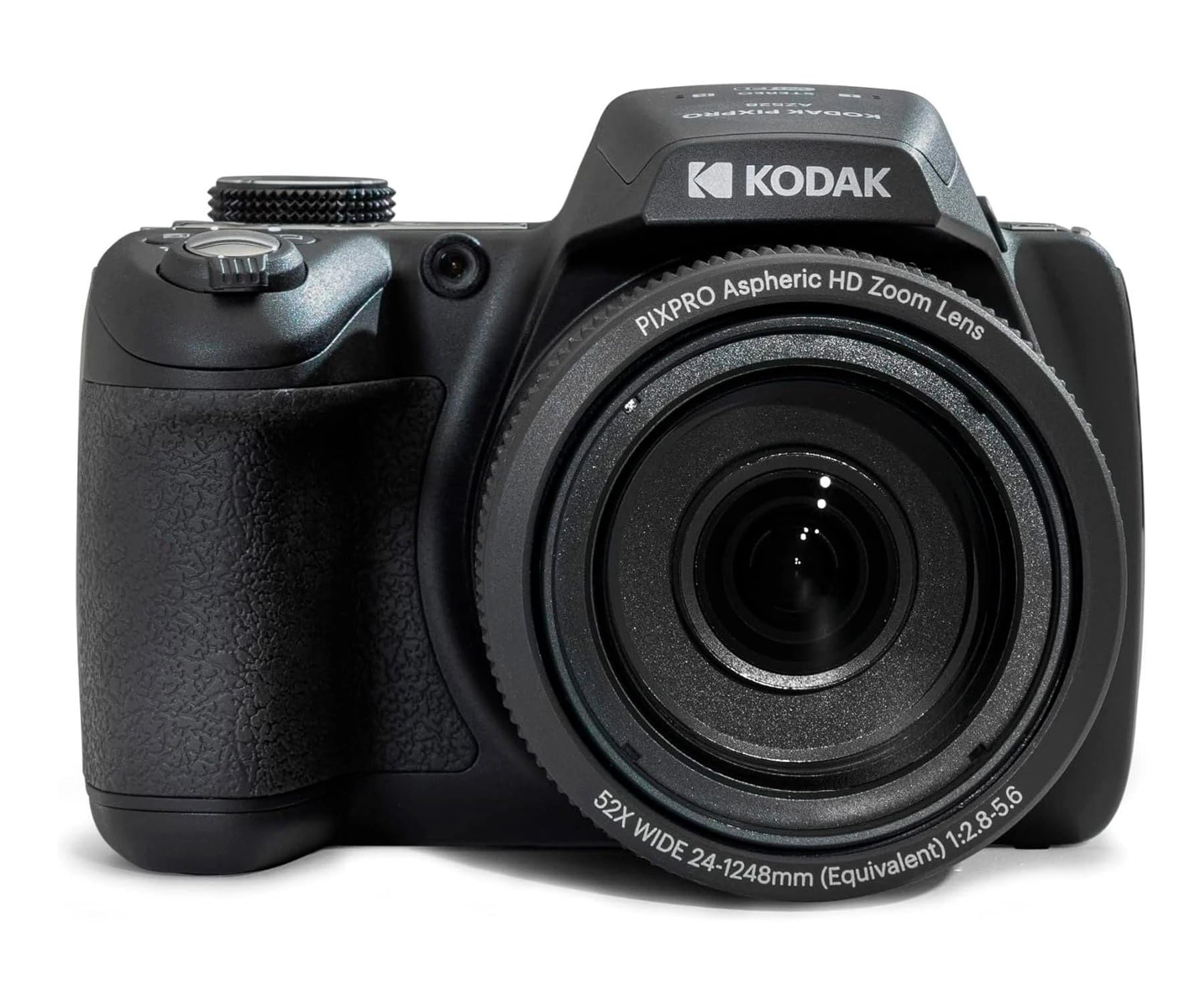
The lowest-cost way to get 52x optical zoom without sacrificing image sharpness at full reach.
With a 52x optical zoom and a 24mm wide-angle lens, you can swing from a wide castle courtyard view to a tight close-up of a gargoyle in one quick twist of the lens ring. The 16-megapixel BSI CMOS sensor (backside-illuminated Complementary Metal-Oxide-Semiconductor—a sensor design that gathers more light than older types, especially in dim scenes) works with built-in Optical Image Stabilization to keep handheld telephoto shots from blurring. Compared to the Panasonic FZ80D, the Kodak has a 52x zoom versus 60x, and a 24mm lens versus 20mm.
Customers note it is “very easy to use” and one reviewer was happy that “it got a great photograph of this Carolina chickadee” at the backyard feeder. The built-in Wi-Fi lets you send photos straight to a phone for social sharing without waiting until you get back to a laptop. The trade-offs: this camera uses the LB-060 battery, which reviewers describe as short-lived, and the body scuffs easily. It accepts SD cards up to 512GB, so storage is not a concern. For a budget-friendly introduction to superzoom photography, this is your gateway.
What You Get
- 52x optical zoom at a price well below most rivals with similar range
- 24mm wide-angle for landscape shots in addition to telephoto reach
- Wi-Fi for wireless remote control and instant photo transfer
The Compromise
- Battery life is short; a spare LB-060 is almost required for a day out
- Body finish scuffs with regular use according to reviews
- 25 autofocus points is a small number compared to the Sony’s 425, making tracking fast-moving subjects harder
Good for: First-time superzoom buyers on a tight budget who want real optical reach for backyard birds, sports, or bright-day hikes.
Not for: Anyone who needs reliable low-light performance or quick continuous autofocus for fast action.
5. Canon PowerShot V10 Compact Vlogging Camera, 1″ CMOS Sensor, 4K Video Streaming

The tiniest vlogging camera that slides into a fanny pack and shoots 4K video with a built-in stand.
This compact digital camera weighs just 7.6 oz and fits in a pocket, but packs a 1-inch back-illuminated CMOS sensor (a type of image chip where the wiring is on the back, letting more light hit the photosensitive area for better results in dim conditions) and records 4K video at up to 30 fps. The fixed 19mm wide-angle lens (the 35mm equivalent on a full-frame camera) is great for landscapes and selfie-style vlogs, but has zero zoom—you cannot get closer without physically walking. A built-in stand folds out from the body to prop the camera up on a table for hands-free shooting, which is a thoughtful travel touch.
One reviewer noted, “I brought it with me on a trip to Italy and it was so easy to whip out since it is so compact.” Another reviewer had the opposite experience: “I tried using this for B-roll footage for my clinic during my treatments. It was getting hot really quickly and then would turn itself off within a few minutes.” That overheating warning is a real risk if you plan to record long clips in warm environments. The three microphones capture clear audio, and a third internal mic helps cancel background noise. Compared to the Sony ZV-1F, the PowerShot V10 includes the stand, but lacks the Sony’s superior autofocus system with 425 points versus the Canon’s subject-detection autofocus.
Its Strong Points
- Extremely portable—7.6 oz and small enough for a pocket or small bag
- Built-in stand gives you hands-free tabletop shooting right from the start
- 1-inch sensor with 15.2 MP delivers good video quality and low-light reach
Heads Up
- No optical zoom at all—you are stuck at the 19mm wide angle
- Reports of overheating and auto-shutoff after a few minutes of recording
- Lacks a lens cover or windscreen, which can affect outdoor usability
Reach for this if: Vlogging and quick selfie clips are your primary use, and you want the absolute smallest camera that still has a large sensor and 4K video.
Look elsewhere if: You need a camera for extended recording sessions, any kind of zoom, or a reliable all-day companion for travel where overheating would be a dealbreaker.
Understanding the Specs
Optical Zoom Range
This number (like 30x, 52x, or 60x) tells you how many times closer the lens can pull a distant subject than a standard point-and-shoot. An optical zoom moves physical glass elements inside the lens to magnify the image, while digital zoom just crops and enlarges pixels, lowering quality. For travel, a zoom above 30x is helpful for concerts, wildlife, and landmarks you cannot walk up to.
Aperture (F-Stop)
The F-number (like F2.8 or F3.3) controls how wide the lens opens to let in light. A lower number (F2) means a wider opening, which helps in dim scenes and allows you to blur the background behind a subject. A higher number (F8) narrows the opening, so more of the scene stays in focus, which is better for landscapes.
Image Stabilization
Often called OIS (Optical Image Stabilization) or POWER O.I.S., this is a mechanism inside the lens that shifts to counteract your hand shake. It makes a big difference when you are zoomed in fully, because any small hand movement is magnified. Without it, telephoto shots often come out blurry unless you use a tripod.
Sensor Size
A sensor is the electronic chip that captures the light coming through the lens. Larger sensors (like the 1-inch type found in the Sony ZV-1F and Canon PowerShot V10) collect more light and produce less noisy, more detailed images in low light than the smaller sensors typical in budget bridge cameras. Megapixels (MP) measure image resolution, but sensor size and lens quality often matter more for image quality.
FAQ
What is the difference between optical zoom and digital zoom?
Will a fixed wide-angle camera like the Sony ZV-1F work for general travel photos?
How many megapixels do I need for travel prints and social media?
What does a 1-inch sensor mean compared to a standard compact camera sensor?
Will the Panasonic ZS99 fit in my pants pocket?
Do I need a separate microphone with these cameras?
How long do the batteries last on these cameras during a day trip?
Can I transfer photos to my phone wirelessly from these cameras?
Is a bridge camera like the Panasonic FZ80D too heavy for casual travel?
Which camera among these is best for a beginner who wants to learn photography?
Final Thoughts: The Verdict
For most people, the affordable travel camera winner is the Panasonic LUMIX FZ80D because its 60x optical zoom covers wildlife, landscapes, and stadium seats with reliable stabilization and the ability to pull 8MP stills from 4K video. If you want a camera that slides into a pocket and still reaches 30x, grab the Panasonic LUMIX ZS99. And for content creators who prioritize wide-angle selfie convenience and a 1-inch sensor, the Sony ZV-1F is the clear choice.
How We Picked
We do not accept paid placement. Every pick is matched to a real buyer and a real use-case; we do not hands-on test units.
Sources & Methodology
Specifications: manufacturer listings and product documentation. Review insights: verified customer reviews, as of July 2026. Pricing: not shown on this page (it changes often); check the current price via the retailer link.
As an Amazon Associate, FitlyFast earns from qualifying purchases. This does not affect which products we feature.