
Our readers keep the lights on and the weekend projects moving. As an Amazon Associate, I earn from qualifying purchases.
Specs are compiled from manufacturer listings and verified buyer reviews and can change over time — please confirm the key details on the product page before buying.
If the power goes out after a storm or you are heading off-grid in an RV, you need a generator that can run a refrigerator, some lights, and a phone charger without waking the neighbors or guzzling gas. That is exactly what a 4000 watt generator is built to do — give you enough juice for the essentials while staying portable enough to haul along.
I’m Rikta — the founder and writer behind FitlyFast. This guide is built by comparing the manufacturers’ published specifications and the patterns across verified customer reviews, so you get each pick’s real strengths and trade-offs instead of marketing spin.
This lineup focuses on models near that 4000-watt balance — some surge higher, some run lower, but all deliver genuine heavy-lifting power without stepping into commercial-machine territory. 4000 watt generator options span from budget-friendly open-frame inverters to premium units with remote starts, and this guide sorts through them by what actually matters day-to-day.
Quick Picks
- Champion Power Equipment 4500-Watt RV Ready Portable Inverter Generator — Endurance Champion
- Westinghouse 5000 Peak Watt Super Quiet Portable Inverter Generator — Premium Quiet
- WEN Quiet and Lightweight 4800-Watt RV-Ready Portable Inverter Generator (56477i) — Best Overall
- WEN 4500-Watt Inverter Generator, RV-Ready, Quiet, Portable (56432i) — Lightweight Value
- ERAYAK 4500W Portable Inverter Generator for Home Use — Ultra-Low THD
- PowerSmart 4400-Watt Open Frame Inverter Generator — Budget Champion
How To Choose The Best 4000 Watt Generator
Picking the right generator depends on matching its output and fuel efficiency to what you actually need to power. This section walks you through the specs that separate a good fit from a mistake.
Running Watts vs Surge Watts
The running (or rated) wattage is what the generator can supply continuously — that is the number to match against your total load. Surge (peak) watts handle the momentary extra draw when a motor starts up, like a fridge compressor or an AC unit. A 4000-watt generator might surge to 4500W, but you should size based on the continuous figure so the generator is not always at its limit.
Inverter vs Open Frame
Inverter generators produce cleaner power (lower THD, or total harmonic distortion — a measure of how much the electricity wave shape is distorted) and run more quietly and efficiently than traditional open-frame models. The downside is a higher price. For sensitive electronics like laptops and CPAP machines, an inverter is the safer bet. An open-frame is heavier and louder but often cheaper for similar rated power.
Runtime and Fuel Capacity
A generator’s fuel tank size directly determines how long it runs between refills. Check the runtime figure listed at 25% load — that gives you a realistic estimate for light use during an overnight outage. Larger tanks (3+ gallons) can push runtimes past 12 hours, which means less disruption when you are sleeping.
Quick Comparison
| Model | Best For | Peak Watts | Weight | Runtime (25% Load) | Amazon |
|---|---|---|---|---|---|
| Champion 4500W | Longest continuous runtime | 4500 | 92.2 lbs | 14 hours | Amazon |
| Westinghouse iGen | Premium quiet performance | 5000 | — | 18 hours | Amazon |
| WEN 4800W | Wheels + RV-ready balance | 4800 | 72.7 lbs | — | Amazon |
| WEN 4500W | Lightest inverter pick | 4500 | 53 lbs | — | Amazon |
| ERAYAK 4500W | Ultra-low THD for electronics | 4500 | 55.12 lbs | — | Amazon |
| PowerSmart 4400W | Budget-friendly inverter | 4400 | 61.29 lbs | 11 hours | Amazon |
In‑Depth Reviews
1. Champion Power Equipment 4500-Watt RV Ready Portable Inverter Generator

The quiet workhorse that keeps a food truck running 12 hours a day for eight years without a hitch.
If you need extended runtime without constant refueling, the Champion delivers — up to 14 hours on just 2.3 gallons of gasoline (that is at 25% load). Buyers running a food truck report this model handled heavy equipment non-stop for a year-long test with zero shutdowns, which is rare for an inverter in this class. The 4500 starting watts and 3500 running watts pair with a 212cc 4-stroke engine, and the 61 dBA noise level keeps things neighborhood-friendly. It also has a CO Shield auto shutoff (a carbon monoxide sensor that kills the engine if CO builds up), an EZ Start Dial, and a 120V 29.2A RV outlet for direct camper hookup.
Unlike some lighter models, the Champion weighs 92.2 lbs — noticeably heavier than the WEN 4500W at 53 lbs — so you will want the included wheel kit for rolling it around. The Intelligauge display (a digital panel that shows voltage, frequency, and run hours) helps you track maintenance without guesswork. The 3-year warranty and free lifetime tech support back it up.
The long-haul advantage
- 14-hour runtime at 25% load
- 61 dBA — quiet enough for campgrounds
- CO Shield auto shutoff for safety
The weight penalty
- 92.2 lbs — heavier than many competitors
- Pull start can be tricky at high altitude
- No remote start option
Best for sustained use: If you need a generator that runs a camper AC all night or powers equipment all day, this Champion has the fuel tank and track record to do it.
Limitation to know: At nearly 93 lbs, it is not the pick for quick-trip portability — budget for the weight if you move it often. Stick to the lighter WEN 4500W if you are loading a generator solo into an SUV.
2. Westinghouse 5000 Peak Watt Super Quiet Portable Inverter Generator
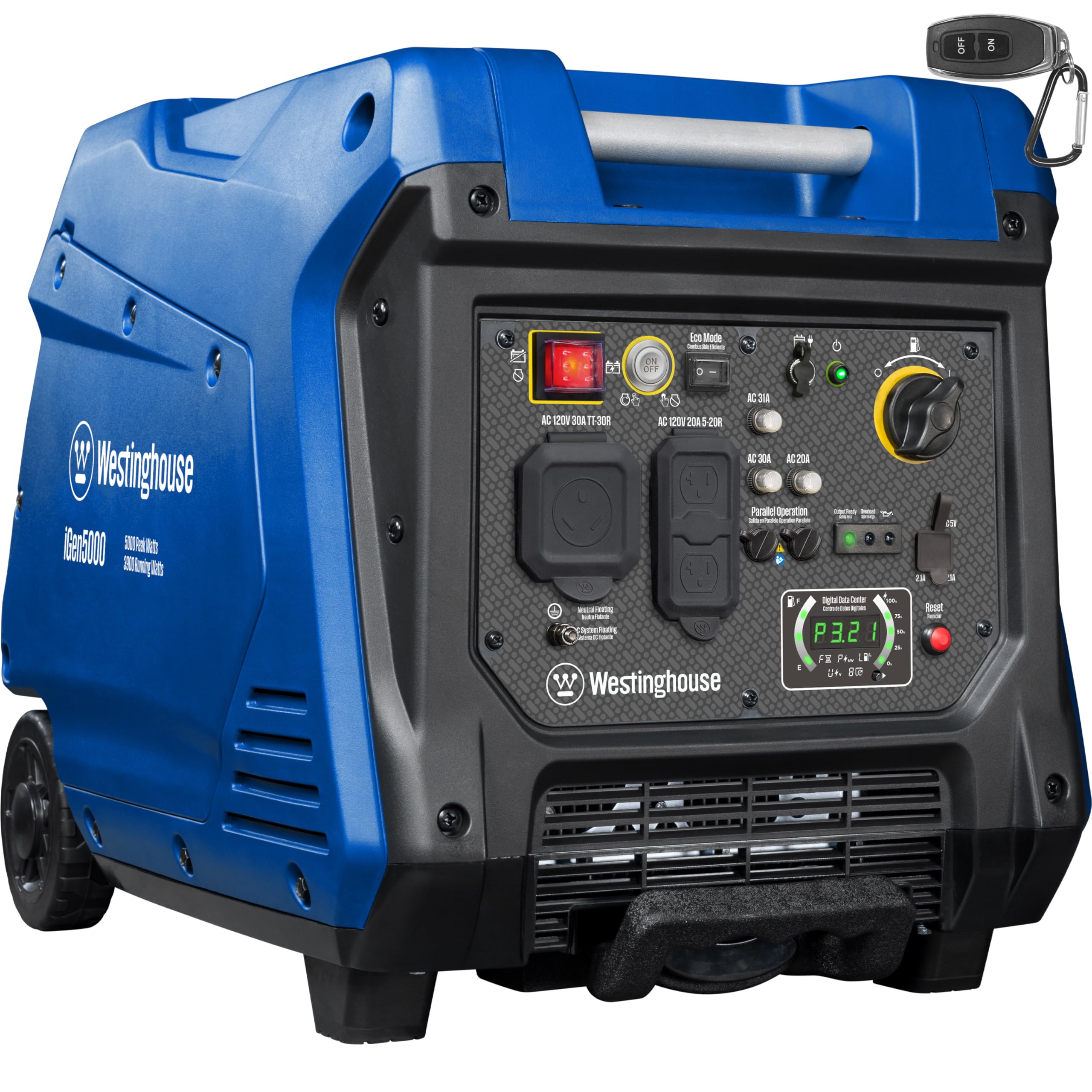
A whisper-quiet generator you can start from your couch with a key fob.
The Westinghouse is built for convenience first. It has a remote electric start with a key fob, plus an auto choke (so you do not have to mess with a throttle lever) and a backup recoil pull cord. Buyers report the same unit is sold under the Cummins brand for, which says something about the build. The 5000 peak watts and 3900 rated watts come with less than 3% THD (total harmonic distortion — a measure of electrical noise), making it safe for laptops and TVs. Noise output is as low as 52 dBA, which one owner said was quieter than their Honda EU3000iS.
With a 3.4-gallon tank, it runs up to 18 hours at 25% load — the longest in this roundup — blowing past the Champion’s 14-hour runtime. It has a rotating digital display that cycles through fuel level, power output, remaining run time, voltage, and lifetime hours. The telescoping handle makes moving it easier, though the unit is substantial. One buyer used their first unit for 2200+ hours before replacing it, which speaks to long-term reliability. Unlike the heavier Champion, the Westinghouse moves easier on its wheels, but it has a higher sticker price.
Convenience that works
- Key fob remote start
- 52 dBA — very quiet
- 18-hour runtime on 3.4 gallons
Premium cost
- Highest price in this lineup
- Battery charging is not automatic
- Needs high-altitude kit above 2000 ft
For RV owners who want luxury: If starting a generator with a key fob and running an RV AC all night matters to you, the Westinghouse offers the best user experience in this class.
Budget note: This is the premium pick — the price reflects the remote start, long runtime, and ultra-low noise, so weigh those against a simpler model if cost is the main concern. skip it if you are on a tight budget; the PowerSmart is a wiser choice for occasional use.
3. WEN Quiet and Lightweight 4800-Watt RV-Ready Portable Inverter Generator (56477i)

The balanced pick that wheels right out of the garage and powers the fridge for a year straight.
The WEN 56477i hits the exact 4000 rated watts most buyers search for, with a 4800 surge peak for starting loads. It uses a 224cc engine — the largest displacement in this comparison, bigger than the 181cc in the lighter WEN 4500W — giving it grunt without straining. It comes with onboard wheels and a telescoping pull handle, which reviewers highlight as a major bonus because you do not have to carry the 72.7 lbs. The WEN Watchdog CO Shutdown Sensor automatically turns the generator off if carbon monoxide reaches dangerous levels, an important safety net if you are running it near a camper or garage.
Owners mention it has powered a refrigerator and a medium freezer for a full year without issues, as long as monthly oil checks and test starts are done. It has four 120V receptacles, a TT-30R RV outlet, a 12V DC port, and two USB ports — enough connections to run multiple appliances. The fuel shutoff carburetor feature lets you drain the remaining fuel before storage, extending engine life. At 72.7 lbs, it is heavier than the 53 lb WEN 4500W but lighter than the 92.2 lb Champion, and the included wheels make the weight manageable.
Everything you need built in
- Wheels and telescoping handle included
- 4000 rated watts — exact target output
- CO shutoff sensor for safety
Not the lightest
- 72.7 lbs without fuel
- Recoil start only — no electric or remote start
- Dimensions larger than some rivals (23.8″L x 12.6″W x 22″H)
The all-around pick: If you want the exact 4000 watts you searched for, plus wheels and a CO sensor in one solid package, this WEN is the most balanced choice for home backup and RV use.
What you miss: No push-button or remote start — you pull the recoil cord every time, which is fine for occasional use but less convenient if you start it daily. The Westinghouse offers a key fob here, but costs more.
4. WEN 4500-Watt Inverter Generator, RV-Ready, Quiet, Portable (56432i)
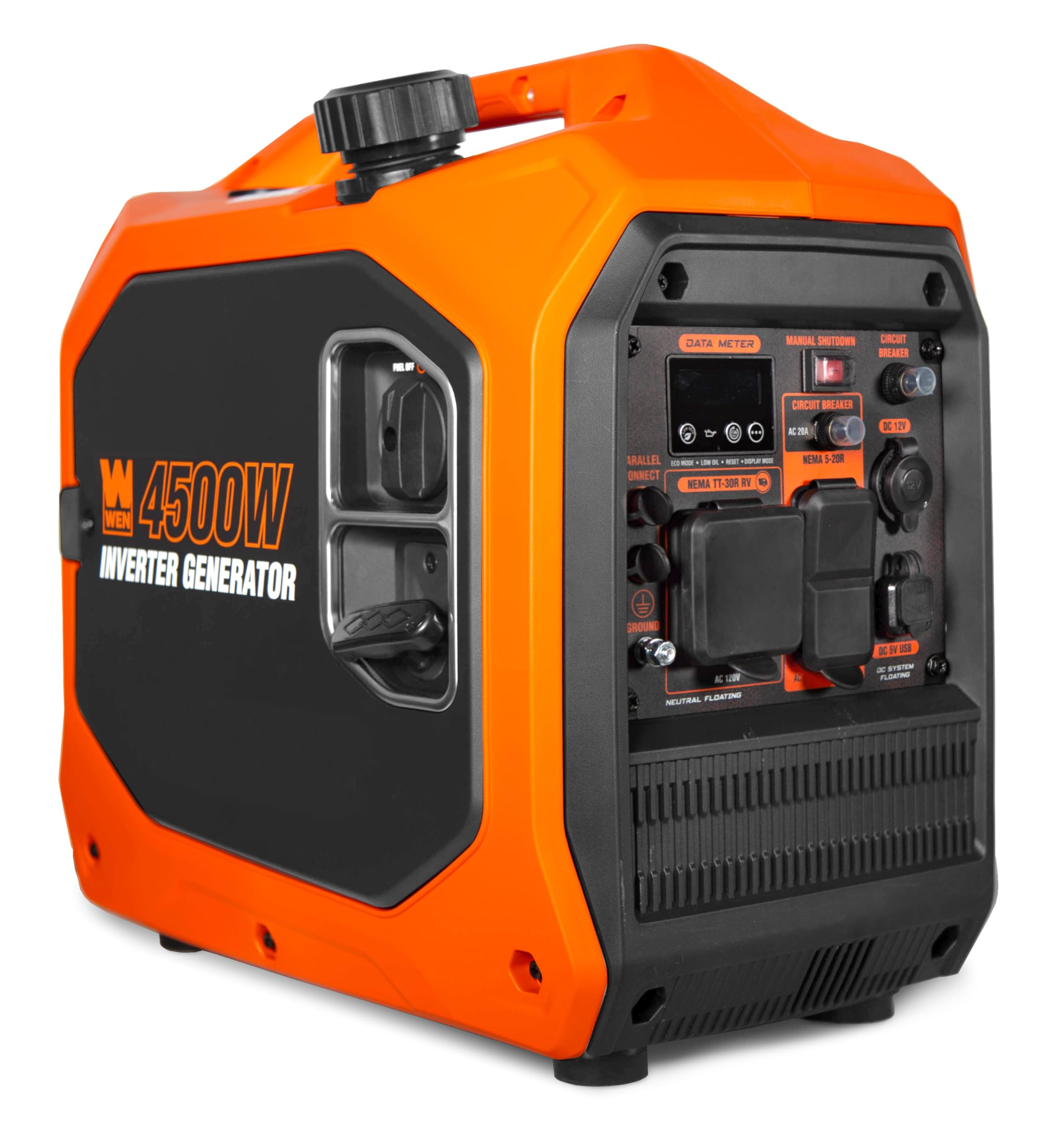
The lightest inverter in the lineup at 53 lbs — easy to toss in the truck by yourself.
At just 53 lbs, this WEN is the most portable inverter generator that still delivers a true 4500 surge watts and 3600 rated watts. It uses a 181cc engine versus the 224cc in the 4800W WEN, but for running a small camper, a fridge, lights, and a TV, that is plenty. The clean power output (low THD) means you can plug your laptop or smartphone directly in without worrying about voltage spikes. Customers note it runs 6 to 7 hours on a full tank of fuel, which is enough for a night’s sleep during an outage.
The fuel shutoff feature helps the generator last longer by draining the carburetor before storage. It includes two 120V outlets, a TT-30R RV receptacle, a 12V DC port, and two USB ports. It does not have wheels or a handle, but at this weight you can carry it one-handed. One reviewer noted it is quieter than their Champion generator, though another reported a defect where sand got into the engine — something to watch for if you set it directly on dirt or gravel. The 3-year warranty covers it, but set it on a solid surface or a mat to avoid debris intake.
Portability first
- 53 lbs — lightest in this comparison
- Clean inverter power for electronics
- Compact dimensions (19.3″L x 12″W x 18.3″H)
Size trade-offs
- No wheels or handle
- Lower rated wattage (3600W) than the 4800W model
- Some quality-control concerns reported
Grab it for travel: If portability is your top priority — camping trips, job sites, or loading into an SUV — the 53-lb WEN 4500W is the easiest to move in this class.
Caveat on surface: Owners advise against setting it directly on bare ground because the bottom intake can pull in debris; a rubber mat or a flat board solves this.
5. ERAYAK 4500W Portable Inverter Generator for Home Use

Clean enough power for CPAP machines — and quiet enough to sleep next to.
The ERAYAK 4500W stands out for its extremely clean power: total harmonic distortion (THD) is rated between 0.2% and 1.2%, which is well below the 3% threshold most manufacturers cite for safe use with sensitive electronics like laptops, gaming consoles, and medical devices like CPAP machines. At 3500 running watts and 4500 peak watts, it can handle a refrigerator and some lights, but it falls short of the 4000-rated-watt mark — the WEN 4800W and Westinghouse both offer higher continuous output. The 55.12 lb weight makes it comparable to the lighter WEN 4500W, and it comes in at 55.12 lbs versus the 61.29 lb PowerSmart.
It runs at 60.5 dBA — quiet for this class — and features Eco Mode to adjust engine speed for fuel savings. The 50A parallel-ready capability means you can link two units to produce 7000 rated watts and 9000 peak watts, a useful upgrade path if your power needs grow. One buyer mentioned it worked fine for about 350 hours over 2 months before suddenly stopping; this is worth factoring in if you plan to rely on it daily rather than just for emergencies. The electric start with included tools and a 3-year limited warranty add confidence.
Clean and quiet
- 0.2%-1.2% THD — excellent for electronics
- 60.5 dBA noise level
- Parallel-ready for power expansion
Output and durability
- 3500 running watts — lower than some rivals
- Customer reports of failure after 350 hours
- Recoil start can be stiff, per buyers
Best for sensitive devices: If you need to safely power CPAP machines, laptops, or gaming consoles, the ERAYAK’s sub-1.2% THD offers the cleanest power in this group.
Runtime check: The fuel efficiency is good (0.21 gal/hr at 25% load), but with a smaller tank than the Champion or Westinghouse, you will refuel more often during long outages. For overnight use without interruption, the Champion’s 14-hour tank is the better companion.
6. PowerSmart 4400-Watt Open Frame Inverter Generator

An affordable inverter that runs 11 hours on a tank and punches above its price tag.
If you are looking for a generator for occasional backup or camping without spending premium money, the PowerSmart 4400W delivers solid specs at a budget-friendly level. It has a 223cc engine, 4400 starting watts and 3600 rated watts, and a 1.6-gallon fuel tank that provides 11 hours of runtime at 25% load. At 61.29 lbs it is heavier than the ERAYAK (55.12 lbs) and the lighter WEN 4500W (53 lbs), but lighter than the Champion and the WEN 4800W. The 76 dBA sound level is louder than the inverter-focused models — expect a noticeable hum, though reviewers point out Eco mode helps bring the noise down.
Safety features include carbon monoxide detection, low oil level shutdown, and overload protection. The open-frame design makes it easier to access components but also makes it a bit louder than fully enclosed inverters. Shoppers say it starts easily, but at least one buyer experienced a unit that failed after only one hour of run time — a reminder that budget options can have more variability in quality. For someone who needs backup power a few times a year and can accept more noise for a lower entry price, this PowerSmart fills that gap without emptying the wallet.
Big value for the price
- 11-hour runtime per tank
- CO sensor, low oil shutdown, overload protection
- Solid 3600 rated watts for under
Budget compromises
- 76 dBA — louder than premium inverters
- Some units reported failing early
- No electric start — recoil only
Entry-level pick: If your power needs are occasional (storm backup, weekend camping) and you prioritize lower upfront cost, the PowerSmart is a competent starter generator with safety features built in.
Reliability check: With some buyers reporting early failures, you may want to run a break-in cycle right after purchase and test it before an actual emergency. Buy this model over the premium Westinghouse only if the budget is the main line.
Understanding the Specs
Rated Watts vs Starting Watts
Rated (running) watts is the continuous power the generator produces hour after hour. Starting (peak) watts is the brief surge power needed to start motors in appliances like refrigerators (which can draw 2-3x their running wattage for a second or two). When sizing a generator, total up the running watts of everything you want to power and add the highest single starting wattage — that peak number should not exceed the generator’s surge capacity. For example, a 4000-watt rated generator like the WEN 4800W can surge to 4800W, handling a fridge and a microwave starting at the same time.
Total Harmonic Distortion (THD)
THD measures the electrical noise in the generator’s output. A lower percentage means cleaner power that mimics utility-supplied electricity. Standard generators often have THD above 5%, which can cause buzzing in speakers, flickering in lights, or even damage to sensitive electronics over time. Inverter generators (like all picks in this guide) typically keep THD below 3%, and models like the ERAYAK go as low as 0.2% to 1.2%. For laptops, CPAP machines, gaming consoles, and modern TV sets, an inverter generator with low THD is strongly preferred over a conventional open-frame non-inverter model.
FAQ
Will a 4000 watt generator run a house?
What is the difference between an inverter generator and a conventional generator?
How long can a 4000 watt generator run continuously?
What appliances can I run with a 4000 watt generator?
How do I break in a new 4000 watt generator?
Can I connect a 4000 watt generator to my house panel?
Is 76 dBA too loud for a generator?
How do I maintain a 4000 watt generator?
Can I run a 4000 watt generator on propane?
Final Thoughts: The Verdict
For the majority of shoppers, the 4000 watt generator winner is the WEN 4800W (56477i) because it delivers the exact 4000 rated watts most buyers look for, includes onboard wheels and a telescoping handle, and has a CO shutoff sensor for safety — all without the premium price tag of a remote-start model. If you want the longest continuous runtime for whole-night operation, grab the Champion 4500W with its 14-hour fuel tank. And for pure convenience with a key fob remote start and ultra-quiet 52 dBA operation, the Westinghouse iGen is the top-tier pick that feels a step above everything else in this class.
How We Picked
We do not accept paid placement. Every pick is matched to a real buyer and a real use-case; we do not hands-on test units.
Sources & Methodology
Specifications: manufacturer listings and product documentation. Review insights: verified customer reviews, as of July 2026. Pricing: not shown on this page (it changes often); check the current price via the retailer link.
As an Amazon Associate, FitlyFast earns from qualifying purchases. This does not affect which products we feature.