
Our readers keep the lights on and the weekend projects moving. As an Amazon Associate, I earn from qualifying purchases.
Specs are compiled from manufacturer listings and verified buyer reviews and can change over time — please confirm the key details on the product page before buying.
You want a 20-gallon air compressor that actually keeps up with your tools without making you want to wear earplugs. It is the right tank size for a home garage or small workshop — enough air to run a framing nailer, impact wrench, or paint sprayer without cycling on every minute, but small enough to tuck against a wall. The problem is that the noise level, pressure, and air flow (the volume of air delivered per minute) vary wildly between models, and those numbers decide whether the compressor feels like a helper or a headache.
I’m Rikta — the founder and writer behind FitlyFast. This guide is built by comparing the manufacturers’ published specifications and the patterns across verified customer reviews, so you get each pick’s real strengths and trade-offs instead of marketing spin.
This breakdown of the best 20 gallon air compressor options helps you match the machine to your actual jobs without paying for features you will never use.
Quick Picks
- Craftsman CMXECXA0232043 20 Gallon Oil-Free Air Compressor — Best Overall
- Stealth SAQ-12018 20 Gallon Ultra Quiet Air Compressor — Quiet Workhorse
- California Air Tools 20015HP 1.5 HP Ultra Quiet 20 Gallon Air Compressor — Whisper Quiet
- VEVOR 20 Gallon 2HP Oil-Lubricated Belt-Drive Air Compressor — High Flow Belt-Drive
- Albott AIC001 20 Gallon Vertical Wheeled Air Compressor — Compact Value
- DeWalt DXCMPA1982054 20-Gallon Portable Air Compressor — Pro Air Flow
- DeWalt DXCM201 20 Gal. 200 PSI Oil-Lubricated Belt Drive Air Compressor — Maximum Pressure
- Ingersoll Rand P1.5IU-A9-H Garagemate 20 Gallon Horizontal Air Compressor — Professional Grade
- VEVOR 20 Gallon 4HP Oil-Free Ultra Quiet Air Compressor — Oil-Free Powerhouse
How To Choose The Best 20 Gallon Air Compressor
A 20-gallon tank is a meaningful step up from smaller portable units. Before you buy, focus on these three factors because they control everything about how the compressor performs in your shop.
CFM at 90 PSI — The real measure of power
CFM stands for cubic feet per minute, and it tells you how much air the compressor can deliver at a given pressure. Most air tools list their required CFM at 90 PSI. A nail gun might need 2-3 CFM, while a die grinder or impact wrench can require 5 CFM or more. If the compressor’s CFM rating at 90 PSI is lower than the tool’s requirement, the tool will run weakly or the compressor will cycle on and off constantly. Look for at least 4-5 CFM at 90 PSI for general shop use.
Oil-free vs. oil-lubricated pumps
Oil-free pumps require almost no maintenance — you never change oil — and they are generally cleaner for tasks like spray painting because no oil mist gets into the air. They tend to be louder and may have a shorter lifespan. Oil-lubricated pumps are quieter, run cooler, and typically last longer, but you must check and change the oil periodically. If you use a compressor daily, an oil-lubricated unit is usually worth the extra attention.
Noise level — how loud is too loud?
A standard direct-drive compressor can hit 80-90 decibels, which is loud enough to require hearing protection during extended use. “Ultra quiet” models drop to around 68-78 decibels, which is closer to a normal conversation. If you work in a shared garage, near living spaces, or just value your hearing, a quieter model makes a real difference in daily comfort. The decibel rating is measured at a set distance, so check that number before buying.
Quick Comparison
| Model | Best For | Max Pressure (PSI) | CFM at 90 PSI | Item Weight (lbs) | Amazon |
|---|---|---|---|---|---|
| Craftsman CMXECXA0232043 | High-pressure jobs & quick fill | 175 | 4.0 (est. from 5 CFM at unknown PSI) | — | Amazon |
| Stealth SAQ-12018 | Quiet operation with sturdy build | 150 | 5.0 | 121.4 | Amazon |
| California Air Tools 20015HP | Ultra quiet & noise-sensitive shops | 175 | 3.8 | 113 | Amazon |
| VEVOR V-2065/135-10A68L | High CFM & belt-driven durability | 135 | 6.5 | — | Amazon |
| Albott AIC001 | Budget-friendly & space-saving vertical | 120 | — | 101 | Amazon |
| DeWalt DXCMPA1982054 | Pro-level airflow for multiple tools | 155 | 5.7 | 166 | Amazon |
| DeWalt DXCM201 | Highest pressure for extended run time | 200 | 6.2 | 137 | Amazon |
| Ingersoll Rand P1.5IU-A9-H | Professional-grade cast iron longevity | — | 5.2 | — | Amazon |
| VEVOR Compresseur à air sans huile75 | High CFM oil-free & quiet | 125 | 10.6 | 134.7 | Amazon |
In‑Depth Reviews
1. Craftsman CMXECXA0232043 20 Gallon Oil-Free Air Compressor

Delivers high pressure and fast recovery for serious tool use while staying affordable.
This Craftsman gives you 175 PSI — the same high pressure as the California Air Tools model but at a lower entry price. The 20-gallon tank and 1.8 HP (horsepower) motor mean you can drive a framing nailer or a paint sprayer for longer stretches before the compressor kicks back on. The oil-free pump keeps maintenance simple: no oil changes, no mess, just plug it in and go. The stainless steel tank resists rust, which adds years of life compared to painted steel tanks.
Buyers report that it filled their tank and a separate 20-gallon portable tank in half the time compared to their old unit, which is a strong sign of fast recovery. The unit is fairly quiet for an oil-free compressor, and the two quick couplers let you switch between tools easily. The 175 PSI gives you a 30% higher pressure ceiling than the VEVOR 2HP model’s 135 PSI, which means more stored energy for tough jobs.
What makes it a solid buy
- 175 PSI max pressure stores more energy for longer tool run time
- Oil-free pump means zero maintenance and cleaner air
- Stainless steel tank resists corrosion
Consider before ordering
- A few owners reported safety concerns after extended use
- Noise level is moderate for an oil-free unit
Who it fits: Home users and DIYers who want high tank pressure and low maintenance for nail guns, staplers, and inflators without a premium price tag.
A real limitation: The Craftsman brand name and 1-year limited warranty may not satisfy professionals who run the compressor daily.
2. Stealth SAQ-12018 20 Gallon Ultra Quiet Air Compressor

Operates at conversation-level noise while delivering steady 5 CFM for demanding tools.
If you need a quiet compressor, the Stealth is the pick. At 68 decibels, it is roughly half as loud as a typical direct-drive compressor — you can hold a normal conversation next to it without raising your voice. The 1.8 HP oil-free pump pushes 5.5 CFM at 40 PSI and 5 CFM at 90 PSI, meaning it has the air flow to keep up with an impact wrench or a die grinder. The 150 PSI peak pressure provides a solid reserve for short bursts of high-demand tools, though it is a 14% lower ceiling than the Craftsman’s 175 PSI.
One owner noted they used it for detailing cars and the 20-gallon tank kept up with a Tornador cleaning gun without lagging. The heavy-duty steel tank and 8-inch rubber wheels make it stable on shop floors, and the limited lifetime warranty shows confidence in the build. At 121.4 pounds, it is heavier than the Albott by about 20% (101 lbs), so moving it up stairs is a two-person job — but once on the wheels, it rolls easily.
Why it stands out
- 68 dB noise level is genuinely quiet for a 20-gallon unit
- 5 CFM at 90 PSI runs most air tools steadily
- Limited lifetime warranty adds confidence
Know before you buy
- Some units had restart issues after light use
- At 121 lbs, lifting into a truck bed is difficult
the balance: Ideal for anyone who works in a noise-sensitive space — a home garage, an indoor shop, or even a van — and needs real air flow, not just an inflator.
The trade-off: The quiet motor comes with a premium price compared to louder oil-free models of similar capacity.
3. California Air Tools 20015HP 1.5 HP Ultra Quiet 20 Gallon Air Compressor

Runs at only 70 decibels while hitting 175 PSI — the quietest high-pressure option here.
The California Air Tools 20015HP combines high pressure with a genuinely low noise signature. The 1.5 HP motor spins at just 1750 RPM (revolutions per minute), which cuts vibration and noise drastically compared to faster motors. At 70 dB, it is nearly as quiet as the Stealth while delivering a higher 175 PSI — a 46% higher maximum pressure than the Albott’s 120 PSI. The oil-free dual piston pump is rated for over 3000 hours of life, which is exceptional for an oil-free design, and it produces cleaner air than oil-lubricated models, so it is a strong choice for painting.
However, the CFM (air flow) is lower than the Stealth: 3.8 CFM at 90 PSI versus 5 CFM. That 25% less air flow means you may need to pause on high-consumption tools like a die grinder. Owners mention the 20-gallon tank compensates for the lower CFM, and the compressor is described as “super quiet” in a small shop. One owner noted a pressure control valve failure after 3 months, causing constant 170 PSI output — a point worth considering for long-term reliability.
Why pick this one
- 175 PSI max pressure rivals the Craftsman at lower noise
- 70 dB noise level is ideal for shared or indoor spaces
- Pump rated for over 3000 hours of service life
Heads up
- 3.8 CFM at 90 PSI limits high-demand tool use
- Some units had regulator drift and valve failures
Best suited for: A small shop or home garage where noise is the number one concern and you mostly run nailers, staplers, or spray guns that do not need high CFM.
One caveat: The lower air flow means this is not the best pick for continuous high-consumption tools like sanders or grinders.
4. VEVOR 20 Gallon 2HP Oil-Lubricated Belt-Drive Air Compressor
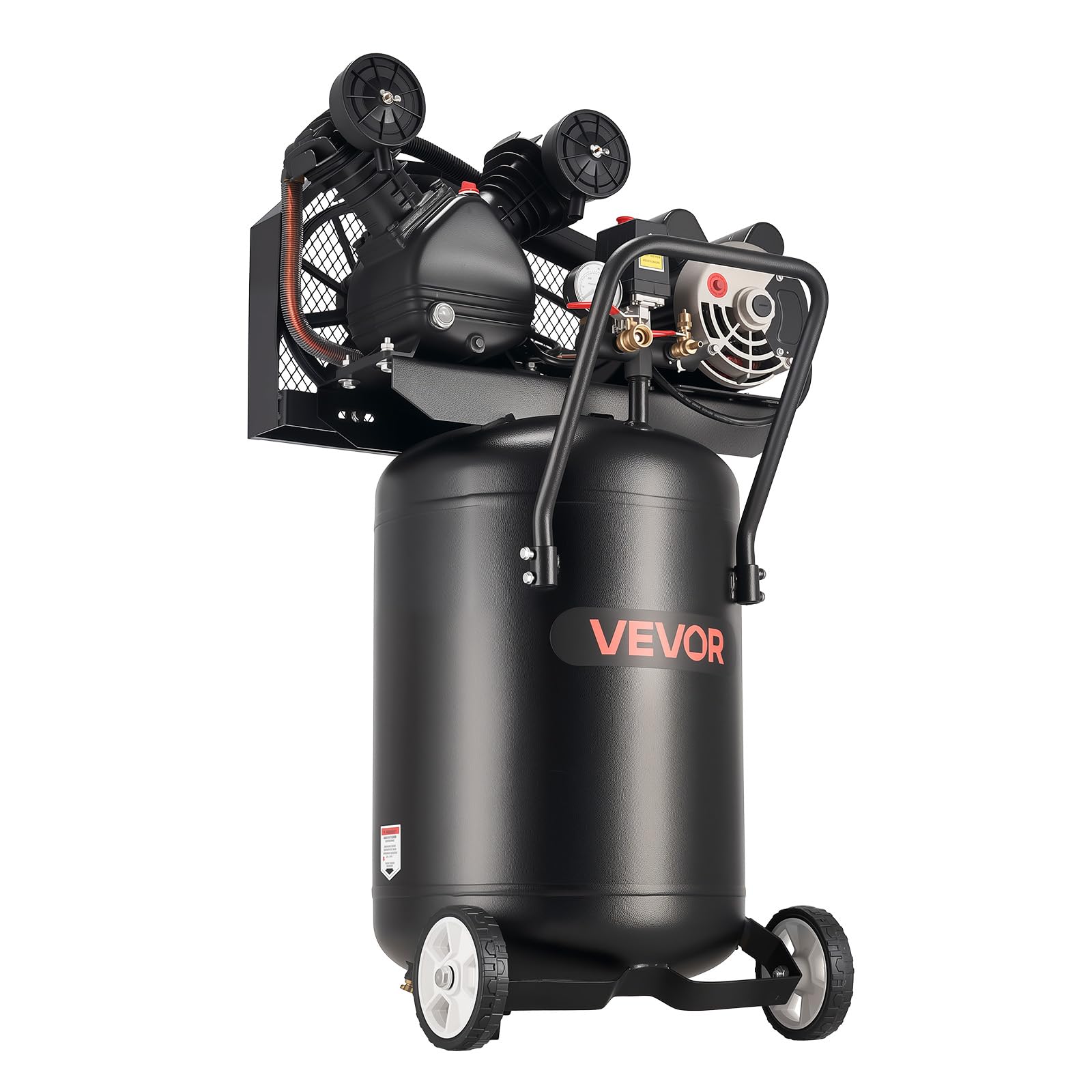
Blows past competitors with 6.5 CFM at 90 PSI for demanding continuous-use tools.
The VEVOR 2HP model is built for real air flow. The belt-driven, oil-lubricated pump runs smoother and cooler than direct-drive oil-free pumps, and the oil observation mirror lets you check the level at a glance. The 2.75 mm thick carbon steel tank is noticeably thicker than many competitors, which helps it resist corrosion and handle the 135 PSI max pressure.
The belt-drive system also makes this unit quieter than a typical direct-drive oil-free compressor, though it is not as hushed as the Stealth or California Air Tools models. Customers note it is “pretty quiet” after a proper break-in period, though the regulator knob feels cheap and hard to turn. Some units arrived with broken gauges due to flimsy packaging — a pattern in customer reviews that is note before you buy.
What it does well
- 6.5 CFM at 90 PSI is excellent for running spray guns and sanders
- Oil-lubricated belt drive is quieter and more durable than oil-free pumps
- Thick 2.75 mm carbon steel tank resists rust and leaks
Things to watch
- Poor packaging leads to damage during shipping
- Some plastic parts (regulator knob) feel cheap
Who should grab this: Serious home mechanics and detailers who need high continuous air flow for spray painting, sanding, or running multiple tools — and prefer the longevity of an oiled pump.
The risk: Shipping damage is a common complaint, so inspect the unit immediately upon arrival and contact the seller if anything is broken.
5. Albott AIC001 20 Gallon Vertical Wheeled Air Compressor
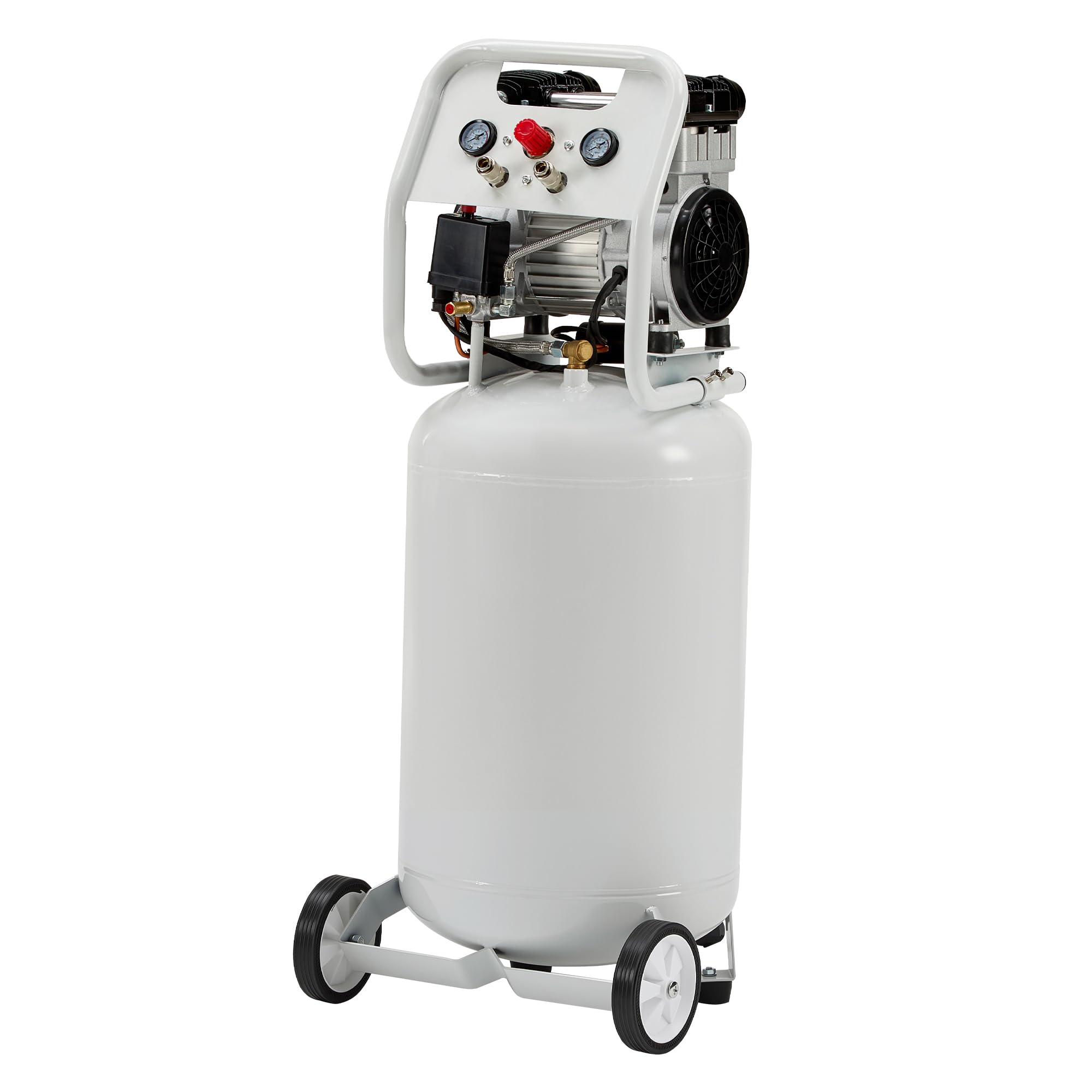
A lightweight vertical design that tucks into tight corners without sacrificing tank capacity.
The Albott is the lightest 20-gallon unit here at 101 pounds — about 20% lighter than the Stealth (121.4 lbs) — and the vertical footprint (17.5″L x 16″W x 43.7″H) takes up less floor space than horizontal tanks. The 1.8 HP copper wire motor pushes up to 120 PSI, which is enough for tire inflation, nail guns, and basic shop tools, but it is a 46% lower pressure ceiling than the Craftsman or California Air Tools models. The oil-free dual piston system keeps maintenance simple, and dual cooling fans with overheat protection add a safety layer.
Reviewers point out it is “very quiet” and has good airflow with a Tornador for car detailing, though it gets hot fast during extended use. One owner noted the sealed pressure switch prevents fixing an internal air leak, so repairs may be limited. The cast iron and aluminum construction feels solid, but a few units arrived with cracked wheels — an easy fix with replacement mower wheels, per one review.
What works
- 101 lbs is light for a 20-gallon tank, easy to move around
- Vertical design saves valuable garage floor space
- Oil-free pump and dual cooling fans require little maintenance
What does not
- 120 PSI is the lowest max pressure of any pick here
- Some units arrive with cracked or broken wheels
Reach for this if: You need a 20-gallon tank but have limited floor space and light use — tire inflation, brad nailers, and occasional detailing — where 120 PSI is adequate.
Look elsewhere if: You routinely run tools that need high pressure, like impact wrenches or paint sprayers, because the lower pressure ceiling will cause frequent cycling.
6. DeWalt DXCMPA1982054 20-Gallon Portable Air Compressor

Delivers pro-grade air flow with 5.7 CFM at 90 PSI in a portable 20-gallon package.
The DeWalt DXCMPA1982054 is a serious step up in air delivery. With 7.0 CFM at 40 PSI and 5.7 CFM at 90 PSI, it beats the Stealth (5.0 CFM) and the California Air Tools (3.8 CFM) by a wide margin. The 155 PSI max pressure is a middle ground — higher than the VEVOR 2HP (135 PSI) but lower than the Craftsman and California Air Tools (175 PSI). The 1.9 HP dual-voltage motor runs on a standard 120V outlet and can be rewired for 240V for faster recovery in a shop setting.
The ASME-rated (American Society of Mechanical Engineers) tank and pre-attached pneumatic tires signal a commercial-grade build, though the unit is heavy at 166 pounds — noticeably heavier than the Ingersoll Rand (137 lbs) and far heavier than the Albott (101 lbs). Shoppers say it is quiet and runs all tools including a die grinder, but getting it in and out of a truck requires a helper. The warranty is effectively through the manufacturer rather than DeWalt directly, which some owners found frustrating for claims.
Strength
- 5.7 CFM at 90 PSI runs die grinders, sanders, and spray guns
- Dual-voltage motor (120V/240V) offers flexibility for shops
- ASME-rated tank and pneumatic tires are commercial-grade
Weakness
- 166 lbs is very heavy; moving it alone is tough
- Warranty support goes through the actual manufacturer, not DeWalt
Who needs this: A serious home mechanic or woodworker who runs high-CFM tools like sanders and die grinders all day and wants commercial-level air delivery from a portable 20-gallon tank.
The catch: The heavy weight makes it essentially a stationary shop unit — not a compressor you want to load and unload from a truck regularly.
7. DeWalt DXCM201 20 Gal. 200 PSI Oil-Lubricated Belt Drive Air Compressor

Hits 200 PSI — the highest pressure of any 20-gallon model here for maximum tool run time.
The DeWalt DXCM201 is a different class of compressor. It uses a two-stage, oil-lubricated belt-drive pump that compresses air twice for higher pressure, reaching 200 PSI — a 14% higher ceiling than the Craftsman (175 PSI) and a 48% higher ceiling than the VEVOR 2HP (135 PSI). According to DeWalt, that 200 PSI gives you 53% longer air tool run time than a 155 PSI belt-drive compressor. The 6.2 CFM at 90 PSI means it also has solid air flow for running multiple tools.
The 78 dBA noise level is quieter than a typical direct-drive oil-free compressor, though not as hushed as the Stealth (68 dB) or California Air Tools (70 dB). The cast iron construction, aluminum head and valve plate, and high-efficiency aluminum flywheel are built for heat dissipation and durability. At 137 pounds, it is lighter than the DeWalt DXCMPA1982054 (166 lbs) but heavier than the Stealth (121.4 lbs). Some buyers report quality control issues — one unit failed after 2 hours, and another arrived with a bent air filter.
Why it leads
- 200 PSI max pressure gives the longest run time between cycles
- 6.2 CFM at 90 PSI handles high-demand tools well
- Belt-drive and cast iron build enhance longevity
Be aware
- Higher initial cost than most competitors
- Quality control and shipping damage reported in some reviews
Ideal for: A professional or serious DIYer who uses air tools for long stretches and wants the maximum stored energy from a 20-gallon tank to minimize compressor cycling.
A real trade-off: The premium price and occasional quality issues mean you should inspect the unit thoroughly on arrival and register the 2-year limited warranty quickly.
8. Ingersoll Rand P1.5IU-A9-H Garagemate 20 Gallon Horizontal Air Compressor
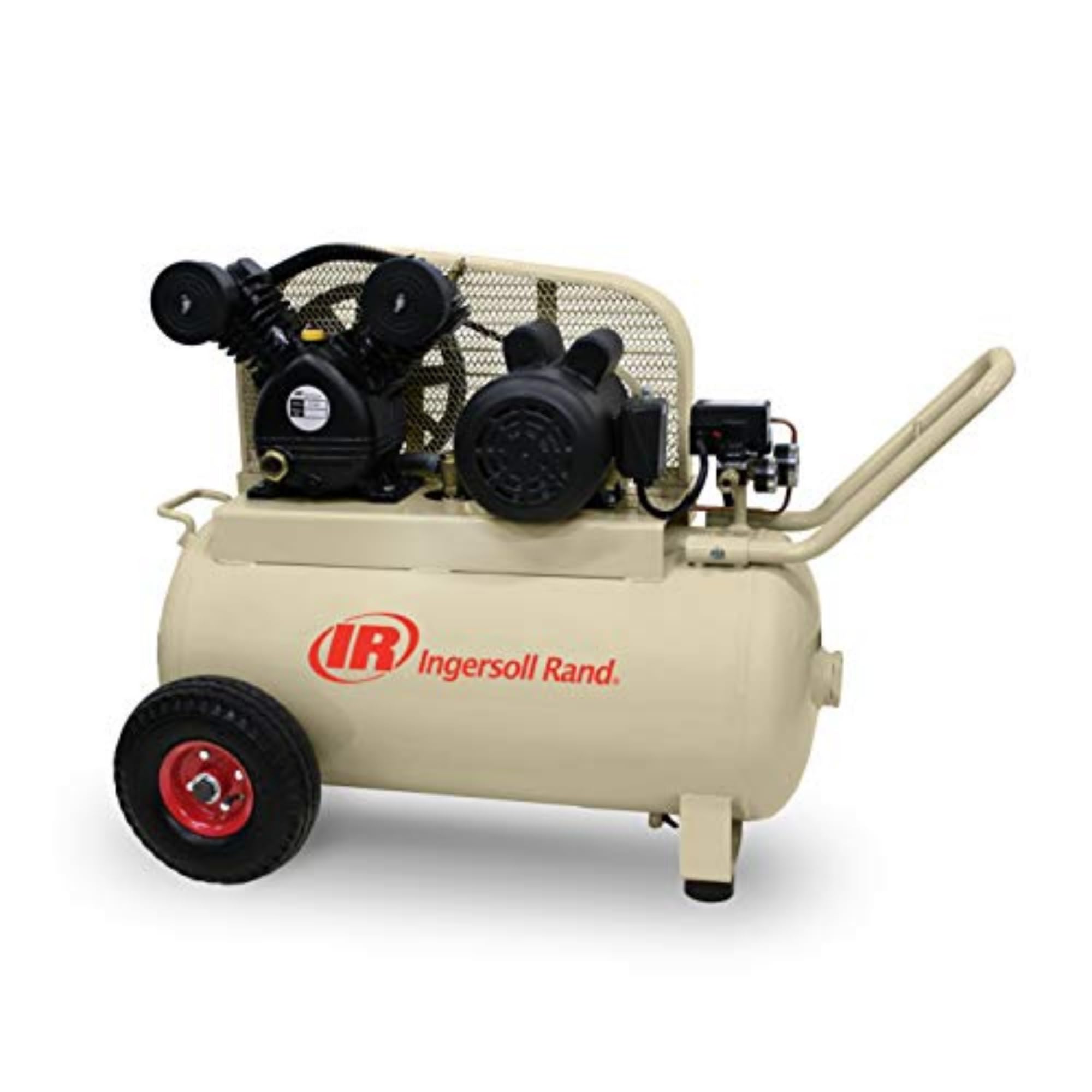
Built with a cast iron cylinder and frame for longevity that outlasts oil-free competitors.
The Ingersoll Rand Garagemate is not the quietest or the highest-pressure option, but it is built to a standard that few other 20-gallon compressors match. The cast iron cylinder and frame, along with a protective enclosed belt guard, give it a distinctly commercial feel. The All Season Select synthetic lubricant lasts 2,000 hours between changes — four times longer than petroleum-based oils — so you spend less time on maintenance. At 5.2 CFM at 90 PSI and an 80 dBA noise level, it is competitive on air flow but louder than the Stealth or California Air Tools.
One reviewer noted it is “made in Taiwan, not China,” with heavy metal parts and excellent packaging that survived shipping. However, the owner’s manual is poorly translated and lacks clear instructions on adjustments like cutoff pressure. The tank drain valve is positioned awkwardly, hitting the ground before it fully opens, and the gauges face away from the user. Some units arrived with physical damage, and Ingersoll Rand’s customer support was difficult to reach for warranty issues.
Where it excels
- Cast iron cylinder and frame are built for years of use
- Synthetic oil lasts 2,000 hours between changes (four times longer than standard oil)
- Excellent packaging reduces shipping damage risk
Where it falls short
- 80 dB is louder than the quietest oil-free picks
- Poor manual and awkward drain valve placement
Best for: A buyer who values oil-lubricated durability and brand reputation over absolute quietness or the highest PSI, and who plans to keep the compressor for many years.
Not for: Anyone who needs a whisper-quiet compressor for indoor use or expects a polished user experience from the start.
9. VEVOR 20 Gallon 4HP Oil-Free Ultra Quiet Air Compressor

Pumps out an astonishing 10.6 CFM at 90 PSI — more air than any other oil-free 20-gallon unit.
This VEVOR model is the air flow king. At 10.6 CFM at 90 PSI, it delivers roughly 63% more air than the DeWalt DXCM201 (6.2 CFM) and nearly three times the air of the California Air Tools (3.8 CFM). The 4HP (3KW) motor is the highest horsepower rating here, though the max pressure is a moderate 125 PSI — lower than most competitors. The oil-free pump keeps maintenance simple, and the 78 dB noise level is fairly quiet for a unit pushing this much air, thanks to the quality silencer with a thickened muffler cover and filter cotton.
The 3-layer coating on the Q235B structural steel tank resists rust, and the large cooling fan and automatic overheat protection add safety. However, the power cord is only 40 inches long, so you need an outlet very close — extension cords can cause failure. Some reviewers also note the small wheels make it prone to tipping. The instructions are reportedly useless, and a few owners received units with broken gauges and flimsy packaging.
Biggest selling points
- 10.6 CFM at 90 PSI is class-leading for running high-consumption tools
- 78 dB noise level is reasonable for the massive air output
- 3-layer tank coating resists rust and corrosion
Downsides to consider
- Very short 40-inch power cord limits placement
- Small wheels and tendency to tip if bumped
Who it serves: A shop that runs multiple high-CFM tools simultaneously or uses a spray gun with high volume requirements and wants oil-free simplicity.
Biggest frustration: The short cord is a genuine usability issue — you either need an outlet within arm’s reach or a heavy-duty extension cord that the unit can handle.
Understanding the Specs
CFM at 90 PSI
CFM stands for cubic feet per minute, and it measures the volume of air the compressor can deliver at a specific pressure. The 90 PSI figure is the industry standard test point because most air tools operate around that pressure. A higher CFM number at 90 PSI means the compressor can run larger tools or multiple tools without dropping pressure. For example, the VEVOR 4HP model delivers 10.6 CFM at 90 PSI, which allows it to run a high-volume spray gun continuously, while the California Air Tools model at 3.8 CFM is better suited for low-consumption tools like nail guns.
PSI and Tank Capacity
PSI (pounds per square inch) is the pressure the tank holds. A higher PSI means more stored energy, which translates to longer tool run time before the compressor kicks back on. A 200 PSI tank like the DeWalt DXCM201 can run a tool about 53% longer than a 155 PSI tank of the same size. The 20-gallon capacity is the standard middle ground — larger than small 4-6 gallon portable units but not as bulky as 60-gallon stationary compressors. The combination of high PSI and a 20-gallon tank gives you a solid reserve of stored air for short bursts of high-demand tools.
FAQ
How many CFM do I need to run a paint sprayer?
Can a 20-gallon air compressor run an impact wrench?
Is oil-free or oil-lubricated better for a 20-gallon air compressor?
What does 175 PSI mean for a 20-gallon tank?
How loud is a 68 dB air compressor compared to a standard one?
Can a 20-gallon air compressor run a sandblaster?
Will a 20-gallon air compressor fit in a standard garage?
How long does a 20-gallon air compressor typically last?
Does a 20-gallon air compressor need a special electrical outlet?
What is the difference between SCFM and CFM?
Final Thoughts: The Verdict
If you want one dependable pick, the 20 gallon air compressor winner is the Craftsman CMXECXA0232043 because it delivers high 175 PSI pressure and an oil-free pump at a competitive price, giving you the best balance of power, maintenance simplicity, and value for a home garage. If you need whisper-quiet operation for an indoor shop, grab the Stealth SAQ-12018 for its 68 dB noise level and solid 5 CFM air flow. And for professional-grade air delivery with the highest pressure on the market, the standout is the DeWalt DXCM201 with its 200 PSI and belt-driven durability.
How We Picked
We do not accept paid placement. Every pick is matched to a real buyer and a real use-case; we do not hands-on test units.
Sources & Methodology
Specifications: manufacturer listings and product documentation. Review insights: verified customer reviews, as of July 2026. Pricing: not shown on this page (it changes often); check the current price via the retailer link.
As an Amazon Associate, FitlyFast earns from qualifying purchases. This does not affect which products we feature.