
Our readers keep the lights on and the weekend projects moving. As an Amazon Associate, I earn from qualifying purchases.
Specs are compiled from manufacturer listings and verified buyer reviews and can change over time — please confirm the key details on the product page before buying.
Painting a fence, a dresser, or a set of kitchen cabinets by hand is a slow, aching chore. The roller splatters, the brush leaves streaks, and your arm tires long before the job is done. A decent sprayer turns that weekend slog into a few hours of smooth, satisfying work. The trick is finding the one that actually works without emptying your wallet.
I’m Rikta — the founder and writer behind FitlyFast. This guide is built by comparing the manufacturers’ published specifications and the patterns across verified customer reviews, so you get each pick’s real strengths and trade-offs instead of marketing spin.
The crowd favorite here has over 10,000 owners giving it a 4.4-star score, which tells you real people are getting real results. This guide breaks down the five best options for a budget paint sprayer that won’t leave you frustrated with clogs and sputters.
Our Picks at a Glance

How To Choose The Best Budget Paint Sprayer
A cheap sprayer that clogs after ten minutes is no bargain. You want the one that delivers a consistent spray and cleans up without a fight. Here is what separates a winner from a wasted afternoon.
HVLP vs. Airless vs. Handheld
Most budget sprayers use HVLP (High Volume, Low Pressure) technology. This simply means it moves a lot of air at a low pressure to atomize the paint into a fine mist. You get good control and less overspray—the paint flying everywhere but the target. Airless sprayers are faster and handle thicker paint, but they cost more and create a ton of overspray. For the budget buyer doing furniture, fences, and cabinets, a corded electric HVLP is the smart, manageable choice.
Nozzle Size and Spray Patterns
The nozzle dictates what you can spray. A 1.0mm nozzle is for thin stains and sealers. A 2.5mm or 3.0mm nozzle is for thicker latex and primer. A good kit includes three or four sizes so you can switch jobs without buying new parts. Three adjustable spray patterns—horizontal, vertical, and circular—let you adapt to the shape of your project. A wide horizontal fan covers a wall or fence fast, while a vertical line handles trim or a picket.
Cordless vs. Corded
Cordless sprayers run on power tool batteries (like Ryobi 18V). They are incredibly convenient for outdoor work far from an outlet, but battery life is a real limit—you might get through one or two doors per charge. Corded models give you unlimited runtime and consistent power, which matters if you are painting a whole room or a long fence. The trade-off is dragging an extension cord around. For a first sprayer, a corded electric unit is generally more reliable and easier to learn on.
Quick Comparison
| Model | Best For | Power Source | Nozzles Included | Cup Capacity | Amazon |
|---|---|---|---|---|---|
| Histely Cordless for Ryobi★ Best Overall | Battery Freedom | Ryobi 18V Battery | Four Brass (1.0mm, 1.8mm, 2.5mm, 3.0mm) | 1000ml | Amazon |
| HomeRight Super Finish MaxAlso Great | Premium Pick | Corded Electric (450W) | Three Brass (1.5mm, 2.0mm, 4.0mm) | ~32 fl. oz | Amazon |
| Batavia 700W HVLP | Split-Design Speed | Corded Electric (700W) | Four (1mm, 1.5mm, 2mm, 3mm) | 40 fl. oz | Amazon |
| Tilswall Alien500 | Lightweight Start | Corded Electric | Four (1.0mm, 1.5mm, 1.5mm, 2.0mm) | 600ml | Amazon |
| Tilswall Shark 600 | No-Assembly Value | Corded Electric | Three (1.3mm, 1.8mm, 2.6mm) | 1000ml | Amazon |
In‑Depth Reviews
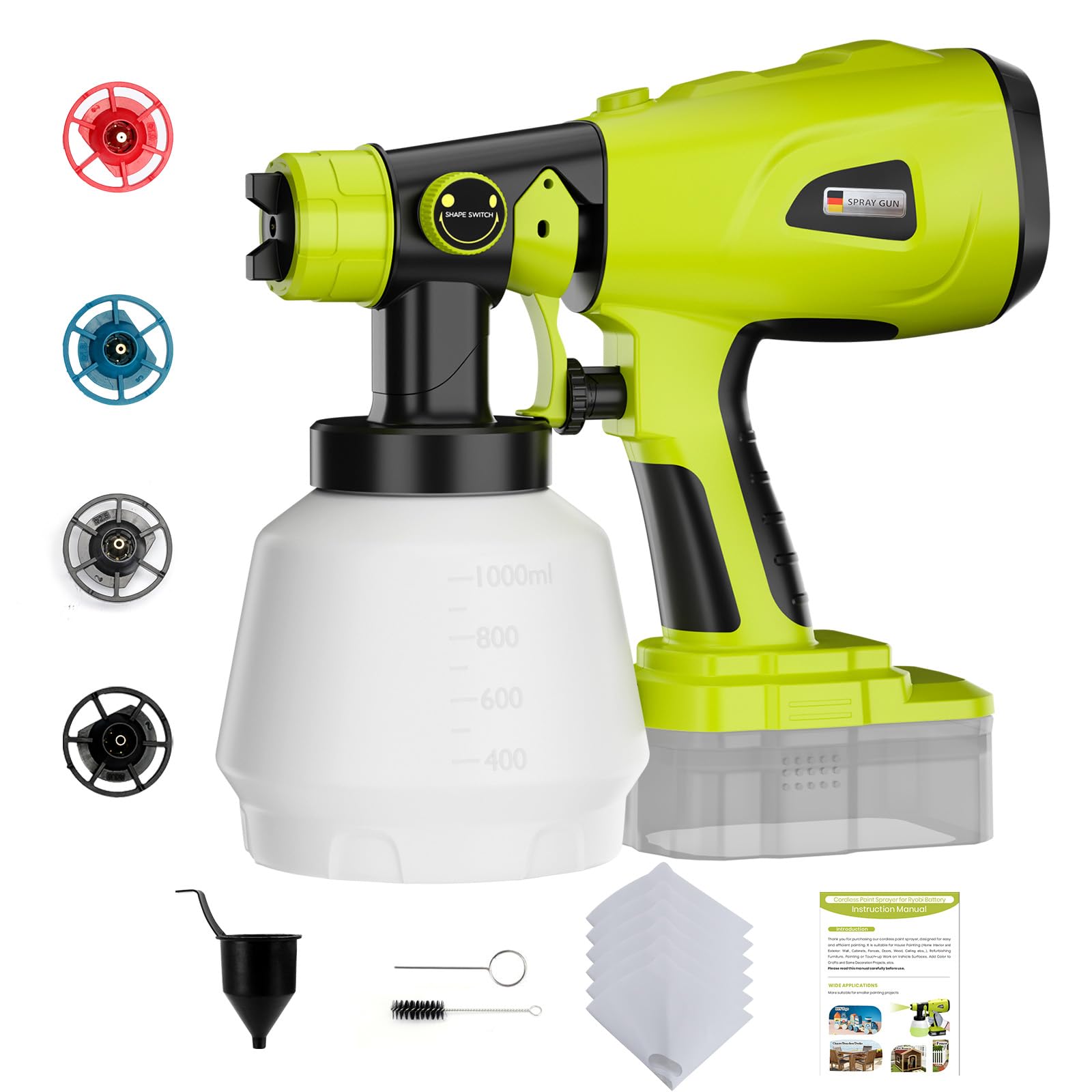
1. Paint Sprayer for Ryobi One+ 18V Battery w/1000ML Large Container
Your Ryobi 18V battery turns into a cordless paint gun that stained a whole fence in under 2.5 hours.
No extension cords, no hunting for an outlet—just slap your existing Ryobi One+ 18V battery (like the P100 or P102 models) onto this Histely sprayer and walk around the yard. The 1000ml large container holds enough stain or paint to keep going without constant refills, which is the bottleneck on many smaller cup-style sprayers. The kit comes with four brass nozzles in sizes 1.0mm, 1.8mm, 2.5mm, and 3.0mm—each matched to a specific project type, from DIY toys (1.0mm) to thick fence paint (3.0mm). Three spray patterns (vertical, horizontal, circular) round out the versatility.
Owners confirm the one big selling point: you can “stain an entire wooden privacy fence in under 2.5 hours with uniform spray pattern” using a couple of 4Ah batteries. The low-voltage protection system is a smart safety extra that stops the sprayer from draining your battery dead. The honest limitation is that it runs best on larger-capacity batteries; an extended job will require battery swaps, especially with a 2Ah pack. Most owners find they get about 4-5 doors per 18V 4Ah charge. You also must thin the paint to the right consistency—the instructions recommend spraying a test pattern on cardboard to avoid clogs—which adds a small learning step.
The Cordless Upside
- Total freedom of movement for fences, sheds, and outdoor furniture away from any power outlet.
- Fully compatible with the massive Ryobi One+ battery ecosystem if you already own those tools.
- Four brass nozzles give you a dedicated tip size for everything from thin stain to thick primer.
The Battery Reality
- Battery life is real; a 4Ah pack manages 4-5 doors, so buy a second battery for bigger jobs.
- Paint must be thinned to the right viscosity to prevent clogs—not a “fill and go” corded experience.
- Plastic build feels light and functional but not as durable as a premium corded unit.
Reach for it if: you are already in the Ryobi battery system and need a cordless sprayer for outdoor projects like fences and decks where dragging a cord is a hassle.
Look elsewhere if: you want to spray thick latex paint or primer on interior walls without thinning it first—a corded HVLP handles that better.
2. HomeRight C800971 Super Finish Max
The crowd favorite with over 10,000 ratings that actually delivers a factory-smooth finish on cabinets and trim.
This is the sprayer that convinced thousands of weekend warriors to ditch their brushes for good. Its 450-watt motor handles the full range of homeowner paints—latex, enamel, chalk-type paint, stain, polyurethane, and sealer—without requiring you to thin them down first, which removes a huge variable for a beginner. The kit includes three brass spray tips, which last far longer than the plastic ones found on cheaper units: the 1.5mm blue tip for stains, the 2.0mm green tip for latex and chalk paint (which comes installed), and the 4.0mm red tip for primer and thick latex.
What wins people over is the finish it puts down. Buyers report that with a little practice, they get a “factory smooth look” on kitchen cabinets and doors with zero brush strokes. The adjustable material flow knob and the three spray patterns (horizontal, vertical, round) give you real control over how much paint lands and where. The honest trade-off is that it has noticeable overspray—about a 5-6 foot cloud of fine mist. You need to mask off the surrounding area thoroughly, and the airflow can be strong enough to shift a drop cloth. Cleaning is also a project; it takes a good 10-15 minutes to disassemble and rinse all the parts, and the plastic components can hold onto paint stubbornly.
Why Owners Swear By It
- Brass nozzles outlast plastic, delivering consistent spray performance without wearing out quickly.
- Sprays quality paint (like Benjamin Moore) without needing to be thinned—fill the cup and go.
- The adjustable settings let you dial in the perfect fan and flow for trim versus broad walls.
The Real-World Catch
- Overspray is significant; you must mask a generous area (5-6 ft) to avoid a drift of paint mist.
- The quart-sized cup feels awkwardly attached and can be tricky to clean fully after a heavy session.
- Thick ceiling paint can sputter; some owners suggest dry-rolling the finish for a final smooth coat.
Your best bet if: you want professional-looking results on furniture, cabinets, and trim with a reliable unit that has proven itself on tens of thousands of projects.
Think twice if: you are painting a large fence or exterior wall and don’t want to invest the time in masking and meticulous cleanup between coats.
3. Upgraded Paint Sprayer-BATAVIA 700W HVLP

A split motor-and-gun design that puts a 1-lb spray head in your hand and the weight on your shoulder.
This Batavia sprayer solves the chronic shoulder ache problem that plagues long painting sessions. The motor part attaches to a shoulder strap, while the detachable handheld spray gun weighs just one pound. The 6.5-foot flexible air hose lets you move freely—owners say it covers a 12×12 foot painting area in about six minutes. The 700-watt high-power motor delivers enough airflow to handle thick latex, which means a finer finish with less orange-peel texture.
The thing owners rave about is how it saves paint. As owners mention: it “applied Behr exterior stain flawlessly using half the paint of a Graco airless.” The reliability gets the most praise—49 owners single it out as dependable, which is notable for a budget sprayer. The 360-degree anti-backflow design is a practical touch that prevents clogging before it starts. Cleaning is straightforward with the included brush and needle, and the visible design lets you see if residue is building up. The plastic nozzles may wear over time, but the real gripe is the paint jar—some find it hard to get completely clean between color changes.
Best for the non-stop painter: If you have a fence, a deck, or a series of doors to spray, the split design keeps your arm fresh and the 700W motor keeps the material flowing.
The one caveat: The turbine motor gets warm during extended use and needs a rest period, so plan breaks for stirring or taping.
4. Tilswall Paint Sprayer Alien500 Ultra Lightweight
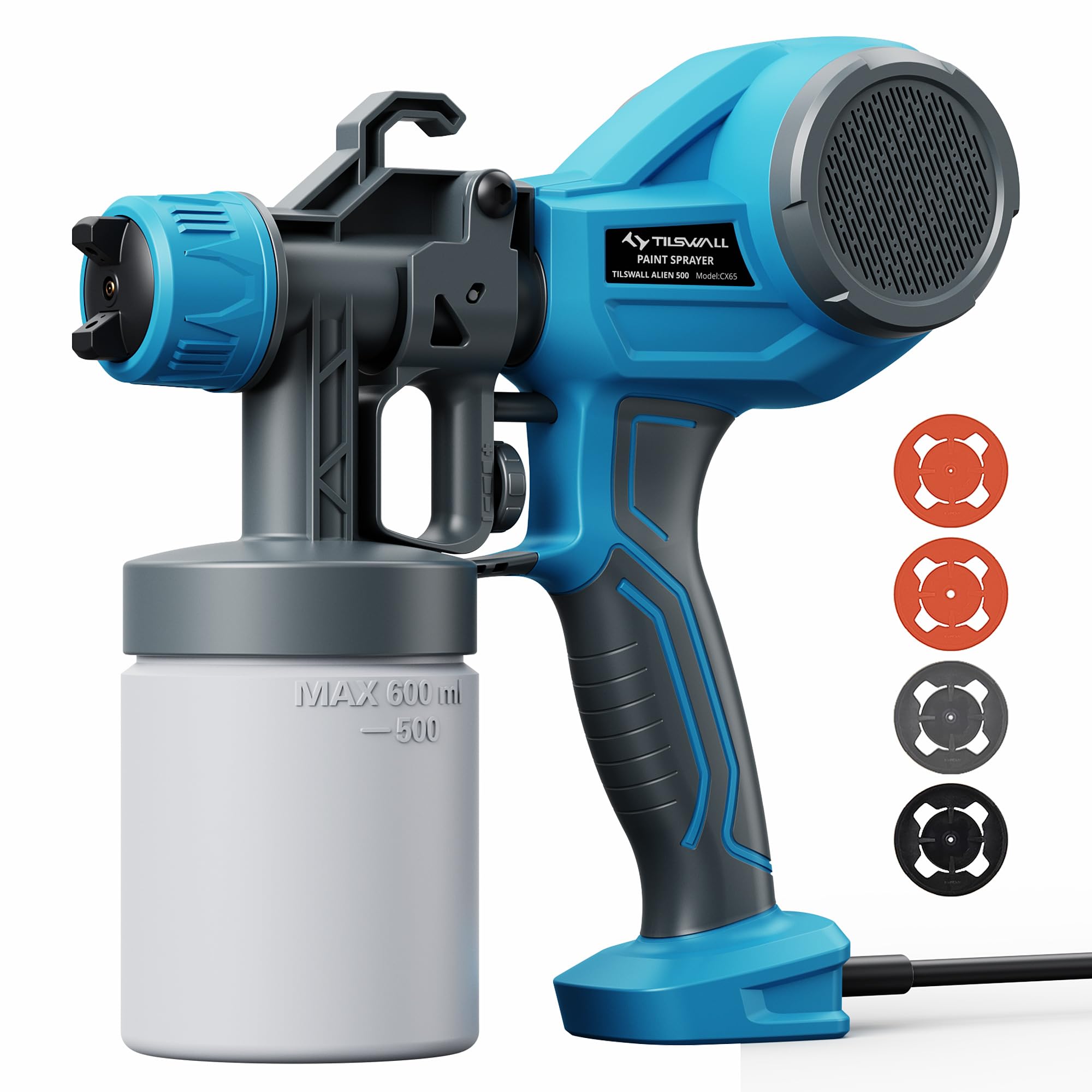
Weighs just 1.54 pounds, so a beginner can paint all weekend without their arm going numb.
For someone who has never held a paint sprayer, the Tilswall Alien500 is almost risk-free. It is 1.54 pounds and fits in one hand comfortably—the “alien” shape is genuinely ergonomic, with a grip that feels natural. Assembly is a press-and-twist affair with no tools; the included instruction manual and step-by-step video guide you through the process. The 600ml cup is small, but that makes it manageable for a single-coat project on a piece of furniture or a small shed. Three spray patterns (horizontal, vertical, elliptical) and four nozzle sizes (1.0mm, 1.5mm, 1.5mm, 2.0mm) give you a surprising range for such a light unit.
The real-world test is that owners used it to “paint 200 sq ft deck and shed in two weekends” without any arm fatigue. The HVLP technology keeps overspray to a minimum, which is great for a backyard project where you don’t want to mask the neighbor’s patio furniture. The catch is that it is built for small projects, not whole-house jobs. The 600ml cup means frequent refills on a large wall. There is also a quality-control note: a few owners found that the correct filler tube for overhead spraying was missing from their package, so double-check the accessories if you plan to paint a ceiling. You must thin the paint to under 100 din-S for it to spray evenly—this is not optional.
Ideal first sprayer: The lightest pick on this list, perfect for a homeowner who wants to paint a chair, a dresser, or a small fence without a big investment or a steep learning curve.
The practical limit: The small cup and beginner-focused motor mean it is not for painting an entire room’s walls or a large exterior—save that for a unit with a bigger tank and more power.
5. Tilswall Paint Sprayer, Shark 600 Ultra-Light HVLP
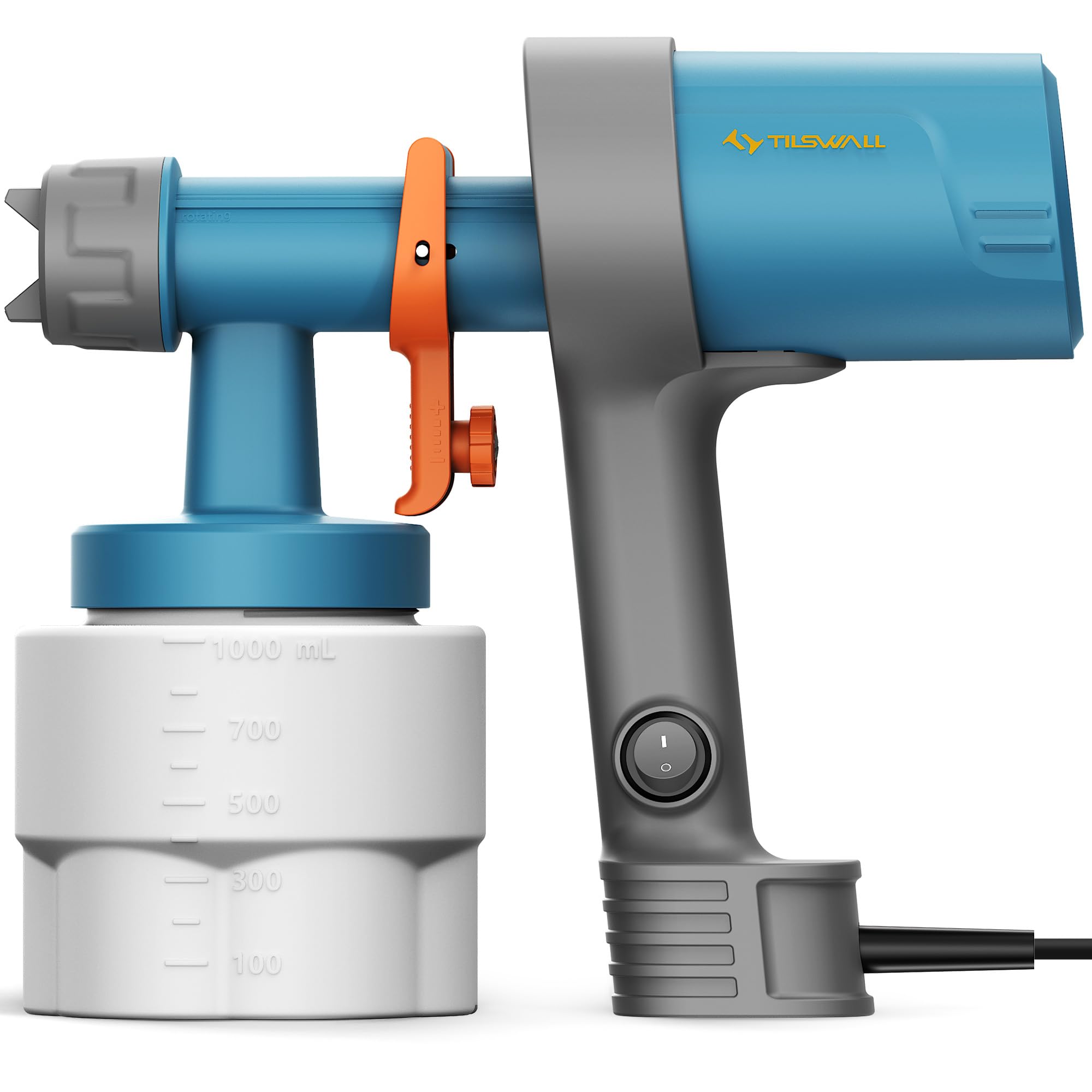
Comes from the start ready to spray—no assembly, no wrenches, just fill the 1000ml cup and pull the trigger.
The Shark 600 is Tilswall’s answer to anyone who hates assembly manuals. It arrives fully put together, which makes it the fastest path from unboxing to painting. The 1000ml tank is generous compared to the Alien500’s 600ml cup, so you get fewer refill stops on a fence or a large piece of furniture. The adjustable flow rate goes from zero up to 1200 mL/min, and the three spray patterns (horizontal, vertical, circular) with three nozzle sizes (1.3mm, 1.8mm, 2.6mm) cover the standard range of DIY tasks. It weighs 2.2 pounds and is 47% lighter than “traditional” sprayers, according to the maker—compact enough to store in a drawer.
Owners describe it as an “amazing first paint sprayer” that delivered “even application” and “a breeze” to clean. The variable flow control is a key feature for dialing in the right amount of paint for a fine finish on trim versus a wide fan for a wall. The practical complaint is that the trigger flow control knob can rotate accidentally during use, changing your spray rate mid-stroke without warning. The plastic feel is sturdy but not premium, and some owners found the spray pattern uneven on first use until they thinned the paint correctly. The included viscosity cup makes that step easy—just dip and time the flow.
What You Get Instantly
- Zero assembly—open the box, fill the 1000ml tank, plug in, and spray immediately.
- The adjustable flow rate gives you fine-grained control from a mist for stain to a heavy stream for latex.
- Takes just minutes to clean with warm water and detergent, as long as you do it within 15 minutes of use.
The Annoyance to Know
- The flow control knob is easy to bump, which can change your spray pattern mid-project if you are not careful.
- The 1000ml tank sounds big, but it still runs out fast on a large wall—expect refills on any room-sized job.
- Not ideal for thick paint straight from the can; you must thin it using the included viscosity cup for consistent results.
Best for the impatient DIYer: You want to start painting right now with zero setup time, and you need a large cup to minimize refills on a medium-sized project like a deck or a set of cabinets.
skip it if: you are tackling thick ceiling paint or a major exterior job—the variable control and plastic construction feel more at home on trim, furniture, and fences.
Understanding the Specs
Nozzle Size and Material
The nozzle size determines how thick the paint can be. A 1.0mm nozzle works for thin stains and varnish, while a 4.0mm nozzle handles thick latex and primer. Most budget kits include three or four sizes, letting you swap for different materials. Brass nozzles are more durable than plastic, resisting wear from abrasive paint particles and cleaning. Plastic nozzles are cheaper to replace but can crack or deform under heavy use.
Viscosity and Thinning
Viscosity is a measure of how thick and resistant to flow a liquid is—think of it as “paint thickness.” Most budget HVLP sprayers require you to thin the paint to a specific viscosity (often measured in “din-s” units). If the paint is too thick, the gun clogs and spits blobs. If it is too thin, you get runs and drips. Use the included viscosity cup: fill it with your mixed paint and time how long it takes to empty. That tells you if you need to add water or thinner.
FAQ
Will a budget paint sprayer handle latex paint straight from the can?
How do I clean a paint sprayer without ruining it?
What size nozzle do I need for staining a fence?
Is a cordless or corded paint sprayer better for a beginner?
Why is my paint sprayer spitting and clumping?
How long does a budget paint sprayer typically last?
Can I use a paint sprayer for primer and polyurethane?
What is the difference between a 2.0mm and a 4.0mm spray tip?
Do I need an air compressor to use an HVLP paint sprayer?
Final Thoughts: The Verdict
If you want one dependable pick, the best budget paint sprayer is the HomeRight Super Finish Max because it has proven itself with over ten thousand owners, delivers a smooth finish on trim and furniture, and sprays quality latex without thinning. If you want the cordless convenience of using your Ryobi 18V batteries for outdoor fence projects, grab the Histely Cordless Sprayer. And for the absolute lightest and most beginner-friendly option for small indoor projects, the Tilswall Alien500 is the one to reach for.
How We Picked
We do not accept paid placement. Every pick is matched to a real buyer and a real use-case; we do not hands-on test units.
Sources & Methodology
Specifications: manufacturer listings and product documentation. Review insights: verified customer reviews, as of July 2026. Pricing: not shown on this page (it changes often); check the current price via the retailer link.
As an Amazon Associate, FitlyFast earns from qualifying purchases. This does not affect which products we feature.