
Our readers keep the lights on and the weekend projects moving. As an Amazon Associate, I earn from qualifying purchases.
Specs are compiled from manufacturer listings and verified buyer reviews and can change over time — please confirm the key details on the product page before buying.
The small DIN dial on your ski binding controls how hard a fall has to be before your boot releases. Set it wrong and you risk a season-ending leg injury from a binding that won’t let go — or a frustrating pre-release (a pop-out on every turn) from one that’s too loose. These three bindings answer the question: which one do I pay for? Each has a real trade-off you need to know before mounting. The Marker Griffon 13 is the best overall buy for most skiers because its DIN 4 to 13 range, multi-pivot toe (releases from several angles), and 120 kg max weight cover everything from park to powder without forcing you into a niche binding.
I’m Rikta — the founder and writer behind FitlyFast. This guide is built by comparing the manufacturers’ published specifications and the patterns across verified customer reviews, so you get each pick’s real strengths and trade-offs instead of marketing spin.
Your alpine ski bindings are the only mechanical link between boot and ski. They control how safely you release in a crash and how much control you feel underfoot.
Our Picks at a Glance

How To Choose The Best Alpine Ski Bindings
They must hold you in tight for aggressive turns, then release predictably when the torque gets too high.
Match the DIN to Your Ability, Not Your Ego
DIN is a standardized release-force number — higher means a stiffer hold, lower means an easier pop-out. A DIN range from 4 to 13 works for most intermediate to advanced skiers. The right setting depends on your weight, boot sole length (the measurement from heel to toe of your boot), and skill level, not your top speed on a groomer. Pushing a binding to the top of its DIN range without matching body weight and technique gives a false sense of security and risks injury.
Toe and Heel Design Dictate On-Snow Feel
Multi-pivot toes, like the Triple Pivot Elite, allow release from several angles — crucial in twisting falls. Turntable heels (found on the Look Pivot 14) rotate with the boot during a release, reducing the chance of a pre-release in a hard carve. A standard fixed heel, like an Inter Pivot, transfers energy directly for a firmer platform on groomed snow.
Quick Comparison
In‑Depth Reviews
1. Marker Griffon 13 Ski Bindings 2024
Our pick — over 4.5★ from 100+ verified ratings; the strongest balance of quality and price.
The go-to binding for skiers who charge everything from groomers to the terrain park.
The Griffon 13 covers the widest range of skiers here because its DIN 4 to 13 scale, multi-pivot toe, and 120 kg max weight handle everything from a fast intermediate to a heavy expert. The Triple Pivot Elite 2 Toe (a toe piece designed to release your boot from multiple angles) reduces the risk of a twisted knee in a fall in crud or heavy snow. The stainless steel AFD (Anti-Friction Device, a small sliding plate under the toe) keeps the release force consistent even after a season of dirt and wear. Buyers call it “reliable” and “the most popular binding ever made” — over 130 ratings back that up, and buyers report they put it on their second, third, and fourth sets of skis.
At an 18 mm stand height at the toe and 24 mm at the heel, you get solid edge feel for carving without burying the boot too deep for park landings. The Inter Pivot 2 Heel uses an oversized axle to transfer energy into the ski efficiently, so your carve doesn’t get wasted flex. The DIN adjusts from 4 to 13, comfortably covering intermediates through experts.
Owners mention it arrives fast and installs easily at any shop. One reviewer mentions “a broken leg” but clarifies it was “user error…not binding related” — a reminder that professional mounting and the correct DIN setting are essential. For most, the Griffon is the binding they keep buying for every new pair of skis.
What owners rave about
- Triple Pivot Elite 2 Toe releases consistently from multiple angles in a fall, protecting your knees
- Stainless steel AFD stays reliable through dirt and wear so the release force doesn’t drift
- Supports up to 120 kg — the highest max weight here, so heavier skiers can trust it
- 16 oz weight keeps the setup light on your feet, noticeably lighter than the 4 lb Squire
The real-world catch
- Must be professionally mounted and set to your correct DIN — an incorrect setting voids the safety margin
- Does not mention GripWalk compatibility (the newer rockered boot sole) in its specs, unlike the Squire
Your pick if: you ski a mix of piste, park, powder, and trees and want one binding that reliably handles it all without a second thought.
Think twice if: you are still progressing as a beginner — the 4–13 DIN range is wasted if you stay under DIN 6, and a lighter binding saves weight.
2. Marker Squire 11 All-Mountain Ski Bindings
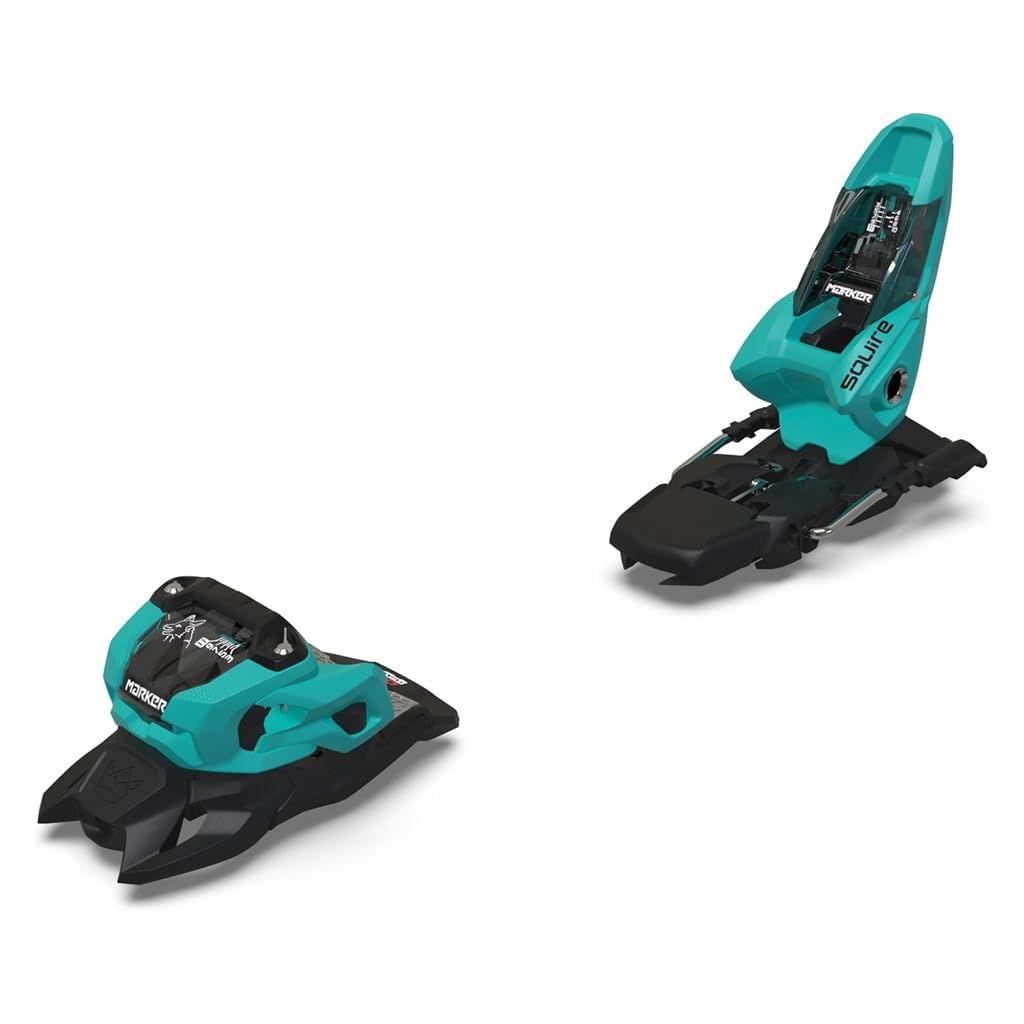
A lighter, friendlier step-in for skiers moving up from rental gear.
The Squire 11’s easy-entry Hollow Linkage 2 Heel needs less force to click into than the Griffon’s heavier Inter Pivot heel — a real convenience when you are clicking in on a steep traverse after a long run. Its Triple Pivot Light 2 Toe works with both standard alpine soles and GripWalk soles (the newer rockered boot sole with a rubber walking pad that is now common on all-mountain boots), so you are not locked into one boot type. Customers note these “work flawlessly” and that they had to “replace my bindings mid season, but these are better.”
The maximum DIN of 11 is designed for beginners and intermediates, and the 110 kg max weight means lighter and average-sized skiers get the most out of it. At 4 pounds, it is heavier than the Griffon (16 oz), but that extra weight is in the heel and toe unit — most skiers won’t feel it on the snow. The AFD (the anti-friction plate under the toe) is built to release consistently even with snow and ice buildup, which is an advantage for resort skiers riding through spring slush.
The crowd behind this binding is smaller (over 30 ratings) but every single review is a full five stars. The trade-off: the 11 DIN ceiling and 110 kg max weight cap it lower than the Griffon. Heavier skiers building muscle and power will outgrow this binding before the Griffon. For a solid intermediate on blue and black groomers, it’s a perfect fit.
Why it clicks
- Hollow Linkage 2 Heel means an easy step-in every time, even on steep terrain
- GripWalk compatible — works with modern rockered boots from the start without adapters
- AFD stays accurate even with snow and grime underfoot, so release reliability doesn’t drop
- Flawless 5-star consensus from every reviewer — rare for any product
The growth ceiling
- Max DIN of 11 limits heavy or very aggressive skiers who push the release-force threshold
- Max weight 110 kg (9% less than the Griffon’s 120 kg)
- Heavier than the Griffon at 4 lbs vs 16 oz — noticeable if you carry skis
Grab it if: you are a solid intermediate moving up to harder terrain and want a reliable, easy-entry binding that fits GripWalk boots without adapters.
Outgrow it if: you are already skiing at DIN 10+ on a heavy frame — the Griffon 13 has more headroom for your future muscle.
3. Look Pivot 14 GW

The turntable heel binding that rotates with you to protect knees in a crash.
The Look Pivot 14 is the binding advanced and expert skiers choose when they want the most natural flex underfoot and the best ACL (anterior cruciate ligament) protection available. The critical difference is the Turntable Heel — instead of a fixed heel that pivots on one point, this heel rotates 180 degrees on a full turntable, so the boot releases in a pure rotational motion that reduces torque on your knee. That 180-degree multi-directional release is the engineering that makes reviewers point out “these could be the difference between a sore leg or a season ending ACL.” The Aluminum Race Toe Piece adds stiffness for direct input into the ski, and the 7 Points of Contact spread forces across the binding for a gradual, predictable release. This delivers a noticeably smoother flex underfoot than the Griffon’s fixed Inter Pivot heel.
All reviews are five-star and passionate, calling them “the best bindings out there” and “awesome for all mountain senders.” Owners love “how they give more natural flex to the ski and how the heel rotates on release.” The honest trade-off: the turntable heel “can automatically snap into the stop bar and cinch a finger like an old school mouse trap” — a real finger-pinch hazard off the snow. Not a design flaw, but a mechanism you learn to respect. The other trade-off: at 4 pounds these are not a lightweight touring binding, and the premium price targets skiers who already know they need the turntable’s release characteristics.
Over 15 ratings with a consistent 5-star consensus mean once skiers try the Pivot, most don’t switch back. They are GripWalk compatible, fitting modern boots. The fit is “snug” — these are precision pieces that need professional mounting. The “intermediate to advanced” skill recommendation is accurate, but realistically, this binding rewards skiers charging hard enough to appreciate the rotational heel release in a fall.
The defining edge: The turntable heel rotates with the boot during a release, offering a level of knee protection that fixed-heel bindings like the Griffon’s Inter Pivot simply cannot replicate.
The honest caution: The heel can snap closed on a finger — handle it deliberately, and keep kids away from the heel piece when it is unlatched.
Match with: aggressive all-mountain and freeride skiers who push hard and want the best possible release dynamics for knee safety over the Griffon’s lighter, versatile platform.
Skip if: you are a light intermediate or budget-conscious — the premium price and finger-pinch risk aren’t worth it unless you truly need the turntable.
Understanding the Specs
DIN Range
The DIN setting is a number — typically 3 to 14 on adult bindings — that controls the force required to release your boot. Your correct DIN is calculated from your weight, boot sole length (the measurement from heel to toe of your boot), age, and skier type.
A binding with a wide range (like 4–13) lets you adjust as you progress, while a narrow range (like a race-only 14+) locks you into expert terrain.
Stand Height
Stand height is the distance from the top of the ski to the bottom of your boot sole. It is measured in millimeters at the toe and heel. A lower stand height (around 15–20 mm) gives you better edge feel and snow contact for carving. A higher stand height (around 25 mm+) gives you more leverage for deeper powder but reduces the immediate connection to the edge.
If you mainly ski groomers, look for a lower stand height. If you spend time in deep snow, a slightly higher platform helps keep you on top of it.
FAQ
What does DIN mean on a ski binding?
Can I mount ski bindings myself?
What is a GripWalk sole and do I need bindings that support it?
How tight should my ski bindings be?
Can I use alpine bindings for touring or backcountry skiing?
What is an AFD and why does it matter?
How often should I replace my ski bindings?
Are heavier bindings better for stability?
How do I know if my boot sole length is compatible with a binding?
Final Thoughts: The Verdict
For most skiers, the alpine ski bindings winner is the Marker Griffon 13. It is the best overall because its DIN 4 to 13 range, multi-pivot toe, and 120 kg weight ceiling cover the broadest mix of skiers in a package light enough (16 oz) for the park and strong enough for charging. If you want an easier step-in and GripWalk compatibility at a friendlier DIN ceiling, grab the Marker Squire 11. And for aggressive skiers who want the gold standard in rotational heel release and knee protection, the Look Pivot 14 GW is the one to reach for.
How We Picked
We do not accept paid placement. Every pick is matched to a real buyer and a real use-case; we do not hands-on test units.
Sources & Methodology
Specifications: manufacturer listings and product documentation. Review insights: verified customer reviews, as of July 2026. Pricing: not shown on this page (it changes often); check the current price via the retailer link.
As an Amazon Associate, FitlyFast earns from qualifying purchases. This does not affect which products we feature.