
Our readers keep the lights on and the weekend projects moving. As an Amazon Associate, I earn from qualifying purchases.
Specs are compiled from manufacturer listings and verified buyer reviews and can change over time — please confirm the key details on the product page before buying.
You want to reclaim your desk, but you worry that compact computer speakers will sound tinny and hollow, ruining your movies and music. The 9 models here show that a small footprint doesn’t have to mean tiny sound — they range from a 5W monitor-clipping bar to a 100W desktop powerhouse, so there’s a fit for every setup and budget.
I’m Rikta — the founder and writer behind FitlyFast. This guide is built by comparing the manufacturers’ published specifications and the patterns across verified customer reviews, so you get each pick’s real strengths and trade-offs instead of marketing spin.
To pick the right set, decide first: do you need a space-saving bar for calls, or a beefier pair for gaming and music? Your answer narrows the field instantly.
Our Picks at a Glance


How To Choose The Best Compact Computer Speakers
The biggest mistake is judging a speaker by its size alone. A tiny 5W bar can be perfect for Zoom calls, while a compact 100W system can genuinely shake a desk with music. Matching the speaker’s power and connections to your actual use — calls, gaming, music, or movies — is the real trick.
Start with your daily use case
If you spend your day in video meetings, prioritize a built-in speakerphone and clear voice reproduction over raw wattage. If you’re gaming or listening to music, you’ll want more power and a dedicated subwoofer or passive bass radiator for low-end punch.
Check the connections your devices have
USB speakers are plug-and-play with nearly any PC or laptop. Bluetooth adds wireless freedom for phones and tablets but check the version for stability. A 3.5mm AUX input remains the most universal wired fallback for older gear. Look for a model that matches the ports your equipment actually has.
Think about the physical fit
Measure your desk and monitor. A soundbar that clips to the bottom of your monitor saves the most space, while a 2-speaker setup needs a few inches on each side. Pay attention to how thick your monitor is — some clamps only fit slimmer panels. If space is tight, the bar design wins every time.
Quick Comparison
| Model | Best For | Power | Connections | Bass System | Amazon |
|---|---|---|---|---|---|
| Cyber Acoustics CA-2890BT★ Best Overall | Monitor-clipping desk bar | 5W | USB, Bluetooth 5.0 | None | Amazon |
| Creative Pebble SEStyle Pick | Compact 2.0 set with RGB | 4.4W RMS | USB-C, AUX | Passive radiators | Amazon |
| Sanyun SW102Budget Champion | Budget 2.0 with 360° sound | 10W (5W x2) | USB, 3.5mm AUX | Bottom-firing passive radiator | Amazon |
| Cyber Acoustics CA-2890PRO | 20W bar with smart voice tech | 20W | USB-C/USB-A, Bluetooth | Rear-facing bass radiator | Amazon |
| KASOHQEE Bluetooth Speaker | Under-monitor stereo soundbar | 10W (5W x2) | Bluetooth 5.3, USB, AUX, Type-C | None | Amazon |
| Sanyun SW208 | HiFi bookshelf pair | 60W (30W x2) | Bluetooth 5.0, USB, 3.5mm AUX | 4-inch carbon fiber drivers | Amazon |
| Bluedee 2.1 Speakers | Desktop 2.1 with subwoofer | 80W peak | Bluetooth 5.4, USB, USB-C, AUX | Dedicated subwoofer | Amazon |
| Audioengine A1 | Room-filling compact pair | 60W | Bluetooth APTX, RCA, AUX | Hand-built wood cabinets | Amazon |
| Edifier M90 | Premium desktop hub | 100W RMS | Bluetooth 6.0, HDMI eARC, Optical, AUX, USB-C | 4-inch aluminum driver + SUB OUT | Amazon |
In‑Depth Reviews
1. Cyber Acoustics CA-2890BT USB and Bluetooth Speaker Bar
Our pick — 4.5★ from 700+ verified ratings; the strongest balance of quality and price.
The monitor-clipping bar that turns a cramped desk into a clear-sounding call hub.
This 5W speaker bar is the easiest upgrade for a desk with zero spare surface. It attaches to the bottom of your monitor, freeing your workspace completely, and it runs on a single USB cable that handles both power and sound. Buyers report it’s “much smaller than I expected, however, it is the perfect size for my desk” — a compact bar that vanishes under the monitor yet stays clearly audible.
Connectivity is where this bar earns its keep. It pairs with your PC or Mac over USB and your smartphone over Bluetooth 5.0, with a multi-function button that toggles between the two sources. The built-in mic handles hands-free calls and virtual meetings, and a mic mute button with an LED indicator means you’re never caught off guard on a video call. Setup is genuinely plug-and-play, and the included USB-A to USB-C converter covers newer laptops that dropped the larger port.
The honest trade-off is bass. At 5W, this is a voice-and-clarity speaker, not a music thumper — owners describe the sound as good rather than excellent, and the clip only fits monitors around 1 to 1.5 inches thick. If your monitor is thicker, you’ll likely clip it to a nearby shelf instead, which owners mention works fine.
Desk-saver verdict: The single-cable design and true plug-and-play setup make it the lowest-friction way to get dramatically better sound than your laptop’s built-in drivers. It’s a bit of a crowd favorite — 4.5 stars across 700+ ratings confirms the broad appeal.
Who it’s not for: Bass seekers and owners of ultra-thick monitors will want a speaker with more power or a different mounting approach.
Reach for this if: your desk is full and your priority is crisp voice for calls, meetings, and podcasts.
Look elsewhere if: you need room-filling music playback or deep low-end punch.
2. Creative Pebble SE 2.0 Desktop Speakers
The orb-shaped pair that dresses up your desk while outperforming its tiny footprint.
At just 116 mm (4.6 inches) tall, the Pebble SE squeezes into corners other speakers can’t, yet it doesn’t sound like it. With up to 4.4W RMS power and built-in passive radiators, it delivers a fuller, more balanced tone than the size suggests. Customers note these “little things are LOUD! And have more bass than I expected” — a recurring surprise for first-time owners.
The design does double duty. The matte, orb-shaped cabinets come in white or black, and the 7 built-in RGB presets let you cycle through a dynamic spectrum or settle on a static glow. A convenient volume knob sits right on the front for quick adjustments. The signature 45° improve angle tilts the drivers up, directing audio straight at your ears rather than into your monitor.
Setup is a single cable: USB-C for power, AUX for audio. One honest caveat — the two speakers are wired to each other, so you can’t separate them far apart, and the sound from the start can be a touch muddy until you tweak an EQ. Compared to the Cyber Acoustics bar above, this is the better pick if you want stereo separation and visual flair rather than a built-in mic.
Why owners love it
- Sound quality is the thing everyone raves about — it’s the most-praised aspect by a wide margin
- Value for money ranks second, with buyers calling them underrated for the price
- RGB lighting adds 12 enthusiastic mentions for the color-changing LED glow
What to know before buying
- Bass is present but not overwhelming — don’t expect subwoofer-level thump
- The left-right cable tether limits how far apart you can place the pair
Best for: gamers and streamers who want an aesthetic desk setup plus genuinely loud, balanced 2.0 audio.
skip it if: you need a speakerphone mic or the ability to position each speaker far apart.
3. Sanyun SW102 Computer Speakers
The compact 10W pair that “punches” above its footprint with a surprising low end.
For a pair that measures just 3.94 x 2.76 x 2.95 inches, the SW102 delivers a remarkably rich sound. It packs 10W total power (5W per speaker) and uses bottom-firing passive bass radiators tested down to 115Hz — the secret to the deep low end that defies its tiny size. The sound is clear, bright, and smooth, and the 2.0 channel stereo setup creates a proper soundstage when you separate the speakers about a meter apart.
Setup is dead simple: plug the USB cable into your computer or any 5V charger for power, and connect the 3.5mm audio jack to your device. The independent wire control gives you easy volume adjustment right at the cable. It works with computers, laptops, tablets, smartphones, and even DVD players, making it among the most versatile budget sets available.
Owners consistently highlight the sound quality and value, but there are trade-offs. The blue LED ring light is bright enough that some people cover it or snip the wire, and the bass can crackle at very high volumes. Still, for a pure plug-and-play 2.0 set, it’s the value leader — and the crowd agrees, with thousands of ratings backing it.
Why it wins on value: Sound quality is the single most-praised feature with well over a thousand mentions, and the compact size gets hundreds of positive callouts. Few budget speakers earn this level of consensus.
The fair warning: Bass at max volume distorts, and the bright blue LED isn’t to everyone’s taste — both are easy to live with given the price.
Pick this up if: you want maximum audio quality per dollar on a tight budget and don’t mind a blue glow.
Think twice if: you need Bluetooth or a speakerphone — this is strictly wired.
4. Cyber Acoustics CA-2890PRO USB and Bluetooth Speaker Bar

The 20W bar built for serious meetings, with a mic that reaches across the room.
Take the simplicity of the CA-2890BT and multiply the power by four. This 20W version adds a rear-facing bass radiator for fuller sound, and its Smart Voice Enhancement Technology actively minimizes background noise on calls. Reviewers point out the mic picks up a voice from 8 feet away even with a fan running — a level of pickup that makes it feel like a proper conference speakerphone.
The clamping system is also more flexible, attaching to monitors up to 2 inches thick — a step up from the slimmer clip on its sibling. It connects via USB-C or USB-A to your desktop or laptop, plus Bluetooth for your smartphone, with accessible controls for switching sources, play/pause, volume, and mic mute. The 20W output delivers clear, crisp audio with accurate mids and clean highs, though the bass is still modest for a bar this size.
Compared to the 5W Cyber Acoustics model above, this one is the louder, clearer, more meeting-focused sibling — the extra 15W translates to noticeably stronger presence in a larger room. Owners are emphatic that it “easily competes with products costing over” — a claim backed by its 20W output and voice-enhancement tech. The recurring gripe is the clip range: if your monitor’s bezel is unusually shaped, the clamp may not seat perfectly, though the bar sits fine on a desk anyway.
Meeting-ready verdict: Clear vocal reproduction is the top praise, with sound quality the most-cited strength. The Smart Voice Enhancement and 8-foot mic pickup make it a genuine conference-room contender on a desk budget.
Who it’s not for: Music lovers wanting stereo imaging or deep bass — this bar prioritizes voice above all.
Choose this if: your day is packed with Zoom, Teams, and WebEx calls and you want a mic that actually captures you.
Pass if: music playback is your main use — a 2.0 set or subwoofer system serves that better.
5. KASOHQEE Bluetooth Computer Speakers
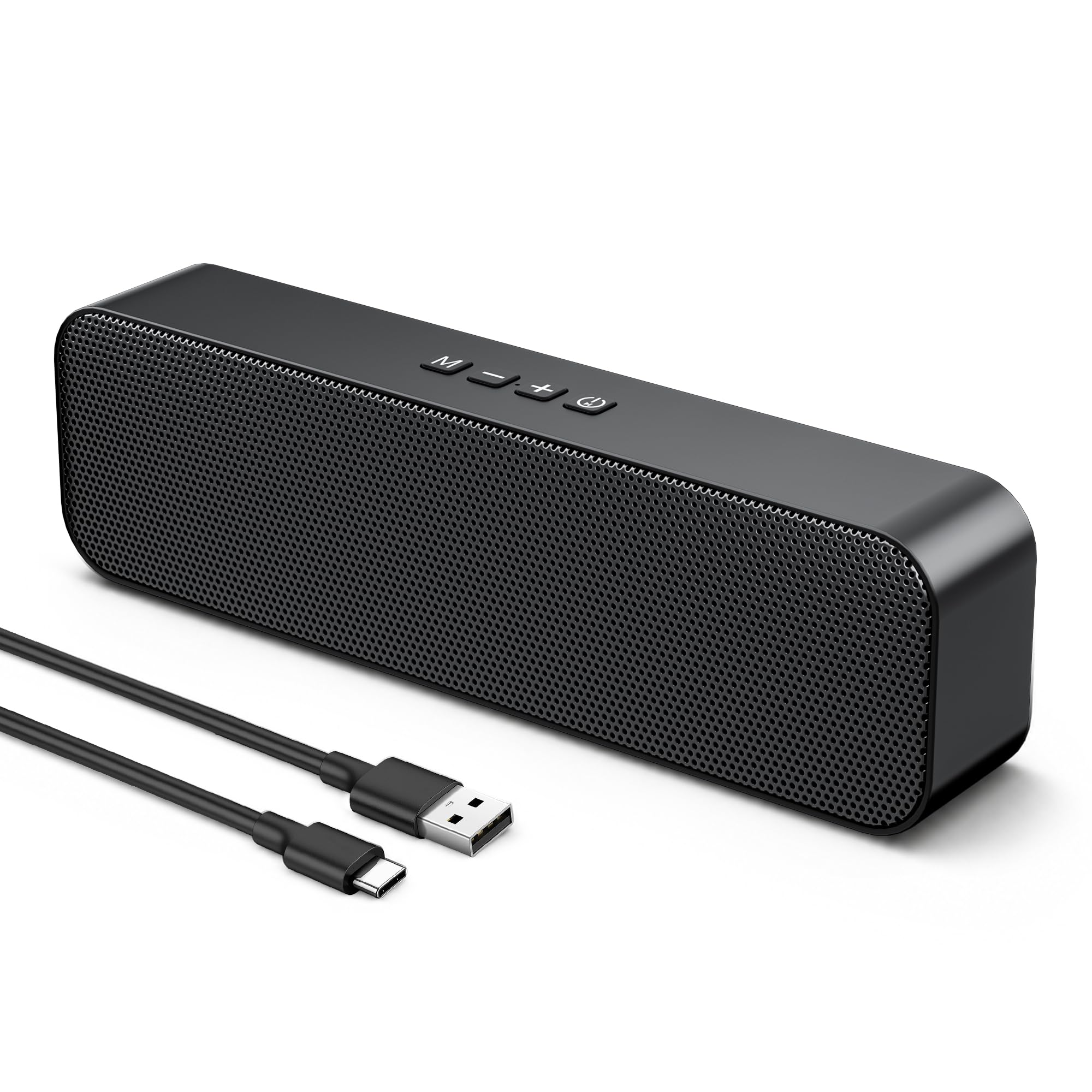
A 10W stereo soundbar slim enough to tuck under any monitor for a clean, modern desk.
At 8.74 x 2.56 x 1.46 inches, this soundbar slips beneath most monitors to boost your desktop space. Two 5W magnetic drivers with a dual-channel interface create an rich stereo field, and the 20 kHz frequency response keeps highs crisp and detailed. Shoppers say excellent clarity from 5 to 20 kHz, with distinct snares and hi-hats that make it a surprising performer for its size.
Flexibility is the core strength. It supports Bluetooth 5.3 for stable wireless, plus 3.5mm AUX and USB/Type-C wired connections, so it works with laptops, tablets, smartphones, PS5, and even projectors. The USB power means it turns on the moment you plug it in — no drivers, no software. That makes it ideal for switching between a desktop, a gaming console, and a phone throughout the day.
The honest limits: bass is weak for music, and AUX mode is quieter and less clear than USB or Bluetooth. One reviewer noted a quirk where the speaker randomly switches input modes, though others report flawless operation. Compared to the Sanyun SW102 2.0 set above, this bar trades a bit of stereo separation for a much more compact, multi-device-friendly form factor.
Versatility win: The triple-input design (BT 5.3, USB, AUX) makes it the most device-agnostic soundbar in this list — one speaker for your PC, phone, and console.
Keep expectations in check: It’s tuned for voice, gaming, and video, not critical music listening.
Grab it if: you need a single under-monitor speaker that switches easily between work, gaming, and phone audio.
pass on it if: bass-heavy music is a priority — the soundbar profile stays on the brighter, lighter side.
6. Sanyun SW208 3″ Active Bluetooth Bookshelf Speakers

The wood-cabinet bookshelf pair that brings genuine HiFi depth to a desktop.
This is the step up from the SW102 for anyone ready to treat audio seriously. Each speaker pushes 30W (60W total) through a carbon fiber driver with multi-layer voice coil technology, delivering warm mids, deep lows, and bright highs. The premium wood cabinet construction looks and feels far more expensive than it is, and the front-facing design creates a wide, reflective soundstage when placed about 4 feet apart.
The 24-bit DAC is the hidden gem. When you connect via USB, the built-in digital-to-analog converter pulls the digital signal directly from your device, reducing conversion loss for cleaner, more accurate playback. You also get Bluetooth 5.0 for wireless streaming and dedicated treble and bass adjustment knobs on the side of the main speaker, so you can tune the sound to your room and taste. A quiet standby mode filters input noise automatically.
Owners praise the value and the clean appearance, but the sound quality gets mixed feedback — some find it rich and balanced, others a touch muddy. Placement matters enormously: flat against a monitor they’re good, but angled on stands they’re excellent. The max volume is also modest, best for desk listening rather than filling a large room. Compared to the 10W SW102, this is the clear upgrade for depth, detail, and tuning control.
Value-first verdict: Value for money is the most-praised aspect by far, with hundreds of owners calling it a steal for the build and sound. Appearance ranks second — that wood cabinet wins people over.
The placement caveat: Sound quality itself earns mixed reviews, with one buyer noting the volume drops sharply if you sit off-axis. Angle them toward your ears for best results.
Buy it if: you want real HiFi sound, adjustable EQ, and a premium wooden look without jumping to a four-figure system.
Look elsewhere if: you need to fill a large room or want thunderous bass — a subwoofer system serves that better.
7. Bluedee 2.1 Computer Speakers with Subwoofer
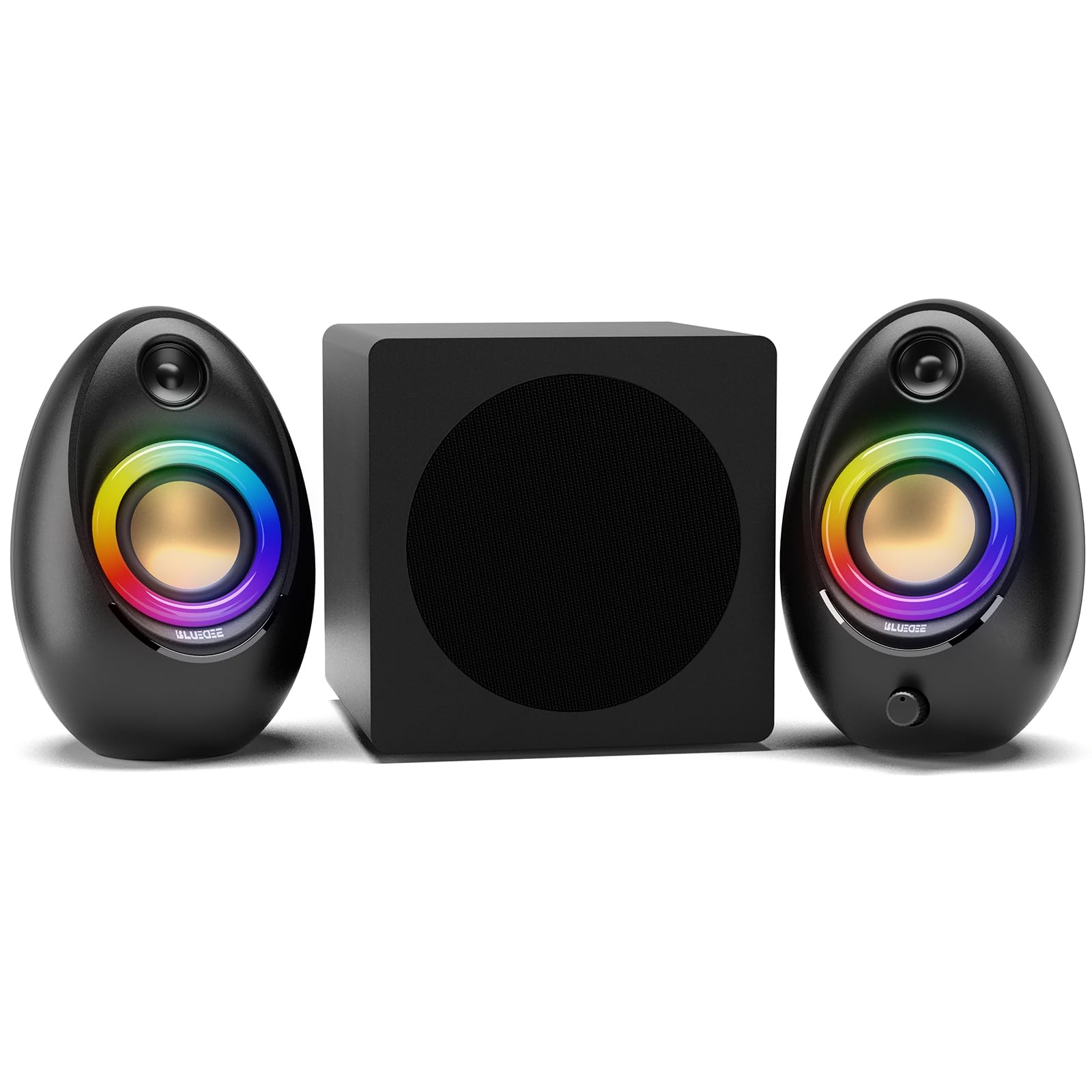
The 2.1 setup with a dedicated subwoofer that brings genuine rumble to a small desk.
If bass is your non-negotiable, this is the compact answer. The 80W peak power splits between two satellites and a dedicated subwoofer, keeping low frequencies out of the main drivers so vocals stay clear while the bass punches. DSP tuning smooths harsh highs, and buyers report “deep, punchy bass without muddy sound” — a combination that’s rare at this size.
The control scheme is refreshingly simple. One all-in-one knob handles volume, play/pause, lighting effects, and mode switching, so you never hunt for buttons. Bluetooth 5.4 covers wireless, while USB, USB-C, and 3.5mm AUX handle wired connections from any desktop, laptop, or console. The desk-friendly RGB lighting switches between dynamic colors and a soft static glow depending on your mood.
The trade-off at high volume: owners note distortion creeps in when you really push it on bass-heavy tracks, and the egg-shaped satellites can roll around if bumped. Compared to the Sanyun SW208 bookshelf pair above, this one trades some audiophile refinement for a far more visceral, movie-and-gaming-friendly low end.
The wins owners highlight
- Sound quality is the standout — the most-praised aspect, with buyers calling it a total upgrade for music and gaming
- RGB lighting ranks second, with owners loving the customizable glow
- Clear highs and balanced mids keep vocals intelligible even with the subwoofer thumping
The honest catches
- High-volume playback distorts on bass-heavy tracks — keep it below max
- The satellite speakers’ round shape means they roll if nudged
Reach for it if: movies and games demand real low-end rumble and you want a complete 2.1 system without a huge footprint.
Consider alternatives if: your listening is all subtle acoustic music — the subwoofer bias becomes noticeable.
8. Audioengine A1 Wireless Computer Speakers

The hand-built wooden pair that delivers room-filling clarity from a genuinely small cabinet.
Audioengine’s A1 proves that “compact” and “room-filling” aren’t opposites. This pair delivers a desktop-shaking 60 watts of clean audio through custom hand-built wood cabinets, tuned by musicians for that signature warmth. The 6-centimeter drivers produce surprising bass for their size — One owner reported hearing it “through the wall” from a bedside setup. Clarity is the headline: clear vocals and crisp detail that make both music and dialogue shine.
Wireless is handled by Bluetooth APTX, with a stated range up to 100 feet — plenty to roam your room while music plays. For wired purists, RCA and AUX inputs provide a lossless path, and the speaker supports 32-bit/192kHz audio through your sound card settings if you want to go deep into hi-res territory. The compact size is the second-most-praised feature, with owners calling it the ideal tiny speaker for a desk or bedside table.
The premium price brings premium expectations, and the value judgment splits buyers. Some call it worth every dollar; others feel it doesn’t justify the cost. Bluetooth can drop out on older laptops (a BT 5.0 adapter fixes it), and there’s no optical input. Compared to the Bluedee 2.1 system above, the A1 trades the subwoofer thump for a far more refined, balanced, and natural sound signature.
The audiophile take: Sound quality dominates the praise — it’s the most-mentioned aspect by a wide margin. Compact size and appearance round out the top three.
The honest friction: Value for money earns mixed feedback, and the grey finish lacks speaker grills, leaving the drivers exposed. Some owners mention Bluetooth quirks on older hardware.
Choose this if: you want premium, musician-tuned sound in a compact pair that genuinely fills your workspace — and you’re willing to pay for it.
it’s not for you if: your budget is tighter, or you need multiple wired inputs like optical or HDMI.
9. Edifier M90 Computer Speakers
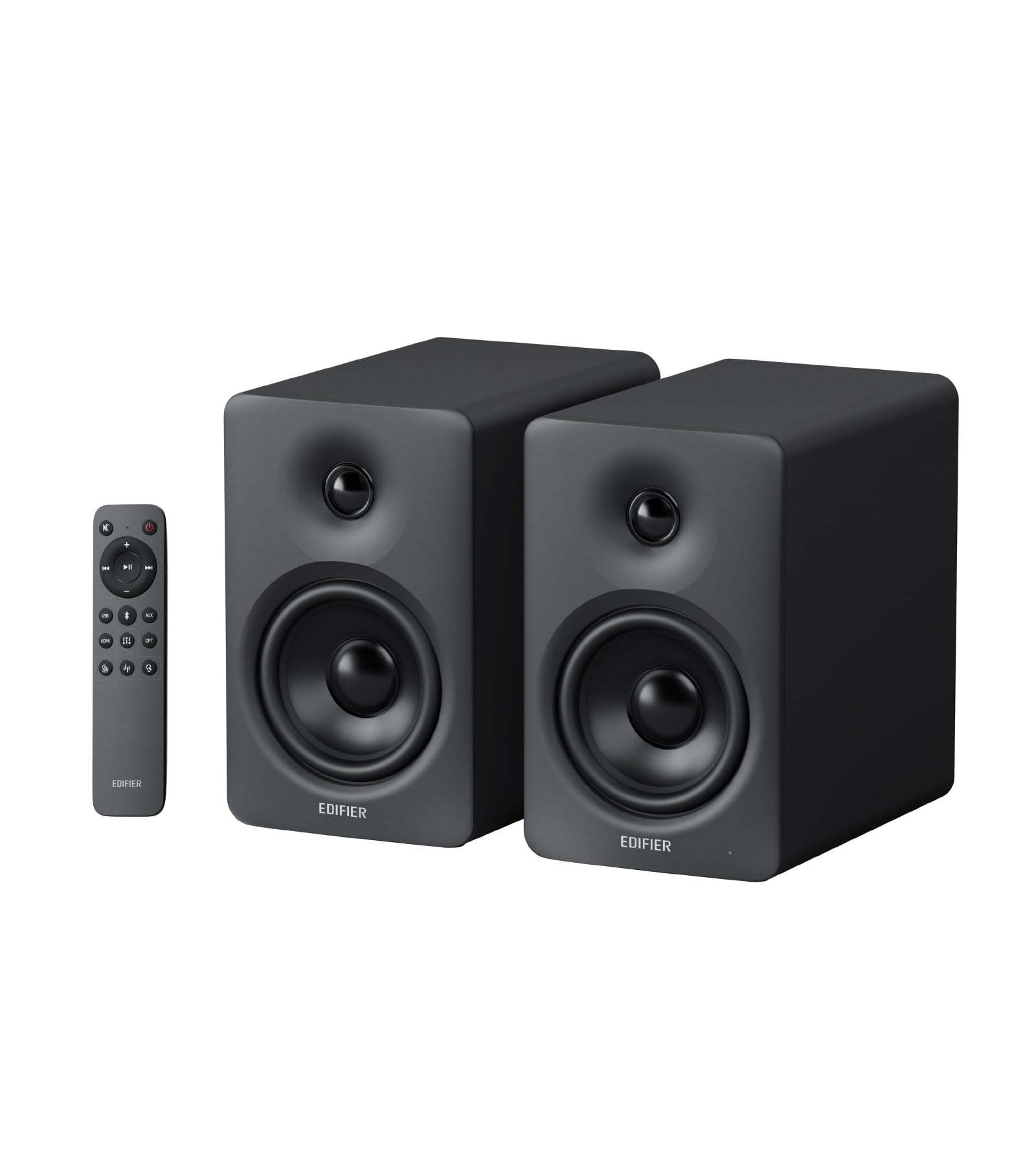
The 100W desktop hub that replaces a soundbar, a DAC, and a remote in one compact package.
This is the endgame for compact desktop audio. A full 100W RMS flows through dual Class-D amplifiers into a 4-inch aluminum driver and a 1-inch silk dome tweeter, delivering clean, controlled bass and detailed highs. Customers note it “beats a Samsung 3.1 soundbar for desktop” use — high praise from a speaker that takes up a fraction of the space. The bass is notably clean and controlled, even before you add the dedicated subwoofer.
The connectivity is class-leading in this list. HDMI eARC (a channel that lets your TV remote control the speaker volume) works with your TV remote, while Optical, AUX, and USB-C inputs handle every other device you own. Bluetooth 6.0 with the high-resolution LDAC codec (a wireless audio format for high-quality sound) streams Hi-Res audio from compatible Android devices, and a SUB OUT port lets you add a powered subwoofer to transform it into a 2.1 system. A 2.4GHz remote plus the Edifier ConneX app gives you full EQ control and sound presets.
The trade-offs are size and weight: at 8 kg (about 17.6 lbs), this is a hefty speaker that demands a sturdy desk, and the 15.62-inch depth means it’s the largest “compact” option here. Owners note it’s best for desk use; using it as a standalone TV speaker without a sub leaves the low end lacking for a living room. The EQ customization also requires a Bluetooth connection to tweak. Compared to the Audioengine A1 above, the M90 offers far more connectivity and power but demands more physical space.
The performance verdict: Sound quality is the overwhelming top praise, followed by value for money. The combination of a 4-inch aluminum driver and silk dome tweeter explains the detail — it’s the most technically advanced speaker here.
Who it suits: Power users who want one speaker to rule a PC, TV, streaming stick, and record player, with room to grow into a 2.1 setup.
Invest here if: you want flagship-class sound, every connection imaginable, and remote/app control in a single desktop speaker.
Think smaller if: your desk is tight — at 8 kg and over 15 inches deep, it’s the bulkiest pick in this roundup.
Understanding the Specs
Power output (watts)
Watts measure how loud a speaker can get before distortion. A 5W bar is perfect for voice calls at close range, while 10W to 20W handles music in a small room. Anything above 60W starts to genuinely fill a larger space. Match the wattage to your room size and listening habits — you don’t need 100W for a cramped dorm desk.
Passive radiators
A passive radiator is a non-powered driver that vibrates along with the main speaker to push more air and create bass. It’s how compact speakers like the Sanyun SW102 (tested to 115Hz) produce low-end rumble without needing a bulky subwoofer. If you see this feature, it means the manufacturer engineered around the size limit to preserve bass depth.
Bluetooth versions
Bluetooth 5.0 and newer offer better range, stability, and battery efficiency than older versions. The KASOHQEE and Bluedee use Bluetooth 5.3 and 5.4 respectively, while the Edifier M90 leaps to Bluetooth 6.0 with LDAC support for high-resolution streaming. When you prioritize wireless, pick the newest version you can afford — the gap between 5.0 and 5.3 is noticeable in connection stability.
Connectivity inputs
The inputs determine what devices you can plug in. USB handles power and audio in one cable on many models. AUX (3.5mm) is the universal analog fallback. HDMI eARC, Optical, and RCA open up TVs and higher-end audio gear. A speaker with more inputs is more future-proof — you won’t need a new speaker when you upgrade your computer or add a console.
FAQ
Will compact speakers fit under a standard monitor?
Do USB-powered speakers need a separate power outlet?
Can I connect Bluetooth speakers to a desktop PC that lacks Bluetooth?
What is the difference between 2.0 and 2.1 speaker systems?
How long do compact computer speakers last?
Is there a noticeable difference between 5W and 100W speakers on a desk?
Does monitor thickness affect which speaker bar I can buy?
Are compact speakers with RGB lighting worth it for listening?
Can I add a subwoofer to compact speakers later?
Final Thoughts: The Verdict
If you want one dependable pick, the best compact computer speakers winner is the Cyber Acoustics CA-2890BT because it combines true plug-and-play USB setup, a built-in speakerphone, and a space-saving monitor clip in one easy package. If you want stereo separation and visual flair, grab the Creative Pebble SE. And for bass-heavy gaming and movies, the Bluedee 2.1 system is the one to reach for. The common thread across every pick is honest value — each one earns its place with real, repeatable sound quality rather than marketing hype.
How We Picked
We do not accept paid placement. Every pick is matched to a real buyer and a real use-case; we do not hands-on test units.
Sources & Methodology
Specifications: manufacturer listings and product documentation. Review insights: verified customer reviews, as of August 2026. Pricing: not shown on this page (it changes often); check the current price via the retailer link.
As an Amazon Associate, FitlyFast earns from qualifying purchases. This does not affect which products we feature.