
Lithium iron phosphate (LiFePO4) chemistry has changed the game for RV, marine, and off-grid power. A single 12V 100Ah lithium battery weighs roughly 20–23 pounds compared to a 60-pound lead acid battery, delivers up to 15,000 deep cycles, and holds consistent voltage until the very end of the discharge curve. The right battery will save you space, weight, and constant replacements — the wrong one can leave you stranded with a BMS that won’t wake up after a cold snap.
I’m Rikta — the co-founder and writer behind FitlyFast. I’ve analyzed dozens of LiFePO4 battery datasheets and cross-referenced cycle-life claims with real-world user data for deep-cycle applications in solar arrays, trolling motors, and camper van builds.
To help you cut through the noise, I’ve reviewed nine of the current market leaders to find the best 12v 100ah lithium battery that balances cycle life, BMS protection, physical footprint, and real-world reliability for your specific setup.
How To Choose The Best 12V 100Ah Lithium Battery
A 12V 100Ah battery stores 1.28 kWh of energy. That sounds simple, but the differences in cell quality, BMS programming, and physical dimensions make the gap between a battery that fits your battery box and lasts a decade and one that causes a parasitic draw headache in the first year. These are the three specs I check first.
BMS Specifications and Low-Temperature Protection
The Battery Management System is the battery’s brain. A robust BMS protects against overcharge, deep discharge, overcurrent, short circuit, and temperature extremes. The most critical feature for a lithium battery used in an RV or boat is low-temperature cut-off: a quality BMS will stop the battery from charging below 32°F to prevent permanent cell damage. Without this, a single freezing night with a solar panel connected can ruin the battery. Also verify the BMS current rating — 100A is standard for a 100Ah cell, but stronger BMS units at 150A handle higher surge loads.
Cell Grade and Construction
The cells inside the battery case determine cycle life and safety. Grade A prismatic LiFePO4 cells from manufacturers like CATL or EVE have tight voltage matching and minimal internal resistance. Cheaper Grade B cells may self-discharge unevenly, causing early BMS cell-balancing failures. Look for specifications that explicitly state “Grade A” or “EV grade” cells and a cycle life of 4000+ cycles at 100% depth of discharge. A battery that works at 80% DOD will last longer per cycle but deliver less usable capacity daily.
Physical Fit and Expandability
Not all 12V 100Ah lithium batteries share the same footprint. Group 31 batteries measure roughly 13 x 6.8 x 8.4 inches, while compact Group 24 or “mini” sizes come as small as 9 x 5.4 x 8.2 inches. Always measure your battery tray before buying. If you plan to expand your bank later, verify that the battery supports both series (for 24V or 48V systems) and parallel connections, and check the maximum number of units the BMS can handle in one bank.
Quick Comparison
On smaller screens, swipe sideways to see the full table.
| Model | Category | Best For | Key Spec | Amazon |
|---|---|---|---|---|
| Battle Born 12V 100Ah | Premium | Zero-maintenance mobile power | 3000-5000 cycles at 100% DOD | Amazon |
| Renogy Core Mini 100Ah | Premium | Tight-space installs (Group 22NF) | Mini size 9.0 x 5.4 x 8.4 in | Amazon |
| Litime TM 100Ah Group 31 | Premium | Trolling motor with TVS protection | 22.16 lbs, ABYC E-13 compliant | Amazon |
| Power Queen 12.8V 100Ah | Mid-range | Marine and trolling motor builds | TVS surge protector, 40 milliohms | Amazon |
| OKMO 12V 100Ah (2-Pack) | Mid-range | Multi-battery bank builds | 23.15 lbs per unit, 100A BMS | Amazon |
| Redodo 12V 100Ah LiFePO4 | Mid-range | Solar and home backup systems | 4000 cycles at 100% DOD | Amazon |
| VATRER POWER Group 24 | Mid-range | Fast charging with 150A BMS | 150A BMS, 23.48 lbs | Amazon |
| WattCycle 12V 100Ah Mini BT | Mid-range | Bluetooth monitoring on a budget | 20.94 lbs, 9 x 5.4 x 8.2 in | Amazon |
| WEIZE 12V 100Ah Mini | Budget | Entry-level lithium for fish finders | 63.7 lbs (lead calcium) | Amazon |
In‑Depth Reviews
1. Battle Born 12V 100Ah LiFePO4
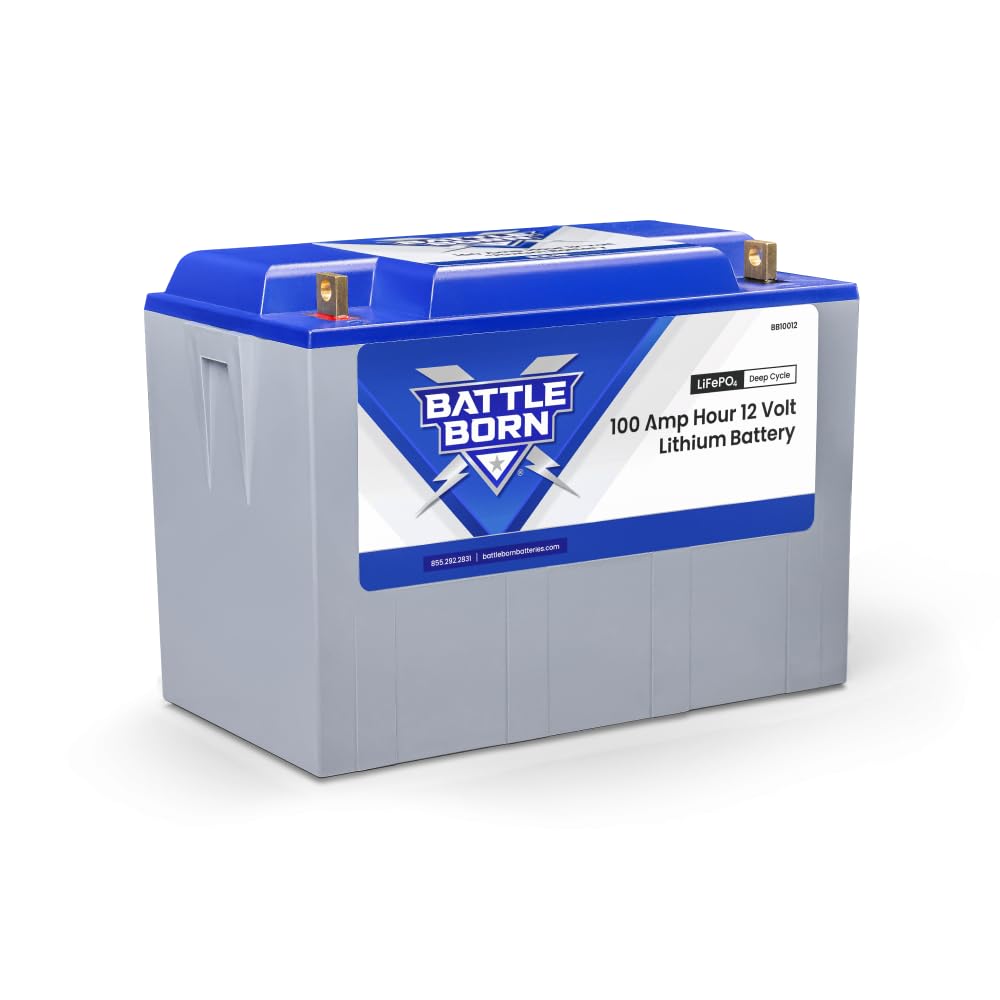
Battle Born is the reference standard for drop-in lithium in the RV and van conversion space. At 31 pounds, it is heavier than most of the other 100Ah lithium batteries on this list, but the rugged internal BMS with low-temperature protection, high/low voltage cut-off, and short circuit protection delivers the peace of mind needed for full-time living. The LiFePO4 chemistry supports 3000 to 5000 full discharge cycles — a realistic 10 to 15-year service life under daily use.
The side-post flag terminals fit standard US battery cables without adapter brackets, and the battery can be wired in series or parallel up to a 4S4P configuration. Its self-discharge rate is roughly 2 to 3 percent per month, so it can sit on a shelf for an entire off-season without needing a trickle charge. All of this comes with the highest cost on this list, but the warranty support and US-based customer service have consistently positive reports.
For anyone building a high-use RV solar bank or a marine system where battery failure means a ruined trip, Battle Born justifies its premium BMS integration and real-world cycle life. It is also the safest choice if you plan to mount the battery in a hard-to-reach compartment where you cannot check state of charge weekly.
Why it’s great
- 3000-5000 cycle life at 100% DOD
- Built-in low-temp cut-off prevents charging damage
- Excellent post-sale customer support
Good to know
- Heaviest option at 31 lbs
- Highest upfront cost
- Flag terminals may not fit all aftermarket connectors
2. Renogy 12V 100Ah Core Mini
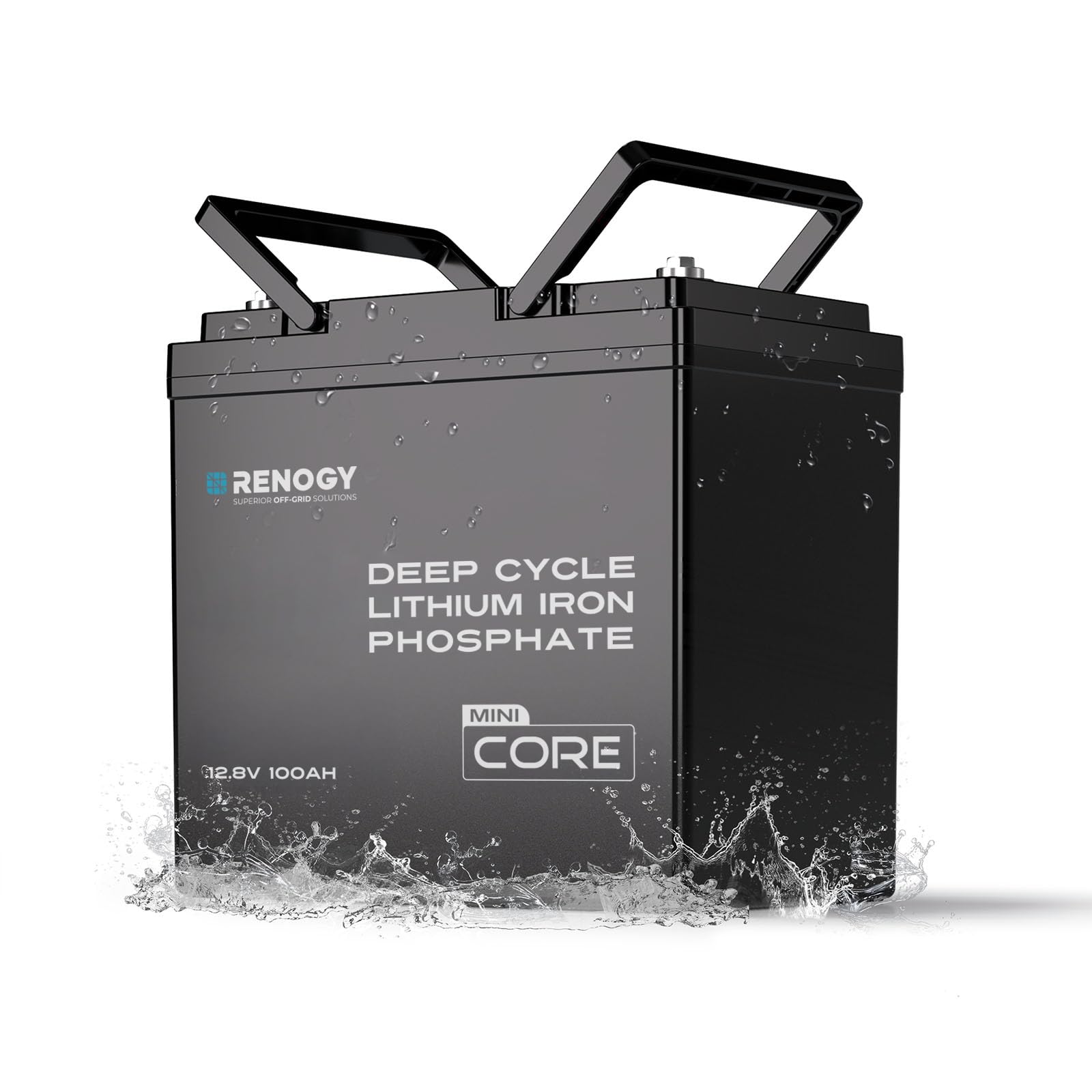
Renogy’s Core Mini series is built for spaces that cannot fit a standard Group 31 battery. It measures just 9.02 x 5.43 x 8.39 inches, matching a Group 22NF footprint, so you can install it sideways in a teardrop trailer tray or under a boat console. The case carries an IP65 rating, meaning it resists water splashes and dust ingress — a rare spec for a lithium battery at this price tier.
The 100A BMS protects against low-temperature charging, overvoltage, overcurrent, and short circuits. Integrated metallic cell spacers keep the prismatic LiFePO4 cells locked in place during vibration on rough roads or choppy water. Optional remote monitoring requires a Renogy 300A Battery Shunt and the DC Home app — a nice add-on if you are already in the Renogy ecosystem with a charge controller and inverter.
At 22.7 pounds, it is among the lightest 100Ah batteries tested. The trade-off for the mini size is a slightly reduced maximum discharge current compared to some Group 31 models, but for powering a 12V fridge, lights, and a small inverter (1000W or less), it handles the load without issue. This is the best pick for a camper van with a pre-built cavity that can only accept a short battery.
Why it’s great
- Smallest footprint in the comparison (Group 22NF)
- IP65 dust and water resistance
- Optional Bluetooth monitoring with Renogy shunt
Good to know
- Discharge current may limit high-draw inverters
- Monitoring requires separate shunt
- Less energy density than full-size competitors
3. Litime 12V 100Ah TM Group 31

Litime’s TM (Trolling Motor) series passes the ABYC E-13 marine standard, which means the BMS has triple protection against dust, water, and salt spray. That certification alone makes it the strongest candidate for a saltwater boat where corrosion can kill a standard lithium pack within a season. The built-in TVS surge protector absorbs voltage spikes from electric trolling motors and outboard charging systems, keeping the BMS alive during gusty conditions.
At 22.16 pounds, it is 64 percent lighter than a 63-pound lead acid battery — the weight savings on a small bass boat or jonboat measurably improve hole shot and planing time. Low-temperature protection stops charging below 32°F and stops discharging below -4°F. This is critical for anglers who leave the boat in a cold garage. Cycle life is rated at 4000+ cycles at 100% DOD, which matches the mid-range class perfectly.
The standard Group 31 form factor fits most existing battery trays, making it a literal drop-in replacement for AGM batteries. A 5-year warranty sweetens the deal. If you run a Minn Kota, Newport, or MotorGuide trolling motor and want a battery that handles vibration and voltage spikes without complaint, Litime TM is the sensible mid-range pick.
Why it’s great
- ABYC E-13 marine compliance
- TVS surge protection for trolling motors
- 64% lighter than equivalent lead acid
Good to know
- No built-in Bluetooth monitoring
- Group 31 size may not fit small trays
- Alternator charging needs DC-DC converter for optimal safety
4. Power Queen 12.8V 100Ah
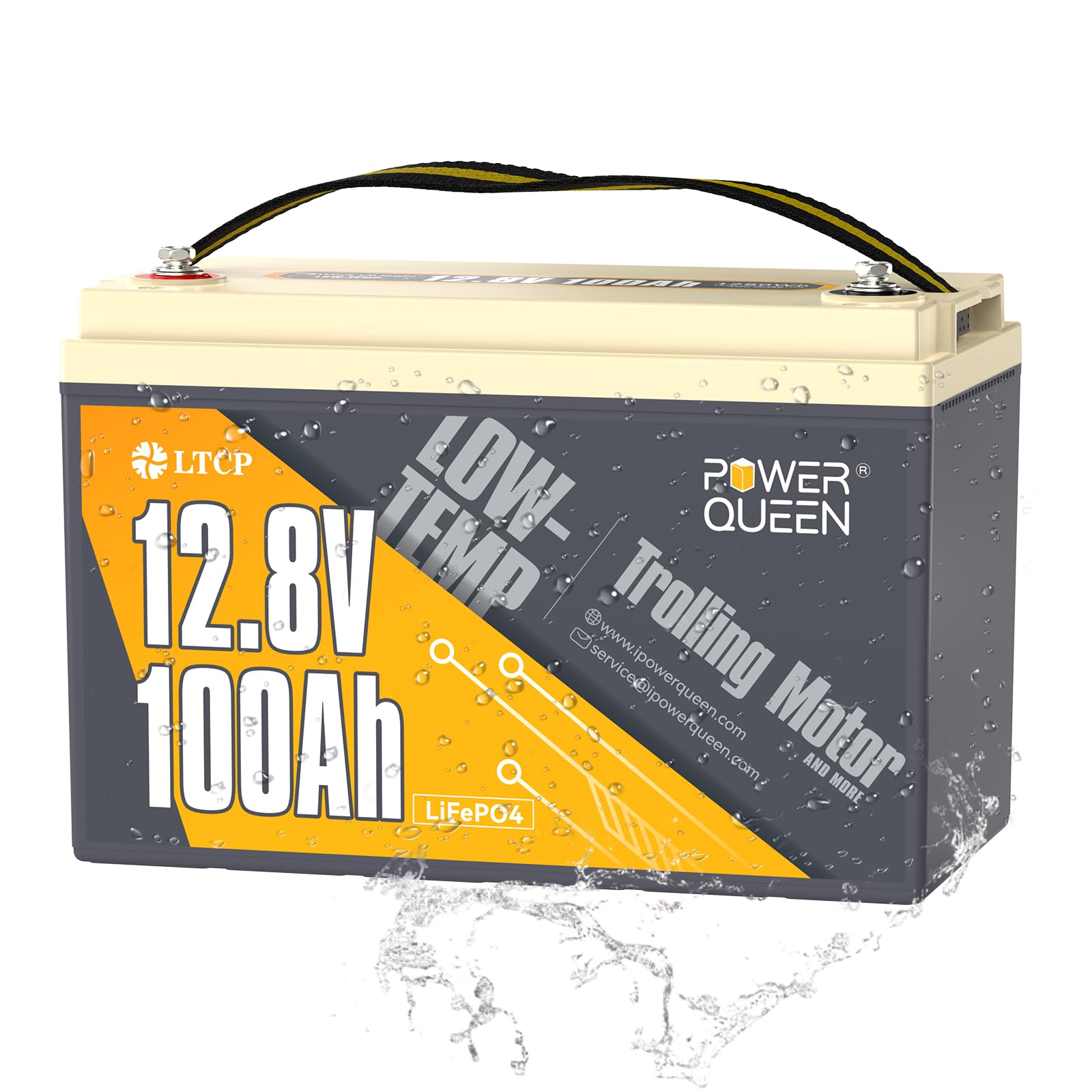
Power Queen configures this battery specifically for trolling motors up to 120lb thrust, which is higher than most 100Ah batteries specify. The secret is the TVS surge protector embedded in the BMS, which clamps voltage transients before they reach sensitive motor electronics. It also meets ABYC E-13 marine safety requirements, so the BMS is sealed against dust, water spray, and salt corrosion.
The battery weighs just 22 pounds in a standard Group 31 package. Low-temperature protection stops charging below 32°F and stops discharging below -4°F. Cycle life is rated at 4000+ cycles at 100% DOD, and the unit supports expansion up to 4P4S (51.2V 400Ah). The internal resistance spec is a tight 40 milliohms, meaning less energy wasted as heat during high-discharge pulls from a trolling motor.
Users report running trim tabs, fish finders, and live wells off this battery for full day trips without dropping below 12.0V. The flat voltage curve of LiFePO4 means your trolling motor runs at full speed until the battery is genuinely empty — no gradual slowdown like with lead acid. For a dedicated marine battery that costs significantly less than Battle Born, Power Queen delivers trustworthy specs.
Why it’s great
- TVS surge protection for 120lb trolling motors
- ABYC E-13 marine safety compliance
- Low 40 milliohm internal resistance
Good to know
- No Bluetooth or remote monitoring
- Group 31 size may require tray adapter
- Alternator charging must go through a DC-DC charger
5. OKMO 12V 100Ah (2-Pack)
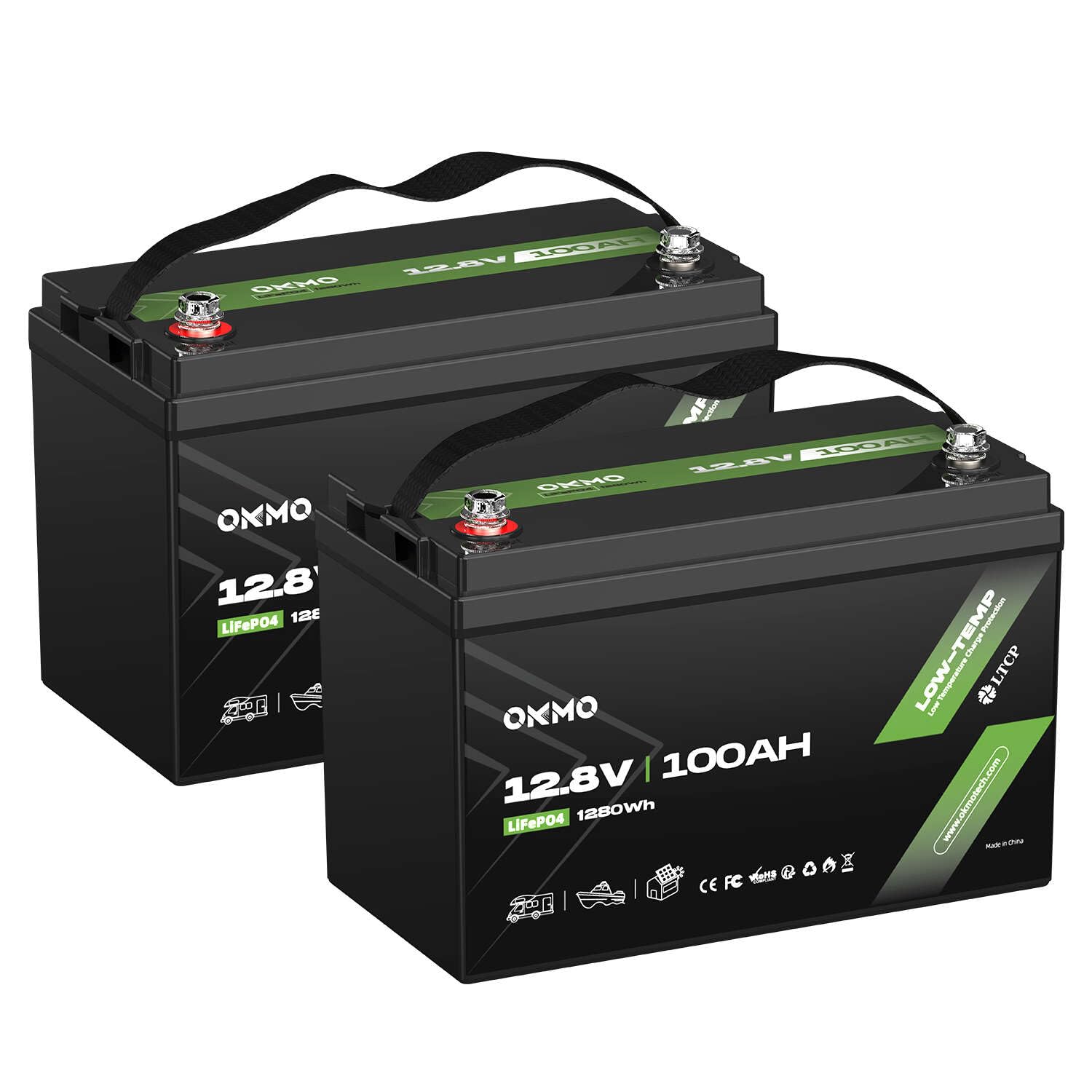
OKMO sells its 100Ah lithium battery as a 2-pack, which simplifies the purchasing process for anyone planning a 24V system or a 200Ah 12V bank from the start. Each battery weighs 23.15 pounds — heavier than the Renogy Mini but still 60 percent lighter than the equivalent lead acid capacity. The built-in 100A BMS covers overcharge, deep discharge, overcurrent, and short circuit scenarios, plus a low-temperature cut-off that stops charging below 32°F.
The Grade A LiFePO4 cells inside support 4000 to 15000 cycles depending on DOD (lower DOD equals more cycles). The battery can be expanded to 4S4P for a 51.2V 400Ah bank. The case features a standard M8 bolt terminal, so there is no need for special adapters to connect bus bars. Multiple users report these batteries working well in series for 24V electric outboard motors and parallel for diesel heater setups in small campers.
The value proposition here is clear: you get two matched batteries in one order, which avoids the problem of buying two separate batteries at different times that may have slightly different internal resistance. Just be aware that the square case and compact footprint may not fit all Group 31 battery boxes without shimming.
Why it’s great
- Convenient 2-pack for bank builds
- Grade A LiFePO4 cells with 10-year lifespan
- Low-temperature cut-off protection
Good to know
- Some units arrive in sleep mode; needs initial charge
- Customer reports of DOA units requiring warranty swap
- No app monitoring available
6. Redodo 12V 100Ah LiFePO4
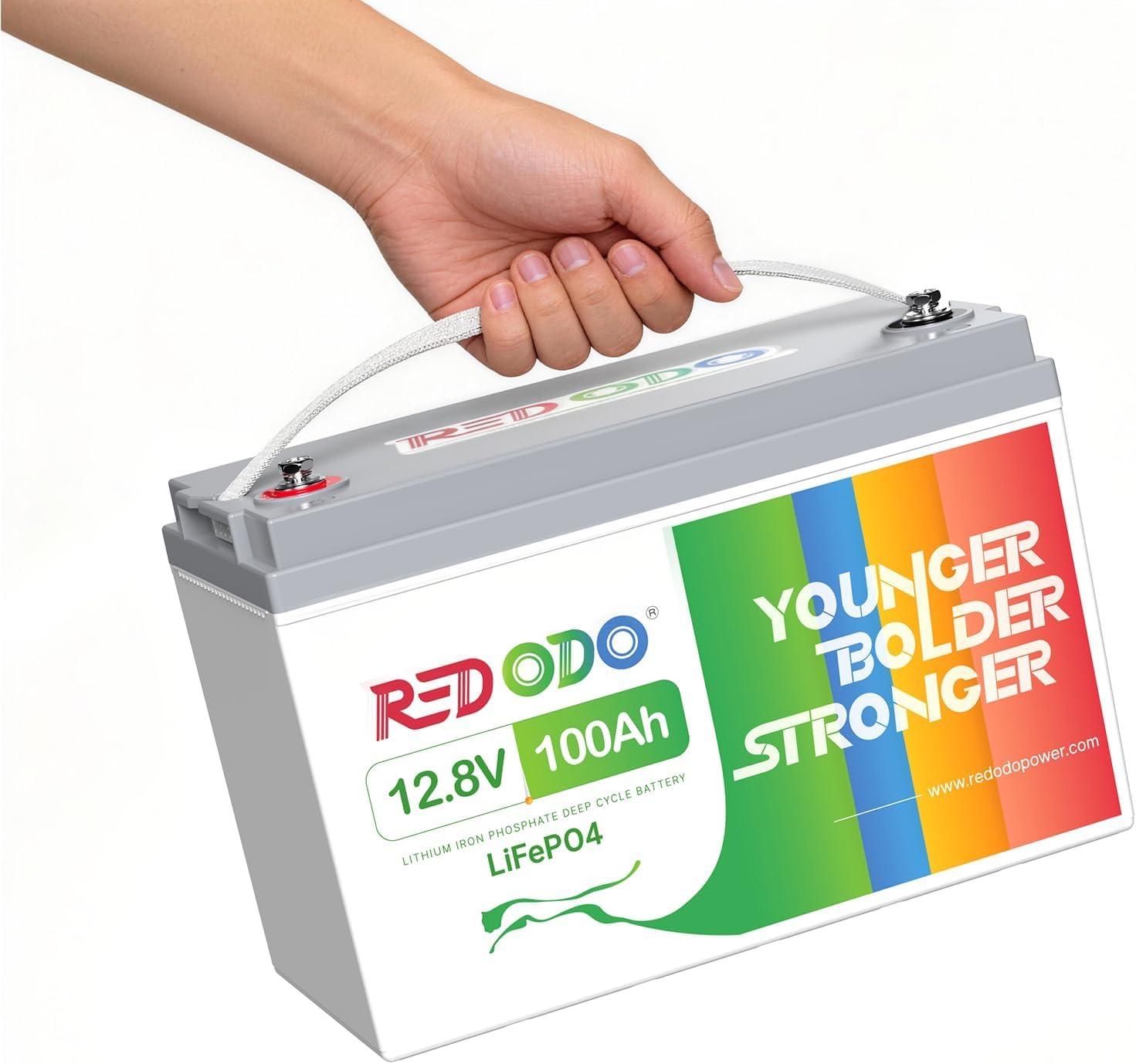
Redodo positions its 12V 100Ah LiFePO4 battery squarely at solar and home backup users. With a Group 31 form factor measuring 13 x 6.77 x 8.43 inches and weighing 22.04 pounds, it fits standard battery trays and leaves room for a second unit side-by-side. The built-in 100A BMS covers overcharge, over-discharge, overcurrent, and high-temperature protection — well-matched to a 200W to 400W solar array with a 30A to 40A charge controller.
The battery uses automotive-grade LiFePO4 cells that maintain a low 3 percent self-discharge rate per month. The cycle life rating starts at 4000 cycles at 100% DOD and climbs to 15000 cycles at 60% DOD. For a home backup system that cycles daily, this translates to 10+ years of use before capacity drops below 80%. The battery supports 4S series and 4P parallel connections for expansion up to 48V 400Ah.
Real-world feedback from the pool cleaning industry is telling: users who switched from lead-acid batteries in robotic pool cleaners report zero voltage sag throughout the entire workday, which translates to consistent suction and no midday battery swaps. The same story holds true for electric mower conversions. If you need a mid-range lithium battery that performs reliably in solar and light commercial applications, Redodo delivers consistent value.
Why it’s great
- Very low self-discharge rate (3% per month)
- Works with 14.6V LiFePO4 chargers and solar
- Good customer support for configuration help
Good to know
- No low-temperature charging protection on some batches
- No Bluetooth monitoring
- Not for engine starting or golf cart use
7. VATRER POWER Group 24
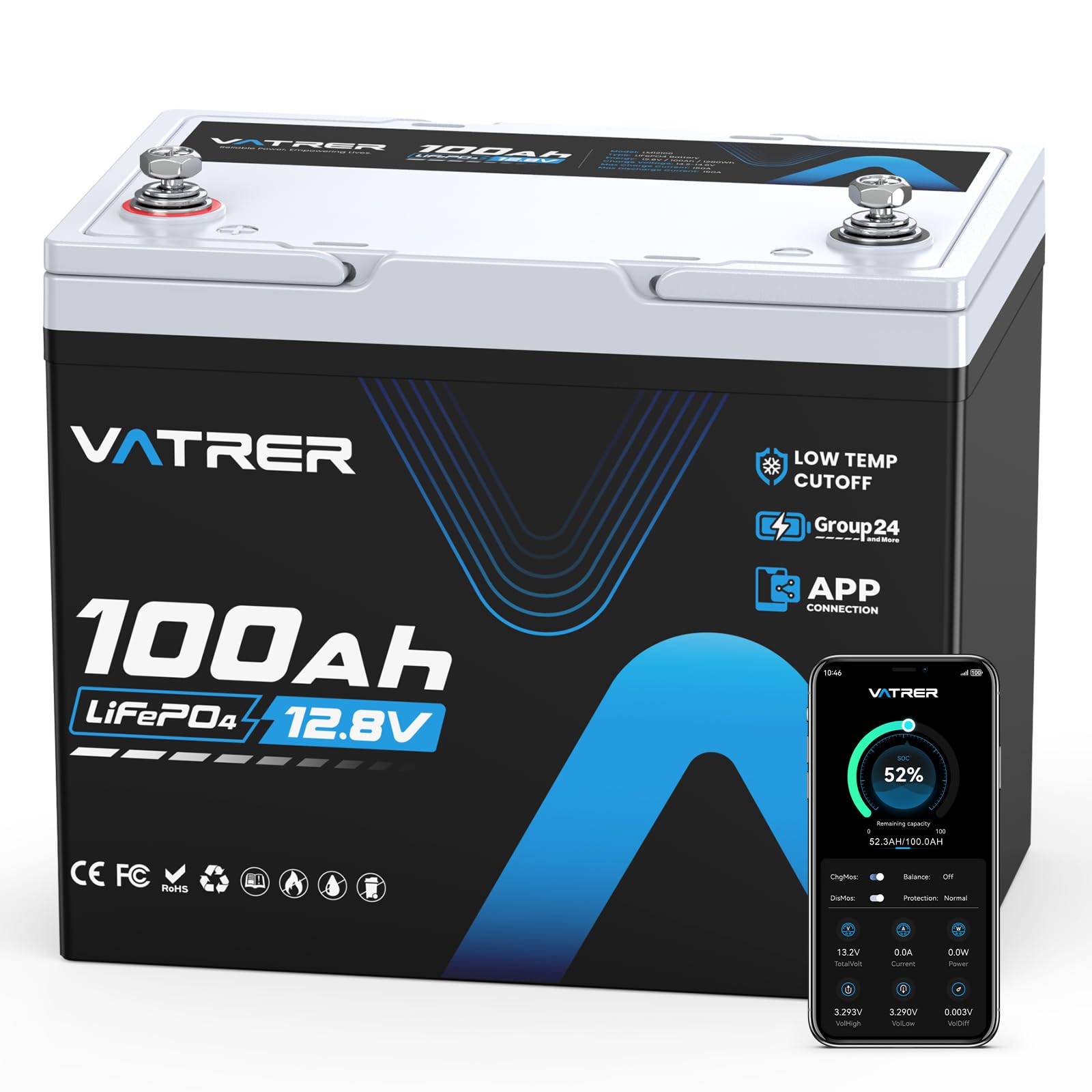
VATRER POWER stands out with a 150A BMS, which is 50% stronger than the standard 100A BMS found on most 100Ah lithium batteries. This higher BMS rating means the battery can sustain bigger loads — running a 2000W inverter or starting a high-torque trolling motor without the BMS tripping into protection mode. It also supports faster charging: the spec sheet states a full charge in about 2 hours using a 600W MPPT solar panel, which is six times faster than a lead acid battery of the same capacity.
The battery operates between -4°F and 140°F. High-temperature cut-off stops charging at 167°F to prevent thermal damage — a legitimate safety feature for battery compartments that heat up in summer. At 23.48 pounds and a Group 24 footprint (10.24 x 6.61 x 8.35 inches), it is physically smaller than Group 31 batteries, making it easier to fit two units side-by-side in a typical RV battery tray.
Users report reliable performance running 1kW inverters for camping trips and pairing two in parallel for 200Ah capacity on a trolling motor. The integrated handle makes carrying easier than the smooth-case alternatives. For buyers who plan to run a moderately sized inverter for coffee makers or power tools on the go, the 150A BMS is the standout feature here.
Why it’s great
- 150A BMS handles larger inverter loads
- Compact Group 24 size
- High-temperature cut-off for safety
Good to know
- No built-in Bluetooth
- Cannot be used as a starter battery
- Warranty contact via official website only
8. WattCycle 12V 100Ah Mini BT
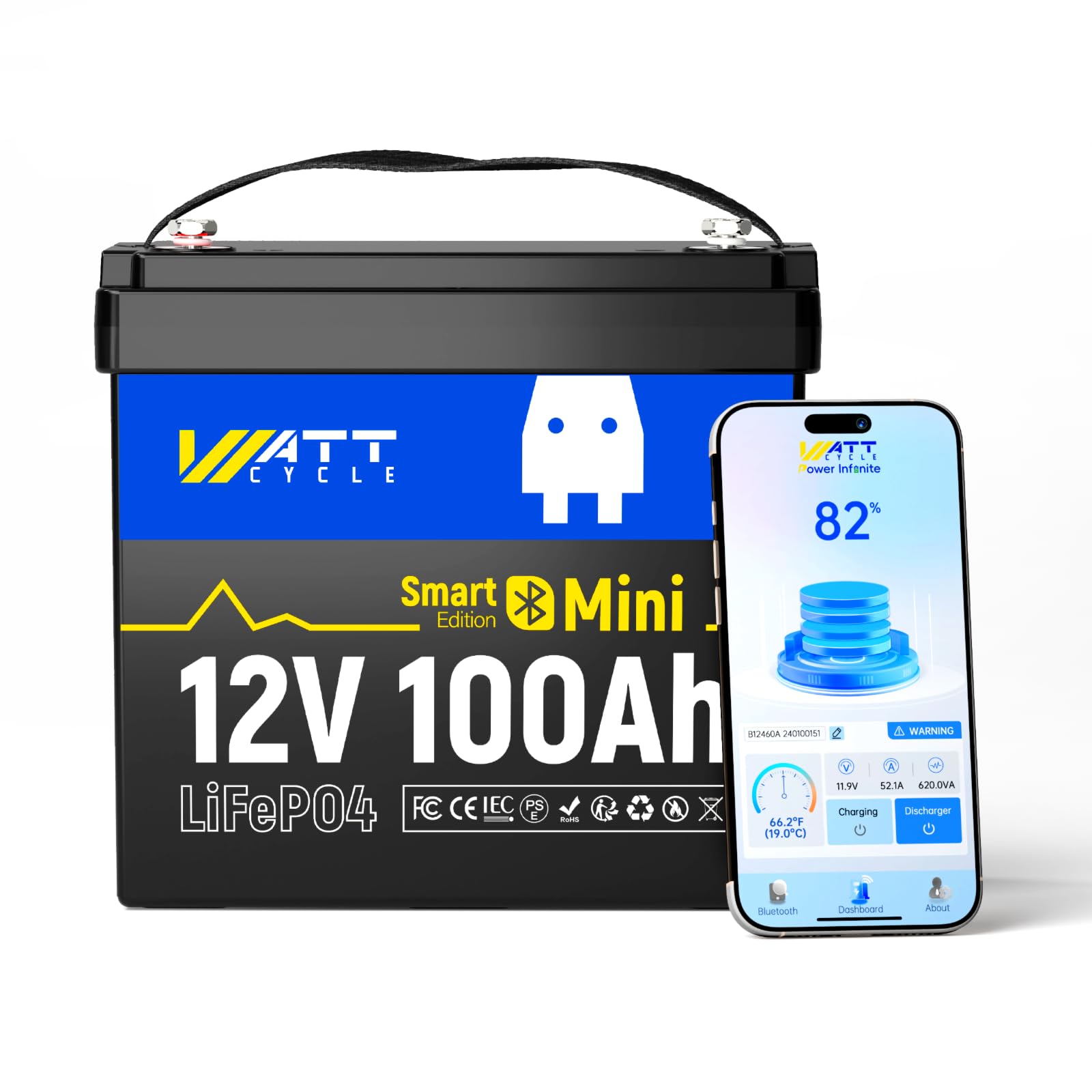
WattCycle’s Mini BT claims the smallest physical footprint at 9.02 x 5.43 x 8.19 inches and the lightest weight in this comparison at just 20.94 pounds. The big selling point is integrated Bluetooth: after downloading the WattCycle app, you can monitor voltage, charging/discharging current, temperature, and alarm prompts in real time. That is useful for tracking state of charge without needing a separate battery monitor shunt.
The battery uses Grade A+ EV cells with a claimed 15000 cycles (at shallow DOD) and a 10-year lifespan. The 100A BMS protects against overcharge, deep discharge, overload, overheating, low temperatures, and short circuits. The low-temperature protection automatically shuts off charging below 32°F — a critical feature for winter camping or cold garages. The battery supports 4S4P expansion for a maximum bank of 20.48 kWh.
There are some reliability concerns with the BMS in extreme cold conditions — a few users reported BMS failure after freezing exposure, though the warranty support resolved the issue within a month. The Bluetooth app has had stability problems after firmware updates, but the hardware itself generally works well. For a budget-conscious buyer who wants app-based monitoring in a small package, WattCycle is a capable entry point.
Why it’s great
- Lightest and most compact 100Ah battery tested
- Bluetooth monitoring via mobile app
- Grade A+ cells with 15000 cycle life potential
Good to know
- Bluetooth app has had stability issues
- BMS reliability concerns in sub-freezing conditions
- Warranty replacement can take up to a month
9. WEIZE 12V 100Ah Mini

WEIZE sells this unit as a “mini” 12V 100Ah battery, but it is important to know the chemistry: this is a lead calcium gel battery, not a LiFePO4 lithium battery. At 63.7 pounds, it weighs three times as much as a modern lithium alternative of the same capacity, and the cycle life is roughly 200 to 500 cycles — a fraction of what lithium delivers. It includes a 100A BMS, which is unusual for a lead-based chemistry, providing overcharge and short circuit protection.
The dimensions (10.24 x 6.61 x 8.27 inches) make it physically compact for a lead acid battery, fitting in many Group 24 trays. Users report good results running fish finders and electronics on small fishing boats, keeping the starting battery isolated. The gel electrolyte handles vibration better than flooded lead acid and is less prone to thermal runaway. A 15-year standby life under optimal float conditions is claimed, though deep cycling will drastically shorten that.
For a buyer on a tight budget who only needs a 100Ah battery for light accessory loads (LED lights, a fish finder, a small radio) and does not plan to cycle it deeply every day, this WEIZE gel battery works as an interim solution. But anyone planning to run a trolling motor, an inverter, or solar charging should redirect their budget to a true LiFePO4 battery — the cycle life math makes lithium cheaper per cycle in the long run.
Why it’s great
- Compact size for a lead-based battery
- Gel electrolyte resists vibration
- Built-in BMS for basic protection
Good to know
- Lead calcium chemistry — not actual lithium
- Weighs 63.7 lbs (three times a LiFePO4 battery)
- Only 200-500 deep cycles
FAQ
Can I replace my lead acid battery with a lithium 12V 100Ah battery without changing my charger?
What does low-temperature cut-off mean and why is it important for a lithium battery?
How many 12V 100Ah lithium batteries can I connect in parallel or series?
Can I use a 12V 100Ah lithium battery as a starter battery for my car or truck?
Final Thoughts: The Verdict
For most users, the best 12v 100ah lithium battery winner is the Litime 12V 100Ah TM Group 31 because it balances ABYC E-13 marine compliance, TVS surge protection, low-temperature cut-off, and a realistic cycle-life rating at a price that does not require a second mortgage. If you want the absolute smallest footprint for a tight compartment, grab the Renogy Core Mini — it fits in a Group 22NF tray with IP65 water resistance. And for a zero-maintenance, 10-year battery that can sit in a boat or RV full-time without worry, nothing beats the Battle Born 12V 100Ah.