
Our readers keep the lights on and the weekend projects moving. As an Amazon Associate, I earn from qualifying purchases.
An 18650 battery without a proper charger is a recipe for reduced lifespan, fire risk, or both. The right charger doesn’t just fill a cell; it identifies its chemistry, tests its actual capacity, and protects against overcharge, reverse polarity, and short circuits. Whether you power flashlights, vapes, or garden lights, the charging station you choose directly determines how often you replace batteries and how safe your home stays.
I’m Rikta — the co-founder and writer behind FitlyFast. This guide digs into real LCD monitors, charge current specs, bay counts, and capacity-testing features across seven models to find the one that balances speed, safety, and intelligence for your daily routine.
After testing readouts, measuring charging times, and cross-referencing verified customer feedback, I’ve narrowed the field to deliver the definitive list of the best 18650 battery and charger combos that actually deliver on their promises.
How To Choose The Best 18650 Battery And Charger
Selecting a charger is more nuanced than just picking the cheapest slot count. The wrong current, a missing chemistry mode, or a lack of independent bays can ruin your expensive 18650s in a few cycles. Focus on these three factors to make a smart buy.
Bay Count and Independent Slots
More bays aren’t always better, but independent slots are non-negotiable. A two-bay unit like the Nitecore UMS2 handles daily rotation for a flashlight user. An eight-bay model like the XTAR VC8 Plus suits vapers, headlamp users, or anyone maintaining a stockpile. Independent slots mean each battery gets its own charge circuit — so you can mix a partially drained cell with a full one without issues.
Charge Current and Chemistry Detection
Look for adjustable current per slot. Charging a 18650 at 1A is standard and safe; 2A or 3A speeds things up but may reduce cycle life on older cells. Automatic chemistry detection stops you from frying a 3.2V LiFePO4 with a 4.2V Li-ion profile. The best chargers in this list — the EBL and the XTAR — let you switch between 0.25A for delicate cells and 3A for fast refills.
Capacity Testing and Display Quality
A charger that only fills a battery tells you nothing about its health. Models with a discharge-then-charge grade mode reveal the true milliamp-hour capacity of any 18650. This is critical when you buy budget cells that claim 3500mAh but deliver only 2400. An LCD that shows voltage, current, internal resistance, and elapsed time saves you from guessing whether a battery is still reliable.
Quick Comparison
On smaller screens, swipe sideways to see the full table.
| Model | Category | Best For | Key Spec | Amazon |
|---|---|---|---|---|
| Nitecore UMS2 | Premium Dual-Bay | Fast EDC & Travel | 3A single-slot, USB-C input | Amazon |
| EBL PD4 | Mid-Range 4-Bay | Capacity Testing & Analysis | 2A on channels 1 and 4 | Amazon |
| XTAR VC8 Plus | Premium 8-Bay | High-Volume Charging & Grading | 3A*1 / 2A*2 / 1A*8 | Amazon |
| MIEKLAE S8 | Premium 10-Slot | Multi-Chemistry Bulk Charging | 10 slots, 2A per channel | Amazon |
| 4-Slot Fast Charger (MAXLSHALL) | Mid-Range 4-Bay | Budget-Friendly 4-Slot Charging | 2A on slots 1 and 4 | Amazon |
| EdisonBright ARE-C1+ | Premium Compact | Premium Compact with Case | Dual independent channels | Amazon |
| YSKXOIMA Universal Set | Budget Entry Set | Starter Kit with Batteries | 4 batteries included | Amazon |
In‑Depth Reviews
1. Nitecore UMS2

The Nitecore UMS2 is the gold standard for a compact dual-bay charger that doesn’t compromise on speed or intelligence. With a maximum 3A single-slot current when paired with a 9V QC2.0+ adapter, or 1A per slot from a standard 5V/2A USB source, it outperforms many larger units. The LCD screen reports real-time voltage, charging current, elapsed time, and battery health — including internal resistance readings that help you spot failing cells before they cause trouble.
This charger automatically detects battery chemistry and size, adjusting voltage and current to protect Li-ion, IMR, LiFePO4, Ni-MH, and Ni-CD cells. It supports a huge array of sizes — from 10440 up to 26700 — making it the most versatile travel-friendly option in this guide. The bundled organizer keeps batteries neatly stored when you’re on the move.
A small number of users note an occasional high-pitched electrical squeal during operation, and there is no auto-off feature after charging is complete. But for speed, build quality, and sheer compatibility, the UMS2 is the charger most vapers, flashlight enthusiasts, and tech users will never outgrow.
Why it’s great
- 3A max single-slot with QC2.0 input
- Clear LCD with internal resistance readout
- Ultra-wide chemistry and size support
Good to know
- No auto-off feature
- Some units produce a faint electrical whine
2. EBL PD4
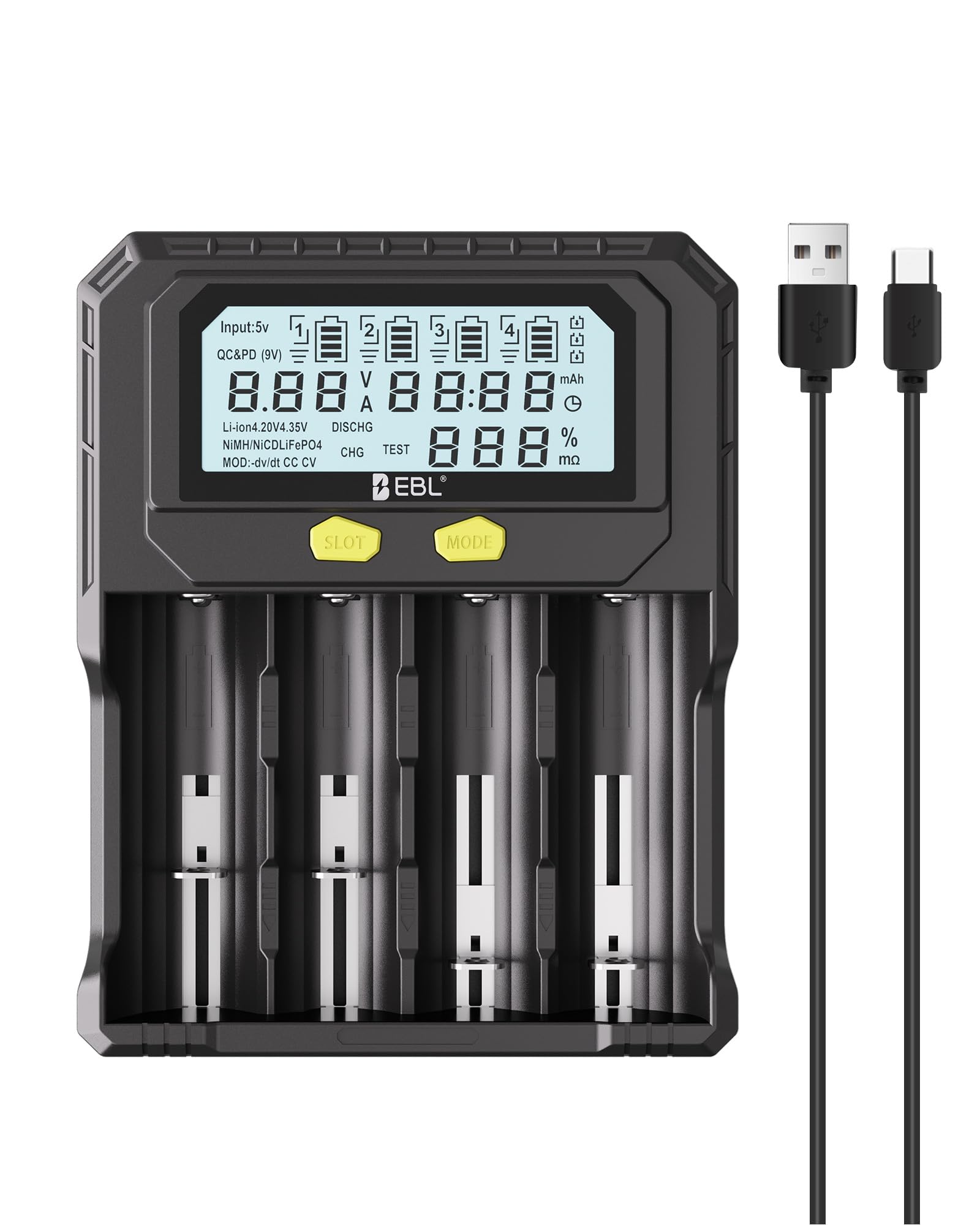
The EBL PD4 brings lab-grade functionality to a budget-friendly four-bay package. Channels 1 and 4 support up to 2000mA each, delivering charging speeds up to four times faster than standard chargers. But the real value is in the discharge mode and capacity testing — you can drain a battery, measure exactly how many milliamps it holds, and decide whether it’s worth keeping or belongs in recycling.
It automatically recognizes battery type (Li-ion, LiFePO4, Ni-MH, Ni-CD) and sets the correct charging profile. The 0V reactivation feature brings over-discharged cells back to life, which is a lifesaver for salvaging old power tool packs. The LCD screen shows estimated charging time, type, and current per slot in real time.
Some users have reported the unit occasionally shuts down unexpectedly and needs a manual unplug to restart. This doesn’t affect its day-to-day performance for most people, but it’s worth noting if you need absolute reliability for unattended charging. Overall, the EBL PD4 is the best choice for anyone who wants to test and rejuvenate batteries, not just charge them.
Why it’s great
- Discharge and capacity test modes
- 2000mA on bays 1 and 4
- 0V reactivation for dead cells
Good to know
- Occasional random shutdown requiring power cycle
- Menu system takes a few tries to learn
3. XTAR VC8 Plus

The XTAR VC8 Plus is the workhorse for heavy users who need to charge and analyze eight 18650s at once. It delivers up to 3A on a single slot, 2A on two slots, or 1A across all eight — all from the included 12V/3A adapter. The VA LCD screen displays voltage, current, battery type, internal resistance, and capacity for each slot independently, so you’re never in the dark about a single cell.
The grade mode on channels 1 through 4 is a standout feature: it charges, discharges, and recharges a battery to report its actual milliampere-hour capacity. This exposed overrated “3500mAh” cells as ~2400mAh in real-world use, earning praise from users who test bulk-purchased batteries. The store mode discharges or charges cells to a safe storage voltage, extending their lifespan during long idle periods.
One concern from a buyer was a faulty port after a month, but the vast majority of reviews report flawless operation for well over a year of daily use. If you manage a large rotation of 18650s for flashlights, vapes, or DIY power walls, the VC8 Plus offers the best capacity-testing value on the market.
Why it’s great
- 8 independent bays with grade testing
- Adjustable 0.25A to 3A per slot
- Store mode for long-term battery preservation
Good to know
- Only CH1-CH4 can test capacity
- One report of overcharge failure on a single port
4. MIEKLAE S8
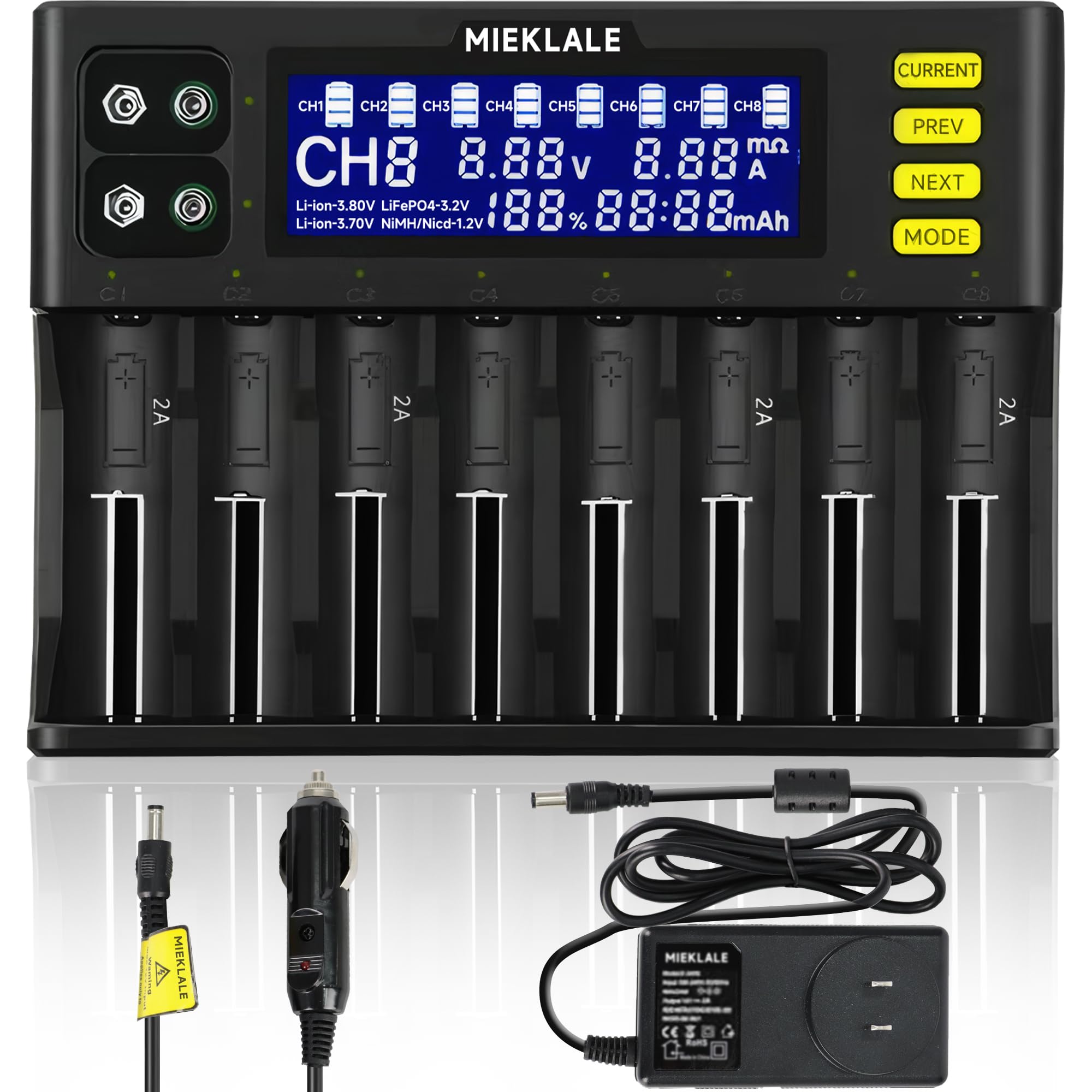
The MIEKLAE S8 is the only charger in this roundup that handles ten batteries simultaneously — eight standard slots plus two dedicated to 9V Ni-MH/Ni-CD cells. It includes a 12V/4A power adapter that enables 2A charging across multiple channels, and five selectable current levels give you precise control over charge speed for each bay. The LCD screen presents voltage, current, charging time, capacity, energy percentage, and internal resistance all on one screen.
This charger auto-detects battery chemistry and flags bad batteries automatically, making it ideal for workshops or families that accumulate a mix of 18650s, AAs, AAAs, and 9V rechargeables. The reverse polarity and short-circuit protections give you peace of mind when dealing with older or unknown cells that might be damaged.
The interface requires a short learning curve — the display text can be a bit cryptic at first — and the light plastic body doesn’t feel as premium as the XTAR. But for sheer slot count and the ability to charge 9V batteries, the S8 is a unique and powerful option for power users.
Why it’s great
- 10 total slots including 9V support
- 2A per channel with included 12V/4A adapter
- Auto-identifies chemistry and bad cells
Good to know
- Interface can be confusing at first
- Build feels light compared to premium rivals
5. 4-Slot Fast Charger (MAXLSHALL)
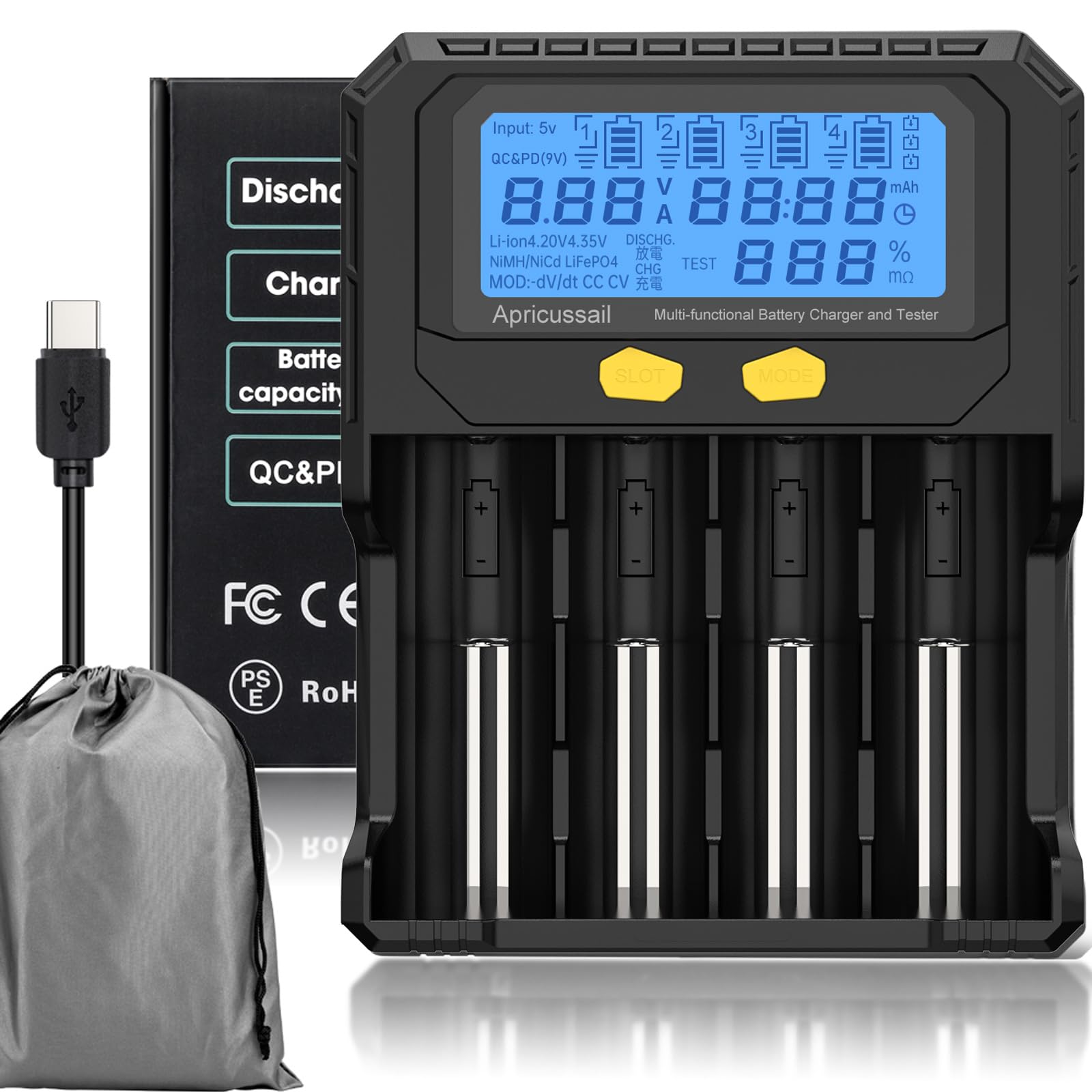
This 4-slot charger from MAXLSHALL packs a surprising amount of intelligence into a compact body. It delivers up to 2A per slot on channels 1 and 4 when using the included fast-charging cable, and 1A across all four bays when charging simultaneously. Flame-retardant materials and built-in overcharge, over-discharge, short-circuit, and reverse polarity protections make it a safe pick for daily use.
The 4th slot’s 3-in-1 functionality lets you charge, discharge, and test capacity — a feature usually reserved for more expensive models. The large LCD screen clearly displays charging time, current capacity, and voltage for each slot, so you can track all four batteries at a glance. It supports LiFePO4, Li-ion, Ni-MH, and Ni-CD chemistries, covering almost every rechargeable battery you’d own.
Build quality feels solid for the price point, but the manual is sparse on explaining the capacity test procedure. A few users wished for a memory function to retain settings between sessions. For a mid-range four-bay with testing capability on a single slot, this charger offers excellent value.
Why it’s great
- 2A charge rate on slots 1 and 4
- Slot 4 does discharge and capacity testing
- Flame-retardant build for safety
Good to know
- Capacity test procedure isn’t well explained
- No settings memory between power cycles
6. EdisonBright ARE-C1+

The ARE-C1+ from Fenix (sold here as the EdisonBright bundle) is a premium dual-channel charger that can be powered by either AC or DC input, making it the most travel-flexible option. Each of the two slots is controlled by a dedicated button, giving you independent monitoring and control. The LCD screen shows charging progress and voltage, and the charger supports Li-ion 18650, 16340, 14500, 10440, plus Ni-MH/Ni-CD AA, AAA, and C sizes.
The bundle includes the EdisonBright BBX3 battery case, which protects cells during transit — a thoughtful addition for photographers, hikers, or vapers who carry spare batteries daily. The multi-protection circuit guards against overcharge, short circuit, and reverse polarity, matching the safety of much newer chargers.
The maximum charge current is limited to 1A, which means it’s slower than modern USB-C competitors. And at this price point, you’re paying for the Fenix build quality and the case rather than raw speed. But if you value a bulletproof build and the ability to plug into a wall outlet or a car adapter, this is a compact, elegant solution.
Why it’s great
- AC and DC input for universal travel use
- Includes a premium battery carry case
- Independent dual-channel buttons
Good to know
- Only 1A max per slot
- Higher price for the feature set compared to rivals
7. YSKXOIMA Universal Set
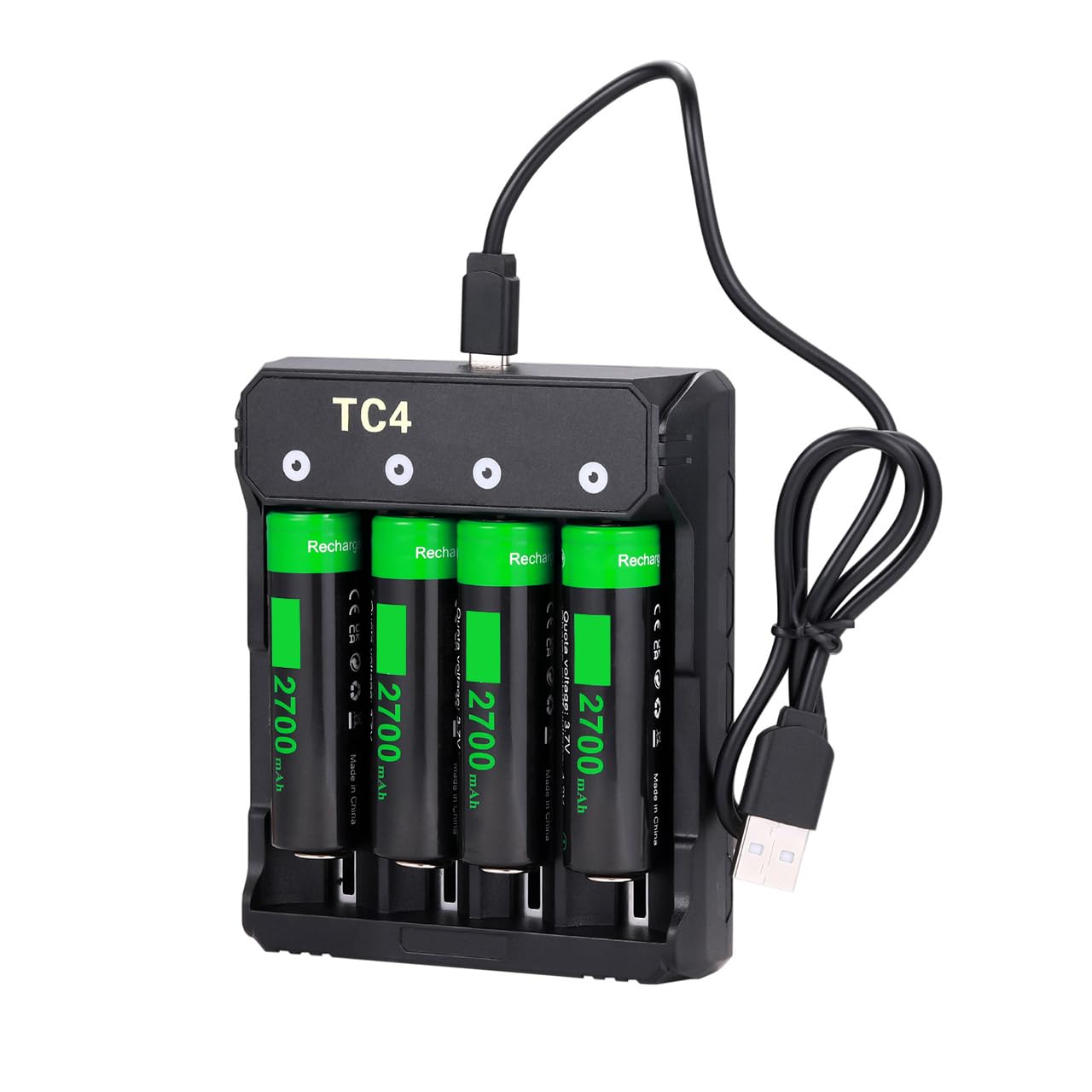
If you’re new to 18650-powered devices and don’t want to buy batteries and a charger separately, the YSKXOIMA set is the simplest entry point. It comes with four button-top 18650s and a compact charger. The charger includes overcharge, short-circuit, and overheat protection, so it’s safe for first-time users who may not know the risks of improper charging.
The included batteries hold a charge well for flashlights, emergency radios, and garden lights, according to verified buyers. The charger uses a standard micro-USB input and has a red/green LED indicator for each slot. It’s not the fastest — no LCD or adjustable current — but it works reliably for casual users who just want a battery backup for outdoor lights or a headlamp.
The batteries arrive at a low state of charge and need a full cycle before first use. Some users noted that the charger lacks a charge level meter, so you can’t see the exact voltage. But as a grab-and-go kit that includes both a safe charger and functional batteries, this set is hard to beat for its price.
Why it’s great
- Includes four 18650 batteries and a charger
- CE and UL certified for safety
- Simple red/green LED status per slot
Good to know
- No LCD or adjustable charge current
- Batteries arrive partially discharged
FAQ
Can I charge a 3.2V LiFePO4 battery in a standard 18650 Li-ion charger?
What does internal resistance (mΩ) tell me about my 18650 battery?
Is it safe to leave 18650 batteries on the charger overnight?
How many 18650 batteries can I charge at once with these chargers?
What does “0V reactivation” mean on a battery charger?
Final Thoughts: The Verdict
For most users, the best 18650 battery and charger combination is the Nitecore UMS2 because it combines the fastest USB-C charging, automatic chemistry detection, and a clear LCD in a compact dual-slot form that serves everyday needs perfectly. If you want capacity testing and discharge analysis, grab the EBL PD4 — it’s the best tool for verifying battery health without spending on lab gear. And for heavy users managing eight or more cells, nothing beats the XTAR VC8 Plus for bulk charging and grade-mode testing that reveals the true capacity of every 18650 you own.