
Our readers keep the lights on and the weekend projects moving. As an Amazon Associate, I earn from qualifying purchases.
The challenge is finding a unit that delivers clear, distortion-free sound at a reasonable volume without dominating your counter or bookshelf. Many so-called shelf systems compromise on speaker quality, amplifier power, or connectivity, leaving you with a box that looks the part but sounds thin.
I’m Rikta — the co-founder and writer behind FitlyFast. I’ve spent countless hours analyzing amplifier specs, driver materials, DSP configurations, and real customer feedback across more than forty micro and shelf stereo models to separate the genuinely capable units from the ones that just promise big sound.
No single audio shelf system is right for every room or every listener — the right one depends on your source format, speaker placement, and how much low-end weight you expect from a compact enclosure.
How To Choose The Best Audio Shelf System
A shelf stereo lives in a fixed location — it needs to match your source preferences (CD, vinyl, streaming) and your room size without needing a second mortgage on speaker cables. Three decisions drive the choice.
Power and Driver Architecture
RMS wattage tells you the sustained output before distortion climbs. For a bedroom or small office, 20W to 40W per channel is enough. For a living room or open-concept space, look for 50W or more per channel. Driver layout matters more than many shoppers realize: a two-way design with a dedicated tweeter and woofer handles midrange clarity better than a single full-range driver. Silk dome tweeters produce smoother highs than standard mylar, and a woofer larger than 4 inches is typically needed for noticeable bass.
Source Connectivity and Input Flexibility
Confirm the system supports the formats you actually use. Integrated CD players remain common, but some models omit them entirely. If you stream from a phone, Bluetooth 5.0 or higher provides stable range and audio quality. A USB port lets you play MP3 and WMA files directly. For vinyl listeners, a built-in phono preamp saves you from buying an external box. Systems with an AUX input or optical input give you room to add a TV or game console later.
Speaker Placement and Enclosure Design
Bass reflex ports increase low-end output, but they need breathing room — at least 6 to 8 inches from the rear wall or the bass turns muddy. Front-ported designs are more forgiving in tight spaces. If your shelf is crowded or shallow, a sealed enclosure or a system with adjustable EQ lets you tune out the boxiness. The unit’s physical footprint also matters: measure your available width and depth before buying, and note whether the speakers are detachable from the main receiver.
Quick Comparison
On smaller screens, swipe sideways to see the full table.
| Model | Category | Best For | Key Spec | Amazon |
|---|---|---|---|---|
| Denon D-M41 | Premium | Audiophile clarity in small rooms | 2x30W RMS / 20 Hz–20 kHz | Amazon |
| QLEARSOUL HiFire X | Premium | 100W RMS / 5.3″ woofer | Amazon | |
| Philips TAM8905 | Premium | Wi-Fi streaming and internet radio | 100W / 50 Hz–20 kHz | Amazon |
| DIGITNOW Turntable | Mid-Range | Entry-level vinyl with Bluetooth | 36W / 1.5 kg platter | Amazon |
| Panasonic SC-PM700 | Mid-Range | 80W power in a compact footprint | 80W RMS / 10 cm woofer | Amazon |
| LONPOO 100W LP-609 | Mid-Range | Retro style with DSP tuning | 100W / 4″ woofer + 1″ tweeter | Amazon |
| Sony SS-CS5M2 | Mid-Range | Hi-Res passive speakers (pair) | 53 Hz–50 kHz / 5.12″ woofer | Amazon |
| Panasonic SC-PM270 | Mid-Range | Simple all-in-one for small rooms | 20W RMS / 10 cm woofer | Amazon |
| LONPOO LP-816 | Budget | Vintage look at an entry price | 40W RMS / 4″ drivers | Amazon |
In‑Depth Reviews
1. Denon D-M41

The Denon D-M41 is the most serious compact system in this lineup. Its triple noise reduction design preserves signal purity across the FM/AM tuner, Bluetooth input, and CD transport. The included SC-M41 bookshelf speakers use a 4.75-inch woofer and a one-inch silk dome tweeter that deliver smooth, natural mids without the metallic edge common in cheaper mylar domes.
With a frequency response of 20 Hz to 20 kHz and 30 watts per channel, this system fills a medium-sized room with balanced sound. The bass is present but not overbearing — adding a subwoofer is worthwhile if you want the lowest octave for electronic or orchestral tracks. The dedicated headphone amplifier is a rare inclusion at this price tier.
There is no USB port for direct flash drive playback, and the system is physically larger than most micro units. The build quality, however, justifies the investment: metal chassis, tactile buttons, and a remote that feels substantial. For buyers who prioritize signal integrity and long-term reliability over the last dollar of value, this is the unit.
Why it’s great
- Silk dome tweeter for detailed highs without fatigue
- Triple noise reduction design keeps the signal clean
- Separate headphone amplifier with real volume headroom
Good to know
- No USB port for direct file playback
- Requires subwoofer for deep bass extension
- Larger footprint than micro competitors
2. QLEARSOUL HiFire X
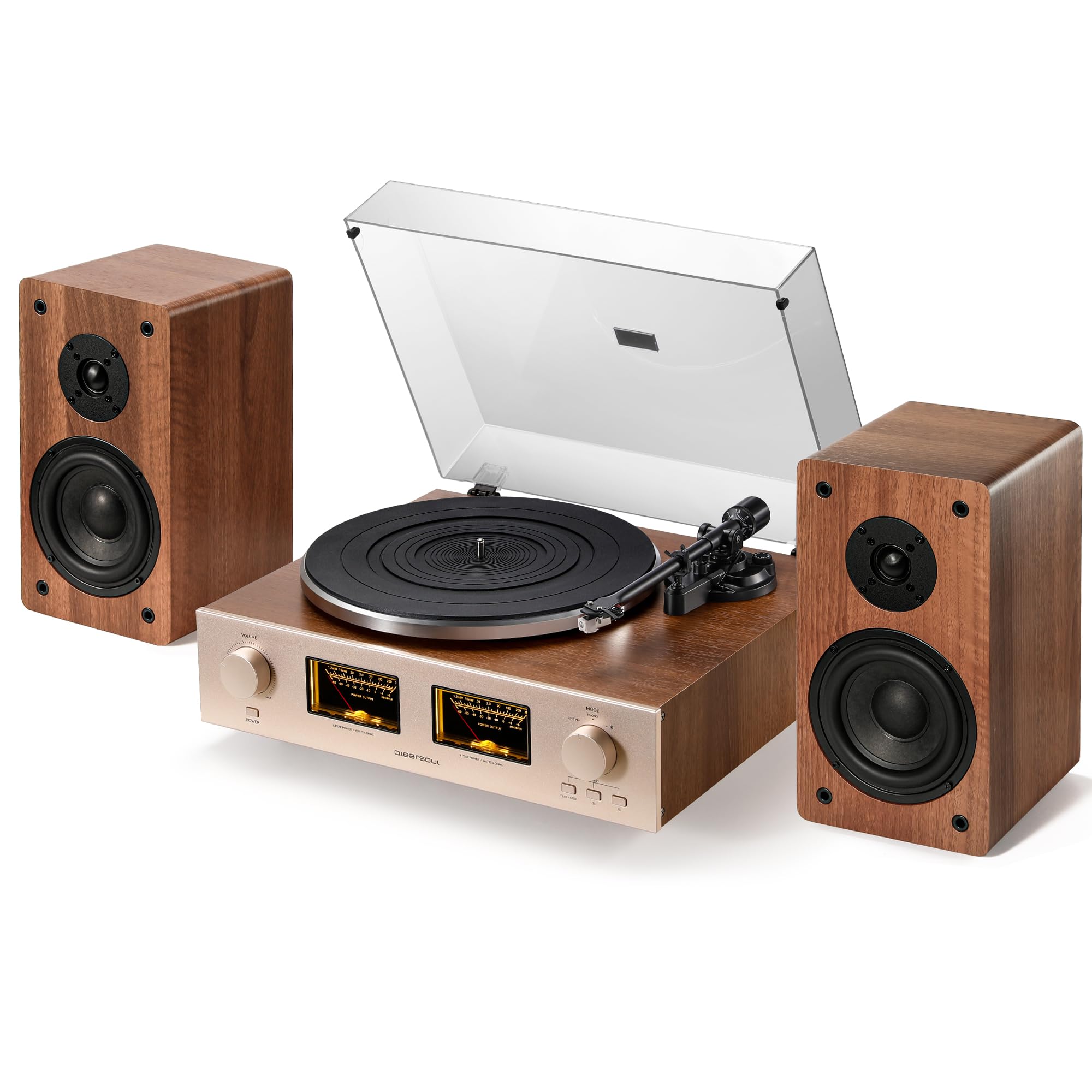
The HiFire X stands out for its analog-style VU meters and a fully CNC-machined aluminum control panel — a tactile experience most plastic-bodied units lack. It delivers 100 watts RMS through dual bookshelf speakers that pair a 5.3-inch woofer with a 1.5-inch silk dome tweeter. The DSP amplifier selects a dedicated EQ curve for phono, Bluetooth, or LINE-IN input, which prevents the muffled sound that often plagues all-in-one turntable systems.
Setup takes about 15 minutes, and the built-in switchable phono preamp means you do not need an extra box between the turntable and the amplifier. The adjustable counterweight and anti-skate mechanism on the tonearm allow you to dial in tracking force correctly for different cartridge weights, reducing distortion on dynamic passages.
One omission: there is no automatic tonearm lift at the end of a record, so the needle sits in the run-out groove until you lift it. The walnut finish and 35-pound total weight give it a substantial presence. This system works best for classical and jazz listeners who want the ritual of vinyl plus the convenience of Bluetooth streaming.
Why it’s great
- Real-time VU meters add analog character and visual feedback
- DSP preamp optimizes EQ per input source automatically
- Adjustable counterweight for precise tracking force
Good to know
- No auto-stop at the end of a record side
- Not ideal for bass-heavy genres at maximum volume
- Heavy unit at 35 pounds — plan shelf support
3. Philips TAM8905

Unlike most shelf systems that rely entirely on Bluetooth, the Philips TAM8905 adds Wi-Fi streaming with Spotify Connect and internet radio. That makes it the strongest option if your primary listening comes from streaming services rather than physical media. The system produces 100 watts of clean output through a 5.25-inch woofer and dome tweeter in each speaker, with bass reflex ports that extend low-end presence.
The central unit features a matte aluminum finish and a color display that shows album art, track info, and station data. It can read from a USB drive and also includes an AUX input and headphone jack. The FM tuner is digital and stores presets, a feature the Panasonic PM270 lacks. Setup is slightly more involved than a basic Bluetooth unit because you must connect the speakers to the receiver and configure the Wi-Fi.
Some users report that Bluetooth audio quality sounds noticeably inferior to Wi-Fi streaming — the system’s internal DSP treats the Bluetooth signal less favorably. Stick to Wi-Fi or AUX for the best fidelity. The speakers are wired, not wireless, so you need to route cable from the receiver to each speaker.
Why it’s great
- Wi-Fi streaming with Spotify Connect for higher bitrate audio
- Internet radio with station presets beyond FM
- Color display with album art and track metadata
Good to know
- Bluetooth quality lags behind Wi-Fi streaming
- Speaker wire must be routed from receiver to each speaker
- Setup involves Wi-Fi configuration steps
4. DIGITNOW Turntable HiFi System
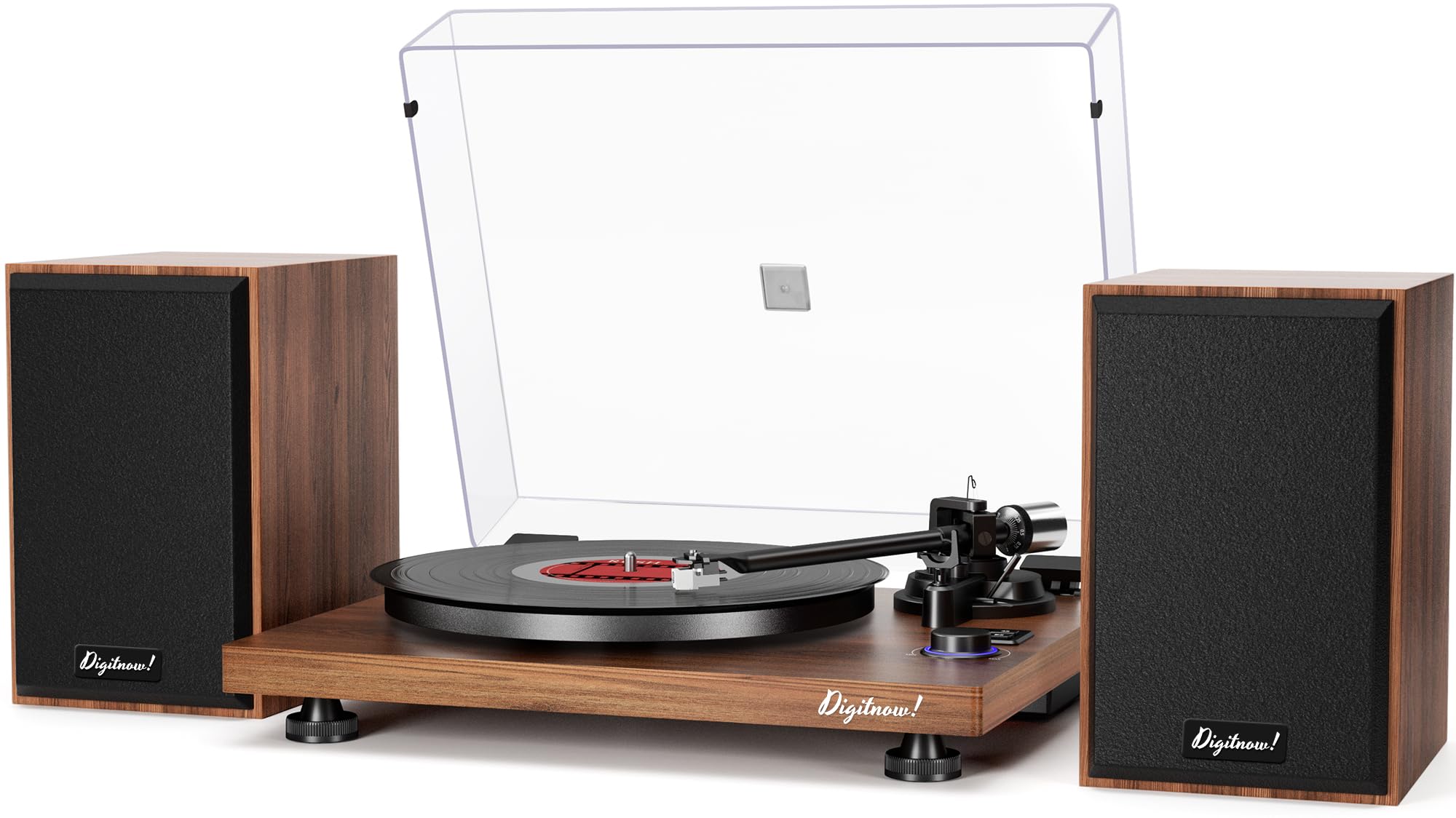
The DIGITNOW system packages a belt-drive turntable with a pair of 36-watt bookshelf speakers, making it a turnkey solution for anyone reentering vinyl without existing components. It includes a built-in switchable phono preamp and a precision-machined iron platter that weighs 1.5 kilograms, providing stable rotation and reducing wow and flutter. The adjustable counterweight and anti-skate mechanism let you balance the AT-3600L cartridge for accurate tracking.
Bluetooth playback works for streaming from a phone to the speakers, though this model does not transmit Bluetooth to external speakers — the wireless path is one-directional. A USB port lets you convert vinyl to MP3 on a computer, a useful option for digitizing older records. The wooden cabinet and brown finish give it a clean mid-century look that suits most living rooms.
Pairing can be slightly inconsistent on some units, and the internal speakers are not as resolving as a separates system. For a single-box starter setup that includes everything needed to play a record within minutes of unboxing, though, this system succeeds. It works best at moderate volumes where the 36-watt headroom is sufficient.
Why it’s great
- Includes turntable, speakers, phono preamp — no extra purchases needed
- Adjustable counterweight and anti-skate for proper cartridge setup
- USB output for digitizing vinyl records
Good to know
- Bluetooth is input only — cannot stream to external speakers
- 36W limits maximum clean volume in larger rooms
- Pairing can be inconsistent on some individual units
5. Panasonic SC-PM700

With 80 watts RMS (40W per channel), the SC-PM700 is one of the most powerful micro systems available. It uses a 10-centimeter woofer and a 6-centimeter tweeter per speaker, both housed in a bass reflex enclosure. Panasonic’s Sound Remastering technology aims to reduce distortion from compressed digital files, and it noticeably cleans up MP3 and Bluetooth streams that sound thin on other units.
The front panel includes a large volume knob and physical buttons for bass, treble, and My Sound presets — no menu diving. A headphone jack is available on the front panel. The remote control is included and uses clear, large-button labeling that older users will appreciate. Setup takes under five minutes.
A small number of units have reported CD player failures within days of use, and the labeling on the unit’s black controls is tiny and hard to read without bright light. The radio reception with the included indoor antenna is good for a micro system. For buyers who want real power in a compact chassis and stream most of their audio from a phone, this is the strongest mid-range option.
Why it’s great
- 80W RMS in a surprisingly compact chassis
- Sound Remastering improves compressed Bluetooth audio
- Physical bass and treble knobs for quick tuning
Good to know
- Occasional CD player reliability concerns reported
- Control labels on black finish are very small and low-contrast
- Remote requires separate AA battery not included
6. LONPOO 100W LP-609
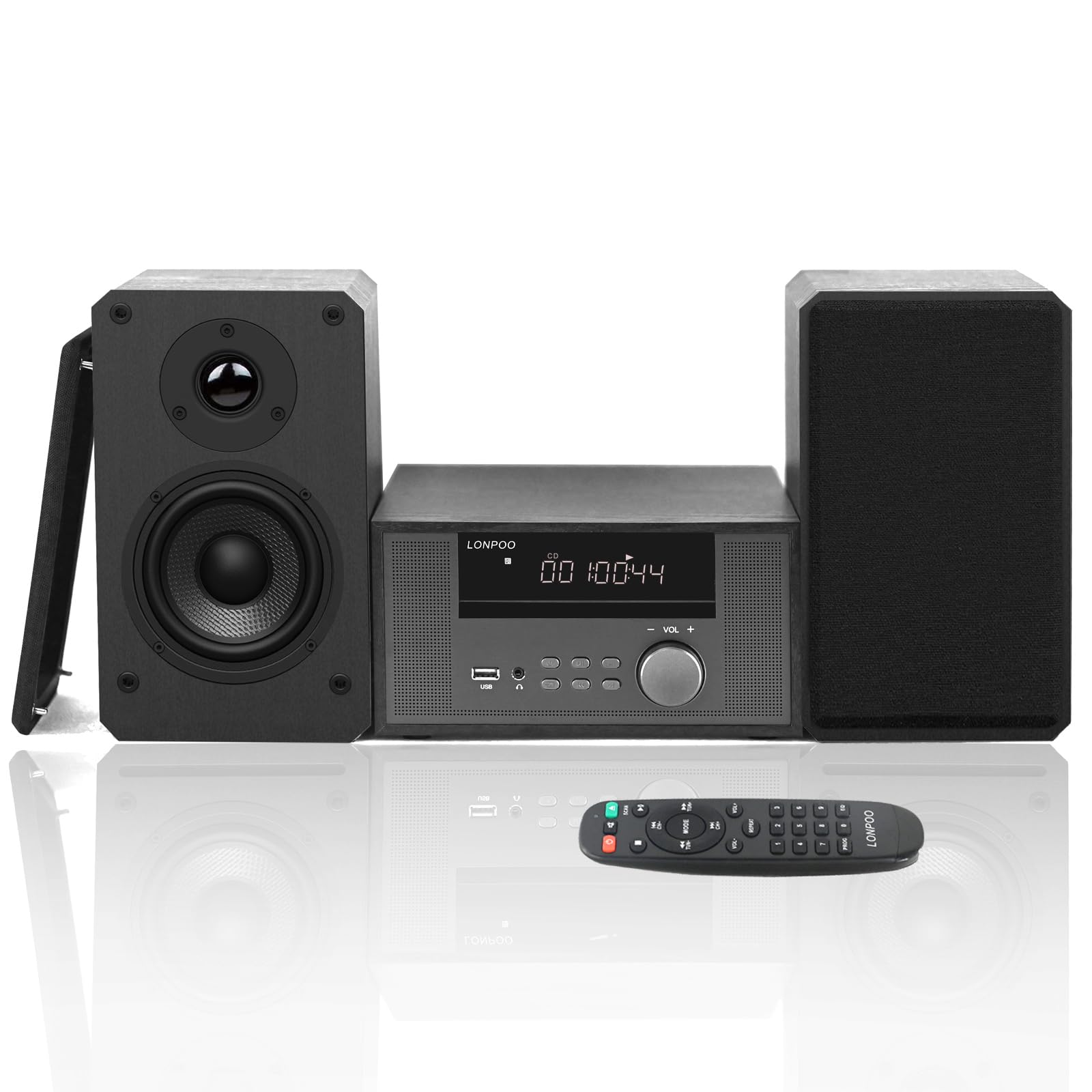
The LP-609 is a visually striking system with a dark gray aluminum amplifier and two wooden bookshelf speakers. It pushes 100 watts through a four-inch rubber woofer and a one-inch silk dome tweeter per speaker. The DSP technology provides five EQ modes — including rock, pop, and classical — plus repeat and shuffle functions for CD playback. It reads CD, CD-R, and CD-RW discs without issues.
Bluetooth 5.3 provides a stable connection with minimal dropouts up to 30 feet. The amplifier unit includes a headphone jack, an AUX input, and a USB port for MP3 and WMA files. The remote control covers all core functions. The speakers use a bass reflex port on the rear, so you need at least six inches of clearance behind each speaker to avoid boomy, undefined bass.
Some users note that the bass is present but not punchy — the four-inch woofer cannot move enough air for deep low-end. The system also tends to run warm after extended use at high volume. For its price point, the build quality and feature set are impressive, but the sound signature is more polite than powerful.
Why it’s great
- 100W RMS output with silk dome tweeter for smooth highs
- DSP tuning with five EQ presets for different genres
- Bluetooth 5.3 provides reliable streaming range
Good to know
- 4-inch woofer limits bass extension and punch
- Runs warm after extended high-volume use
- Rear bass reflex ports need rear clearance
7. Sony SS-CS5M2

The Sony SS-CS5M2 is a pair of passive bookshelf speakers, not a full system. You need a separate amplifier or receiver to drive them. What you get for the investment is a 3-way, 3-driver design with a 5.12-inch woofer, a high-precision tweeter, and a wide-dispersion super tweeter. The frequency response reaches up to 50 kHz, qualifying for Hi-Res Audio certification, and the bass reflex enclosure helps keep low frequencies clean.
These speakers excel at recreating a wide soundstage with clear vocals and detailed instrument separation. The super tweeter adds airiness to cymbals and string harmonics that two-way designs often roll off. For nearfield desk listening or small-room setups with a quality amplifier, the clarity is exceptional for the price. They pair naturally with Sony AV receivers but work with any competent amplifier.
The speakers require a subwoofer for true full-range playback — the 5.12-inch woofer only reaches down to about 53 Hz. The rear port needs space behind the cabinet, and the speakers themselves benefit from isolation pads to reduce unwanted resonance transfer to furniture. At their normal selling price, the value is strong; at full retail, there are better-tier options.
Why it’s great
- 3-way driver array produces wide soundstage and airy treble
- Hi-Res Audio certified with 50 kHz frequency response
- Excellent clarity and detail for nearfield listening
Good to know
- Passive speakers — requires a separate amplifier
- Needs subwoofer for deep bass below 53 Hz
- Rear bass reflex port requires careful placement
8. Panasonic SC-PM270

The SC-PM270 is Panasonic’s entry-level compact system that delivers 20 watts RMS through a 10-centimeter woofer and a 6-centimeter tweeter. It covers the basics — CD player, FM radio, USB flash drive playback, and Bluetooth — without superfluous features. The Bluetooth Re-Master function compensates for data lost during compression, which makes streamed audio sound cleaner than you would expect from a 20-watt system.
Setup is extremely simple: attach the speakers using the included wire, plug in the power, and you are operational. The large volume knob on the front panel makes level control easy, and the remote covers all functions from across the room. The FM tuner has clear reception, though it lacks preset memory — you must tune manually each time. There is no AUX input or headphone jack, which limits connectivity with older devices.
The sound signature is clear and balanced at low to moderate volumes, making it ideal for a kitchen counter, bedside table, or small office. At higher volumes near its power ceiling, the sound can become strained. For a dedicated space where you primarily listen at background levels, the PM270 is a reliable, space-efficient choice.
Why it’s great
- Bluetooth Re-Master improves compressed audio streams
- Very compact footprint — fits on narrow shelves
- Large volume knob and simple tactile controls
Good to know
- No AUX input, headphone jack, or radio presets
- 20W RMS limits clean volume in larger rooms
- Speakers are wired with basic spring clip terminals
9. LONPOO LP-816
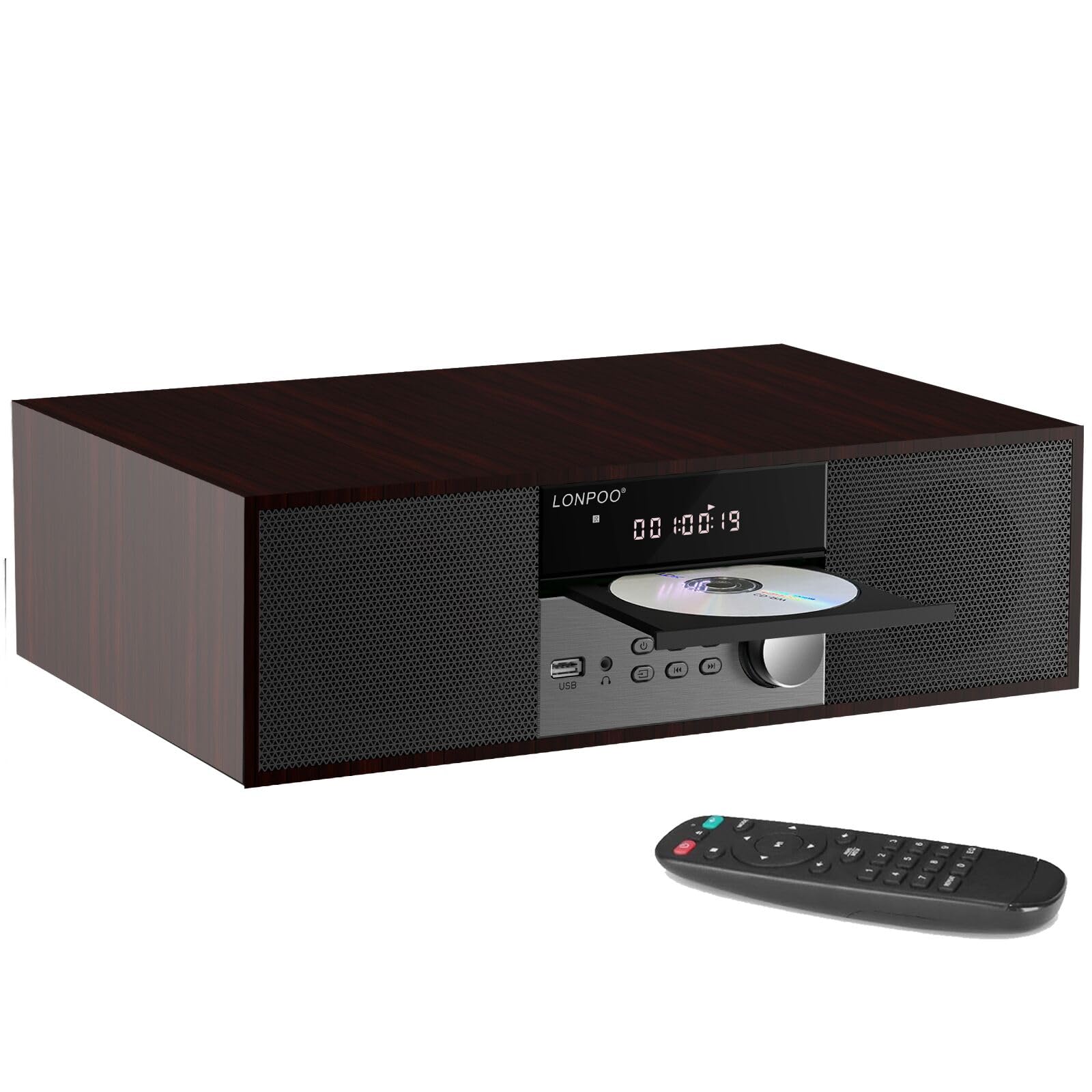
The LP-816 is the most affordable complete system in this guide, and it focuses on delivering the core functions without premium frills. It produces 40 watts RMS from four-inch drivers housed in low-resonance cabinets. The Copper Cap tweeter design reduces voice coil inductance fluctuations, which results in clearer high-frequency reproduction than you typically hear at this price tier. It supports CD playback, FM radio, Bluetooth, USB, and AUX input.
The vintage brown finish and compact dimensions make it easy to place on a kitchen counter or small desk. The remote control handles volume, track skipping, and input switching. Bluetooth pairs quickly and holds a connection within a 30-foot range without dropouts. For a budget system, the overall sound is balanced, though the bass is light and the unit runs warm after extended use at moderate volume.
Build quality is acceptable for the price, but the plastic speaker enclosures do not feel as substantial as wood-clad competitors. A small number of units arrive with one channel not functioning, which suggests variable quality control. At its price point, it is a functional entry into shelf audio for someone who just wants music in a room without spending much.
Why it’s great
- Copper Cap tweeter delivers smoother highs than average budget units
- Multiple input sources including AUX and USB
- Very low price barrier to entry for shelf audio
Good to know
- Bass is light due to 4-inch driver size
- Inconsistent quality control — some units arrive with one dead channel
- Plastic enclosures lack the heft of wood cabinets
FAQ
Can I use a shelf system with my TV?
How much power do I need for a bedroom system?
Why do my new bookshelf speakers sound bass-light?
Is Bluetooth 5.0 necessary for a shelf system?
Final Thoughts: The Verdict
For most users, the audio shelf system winner is the Denon D-M41 because it combines genuine audiophile-grade components — a silk dome tweeter and triple noise reduction design — with a reliable CD transport and solid amplifier in a compact form factor. If you want the presence of vinyl and analog VU meters in a single package, grab the QLEARSOUL HiFire X. And for a Wi-Fi streaming hub with Spotify Connect and internet radio, nothing beats the Philips TAM8905.