
Our readers keep the lights on and the weekend projects moving. As an Amazon Associate, I earn from qualifying purchases.
The jump from a toy guitar to a full-size dreadnought can kill a beginner’s momentum before the first chord rings out. A 3/4 scale guitar—with its shorter neck, narrower nut width, and smaller body—puts the essentials within reach of smaller hands, younger players, and adults who crave a portable practice partner. The wrong spec choice here means buzzing frets, painful stretches, or an instrument that collects dust after two weeks.
I’m Rikta — the co-founder and writer behind FitlyFast. My research for this guide involved comparing body woods, scale lengths, nut widths, pickup configurations, and customer feedback across seven distinct 3/4 models, weighing each spec against real-world playability for beginners and traveling musicians alike.
Whether you’re buying for a child aged six to twelve or looking for a travel-friendly second guitar, understanding the difference between a laminate top and solid spruce, or a basic acoustic versus an acoustic-electric with a built-in tuner, makes the difference between a beloved instrument and a frustrating one. I want the best 3/4 guitar for your specific need, so I’ve stacked them up spec-by-spec to save you the guesswork.
How To Choose The Best 3/4 Guitar
Not every compact guitar plays the same. The differences in scale length, body wood, and included electronics can make a 3/4 feel like a premium instrument or a frustrating toy. Focus on these three areas first.
Body Wood and Top Material
The top wood dictates the volume and clarity you hear. A solid spruce top—found on the Yamaha APXT2—delivers brighter, more responsive tone that opens up over years. Laminate tops like the sapele on the Fender FA-15 or the koa pattern HPL on the Martin LXK2 offer more durability and resistance to humidity changes, making them ideal for travel or younger players who might not baby the instrument.
Back and side woods matter too: mahogany warms the sound, sapele sits mid-range, and engineered woods like the linden on the Pyle kit keep costs down but trade some resonance and projection.
Scale Length and Nut Width
Scale length on a 3/4 guitar typically falls between 22 and 23.5 inches. Shorter lengths—like the Ibanez RG MiKro’s 22-inch scale—reduce string tension, making barre chords and bending easier for small hands. Nut width (the space at the top of the neck) ranges from about 1.625 to 1.75 inches. A narrower nut helps kids and players with petite fingers reach across the fretboard without muting adjacent strings.
If you’re buying for a six- to ten-year-old, prioritize a shorter scale and narrower nut. For an adult using the guitar as a travel companion, a slightly wider nut (like the standard 1.75-inch found on the Taylor BT2) preserves a familiar feel closer to a full-size instrument.
Acoustic vs. Acoustic-Electric
An acoustic-electric 3/4 guitar—like the Yamaha APXT2 with its System 68 piezo pickup—allows you to plug into an amplifier or PA system for performances, lessons, or recording. If the player is just starting out and only strumming in the bedroom, a pure acoustic model saves money and avoids battery dependency. But a built-in tuner on an acoustic-electric (also a Yamaha strength) eliminates the need for a separate clip-on device and simplifies practice sessions.
Quick Comparison
On smaller screens, swipe sideways to see the full table.
| Model | Category | Best For | Key Spec | Amazon |
|---|---|---|---|---|
| Yamaha APXT2 | Acoustic-Electric | Plugged-in practice & stage use | 3/4 scale, Spruce top, System 68 pickup | Amazon |
| Taylor BT2 | Premium Acoustic | Rich acoustic tone & fingerstyle | Solid mahogany top, Ebony fretboard | Amazon |
| Martin LXK2 | Travel Acoustic | Rugged travel & balanced tone | HPL Koa top, Rosewood fretboard | Amazon |
| Fender FA-15 | Beginner Bundle | Young player starter kit | Sapele body, Walnut bridge, 23.2″ scale | Amazon |
| Hola! Music HG-36PP | Value Bundle | Complete beginner package | Solid Spruce top, Mahogany back/sides | Amazon |
| Ibanez RG MiKro | Electric Solidbody | Small hands & electric play | 22″ scale, 2 humbuckers, Poplar body | Amazon |
| Pyle Acoustic Guitar Kit | Budget Starter Kit | Entry-level all-in-one | Linden plywood body, 23.2″ scale | Amazon |
In‑Depth Reviews
1. Yamaha APXT2 3/4-Size Acoustic-Electric Guitar – Black

The Yamaha APXT2 sits at the sweet spot where playability meets functionality. Its spruce top projects a clear, bright voice that punches above the small body size, while the meranti back and sides keep the weight manageable for a child or a frequent traveler. The System 68 piezo pickup delivers a clean amplified signal that holds up in classroom settings or open mics, and the built-in chromatic tuner eliminates the need for an external device—a convenience that beginner parents and teachers appreciate.
Players consistently praise its out-of-box playability: the action arrives low enough to avoid frustrating buzzing, and the tuning pegs hold pitch well even after a session of capo work. The thin body profile makes it a natural fit for smaller torsos, though that same shallow depth means the unplugged bass response is modest compared to a deeper-bodied acoustic. Expect a twangy, articulate treble that works well for fingerpicking and single-note runs.
The included gig bag offers basic protection, though several users note the lack of a pick holder and the thin padding. For stage use by a child with a couple years of experience, as one review reported, this guitar is perfectly capable. The compromises are small: the action may benefit from a slight lowering for advanced players, and the electronics can feed back at high stage volumes. But for a 3/4 that does everything—acoustic practice, amplified performance, travel—the APXT2 is the most versatile pick on this list.
Why it’s great
- Built-in tuner simplifies practice and setup
- Spruce top delivers clear, articulate projection
- Acoustic-electric design with piezo pickup for performance flexibility
Good to know
- Shallow body limits unplugged low-end resonance
- Gig bag padding is minimal without a hard case
- Electronics prone to feedback at high volume
2. Taylor BT2 – Mahogany Top

The Taylor BT2 proves that a 3/4 guitar doesn’t have to sound small. Its solid mahogany top produces a warm, rich tone with surprising volume—one customer review noted it can fill a room of seventy people without amplification. The layered sapele back and sides add visual depth and structural stability, while the West African Crelicam ebony bridge and fingerboard provide a responsive, smooth feel that advanced players recognize immediately.
Fingerstyle players will gravitate toward this guitar. The mid-to-high range is crisp and defined, and the satin finish on the mahogany neck allows for quick slides without sticky friction. The action arrives well-adjusted from the factory, with minimal fret buzz even at the lower positions. Some users find the mid-bass slightly muddy and the overall sustain shorter than a full-size dreadnought, but the tradeoff is a compact instrument that records surprisingly well in acoustic duets.
At roughly two kilograms, it’s one of the lighter premium 3/4 models, making it a top-tier travel companion. The included gig bag is a soft case, and Taylor recommends a hard case for flight protection. Humidification is also important—the solid mahogany top is more sensitive to dry climates than a laminate alternative. If you want a 3/4 that sounds like a much larger guitar and feels like a Taylor, the BT2 is the clear choice for serious players and small-statured adults.
Why it’s great
- Solid mahogany top delivers warm, loud projection
- Excellent fingerstyle clarity and responsive fretboard
- Lightweight and comfortable for travel or small adults
Good to know
- Needs humidification to prevent cracking in dry environments
- Soft case included; a hard case is recommended for protection
- Mid-bass can sound muddy compared to larger acoustics
3. Martin LXK2 Little Martin Koa Pattern HPL Top with Padded Gigbag

The Martin LXK2 takes a different approach than the all-solid BT2: it uses high-pressure laminate (HPL) with a koa pattern top. That makes it nearly indestructible—it resists scratches, humidity swings, and temperature changes better than almost any other 3/4 on the market. The tradeoff is that the HPL top doesn’t “open up” or improve with age like solid wood, but the out-of-box tone is balanced, clear, and surprisingly rich in the low-mid range for such a compact body.
Customer reviews frequently compare the LXK2 directly against the Baby Taylor, and many prefer the Martin for its superior intonation and pitch stability across the fretboard. The action is perfect right out of the box, and the “1-style” Sitka spruce bracing adds enough projection to hold its own in a jam session. The rosewood fretboard feels familiar to players accustomed to full-size Martins, and the C.F. Martin script logo on the headstock adds a classic aesthetic touch.
At 8.5 pounds with the gig bag, it’s slightly heavier than the Taylor BT2, but the ruggedness justifies the extra weight. The included padded gig bag is serviceable, though upgrading to a hard case is wise if you plan to fly with it. The tuners have a low ratio, making fine-tuning on the low E string a bit tedious. Despite that, this is the best choice for a parent looking for a 3/4 that can survive camping trips, beach bonfires, and the back of a minivan without cracking.
Why it’s great
- Virtually indestructible HPL laminate resists scratches and humidity
- Excellent intonation and tuning stability across the fretboard
- Balanced tone that projects well for a small body
Good to know
- HPL top will not “open up” or improve in tone over time
- Tuners have a low ratio, making fine-tuning less precise
- Hard case recommended for travel despite included gig bag
4. Fender FA-15 3/4-Scale Kids Steel String Acoustic Guitar Bundle
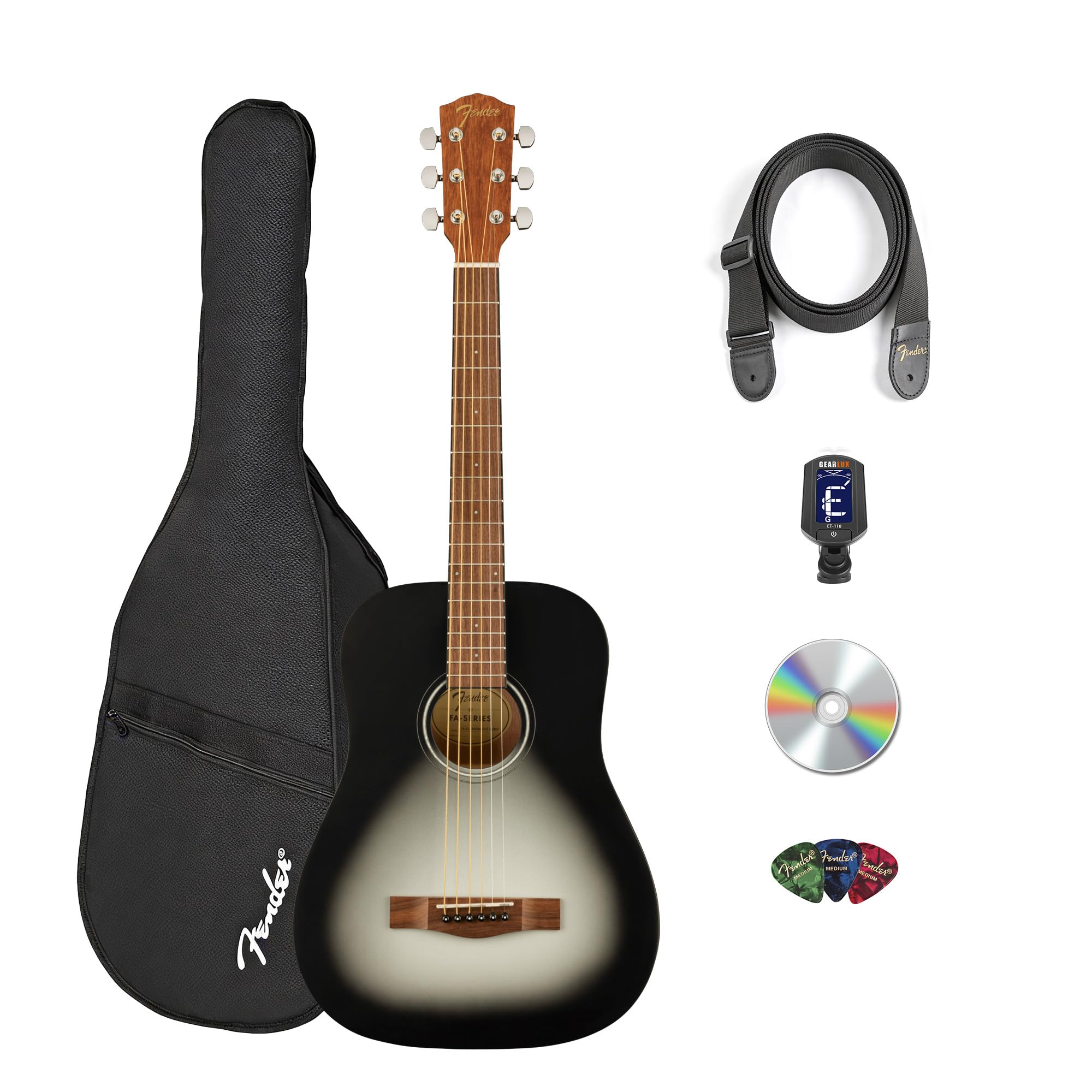
The Fender FA-15 is a dedicated kid-sized acoustic built for ages six to twelve, and it shows in every dimension. The nato neck and walnut fretboard are sized to fit small hands without cramping, and the sapele body offers a balanced, open tone that sounds brighter and more present than the budget-engineered wood kits. The “Moonlight Burst” finish is a visual standout, with a deep gradient that looks more premium than its tier suggests.
The bundle includes a Fender clip-on tuner, a guitar strap, picks, and an Austin Bazaar instructional DVD, making it a complete out-of-box solution for a young beginner. Several reviews from professional musicians note the “surprisingly high-quality sound” and flawless wood finishing. However, the included gig bag is often described as a flimsy dust cover rather than real protection, and some users report missing picks or guides in their kit.
One recurring concern is the lack of an upper strap button, which makes standing play awkward with the included strap. The tuning stability holds up well for a basic sealed-gear system, and the string tension is appropriate for small fingers that aren’t ready for a full-size steel string yet. If you want a brand-name instrument that comes complete and looks beautiful on day one, the FA-15 is the safest bet for a six- to twelve-year-old beginner.
Why it’s great
- Specifically sized for ages 6–12 with short scale and narrow neck
- Sapele body delivers a balanced, bright tone for the price
- Bundle includes tuner, strap, picks, and instructional DVD
Good to know
- Gig bag padding is minimal and offers limited protection
- No upper strap button for comfortable standing play
- Kit accessories occasionally have missing picks or guides
5. Hola! Music 3/4 Size Acoustic Guitar Bundle for Beginners – Purple

The Hola! Music 3/4 bundle is the rare budget-tier package where the guitar itself—not just the accessories—deserves attention. The solid spruce top combined with mahogany back and sides gives it a tonal warmth and dynamic range that surpasses most beginner kits at this tier. The rosewood fingerboard adds a smooth surface for quick chord changes, and the glossy finish makes the purple color pop without feeling cheap.
What sets this bundle apart is the string quality: it ships pre-strung with D’Addario EXP16 coated phosphor bronze strings, a detail usually saved for mid-range instruments. The included gig bag has backpack straps and is well-padded for this price point, and the bundle includes three picks in different sizes, a pick-guard, a hex key, and a strap. One review noted that the pick guard is flimsy and that the action arrived high, requiring a luthier or an experienced player to adjust the bridge.
Multiple customer reviews describe the guitar as “loud and bright,” with one user claiming it out-volumes a full-size guitar in a jam session. The tuning stability improves after an initial break-in period, and the neck feel is comfortable despite being slightly fatter than some competitors. If you’re shopping for a young musician who wants a complete kit with better wood specs than the generic alternatives, the Hola! Music bundle delivers where it counts.
Why it’s great
- Solid spruce top with mahogany back/sides for warm tone
- Pre-strung with high-quality D’Addario EXP16 strings
- Complete bundle with padded gig bag and multiple picks
Good to know
- Action may arrive high and require a professional setup
- Included pick guard is thin and may not adhere well
- Some units have fret buzzing that needs truss rod adjustment
6. Ibanez RG MiKro GRGM21 – Black

The Ibanez RG MiKro brings the 3/4 concept into the electric world with a 22-inch scale length and a poplar solid body. The reduced scale makes string bending effortless and barre chords dramatically easier for small hands. It features two Ibanez humbuckers with a five-way switch, delivering a surprisingly versatile range from smooth jazz to aggressive metal tones. The rosewood fretboard and maple neck follow the classic RG profile, just scaled down.
Customer reviews frequently highlight the build quality as exceptional for this price point, with a satin finish on the back of the neck that allows fast play without catching. However, the guitar almost always needs a professional setup out of the box: the truss rod typically needs adjusting, the fret ends require polishing, and the intonation should be checked before the guitar plays its best. One review noted that tightening the tuner screws and lubricating the nut and string trees significantly improved tuning stability.
The 22-inch scale is notably shorter than even most 3/4 acoustics, which means players with large hands may find the neck too narrow for comfortable play. The included accessories are minimal—no bag, strap, or picks—so factor in a padded gig bag and a cable. If your young guitarist wants to rock out on a full-featured electric that looks and plays like a real Ibanez, the RG MiKro is the best entry point for small-handed shredders.
Why it’s great
- 22-inch short scale makes bends and barre chords easy for small hands
- Dual humbuckers offer versatile tone for a compact electric
- Excellent build quality for the price point
Good to know
- Almost always requires a full professional setup (truss rod, fret polish, intonation)
- No accessories included—no bag, strap, or picks
- Narrow neck may feel cramped for players with larger hands
7. Pyle Acoustic Guitar Kit, 3/4 Junior Size, 36″ Dusk Gray Matte
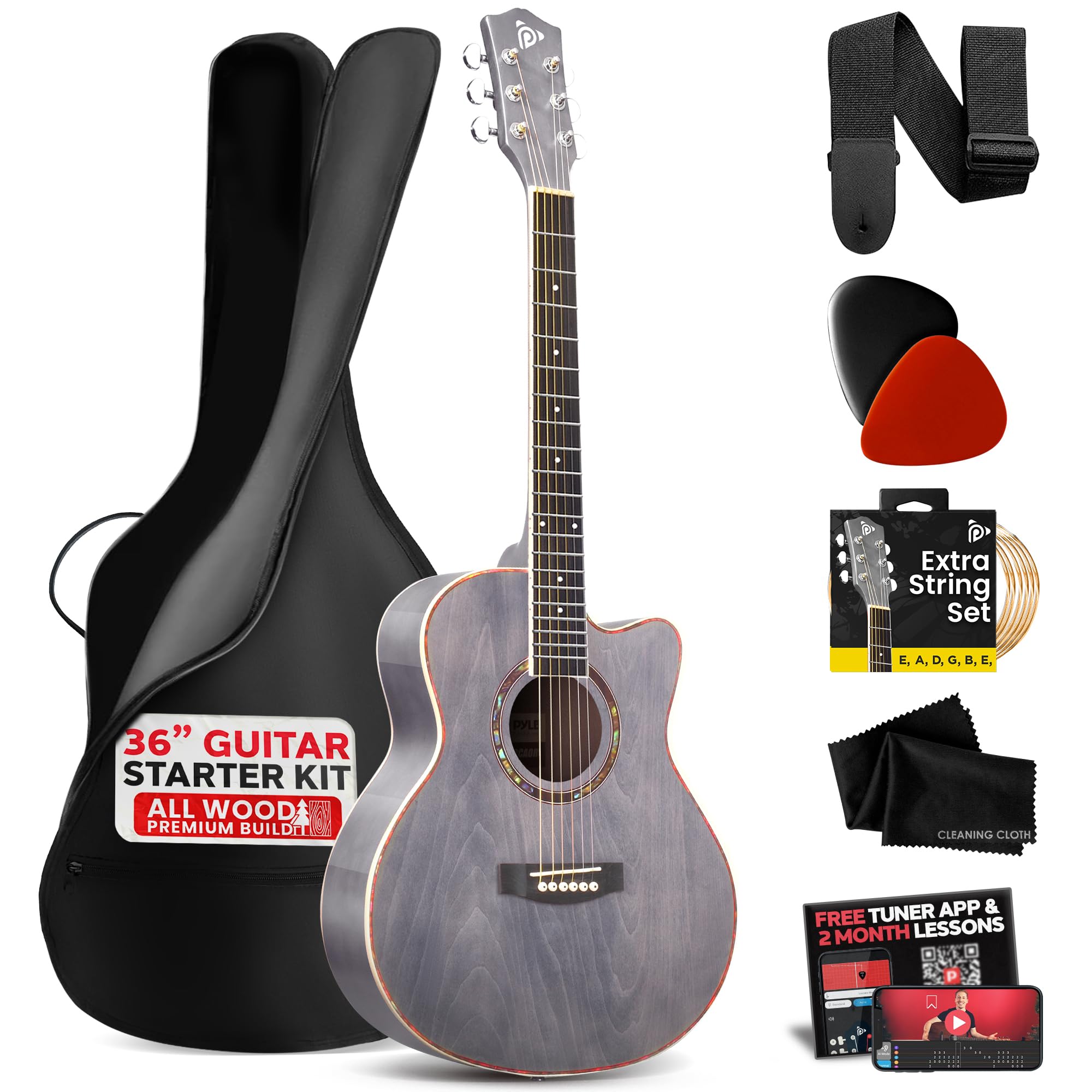
The Pyle Acoustic Guitar Kit is the most affordable entry point on this list, and it’s designed to get a complete beginner strumming in under ten minutes. The all-linden plywood body with a dusk gray matte finish looks tasteful and resists fingerprints. The kit includes a storage gig bag, six spare strings, picks, a cleaning cloth, and a detachable shoulder strap, so nothing extra needs to be bought.
Customer reviews are generally positive for a budget instrument: the tuners hold pitch surprisingly well with a capo, the fretboard is clean with manageable action, and the cutaway body design makes accessing higher frets easier. Several users mention that the included tuner is inaccurate, but the separate chromatic clip-on feature works well enough for quick adjustments. One review noted buzzing at the second fret that was resolved with a simple truss rod turn, suggesting quality control can vary between units.
The steel strings are stiffer than nylon alternatives, so absolute beginners—especially young children—may find finger pain a hurdle in the first week. The sound quality is adequate for practice and small spaces but lacks the resonance and dynamic range of the solid-spruce or solid-mahogany models above.
Why it’s great
- Most affordable 3/4 kit with all accessories included
- Cutaway body design for easier access to higher frets
- Tuning pegs hold pitch well after initial tuning
Good to know
- Included tuner is inaccurate; use a separate clip-on for reliable results
- All-linden plywood body limits resonance and dynamic range
- Steel strings can be painful for absolute beginners
FAQ
What age is a 3/4 guitar suitable for?
Can an adult play a 3/4 guitar comfortably?
Should I buy an acoustic-electric 3/4 guitar for a beginner?
What is the difference between a 3/4 and a 1/2 size guitar?
Final Thoughts: The Verdict
For most users, the best 3/4 guitar winner is the Yamaha APXT2 because it combines a responsive spruce top, reliable acoustic-electric electronics, and a built-in tuner at a mid-range price that doesn’t sacrifice quality. If you want a warmer, more sophisticated acoustic sound for fingerstyle play, grab the Taylor BT2. And for an indestructible travel companion that can handle any climate without cracking, nothing beats the Martin LXK2.