
Our readers keep the lights on and the weekend projects moving. As an Amazon Associate, I earn from qualifying purchases.
Shifting focus from the stale square of a standard webcam, a 360-degree conference camera turns an entire room into a single, cohesive frame. The core breakthrough is eliminating the far-end disconnect—remote participants no longer watch a talking head but experience the full spatial dynamics of a physical meeting, from the speaker’s gestures to the whiteboard behind them.
I’m Rikta — the co-founder and writer behind FitlyFast. This guide is built from hundreds of hours comparing lens arrays, beamforming mic configurations, and AI speaker-tracking algorithms across the current 360 conference camera market.
Whether you are equipping a huddle room or a boardroom, choosing the right best 360 conference camera requires understanding how stitching, audio pickup range, and auto-framing logic perform in your actual meeting environment.
How To Choose The Best 360 Conference Camera
360 conference cameras come with vastly different lens configurations and audio processing. The right choice depends on room size, participant number, and software ecosystem. Below are the three most critical specifications to evaluate before buying.
Lens Stitching and Room Coverage
Dual 180-degree lenses produce a seamless 360-degree panorama with a single node, minimizing parallax errors and fisheye distortion around table edges. Multi-camera arrays (four or more) capture wider vertical angles but require more aggressive post-processing software, which can introduce latency or visible seams in fast-moving scenes. For round tables, dual-lens designs usually deliver cleaner spatial coherence.
Microphone Array Density and Pickup Range
An 8-mic array with beamforming can lock onto a speaker 18 feet away while rejecting HVAC hum and paper shuffling. Lower-count arrays (3 or 4 mics) reduce pickup radius to roughly 10 feet and struggle with voice isolation in rooms over 300 square feet. Verify that the mic array supports omnidirectional full-room capture, not just directional front-facing pickup.
AI Auto-Framing and Speaker Tracking Logic
Basic AI algorithms simply reframe the last active speaker, which causes excessive panning in multi-speaker discussions. Premium systems use multi-modal tracking (face recognition + voice triangulation) to decide when to show the full room versus a close-up on the current talker. Look for systems that offer a panoramic mode override so remote viewers can see context, not just whoever is loudest.
Quick Comparison
On smaller screens, swipe sideways to see the full table.
| Model | Category | Best For | Key Spec | Amazon |
|---|---|---|---|---|
| Owl Labs Meeting Owl 3 | Premium | Medium/Large Rooms | 18 ft voice pickup range | Amazon |
| NexiGo Meeting 360 Ultra (Gen 3) | Premium | Multi-Camera Ecosystems | 8K capture, 4-camera support | Amazon |
| KanDao Meeting Pro | Premium | Standalone Android OS | 8-mic array, 18 ft range | Amazon |
| COOLPO Camera 360 | Mid-Range | Voice Tracking | 8 mics, AI stand-alone | Amazon |
| Insta360 Link 2 | Mid-Range | Gesture Control & Bokeh | 1/2″ sensor, 4K HDR | Amazon |
| j5create JVU368 | Mid-Range | Travel & Tables | 360° panoramic, remote | Amazon |
| PANOCORE360 Meeting Camera | Mid-Range | Small/Medium Rooms | 4K stitched to 1080p | Amazon |
| OBSBOT Tiny 3 Lite | Mid-Range | Desktop PTZ Tracking | 1/2″ sensor, 4K 120fps | Amazon |
| Bose Professional VB-S | Entry-Level | Compact Single Station | 4K 5x digital zoom | Amazon |
In‑Depth Reviews
1. Owl Labs Meeting Owl 3

The Owl Labs Meeting Owl 3 is the industry benchmark for plug-and-play hybrid collaboration. Its Owl Intelligence System fuses visual and audio cues to switch between the full 360-degree room view and a close-up of the active speaker, producing a smooth, natural transition even in discussions with three or four participants. The 1080p output is adequate for standard-sized screens, though some users note it feels soft when projected onto large conference room displays above 65 inches.
The 360-degree audio pickup reaches 18 feet, and the eight-microphone array does an excellent job isolating voices in carpeted rooms with standard acoustics. Dual-Owl pairing extends coverage to larger rectangular spaces without introducing echo, making it the most flexible scaling solution among standalone 360 cameras. The build quality is exceptional—verified by units surviving multiple drops over two years of daily use.
Its strongest weakness is the 1080p ceiling; in boardrooms with high-resolution displays, remote participants can see pixelation during digital zoom. The proprietary Owl Nest management tool gives IT admins fleet-level control, but the lack of an HDMI output limits direct connection to TVs without a computer. For teams that prioritize reliability and ease-of-deployment over raw resolution, this remains the most proven 360 conference camera on the market.
Why it’s great
- Seamless AI speaker tracking with panoramic context
- Rugged design survives frequent transport and drops
Good to know
- Video resolution limited to 1080p at a premium price
- Requires connected computer for most use cases
2. NexiGo Meeting 360 Ultra (Gen 3)
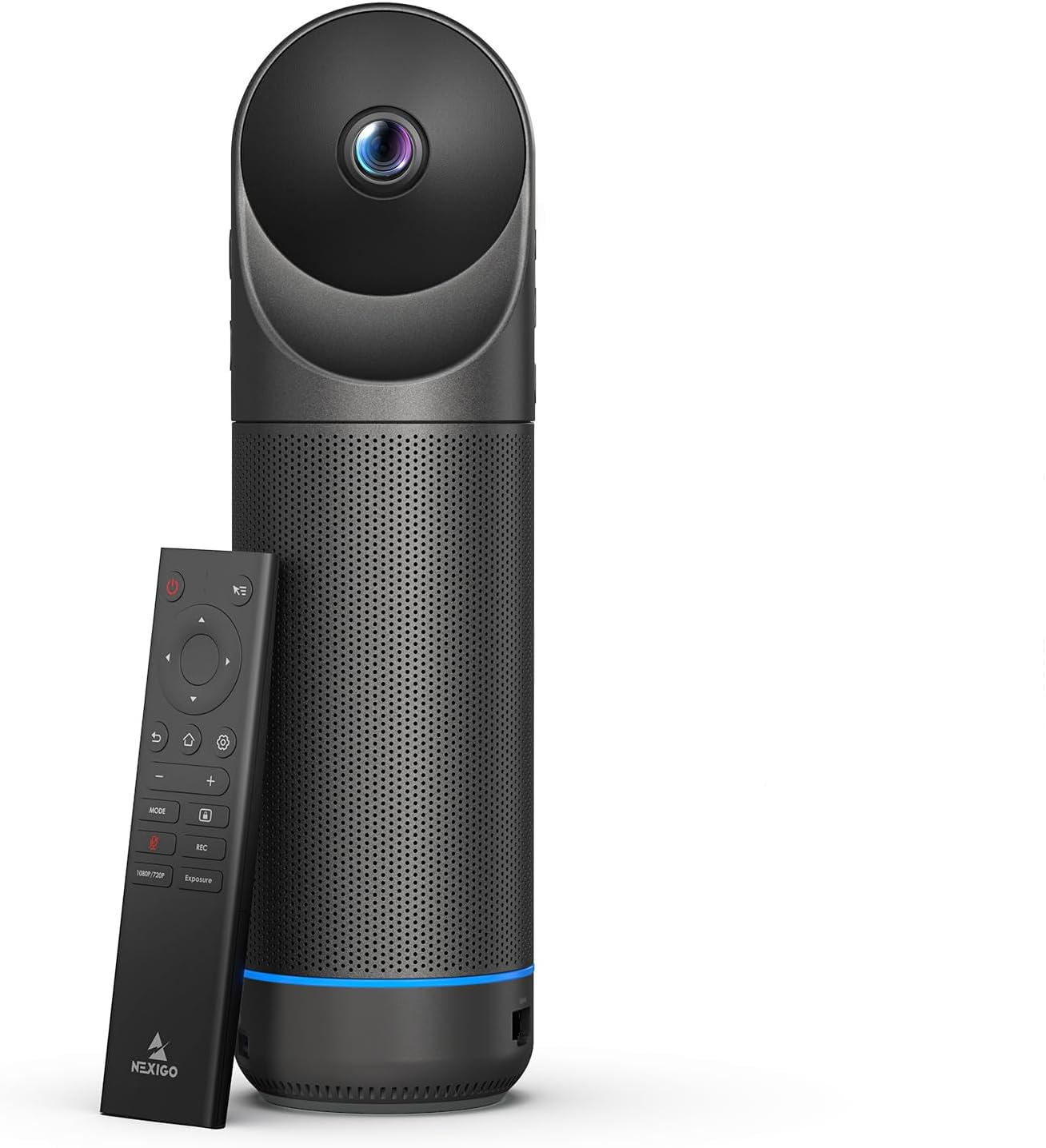
The NexiGo Meeting 360 Ultra Gen 3 distinguishes itself with a multi-camera architecture capable of stitching feeds from up to four physical units into a single cohesive 360-degree 8K capture downsampled to 1080p output. This gives it a genuine edge in L-shaped or long rectangular rooms where a single 360 camera leaves blind spots—the system detects participants across wider floorplans and automatically frames the active speaker with context from the other zones.
Its built-in Android OS eliminates the need for a connected laptop out of the box, allowing direct connection to a TV via HDMI for standalone Zoom, Teams, or Google Meet sessions. The eight-omnidirectional-mic array delivers the same 18-foot coverage as the Owl, but with a more aggressive noise gate that quiets side conversations. The onboard Hi-Fi speakers produce bi-directional sound that fills a medium conference room without distortion.
Downsides include a setup process that is slightly more involved than a single-unit plug-and-play system, as the multi-camera pairing requires the NexiGo Meeting Studio app. The 8K capture sensor creates very large still frames, but the video output is hard-limited to 1080p, so the sensor’s resolution headroom mostly benefits digital zoom quality. For teams that already own one 360 camera and want to expand coverage, this is the most forward-looking ecosystem.
Why it’s great
- Supports up to four daisy-chained cameras for large rooms
- Standalone operation without a laptop via built-in Android OS
Good to know
- Multi-camera setup requires dedicated app for pairing
- Video output limited to 1080p despite 8K sensor capture
3. KanDao Meeting Pro

The KanDao Meeting Pro packages dual 195-degree lenses into a single body that produces a complete 360-degree view with minimal stitching artifacts. Its five smart modes—Discussion, Global, Presentation, Patrol, and Custom—give meeting leaders granular control over how the camera frames participants. Discussion mode automatically tightens to the active speaker, while Patrol mode cycles through preset focus zones around the table for persistent scanning.
The eight-microphone array captures audio with an 18-foot pickup radius and includes a 5W high-fidelity speaker that projects clearly without a separate soundbar. The unit runs Android 10, enabling standalone use with a connected TV or monitor via HDMI, though initial setup requires a paired keyboard for Wi-Fi configuration and APK installations, which is less polished than the NexiGo’s native app store. Local recording to SD cards at 1080p is a practical asset for firms that archive meetings.
A notable limitation is the lack of Google Play Protect certification, meaning the standalone Android mode forces manual APK sideloading for apps not pre-installed. The lightweight 0.8 kg body is portable, but the absence of a dedicated travel case is a minor oversight. For teams that appreciate flexible view layouts and local recording, the KanDao delivers premium-adjacent features at a more accessible entry point than the Owl or NexiGo.
Why it’s great
- Five specialized meeting modes (Patrol, Discussion, Global)
- Local 1080p recording to SD card without a computer
Good to know
- Standalone Android mode needs manual APK sideloading
- No travel case included for portable use
4. COOLPO Camera 360

COOLPO’s AI Huddle Pana stands out for its 4K 360-degree capture with no visible stitching line, thanks to its proprietary hardware-level spherical fusion. The eight-microphone array, combined with the MeetingFlex AI engine, performs stand-alone edge computing that processes all voice tracking and noise cancellation locally—no cloud data is transmitted, which satisfies strict corporate security policies. Speaker tracking is fast enough to follow a presenter walking around a conference table without the nausea-inducing snap that cheaper units produce.
Plug-and-play setup over USB works with Windows, macOS, Zoom, Teams, and Google Meet without driver downloads. The physical USB connection doubles as a security guarantee against wireless interception. Audio quality is genuinely impressive for conference calls, with the mics capturing voices crisply up to 15 feet away; the built-in speaker, however, begins to distort above 70% volume in larger rooms, so pairing with a separate soundbar is recommended for spaces exceeding 20 participants.
The fish-eye lens introduces distortion at the table’s edges, creating a curved visual that takes getting used to. The older microUSB connector on some units feels dated compared to the USB-C found on newer 360 cameras. For security-conscious organizations that want 4K resolution and local-only AI processing, the COOLPO delivers reliable hardware with a privacy-first architecture.
Why it’s great
- Local AI processing with no cloud data transfer
- 4K capture with seamless hardware stitching
Good to know
- Fisheye distortion visible around table edges
- Speaker quality drops above 70% volume level
5. Insta360 Link 2

Insta360’s Link 2 is a PTZ webcam that physically pans and tilts rather than using digital cropping, giving it a unique advantage for desktop and small-room setups. Its 1/2-inch CMOS sensor captures true 4K HDR video with phase-detection autofocus that locks onto faces faster than most contrast-based systems, making it ideal for dynamic presentations and product demos. The dedicated Link Controller software opens up pro-grade calibration like exposure gamma curves and NVIDIA Maxine Eye Contact for post-production refinement.
Gesture control is genuinely useful during calls—raising a hand triggers tracking, and palm gestures enable zoom and Whiteboard Mode without fumbling for a remote. The AI noise-canceling algorithm effectively filters keyboard clatter and open-office chatter, though the integrated tri-mic array is weaker on pickup range than the larger 360 all-in-ones, topping out around 8 feet. DeskView mode tilts the camera downward to capture paper documents on a table, a practical feature for remote teaching and design reviews.
The magnetic mount is strong and includes recognition markers for software calibration, but the gimbal mechanism can occasionally lose track of a fast-moving speaker and snap to a random object in the background. The unit is not currently compatible with ARM-based Windows systems or Windows Hello Face Recognition. For professionals who want a high-quality PTZ camera with physical movement rather than 360-degree room capture, the Link 2 is the best desktop-specific option here.
Why it’s great
- Physical PTZ gimbal with gesture and voice control
- 1/2-inch sensor with PDAF and professional software suite
Good to know
- Mic pickup range is limited compared to all-in-one room cameras
- Not compatible with ARM-based Windows or Windows Hello
6. j5create JVU368

The j5create JVU368 brings a portable, tabletop 360-degree design that fits into a detachable travel case, making it a solid choice for on-site client meetings and multi-location teams. Its AI cropping feature automatically identifies the active speaker out of a 2-3 person group, producing close-up framing suitable for podcasts and around-table streaming. The included remote control offers digital zoom and pan, which reduces the need for software tinkering during live calls.
Video output is 1080p with no 4K option, but the 360-degree panoramic view gives remote participants a full-context room shot that static webcams cannot match. The omnidirectional microphone with advanced noise cancellation delivers clear audio in small to medium rooms, though the speaker output lacks the fullness needed for music or high-volume presentations. Users report the AI auto-framing works best when participants stay within 6 feet of the camera center.
Build quality is a mixed bag—the electronics and acoustics are strong, but some units have documented issues with the magnetic lens cap adhesive failing and the base glue separating after a few weeks of use. The plastic body feels lighter than the metal-premium class, which may affect long-term durability in daily transport. For budget-constrained teams that need 360 coverage with decent tracking at the lowest price point, the j5create JVU368 is the best entry-level large-room option.
Why it’s great
- Portable design with included travel case
- AI cropping tracks 2-3 participants for close-up shots
Good to know
- Build quality concerns with magnetic cap and base glue
- 1080p only, no 4K video output
7. PANOCORE360 Meeting Camera
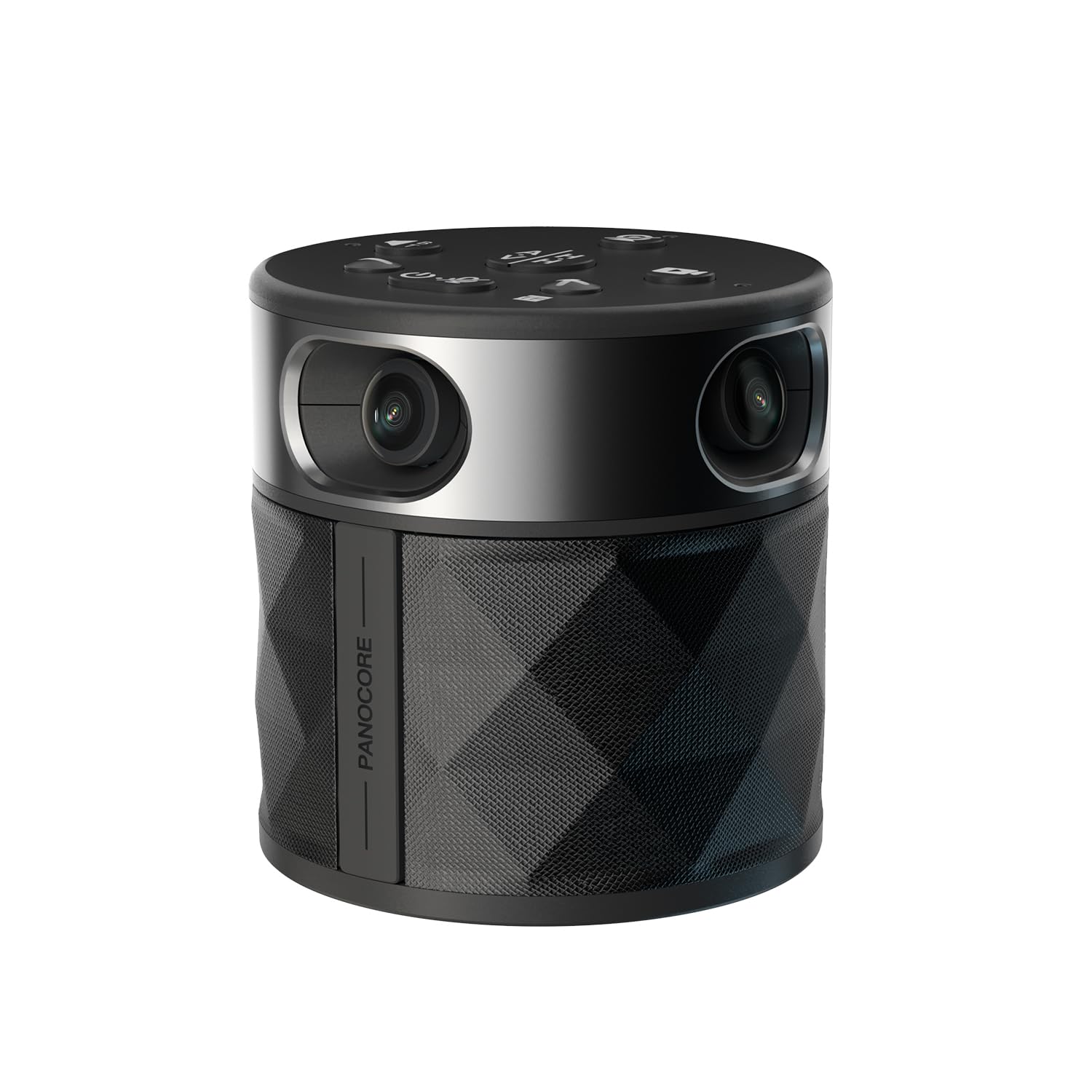
The PANOCORE360 distinguishes itself with chip-level vision stitching that fuses four camera feeds into a 4K capture and downsamples to a 1080p output stream. This on-device processing means the camera works without requiring heavy computational overhead from the connected PC, and it consumes only 5V/1.67A via USB. The small form factor includes a built-in speaker and three-microphone omnidirectional array with a 10-foot pickup range—sufficient for huddle rooms with up to six attendees.
Auto speaker focus works in two modes: a full 360-degree view that follows the talker while showing room context, or a dual 180-degree widescreen that splits the environment into two wall feeds. The local recording function stores MP4 files directly to a MicroSD card, enabling meeting capture without any software subscription. Setup is genuinely driver-free, and compatibility spans Zoom, Teams, Webex, and Google Meet without platform lock-in.
The tripod base feels light and slightly unstable, and the 1080p output lacks the crispness of native 4K conference cameras when displayed on large monitors. The three-mic array limits pickup to 10 feet, so participants at the far end of a 12-person table may sound distant. For small huddle spaces that need 360 room capture with plug-and-play simplicity, the PANOCORE360 is a well-executed budget entry that punches above its weight in stitching quality.
Why it’s great
- 4K stitching to 1080p via dedicated chip-level processing
- Local MP4 recording to MicroSD without software
Good to know
- Mic pickup limited to 10 feet, best for smaller rooms
- 1080p output is soft compared to native 4K units
8. OBSBOT Tiny 3 Lite
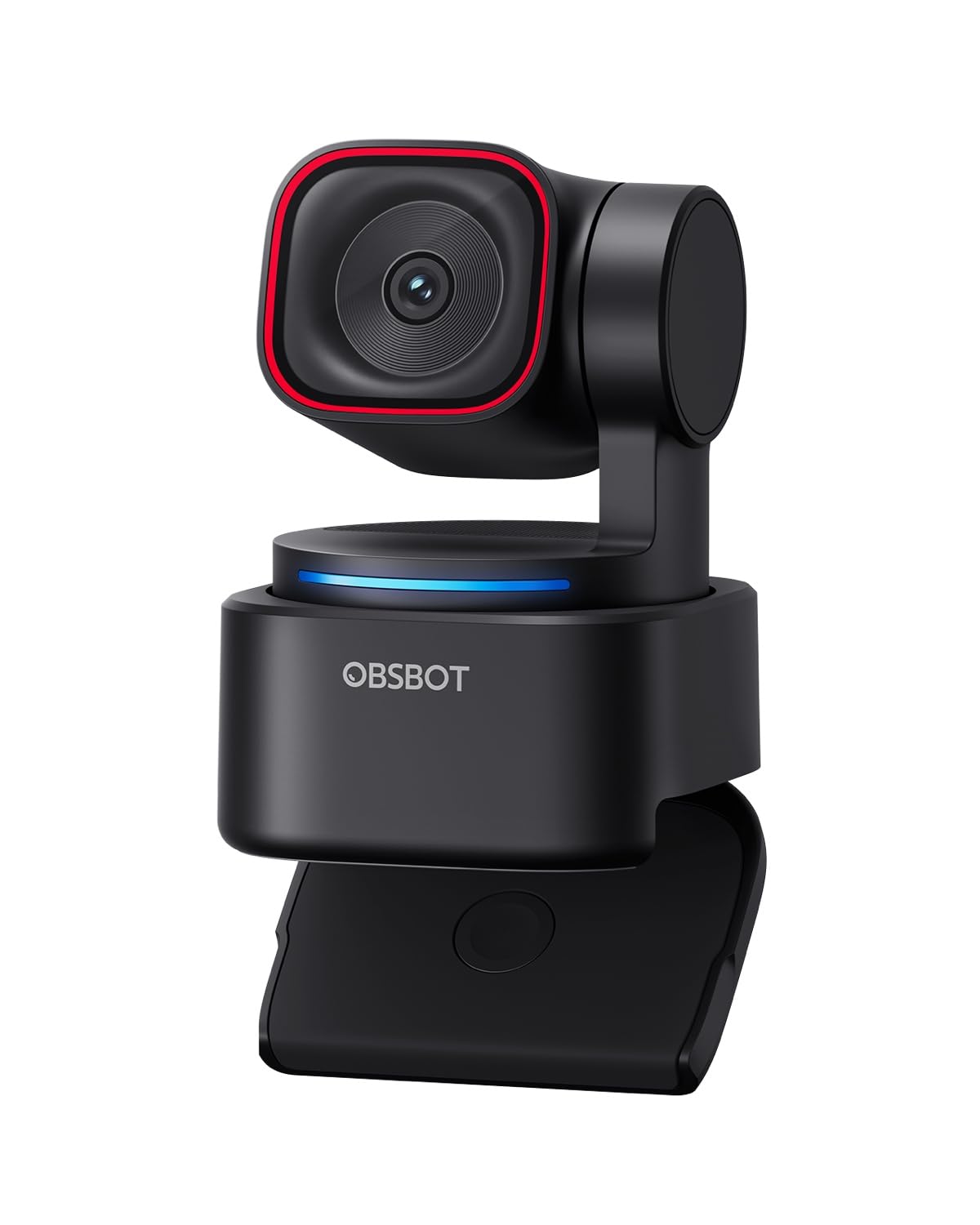
The OBSBOT Tiny 3 Lite is a 48% smaller and 34% lighter evolution of its predecessor, packing a 1/2-inch CMOS sensor that captures 4K at 30 fps or 1080p at 120 fps. Its 4x digital zoom and phase-detection autofocus (PDAF) provide crisp, fast focus transitions even in low-light environments, with a wide ISO range of 100-6400 producing balanced results in dim conference rooms. The tri-mic array transitions between omnidirectional room pickup and directional MEMS mics for spatial audio recording.
AI Tracking 2.0 supports over 200 object types, including group tracking that keeps multiple meeting participants framed together during collaborative sessions. Gesture and voice commands allow hands-free control—raising a palm starts tracking and waving controls zoom, which streamlines presentations. The OBSBOT Center software includes a teleprompter, background blur, and NVIDIA Maxine Eye Contact, giving content creators and remote workers pro-level tools without a separate switcher.
Some users report that the AI tracking occasionally locks onto background objects instead of the intended speaker, especially when the target moves behind a chair or desk. The lack of a built-in flash memory means all recording relies on the host computer’s resources, which can introduce latency on older laptops. For solo streamers, educators, and professionals who want a desktop PTZ camera with robust AI features and a small footprint, the Tiny 3 Lite is the best compact choice in this range.
Why it’s great
- 48% smaller than previous model with upgraded 1/2″ sensor
- 120 fps at 1080p for ultra-smooth motion capture
Good to know
- AI tracking can occasionally lock onto background objects
- All recording relies on host computer, no onboard storage
9. Bose Professional VB-S

The Bose Professional VB-S is an all-in-one videobar that blends a 4K PTZ camera with Bose’s class-leading audio engineering. The four-beamforming microphone array focuses on human voices while filtering out HVAC hum and paper shuffling, paired with a hi-fidelity Bluetooth speaker that doubles as a music streamer during breaks. The 5x digital zoom combined with digital PTZ functionality and two auto-framing modes gives small-room meetings a polished broadcast quality, though the camera sensor is not in the same class as dedicated 360-degree units.
Setup is genuinely simple—plug the USB-C cable into a laptop and the VB-S appears as both a microphone and speaker, eliminating the need for separate peripherals. Compatibility spans Google Meet, Microsoft Teams, Zoom, and more, with the included IR remote providing manual control over presets and zoom. Build quality is exceptional, with a low-profile black enclosure that blends into credenzas and wall mounts without dominating the room.
The VB-S does not capture true 360-degree room coverage; its wide-angle lens covers about 120 degrees, so it is best suited for single-conference-table setups rather than full-room panoramic views. The small size means the speaker can feel underpowered in rooms with more than eight people, and the proprietary power brick is larger than expected for the unit’s footprint. For offices that prioritize superb audio quality and a simple videobar experience over 360-degree capture, the VB-S delivers Bose sound in a professional video package.
Why it’s great
- Best-in-class beamforming mic array from Bose
- Bluetooth music streaming for meeting breaks
Good to know
- Wide angle only, no 360-degree room capture
- Speaker power limited; not ideal for rooms with 8+ people
FAQ
Can a 360 conference camera replace a standard webcam for single-person calls?
What is the minimum recommended room size for a 360 conference camera?
Do 360 conference cameras require special software or drivers?
How do multi-camera 360 systems handle overlapping coverage?
Final Thoughts: The Verdict
For most users, the best 360 conference camera winner is the Owl Labs Meeting Owl 3 because its proven speaker-tracking intelligence and 18-foot mic range make it the most reliable choice for mixed-participant hybrid meetings in standard conference rooms. If you want multi-camera coverage for large or oddly-shaped rooms, grab the NexiGo Meeting 360 Ultra (Gen 3). And for budget-friendly 360 capture in small huddle spaces, nothing beats the PANOCORE360 Meeting Camera.