
Our readers keep the lights on and the weekend projects moving. As an Amazon Associate, I earn from qualifying purchases.
Specs are compiled from manufacturer listings and verified buyer reviews and can change over time — please confirm the key details on the product page before buying.
If you want crisp details straight from the start without spending a week tinkering, your main choice today is between fast core‑XY filament printers and ultra‑fine resin machines. One type builds tough functional parts at speed; the other sculpts miniature figurines with near‑invisible layer lines. Picking wrong can leave you swapping machines six months in.
I’m Rikta — the founder and writer behind FitlyFast. This guide is built by comparing the manufacturers’ published specifications and the patterns across verified customer reviews, so you get each pick’s real strengths and trade-offs instead of marketing spin.
if you need industrial‑grade engineering materials or a resin printer for jeweler‑level precision, the right 3d printer for your workshop depends on matching print speed, material range, and enclosed features to the specific parts you plan to make day after day.
Quick Picks
- Bambu Lab P1S 3D Printer — Best Overall
- QIDI PLUS4 3D Printer — Engineering Champion
- ELEGOO Centauri Carbon 3D Printer — Best Value
- FLASHFORGE AD5X Multi‑Color 3D Printer — Multi‑Color Entry
- ELEGOO Mars 5 Ultra 9K MSLA Resin 3D Printer — Resin Detail King
- ANYCUBIC Photon Mono 4 Resin 3D Printer — Budget Resin Entry
How To Choose The Best 3D Printer
The right 3D printer for you lives at the intersection of what you want to print and how fast you want it done. Before scrolling through specs, ask yourself one question: am I printing detailed miniatures and jewelry (resin), or functional parts, prototypes, and large models (FDM)? That answer alone cuts half the options.
Build Volume and Print Size
Build volume is the three‑dimensional box your printer can fill. If you regularly need a part larger than roughly 6 inches on a side, a resin printer will feel cramped — you will have to split the model and glue sections. Resin machines typically top out around 6.5 inches on the Z axis, while FDM printers commonly offer 10‑inch cubes or larger, which lets you print helmets, brackets, and full‑size prototypes in one piece.
Nozzle Temperature and Material Range
The maximum nozzle temperature (measured in degrees Celsius) dictates which plastic filaments you can use. Standard printers top out around 260°C, which handles PLA, PETG, and basic ABS. If you want to print carbon‑fiber nylon, PPS‑CF, or polycarbonate, you need a hotend (the heated part that melts filament) rated to at least 320°C — and ideally an enclosed chamber that can maintain a stable heated environment to prevent warping and layer separation. The higher the nozzle temperature, the wider your material toolbox.
Print Speed and CoreXY Structure
Speed matters most when you print the same part multiple times or make large objects. A CoreXY motion system (a belt-driven design that moves only the light print head, not the heavy bed) is lighter and faster than the traditional bed‑slinger design. Print speeds of 500 or even 600 mm/s are common on CoreXY machines today, paired with acceleration values up to 20,000 mm/s². A resin printer typically moves much slower, around 70–150 mm/h on the Z axis, because each layer must be cured by a UV screen. Fast FDM wins for functional prototyping; slow resin wins for surface finish.
Quick Comparison
| Model | Best For | Print Speed | Build Volume | Weight | Amazon |
|---|---|---|---|---|---|
| Bambu Lab P1S | Multi‑Color & Enclosed | 500 mm/s | — | 38.9 lb | Amazon |
| QIDI PLUS4 | High‑Temp Engineering Filaments | 600 mm/s | 12 x 12 x 11 in | 59.4 lb | Amazon |
| ELEGOO Centauri Carbon | Out‑of‑Box Simplicity | 500 mm/s | 256 x 256 x 256 mm | 38.5 lb | Amazon |
| FLASHFORGE AD5X | Multi‑Color Entry Level | 600 mm/s | 220 x 220 x 220 mm | 24.2 lb | Amazon |
| ELEGOO Mars 5 Ultra 9K | Ultra‑Fine Resin Details | 150 mm/h | 6.04 x 3.06 x 6.49 in | 24.6 lb | Amazon |
| ANYCUBIC Photon Mono 4 | Budget Resin Prints | 70 mm/h | 6.04 x 3.42 x 6.49 in | 7.7 lb | Amazon |
In‑Depth Reviews
1. Bambu Lab P1S 3D Printer

The enclosed workhorse that just prints without fuss, from the start in 15 minutes.
You get crisp parts from day one because the P1S has automatic bed leveling (the printer measures the bed tilt and compensates, so you do not need to screw around with a feeler gauge). Its CoreXY motion system moves the print head at 500 mm/s with 20000 mm/s² acceleration, so that large bracket or prototype finishes in hours, not days. The fully enclosed design keeps drafts off the print — reviewers report fewer warped corners on filaments like PETG, ABS, and ASA compared to open-frame printers.
To print up to 16 colors or multiple materials in one run, you add the Bambu Lab AMS unit (sold separately). That single-run flexibility lets you make models with different colors or soluble support structures. Buyers report that the 38.9‑pound frame stays solid at high speed, which helps avoid the ringing (ghost lines on the surface) that cheaper printers show on fast moves.
At 38.9 pounds, this machine is far more stable than a 7.7‑pound resin printer like the ANYCUBIC Photon Mono 4 — that mass soaks up vibration for clean layers. The trade‑off is that the P1S does not officially support carbon‑ or glass‑fiber reinforced filaments, so if you need those extreme materials, you will want a hotter hotend like the QIDI PLUS4’s 370°C extruder.
Why It Wins
- Fully enclosed design for consistent ABS and ASA prints
- Up to 16‑color/multi‑material support via optional AMS
- Set up in 15 minutes, auto bed leveling from the start
The Limits
- Not recommended for carbon or glass‑fiber reinforced filaments
- Requires additional AMS unit for multi‑color capability
Your best match if: you want fast, reliable, multi‑color printing in an enclosed environment without spending days on setup.
The catch: you will need the separate AMS for multi‑color, and you cannot print the hardest engineering composites with it.
2. QIDI PLUS4 3D Printer

A monster‑sized machine that prints exotic filaments at temperatures others cannot reach.
You print carbon‑fiber nylon (PPS‑CF) or PPA‑CF/GF because the direct extruder hits 370°C — 50°C hotter than the ELEGOO Centauri Carbon’s 320°C nozzle, so it melts filaments that would jam a standard printer. The second‑generation active chamber heating system maintains a consistent 65°C inside; the 400W heater plus dual‑layer insulation means warping and cracking on high‑temperature parts drop significantly, according to reviewers. With a large 12 x 12 x 11 inch build volume, you can print sizable functional components in one go.
This printer hits 600 mm/s print speed (20% faster than the ELEGOO Centauri Carbon’s 500 mm/s), and the CoreXY structure keeps it stable at those speeds. The dual‑motor Z‑axis and 6‑mm thick aluminum bed with 10‑mm lead screws add rigidity that matters when you are printing tough carbon‑filled nylon. Owners mention the HD camera and remote control via the QIDI app are reliable for keeping an eye on long overnight runs.
At 59.4 pounds, it is the heaviest machine on this list — the Bambu Lab P1S is 38.9 pounds, nearly 20 pounds lighter — so you will want a sturdy table. The PLUS4 also supports future multi‑color printing via the QIDI BOX (launching later), so it is not stuck with single‑color parts forever.
Standout Traits
- 370°C hotend for PPS‑CF, PPA, polycarbonate, and more
- Active 65°C heated chamber — reduces warping on large parts
- 12 x 12 x 11 inch build volume handles big single prints
Consider Before
- At 59.4 lb, it needs a strong workbench; not portable
- Premium price reflects engineering‑grade capability
Reach for this if: you print carbon‑fiber, nylon, or other high‑temp filaments and cannot afford failed prints due to chamber temperature drop.
Look elsewhere if: you mostly print PLA and PETG — you are paying for extreme heat capacity you will not use.
3. ELEGOO Centauri Carbon 3D Printer
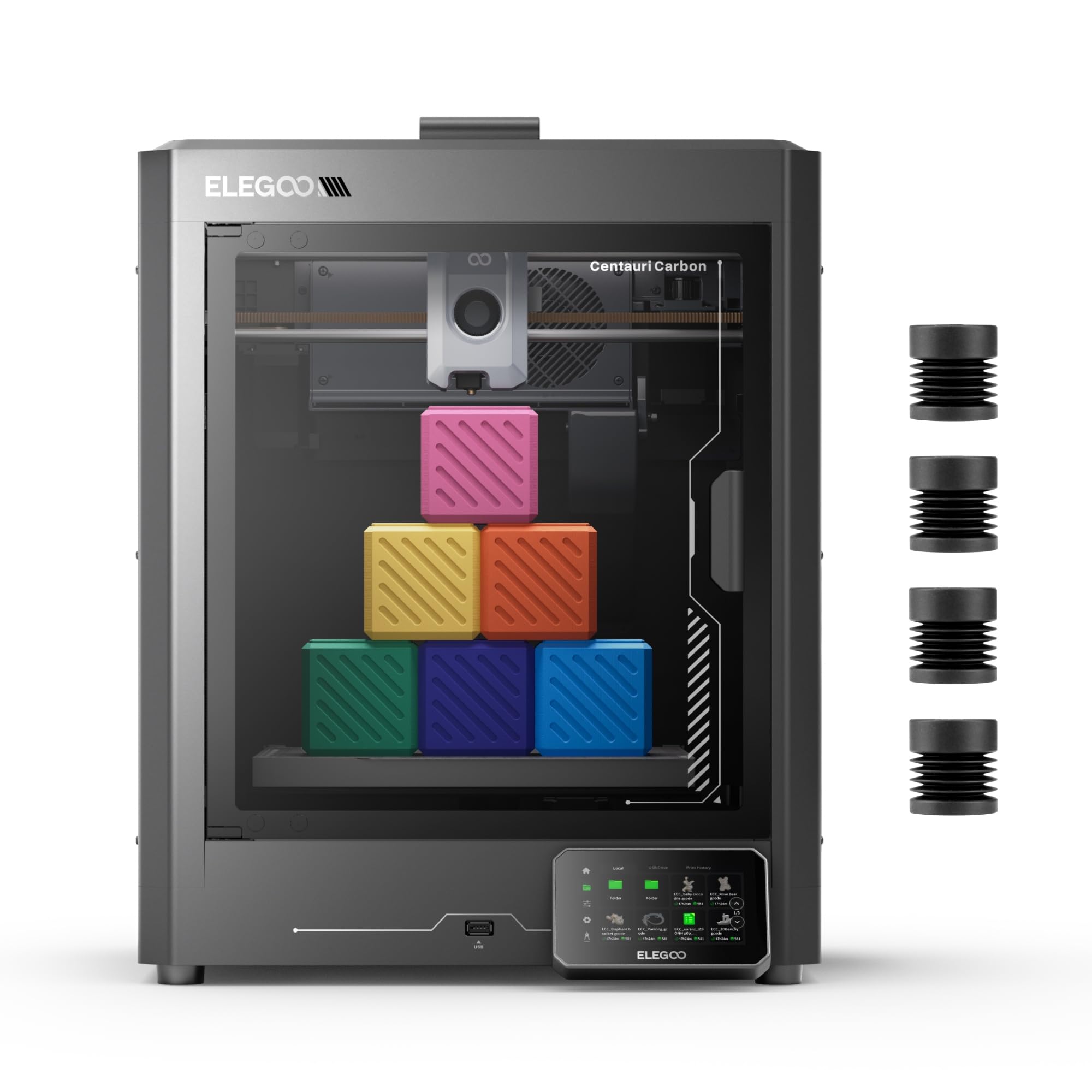
Fully assembled and pre‑calibrated so you can print within minutes of unboxing.
You load filament and start printing because auto bed leveling is already configured. The 256 x 256 x 256 mm (ten‑inch cube) build volume gives you a spacious platform without taking up too much desk space. Its CoreXY structure delivers up to 500 mm/s speed and 20000 mm/s² acceleration, which is right in line with the Bambu Lab P1S and good for rapid prototyping. The 320°C brass‑hardened steel nozzle means you can print carbon‑fiber reinforced filaments — something the P1S does not officially support.
What makes this printer different is the die‑cast aluminum frame — it is a single rigid casting that minimizes vibrations. Combined with automatic vibration compensation and pressure advance (software that adjusts filament flow for sharp corners), the first layer goes down smooth and consistent even at high speeds. A built‑in chamber camera with dual LED lighting lets you watch prints remotely, and the upgraded dual‑sided plate has a PLA Specific Surface that sticks well without needing a hot bed at high temperature.
Customers note that the enclosed chamber keeps drafts off the print, which helps with ABS and nylon. At 38.5 pounds it is comparable to the Bambu Lab P1S (38.9 pounds), but the ELEGOO leans more toward engineering filaments thanks to the higher nozzle rating.
Why It Shines
- Pre‑assembled and pre‑calibrated — true out‑of‑box experience
- 320°C nozzle handles carbon‑fiber nylon and similar engineering composites
- Die‑cast frame dampens vibration for clean high‑speed layers
One Drawback
- Does not officially support multi‑color printing without a separate upgrade
- Build plate is dedicated to PLA specific surface; swapping for different materials takes more effort
Best for beginners and tinkerers: you want a fast, enclosed CoreXY printer that handles advanced filaments without any assembly hassle.
The limitation: if multi‑color is your priority, the Bambu Lab P1S plus AMS gives you more flexibility.
4. FLASHFORGE AD5X Multi‑Color 3D Printer
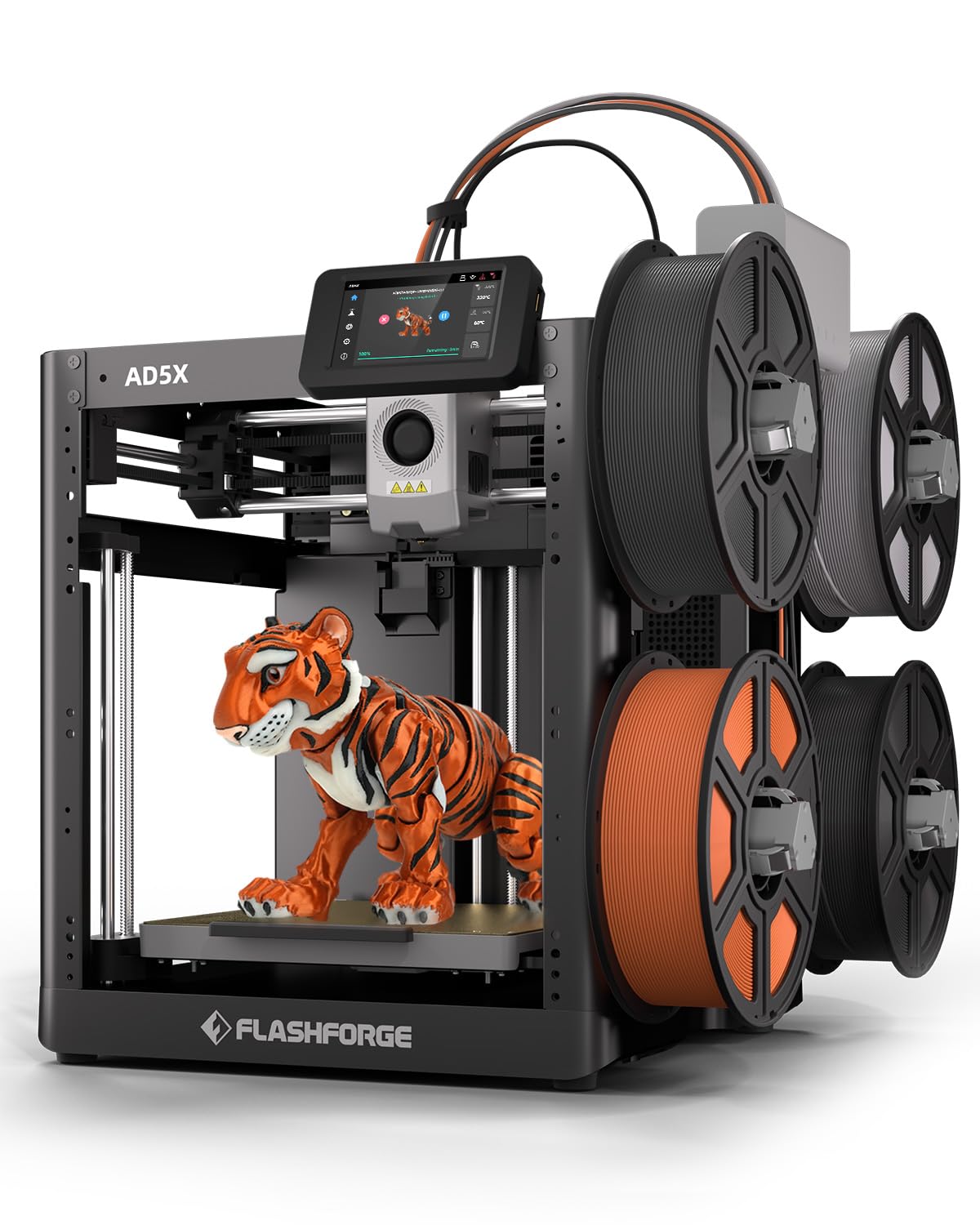
A fast, 4‑color CoreXY machine that brings multi‑material printing to a much lower price point.
You get up to four colors simultaneously without needing a separate multi‑material unit — that keeps the upfront cost down compared to the Bambu Lab P1S, which requires the optional AMS for the same capability. The CoreXY structure runs at speeds up to 600 mm/s with 20000 mm/s² acceleration, so you get the same rapid prototyping speed as premium machines. The 300°C direct‑drive extruder (the motor pushes filament directly, not through a tube) with 0.4 mm pre‑installed nozzle is versatile for everyday PLA, PETG, and ABS, and you can swap to a 0.25 mm nozzle for tiny details or a 0.8 mm nozzle for large functional parts.
One‑click auto leveling is standard, and a dual‑channel cooling fan plus vibration compensation keep print quality high. The built‑in resume printing function handles power loss, and you can control everything remotely through the Flash Maker mobile app. The 220 x 220 x 220 mm build volume is good for typical desk projects, though smaller than the 256‑mm cubes of the ELEGOO Centauri Carbon and Bambu Lab P1S.
At 24.2 pounds it is significantly lighter than the all‑metal competitors — easier to move around, but you lose some of the vibration‑damping mass that frames like the die‑cast Centauri Carbon provide. Reviewers mention the auto‑filament feeding works well for smooth color switches.
What Works
- Built‑in 4‑color printing without extra hardware purchase
- 600 mm/s speed rivals much more expensive machines
- Interchangeable nozzles (0.25–0.8 mm) for detail or speed
What to Note
- 220 mm build volume is smaller than the 256‑mm competitors
- 300°C extruder cannot handle extreme composites like PPS‑CF
Choose this for: creative multi‑color projects without the premium price tag, and for printing at up to 600 mm/s.
skip it if: you need a larger build plate or plan to print carbon‑fiber reinforced filaments regularly.
5. ELEGOO Mars 5 Ultra 9K MSLA Resin 3D Printer

The resin printer with an AI camera and smart sensor that catches print errors before you waste resin.
You get figures, rings, and dental models with extremely fine surface detail that an FDM printer cannot match because the 9K LCD screen (9,024 x 5,120 pixels across the screen) cures each layer of liquid resin with sub‑20‑micron precision. The built‑in smart mechanical sensor detects when the resin is low, if a foreign object is in the vat, or if the light board temperature is too high — then it alerts you or pauses. An AI camera inside the build area monitors for empty build plates and model warping, and it lets you record time‑lapse videos of the whole print process.
Print speed on the Z axis reaches 150 mm/h — twice as fast as the ANYCUBIC Photon Mono 4’s 70 mm/h — thanks to the Tilt Release Innovation, which reduces the time the build plate needs to lift and separate from the vat. The print volume is 6.04 x 3.06 x 6.49 inches, similar to the Photon Mono 4 but with a smarter detection system. It supports WiFi cluster printing (up to 6–10 Mbps) over both 2.4G and 5G networks, so you can start prints and do OTA (over‑the‑air) firmware updates from your phone.
At 24.6 pounds, the Mars 5 Ultra is about three times heavier than the ANYCUBIC Photon Mono 4 (7.7 pounds) — that extra mass comes from the larger metal chassis and the integrated smart components. Reviewers praise the automatic leveling (a mechanical sensor and spring handle it with one click) for removing the biggest headache of resin printing.
What Makes It Special
- Built‑in AI camera and smart mechanical sensor catch errors early
- 9K resolution for smooth, detailed surfaces on miniatures
- WiFi cluster printing with 2.4G and 5G support
The Trade‑Offs
- Small build volume (6 inch range) limits you to small objects
- Resin printing requires post‑processing (wash and cure station recommended)
Grab it if: you want a worry‑free resin printer where the machine watches for mistakes and gives you a time‑lapse of the process.
Not for you if: you need large functional parts — go with an FDM printer instead.
6. ANYCUBIC Photon Mono 4 Resin 3D Printer

A 10K resin printer at a budget price that packs twice the precision of the older Mono 2.
You get almost injection‑molded surface finish because the 7‑inch 10K monochrome LCD screen has a resolution of 9024×5120, giving each pixel a tiny 17×17μm size on the X and Y axes — meaning you see almost no visible layer lines even on smooth curves. The Anycubic LighTurbo matrix light source spreads the UV light uniformly across the build area, which reduces layer lines and rasterization artifacts (blurry pixel edges) for a smoother finish than earlier Mono models.
Print volume is 6.04 x 3.42 x 6.49 inches, which is standard for this price tier — enough for tabletop miniatures, jewelry patterns, and small prototypes. The laser‑engraved print platform improves adhesion so your model does not lift or warp during the print, and the four‑screw leveling method is simple: once you set it, you do not need to re‑level between prints. It also supports power‑loss resume printing, so a flicker in the middle of a six‑hour print does not ruin the model.
At 7.7 pounds the Photon Mono 4 is astonishingly light compared to larger resin machines like the ELEGOO Mars 5 Ultra at 24.6 pounds — it is genuinely portable and easy to move between rooms. Reviewers point out the user‑friendly leveling and the 70 mm/h print speed make it an excellent first resin printer for people coming from FDM.
What You Get
- 7‑inch 10K screen (17×17μm pixel size) for high detail
- Laser‑engraved platform improves adhesion without warping
- Lightweight at 7.7 lb — easy to move or store
What Is Limited
- No WiFi, no camera, no smart sensors — simpler than the Mars 5 Ultra
- 70 mm/h print speed is half the speed of the Mars 5 Ultra’s 150 mm/h
Ideal for the budget‑minded maker: you want the highest resolution per dollar for miniatures and small models.
Look past it if: you want remote monitoring, faster speeds, or the convenience of built‑in AI monitoring.
Understanding the Specs
Print Speed (mm/s vs mm/h)
FDM printers measure speed in millimeters per second (mm/s) — how fast the print head moves horizontally. A speed of 500–600 mm/s is considered fast for FDM today. Resin printers measure speed in millimeters per hour (mm/h) because each layer must be exposed and cured by a UV screen. A resin speed of 150 mm/h is fast for that category. Always check which unit the manufacturer uses, or you will accidentally compare horizontal travel with vertical layer growth.
Build Volume
Build volume is given as Width x Depth x Height in either inches or millimeters. This tells you the largest single object you can print without splitting it. An FDM printer with a 256 mm cube (about 10 inches) can print a helmet piece or a large bracket. A resin printer with a 6.5 inch Z height is great for miniatures and rings but too small for functional parts that are more than a few inches tall.
Nozzle Temperature and Chamber Heating
The nozzle temperature (measured in °C) determines which filaments you can melt. Standard PLA needs about 200°C; ABS and PETG need 240–260°C; carbon‑fiber nylon and polycarbonate need 300°C or higher. An enclosed chamber that can be actively heated (like the QIDI PLUS4’s 65°C) keeps the air inside warm so high‑temperature filaments do not cool unevenly and warp or crack during printing.
Automatic Bed Leveling
Automatic bed leveling means the printer uses a sensor to measure the distance between the nozzle and the print bed at several points, then compensates for any tilt or unevenness during the first layer. This saves you the tedious manual process of turning four screws and checking with a piece of paper. Most modern printers include it, but budget resin printers sometimes still require manual leveling.
FAQ
What is the difference between FDM and resin 3D printing?
Do I need an enclosed 3D printer?
What does 10K or 9K mean on a resin printer?
Can I print multi‑color with these printers?
How fast is fast enough for a 3D printer?
What is CoreXY and why does it matter?
What filaments can a 300°C nozzle print?
How much maintenance does a 3D printer need?
Can I connect these printers to WiFi?
What does auto bed leveling actually do?
Final Thoughts: The Verdict
For the majority of shoppers, the 3d printer winner is the Bambu Lab P1S because it combines a fully enclosed design, automatic bed leveling, and up to 16‑color capability in a package that is ready to print in 15 minutes. If you need to print carbon‑fiber or PPS composites, grab the QIDI PLUS4 with its 370°C hotend and 65°C active chamber. And for ultra‑fine detail at a budget price, the ANYCUBIC Photon Mono 4 delivers a 10K resolution at 17‑micron pixel size for miniatures and jewelry on a budget.
How We Picked
We do not accept paid placement. Every pick is matched to a real buyer and a real use-case; we do not hands-on test units.
Sources & Methodology
Specifications: manufacturer listings and product documentation. Review insights: verified customer reviews, as of July 2026. Pricing: not shown on this page (it changes often); check the current price via the retailer link.
As an Amazon Associate, FitlyFast earns from qualifying purchases. This does not affect which products we feature.